This article is based on publicly available IR materials and is not a recommendation to buy or sell any specific securities.
Note: Pole To Win Holdings, Inc. has a January fiscal year-end and labels the fiscal year covered here as “FY2026/1” (also written “FY1/2026”; the fiscal year ended January 31, 2026); on this site the most recently completed fiscal year is classified as FY2025, and the labels used in the text, tables and segment data below follow the company’s own materials.
Pole To Win Holdings, a global BPO partner for game and software development, reported FY2026/1 sales of 48,837 million yen (-6.5% YoY), an operating loss of 238 million yen, an ordinary loss of 508 million yen and a net loss attributable to owners of parent of 3,479 million yen. The company explains that sales declined as a whole because of the withdrawal from Media Contents, while Domestic Solutions (+5.3% YoY) and Overseas Solutions (+2.7% YoY) grew. An extraordinary loss of ¥3.473 billion, mainly impairment losses, weighed on the bottom line. For FY2027/1 the company forecasts sales of 47,082 million yen, operating profit of 2,014 million yen and net income of 700 million yen, and plans to keep the annual dividend at ¥16.
Consolidated Results (Full-Year Actual)
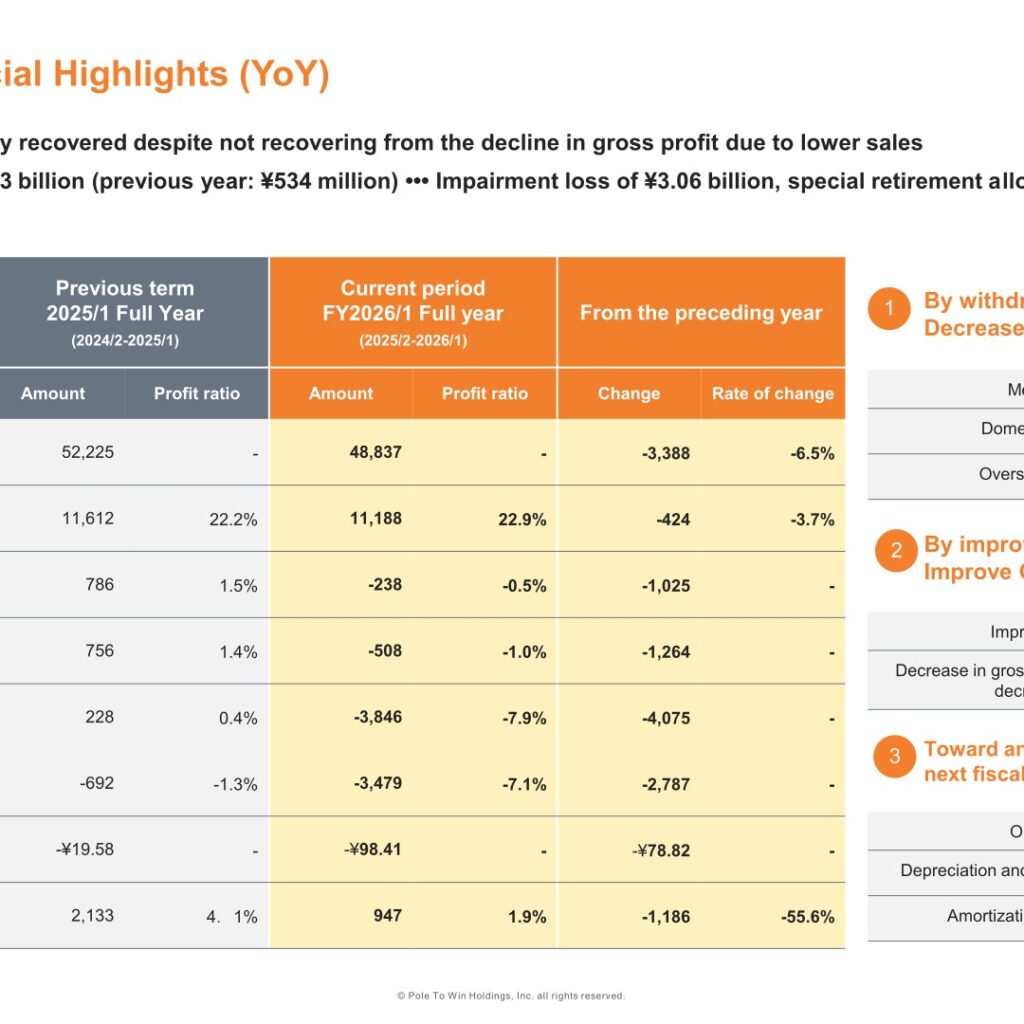
Gross profit was 11,188 million yen, with the gross profit margin improving to 22.9% from 22.2%. The company states that the gross profit margin steadily recovered through an improved sales mix (+¥329 million), although this did not offset the decline in gross profit due to lower sales (-¥753 million). By segment, the sales change comprised Media Contents -¥5.253 billion, Domestic Solutions +¥1.314 billion and Overseas Solutions +¥550 million. EBITDA was 947 million yen (-55.6% YoY).
The extraordinary loss of ¥3.473 billion (previous year: ¥534 million) included impairment losses of ¥3.06 billion and a special retirement allowance of ¥299 million. By timing and nature, the company lists impairment of game co-development projects of 288 million yen recorded by 3Q, a 4Q impairment loss related to Ghostpunch of 1,693 million yen, a 4Q impairment loss related to the former MSD Holdings of 986 million yen, and other 4Q items (special retirement benefits, loss on disposal of property, plant and equipment, etc.) of 504 million yen. The company says these reflect loss processing on goodwill, intangible assets, etc. arising from past M&A, and that the impairments will reduce the depreciation burden from FY2027/1 onward.
| Item (millions of yen) | FY2026/1 | FY2025/1 | Change | Rate of change |
|---|---|---|---|---|
| Sales | 48,837 | 52,225 | -3,388 | -6.5% |
| Gross profit | 11,188 | 11,612 | -424 | -3.7% |
| Operating profit | -238 | 786 | -1,025 | – |
| Ordinary profit | -508 | 756 | -1,264 | – |
| Net income before income taxes | -3,846 | 228 | -4,075 | – |
| Profit attributable to owners of parent | -3,479 | -692 | -2,787 | – |
| Net income per share | -¥98.41 | -¥19.58 | -¥78.82 | – |
| (Reference) EBITDA | 947 | 2,133 | -1,186 | -55.6% |
Against the latest forecast, sales of 48,837 million yen exceeded the forecast of 48,529 million yen by 307 million yen (+0.6%). Operating profit came in 517 million yen below the forecast of 279 million yen, ordinary profit 657 million yen below the forecast of 149 million yen, and net income 3,163 million yen below the forecast of -316 million yen. The company attributes the shortfall to an extraordinary loss of ¥3.184 billion recorded in 4Q based on the policy announced at the 3Q results, the recognition of an allowance for doubtful accounts and related expenses overseas, and an increase in various expenses as a result of measures to raise the probability of achieving a profit from FY1/2027.
At the end of FY1/2026, total assets were 22,328 million yen (-21.5%), including a 3,823 million yen decrease in intangible assets to 360 million yen, which the company links to the Media Contents withdrawal and M&A-related impairments. Net assets were 8,422 million yen (-32.3%), cash and deposits were 6,986 million yen, and the equity ratio was 37.7% (-6.0Pt). Net cash provided by operating activities was 385 million yen (previous year: 919 million yen), cash flow from investing activities was -282 million yen (previous year: -3,178 million yen), including ¥888 million of proceeds from sales of shares of subsidiaries associated with the Media Contents withdrawal, and cash flow from financing activities was 12 million yen.
Segment Results
Domestic Solutions sales rose to 25,904 million yen (+1,314 million yen), driven by the Game segment, but operating profit fell to 1,128 million yen (-582 million yen) due to the absence of EC projects in the previous fiscal year and increased expenses associated with the consolidation and opening of Akihabara No.2 Center. Overseas Solutions sales rose ¥500 million YoY to 20,792 million yen, but it recorded an operating loss of 939 million yen due to expenses such as streamlining of the organization to prepare for the decline in sales in FY1/2027, as well as an allowance for doubtful accounts attributable to European clients. Media Content sales decreased to 2,139 million yen due to the exclusion of HIKE from consolidation, while its operating loss improved by ¥506 million to 141 million yen. Palabra, which became the only member company of Media Content after 3Q, is integrated into Domestic Solutions from FY1/2027.
| Segment (millions of yen) | Metric | FY1/2026 | FY1/2025 | Change |
|---|---|---|---|---|
| Domestic Solutions | Sales | 25,904 | 24,590 | +1,314 |
| Domestic Solutions | Operating profit | 1,128 | 1,711 | -582 |
| Domestic Solutions | Operating profit rate | 4.4% | 7.0% | -2.6Pt |
| Overseas Solutions | Sales | 20,792 | 20,241 | +550 |
| Overseas Solutions | Operating profit | -939 | 43 | -982 |
| Overseas Solutions | Operating profit rate | -4.5% | 0.2% | -4.7Pt |
| Media Content | Sales | 2,139 | 7,393 | -5,253 |
| Media Content | Operating profit | -141 | -647 | +506 |
| Group Consolidated | Sales | 48,837 | 52,225 | -3,388 |
| Group Consolidated | Operating profit | -238 | 786 | -1,025 |
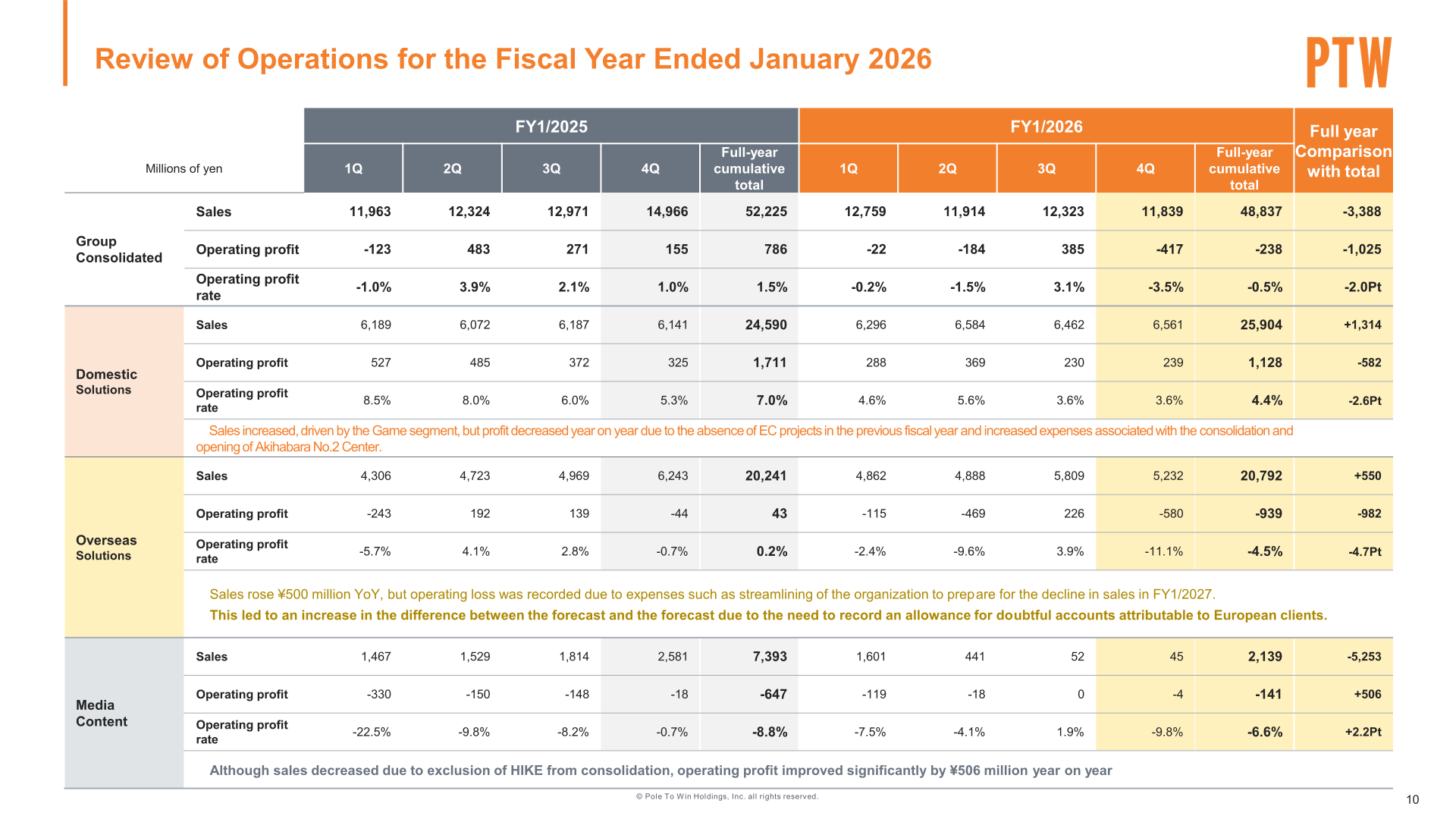
Group employees totaled 7,704 at the end of 4Q of FY1/2026 (-434, -5.3%), of which 2,953 were full-time employees (-394, -11.8%). In Overseas Solutions, the headcount fell to 2,533 as the company progressed with the temporary streamlining of its system after the peak at 1Q of FY1/2026.
FY2027/1 Forecast
The company plans a return to profitability for the first time in 4 fiscal years, citing the earnings base restructured through business reorganization. It forecasts lower sales and higher profits, with sales down 1,755 million yen (-3.6%) due to the absence of Media Contents (-¥2.139 billion) and a temporary decline in Overseas Solutions sales (-¥2.072 billion), partly offset by Domestic Solutions (+¥2.457 billion), for which it expects record-high sales. Operating profit is forecast to improve by 2,253 million yen, with contributions of +¥1.591 billion from Overseas Solutions, +¥141 million from Media Contents, +¥84 million from Domestic Solutions and +¥437 million company-wide. The company expects net income at H1 to be in the red, with profits accumulating gradually and 3Q expected to be the peak for both sales and operating profit.
| Item (millions of yen) | FY2027/1 Forecast | FY2026/1 Actual | Change | Rate of change |
|---|---|---|---|---|
| Sales | 47,082 | 48,837 | -1,755 | -3.6% |
| Operating profit | 2,014 | -238 | +2,253 | – |
| Ordinary profit | 1,891 | -508 | +2,399 | – |
| Profit attributable to owners of parent | 700 | -3,479 | +4,179 | – |
| Net income per share | ¥19.81 | -¥98.41 | +¥118.21 | – |
| (Reference) EBITDA | 2,867 | 947 | +1,920 | +202.7% |
| Dividend per share | ¥16 | ¥16 | ±¥0 | – |
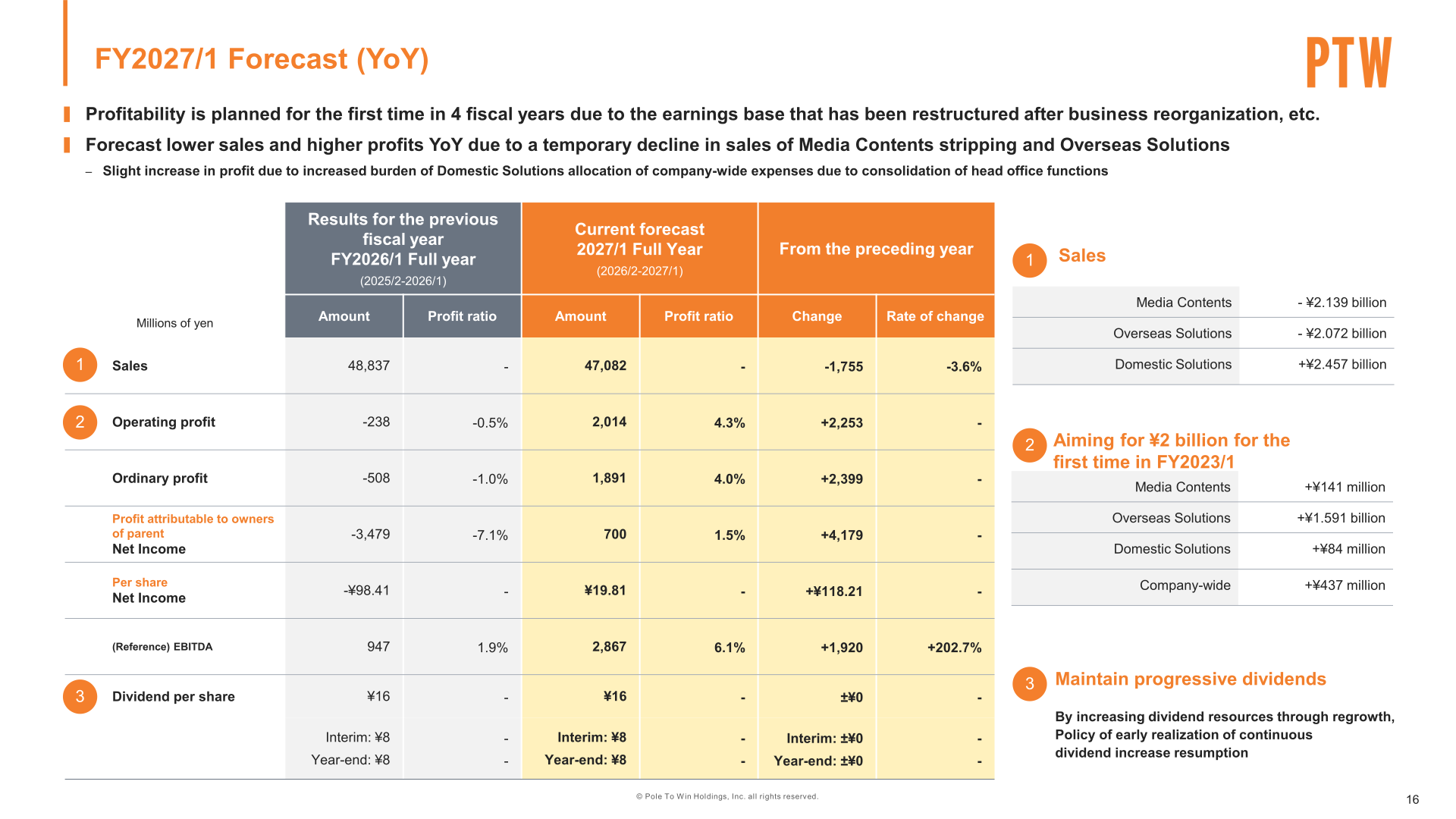
By segment, Domestic Solutions is forecast at sales of 28,362 million yen (+9.5%) and operating profit of 1,212 million yen (+7.5%), with strategies including expanding sales in the FoodTech and FinTech areas of the Tech field and evolving the business structure based on AI techniques. Overseas Solutions is forecast at sales of 18,720 million yen (-10.0%) and operating profit of 651 million yen, compared with a loss of 939 million yen in FY1/2026; the company notes that the environment is changing drastically and that the accuracy of the results forecast is low.
Shareholder Returns
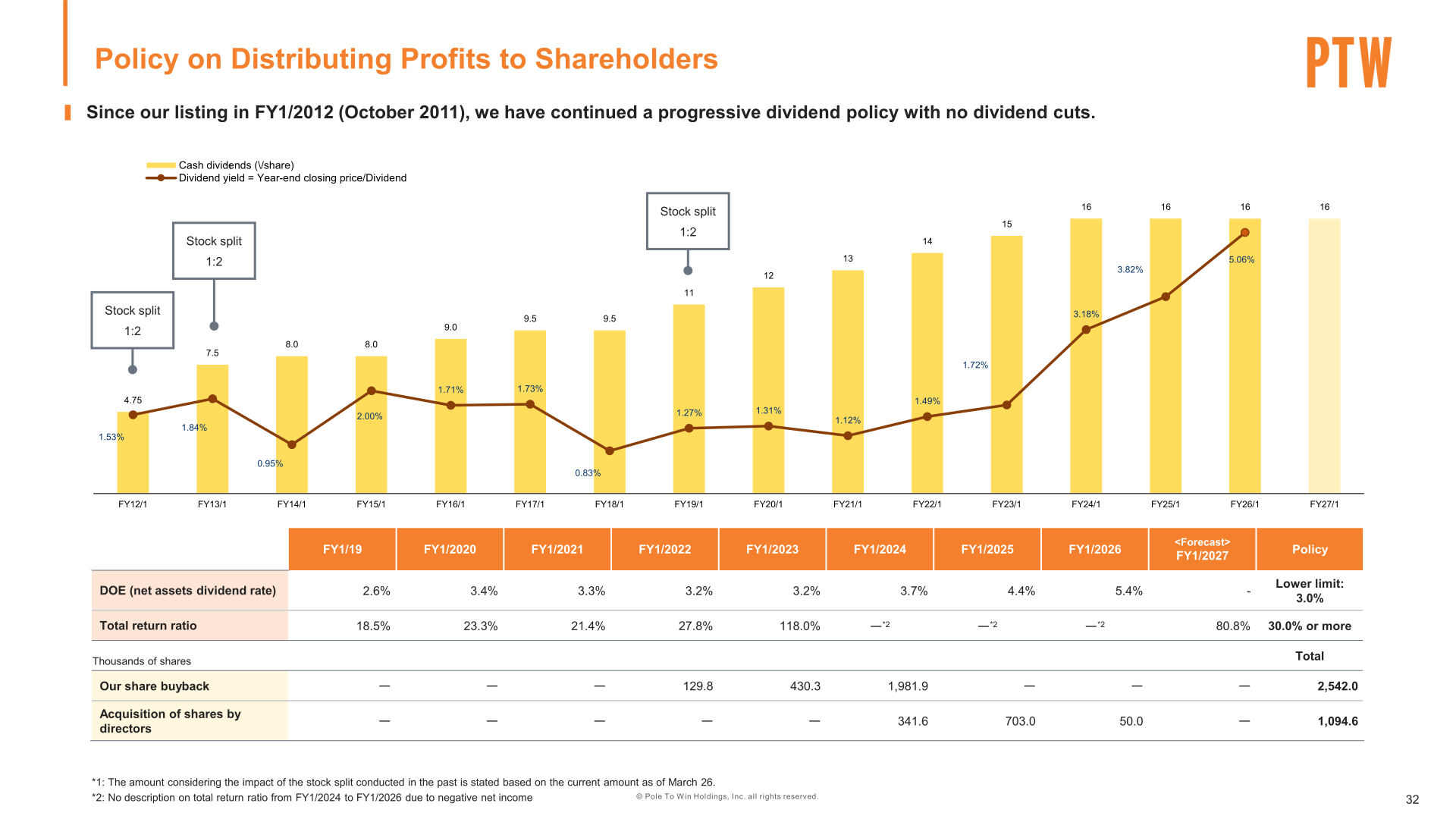
The dividend for FY1/2026 was ¥16 per share (interim ¥8, year-end ¥8), unchanged from the forecast, and the company plans ¥16 (interim ¥8, year-end ¥8) for FY1/2027. The company states that since its listing in FY1/2012 (October 2011) it has continued a progressive dividend policy with no dividend cuts, and that it aims for early resumption of continuous dividend increases by increasing dividend resources through regrowth. Its policy sets a lower limit of 3.0% for DOE and a total return ratio of 30.0% or more. Capital allocation places shareholder returns and growth investment (in principle within the scope of operating CF) as priorities, with working capital of approximately 2 months’ worth of monthly sales and agile allocation to M&A and share buybacks.
| Item | FY1/2025 | FY1/2026 | FY1/2027 (Forecast) | Policy |
|---|---|---|---|---|
| Annual dividend per share (¥) | 16 | 16 | 16 | Progressive dividend |
| DOE (net assets dividend rate) | 4.4% | 5.4% | – | Lower limit: 3.0% |
| Total return ratio | — | — | 80.8% | 30.0% or more |
Management Policy and Topics
The company positions the period through FY1/2026 as a restructuring stage and FY1/2027 onward as a re-growth stage. During FY1/2026 it withdrew from the Media Contents business, rebranded its overseas subsidiaries under the Side name, converted sub-subsidiaries such as SynX into direct subsidiaries and established a risk management committee. ROE for FY1/2026 was -33.4%, and the company sets an ROE target level of 15.0% for FY1/2029, aiming to improve profitability while restraining the rise in financial leverage. For growth investment it assumes a WACC of 8% and verifies effectiveness against a target ROIC of 10%.
Among initiatives announced in FY1/2026, the company concluded an MoU with Savvy Games Group, a subsidiary of the Saudi Arabian government-affiliated fund, with a new studio in Riyadh scheduled to begin full-scale operations by the end of this year, and established a Taipei Studio. On the AI front, it announced the game QA solution Razer Cortex (August 2025), described as the world’s first service that utilizes AI to analyze the outcome of a large-scale test play, announced a system that automates the design of software testing plans (October 2025), and made fully operational the comprehensive IT solution service “SynX One” providing 24/7/365 security monitoring and response.
This article is an analysis based on publicly available information and is not a recommendation to buy or sell any specific securities. Investment decisions are your own responsibility.