This article is based on publicly available IR materials and is not a recommendation to buy or sell any specific securities.
Note: Pro-Ship labels the fiscal year ended March 31, 2026 as “FY2026” (FY2026/3) in its materials, while this site classifies it as FY2025. The labels in the text and tables below follow the company’s presentation.
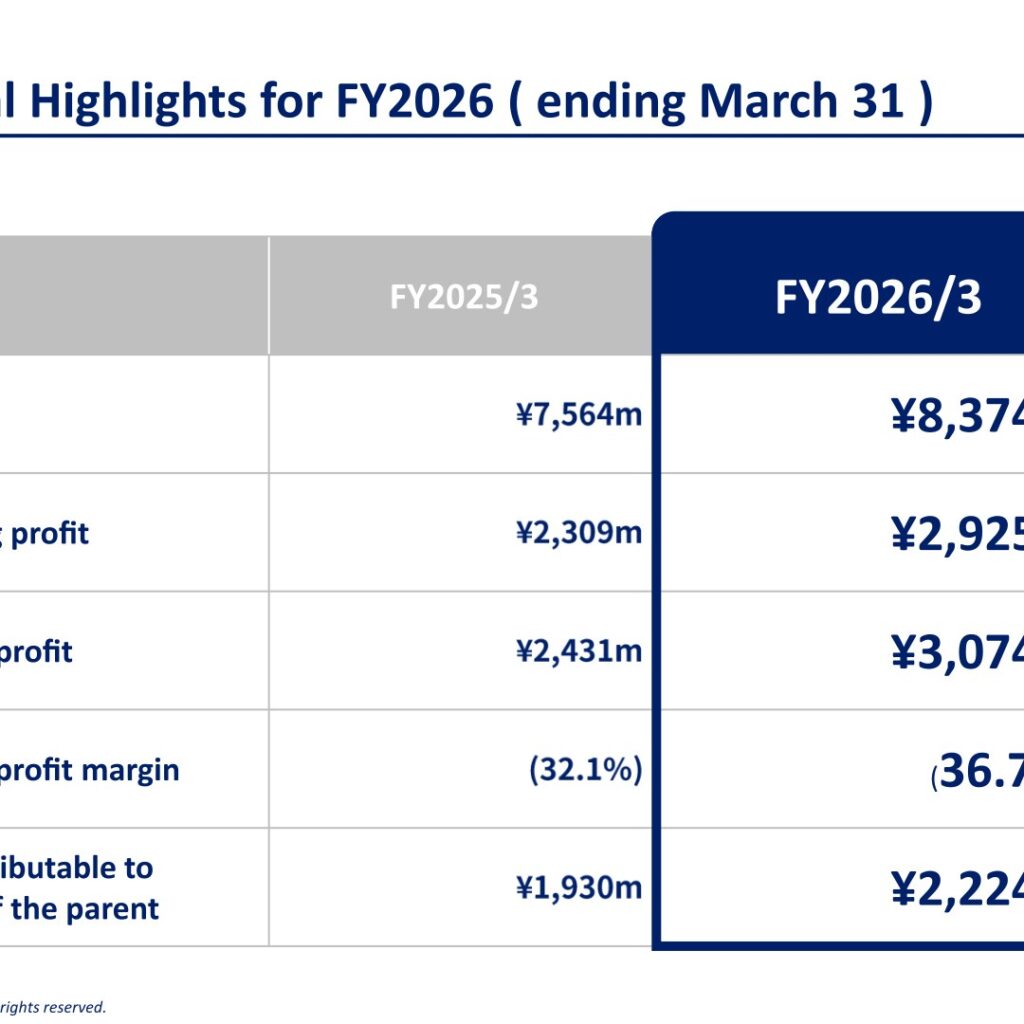
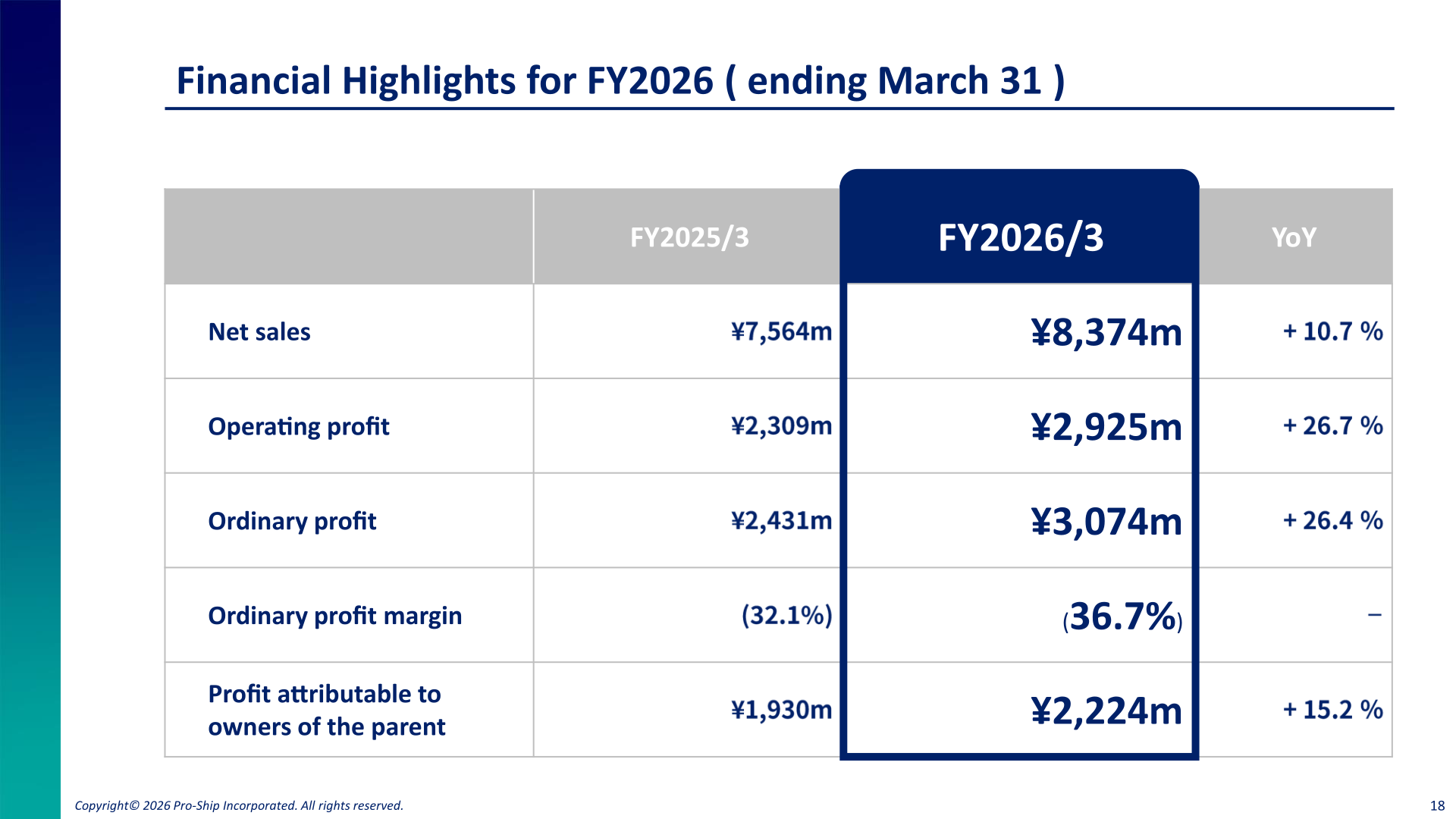
Pro-Ship Incorporated, which provides the ProPlus series of fixed asset management solutions, reported net sales of ¥8,374m (+10.7% YoY), operating profit of ¥2,925m (+26.7%), ordinary profit of ¥3,074m (+26.4%) and profit attributable to owners of the parent of ¥2,224m (+15.2%) for the fiscal year ended March 31, 2026. Net sales and ordinary profit were both record highs, and the ordinary profit margin rose from 32.1% to 36.7%. Ordinary profit per employee reached ¥10.83 m, achieving the medium-term plan target three years early. For FY2027/3, the company forecasts net sales of ¥10,000 m and ordinary profit of ¥3,350 m.
Consolidated Results (Full-Year Actual)
In the second year of the medium term business strategy “Be Hybrid 2028,” all main performance indicators exceeded the previous year. The company cited progress in version upgrades for existing customers, the advancement of large-scale projects in the infrastructure sector, and accelerating demand and strong pipeline growth driven by enterprise readiness for the upcoming new lease accounting standards. The impact of the new lease accounting standards is expected to contribute to earnings from the next fiscal year onward.
| Item | FY2026/3 | FY2025/3 | YoY |
|---|---|---|---|
| Net sales | ¥8,374m | ¥7,564m | +10.7% |
| Operating profit | ¥2,925m | ¥2,309m | +26.7% |
| Ordinary profit | ¥3,074m | ¥2,431m | +26.4% |
| Ordinary profit margin | 36.7% | 32.1% | – |
| Profit attributable to owners of the parent | ¥2,224m | ¥1,930m | +15.2% |
Operating profit increased by ¥615 million year on year. Contributing factors were an increase in gross profit due to higher sales (+¥452 million), improved cost efficiency (+¥93 million) and a decrease in R&D expense (+¥254 million; R&D expense of 201 versus 456 in the previous year, in millions of yen), partly offset by gross margin compression driven by higher software maintenance costs (-¥57 million) and by increased marketing investments (-¥55 million). On the cost side, the company pointed to a streamlined implementation process, improved productivity per employee backed by investment in human resources, and company-wide quality control enhancement.
Net Sales Breakdown and Orders
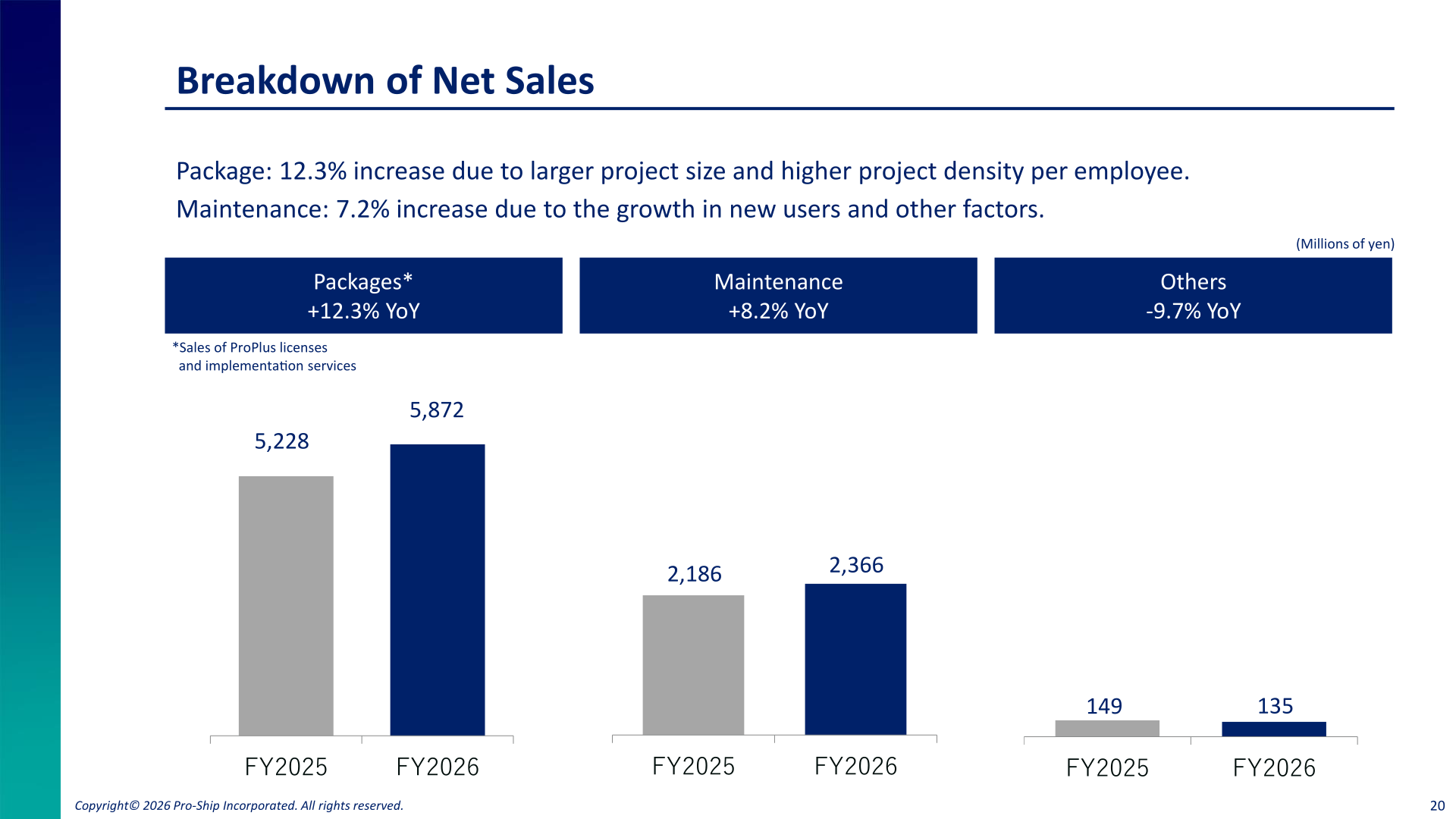
Package sales (sales of ProPlus licenses and implementation services) rose 12.3% due to larger project size and higher project density per employee. Maintenance sales rose 8.2%, which the company attributed to growth in new users and other factors, while Others declined 9.7%.
| Category (Millions of yen) | FY2026 | FY2025 | YoY |
|---|---|---|---|
| Packages | 5,872 | 5,228 | +12.3% |
| Maintenance | 2,366 | 2,186 | +8.2% |
| Others | 135 | 149 | -9.7% |
Total orders received were ¥9,038m (+7.7%) and the total order backlog was ¥6,589m (+10.8%). By category, Package orders received were ¥6,238m (+3.3%) with a backlog of ¥3,500m (+10.8%), driven by increased project capacity through talent development and resource scaling. Maintenance orders received were ¥2,656m (+21.1%) with a backlog of ¥3,018m (+10.6%), reflecting larger project size and an increase in new users. Other orders received were ¥143m (-12.0%) with a backlog of ¥70m (+14.3%).
FY2027 Forecast
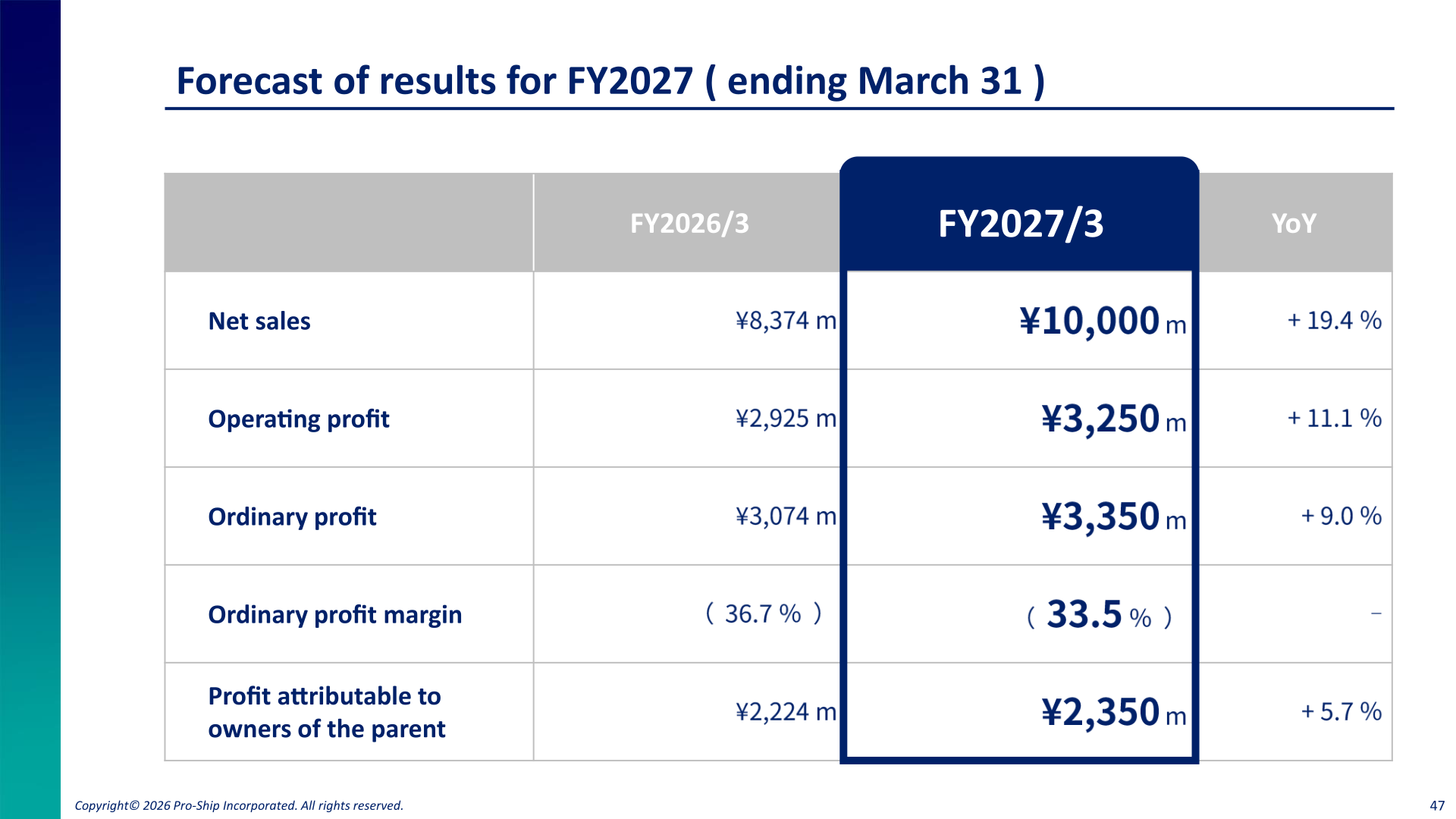
For FY2027/3, the company forecasts net sales of ¥10,000 m (+19.4%), operating profit of ¥3,250 m (+11.1%), ordinary profit of ¥3,350 m (+9.0%) and profit attributable to owners of the parent of ¥2,350 m (+5.7%), with the ordinary profit margin at 33.5%. The company positions the year as the move of “Be Hybrid 2028” from the “Building Phase” to the “Expansion Phase” and targets a third consecutive year of record-high profits. Growth drivers include new lease accounting compliance for existing customers (target revenue: ¥4B–¥5B), the full-scale commercialization of the lease-compliance SaaS “ProPlus+” (target revenue: ¥1B–¥2B), and the acquisition of social infrastructure enterprises triggered by the new lease accounting standards (3 or more companies). As factors weighing on profit, the company cites a temporary decline in productivity during the initial response to the new standards and a concentration of service requests from users with free upgrade options under maintenance contracts.
| Item | FY2027/3 (Forecast) | FY2026/3 (Actual) | YoY |
|---|---|---|---|
| Net sales | ¥10,000 m | ¥8,374 m | +19.4% |
| Operating profit | ¥3,250 m | ¥2,925 m | +11.1% |
| Ordinary profit | ¥3,350 m | ¥3,074 m | +9.0% |
| Ordinary profit margin | 33.5% | 36.7% | – |
| Profit attributable to owners of the parent | ¥2,350 m | ¥2,224 m | +5.7% |
Shareholder Returns
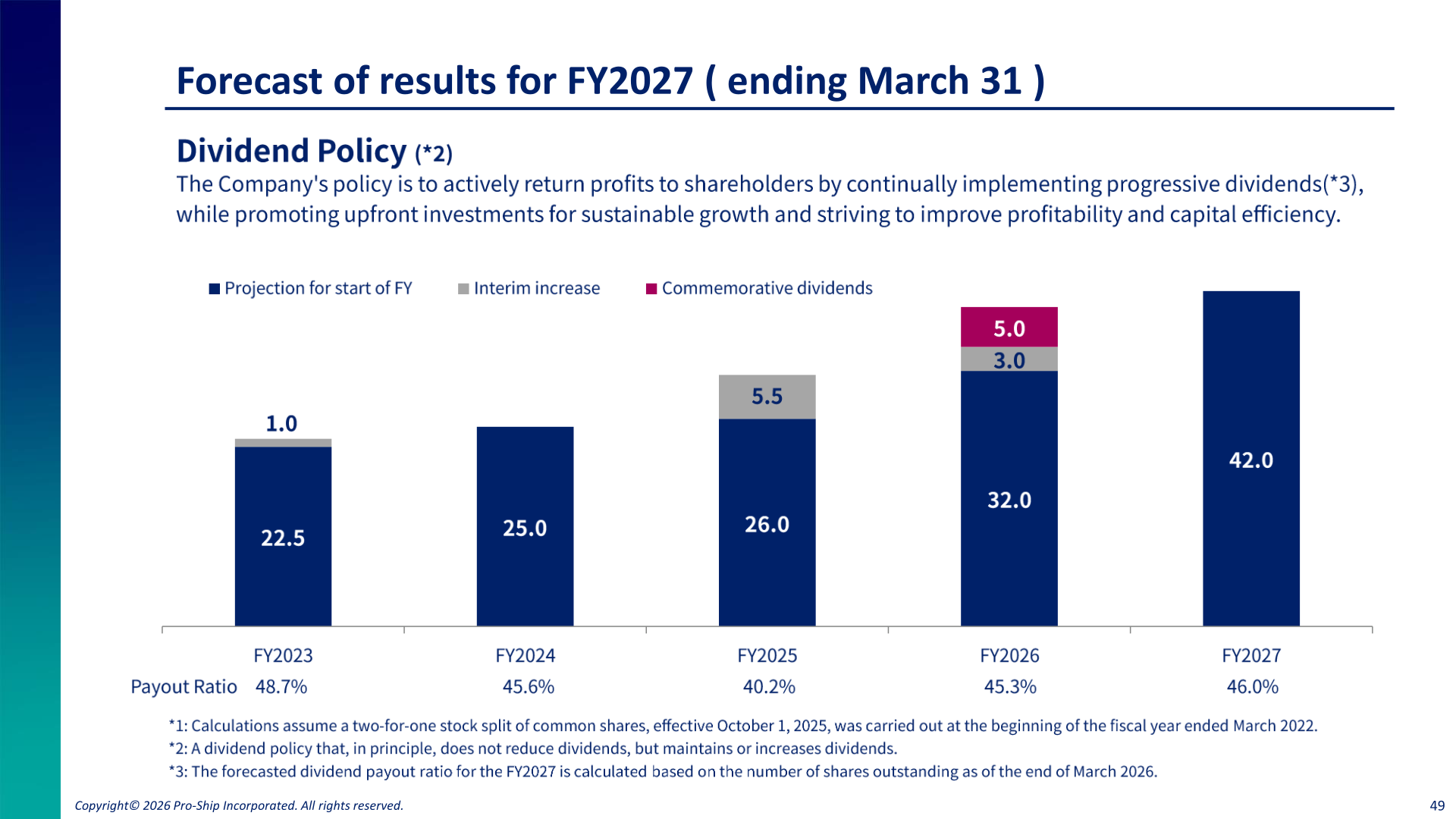
The company’s policy is to actively return profits to shareholders by continually implementing progressive dividends, defined as a policy that, in principle, does not reduce dividends but maintains or increases them. For FY2026, it implemented a 3-yen interim dividend increase on top of the 32.0-yen projection at the start of the year, plus a 5-yen commemorative dividend marking 5,500 company adoptions, for a payout ratio of 45.3%. For FY2027, the dividend projection is 42.0 yen, with a forecast payout ratio of 46.0%. Dividend figures assume that the 2-for-1 stock split effective October 1, 2025 was carried out at the beginning of the fiscal year ended March 2022. Share buybacks are to be conducted opportunistically and flexibly.
| Dividend per share (yen) | Projection for start of FY | Interim increase | Commemorative dividend | Payout ratio |
|---|---|---|---|---|
| FY2025 | 26.0 | 5.5 | – | 40.2% |
| FY2026 | 32.0 | 3.0 | 5.0 | 45.3% |
| FY2027 (Forecast) | 42.0 | – | – | 46.0% |
Under its cash allocation plan for FY3/2025–FY3/2029, the company allocated ¥0.87B in FY2025 (11.5% of net sales) and ¥1.06B in FY2026 (12.6% of net sales) to product development investment, and paid shareholder dividends of ¥0.61B and ¥0.93B, respectively. It also executed a strategic capital and business alliance with Fast Accounting Co., Ltd. The company noted that ROE declined year-on-year as forecast, as shareholders’ equity expanded, but that capital efficiency remains at a high level.
Medium-Term Plan: “Be Hybrid 2028”
The medium term business strategy “Be Hybrid 2028” targets net sales of ¥15.0 b and ordinary profit of ¥4.5 b in FY2029, an average annual growth rate of net sales of 17.1% and of ordinary profit of 19.1%, an ordinary profit margin of over 30% throughout FY2025–2029, and ordinary profit per employee of over ¥10 m. In FY2026, net sales reached ¥8.3 b, ordinary profit ¥3.0 b, the ordinary profit margin 36.7% and ordinary profit per employee ¥10.83 m. During the two-year “Building Phase,” the company established a “Hybrid Model” that combines an enterprise on-premises/package model for complex enterprise requirements with a SaaS model built for rapid deployment and high scalability.
Regarding the new lease accounting standards, the company said that for existing customers, actions in FY2026 remained limited to preliminary preparations such as system version upgrades because corporate policy reviews did not progress as anticipated, and it has set an FY2027 net sales target of ¥4.0B–¥5.0B from this area. For new customers, Phase 1 selective deployments were completed on schedule, and it has initiated a full-scale market rollout targeting 500+ large enterprises (annual revenue >¥100B) by FY2028-end. In social infrastructure (electric power, gas and railways), the second implementation project went live and the contract for the third was secured. The ProPlus series is used by over 5,500 corporate groups, including 110 out of the 225 Nikkei 225 companies.
This article is an analysis based on publicly available information and is not a recommendation to buy or sell any specific securities. Investment decisions are your own responsibility.