This article is based on publicly available IR materials and is not a recommendation to buy or sell any specific securities.
Note: Daiho Corporation does not publish an English results presentation; this article is an English translation of the Japanese-language article on our sister site Investalk, which is based on the company’s Japanese-language IR materials, with figures transcribed as reported. This site classifies the most recently completed fiscal year as FY2025; the company labels the same period the fiscal year ended March 31, 2026 (fiscal 2025), and the source labels are retained in the body text and tables. Amounts are stated in millions of yen, following the source materials, except where the source itself uses units of ¥100 million, which are rendered in billions of yen.
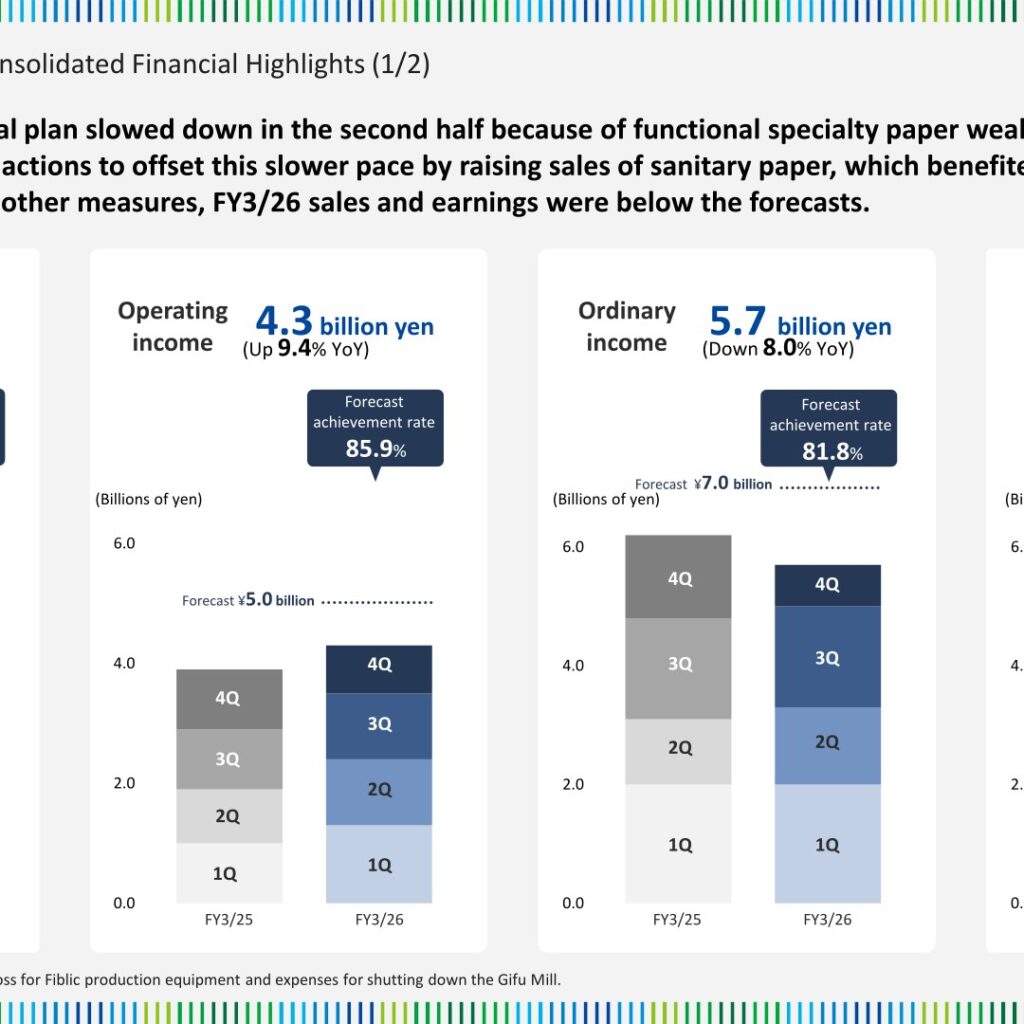
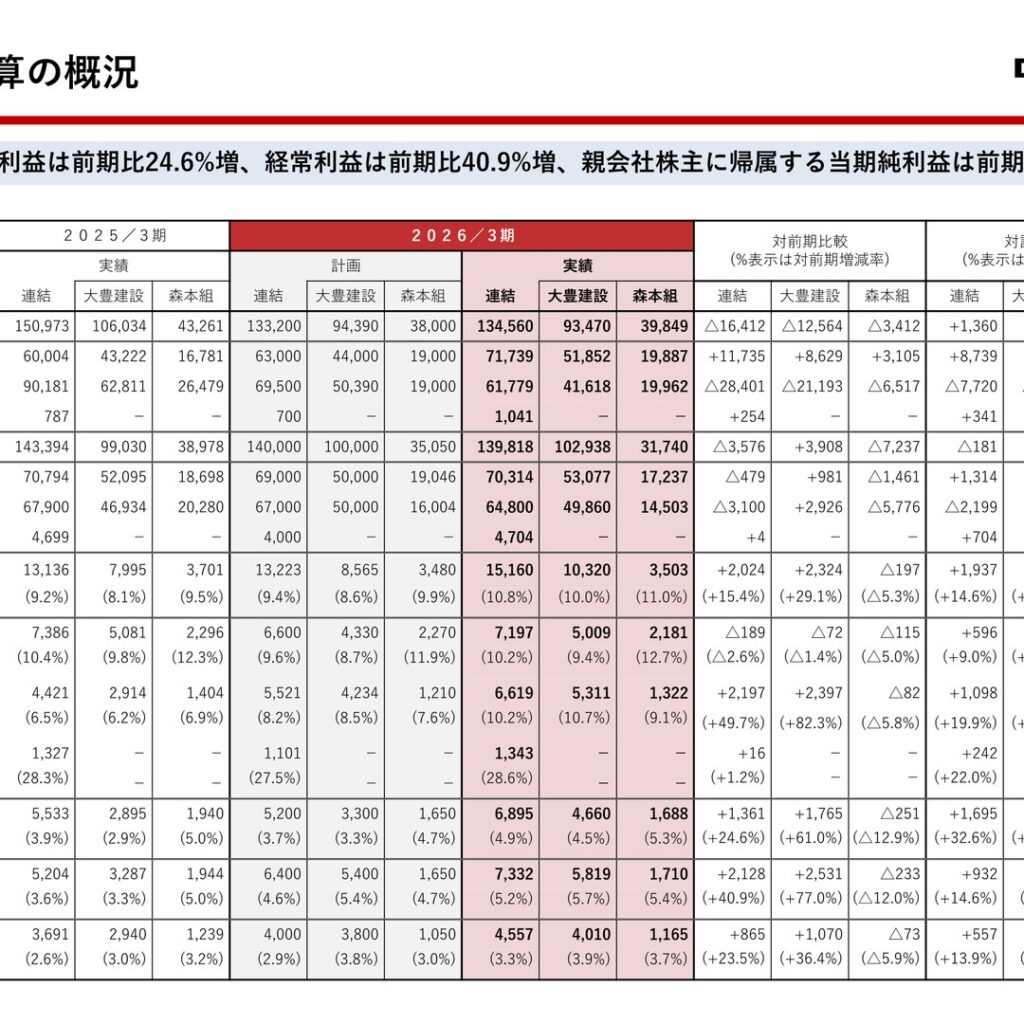
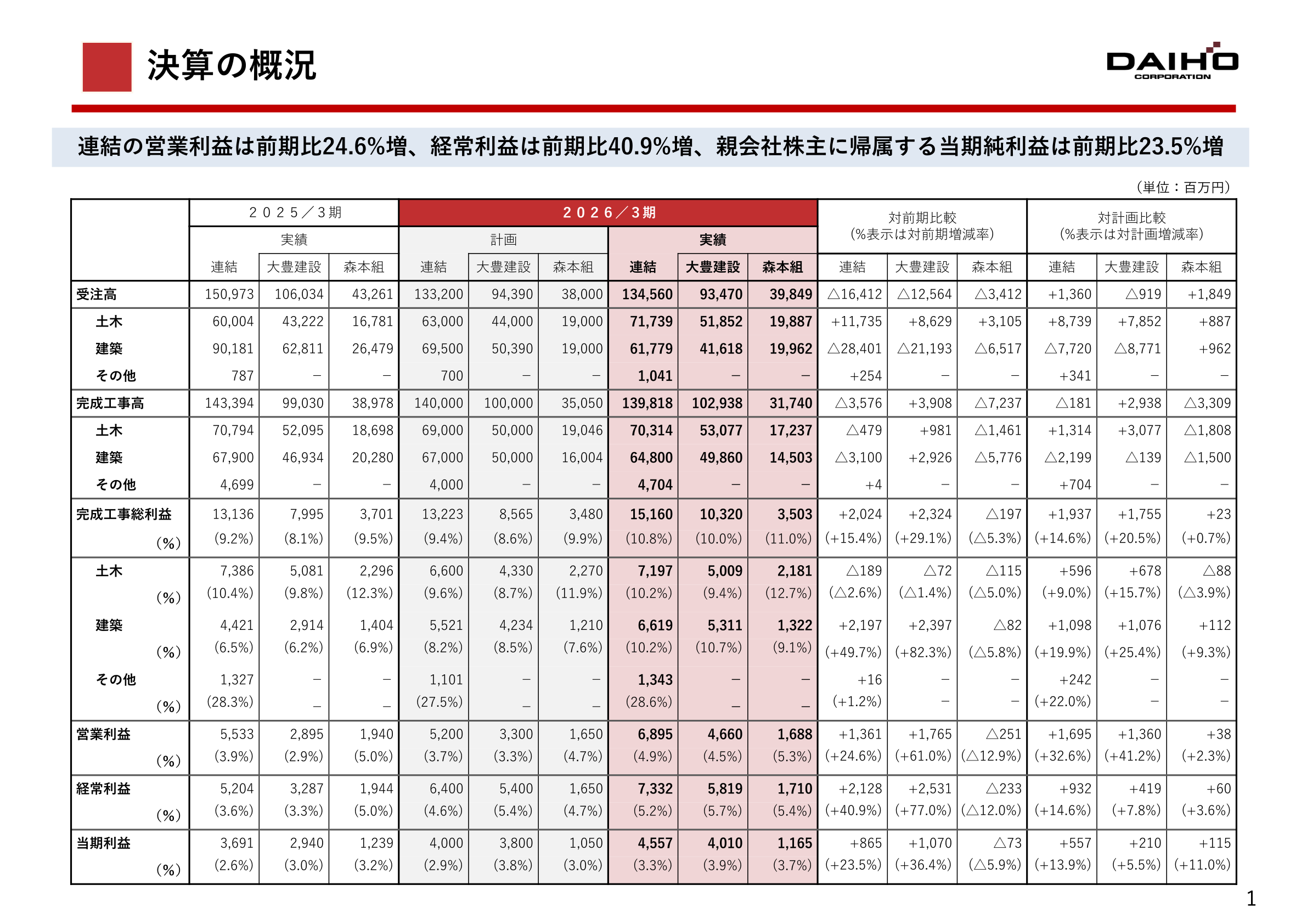
For the fiscal year ended March 31, 2026 (fiscal 2025), Daiho Corporation’s consolidated net sales of completed construction contracts decreased to ¥139,818 million (down ¥3,576 million year on year), while gross profit on completed construction contracts expanded to ¥15,160 million (up ¥2,024 million) and the gross profit margin on completed construction contracts improved from 9.2% in the previous fiscal year to 10.8%. Operating profit was ¥6,895 million, up 24.6% year on year; ordinary profit was ¥7,332 million, up 40.9%; and profit attributable to owners of parent was ¥4,557 million, up 23.5%. Operating profit, ordinary profit and profit for the year all finished above the initial plan (operating profit of ¥5,200 million, ordinary profit of ¥6,400 million and profit for the year of ¥4,000 million). In the materials, the company states that the fiscal 2025 results represent progress ahead of the medium-term management plan.
Consolidated Results (Fiscal Year Ended March 31, 2026, Actual)
Orders received were ¥134,560 million on a consolidated basis (¥150,973 million in the previous fiscal year, down ¥16,412 million), but came in ¥1,360 million above the plan of ¥133,200 million. Net sales of completed construction contracts were ¥139,818 million, ¥181 million below the plan of ¥140,000 million and down ¥3,576 million year on year. Gross profit on completed construction contracts was ¥15,160 million (¥1,937 million above the plan of ¥13,223 million, up 15.4% year on year), and the gross profit margin on completed construction contracts was 10.8% (plan 9.4%, previous fiscal year 9.2%). Operating profit was ¥6,895 million (¥1,695 million above plan, or 32.6% above plan), ordinary profit was ¥7,332 million (¥932 million above plan), and profit for the year was ¥4,557 million (¥557 million above plan).
| Item | FY ended March 2026 (Actual) | FY ended March 2025 (Actual) | Change vs. previous fiscal year |
|---|---|---|---|
| Orders received | 134,560 | 150,973 | △16,412 |
| Net sales of completed construction contracts | 139,818 | 143,394 | △3,576 |
| Gross profit on completed construction contracts | 15,160 | 13,136 | +2,024 (+15.4%) |
| Gross profit margin on completed construction contracts | 10.8% | 9.2% | − |
| Operating profit | 6,895 | 5,533 | +1,361 (+24.6%) |
| Ordinary profit | 7,332 | 5,204 | +2,128 (+40.9%) |
| Profit for the year (profit attributable to owners of parent) | 4,557 | 3,691 | +865 (+23.5%) |
Amounts are in millions of yen. On the financial position, consolidated total assets were ¥155,902 million (¥149,842 million at the end of the previous fiscal year, up ¥6,060 million) and net assets were ¥77,225 million (¥73,065 million, up ¥4,160 million), with an equity ratio of 48.4% (47.7% at the end of the previous fiscal year). On a non-consolidated basis, total assets were ¥124,046 million, net assets were ¥61,213 million, and the equity ratio was 49.3% (48.9% at the end of the previous fiscal year).
Results by Business (Civil Engineering, Building Construction and Other)
In civil engineering, consolidated orders received grew to ¥71,739 million (¥60,004 million in the previous fiscal year, up ¥11,735 million), while net sales of completed construction contracts were ¥70,314 million (down ¥479 million) and gross profit on completed construction contracts was ¥7,197 million (down ¥189 million, with a margin of 10.2% against 10.4% in the previous fiscal year), leaving the business broadly flat. In building construction, orders received declined to ¥61,779 million (¥90,181 million in the previous fiscal year, down ¥28,401 million), but against net sales of completed construction contracts of ¥64,800 million (down ¥3,100 million), gross profit on completed construction contracts improved sharply to ¥6,619 million (up ¥2,197 million, or 49.7%), and the margin rose from 6.5% in the previous fiscal year to 10.2%. In other businesses, orders received were ¥1,041 million, net sales of completed construction contracts were ¥4,704 million, and gross profit on completed construction contracts was ¥1,343 million (a margin of 28.6%).
| Category | Metric | FY ended March 2026 | FY ended March 2025 |
|---|---|---|---|
| Civil engineering | Orders received | 71,739 | 60,004 |
| Civil engineering | Net sales of completed construction contracts | 70,314 | 70,794 |
| Civil engineering | Gross profit on completed construction contracts | 7,197 | 7,386 |
| Building construction | Orders received | 61,779 | 90,181 |
| Building construction | Net sales of completed construction contracts | 64,800 | 67,900 |
| Building construction | Gross profit on completed construction contracts | 6,619 | 4,421 |
| Other | Orders received | 1,041 | 787 |
| Other | Net sales of completed construction contracts | 4,704 | 4,699 |
| Other | Gross profit on completed construction contracts | 1,343 | 1,327 |
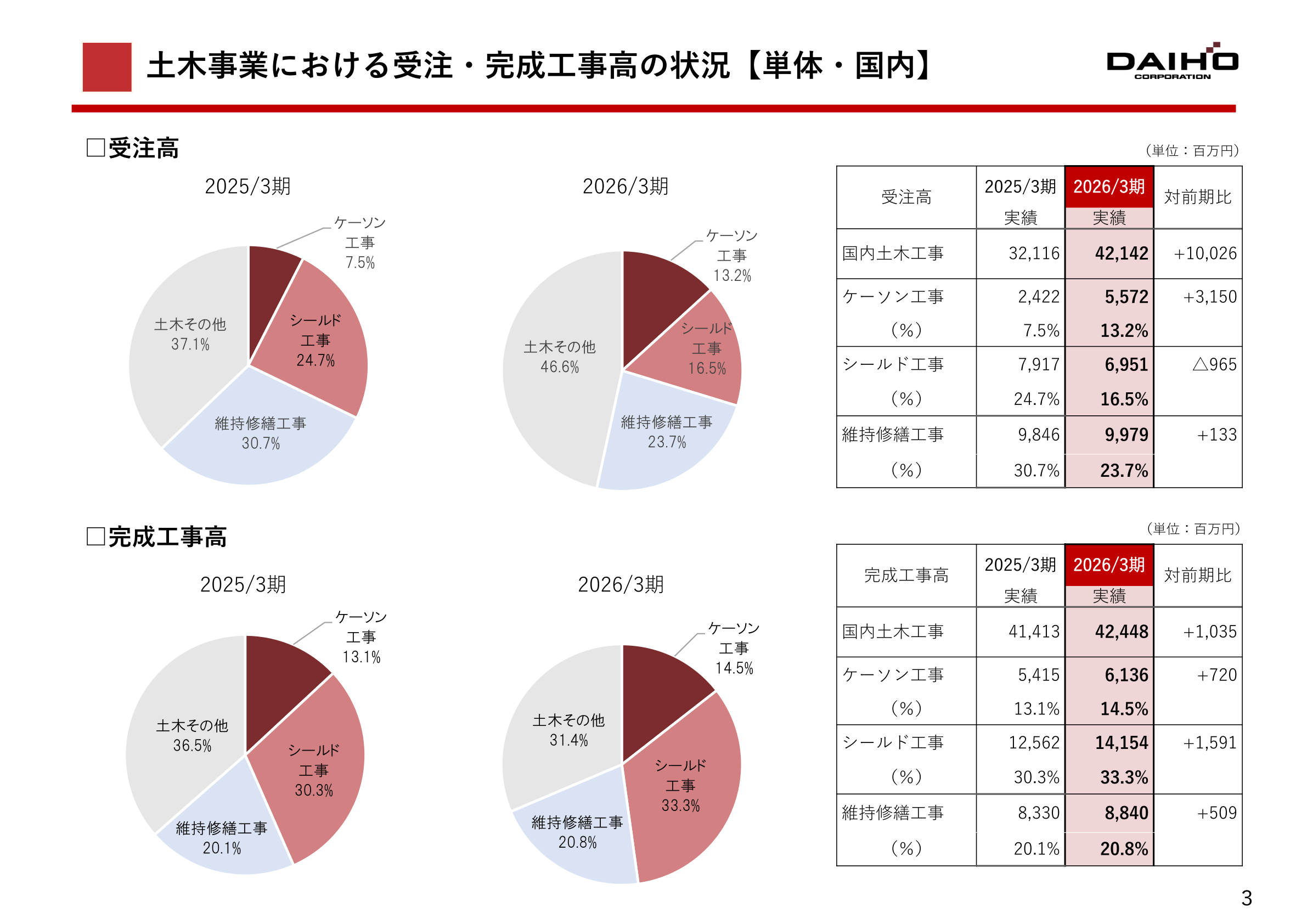
In the non-consolidated, domestic civil engineering business, orders received for domestic civil engineering works were ¥42,142 million (¥32,116 million in the previous fiscal year, up ¥10,026 million). The breakdown was caisson works of ¥5,572 million (13.2% of the total), shield works of ¥6,951 million (16.5%) and maintenance and repair works of ¥9,979 million (23.7%). Net sales of completed construction contracts were ¥42,448 million (up ¥1,035 million), comprising caisson works of ¥6,136 million (14.5%), shield works of ¥14,154 million (33.3%) and maintenance and repair works of ¥8,840 million (20.8%).
In the non-consolidated building construction business, orders received for building works were ¥41,618 million (¥67,961 million in the previous fiscal year, down ¥26,343 million). The breakdown was private-sector residential of ¥28,736 million (69.0%), private-sector non-residential of ¥10,091 million (24.3%) and public-sector works of ¥2,790 million (6.7%). Net sales of completed construction contracts were ¥49,860 million (up ¥2,926 million), comprising private-sector residential of ¥28,299 million (56.8%), private-sector non-residential of ¥17,759 million (35.6%) and public-sector works of ¥3,801 million (7.6%). Note that public-sector orders received of ¥2,799 million in the previous fiscal year do not include ¥5,150 million relating to a cancelled contract.
Plan for the Fiscal Year Ending March 31, 2027 (Fiscal 2026)
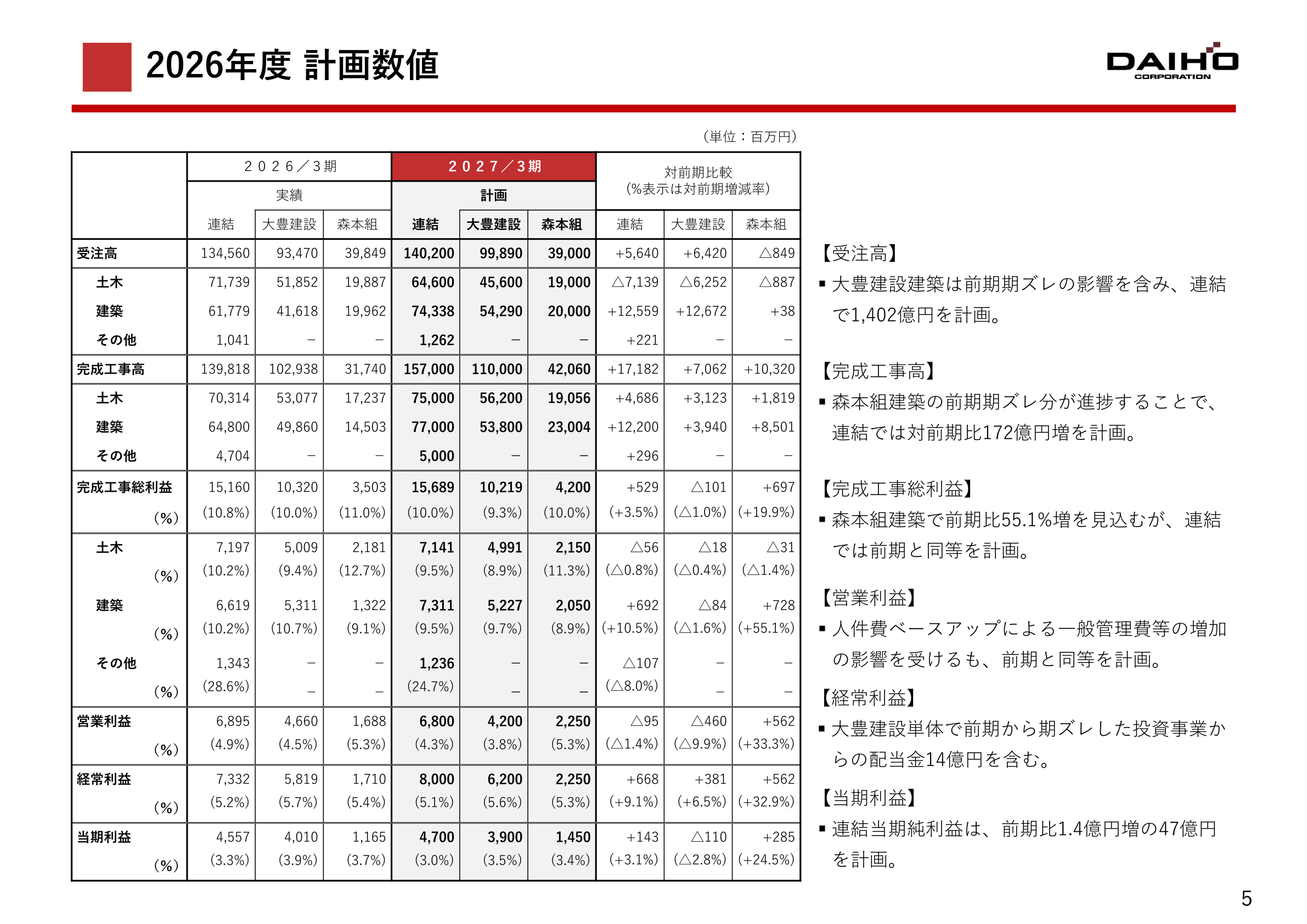
The consolidated plan for fiscal 2026 calls for orders received of ¥140,200 million (up ¥5,640 million year on year), net sales of completed construction contracts of ¥157,000 million (up ¥17,182 million), gross profit on completed construction contracts of ¥15,689 million (up ¥529 million, a margin of 10.0%), operating profit of ¥6,800 million (down ¥95 million, or 1.4%), ordinary profit of ¥8,000 million (up ¥668 million, or 9.1%) and profit for the year of ¥4,700 million (up ¥143 million, or 3.1%). The materials state that orders received are planned at ¥140.2 billion on a consolidated basis, including the effect of timing shifts from the previous fiscal year in Daiho Corporation’s building construction business, and that net sales of completed construction contracts are planned to rise ¥17.2 billion year on year on a consolidated basis as work shifted from the previous fiscal year at Morimotogumi’s building construction business progresses. Gross profit on completed construction contracts is expected to rise 55.1% year on year at Morimotogumi’s building construction business but to be roughly level with the previous fiscal year on a consolidated basis, and operating profit is planned to be roughly level with the previous fiscal year despite the impact of higher selling, general and administrative expenses associated with base pay increases. Ordinary profit includes ¥1.4 billion of dividend income from an investment business at Daiho Corporation on a non-consolidated basis that shifted from the previous fiscal year.
| Item | FY ending March 2027 (Plan) | FY ended March 2026 (Actual) | Change |
|---|---|---|---|
| Orders received | 140,200 | 134,560 | +5,640 |
| Net sales of completed construction contracts | 157,000 | 139,818 | +17,182 |
| Gross profit on completed construction contracts | 15,689 | 15,160 | +529 (+3.5%) |
| Operating profit | 6,800 | 6,895 | △95 (△1.4%) |
| Ordinary profit | 8,000 | 7,332 | +668 (+9.1%) |
| Profit for the year | 4,700 | 4,557 | +143 (+3.1%) |
Amounts are in millions of yen. By business, the consolidated plan calls for orders received of ¥64,600 million in civil engineering, ¥74,338 million in building construction and ¥1,262 million in other; net sales of completed construction contracts of ¥75,000 million in civil engineering, ¥77,000 million in building construction and ¥5,000 million in other; and gross profit on completed construction contracts of ¥7,141 million in civil engineering, ¥7,311 million in building construction and ¥1,236 million in other.
Shareholder Returns
Among its initiatives for management conscious of the cost of capital and the share price, the company states with respect to shareholder returns that it aims to maintain a payout ratio of 70% and to continue raising the dividend through the achievement of its profit targets. It also states that it will consider share buybacks as circumstances warrant. In addition, for cross-shareholdings, the company’s policy is to verify the benefits of each individual holding, judge whether continued holding is appropriate, and aim to reduce them, thereby improving capital efficiency.
Progress of the Medium-Term Management Plan (Fiscal 2023–2027) and Capital Efficiency
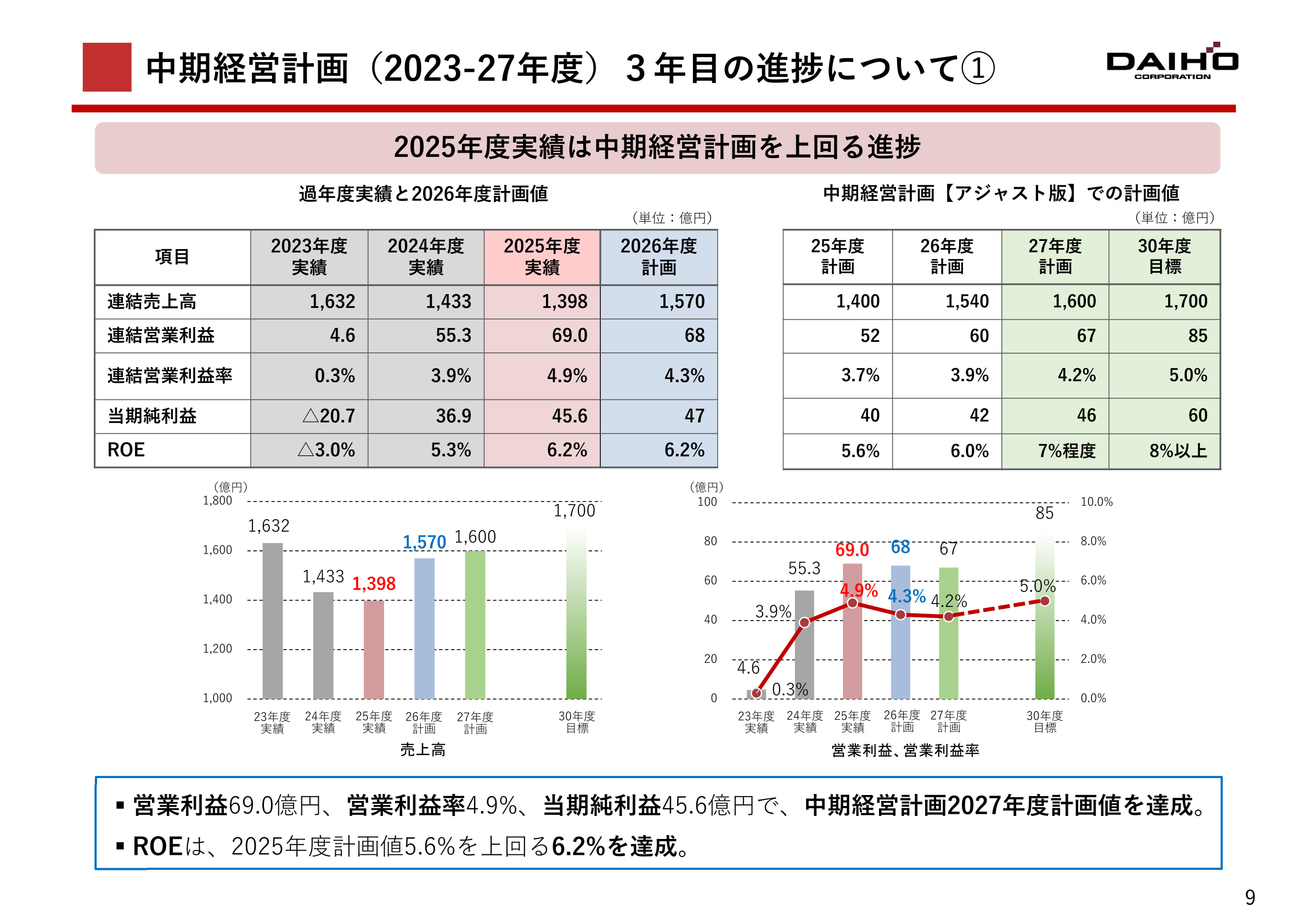
In fiscal 2025, the third year of the medium-term management plan, operating profit was ¥6.90 billion, the operating profit margin was 4.9% and net profit was ¥4.56 billion, achieving the plan values set for fiscal 2027 in the medium-term management plan. ROE was 6.2%, above the fiscal 2025 plan value of 5.6%, and the materials state that the fiscal 2025 results represent progress ahead of the medium-term management plan. Under the adjusted version of the medium-term management plan, the fiscal 2027 plan values are net sales of ¥160.0 billion, operating profit of ¥6.7 billion, an operating profit margin of 4.2%, net profit of ¥4.6 billion and ROE of around 7%, while the fiscal 2030 targets are net sales of ¥170.0 billion, operating profit of ¥8.5 billion, an operating profit margin of 5.0%, net profit of ¥6.0 billion and ROE of 8% or more.
| Item | FY2023 (Actual) | FY2024 (Actual) | FY2025 (Actual) | FY2026 (Plan) |
|---|---|---|---|---|
| Consolidated net sales (¥100 million) | 1,632 | 1,433 | 1,398 | 1,570 |
| Consolidated operating profit (¥100 million) | 4.6 | 55.3 | 69.0 | 68 |
| Consolidated operating profit margin | 0.3% | 3.9% | 4.9% | 4.3% |
| Net profit (¥100 million) | △20.7 | 36.9 | 45.6 | 47 |
| ROE | △3.0% | 5.3% | 6.2% | 6.2% |
On management conscious of the cost of capital and the share price, the company recognizes the group’s cost of shareholders’ equity at around 5–6% and, targeting ROE of 8% or more in fiscal 2030, has set the fiscal 2026 plan value at 6.2%. It states that it will work to raise corporate value in order to secure a share price at a PBR of 1.0 times or above on a sustained basis. On the business side, initiatives cited for strengthening human capital management include the start of operation of a new personnel and remuneration system, the integration of stress checks with an engagement survey, and certifications under the “Eruboshi” program (two stars), “Health & Productivity Management Outstanding Organization 2026” and “Sports Yell Company 2026.” In DX and research and development, the company is advancing the construction of a new core business system (scheduled to go into operation in August 2026), the introduction of Daiho AI, an on-site public demonstration test of an automated excavation system for the pneumatic caisson method, and the construction of a slurry pressure management system for the shield method. In transforming its business structure, it is working on the opening of a facility under a Park-PFI project in Kyoto City (operating a parking lot and cafe over the next 20 years), the conclusion of a business alliance with Fuji P.S. Corporation, and the joint development of low-carbon concrete technology.
This article is an analysis based on publicly available information and is not a recommendation to buy or sell any specific securities. Investment decisions are your own responsibility.