This article is based on publicly available IR materials and is not a recommendation to buy or sell any specific securities.
Note: Sumiseki Holdings does not publish an English results presentation; this article is an English translation of the Japanese-language article on our sister site Investalk, which is based on the company’s Japanese-language IR materials, with figures transcribed as reported. The company labels this period as the fiscal year ended March 2026; this site classifies the most recent completed fiscal year as FY2025 for its title and slug, while the labels used in the body text and tables follow the source materials.
According to the full-year results presentation for the fiscal year ended March 2026 that Sumiseki Holdings released on May 15, 2026, consolidated net sales for the period were 10,658 million yen (a year-on-year change of 393 million yen, or 3.8%) and operating profit was 329 million yen (a change of 281 million yen, or 582.1%). Net sales finished roughly in line with the previous fiscal year, supported by firm demand in the coal business, while operating profit rose sharply year on year, mainly on higher profit in the coal business. Recurring profit, on the other hand, was 2,794 million yen (a change of △1,917 million yen, or △40.7%) and profit attributable to owners of parent was 2,638 million yen (a change of △1,557 million yen, or △37.1%), both down year on year, with the company citing the decline in dividend income from Wambo of Australia (4,626 million yen in the previous fiscal year and 2,401 million yen in the current fiscal year) as the reason. The dividend per share was 20 yen, 5 yen above the initial forecast.
Consolidated Results (FY Ended March 2026 Actual)
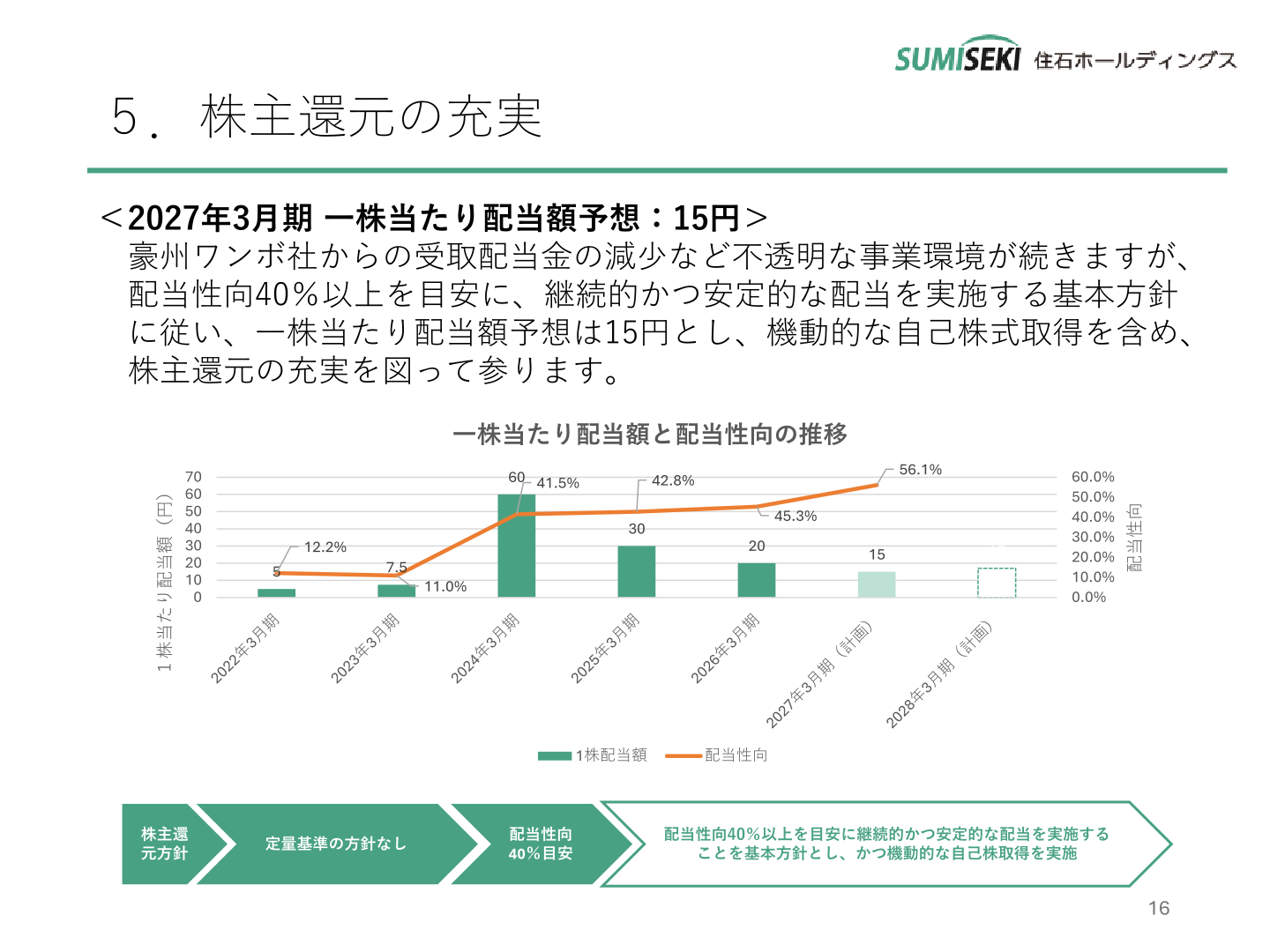
An overview of company-wide results shows net sales of 10,658 million yen (10,264 million yen in the previous fiscal year), operating profit of 329 million yen (48 million yen), recurring profit of 2,794 million yen (4,711 million yen), and profit attributable to owners of parent of 2,638 million yen (4,195 million yen). At the operating level, profit rose 582.1% year on year, while dividend income from Wambo of Australia, which is recorded in non-operating income, fell from 4,626 million yen in the previous fiscal year to 2,401 million yen in the current fiscal year, leaving recurring profit at △40.7% and net profit at △37.1%. The dividend per share was 20 yen (payout ratio 45.3%), down from 30 yen (payout ratio 42.8%) in the previous fiscal year.
| Item | Current FY | Previous FY | Change |
|---|---|---|---|
| Net sales | 10,658 million yen | 10,264 million yen | 393 million yen (3.8%) |
| Operating profit | 329 million yen | 48 million yen | 281 million yen (582.1%) |
| Recurring profit | 2,794 million yen | 4,711 million yen | △1,917 million yen (△40.7%) |
| Profit attributable to owners of parent | 2,638 million yen | 4,195 million yen | △1,557 million yen (△37.1%) |
| Dividend per share | 20 yen (payout ratio 45.3%) | 30 yen (payout ratio 42.8%) | — |
| Dividend income from Wambo of Australia | 2,401 million yen | 4,626 million yen | — |
Segment Results
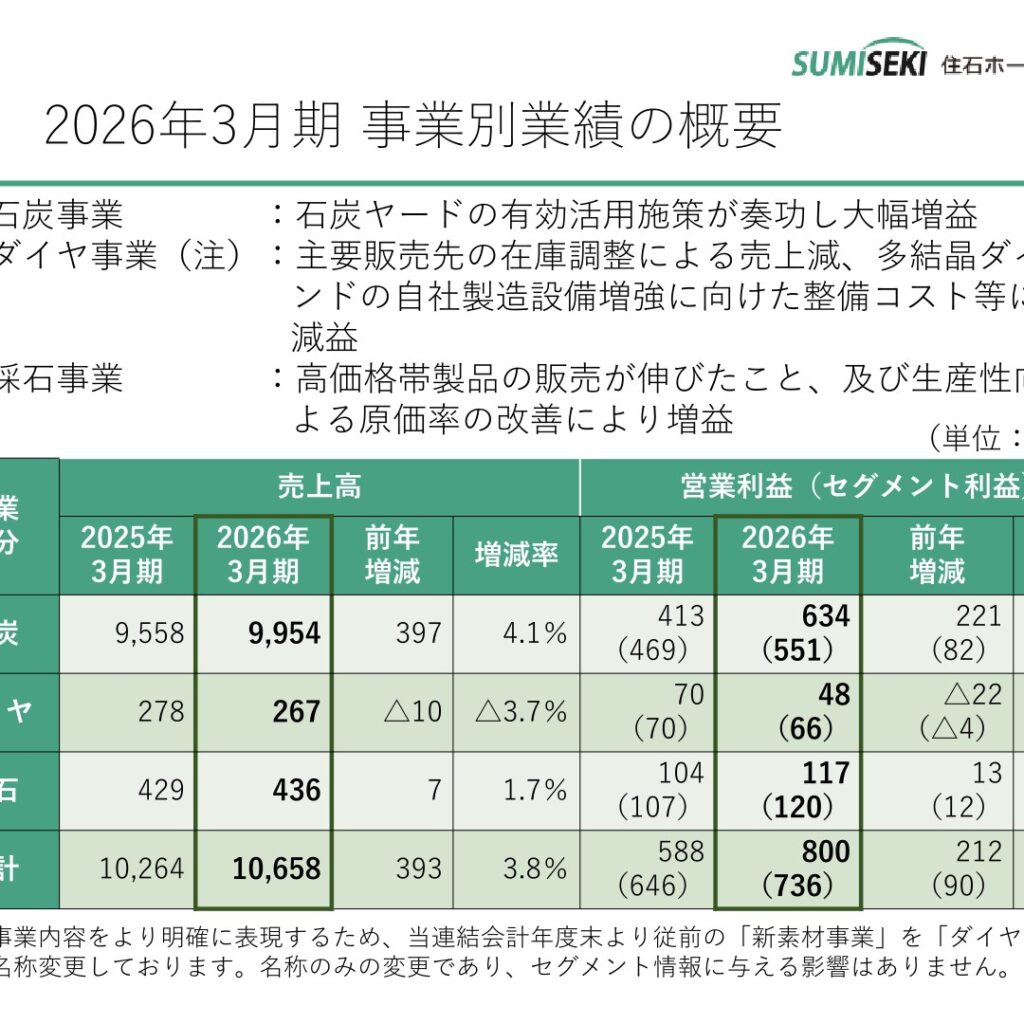
The company reports three business segments: Coal, Diamond and Quarry. In the coal business, measures to make effective use of coal yards paid off and profit rose sharply. In the diamond business, sales fell on inventory adjustments at a major customer, and profit declined because of costs such as the work to expand in-house manufacturing facilities for polycrystalline diamond. In the quarry business, profit increased as sales of higher-priced products grew and the cost ratio improved on productivity gains. For the business segments in total, net sales were 10,658 million yen (10,264 million yen in the previous fiscal year), operating profit was 800 million yen (588 million yen) and segment profit was 736 million yen (646 million yen). In addition, in order to express the content of the business more clearly, the former “New Materials Business” was renamed the “Diamond Business” as of the end of the current consolidated fiscal year; the company explains that this is a change of name only and has no effect on segment information.
| Segment | Metric | Current FY | Previous FY |
|---|---|---|---|
| Coal | Net sales | 9,954 million yen (4.1%) | 9,558 million yen |
| Coal | Operating profit (segment profit) | 634 million yen (551 million yen) | 413 million yen (469 million yen) |
| Diamond | Net sales | 267 million yen (△3.7%) | 278 million yen |
| Diamond | Operating profit (segment profit) | 48 million yen (66 million yen) | 70 million yen (70 million yen) |
| Quarry | Net sales | 436 million yen (1.7%) | 429 million yen |
| Quarry | Operating profit (segment profit) | 117 million yen (120 million yen) | 104 million yen (107 million yen) |
| Total | Net sales | 10,658 million yen (3.8%) | 10,264 million yen |
| Total | Operating profit (segment profit) | 800 million yen (736 million yen) | 588 million yen (646 million yen) |
Full-Year Forecast for the Fiscal Year Ending March 2027
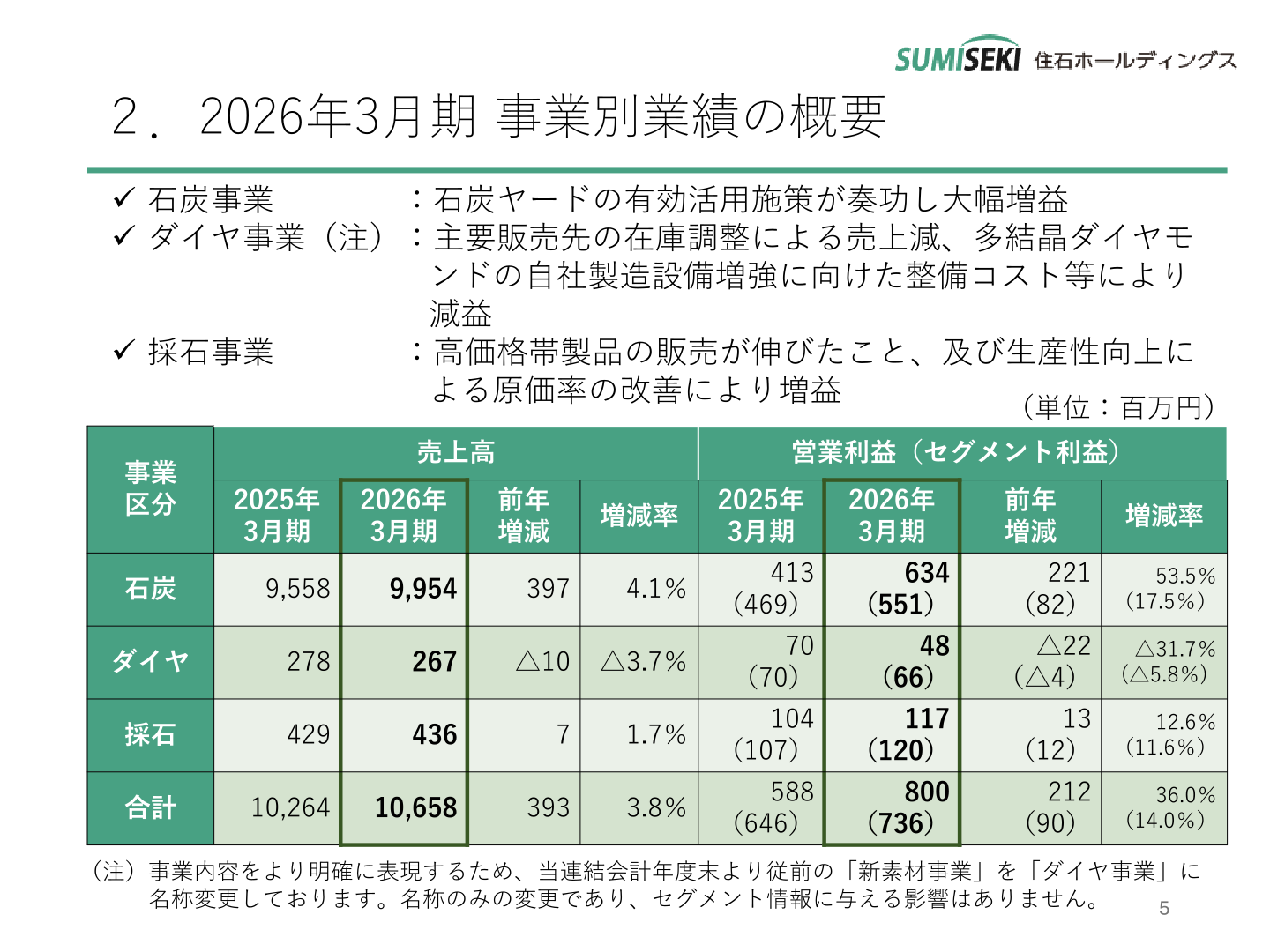
The full-year forecast for the fiscal year ending March 2027 calls for net sales of 9,400 million yen (a year-on-year change of △1,258 million yen, or △11.8%), operating profit of 300 million yen (△29 million yen, △8.8%), recurring profit of 1,800 million yen (△994 million yen, △35.6%), and profit attributable to owners of parent of 1,600 million yen (△1,038 million yen, △39.4%). Net sales are seen as flat versus the previous fiscal year on the assumption that coal prices move stably and firm demand continues, while operating profit is expected to decline because the mainstay coal business is forecast to see lower profit from customers’ fuel switching and reduced operating efficiency of coal storage space, even though the diamond and quarry businesses are planned to post profit growth. Recurring profit and net profit are expected to fall as dividend income is projected to decrease following the end of underground mining production at Wambo of Australia. The forecast dividend per share is 15 yen (payout ratio 56.1%), set so as to provide a continuous and stable dividend.
| Item | FY Ending March 2027 (Forecast) | FY Ended March 2026 (Actual) | Year-on-year change |
|---|---|---|---|
| Net sales | 9,400 million yen | 10,658 million yen | △1,258 million yen (△11.8%) |
| Operating profit | 300 million yen | 329 million yen | △29 million yen (△8.8%) |
| Recurring profit | 1,800 million yen | 2,794 million yen | △994 million yen (△35.6%) |
| Profit attributable to owners of parent | 1,600 million yen | 2,638 million yen | △1,038 million yen (△39.4%) |
| Dividend per share | 15 yen (payout ratio 56.1%) | 20 yen (payout ratio 45.3%) | — |
Shareholder Returns
The shareholder return policy is to pay continuous and stable dividends using a payout ratio of 40% or more as a guideline, and to enhance shareholder returns including flexible acquisition of treasury shares. The company previously stated that it had no policy with quantitative criteria, but it has changed the policy to a payout ratio guideline of 40%. The forecast dividend per share for the fiscal year ending March 2027 is set at 15 yen in line with this basic policy, amid a continuing uncertain business environment that includes the decline in dividend income from Wambo of Australia.
| Fiscal year | Dividend per share | Payout ratio |
|---|---|---|
| FY ended March 2025 | 30 yen | 42.8% |
| FY ended March 2026 | 20 yen | 45.3% |
| FY ending March 2027 (Forecast) | 15 yen | 56.1% |
Progress on the Medium-Term Management Plan
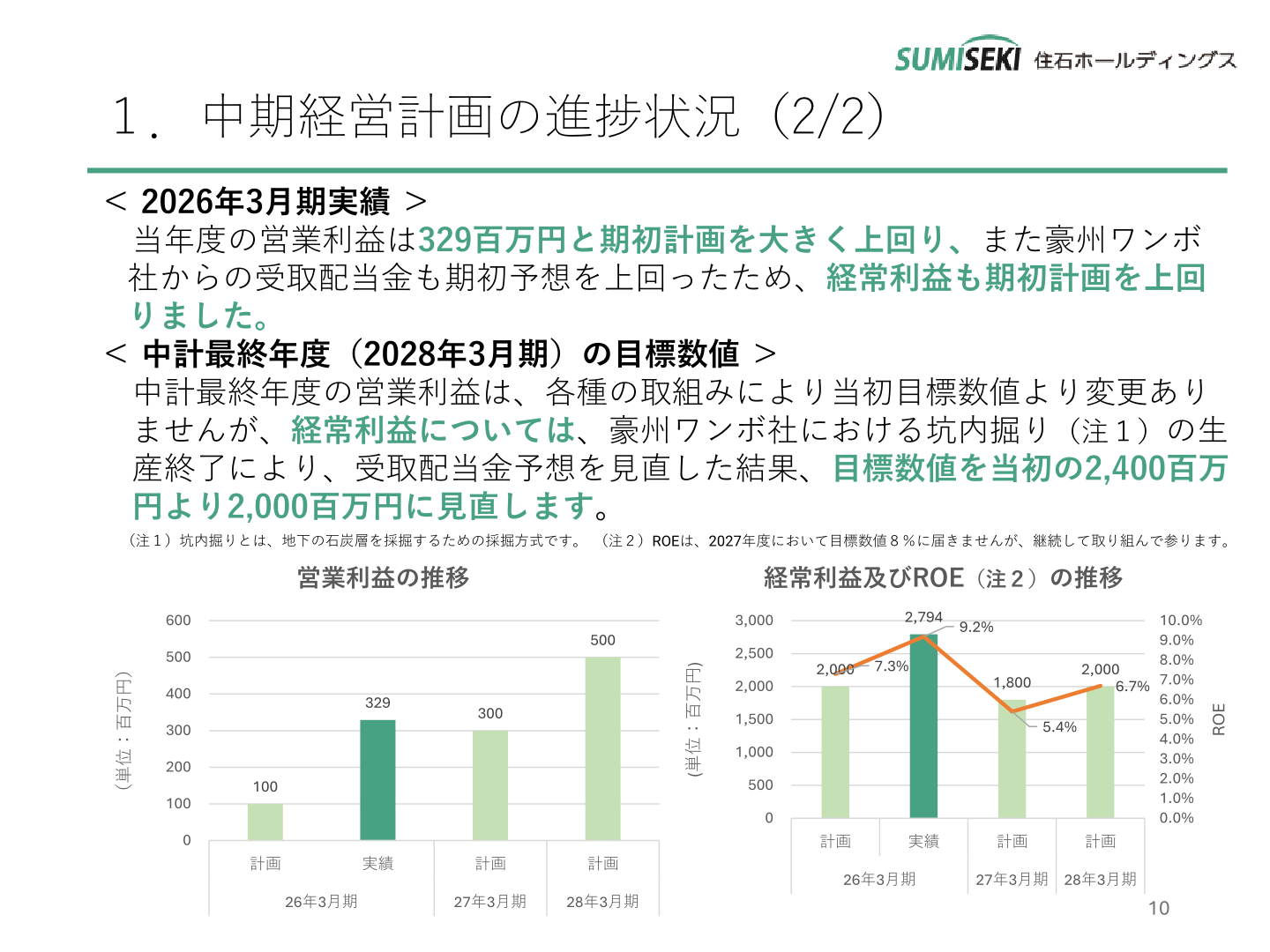
The company announced a medium-term management plan (FY2025 to FY2027) in May 2025, in which it aimed for operating profit of 500 million yen, recurring profit of 2,400 million yen and ROE of 8% or more in FY2027 (the fiscal year ending March 2028). Operating profit of 329 million yen for the fiscal year ended March 2026 significantly exceeded the initial plan, and dividend income from Wambo of Australia also exceeded the initial forecast, so recurring profit likewise exceeded the initial plan. The operating profit target for the final year of the medium-term plan is unchanged from the original figure, but for recurring profit the company has revised the target from the original 2,400 million yen to 2,000 million yen after reviewing its dividend income forecast in light of the end of underground mining production at Wambo of Australia. ROE is not expected to reach the 8% target in FY2027, but the company says it will continue to work toward it. For growth investment, a framework of 3,000 million yen has been set for the three years through FY2027, and the amount of investment decided in FY2025, the first year of the medium-term plan, was 600 million yen (coal business 240 million yen, diamond business 180 million yen, quarry business 65 million yen, new businesses and other 115 million yen), applied mainly to maintenance investment in existing facilities in each business, M&A investment and investment in human resources.
Initiatives in Each Business and New Businesses
In the coal business, in FY2025 the company thoroughly pursued effective use of the coal storage space at NICC (Niihama Coal Center) and maximized earnings through additional orders from large customers such as electric power companies, and it also won increased orders from direct-sales customers and secured the handling of recycled fuel for new customers at existing coal yards. In FY2026, net sales and operating profit are expected to come in below the previous fiscal year’s results, mainly because of a decrease in transshipment transactions at NICC, but the company will work to strengthen earning power through the promotion of resale and direct-sales transactions. In the diamond business, the company carried out renovation of the head office administration building and investment in human resources toward a domestic production expansion structure for polycrystalline diamond, and strengthened its sales structure by starting a capital and business alliance with Trustwell (applying the equity method). Trustwell will be picked up under the equity method in FY2025 and FY2026 and is scheduled to become a consolidated subsidiary from FY2027 onward. In the quarry business, active sales activities in the Shimokita Peninsula area, including raw-material and fuel-related facilities and wind power generation construction work, stabilized orders, while cost reductions that maintained crushed stone quality also paid off. In new businesses, the company began initiatives in the rapidly growing video content industry, and in FY2025 it built relationships with leading companies and decided to participate in production committees for several animated and live-action films.
This article is an analysis based on publicly available information and is not a recommendation to buy or sell any specific securities. Investment decisions are your own responsibility.
![[Obayashi] Investors’ Guide 2026 — The Complete 24-Article Breakdown](https://japan-equity.com/wp-content/uploads/2026/07/hub_cover-1024x1024.png)
![[Obayashi] IR & SR Policy — Feeding Dialogue Back into Management](https://japan-equity.com/wp-content/uploads/2026/07/p32_sq-1024x1024.jpg)
![[Obayashi] Real Estate Development — 18.7% Margin, ¥287.7bn Unrealized Gains](https://japan-equity.com/wp-content/uploads/2026/07/p20_sq-1024x1024.jpg)
![[Obayashi] Domestic Civil Engineering — Resilience Spending Supports 9.6% Margin](https://japan-equity.com/wp-content/uploads/2026/07/p11_sq-1024x1024.jpg)
![[Obayashi] Share Price & External Ratings — vs TOPIX, ESG Index Inclusion](https://japan-equity.com/wp-content/uploads/2026/07/p40_sq-1024x1024.jpg)
![[Construction] ¥75.5tn Investment, Shrinking Workforce — Big-5 Market Share](https://japan-equity.com/wp-content/uploads/2026/07/p12_sq-1024x1024.jpg)
![[Obayashi] Capital Policy & Shareholder Returns — ROE 10%+, DOE ~5%, ¥100bn Buyback](https://japan-equity.com/wp-content/uploads/2026/07/p27_sq-1024x1024.jpg)
![[Obayashi] Reducing Cross-Shareholdings — ¥285.2bn Sold in Five Years](https://japan-equity.com/wp-content/uploads/2026/07/p29_sq-1024x1024.jpg)
![[Obayashi] ¥750bn Investment Plan — ¥300bn to Development, ¥190bn to Tech/DX](https://japan-equity.com/wp-content/uploads/2026/07/p30_sq-1024x1024.jpg)
![[Obayashi] MTP2022 KPIs — Operating Profit ~2x Target, ROE 14.4%](https://japan-equity.com/wp-content/uploads/2026/07/p25_sq-1024x1024.jpg)
![[Obayashi] Cash Allocation — ¥420bn Investment CF Over Five Years](https://japan-equity.com/wp-content/uploads/2026/07/p26_sq-1024x1024.jpg)
![[Obayashi] Green Energy — 44 Plants, 344MW, and the Green Hydrogen Challenge](https://japan-equity.com/wp-content/uploads/2026/07/p21_sq-1024x1024.jpg)
![[Obayashi] Tackling the Labor Shortage — Robotics Construction®](https://japan-equity.com/wp-content/uploads/2026/07/p14_sq-1024x1024.jpg)
