
This article is based on publicly available IR materials and is not a recommendation to buy or sell any specific securities.
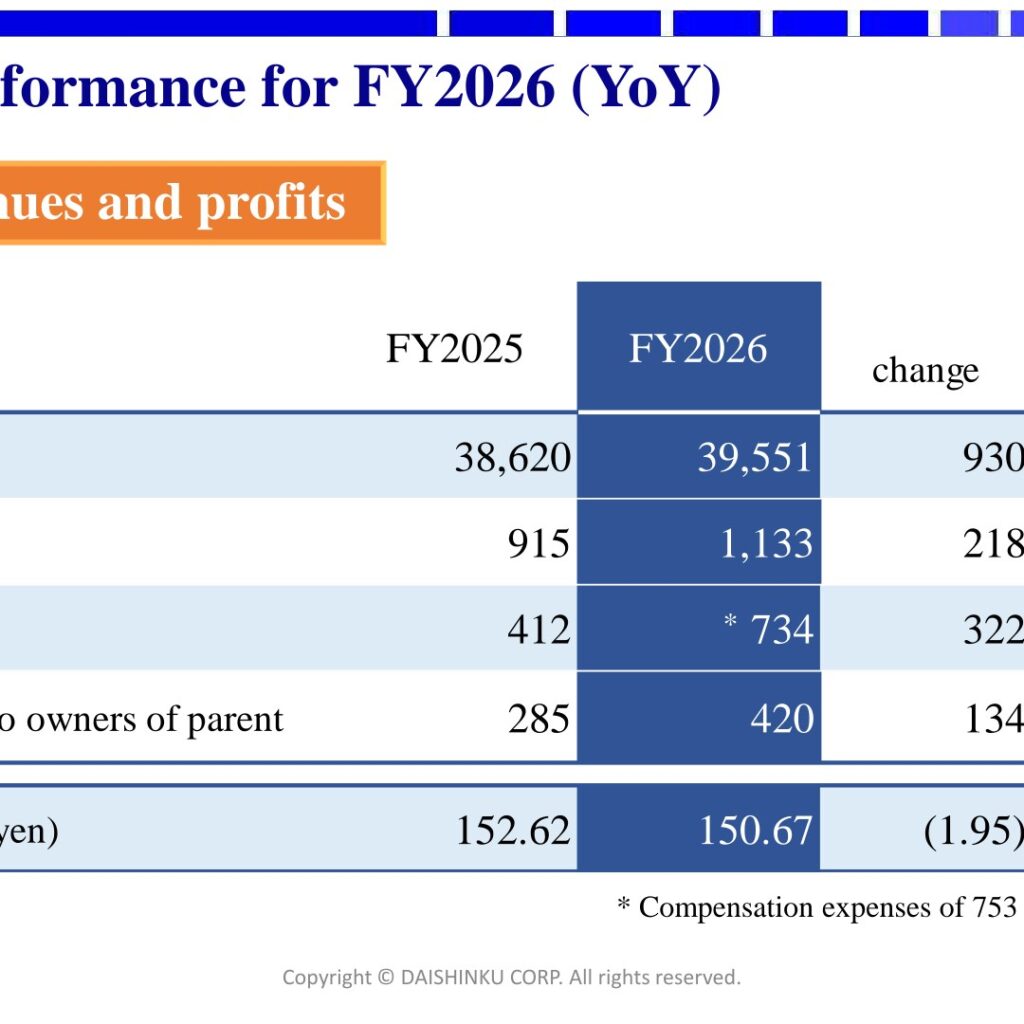
DAISHINKU CORP. (Code: 6962), which sells crystal devices under the KDS brand, reported higher revenues and profits for the fiscal year ended March 31, 2026, in its Financial Results Briefing dated May 27, 2026. Net sales rose 2.4% year on year to 39,551 million yen, operating profit increased 23.9% to 1,133 million yen, ordinary profit increased 78.1% to 734 million yen, and profit attributable to owners of parent increased 47.1% to 420 million yen. For the following fiscal year, the company forecasts net sales of 41,000 million yen and operating profit of 1,400 million yen, again guiding for higher revenues and profits.
Note: The company’s presentation labels the fiscal year ended March 31, 2026 as “FY2026” (and the prior year as “FY2025”); this article keeps the labels as they appear in the materials, while the site classifies this most recently completed fiscal year as FY2025.
Consolidated Results (Full-Year Actual)
The full-year results (unit: millions of yen) are summarized under the heading “Higher revenues and profits.” The ordinary profit figure of 734 million yen carries a footnote stating that compensation expenses of 753 million yen were posted. The average USD rate was 150.67 yen, 1.95 yen lower than the previous year’s 152.62 yen.
| Item | FY2025 | FY2026 | YoY Change | YoY Change (%) |
|---|---|---|---|---|
| Net sales | 38,620 | 39,551 | 930 | 2.4% |
| Operating profit | 915 | 1,133 | 218 | 23.9% |
| Ordinary profit | 412 | 734 | 322 | 78.1% |
| Profit attributable to owners of parent | 285 | 420 | 134 | 47.1% |
| USD average rate (yen) | 152.62 | 150.67 | (1.95) |
According to the operating profit analysis (YoY), operating profit increased due to increased production and operations in response to a buoyant market. The 218 million yen improvement from 915 million yen to 1,133 million yen consisted of +1,440 million yen from changes in marginal profit (including exchange rate fluctuations) and +350 million yen from the indirect department (changes in SG&A and other expenses, including a decrease in personnel expenses), against negative factors of (1,230) million yen from price fluctuation (including exchange rate fluctuations), (110) million yen from the impact of the surge in gold prices, and (230) million yen from the manufacturing department (fixed cost fluctuations, including an increase in depreciation).
On a quarter-on-quarter basis, the January–March quarter of FY2026 also posted higher revenues and profits at the operating level: net sales of 10,005 million yen (up 0.5% from 9,955 million yen in October–December) and operating profit of 609 million yen (up 76.7% from 344 million yen), while ordinary profit fell 66.5% to 207 million yen and profit attributable to owners of parent fell 26.1% to 314 million yen.
Sales by Market
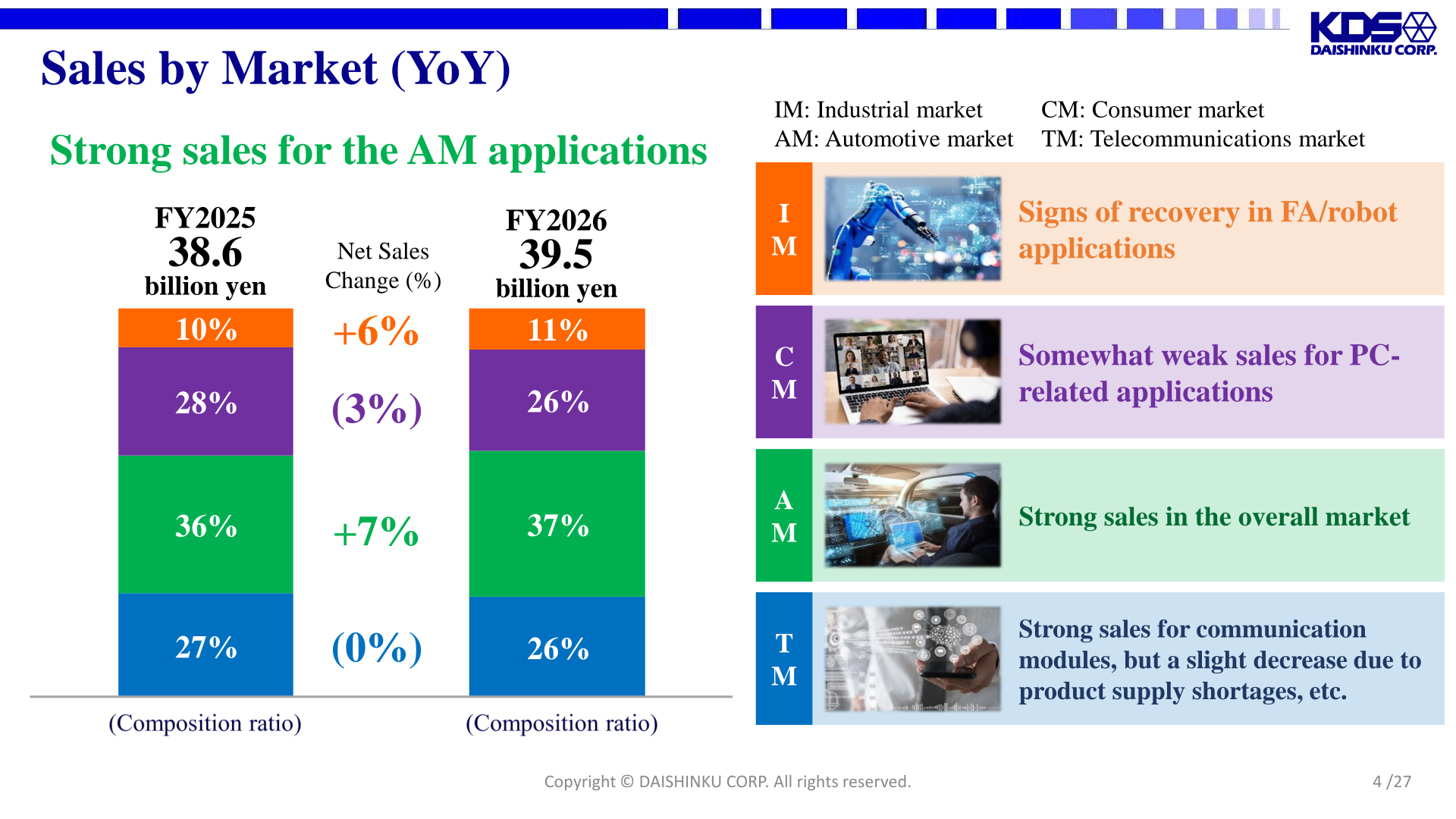
Sales by market for the full year are shown under the heading “Strong sales for the AM applications,” with net sales growing from 38.6 billion yen in FY2025 to 39.5 billion yen in FY2026. By market, the automotive market (AM) saw strong sales in the overall market (+7%), and the industrial market (IM) showed signs of recovery in FA/robot applications (+6%). The consumer market (CM) had somewhat weak sales for PC-related applications ((3%)), and the telecommunications market (TM) had strong sales for communication modules but a slight decrease due to product supply shortages, etc. ((0%)).
| Market | FY2025 Composition Ratio | FY2026 Composition Ratio | Net Sales Change (%) |
|---|---|---|---|
| IM: Industrial market | 10% | 11% | +6% |
| CM: Consumer market | 28% | 26% | (3%) |
| AM: Automotive market | 36% | 37% | +7% |
| TM: Telecommunications market | 27% | 26% | (0%) |
Capital Expenditures and Inventory
Capital expenditures decreased to 6,234 million yen from 7,450 million yen (unit: millions of yen), with the company noting that it invested in capital expenditures in line with completion of the headquarters and plant during the same period in the previous year, and that investments were made in the Arkh-related business. Depreciation increased to 4,240 million yen, while R&D expenses decreased to 1,854 million yen.
| Item | FY2025 | FY2026 | Increase/Decrease |
|---|---|---|---|
| Capital Expenditures | 7,450 | 6,234 | (1,216) |
| Depreciation | 3,986 | 4,240 | 254 |
| R&D expenses | 2,168 | 1,854 | (314) |
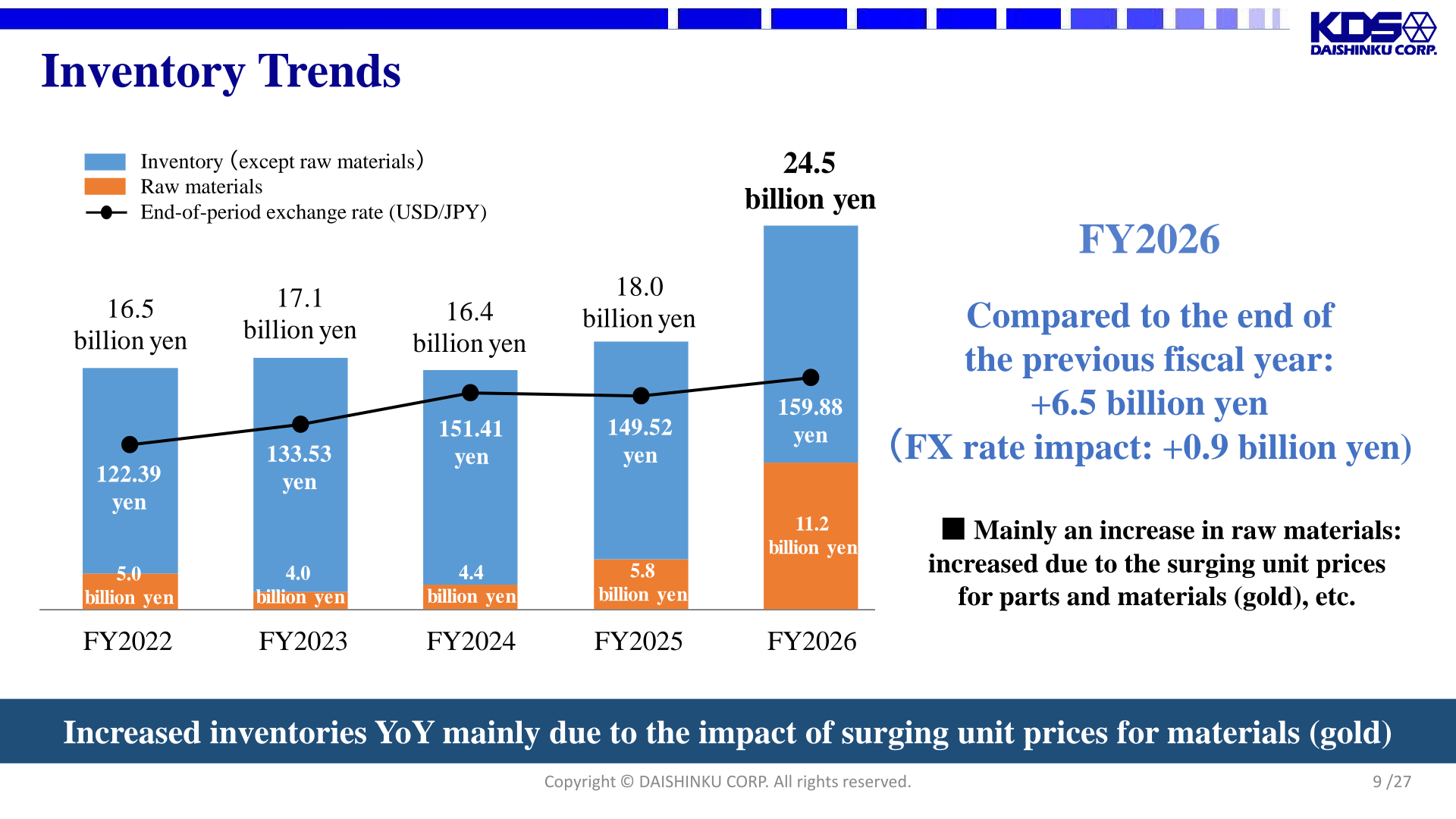
Inventories at the end of FY2026 stood at 24.5 billion yen, an increase of 6.5 billion yen compared to the end of the previous fiscal year (FX rate impact: +0.9 billion yen), mainly due to an increase in raw materials driven by the surging unit prices for parts and materials (gold), etc. Raw materials accounted for 11.2 billion yen, and the end-of-period exchange rate was 159.88 yen to the US dollar.
Full-Year Forecast of FY2027
For FY2027 (unit: millions of yen), the company forecasts higher revenues and profits: net sales of 41,000 million yen (up 3.7%), operating profit of 1,400 million yen (up 23.5%), and ordinary profit of 780 million yen (up 6.2%). Profit attributable to owners of parent is forecast at 100 million yen (down 76.2%), with a footnote stating that the impairment loss of the former head office building was estimated as an extraordinary loss. The assumed USD average rate is 150.00 yen.
| Item | FY2026 | FY2027 (Forecast) | Change | Change (%) |
|---|---|---|---|---|
| Net sales | 39,551 | 41,000 | 1,449 | 3.7% |
| Operating profit | 1,133 | 1,400 | 267 | 23.5% |
| Ordinary profit | 734 | 780 | 46 | 6.2% |
| Profit attributable to owners of parent | 420 | 100 | (320) | (76.2%) |
| Capital expenditures | 6,234 | 4,800 | (1,434) | (23.0%) |
| Depreciation | 4,240 | 5,200 | 960 | 22.6% |
| R&D expenses | 1,854 | 2,400 | 546 | 29.4% |
| USD average rate (JPY) | 150.67 | 150.00 |
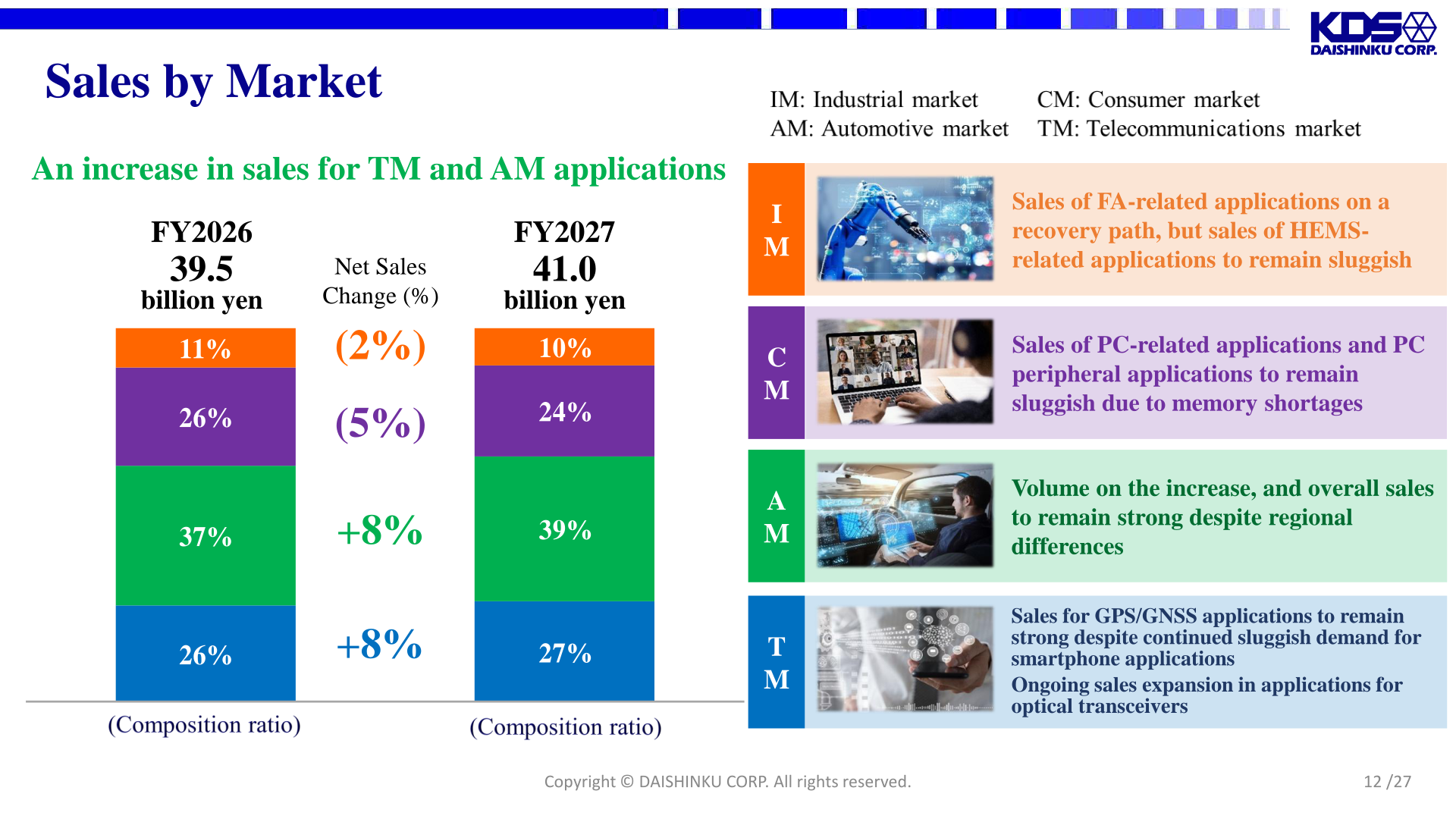
By market, the forecast is headlined “An increase in sales for TM and AM applications,” with net sales expected to grow from 39.5 billion yen in FY2026 to 41.0 billion yen in FY2027. Sales in the telecommunications market are expected to rise 8% (composition ratio 27%), as sales for GPS/GNSS applications remain strong despite continued sluggish demand for smartphone applications, and sales expansion continues in applications for optical transceivers. Automotive market sales are also expected to rise 8% (composition ratio 39%) with volume on the increase. Consumer market sales are expected to decline 5% (composition ratio 24%) as PC-related and PC peripheral applications remain sluggish due to memory shortages, and industrial market sales are expected to decline 2% (composition ratio 10%), with FA-related applications on a recovery path but HEMS-related applications remaining sluggish.
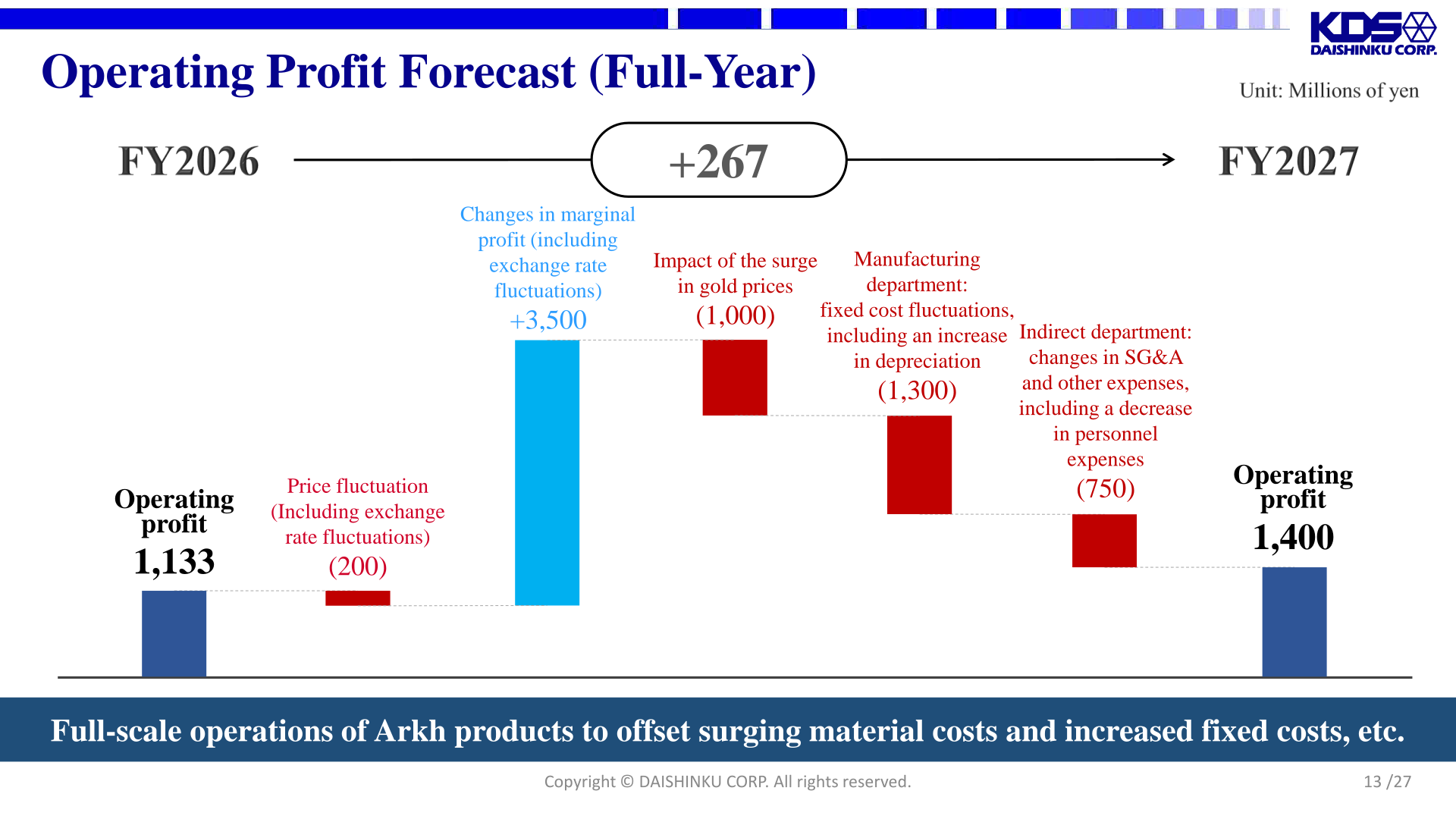
The operating profit forecast bridge shows a 267 million yen increase from 1,133 million yen to 1,400 million yen, with full-scale operations of Arkh products to offset surging material costs and increased fixed costs, etc. Positive and negative factors are +3,500 million yen from changes in marginal profit (including exchange rate fluctuations), (200) million yen from price fluctuation (including exchange rate fluctuations), (1,000) million yen from the impact of the surge in gold prices, (1,300) million yen from the manufacturing department (fixed cost fluctuations, including an increase in depreciation), and (750) million yen from the indirect department (changes in SG&A and other expenses, including a decrease in personnel expenses).
Arkh Series and Growth Strategy
A large part of the briefing is devoted to the Arkh series, described as a novel concept different from conventional products. Arkh.3G uses WLP (wafer-level packaging) technology with photolithography-processed wafer hermetic sealing, achieving a height of 0.13 mm (world’s thinnest/lightest), best suited for built-in ICs and wearables, with an external procurement ratio of 0% versus about 70% for conventional products. Arkh.2G oscillators build Arkh resonators — finished products — into the package instead of crystal chips, providing long-term stability through the dual-package structure and significantly reducing IC yield loss during assembly through wafer-level 100% inspection and quality assurance (KGD: Known Good Die).
The company positions AI data centers and wearable devices as focus domains. In the optical transceiver market, it expects the 1.6 Tbps (312.5 MHz) market to take off rapidly — highly likely to result in supply-demand tightness — driving sales expansion of Arkh differential oscillators. The production and sales plan calls for the launch of Arkh.3G mass production in FY2027 H1, an increase in mass production volume in FY2027 H2, and full-capacity production on the current production line of 25 million units/month (standard items) in FY2028. The company aims to expand the Arkh market share through direct sales as well as alliances (with competitors) and trading companies, and to establish crystal resonators as a de facto standard.
Topics: Geopolitical Risks and Long-Term Plan
On the impact of the Middle East situation, the company states that there are procurement risks but no immediate issues affecting production: a 1-year supply of helium has been secured through multiple sources, a 6-month supply of conductive adhesive has been secured, and there are no issues affecting production for cleaning alcohol (IPA).
FY2027 marks the 7th year of the “OCEAN+2” strategy, the company’s 10-year Long-term Business Plan. Highlighted points include adoption of the Arkh.3G for wearables by major manufacturers, the cost competitiveness of oscillators (differential oscillators) using the Arkh.2G, accelerated cost reductions from the increased size of 4- and 6-inch rough crystals and increased wafer output, a strategy to sell built-in Arkh resonators to competitors, and strength as the market leader in crystal filters. A sensor that enables a paradigm shift in thermal management has been developed, with the possibility of commercialization under review. Dividend and shareholder return figures cannot be confirmed from the materials.
This article is an analysis based on publicly available information and is not a recommendation to buy or sell any specific securities. Investment decisions are your own responsibility.
![[Obayashi] Investors’ Guide 2026 — The Complete 24-Article Breakdown](https://japan-equity.com/wp-content/uploads/2026/07/hub_cover-1024x1024.png)
![[Obayashi] IR & SR Policy — Feeding Dialogue Back into Management](https://japan-equity.com/wp-content/uploads/2026/07/p32_sq-1024x1024.jpg)
![[Obayashi] Real Estate Development — 18.7% Margin, ¥287.7bn Unrealized Gains](https://japan-equity.com/wp-content/uploads/2026/07/p20_sq-1024x1024.jpg)
![[Obayashi] Domestic Civil Engineering — Resilience Spending Supports 9.6% Margin](https://japan-equity.com/wp-content/uploads/2026/07/p11_sq-1024x1024.jpg)
![[Obayashi] Share Price & External Ratings — vs TOPIX, ESG Index Inclusion](https://japan-equity.com/wp-content/uploads/2026/07/p40_sq-1024x1024.jpg)
![[Construction] ¥75.5tn Investment, Shrinking Workforce — Big-5 Market Share](https://japan-equity.com/wp-content/uploads/2026/07/p12_sq-1024x1024.jpg)
![[Obayashi] Capital Policy & Shareholder Returns — ROE 10%+, DOE ~5%, ¥100bn Buyback](https://japan-equity.com/wp-content/uploads/2026/07/p27_sq-1024x1024.jpg)
![[Obayashi] Reducing Cross-Shareholdings — ¥285.2bn Sold in Five Years](https://japan-equity.com/wp-content/uploads/2026/07/p29_sq-1024x1024.jpg)
![[Obayashi] ¥750bn Investment Plan — ¥300bn to Development, ¥190bn to Tech/DX](https://japan-equity.com/wp-content/uploads/2026/07/p30_sq-1024x1024.jpg)
![[Obayashi] MTP2022 KPIs — Operating Profit ~2x Target, ROE 14.4%](https://japan-equity.com/wp-content/uploads/2026/07/p25_sq-1024x1024.jpg)
![[Obayashi] Cash Allocation — ¥420bn Investment CF Over Five Years](https://japan-equity.com/wp-content/uploads/2026/07/p26_sq-1024x1024.jpg)
![[Obayashi] Green Energy — 44 Plants, 344MW, and the Green Hydrogen Challenge](https://japan-equity.com/wp-content/uploads/2026/07/p21_sq-1024x1024.jpg)
![[Obayashi] Tackling the Labor Shortage — Robotics Construction®](https://japan-equity.com/wp-content/uploads/2026/07/p14_sq-1024x1024.jpg)
