
This article is based on publicly available IR materials and is not a recommendation to buy or sell any specific securities.
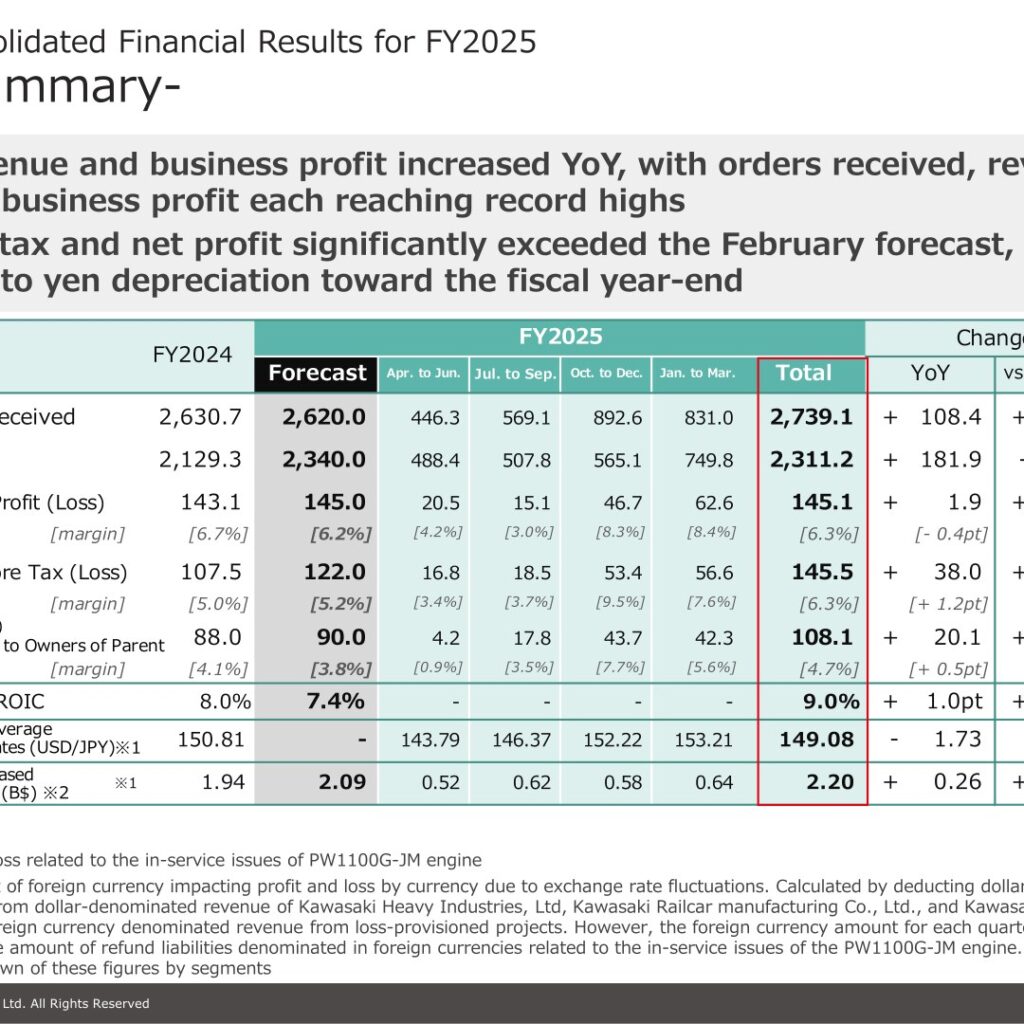
Kawasaki Heavy Industries reported FY2025 results for the year ended March 31, 2026 on May 12, 2026. Orders received, revenue and business profit each reached record highs, with business profit of 145.1 billion yen, up 1.9 billion yen year on year and in line with the February forecast. Strong performance in Aerospace Systems and Energy Solution & Marine Engineering (ES&M), together with a recovery in Precision Machinery & Robot, offset Powersports & Engine (PS&E), which was significantly impacted by U.S. tariff policies. For FY2026, the company forecasts a record-high business profit of 170.0 billion yen based on an assumed exchange rate of JPY150/USD.
Consolidated Results (Full-Year Actual)
Revenue and business profit increased year on year, with orders received, revenue and business profit each reaching record highs. Pre-tax profit and net profit significantly exceeded the February forecast, mainly due to yen depreciation toward the fiscal year-end. Kawasaki has adopted IFRS since the first quarter of FY2022.
| Item | FY2024 | FY2025 | Change (YoY) |
|---|---|---|---|
| Orders Received | 2,630.7 | 2,739.1 | + 108.4 |
| Revenue | 2,129.3 | 2,311.2 | + 181.9 |
| Business Profit | 143.1 | 145.1 | + 1.9 |
| [Business profit margin] | [6.7%] | [6.3%] | [- 0.4pt] |
| Profit Before Tax | 107.5 | 145.5 | + 38.0 |
| Profit Attributable to Owners of Parent | 88.0 | 108.1 | + 20.1 |
| After-tax ROIC | 8.0% | 9.0% | + 1.0pt |
| Weighted-average exchange rate (USD/JPY) | 150.81 | 149.08 | – 1.73 |
In the statement of profit and loss, cost of sales was 1,856.3 billion yen (80.3% of revenue) against 1,697.7 billion yen (79.7%) a year earlier, and gross profit rose 23.3 billion yen to 454.9 billion yen. Selling, general and administrative expenses increased 21.7 billion yen to 328.7 billion yen, but the SG&A ratio declined to 14.2% from 14.4% due to control of fixed costs despite higher expenses accompanying revenue growth. Finance income and finance costs swung by 36.0 billion yen to a positive 0.4 billion yen, as translation gains arose on foreign currency-denominated receivables. Profit attributable to non-controlling interests rose 4.4 billion yen to 6.7 billion yen, reflecting the April 2025 transfer of a 20% stake in Kawasaki Motors, Ltd. (a PS&E business subsidiary) to ITOCHU Corporation.
Total assets stood at 3,324.6 billion yen at the end of March 2026, up 307.6 billion yen, while total equity increased 223.4 billion yen to 948.4 billion yen and interest-bearing debt fell 86.3 billion yen to 606.1 billion yen. Cash flows from operating activities were 140.0 billion yen (down 8.8 billion yen) and free cash flow was 12.0 billion yen, remaining positive for the second consecutive year. Cash flows from investing activities were -128.0 billion yen. The cash conversion cycle lengthened to 172 days at the end of FY2025 from 159 days a year earlier, due to longer days sales outstanding in Aerospace Systems and PS&E.
Segment Results
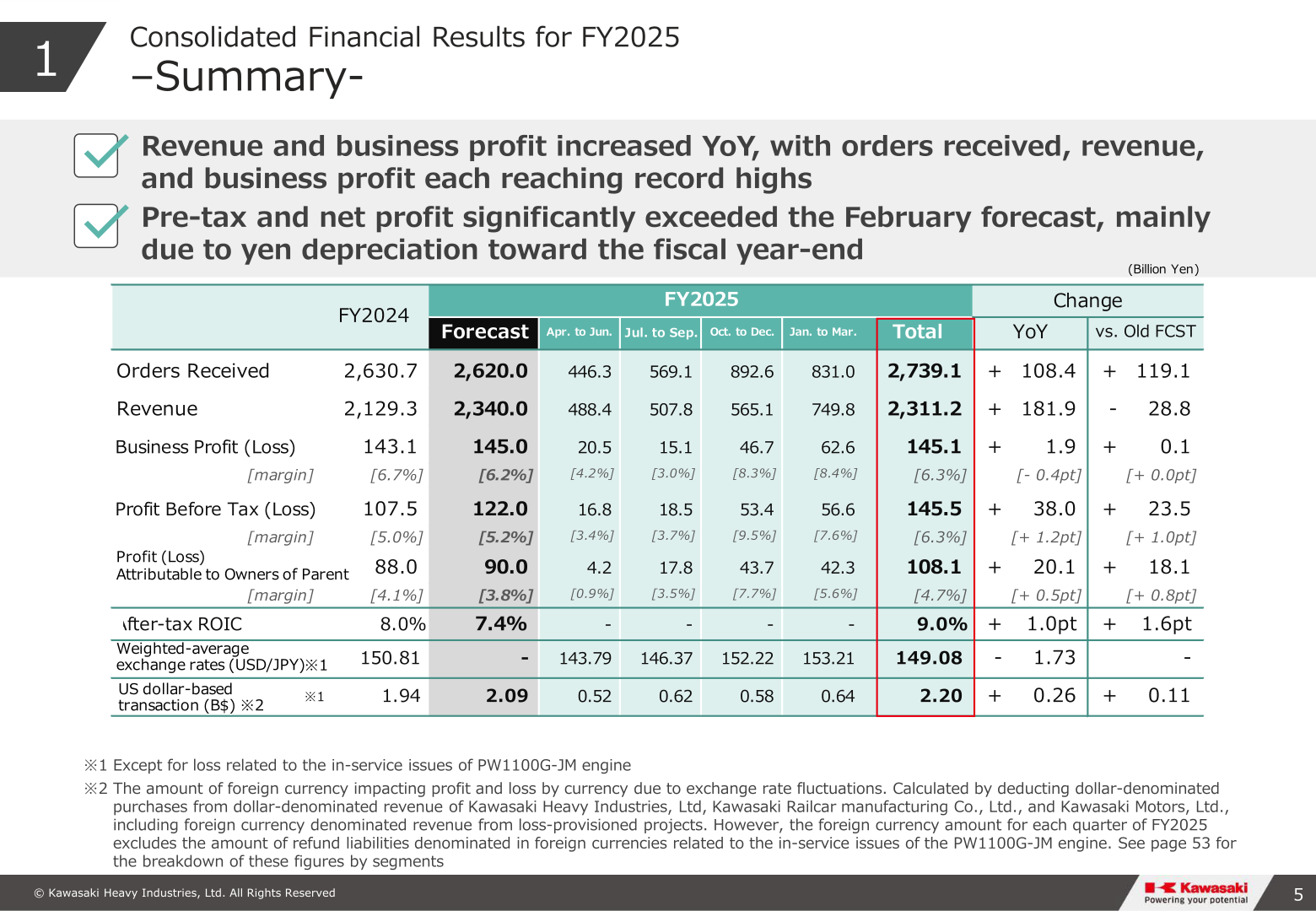
Aerospace Systems saw revenue rise 45.8 billion yen on higher revenue from the Ministry of Defense (MOD) and Boeing, while orders received fell 71.9 billion yen due to the rebound from the prior year’s large MOD order. ES&M achieved year-on-year revenue and business profit growth, driven by strong performance across segments including Energy and Ship & Offshore Structure. PS&E posted revenue growth, while business profit declined due to higher tariff costs and stronger competition in the U.S. powersports market. Rolling Stock business profit remained roughly flat despite revenue growth, due to a one-off loss related to the agreement with WMATA regarding the Washington Metro 7000-series railcars.
| Segment | Orders FY2024 | Orders FY2025 | Revenue FY2024 | Revenue FY2025 | Business Profit FY2024 | Business Profit FY2025 |
|---|---|---|---|---|---|---|
| Aerospace Systems | 882.8 | 810.9 | 567.8 | 613.6 | 55.8 | 62.4 |
| Rolling Stock | 251.5 | 319.1 | 222.3 | 236.2 | 8.4 | 8.6 |
| Energy Solution & Marine Engineering | 542.0 | 552.9 | 398.1 | 433.5 | 44.2 | 55.0 |
| Precision Machinery & Robot | 249.2 | 278.5 | 241.5 | 259.1 | 7.0 | 14.3 |
| Powersports & Engine | 611.6 | 681.7 | 609.3 | 682.8 | 47.8 | 22.7 |
| Others | 93.3 | 95.9 | 90.1 | 85.8 | 5.2 | 7.0 |
| Elimination and corporate | – | – | – | – | – 25.6 | – 25.3 |
| Total | 2,630.7 | 2,739.1 | 2,129.3 | 2,311.2 | 143.1 | 145.1 |
Within Aerospace Systems, Aerospace revenue was 445.6 billion yen and Aero Engine revenue was 168.0 billion yen, and the segment business profit margin improved 0.3pt to 10.2%. In Rolling Stock, North America orders were 227.8 billion yen and Domestic & Asia orders were 91.3 billion yen; on the R211 project for the New York City Subway, the base contract’s 535 cars have been fully delivered and 320 of the 640 Option 1 cars had been delivered as of the end of March 2026. In ES&M, Energy, Plant & Marine Machinery orders rose 101.7 billion yen to 456.2 billion yen while Ship & Offshore Structure orders fell 90.9 billion yen to 96.6 billion yen; share of profit of equity-method investments was 23.7 billion yen. In Precision Machinery & Robot, Hydraulic Components & Systems revenue was 166.1 billion yen and Robotics revenue 92.9 billion yen. In PS&E, revenue from motorcycles for developed countries was 261.9 billion yen, motorcycles for emerging markets 102.6 billion yen, utility vehicles, ATVs and PWC 211.4 billion yen, and general-purpose gasoline engines 106.7 billion yen.
FY2026 Forecast
For FY2026 (the year ending March 31, 2027), Kawasaki assumes an exchange rate of JPY150/USD and expects business profit to reach a record-high 170.0 billion yen, exceeding FY2025 by 24.9 billion yen. The company states it is on track toward achieving the target of a business profit margin exceeding 10% by FY2030. Regarding the situation in the Middle East, the forecast assumes crude oil distribution normalizes by the end of June and incorporates the impact of production delays from material procurement difficulties and higher procurement and fuel prices, primarily affecting PS&E and Vehicles, with an estimated negative impact of approximately 8.0 billion yen on business profit. For U.S. tariff policies, the assumptions are based on regimes and tax measures already implemented or expected to be implemented as of May 12, 2026, and IEEPA tariff refunds are not factored in.
| Item | FY2025 (Actual) | FY2026 (Forecast) | Change |
|---|---|---|---|
| Orders Received | 2,739.1 | 2,540.0 | – 199.1 |
| Revenue | 2,311.2 | 2,560.0 | + 248.8 |
| Business Profit | 145.1 | 170.0 | + 24.9 |
| [Margin] | [6.3%] | [6.6%] | [+ 0.3pt] |
| Profit Before Tax | 145.5 | 147.0 | + 1.5 |
| Profit Attributable to Owners of Parent | 108.1 | 110.0 | + 1.9 |
| After-tax ROIC | 9.0% | 8.6% | – 0.4pt |
| Weighted-average exchange rate (USD/JPY) | 149.08 | 150.00 | + 0.92 |
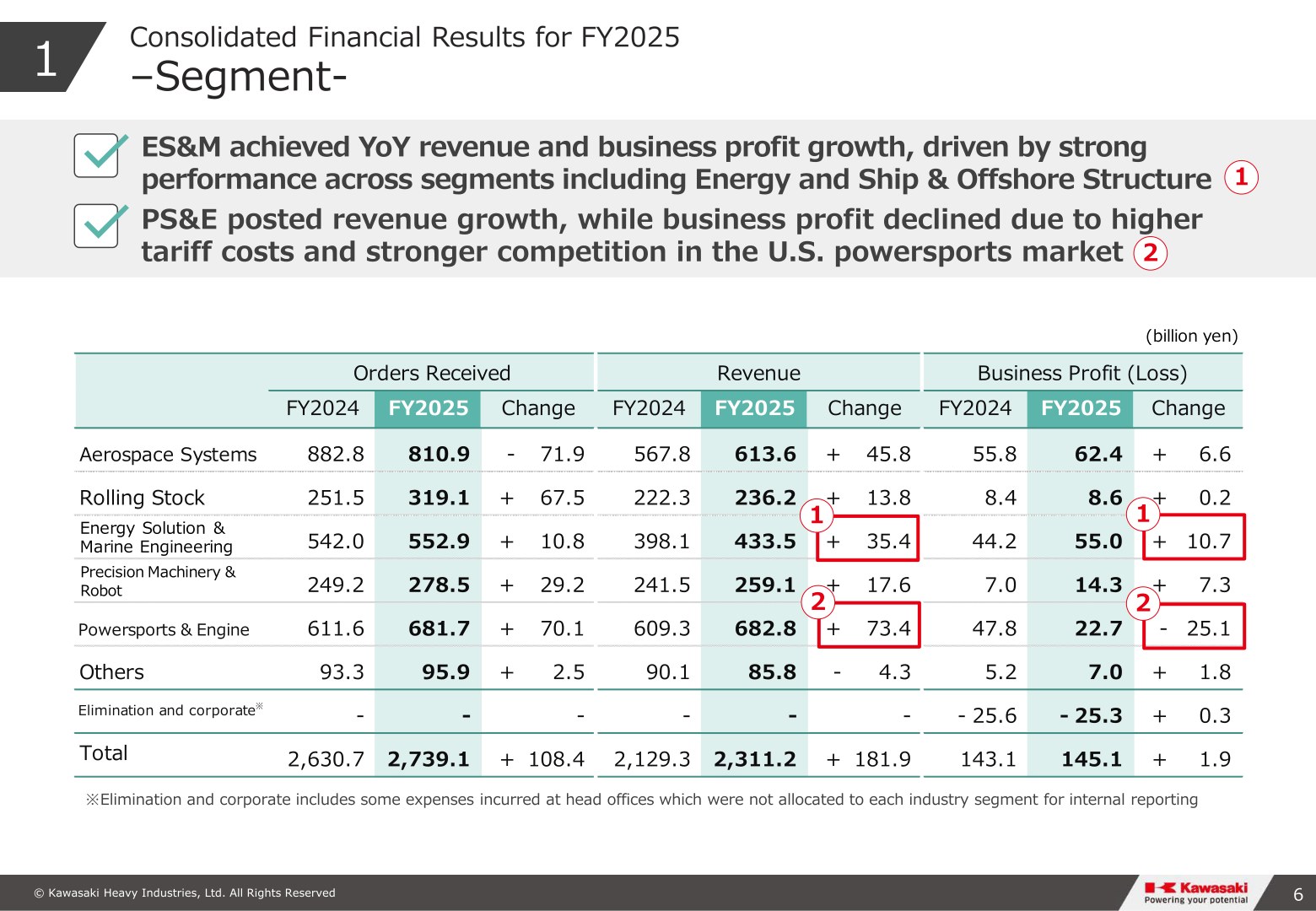
By segment, business profit is expected to grow driven mainly by revenue increases in Aerospace Systems, ES&M, Precision Machinery & Robot and PS&E. In elimination and corporate, business profit will decline due to an increase in investment expenses for new businesses. The estimated cost increase due to U.S. tariff policies embedded in the FY2026 plan totals -15.0 billion yen, comprising +0.2 billion yen for Aerospace Systems, -2.0 billion yen for Precision Machinery & Robot and -13.2 billion yen for PS&E.
| Segment | Orders FY2026 (FCST) | Revenue FY2026 (FCST) | Business Profit FY2026 (FCST) | Business Profit Change vs FY2025 |
|---|---|---|---|---|
| Aerospace Systems | 600.0 | 720.0 | 72.0 | + 9.6 |
| Rolling Stock | 130.0 | 230.0 | 10.0 | + 1.4 |
| Energy Solution & Marine Engineering | 650.0 | 470.0 | 69.0 | + 14.0 |
| Precision Machinery & Robot | 330.0 | 310.0 | 21.0 | + 6.7 |
| Powersports & Engine | 730.0 | 730.0 | 30.0 | + 7.3 |
| Others | 100.0 | 100.0 | 4.0 | – 3.0 |
| Elimination and corporate | – | – | – 36.0 | – 10.7 |
| Total | 2,540.0 | 2,560.0 | 170.0 | + 24.9 |
Shareholder Returns
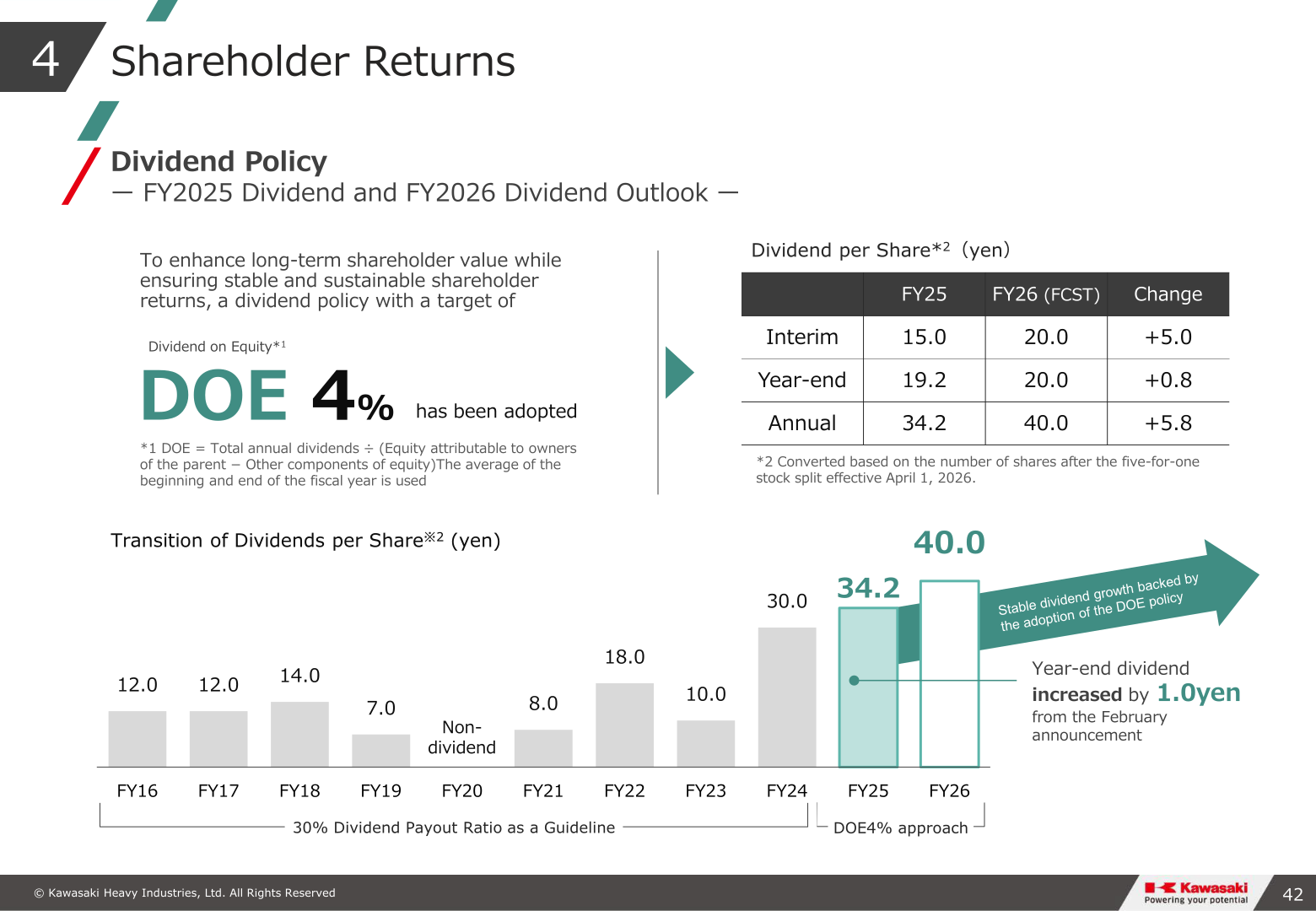
To enhance long-term shareholder value while ensuring stable and sustainable shareholder returns, Kawasaki has adopted a dividend policy with a target of Dividend on Equity (DOE) of 4%, defined as total annual dividends divided by equity attributable to owners of the parent less other components of equity, using the average of the beginning and end of the fiscal year. The FY2025 annual dividend per share is 34.2 yen, comprising an interim dividend of 15.0 yen and a year-end dividend of 19.2 yen; the year-end dividend was increased by 1.0 yen from the February announcement. For FY2026 the company forecasts an annual dividend of 40.0 yen (interim 20.0 yen, year-end 20.0 yen), up 5.8 yen. These per-share figures are converted based on the number of shares after the five-for-one stock split effective April 1, 2026.
| Dividend per Share (yen) | FY2025 | FY2026 (FCST) | Change |
|---|---|---|---|
| Interim | 15.0 | 20.0 | +5.0 |
| Year-end | 19.2 | 20.0 | +0.8 |
| Annual | 34.2 | 40.0 | +5.8 |
Topics
In hydrogen-related projects, demonstration operation of a centrifugal hydrogen compressor for hydrogen liquefaction plants was launched at the Harima Works in January 2026 as part of a NEDO Green Innovation Fund project, and in March 2026 hydrogen co-firing operation across all cylinders was initiated on the first full-scale marine hydrogen engine, with a hydrogen co-firing ratio exceeding 95% at 100% engine load. In March 2026, Kawasaki signed a memorandum of understanding with Bosch Rexroth AG to collaborate on next-generation solutions for construction machinery. On governance, the final investigation report by the Special Investigation Committee into the misconduct incidents identified in 2024 (the submarine maintenance incident and the marine engine incident) was received and publicly disclosed in December 2025, and reforms are being advanced under three pillars: establishing systems to prevent misconduct, enhanced detection, and reforming corporate culture. In the employee engagement survey, the proportion of employees classified as the ‘Active Group’ rose to 36% in FY2025, up 5 pts year on year.
This article is an analysis based on publicly available information and is not a recommendation to buy or sell any specific securities. Investment decisions are your own responsibility.
![[Obayashi] Investors’ Guide 2026 — The Complete 24-Article Breakdown](https://japan-equity.com/wp-content/uploads/2026/07/hub_cover-1024x1024.png)
![[Obayashi] IR & SR Policy — Feeding Dialogue Back into Management](https://japan-equity.com/wp-content/uploads/2026/07/p32_sq-1024x1024.jpg)
![[Obayashi] Real Estate Development — 18.7% Margin, ¥287.7bn Unrealized Gains](https://japan-equity.com/wp-content/uploads/2026/07/p20_sq-1024x1024.jpg)
![[Obayashi] Domestic Civil Engineering — Resilience Spending Supports 9.6% Margin](https://japan-equity.com/wp-content/uploads/2026/07/p11_sq-1024x1024.jpg)
![[Obayashi] Share Price & External Ratings — vs TOPIX, ESG Index Inclusion](https://japan-equity.com/wp-content/uploads/2026/07/p40_sq-1024x1024.jpg)
![[Construction] ¥75.5tn Investment, Shrinking Workforce — Big-5 Market Share](https://japan-equity.com/wp-content/uploads/2026/07/p12_sq-1024x1024.jpg)
![[Obayashi] Capital Policy & Shareholder Returns — ROE 10%+, DOE ~5%, ¥100bn Buyback](https://japan-equity.com/wp-content/uploads/2026/07/p27_sq-1024x1024.jpg)
![[Obayashi] Reducing Cross-Shareholdings — ¥285.2bn Sold in Five Years](https://japan-equity.com/wp-content/uploads/2026/07/p29_sq-1024x1024.jpg)
![[Obayashi] ¥750bn Investment Plan — ¥300bn to Development, ¥190bn to Tech/DX](https://japan-equity.com/wp-content/uploads/2026/07/p30_sq-1024x1024.jpg)
![[Obayashi] MTP2022 KPIs — Operating Profit ~2x Target, ROE 14.4%](https://japan-equity.com/wp-content/uploads/2026/07/p25_sq-1024x1024.jpg)
![[Obayashi] Cash Allocation — ¥420bn Investment CF Over Five Years](https://japan-equity.com/wp-content/uploads/2026/07/p26_sq-1024x1024.jpg)
![[Obayashi] Green Energy — 44 Plants, 344MW, and the Green Hydrogen Challenge](https://japan-equity.com/wp-content/uploads/2026/07/p21_sq-1024x1024.jpg)
![[Obayashi] Tackling the Labor Shortage — Robotics Construction®](https://japan-equity.com/wp-content/uploads/2026/07/p14_sq-1024x1024.jpg)
