
This article is based on publicly available IR materials and is not a recommendation to buy or sell any specific securities.
Sony Financial Group Inc. (SFGI) reported its FY2025 results on May 14, 2026, covering the fiscal year ended March 31, 2026. Group consolidated adjusted net income, the company’s headline profit indicator, was 105.1 billion yen, up 71% year on year, mainly on higher adjusted net income in the life insurance and non-life insurance businesses. On a Japanese GAAP basis, consolidated ordinary revenues rose 9.6% to 2,871.0 billion yen and ordinary profit rose 88.4% to 84.5 billion yen, while profit attributable to owners of the parent fell 29.6% to 55.4 billion yen. Group consolidated ESR stood at 177% at the end of FY25, down 12 points from the end of FY24.
Consolidated Results (Full-Year Actual)
Sony FG presents its results on two bases. The financial statements of SFGI, Sony Life, Sony Assurance and Sony Bank are prepared under Japanese accounting standards (J-GAAP), while the group also discloses figures based on IFRS Accounting Standards for international comparability and to show management indicators suited to its long-term focus. The table below is in billions of yen and follows the labels used in the presentation, where FY25 is the fiscal year ended March 31, 2026.
| Item (billion yen) | FY25 | FY24 | YoY change |
|---|---|---|---|
| Ordinary revenues (J-GAAP) | 2,871.0 | 2,618.7 | +252.3 / +9.6% |
| Ordinary profit (J-GAAP) | 84.5 | 44.8 | +39.6 / +88.4% |
| Profit attributable to owners of the parent (J-GAAP) | 55.4 | 78.7 | (23.2) / (29.6)% |
| Income before income taxes (IFRS) | (11.4) | 130.5 | — |
| Group consolidated adjusted net income | 105.1 | 61.3 | +71% |
| Total assets (period-end) | 23,807.1 | 23,370.9 | +436.2 / +1.9% |
| Total net assets (period-end) | 629.2 | 669.7 | (40.4) / (6.0)% |
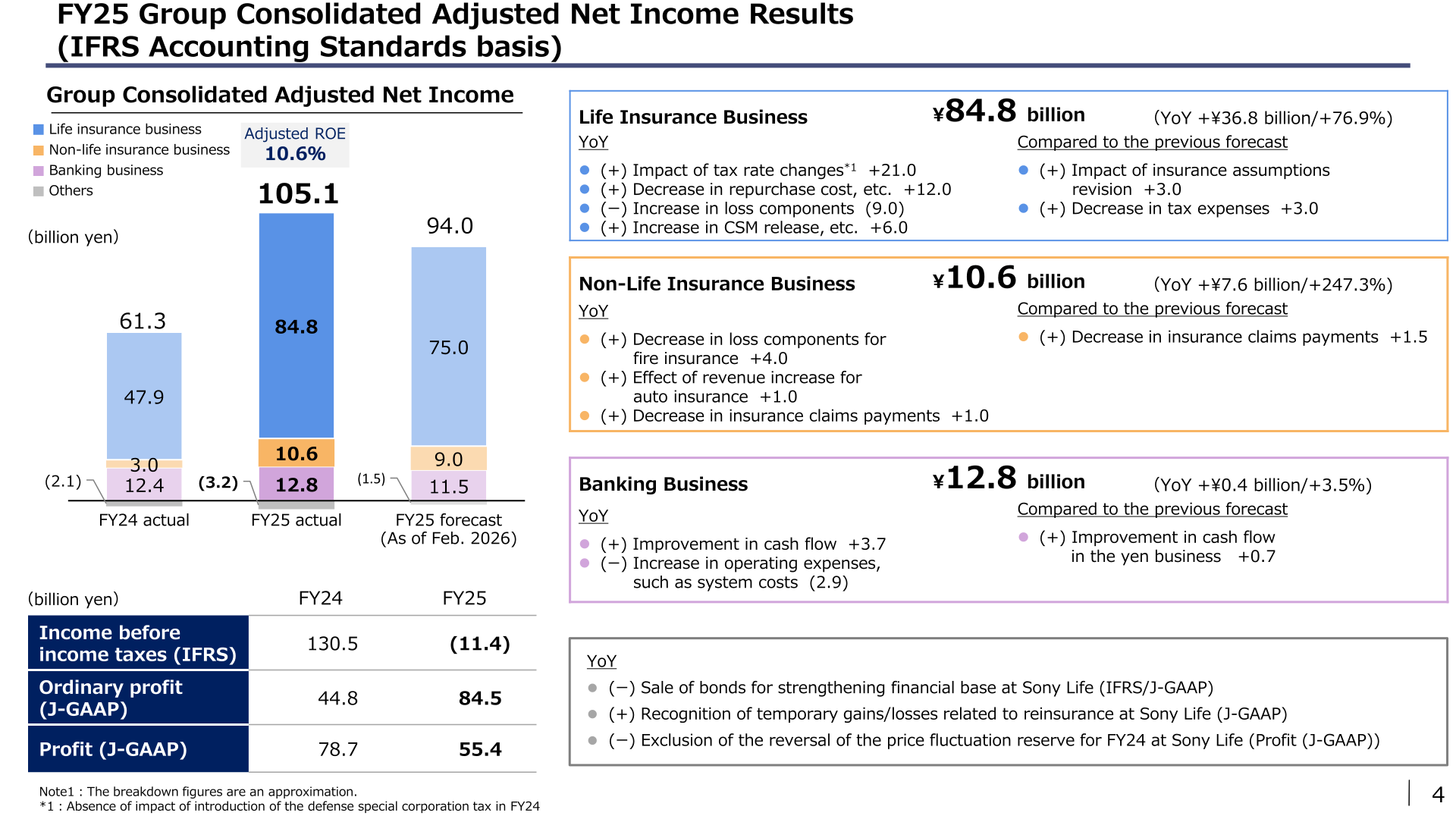
Adjusted net income is defined as SFGI consolidated net income under IFRS Accounting Standards less adjustments for each entity, and was introduced to measure base earnings growth by excluding market fluctuations and one-time factors. The reconciliation shows post-tax net loss under IFRS of 8.6 billion yen for FY25 (against post-tax net income of 74.1 billion yen for FY24), with total adjustments of 113.8 billion yen bringing adjusted post-tax net income to 105.1 billion yen. Adjusted ROE was 10.6%. Revenue on an IFRS basis was 1,017,555 million yen, against 925,311 million yen in FY24.
Results by Business
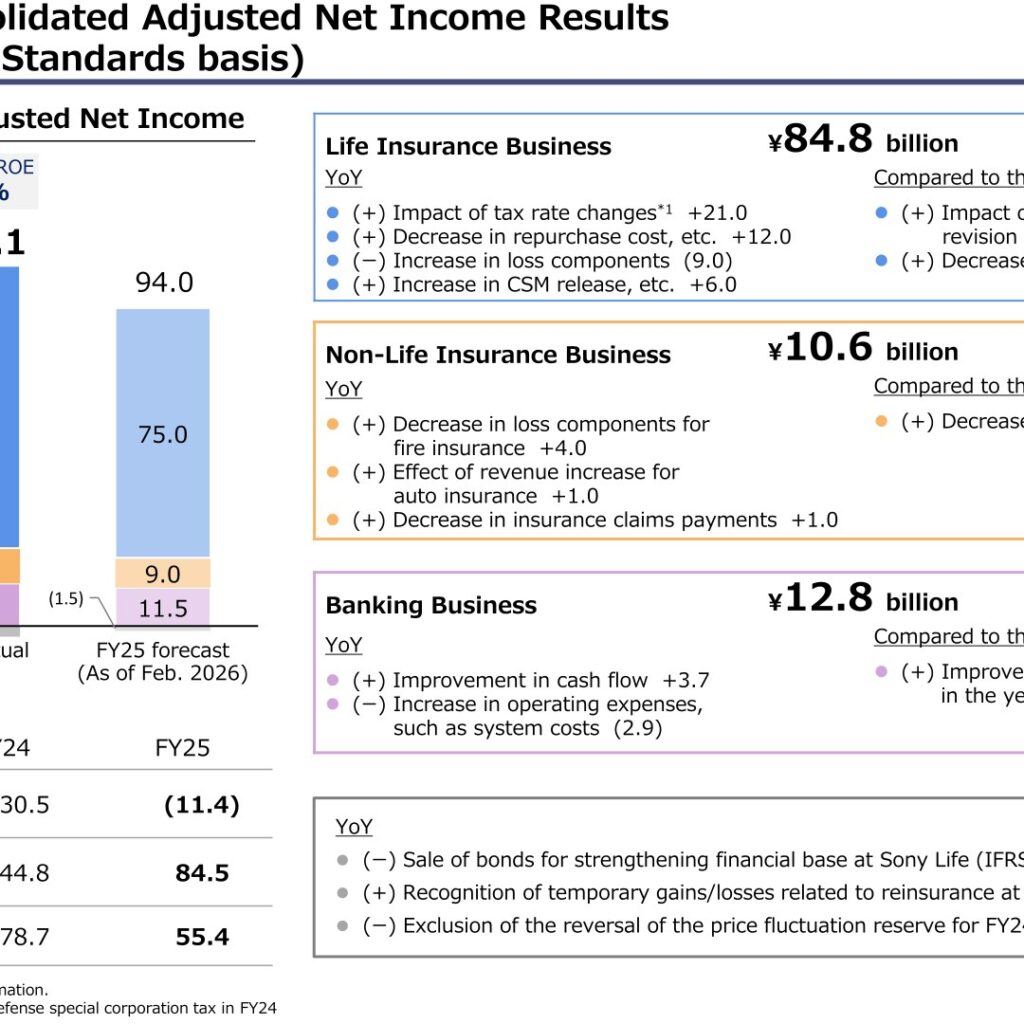
All three core businesses contributed to the increase in adjusted net income. The life insurance business benefited from the absence of the impact of the defense special corporation tax introduced in FY24 (+21.0 billion yen from the tax rate change), a decrease in repurchase cost (+12.0) and an increase in CSM release (+6.0), partly offset by an increase in loss components (9.0). The non-life insurance business gained from lower loss components for fire insurance (+4.0), higher auto insurance revenue (+1.0) and lower insurance claims payments (+1.0). The banking business saw an improvement in cash flow (+3.7) offset by higher operating expenses such as system costs (2.9).
| Business | Metric (billion yen) | FY25 | FY24 | YoY change |
|---|---|---|---|---|
| Life insurance business | Adjusted net income | 84.8 | 47.9 | +36.8 / +76.9% |
| Non-life insurance business | Adjusted net income | 10.6 | 3.0 | +7.6 / +247.3% |
| Banking business | Adjusted net income | 12.8 | 12.4 | +0.4 / +3.5% |
| Others | Adjusted net income | (3.2) | (2.1) | — |
| Group consolidated | Adjusted net income | 105.1 | 61.3 | +71% |
| Sony Life | Ordinary revenues (J-GAAP) | 2,535.0 | 2,317.0 | +217.9 / +9.4% |
| Sony Life | Ordinary profit (J-GAAP) | 59.4 | 20.6 | +38.7 / +188.2% |
| Sony Assurance | Ordinary revenues (J-GAAP) | 191.3 | 168.8 | +22.4 / +13.3% |
| Sony Assurance | Ordinary profit (J-GAAP) | 12.5 | 7.2 | +5.3 / +73.9% |
| Sony Bank | Ordinary revenues (J-GAAP) | 129.8 | 117.0 | +12.8 / +11.0% |
| Sony Bank | Ordinary profit (J-GAAP) | 16.7 | 18.8 | (2.1) / (11.5)% |
At Sony Life, annualized premiums from new policies were 173.0 billion yen for FY25 YTD, down from 180.8 billion yen a year earlier, a decline the company describes as still leaving the level high. Pre-tax CSM closed FY25 at 2,055.9 billion yen against 2,068.5 billion yen at the end of FY24, with new business CSM of 318.7 billion yen, interest accretion of 26.3 billion yen and CSM release of 157.7 billion yen. The balance of loss components on yen-denominated insurance rose to 41.5 billion yen at the end of FY25 from 22.9 billion yen at the end of FY24, while the U.S. dollar-denominated balance was 28.3 billion yen against 29.2 billion yen. The lapse and surrender rate improved to 5.7% in FY25 from 6.0% in FY24. Policy amount in force reached 77,308,784 million yen as of March 31, 2026, and annualized premiums from policies in force were 1,385,196 million yen. Sony Life’s ordinary profit increase under J-GAAP mainly reflects the impact associated with the partial ceding of the in-force block of U.S. dollar-denominated whole life insurance and improved gains and losses on market fluctuations such as foreign exchange, partially offset by deteriorated gains and losses on the sale of securities in the general account resulting from the sale of bonds for ALM rebalancing.
At Sony Assurance, direct premiums written rose to 199.5 billion yen in FY25 from 173.8 billion yen in FY24, with auto insurance at 170.9 billion yen, fire at 18.3 billion yen and other lines at 10.2 billion yen. The combined ratio improved to 92.8% from 95.1%, comprising an E.I. loss ratio of 68.2% (69.7% in FY24) and a net expense ratio of 24.6% (25.4%). The impact of natural disasters on the loss ratio was 0.9 points, against 2.6 points in FY24.
At Sony Bank, yen deposits grew to 3,941.0 billion yen at the end of FY25 from 3,645.5 billion yen a year earlier, while foreign currency deposits were 770.5 billion yen against 771.1 billion yen, a slight decrease the company attributes mainly to profit-taking sales and transfers into yen deposits against a backdrop of yen depreciation. The number of accounts was 2,146 thousand as of March 31, 2026, and the mortgage loan balance was 3,550,309 million yen. The yen loan-deposit spread widened to 0.85% in FY25 from 0.74% in FY24, while the foreign currency security-deposit spread narrowed to 1.3% from 1.9%.
Capital Soundness
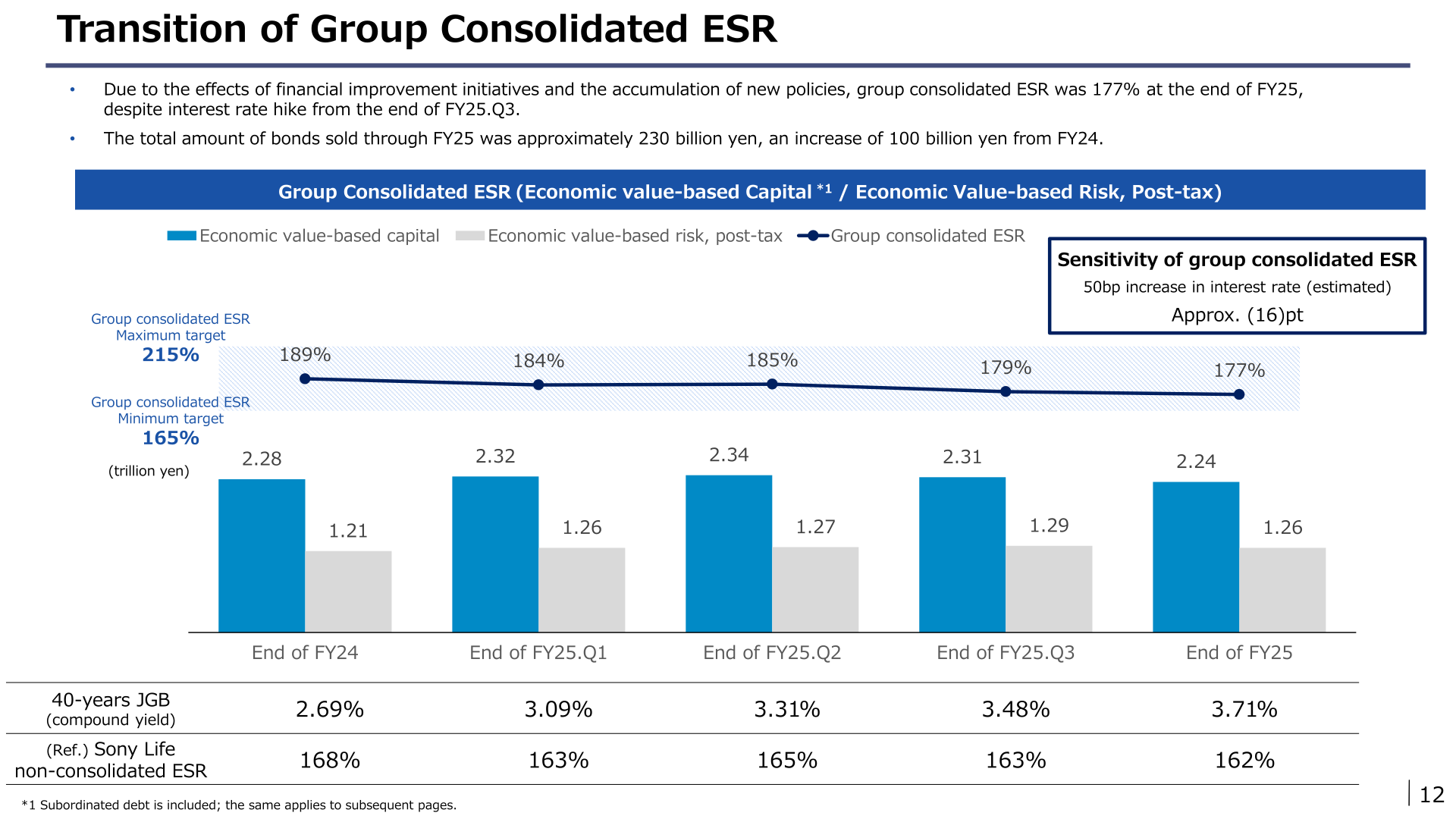
Group consolidated ESR — the ratio of economic value-based capital to economic value-based risk on a post-tax basis — was 177% at the end of FY25, down from 189% at the end of FY24, with economic value-based capital of 2.24 trillion yen and post-tax economic value-based risk of 1.26 trillion yen. The decline came despite financial improvement initiatives and the accumulation of new policies, as the 40-year JGB compound yield rose from 2.69% to 3.71%. The breakdown of the change is an approximate (36) points from the interest rate rise, +8 points from new policy acquisition, +23 points from the effects of measures, (6) points from share repurchases and (1) point from other factors; within the effects of measures, the use of derivatives and sales of bonds contributed +12 points, subordinated financing +8 points and a change of foreign exchange hedges +2 points. The total amount of bonds sold through FY25 was approximately 230 billion yen, an increase of 100 billion yen from FY24. Sony Life’s non-consolidated ESR was 162% at the end of FY25. Sensitivity is estimated at approximately (16) points on group consolidated ESR for a 50bp increase in interest rates.
FY2026 Forecast
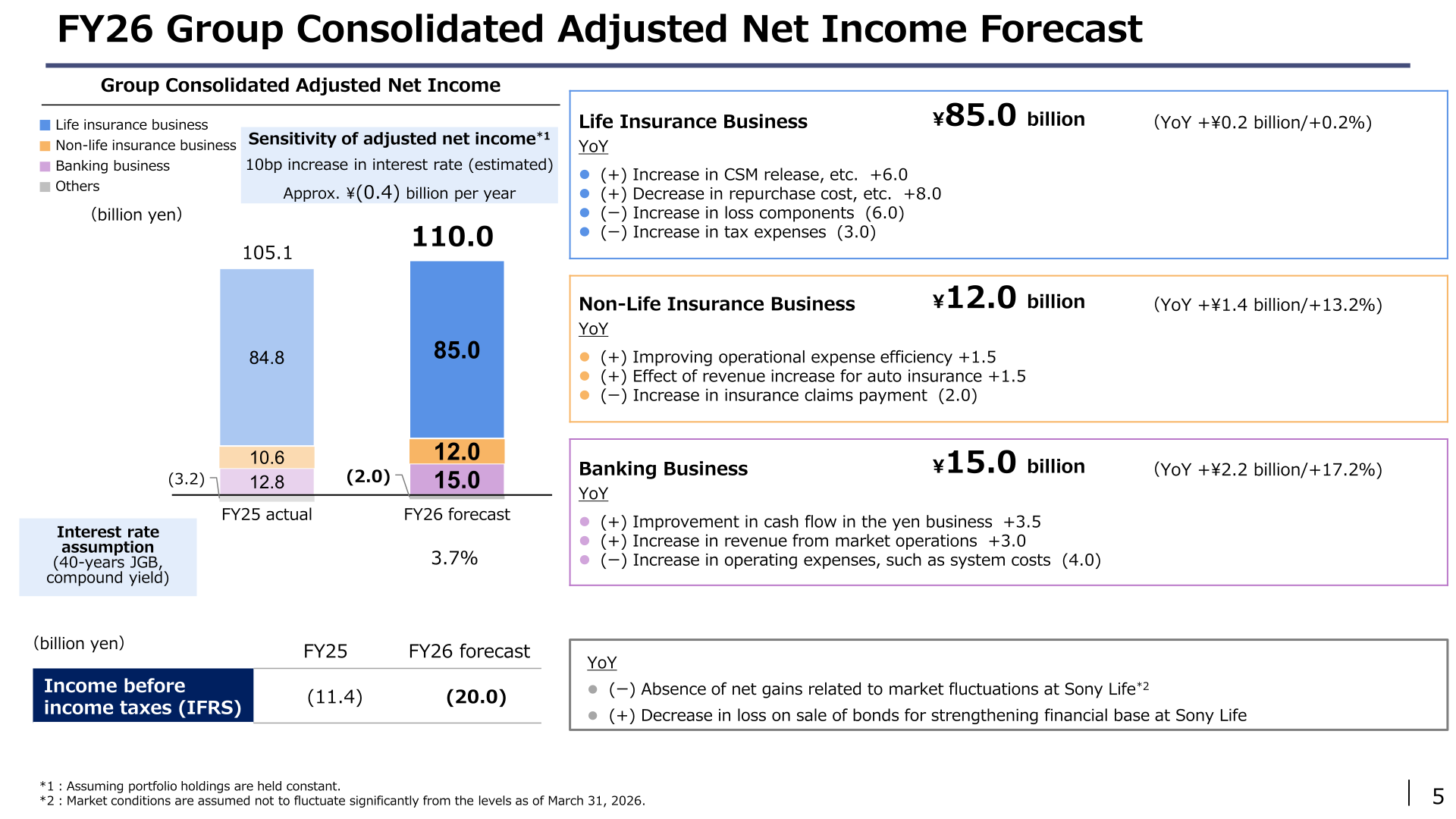
For FY26, Sony FG forecasts group consolidated adjusted net income of 110.0 billion yen, up 5% year on year, driven mainly by higher adjusted net income in the banking and non-life insurance businesses while the life insurance business is expected to be flat. The forecast assumes a 40-year JGB compound yield of 3.7%, and the company estimates sensitivity of adjusted net income at approximately (0.4) billion yen per year for a 10bp increase in interest rates, assuming portfolio holdings are held constant.
| Item (billion yen) | FY26 forecast | FY25 actual | YoY change |
|---|---|---|---|
| Group consolidated adjusted net income | 110.0 | 105.1 | +5% |
| Life insurance business | 85.0 | 84.8 | +0.2 / +0.2% |
| Non-life insurance business | 12.0 | 10.6 | +1.4 / +13.2% |
| Banking business | 15.0 | 12.8 | +2.2 / +17.2% |
| Others | (2.0) | (3.2) | — |
| Income before income taxes (IFRS) | (20.0) | (11.4) | — |
By business, the life insurance forecast reflects an increase in CSM release (+6.0) and a decrease in repurchase cost (+8.0), offset by an increase in loss components (6.0) and higher tax expenses (3.0). Non-life insurance assumes improving operational expense efficiency (+1.5) and the effect of revenue increase for auto insurance (+1.5), against an increase in insurance claims payments (2.0). Banking assumes an improvement in cash flow in the yen business (+3.5) and an increase in revenue from market operations (+3.0), offset by higher operating expenses such as system costs (4.0). The wider forecast IFRS pre-tax loss reflects the absence of net gains related to market fluctuations at Sony Life, partly offset by a decrease in the loss on the sale of bonds for strengthening the financial base.
Shareholder Returns
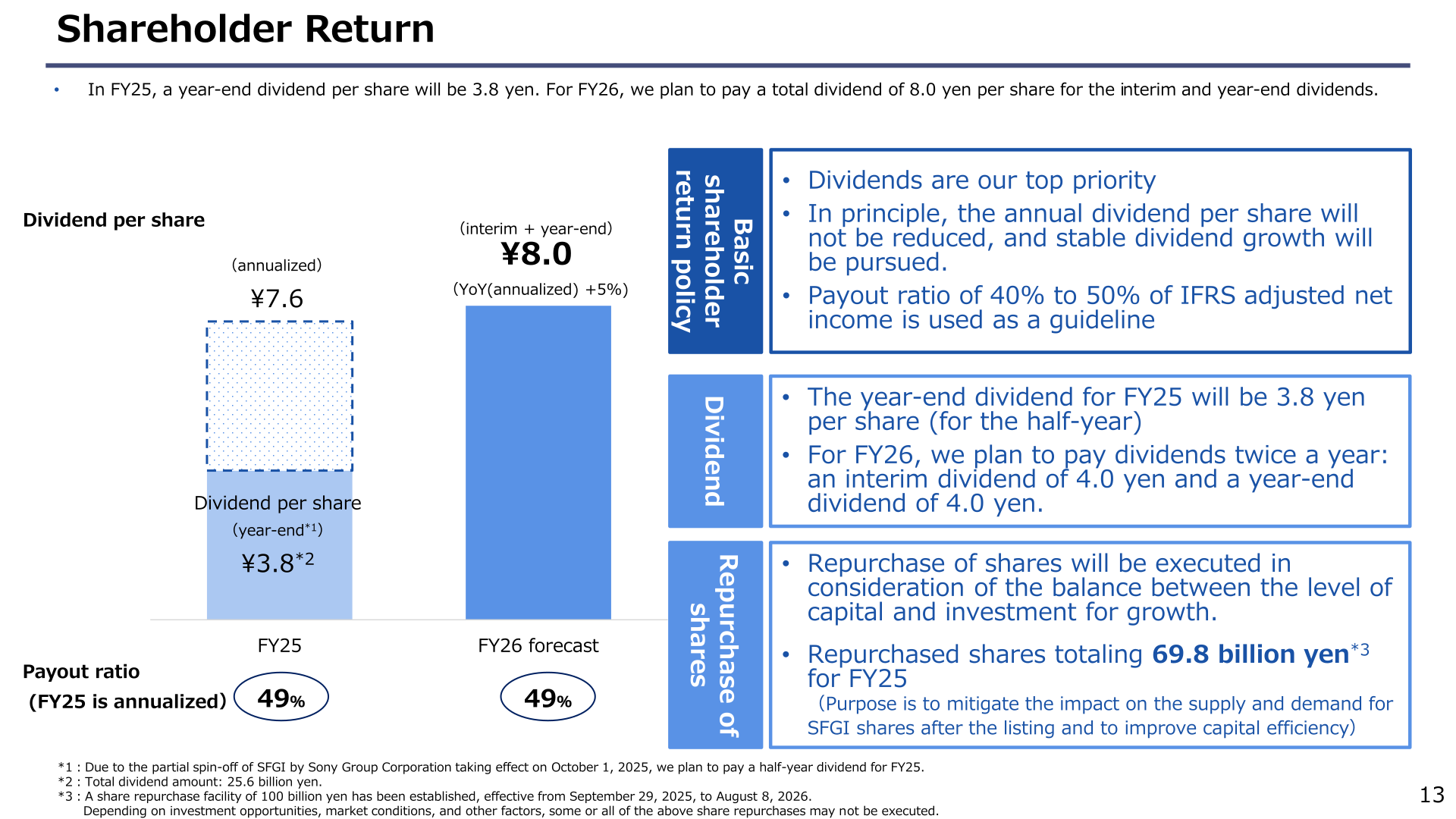
Sony FG states that dividends are its top priority, that in principle the annual dividend per share will not be reduced and stable dividend growth will be pursued, and that a payout ratio of 40% to 50% of IFRS adjusted net income is used as a guideline. For FY25 the year-end dividend per share will be 3.8 yen, a half-year dividend that the company links to Sony Group Corporation’s partial spin-off of SFGI taking effect on October 1, 2025; the total dividend amount is 25.6 billion yen. For FY26 the company plans to pay dividends twice a year, an interim dividend of 4.0 yen and a year-end dividend of 4.0 yen, for a total of 8.0 yen per share, up 5% on an annualized basis. Share repurchases are to be executed in consideration of the balance between the level of capital and investment for growth; repurchased shares totaled 69.8 billion yen for FY25, under a share repurchase facility of 100 billion yen established effective from September 29, 2025 to August 8, 2026, whose stated purpose is to mitigate the impact on the supply and demand for SFGI shares after the listing and to improve capital efficiency. The company notes that, depending on investment opportunities, market conditions and other factors, some or all of the share repurchases may not be executed.
| Item | FY25 | FY26 forecast |
|---|---|---|
| Dividend per share | ¥3.8 (year-end, for the half-year) | ¥8.0 (interim ¥4.0 + year-end ¥4.0) |
| Dividend per share (annualized) | ¥7.6 | — |
| Payout ratio | 49% (annualized) | 49% |
| Total dividend amount | ¥25.6 billion | — |
| Share repurchases | ¥69.8 billion | — |
Medium-Term Targets and Topics
The presentation sets out several forward-looking targets. For group consolidated ESR, the maximum target is 215% and the minimum target is 165%, against the 177% recorded at the end of FY25. In the life insurance sales network, Sony Life had 6,034 Lifeplanner sales specialists at the end of FY25, up 239 from the end of FY24 and above the FY25 target of 5,876, with an FY30 target of 7,000; the number of agency supporters was 318, up 53 from the end of FY24 and above the FY25 target of 294, with an FY30 target of 400. The product and channel mix is shifting: on a new business CSM (pre-tax) basis, capital-light protection-type products accounted for 45.0% in FY25 against 41.6% in FY24, and the ratio of corporate sales has increased.
The materials also cover Sony Life’s response to misconduct by an insurance agent at an exclusive agency, disclosed on January 14. Following an April 24 announcement of initiatives to prevent and detect misconduct early, Sony Life began verification for customers of exclusive agencies on April 28 and received a reporting order pursuant to Article 128 of the Insurance Business Act on April 30. Reports have been received from approximately 30 customers, and at the end of May the company plans to begin verifying customers for whom sales personnel are responsible and to publish a progress report on customer verification. Listed countermeasures include appointing outside directors with compliance expertise to Sony Life, revising employee work rules to explicitly prohibit the exchange of money between customers and employees, establishing Fundamental Principles of Compliance and Risk Management, assigning compliance officers to branch offices and agency locations nationwide, and periodic follow-up calls from headquarters.
This article is an analysis based on publicly available information and is not a recommendation to buy or sell any specific securities. Investment decisions are your own responsibility.
![[Obayashi] Investors’ Guide 2026 — The Complete 24-Article Breakdown](https://japan-equity.com/wp-content/uploads/2026/07/hub_cover-1024x1024.png)
![[Obayashi] IR & SR Policy — Feeding Dialogue Back into Management](https://japan-equity.com/wp-content/uploads/2026/07/p32_sq-1024x1024.jpg)
![[Obayashi] Real Estate Development — 18.7% Margin, ¥287.7bn Unrealized Gains](https://japan-equity.com/wp-content/uploads/2026/07/p20_sq-1024x1024.jpg)
![[Obayashi] Domestic Civil Engineering — Resilience Spending Supports 9.6% Margin](https://japan-equity.com/wp-content/uploads/2026/07/p11_sq-1024x1024.jpg)
![[Obayashi] Share Price & External Ratings — vs TOPIX, ESG Index Inclusion](https://japan-equity.com/wp-content/uploads/2026/07/p40_sq-1024x1024.jpg)
![[Construction] ¥75.5tn Investment, Shrinking Workforce — Big-5 Market Share](https://japan-equity.com/wp-content/uploads/2026/07/p12_sq-1024x1024.jpg)
![[Obayashi] Capital Policy & Shareholder Returns — ROE 10%+, DOE ~5%, ¥100bn Buyback](https://japan-equity.com/wp-content/uploads/2026/07/p27_sq-1024x1024.jpg)
![[Obayashi] Reducing Cross-Shareholdings — ¥285.2bn Sold in Five Years](https://japan-equity.com/wp-content/uploads/2026/07/p29_sq-1024x1024.jpg)
![[Obayashi] ¥750bn Investment Plan — ¥300bn to Development, ¥190bn to Tech/DX](https://japan-equity.com/wp-content/uploads/2026/07/p30_sq-1024x1024.jpg)
![[Obayashi] MTP2022 KPIs — Operating Profit ~2x Target, ROE 14.4%](https://japan-equity.com/wp-content/uploads/2026/07/p25_sq-1024x1024.jpg)
![[Obayashi] Cash Allocation — ¥420bn Investment CF Over Five Years](https://japan-equity.com/wp-content/uploads/2026/07/p26_sq-1024x1024.jpg)
![[Obayashi] Green Energy — 44 Plants, 344MW, and the Green Hydrogen Challenge](https://japan-equity.com/wp-content/uploads/2026/07/p21_sq-1024x1024.jpg)
![[Obayashi] Tackling the Labor Shortage — Robotics Construction®](https://japan-equity.com/wp-content/uploads/2026/07/p14_sq-1024x1024.jpg)
