
This article is based on publicly available IR materials and is not a recommendation to buy or sell any specific securities.
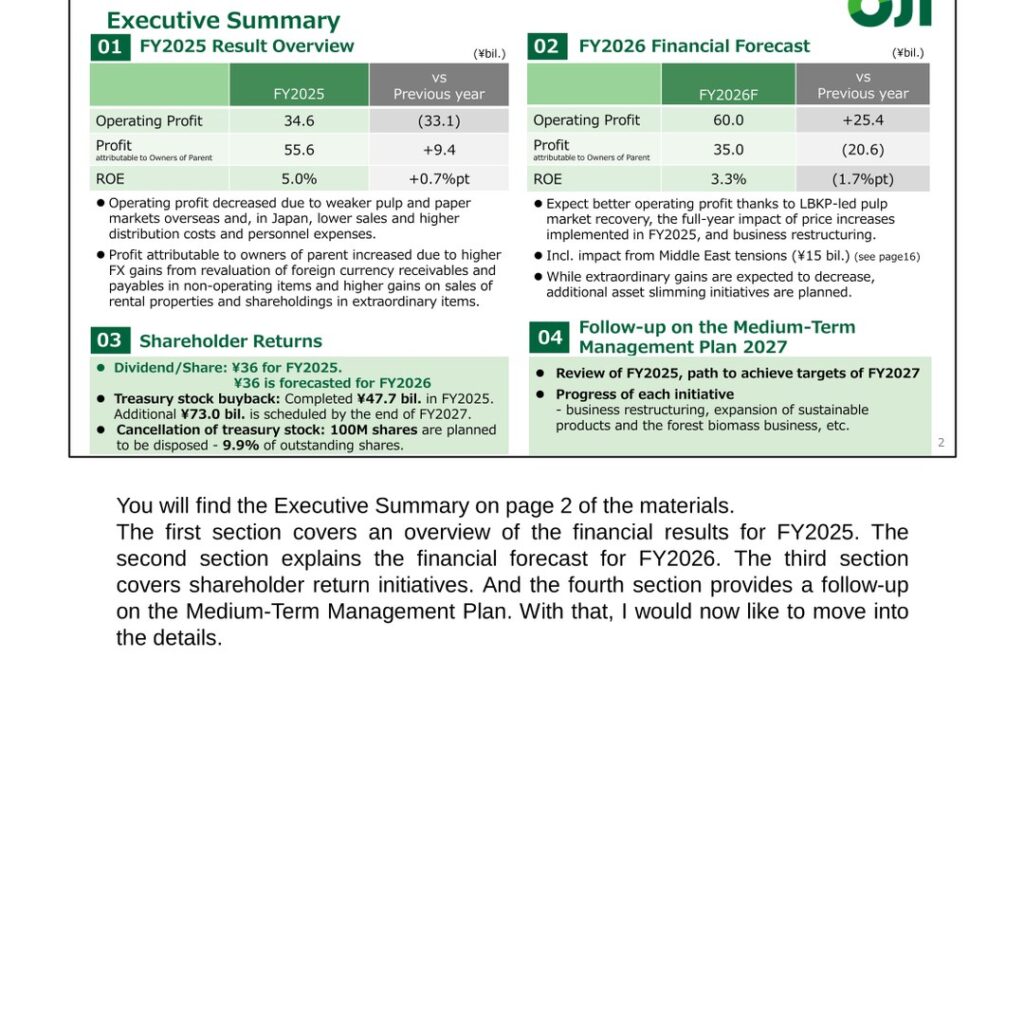
In FY2025 (fiscal year ended March 2026), Oji Holdings’ operating profit decreased to ¥34.6 billion (down ¥33.1 billion year on year), as weaker pulp and paper markets overseas and, in Japan, lower sales combined with higher distribution and personnel expenses weighed on results. Profit attributable to owners of parent rose to ¥55.6 billion (+¥9.4 billion), supported by higher foreign exchange gains from revaluation of foreign currency receivables and payables and higher gains on sales of rental properties and shareholdings. ROE was 5.0% (+0.7%pt). For FY2026, the company forecasts operating profit of ¥60.0 billion (+¥25.4 billion), including a ¥15.0 billion negative impact from Middle East tensions, while profit attributable to owners of parent is forecast to decline to ¥35.0 billion (-¥20.6 billion) as extraordinary gains are expected to be lower.
Consolidated Results (FY2025 Actual)
Net sales for FY2025 were ¥1,861.7 billion (+¥12.4 billion year on year). Operating profit was ¥34.6 billion (down ¥33.1 billion), consisting of ¥39.9 billion from domestic companies (down ¥7.7 billion) and a loss of ¥5.3 billion from overseas companies (down ¥25.4 billion, versus a profit of ¥20.1 billion in FY2024). Domestically, sales price increases added ¥13.0 billion to profit, more than offset by lower sales volume (-¥9.0 billion) and higher other costs, including personnel expenses and distribution costs (-¥7.5 billion) and HQ expenses (-¥3.5 billion), for total other costs of -¥12.2 billion. Overseas, sales prices reduced profit by ¥41.0 billion, mainly on lower pulp prices (-¥34.0 billion) and lower paper prices (-¥7.0 billion), only partly offset by lower raw materials and fuel costs (+¥3.5 billion, including an FX benefit) and other cost improvements (+¥11.1 billion). Ordinary profit was ¥40.5 billion (down ¥28.0 billion), and ROE was 5.0% (+0.7%pt year on year).
| Item | FY2024 | FY2025 | Change |
|---|---|---|---|
| Net Sales (¥bil) | 1,849.3 | 1,861.7 | 12.4 |
| Operating Profit (¥bil) | 67.7 | 34.6 | (33.1) |
| — Domestic Companies (¥bil) | 47.6 | 39.9 | (7.7) |
| — Overseas Companies (¥bil) | 20.1 | (5.3) | (25.4) |
| Ordinary Profit (¥bil) | 68.6 | 40.5 | (28.0) |
| Profit Attributable to Owners of Parent (¥bil) | 46.2 | 55.6 | 9.4 |
| ROE | 4.3% | 5.0% | 0.7%pt |
| Depreciation (¥bil) | 89.2 | 92.8 | 3.6 |
| Average Exchange Rate (¥/US$) | 152.6 | 150.7 | (1.9) |
Segment Results
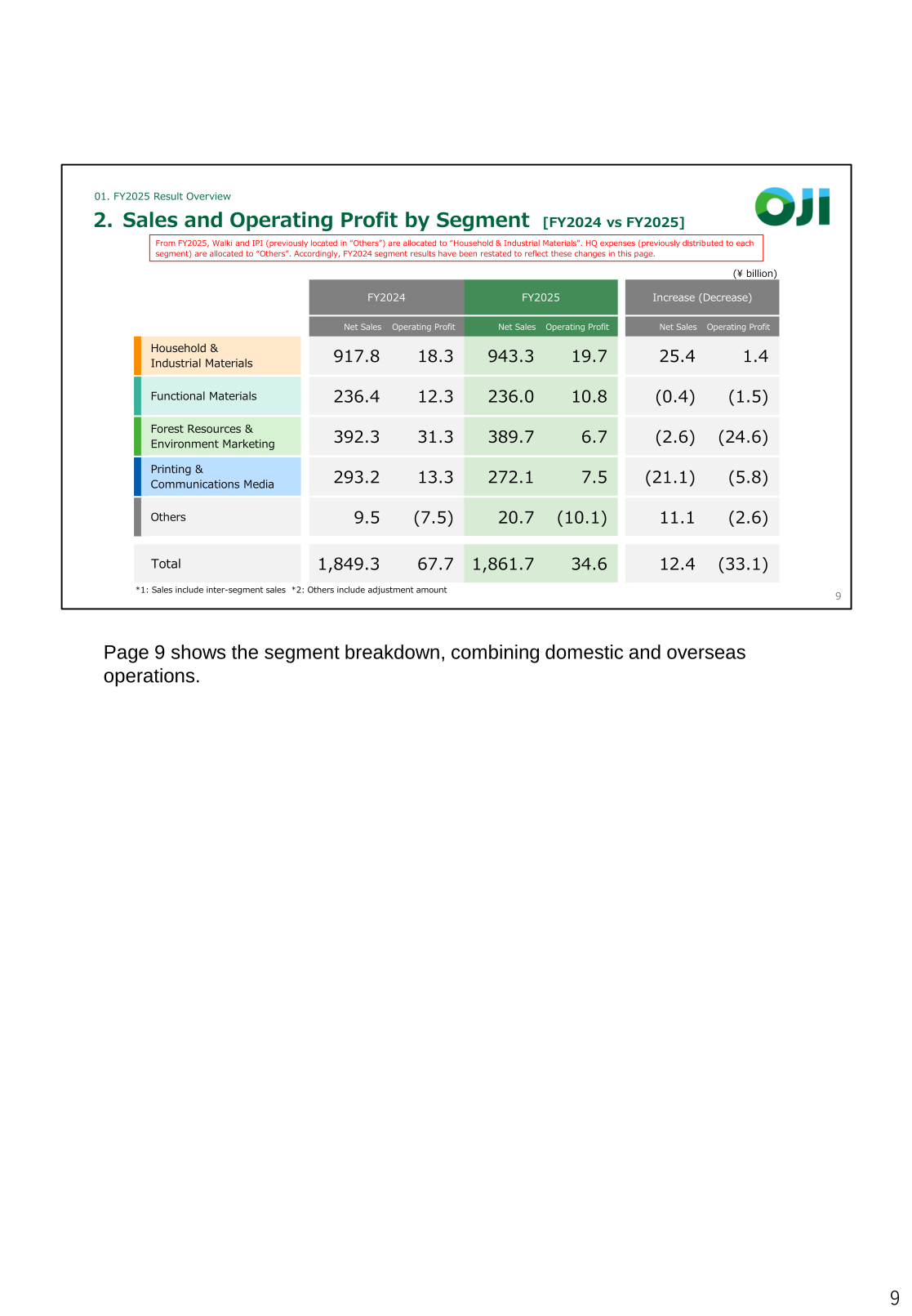
Note: From FY2025, Walki and IPI (previously in ‘Others’) are allocated to Household and Industrial Materials, and HQ expenses (previously distributed to each segment) are allocated to Others; FY2024 segment results have been restated accordingly. Household and Industrial Materials operating profit rose to ¥19.7 billion (+¥1.4 billion), with domestic profit up ¥0.6 billion on price revisions despite higher costs, and overseas profit up ¥0.8 billion aided by business restructuring effects including the withdrawal from the paperboard business at Oji Fibre Solutions. Functional Materials operating profit fell to ¥10.8 billion (-¥1.5 billion): domestic profit rose ¥1.7 billion on price increases centered on Oji F-Tex, while overseas profit fell ¥3.2 billion, driven by lower price and volume at Oji Papéis (Brazil thermal paper) amid competition from low-priced imports and U.S. tariffs that forced a temporary suspension of exports to North America. Forest Resources and Environment Marketing operating profit fell sharply to ¥6.7 billion (-¥24.6 billion), mainly on overseas sales and market factors (-¥27.5 billion) as pulp prices declined — the net price of LBKP for the China market fell from 625 USD/t in 2024 to 540 USD/t in 2025 on a calendar-year basis — partly offset by lower costs (+¥4.7 billion), including at CENIBRA in Brazil. Printing and Communications Media operating profit fell to ¥7.5 billion (-¥5.8 billion): domestic profit fell ¥7.8 billion on lower sales volume and higher raw materials and fuel costs, while overseas profit rose ¥2.0 billion on lower raw materials and fuel costs.
| Segment | Net Sales FY2024 (¥bil) | Net Sales FY2025 (¥bil) | Change | Operating Profit FY2024 (¥bil) | Operating Profit FY2025 (¥bil) | Change |
|---|---|---|---|---|---|---|
| Household and Industrial Materials | 917.8 | 943.3 | 25.4 | 18.3 | 19.7 | 1.4 |
| Functional Materials | 236.4 | 236.0 | (0.4) | 12.3 | 10.8 | (1.5) |
| Forest Resources and Environment Marketing | 392.3 | 389.7 | (2.6) | 31.3 | 6.7 | (24.6) |
| Printing and Communications Media | 293.2 | 272.1 | (21.1) | 13.3 | 7.5 | (5.8) |
| Others | 9.5 | 20.7 | 11.1 | (7.5) | (10.1) | (2.6) |
| Total | 1,849.3 | 1,861.7 | 12.4 | 67.7 | 34.6 | (33.1) |
FY2026 Forecast
For FY2026, Oji Holdings forecasts net sales of ¥1,940.0 billion (+¥78.3 billion) and operating profit of ¥60.0 billion (+¥25.4 billion), including a negative impact of ¥15.0 billion from Middle East tensions (excluding this impact, operating profit would be approximately ¥75.0 billion). Ordinary profit is forecast at ¥45.0 billion (+¥4.5 billion), a narrower increase than operating profit due to lower foreign exchange gains and higher financial expenses from higher interest rates and increased borrowings. Profit attributable to owners of parent is forecast at ¥35.0 billion (-¥20.6 billion), as gains on asset and securities sales, while continuing, are expected to be lower than in FY2025. ROE is forecast at 3.3% (-1.7%pt). Domestic operating profit is forecast at ¥48.0 billion (+¥8.1 billion, including a ¥6.0 billion negative impact from Middle East tensions), driven by sales price increases (+¥45.5 billion, mainly ¥43.5 billion from paper), partly offset by higher raw materials and fuel costs (-¥19.0 billion) and higher other costs (-¥11.9 billion). Overseas operating profit is forecast at ¥12.0 billion (+¥17.3 billion, including a ¥9.0 billion negative impact from Middle East tensions), a turnaround from an overseas loss of ¥5.3 billion in FY2025, driven by higher sales prices (+¥20.0 billion, mainly from higher pulp prices) and higher sales volume (+¥4.5 billion). Forecast assumptions include an exchange rate of ¥155/USD, an Australia coal price of USD141/t, and a Dubai crude oil price of USD76/bbl (annual average, reflecting the Middle East tensions impact).
| Item | FY2025 (Actual) | FY2026F | Change |
|---|---|---|---|
| Net Sales (¥bil) | 1,861.7 | 1,940.0 | 78.3 |
| Operating Profit (¥bil) | 34.6 | 60.0 | 25.4 |
| — Domestic Companies (¥bil) | 39.9 | 48.0 | 8.1 |
| — Overseas Companies (¥bil) | (5.3) | 12.0 | 17.3 |
| Ordinary Profit (¥bil) | 40.5 | 45.0 | 4.5 |
| Profit Attributable to Owners of Parent (¥bil) | 55.6 | 35.0 | (20.6) |
| ROE | 5.0% | 3.3% | (1.7%pt) |
| Depreciation (¥bil) | 92.8 | 89.1 | (3.7) |
| Average Exchange Rate (¥/US$) | 150.7 | 155.0 | 4.3 |
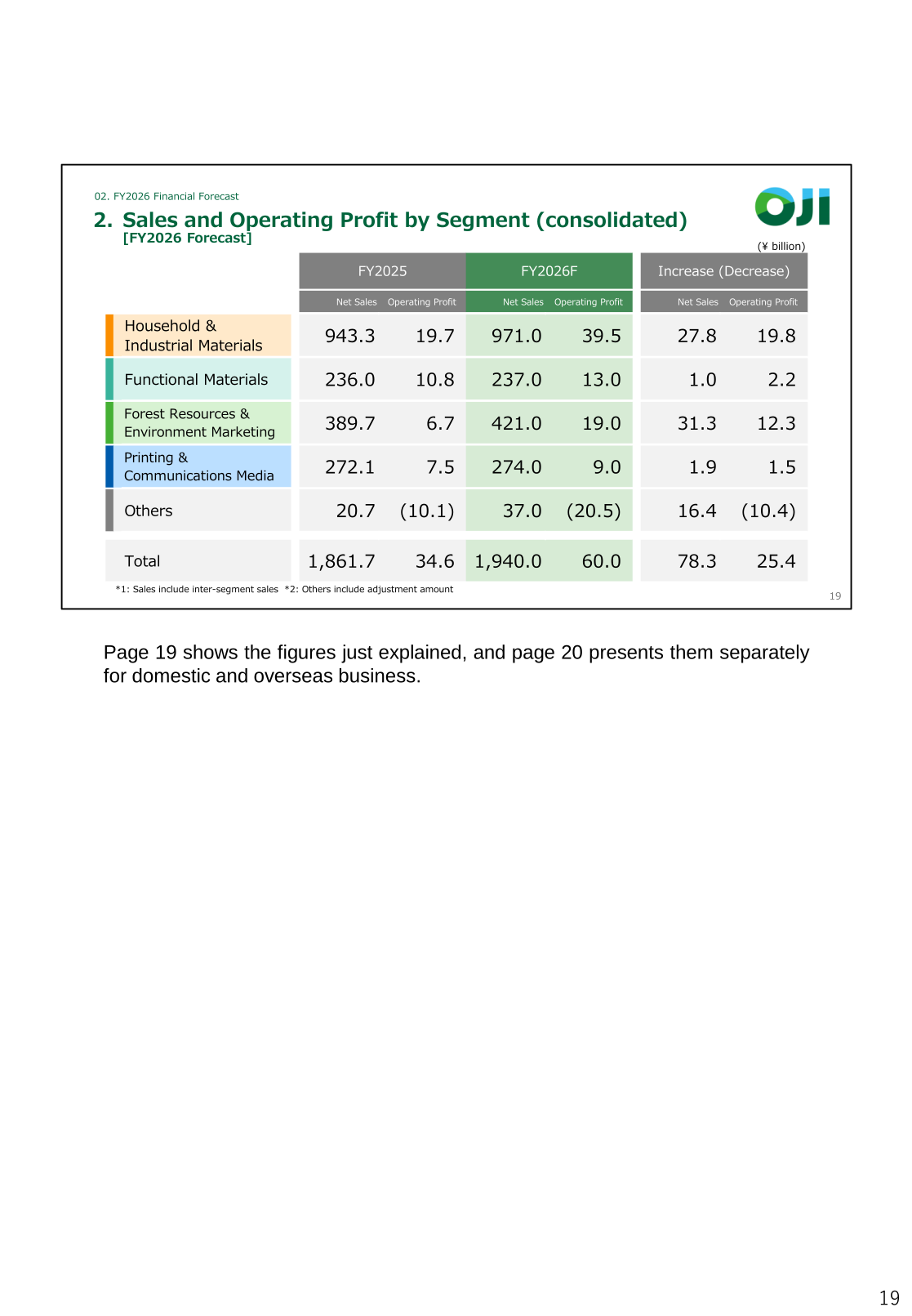
By segment, Household & Industrial Materials operating profit is forecast to rise to ¥39.5 billion (+¥19.8 billion), Functional Materials to ¥13.0 billion (+¥2.2 billion), Forest Resources & Environment Marketing to ¥19.0 billion (+¥12.3 billion, with the China-market LBKP net price assumption rising from 540 USD/t in FY2025 to 615 USD/t in FY2026F), and Printing & Communications Media to ¥9.0 billion (+¥1.5 billion).
| Segment | Net Sales FY2025 (¥bil) | Net Sales FY2026F (¥bil) | Change | Operating Profit FY2025 (¥bil) | Operating Profit FY2026F (¥bil) | Change |
|---|---|---|---|---|---|---|
| Household & Industrial Materials | 943.3 | 971.0 | 27.8 | 19.7 | 39.5 | 19.8 |
| Functional Materials | 236.0 | 237.0 | 1.0 | 10.8 | 13.0 | 2.2 |
| Forest Resources & Environment Marketing | 389.7 | 421.0 | 31.3 | 6.7 | 19.0 | 12.3 |
| Printing & Communications Media | 272.1 | 274.0 | 1.9 | 7.5 | 9.0 | 1.5 |
| Others | 20.7 | 37.0 | 16.4 | (10.1) | (20.5) | (10.4) |
| Total | 1,861.7 | 1,940.0 | 78.3 | 34.6 | 60.0 | 25.4 |
Shareholder Returns
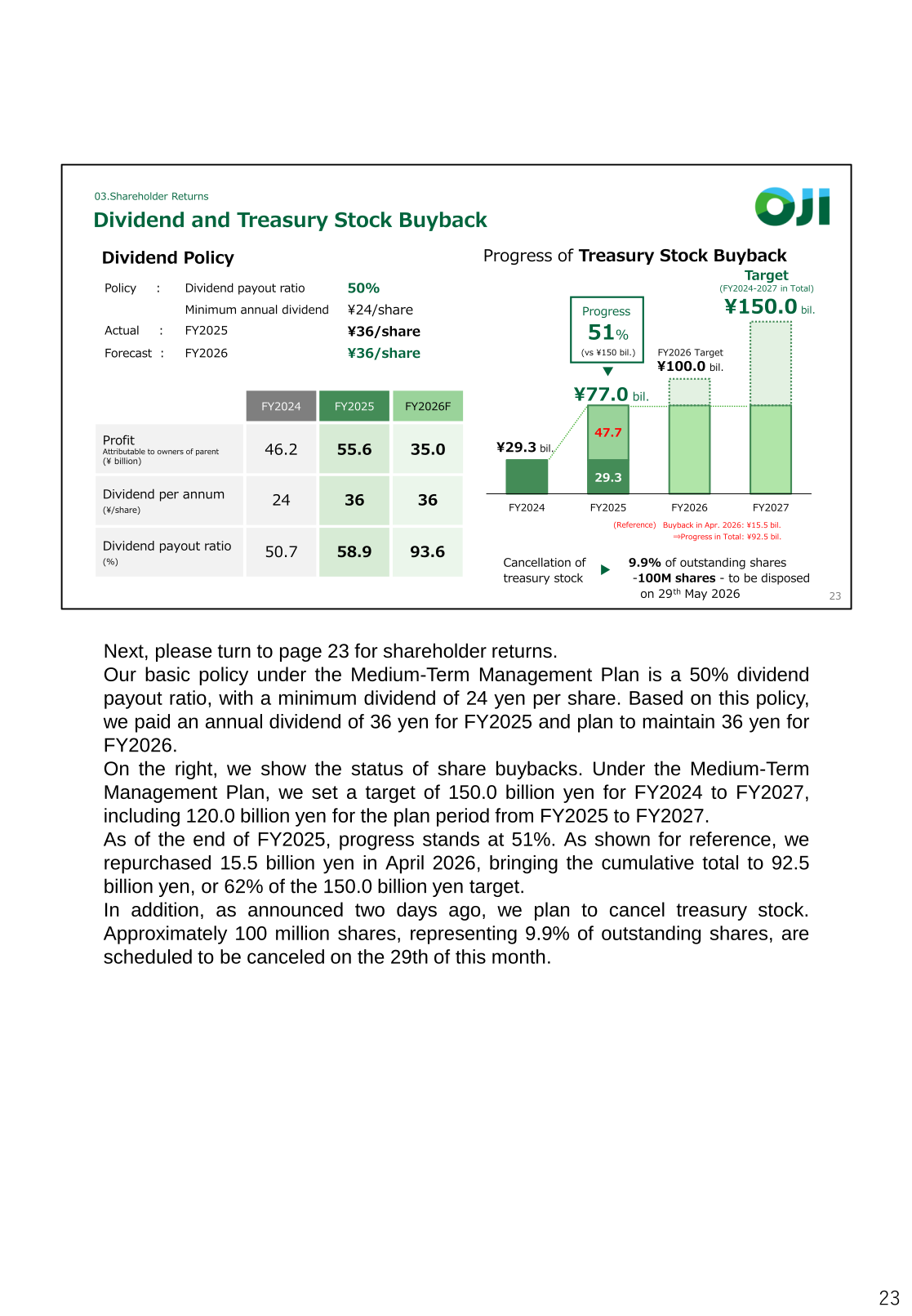
Oji Holdings’ basic capital policy under the Medium-Term Management Plan is a dividend payout ratio of 50%, with a minimum annual dividend of ¥24 per share. The annual dividend was ¥36 per share for FY2025 (payout ratio 58.9%), up from ¥24 per share for FY2024 (payout ratio 50.7%), and is forecast at ¥36 per share for FY2026 (payout ratio 93.6%, reflecting the lower forecast profit). Under the Medium-Term Management Plan, the company set a treasury stock buyback target of ¥150.0 billion for FY2024–FY2027 (including ¥120.0 billion for FY2025–FY2027); it completed ¥47.7 billion of buybacks in FY2025, with an additional ¥73.0 billion scheduled by the end of FY2027 per the executive summary. As of the end of FY2025, progress against the ¥150.0 billion target stood at 51%; following a further ¥15.5 billion repurchase in April 2026, the cumulative total reached ¥92.5 billion, or 62% of the target. The company also plans to cancel treasury stock: approximately 100 million shares, representing 9.9% of outstanding shares, are scheduled to be canceled on May 29, 2026.
Medium-Term Plan / Topics
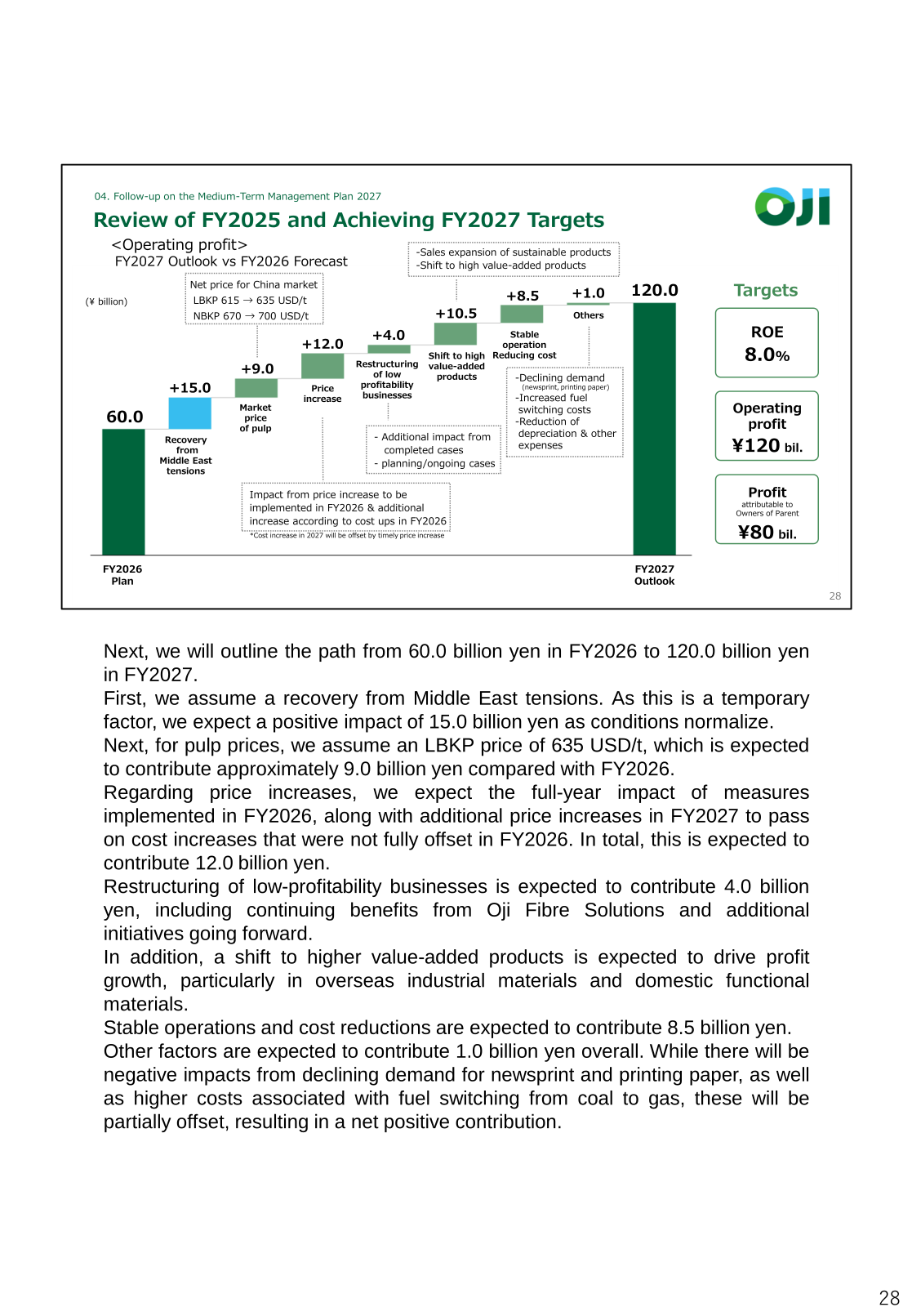
Under the Medium-Term Management Plan 2027, Oji Holdings targets FY2027 operating profit of ¥120.0 billion, ROE of 8.0%, and profit attributable to owners of parent of ¥80 billion. The path from the FY2026 forecast of ¥60.0 billion in operating profit to the FY2027 target of ¥120.0 billion includes a recovery from Middle East tensions (+¥15.0 billion), higher pulp prices assuming an LBKP net price for the China market of 635 USD/t (+¥9.0 billion, up from a 615 USD/t assumption for FY2026), price increases (+¥12.0 billion), restructuring of low-profitability businesses (+¥4.0 billion), a shift to high value-added products, stable operation and cost reductions (+¥8.5 billion), and other factors (+¥1.0 billion). Business restructuring completed or planned in Oceania and Japan — including closure of the Fujinomiya, Edogawa and Tomakomai plants (Oji Nepia), shutdown of N-4 at the Tomakomai Mill of Oji Paper, and divestment or closure of NZ and Australia packaging and NZ containerboard/recycling businesses — is expected to generate an annual impact of over ¥10 billion. The company is also making the forest biomass business a core pillar, including the AustroCel acquisition (Austria; dissolving pulp and bioethanol) and joint development of a biomass EUV resist with imec targeting sales of ¥10 billion per year in the 2030s, alongside portfolio transformation (including pressboard capacity expansion at Oji F-Tex’s Nakatsu mill) and expansion of sustainable products such as Walki’s paper-based packaging solutions in Europe.
This article is an analysis based on publicly available information and is not a recommendation to buy or sell any specific securities. Investment decisions are your own responsibility.
![[Obayashi] Investors’ Guide 2026 — The Complete 24-Article Breakdown](https://japan-equity.com/wp-content/uploads/2026/07/hub_cover-1024x1024.png)
![[Obayashi] IR & SR Policy — Feeding Dialogue Back into Management](https://japan-equity.com/wp-content/uploads/2026/07/p32_sq-1024x1024.jpg)
![[Obayashi] Real Estate Development — 18.7% Margin, ¥287.7bn Unrealized Gains](https://japan-equity.com/wp-content/uploads/2026/07/p20_sq-1024x1024.jpg)
![[Obayashi] Domestic Civil Engineering — Resilience Spending Supports 9.6% Margin](https://japan-equity.com/wp-content/uploads/2026/07/p11_sq-1024x1024.jpg)
![[Obayashi] Share Price & External Ratings — vs TOPIX, ESG Index Inclusion](https://japan-equity.com/wp-content/uploads/2026/07/p40_sq-1024x1024.jpg)
![[Construction] ¥75.5tn Investment, Shrinking Workforce — Big-5 Market Share](https://japan-equity.com/wp-content/uploads/2026/07/p12_sq-1024x1024.jpg)
![[Obayashi] Capital Policy & Shareholder Returns — ROE 10%+, DOE ~5%, ¥100bn Buyback](https://japan-equity.com/wp-content/uploads/2026/07/p27_sq-1024x1024.jpg)
![[Obayashi] Reducing Cross-Shareholdings — ¥285.2bn Sold in Five Years](https://japan-equity.com/wp-content/uploads/2026/07/p29_sq-1024x1024.jpg)
![[Obayashi] ¥750bn Investment Plan — ¥300bn to Development, ¥190bn to Tech/DX](https://japan-equity.com/wp-content/uploads/2026/07/p30_sq-1024x1024.jpg)
![[Obayashi] MTP2022 KPIs — Operating Profit ~2x Target, ROE 14.4%](https://japan-equity.com/wp-content/uploads/2026/07/p25_sq-1024x1024.jpg)
![[Obayashi] Cash Allocation — ¥420bn Investment CF Over Five Years](https://japan-equity.com/wp-content/uploads/2026/07/p26_sq-1024x1024.jpg)
![[Obayashi] Green Energy — 44 Plants, 344MW, and the Green Hydrogen Challenge](https://japan-equity.com/wp-content/uploads/2026/07/p21_sq-1024x1024.jpg)
![[Obayashi] Tackling the Labor Shortage — Robotics Construction®](https://japan-equity.com/wp-content/uploads/2026/07/p14_sq-1024x1024.jpg)
