
This article is based on publicly available IR materials and is not a recommendation to buy or sell any specific securities.
Note: The company labels the fiscal year covered here as “FY 3/2026” (April 1, 2025 through March 31, 2026); the labels used in the text, tables and segment data below follow the presentation. Note: The presentation was partially corrected on June 9, 2026 (P8 Summary of Consolidated Financial Results Forecast, capital expenditure); the figures used here are those of the corrected version.
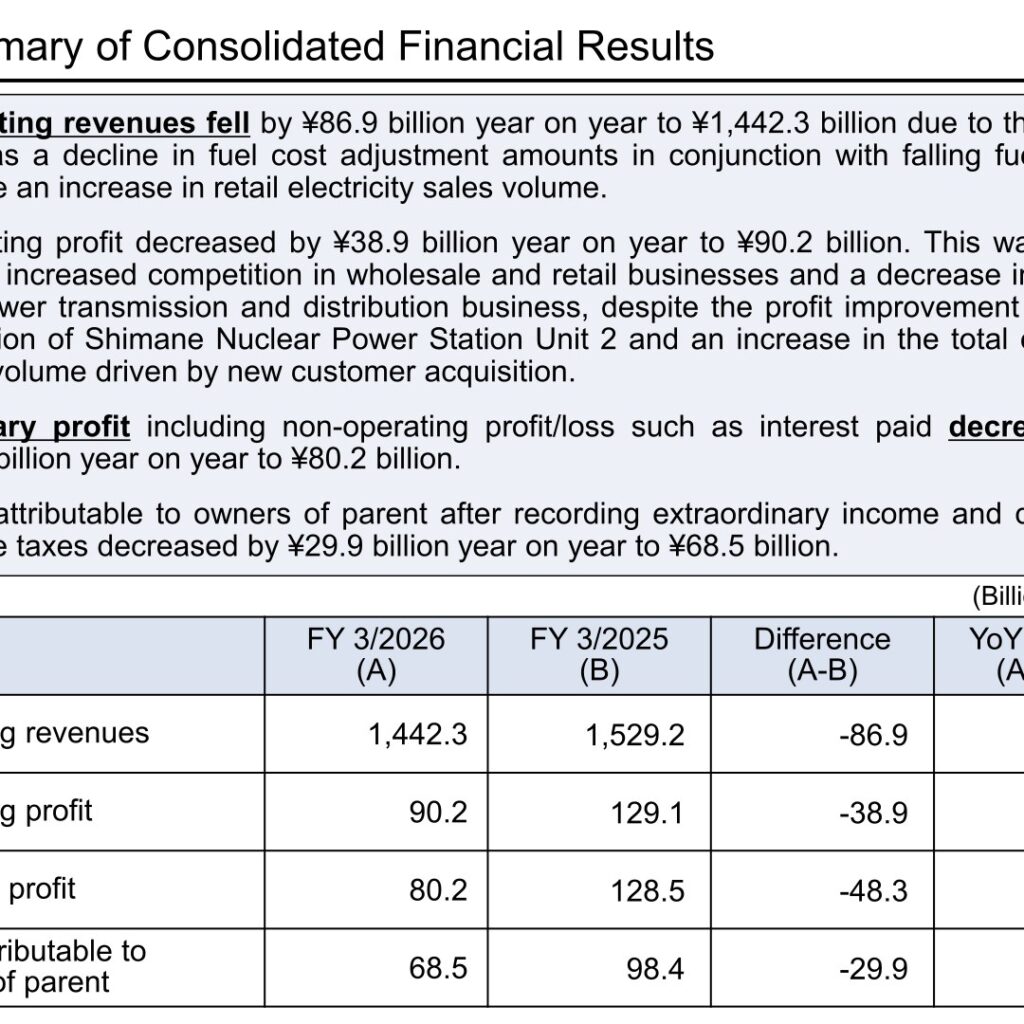
For FY 3/2026, The Chugoku Electric Power Co., Inc. reported operating revenues of ¥1,442.3 billion, down ¥86.9 billion or 5.7% year on year, as fuel cost adjustment amounts declined in conjunction with falling fuel prices despite an increase in retail electricity sales volume. Operating profit decreased by ¥38.9 billion to ¥90.2 billion, ordinary profit decreased by ¥48.3 billion to ¥80.2 billion, and profit attributable to owners of parent decreased by ¥29.9 billion to ¥68.5 billion. Increased competition in the wholesale and retail businesses and a decrease in profit in the power transmission and distribution business outweighed the profit improvement from the operation of Shimane Nuclear Power Station Unit 2 and the increase in total electricity sales volume driven by new customer acquisition.
Consolidated Results (Full-Year Actual)
Ordinary profit including non-operating profit/loss such as interest paid decreased by ¥48.3 billion year on year to ¥80.2 billion. Profit attributable to owners of parent, after recording extraordinary income and deducting income taxes, decreased by ¥29.9 billion to ¥68.5 billion. In the overview of financial results, the company describes FY 3/2026 as a decrease in revenue (-86.9) and a decrease in profit (-48.3) for 2 consecutive years, with increases and decreases in profit based on ordinary profit.
| Item (Billions of yen) | FY 3/2026 (A) | FY 3/2025 (B) | Difference (A-B) | YoY growth (A-B)/B |
|---|---|---|---|---|
| Operating revenues | 1,442.3 | 1,529.2 | -86.9 | -5.7% |
| Operating profit | 90.2 | 129.1 | -38.9 | -30.1% |
| Ordinary profit | 80.2 | 128.5 | -48.3 | -37.6% |
| Profit attributable to owners of parent | 68.5 | 98.4 | -29.9 | -30.4% |
On the consolidated balance sheet, total assets were ¥4,620.5 billion versus ¥4,360.9 billion, net assets were ¥775.2 billion versus ¥705.8 billion, and the shareholders’ equity ratio was 16.8% (19.0% if the hybrid corporate bonds and transition-linked hybrid loans already raised are treated as equity capital) versus 16.2% (18.5%) a year earlier. Cash flows from operating activities were ¥237.2 billion against ¥186.0 billion, cash flows from investing activities were -¥236.2 billion against -¥358.8 billion, and free cash flow was ¥1.0 billion against -¥172.8 billion.
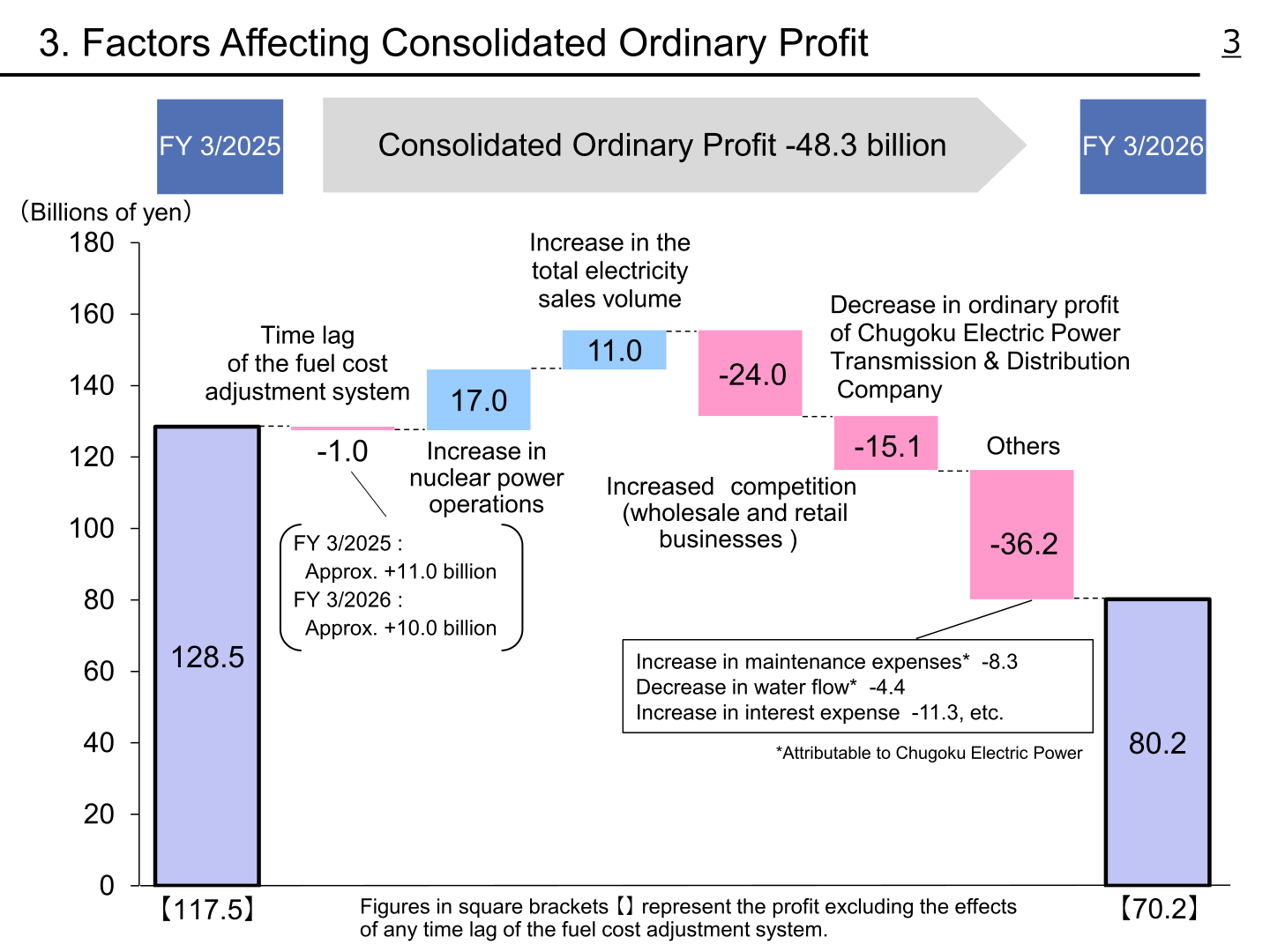
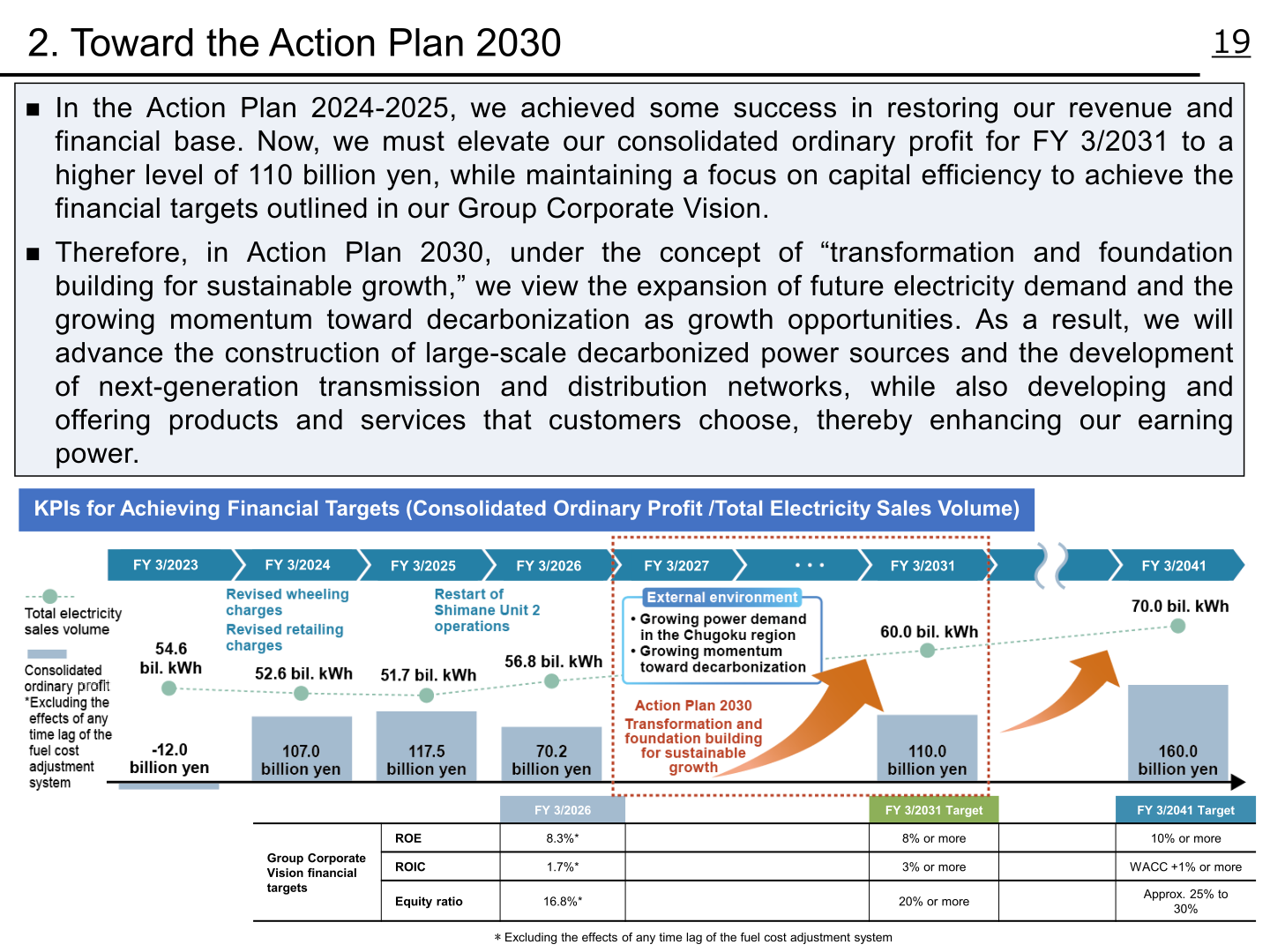
In the breakdown of factors affecting consolidated ordinary profit, the ¥48.3 billion decline comprised the time lag of the fuel cost adjustment system -1.0, an increase in nuclear power operations +17.0, an increase in the total electricity sales volume +11.0, increased competition in the wholesale and retail businesses -24.0, a decrease in ordinary profit of Chugoku Electric Power Transmission & Distribution Company -15.1, and others -36.2 (billions of yen). The time lag of the fuel cost adjustment system was approximately +11.0 billion in FY 3/2025 and approximately +10.0 billion in FY 3/2026; excluding those effects, ordinary profit was 【117.5】 in FY 3/2025 and 【70.2】 in FY 3/2026. Items making up “others” include an increase in maintenance expenses -8.3, a decrease in water flow -4.4 and an increase in interest expense -11.3 (attributable to Chugoku Electric Power).
Electricity Sales Volume and Power Generated and Received
Total electricity sales volume increased by 9.8% year on year to 56.81 billion kWh, with retail electricity sales volume up 8.9% to 45.42 billion kWh and electricity sales volume to other power companies up 13.6% to 11.39 billion kWh. Generated and received electricity increased by 9.7% to 61.08 billion kWh. Nuclear power generation increased to 6.32 billion kWh from 1.98 billion kWh as a result of the operation of Shimane Nuclear Power Station Unit 2, and the nuclear capacity factor rose to 87.9% from 27.6%, while the company’s own thermal power generation decreased to 24.72 billion kWh from 24.95 billion kWh. The water flow rate was 86.5% against 101.1%.
| Item (Billions of kWh) | FY 3/2026 (A) | FY 3/2025 (B) | Difference (A-B) | YoY growth (A-B)/B |
|---|---|---|---|---|
| Total electricity sales volume | 56.81 | 51.75 | 5.06 | 9.8% |
| Retail electricity sales volume: Lighting | 14.91 | 15.53 | -0.62 | -4.0% |
| Retail electricity sales volume: Power | 30.52 | 26.19 | 4.33 | 16.5% |
| Retail electricity sales volume: Subtotal | 45.42 | 41.72 | 3.70 | 8.9% |
| Electricity sales volume to other power companies | 11.39 | 10.02 | 1.36 | 13.6% |
Key factors for the year were an exchange rate of 151 ¥/$ (153 in FY 3/2025), an all Japan CIF crude oil price of 71.4 $/b (82.4), an all Japan CIF imported coal price of 121.0 $/t (151.0) and a nuclear capacity factor of 87.9% (27.6). Crude oil and imported coal CIF prices are preliminary figures for FY 3/2026.
Segment Results
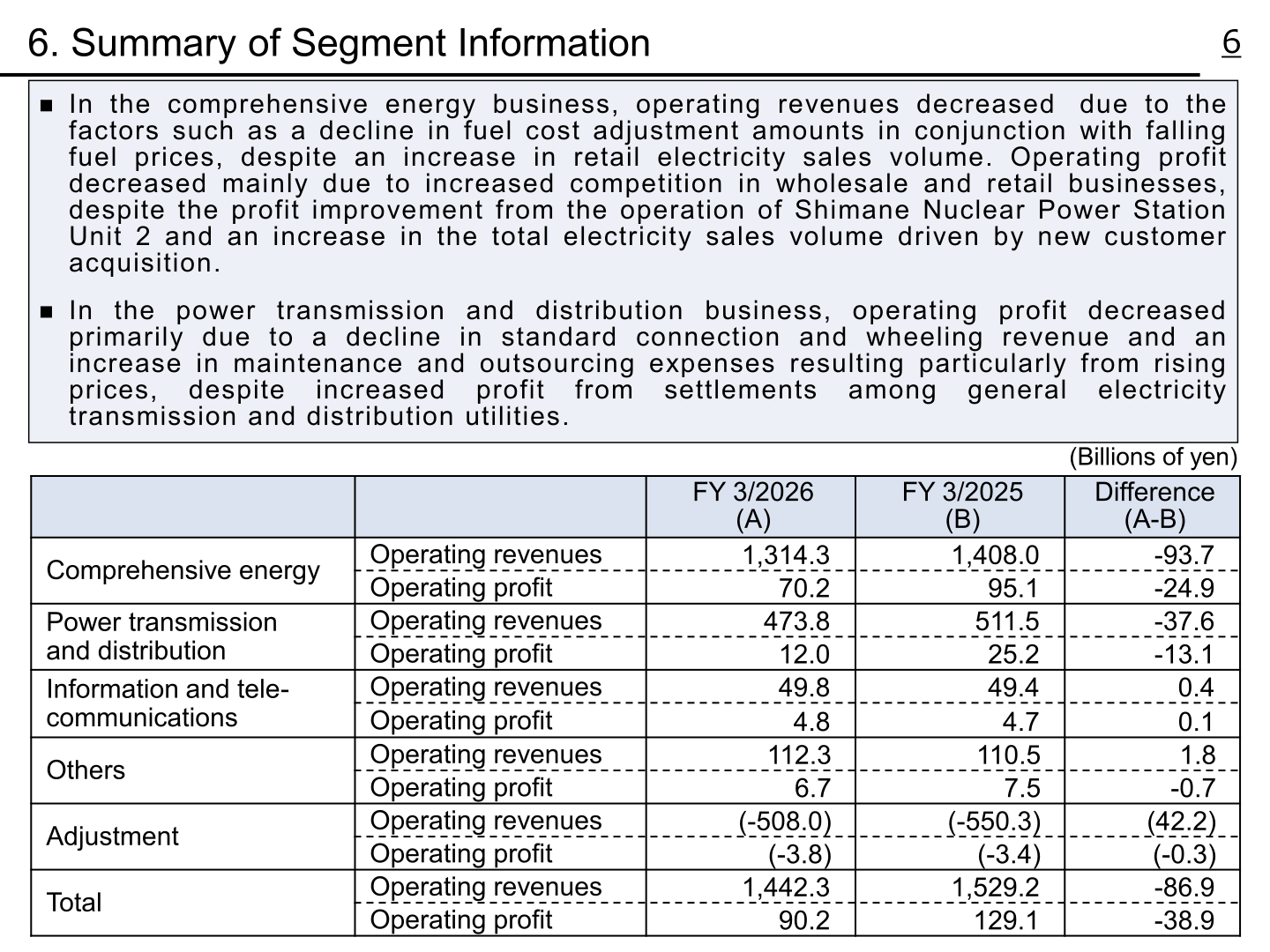
In the comprehensive energy business, operating revenues decreased due to factors such as a decline in fuel cost adjustment amounts in conjunction with falling fuel prices, despite an increase in retail electricity sales volume, and operating profit decreased mainly due to increased competition in wholesale and retail businesses despite the profit improvement from the operation of Shimane Nuclear Power Station Unit 2. In the power transmission and distribution business, operating profit decreased primarily due to a decline in standard connection and wheeling revenue and an increase in maintenance and outsourcing expenses resulting particularly from rising prices, despite increased profit from settlements among general electricity transmission and distribution utilities.
| Segment | Metric (Billions of yen) | FY 3/2026 (A) | FY 3/2025 (B) | Difference (A-B) |
|---|---|---|---|---|
| Comprehensive energy | Operating revenues | 1,314.3 | 1,408.0 | -93.7 |
| Comprehensive energy | Operating profit | 70.2 | 95.1 | -24.9 |
| Power transmission and distribution | Operating revenues | 473.8 | 511.5 | -37.6 |
| Power transmission and distribution | Operating profit | 12.0 | 25.2 | -13.1 |
| Information and tele-communications | Operating revenues | 49.8 | 49.4 | 0.4 |
| Information and tele-communications | Operating profit | 4.8 | 4.7 | 0.1 |
| Others | Operating revenues | 112.3 | 110.5 | 1.8 |
| Others | Operating profit | 6.7 | 7.5 | -0.7 |
| Adjustment | Operating revenues | (-508.0) | (-550.3) | (42.2) |
| Adjustment | Operating profit | (-3.8) | (-3.4) | (-0.3) |
| Total | Operating revenues | 1,442.3 | 1,529.2 | -86.9 |
| Total | Operating profit | 90.2 | 129.1 | -38.9 |
FY 3/2027 Forecast
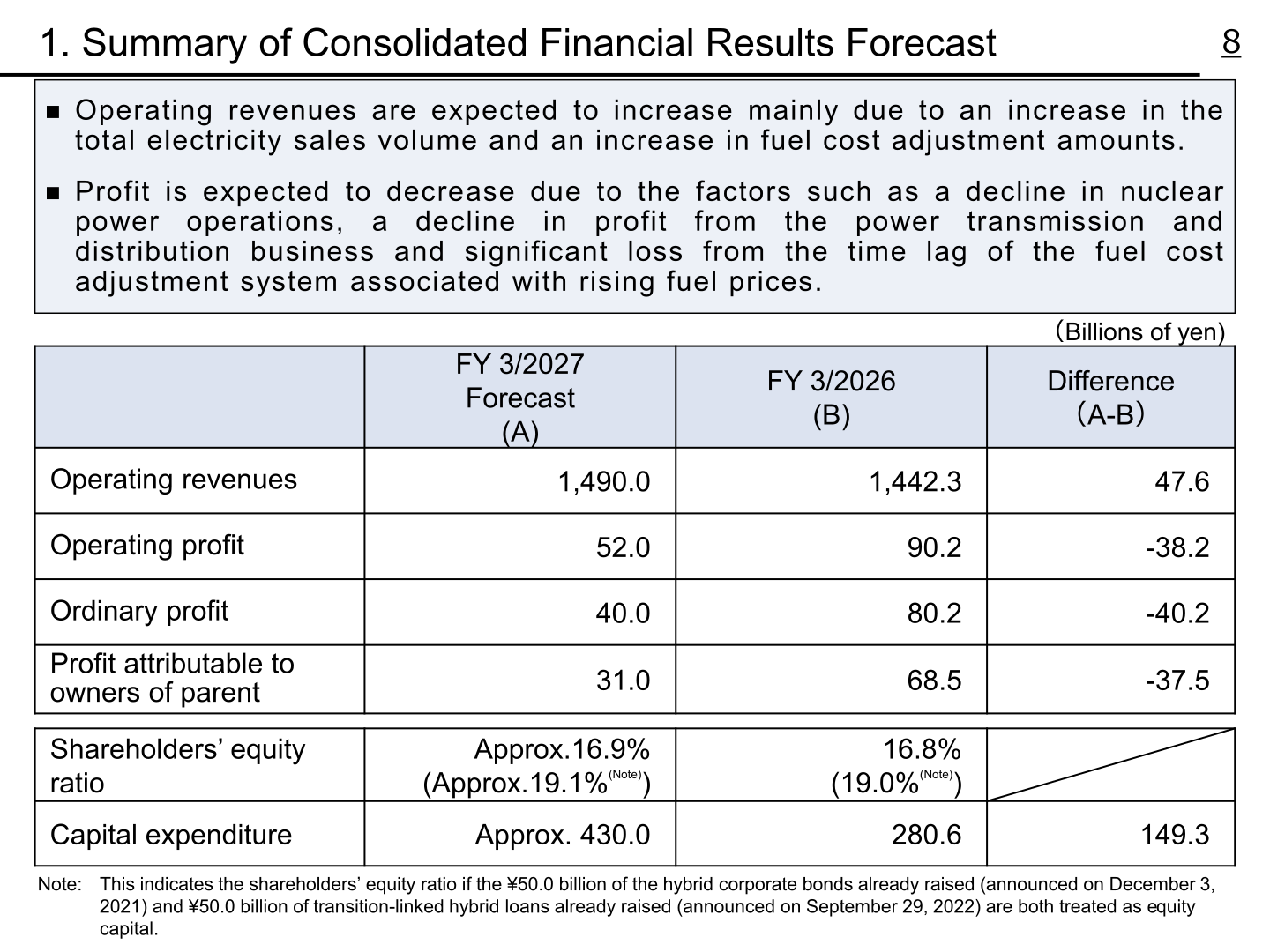
For FY 3/2027, operating revenues are expected to increase mainly due to an increase in the total electricity sales volume and an increase in fuel cost adjustment amounts, while profit is expected to decrease due to factors such as a decline in nuclear power operations, a decline in profit from the power transmission and distribution business, and significant loss from the time lag of the fuel cost adjustment system associated with rising fuel prices. The time lag of the fuel cost adjustment system is assumed at approximately +10.0 billion for FY 3/2026 and approximately -26.0 billion for FY 3/2027, and the nuclear capacity factor assumption moves from 88% to 64%. Assumptions for the forecast include total electricity sales volume of 60.4 billion kWh, an exchange rate of 160 ¥/$ and an all Japan CIF crude oil price of 100 $/b.
| Item (Billions of yen) | FY 3/2027 Forecast (A) | FY 3/2026 (B) | Difference (A-B) |
|---|---|---|---|
| Operating revenues | 1,490.0 | 1,442.3 | 47.6 |
| Operating profit | 52.0 | 90.2 | -38.2 |
| Ordinary profit | 40.0 | 80.2 | -40.2 |
| Profit attributable to owners of parent | 31.0 | 68.5 | -37.5 |
| Shareholders’ equity ratio | Approx.16.9% (Approx.19.1%) | 16.8% (19.0%) | — |
| Capital expenditure | Approx. 430.0 | 280.6 | 149.3 |
By segment, comprehensive energy is forecast to post operating revenues of approximately 1,414.0 and operating profit of approximately 44.0, and the power transmission and distribution business operating revenues of approximately 417.0 and operating profit of approximately 9.0 (billions of yen). The company notes that it has revised the segment classification of some subsidiaries previously included in the others segment and reclassified them into the comprehensive energy business or the power transmission and distribution business effective from FY 3/2027. On capital efficiency, ROIC excluding the effects of any time lag of the fuel cost adjustment system is expected to fall to approximately 1.5% from 1.7%, and ROE on the same basis to approximately 6.4% from 8.3%, against a WACC of 1.2% and a cost of shareholder’s equity of 6.0%.
Regarding its stance on the forecast, the company states that the business environment is uncertain due to the situation in the Middle East, with risks including a wider range of fluctuations in fuel prices, a deterioration in the future procurement environment for fuel and materials, and changes in electricity demand driven by production trends in Japan’s manufacturing industry. The forecast assumes that currently elevated fuel prices will remain high throughout the fiscal year.
Shareholder Returns
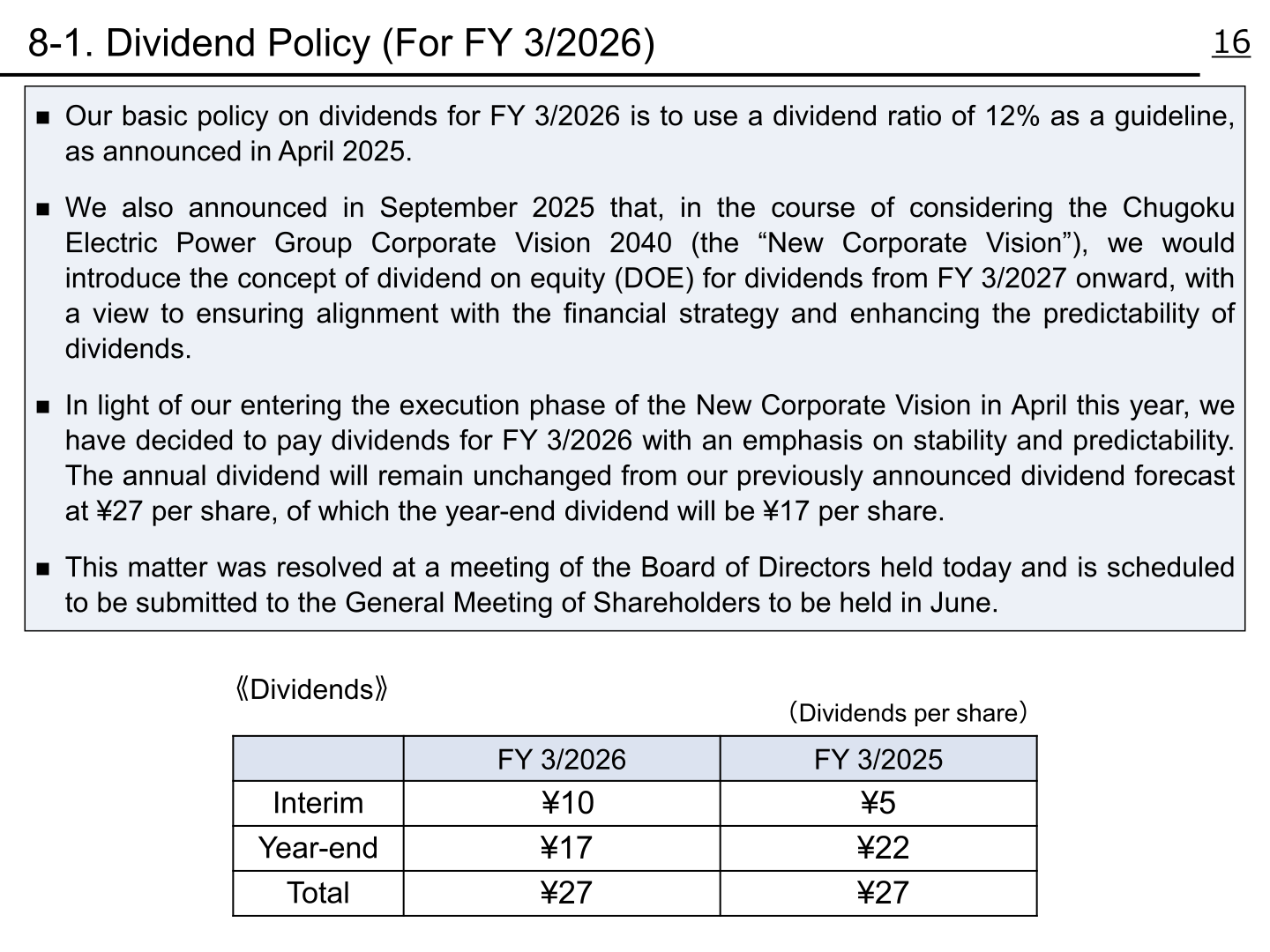
The basic policy on dividends for FY 3/2026 was to use a dividend ratio of 12% as a guideline, as announced in April 2025. In light of entering the execution phase of the Chugoku Electric Power Group Corporate Vision 2040 in April 2026, the company decided to pay dividends for FY 3/2026 with an emphasis on stability and predictability: the annual dividend remains unchanged from the previously announced forecast at ¥27 per share, of which the year-end dividend is ¥17 per share. From FY 3/2027 the company introduces the concept of dividend on equity (DOE) in deciding dividends, and until the start of commercial operation at Shimane Nuclear Power Station Unit 3 it will determine dividends by comprehensively considering the progress in rebuilding its financial base while aiming for a DOE of 2%. The annual dividend forecast for FY 3/2027 is ¥30 per share (interim ¥15 and year-end ¥15), which corresponds to a DOE of approximately 1.5%.
| Dividends per share | FY 3/2026 | FY 3/2025 | FY 3/2027 (Forecast) |
|---|---|---|---|
| Interim | ¥10 | ¥5 | ¥15 (Forecast) |
| Year-end | ¥17 | ¥22 | ¥15 (Forecast) |
| Total | ¥27 | ¥27 | ¥30 (Forecast) |
Medium-Term Plan / Topics
Under the Action Plan 2024-2025, the company achieved its target consolidated equity ratio of 15% one year ahead of schedule—a goal originally set for the end of FY 3/2026, by which time the ratio had recovered as far as 16.8%. Shimane Nuclear Power Station Unit 2 was restarted in December 2024 after 13 years offline, and total electricity sales volume for FY 3/2026 (56.8 billion kWh) rose by +5.1 billion kWh year on year.
In the Action Plan 2030, which runs for five years through FY 3/2031 under the concept of “transformation and foundation building for sustainable growth,” the company aims to elevate consolidated ordinary profit for FY 3/2031 to a higher level of 110 billion yen. Group Corporate Vision financial targets are ROE of 8% or more, ROIC of 3% or more and an equity ratio of 20% or more for FY 3/2031, and ROE of 10% or more, ROIC of WACC +1% or more and an equity ratio of approximately 25% to 30% for FY 3/2041, against FY 3/2026 results of ROE 8.3%, ROIC 1.7% and an equity ratio of 16.8% (excluding the effects of any time lag of the fuel cost adjustment system).
On large-scale power sources, Shimane Unit 2 (nuclear, BWR, 820,000 kW) started commercial operation in January 2025, Shimane Unit 3 (nuclear, ABWR, 1,373,000 kW) is aiming to begin commercial operation by FY 3/2031, and New Yanai Unit 2 (provisional name; LNG, high-efficiency GTCC, 522,700 kW) is planned for July 2030. The company estimates that the operation of Shimane Unit 3 would result in an annual improvement of approximately 30 billion yen in ordinary profit, an increase in operating cash flow of approximately 100 billion yen per year, an improvement in consolidated ROIC of approximately +0.5% point and CO₂ emissions reduction of approximately 3.6 million t per year, based on assumptions of a 70% nuclear power facility utilization rate and a CO₂ emission factor of 0.472 kg-CO₂/kWh.
On measures to improve PBR, FY 3/2026 results were a PBR of 0.5x, a PER of 5.2x, a total asset turnover ratio of 0.32x and an operating profit margin of 5.6% (excluding the effects of any time lag of the fuel cost adjustment system), with a target of a PBR of 1x or more. The company plans to invest approximately 1.7 trillion yen during the Action Plan period (FY 3/2027-FY 3/2031), focused on large-scale power generation facilities and the power transmission and distribution business, with a 0.4 trillion yen net increase in interest-bearing debt. Long-term ratings as of March 31, 2026 were A+ (Stable) from R&I, AA (Stable) from JCR and BBB+ (Stable) from S&P.
This article is an analysis based on publicly available information and is not a recommendation to buy or sell any specific securities. Investment decisions are your own responsibility.
![[Obayashi] Investors’ Guide 2026 — The Complete 24-Article Breakdown](https://japan-equity.com/wp-content/uploads/2026/07/hub_cover-1024x1024.png)
![[Obayashi] IR & SR Policy — Feeding Dialogue Back into Management](https://japan-equity.com/wp-content/uploads/2026/07/p32_sq-1024x1024.jpg)
![[Obayashi] Real Estate Development — 18.7% Margin, ¥287.7bn Unrealized Gains](https://japan-equity.com/wp-content/uploads/2026/07/p20_sq-1024x1024.jpg)
![[Obayashi] Domestic Civil Engineering — Resilience Spending Supports 9.6% Margin](https://japan-equity.com/wp-content/uploads/2026/07/p11_sq-1024x1024.jpg)
![[Obayashi] Share Price & External Ratings — vs TOPIX, ESG Index Inclusion](https://japan-equity.com/wp-content/uploads/2026/07/p40_sq-1024x1024.jpg)
![[Construction] ¥75.5tn Investment, Shrinking Workforce — Big-5 Market Share](https://japan-equity.com/wp-content/uploads/2026/07/p12_sq-1024x1024.jpg)
![[Obayashi] Capital Policy & Shareholder Returns — ROE 10%+, DOE ~5%, ¥100bn Buyback](https://japan-equity.com/wp-content/uploads/2026/07/p27_sq-1024x1024.jpg)
![[Obayashi] Reducing Cross-Shareholdings — ¥285.2bn Sold in Five Years](https://japan-equity.com/wp-content/uploads/2026/07/p29_sq-1024x1024.jpg)
![[Obayashi] ¥750bn Investment Plan — ¥300bn to Development, ¥190bn to Tech/DX](https://japan-equity.com/wp-content/uploads/2026/07/p30_sq-1024x1024.jpg)
![[Obayashi] MTP2022 KPIs — Operating Profit ~2x Target, ROE 14.4%](https://japan-equity.com/wp-content/uploads/2026/07/p25_sq-1024x1024.jpg)
![[Obayashi] Cash Allocation — ¥420bn Investment CF Over Five Years](https://japan-equity.com/wp-content/uploads/2026/07/p26_sq-1024x1024.jpg)
![[Obayashi] Green Energy — 44 Plants, 344MW, and the Green Hydrogen Challenge](https://japan-equity.com/wp-content/uploads/2026/07/p21_sq-1024x1024.jpg)
![[Obayashi] Tackling the Labor Shortage — Robotics Construction®](https://japan-equity.com/wp-content/uploads/2026/07/p14_sq-1024x1024.jpg)
