This article is based on publicly available IR materials and is not a recommendation to buy or sell any specific securities.
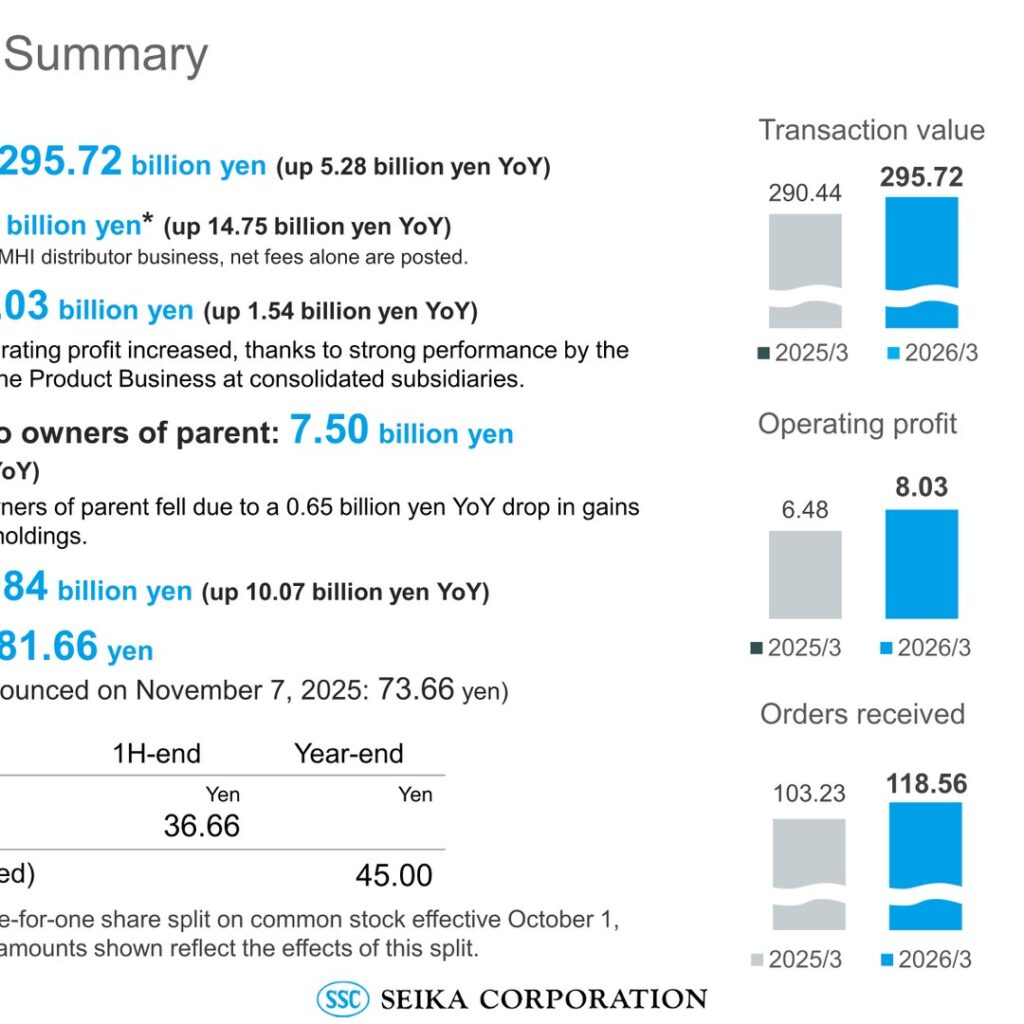
Seika Corporation (TSE Prime: 8061) reported consolidated results for the fiscal year ended March 31, 2026 (FY2025) with net sales of 108.48 billion yen, up 14.75 billion yen year on year, and operating profit of 8.03 billion yen, up 1.54 billion yen, as both the Energy Business and the Product Business at consolidated subsidiaries performed strongly. Profit attributable to owners of parent declined 0.29 billion yen to 7.50 billion yen, mainly due to a 0.65 billion yen year-on-year drop in gains on the sale of cross-shareholdings. Order backlog rose 10.07 billion yen to 76.84 billion yen. The company also raised its FY2025 dividend forecast to 81.66 yen per share, up from the 73.66 yen forecast announced on November 7, 2025.
Consolidated Results (Full-Year Actual)
Transaction value, which includes fee-only revenue recognized for the Mitsubishi Heavy Industries (MHI) distributor business, rose 1.8% to 295.72 billion yen. Orders received increased 14.8% to 118.56 billion yen.
| Item | FY2024 (Year Ended March 2025) | FY2025 (Year Ended March 2026) | Change |
|---|---|---|---|
| Transaction value | 290.44 billion yen | 295.72 billion yen | 1.8% |
| Net sales | 93.73 billion yen | 108.48 billion yen | 15.7% |
| Operating profit | 6.48 billion yen | 8.03 billion yen | 23.8% |
| Ordinary profit | 8.29 billion yen | 9.03 billion yen | 8.9% |
| Profit attributable to owners of parent | 7.79 billion yen | 7.50 billion yen | -3.7% |
| Orders received | 103.23 billion yen | 118.56 billion yen | 14.8% |
| Order backlog | 66.76 billion yen | 76.84 billion yen | 15.1% |
Segment Results
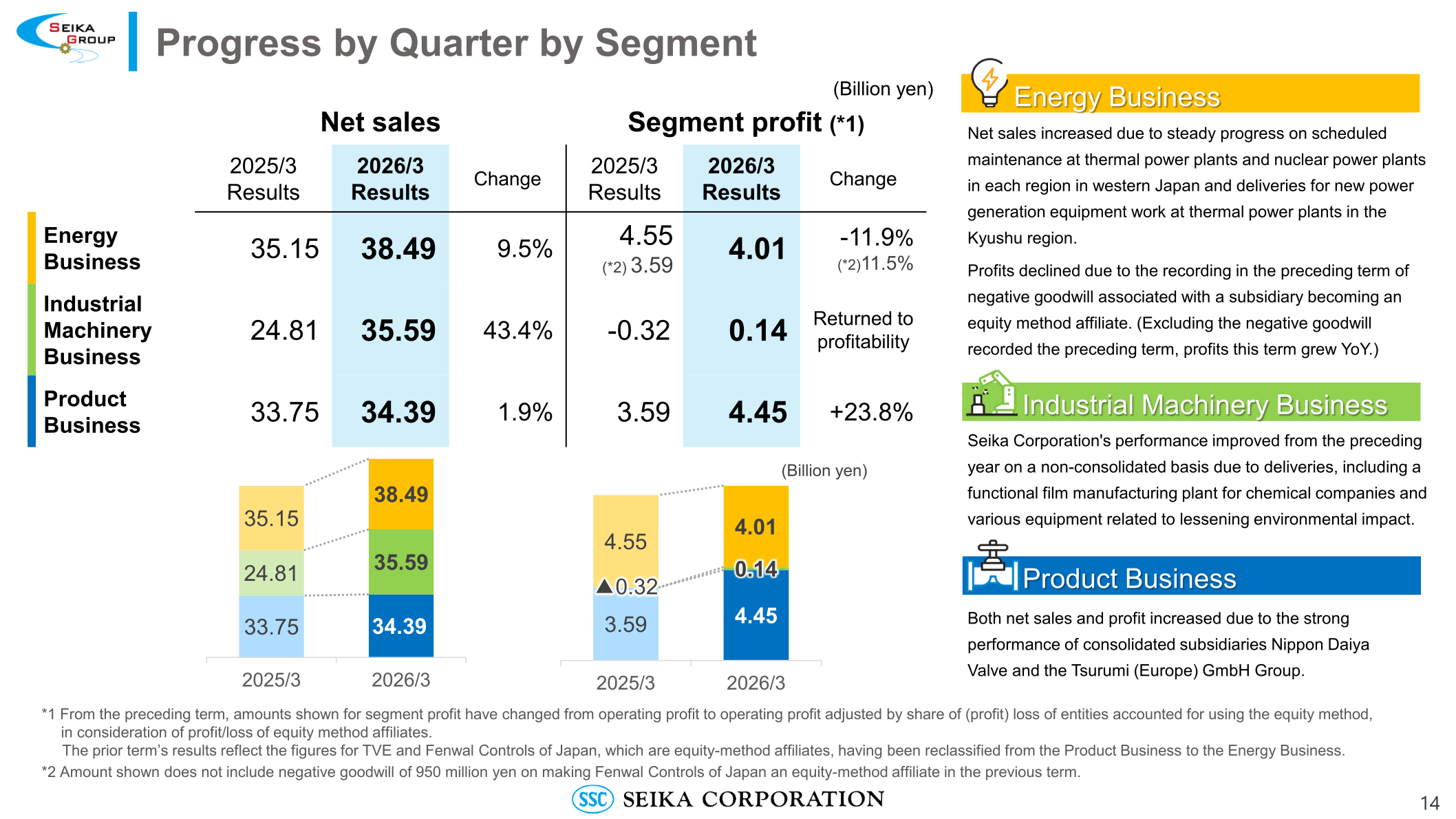
From FY2025, segment profit is calculated as operating profit adjusted for the company’s share of profit or loss of entities accounted for using the equity method; the preceding term’s segment profit figures have been restated on this basis, and TVE Co., Ltd. and Fenwal Controls of Japan, Ltd. were reclassified from the Product Business to the Energy Business. Energy Business net sales grew on steady progress in scheduled maintenance at thermal and nuclear power plants in western Japan and deliveries of new thermal power generation equipment in the Kyushu region, but segment profit fell because the preceding term had included negative goodwill of 0.95 billion yen from making Fenwal Controls of Japan an equity-method affiliate; excluding that negative goodwill, Energy Business profit grew 11.5% year on year. The Industrial Machinery Business returned to profitability on improved non-consolidated performance, including deliveries of a functional film manufacturing plant for chemical companies and equipment related to lessening environmental impact. Product Business net sales and profit both increased on strong performance at consolidated subsidiaries Nippon Daiya Valve Co., Ltd. and the Tsurumi (Europe) GmbH Group.
| Segment | Metric | FY2024 (2025/3) | FY2025 (2026/3) | Change |
|---|---|---|---|---|
| Energy Business | Net sales | 35.15 billion yen | 38.49 billion yen | 9.5% |
| Energy Business | Segment profit | 4.55 billion yen (3.59 billion yen excluding negative goodwill) | 4.01 billion yen | -11.9% (+11.5% excluding negative goodwill) |
| Industrial Machinery Business | Net sales | 24.81 billion yen | 35.59 billion yen | 43.4% |
| Industrial Machinery Business | Segment profit | -0.32 billion yen | 0.14 billion yen | Returned to profitability |
| Product Business | Net sales | 33.75 billion yen | 34.39 billion yen | 1.9% |
| Product Business | Segment profit | 3.59 billion yen | 4.45 billion yen | 23.8% |
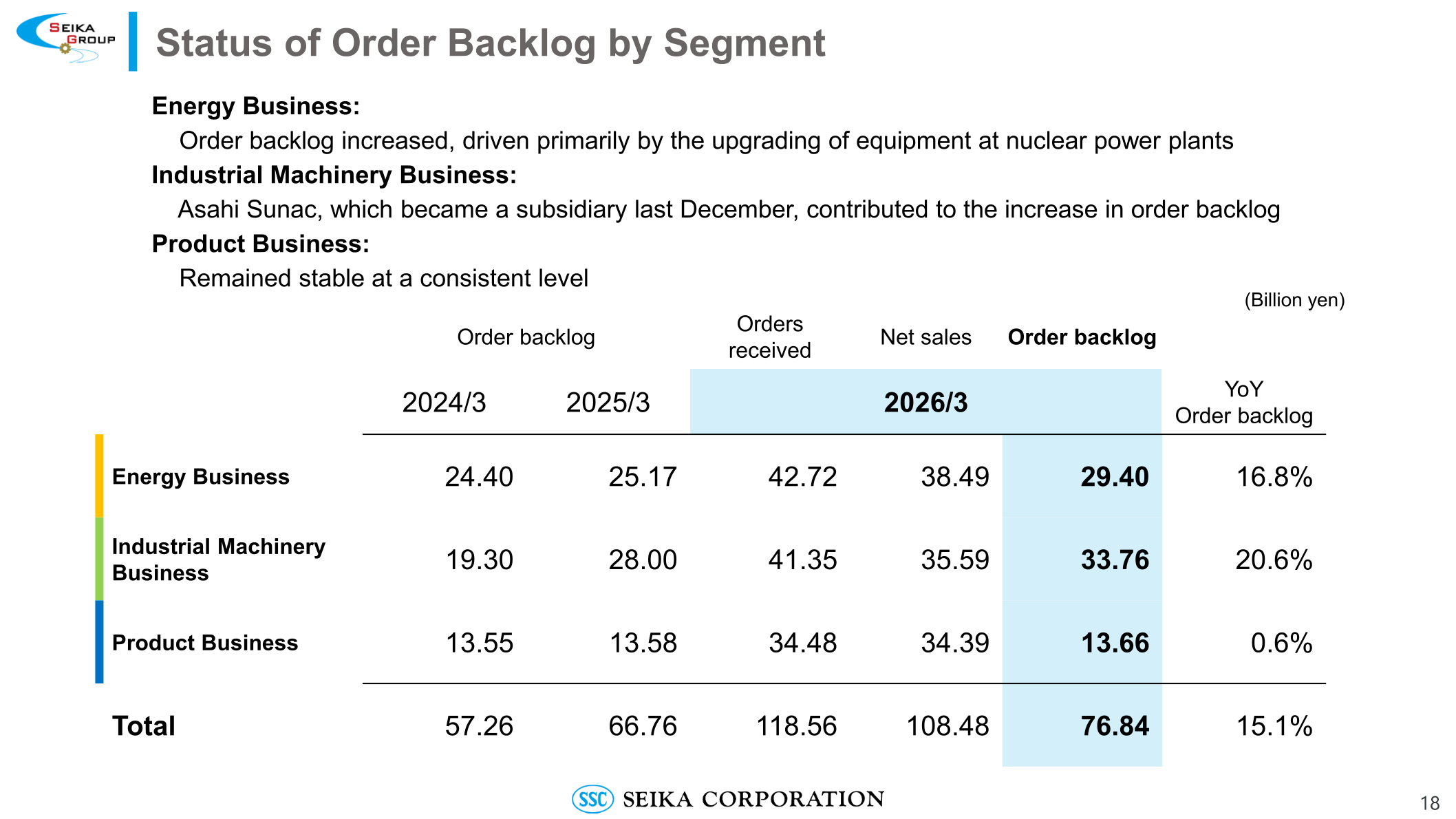
Order backlog rose across all three segments, most notably in the Industrial Machinery Business following the December 2025 acquisition of ASAHI SUNAC CORPORATION, and in the Energy Business on the upgrading of equipment at nuclear power plants.
| Segment | Order Backlog FY2023 (2024/3) | FY2024 (2025/3) | FY2025 (2026/3) | Change |
|---|---|---|---|---|
| Energy Business | 24.40 billion yen | 25.17 billion yen | 29.40 billion yen | 16.8% |
| Industrial Machinery Business | 19.30 billion yen | 28.00 billion yen | 33.76 billion yen | 20.6% |
| Product Business | 13.55 billion yen | 13.58 billion yen | 13.66 billion yen | 0.6% |
| Total | 57.26 billion yen | 66.76 billion yen | 76.84 billion yen | 15.1% |
FY2026 Forecast
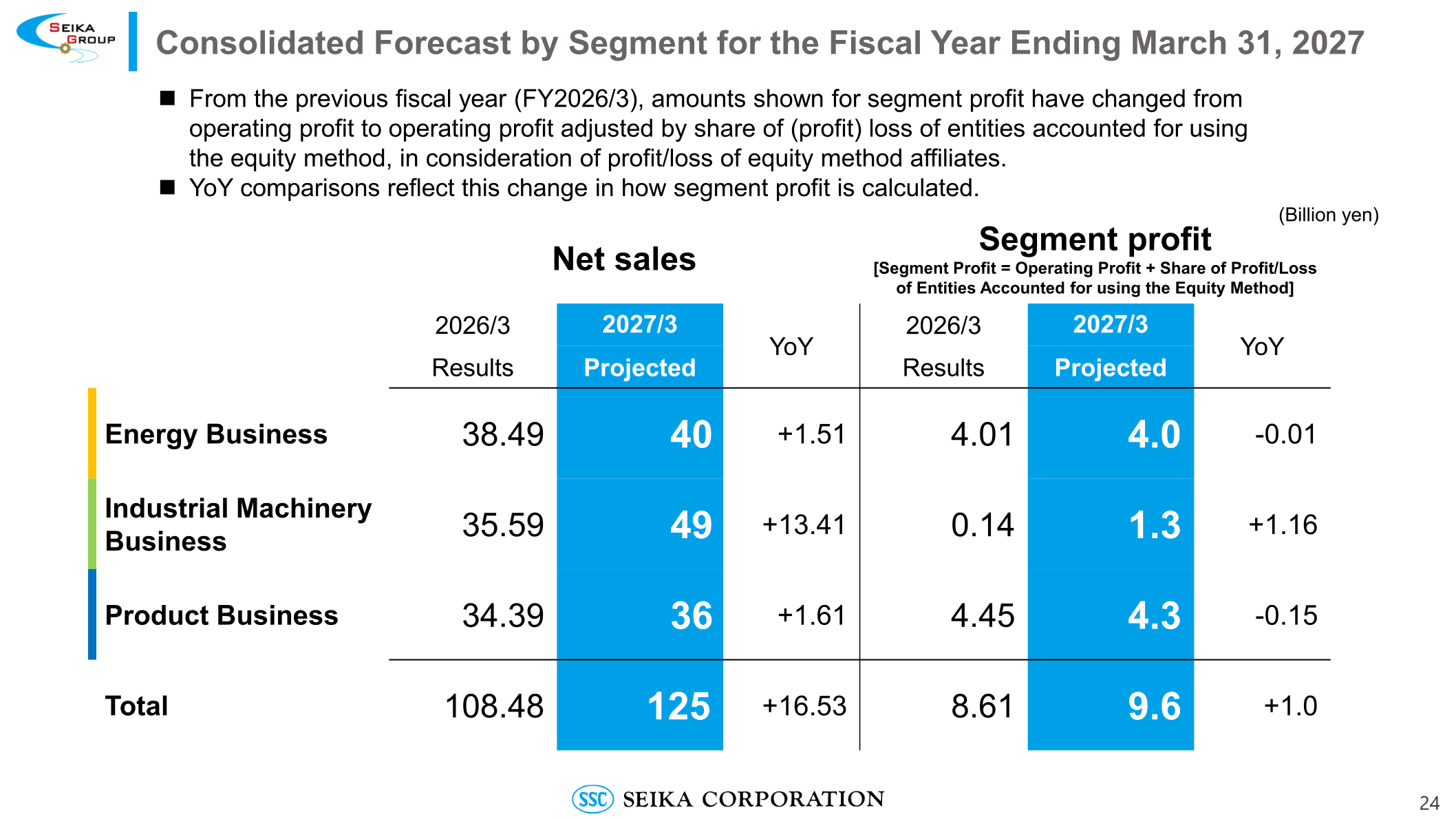
For the fiscal year ending March 31, 2027 (FY2026), Seika Corporation forecasts net sales of 125.0 billion yen, up 15.2%, and operating profit of 9.1 billion yen, up 13.3%, with growth expected across all three segments, most notably the Industrial Machinery Business (net sales forecast of 49 billion yen, up 13.41 billion yen, and segment profit forecast of 1.3 billion yen, up 1.16 billion yen). Annual dividends are forecast at 93 yen per share (1H 46 yen / year-end 47 yen), an increase of 11.34 yen from the FY2025 dividend forecast.
| Item | FY2025 (Actual) | FY2026 (Forecast) | Change |
|---|---|---|---|
| Net sales | 108.48 billion yen | 125.0 billion yen | 15.2% |
| Operating profit | 8.03 billion yen | 9.1 billion yen | 13.3% |
| Ordinary profit | 9.03 billion yen | 9.8 billion yen | 8.4% |
| Profit attributable to owners of parent | 7.50 billion yen | 7.6 billion yen | 1.2% |
| Earnings per share | 208.44 yen | 214.89 yen | — |
| Annual dividends | 81.66 yen (Projected) | 93 yen (1H 46 yen / Year-end 47 yen) | 11.34 yen |
Shareholder Returns
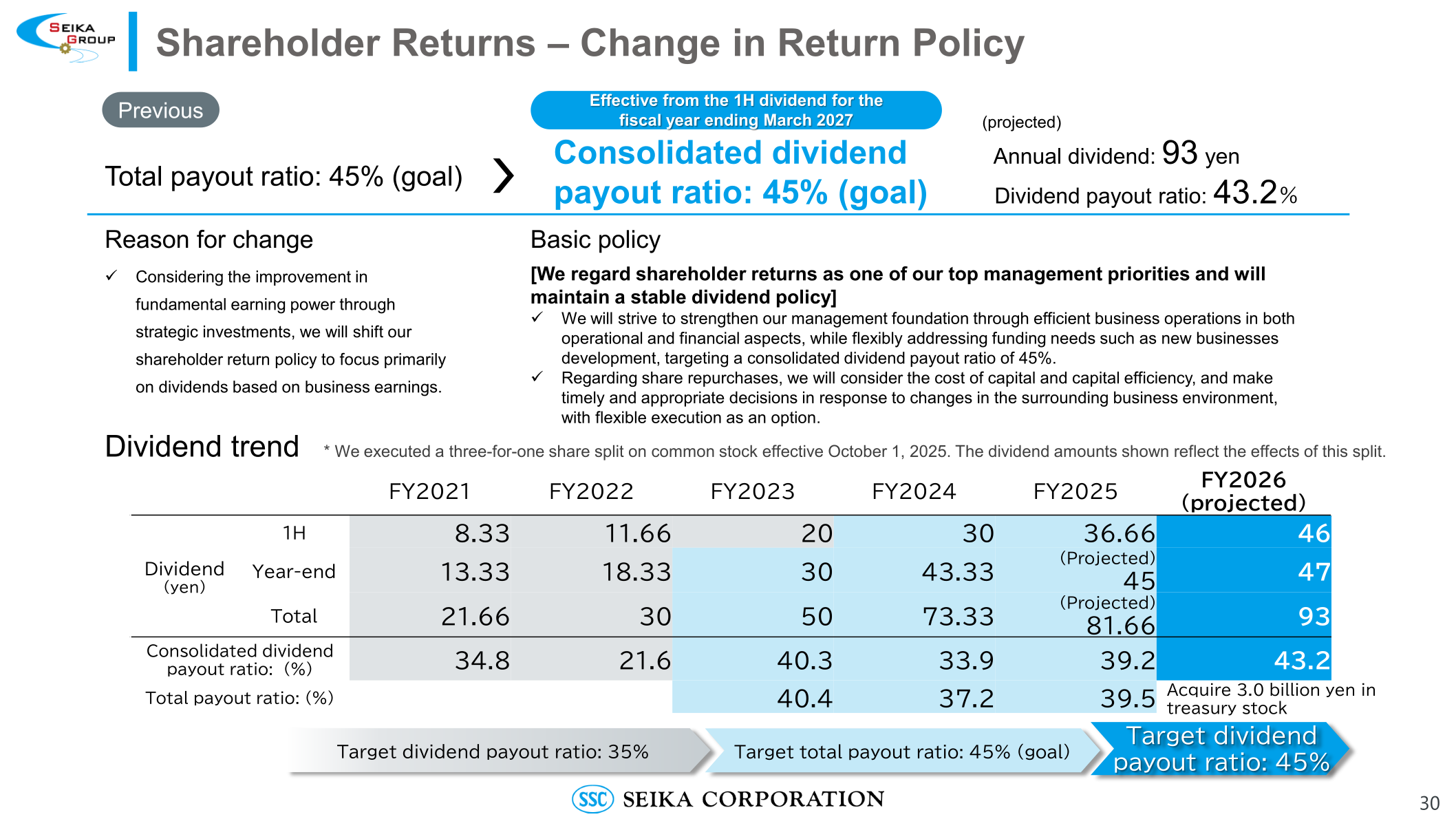
Seika Corporation is changing its shareholder return policy, effective from the first-half dividend for the fiscal year ending March 2027, to a target consolidated dividend payout ratio of 45%, replacing the previous target total payout ratio of 45%. The company said the change reflects an improvement in fundamental earning power through strategic investments and a shift to focus primarily on dividends based on business earnings. Under the new policy, the FY2026 annual dividend forecast of 93 yen corresponds to a dividend payout ratio of 43.2%. Separately, the company has a share buyback program of up to 3.0 billion yen (maximum 1,050,000 shares, 2.89% of shares outstanding excluding treasury stock), to run from May 14 to August 31, 2026, to improve capital efficiency, enhance shareholder returns, and enable flexible capital policy in response to changes in the business environment.
| Item | FY2021 | FY2022 | FY2023 | FY2024 | FY2025 | FY2026 (Forecast) |
|---|---|---|---|---|---|---|
| 1H dividend (yen) | 8.33 | 11.66 | 20 | 30 | 36.66 | 46 |
| Year-end dividend (yen) | 13.33 | 18.33 | 30 | 43.33 | 45 (Projected) | 47 |
| Total dividend (yen) | 21.66 | 30 | 50 | 73.33 | 81.66 (Projected) | 93 |
| Consolidated dividend payout ratio (%) | 34.8 | 21.6 | 40.3 | 33.9 | 39.2 | 43.2 |
| Total payout ratio (%) | n/a | n/a | 40.4 | 37.2 | 39.5 | Acquire 3.0 billion yen in treasury stock (planned) |
Medium-Term Plan / Topics
Under its long-term management vision “VIORB 2030,” Seika Corporation targets FY2030 consolidated net sales of 180.0 billion yen, operating profit of 12.0 billion yen, and ordinary profit of 12.5 billion yen, to be achieved through organic business growth plus non-organic business initiatives. During FY2025, the company acquired an 11.58% stake in TOKYO SANGYO CO., LTD. (securities code 8070) in April 2025, becoming its largest shareholder, and made ASAHI SUNAC CORPORATION a consolidated subsidiary on December 1, 2025 for 18.8 billion yen; following Asahi Sunac’s fiscal year-end change from May 31 to December 31, one month (December 2025) of its results was included in FY2025 consolidated performance. The company also executed a three-for-one stock split effective October 1, 2025, and total assets grew to 197.52 billion yen (equity ratio 27.4%) from 129.53 billion yen, mainly reflecting the Asahi Sunac acquisition; its long-term issuer rating was maintained at A- by JCR.
This article is an analysis based on publicly available information and is not a recommendation to buy or sell any specific securities. Investment decisions are your own responsibility.