
This article is based on publicly available IR materials and is not a recommendation to buy or sell any specific securities.
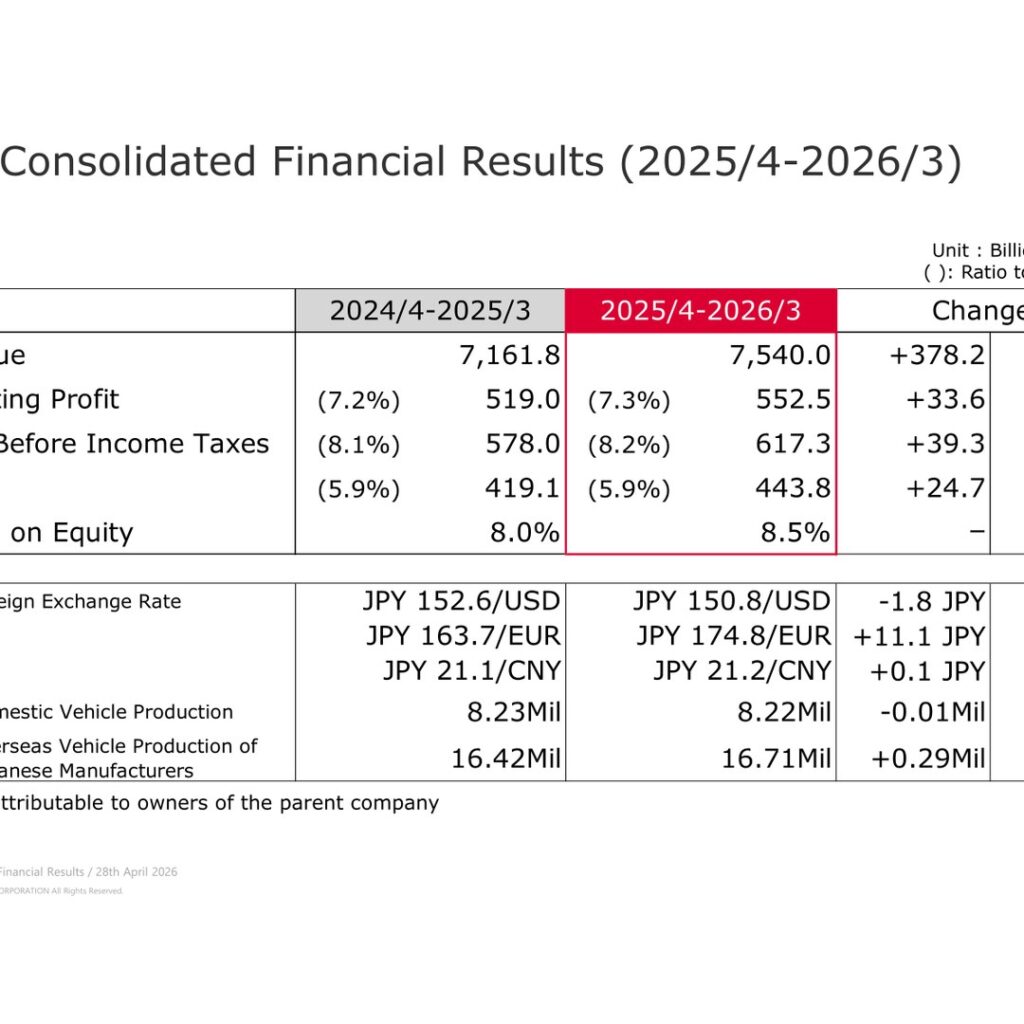
DENSO Corporation announced its financial results for the fiscal year ended March 31, 2026 on 28th April 2026. Consolidated revenue was 7,540.0 billion yen (+5.3% year on year), operating profit was 552.5 billion yen (+6.5%), profit before income taxes was 617.3 billion yen (+6.8%) and profit attributable to owners of the parent company was 443.8 billion yen (+5.9%), with return on equity of 8.5%. The company states that revenue increased on higher vehicle sales and cost recovery from changes to certain product programs, and that ongoing business improvements and higher production volumes enabled a higher operating profit than last year, while tariff-related costs, higher parts and material costs, and increased investment in the workforce affected profitability. For the following fiscal year the company forecasts revenue of 7,670.0 billion yen and operating profit of 500.0 billion yen. The annual dividend for the fiscal year ended is 67 yen, a 3 yen increase from the previous announcement, with a DOE of 3.5%; the forecast for the next fiscal year is 74 yen, a 7 yen increase from the previous year.
Note: This site classifies the most recently completed fiscal year as FY2025. DENSO’s presentation refers to the fiscal year ended March 31, 2026 (2025/4-2026/3) as “FY2026” and to the year ending March 31, 2027 as “FY2027”; the labels in the tables and text below follow the company’s notation, with fiscal years also shown as 25/3, 26/3 and 27/3.
Consolidated Results (Full-Year Actual)
Revenue rose 378.2 billion yen year on year to 7,540.0 billion yen and operating profit rose 33.6 billion yen to 552.5 billion yen, lifting the operating profit ratio from 7.2% to 7.3% of revenue. Preconditions for the year were exchange rates of JPY 150.8/USD (-1.8 yen year on year), JPY 174.8/EUR (+11.1 yen) and JPY 21.2/CNY (+0.1 yen), domestic vehicle production of 8.22 million units (-0.1%) and overseas vehicle production of Japanese manufacturers of 16.71 million units (+1.8%). In the operating profit walk from 519.0 billion yen to 552.5 billion yen, improvement and business agility enhancement contributed +170.0 billion yen (improvement +99.0, business agility +71.0), reduction of tariff costs and reflection of tariffs in price +65.5 billion yen, production volume +25.0 billion yen, F/X rate +8.0 billion yen and fixed cost +4.5 billion yen, while tariffs were -85.5 billion yen, parts and material cost etc. -83.0 billion yen, investment for human resources (wage increase, including suppliers) -49.5 billion yen, quality -13.0 billion yen and structural reforms -8.5 billion yen.
| Item (billions of yen) | 2024/4-2025/3 | 2025/4-2026/3 | Change |
|---|---|---|---|
| Revenue | 7,161.8 | 7,540.0 | +378.2 (+5.3%) |
| Operating Profit | 519.0 (7.2%) | 552.5 (7.3%) | +33.6 (+6.5%) |
| Profit Before Income Taxes | 578.0 (8.1%) | 617.3 (8.2%) | +39.3 (+6.8%) |
| Profit attributable to owners of the parent company | 419.1 (5.9%) | 443.8 (5.9%) | +24.7 (+5.9%) |
| Return on Equity | 8.0% | 8.5% | — |
On cash flows, operating cash flow was +511.0 billion yen (including profit before income taxes +617.3 and depreciation +378.1), investing cash flow was -16.9 billion yen (including capital investment -370.2, proceeds related to cross-shareholdings +457.8 and strategic investment -92.5), and free cash flow was +494.1 billion yen. Financing cash flow was -355.0 billion yen, including corporate bond issuance +93.7, dividends -176.7 and stock buyback -180.0 billion yen, and cash rose from 986.5 billion yen at the beginning of the period to 1,189.1 billion yen at the end.
Segment Results (Revenue by Product and Customer)
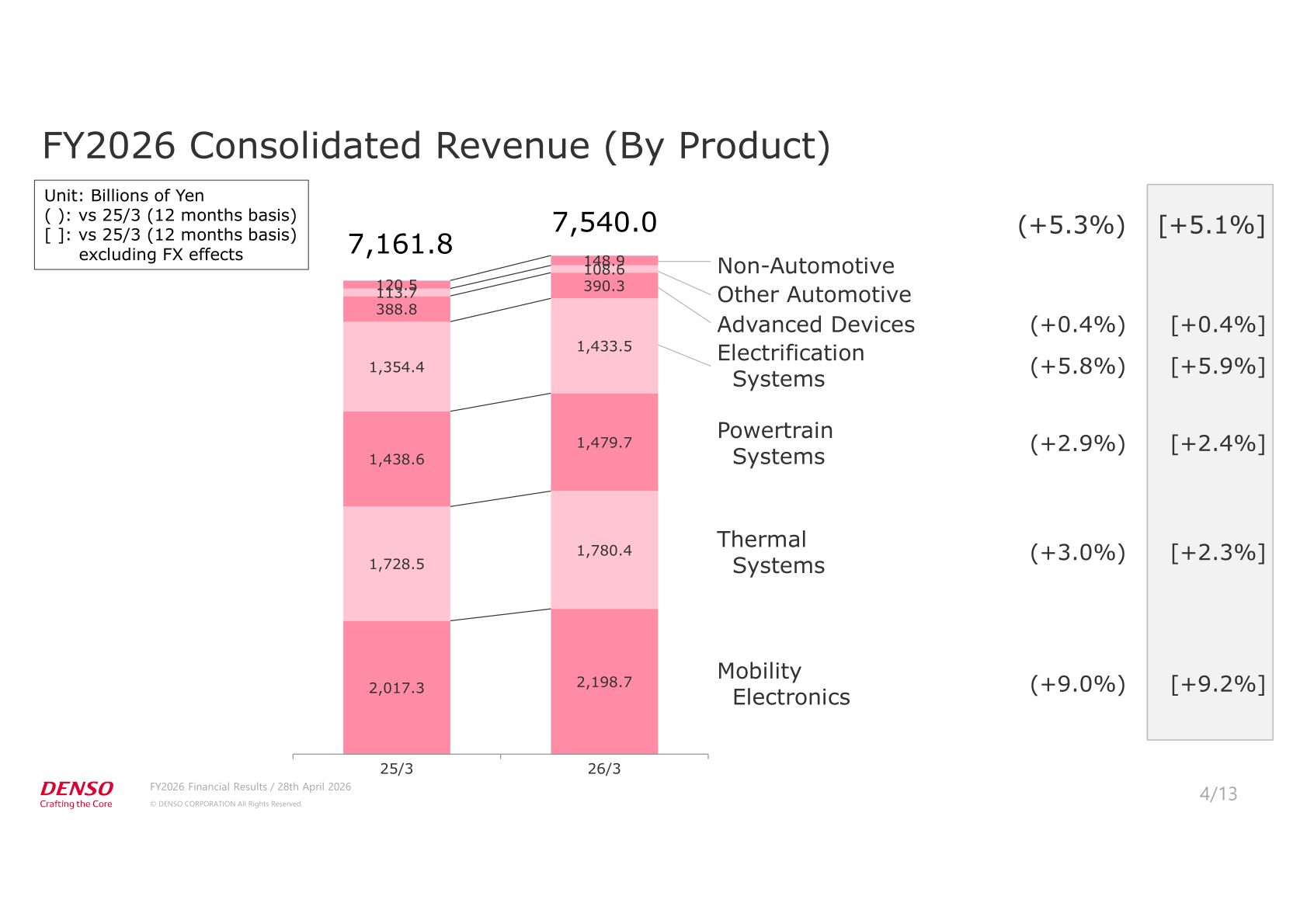
By product field, Mobility Electronics grew 9.0% versus 25/3 (12 months basis) to 2,198.7 billion yen, Thermal Systems grew 3.0% to 1,780.4 billion yen, Powertrain Systems grew 2.9% to 1,479.7 billion yen, Electrification Systems grew 5.8% to 1,433.5 billion yen and Advanced Devices grew 0.4% to 390.3 billion yen. Other Automotive was 108.6 billion yen and Non-Automotive was 148.9 billion yen. By customer, revenue from the Toyota group rose 6.2% (12 months basis) to 4,192.0 billion yen, or 55.6% of the total, and revenue from other OEMs rose 4.6% to 2,716.7 billion yen, or 36.0%.
| Product field (billions of yen) | 25/3 | 26/3 | Change (vs 25/3, 12 months basis) |
|---|---|---|---|
| Mobility Electronics | 2,017.3 | 2,198.7 | +9.0% |
| Thermal Systems | 1,728.5 | 1,780.4 | +3.0% |
| Powertrain Systems | 1,438.6 | 1,479.7 | +2.9% |
| Electrification Systems | 1,354.4 | 1,433.5 | +5.8% |
| Advanced Devices | 388.8 | 390.3 | +0.4% |
| Other Automotive | 113.7 | 108.6 | — |
| Non-Automotive | 120.5 | 148.9 | — |
| Total revenue | 7,161.8 | 7,540.0 | +5.3% |
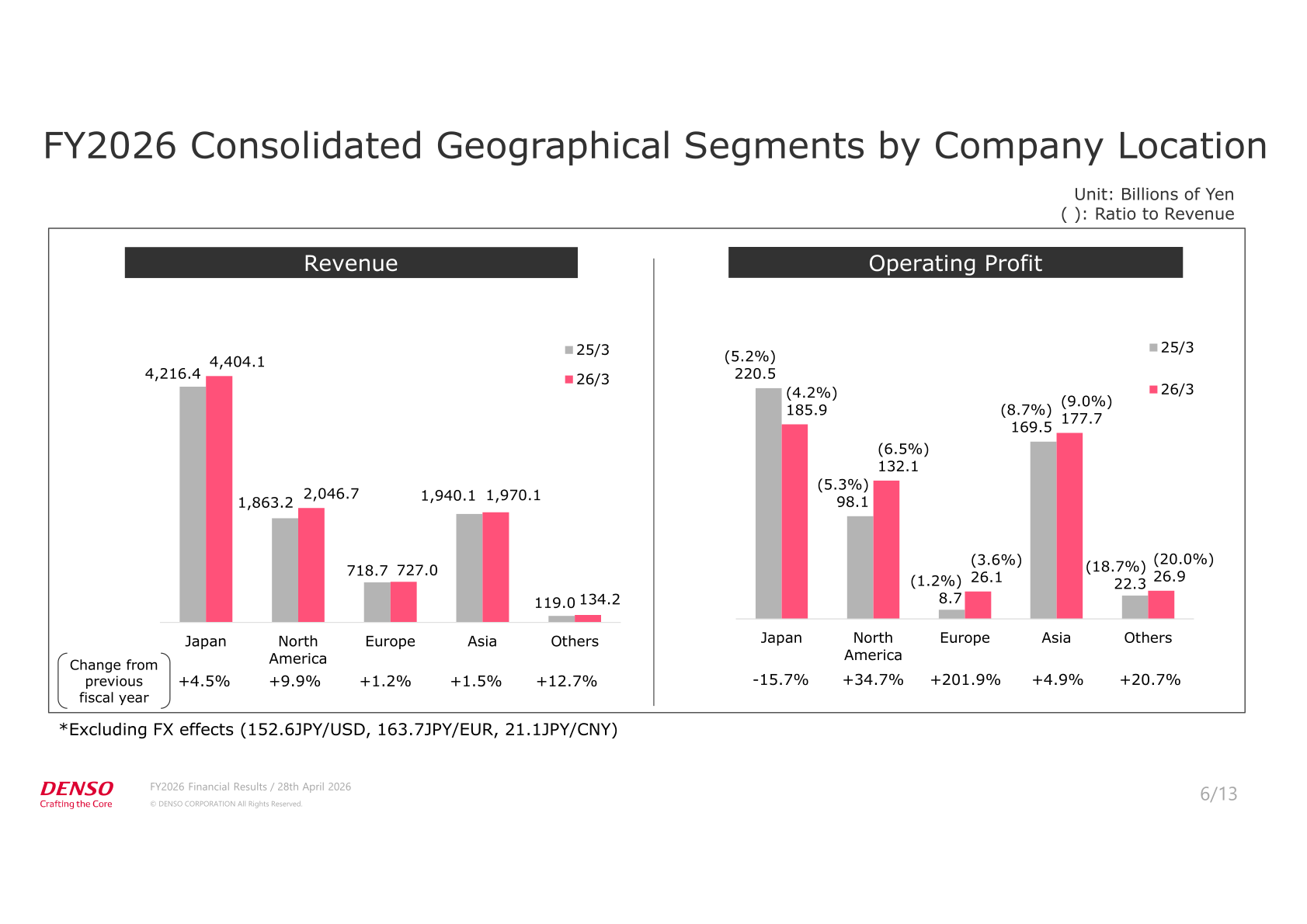
By company location, revenue increased in all regions: Japan +4.5% to 4,404.1 billion yen, North America +9.9% to 2,046.7 billion yen, Europe +1.2% to 727.0 billion yen, Asia +1.5% to 1,970.1 billion yen and Others +12.7% to 134.2 billion yen. Operating profit in Japan fell 15.7% to 185.9 billion yen (4.2% of revenue), while North America rose 34.7% to 132.1 billion yen (6.5%), Europe rose 201.9% to 26.1 billion yen (3.6%), Asia rose 4.9% to 177.7 billion yen (9.0%) and Others rose 20.7% to 26.9 billion yen (20.0%).
Capital expenditures in 26/3 were 369.3 billion yen (4.9% of revenue) and depreciation was 361.1 billion yen (4.8%). R&D expenditures (including capitalized asset) were 690.1 billion yen, or 9.2% of revenue (505.0 billion yen excluding costs to be paid in one lump sum by the customer). For 27/3 the company plans capital expenditures of 400.0 billion yen (5.2%), depreciation of 370.0 billion yen (4.8%) and R&D of 705.0 billion yen (9.2%; 550.0 billion yen excluding costs to be paid in one lump sum by the customer).
FY2027 Forecast
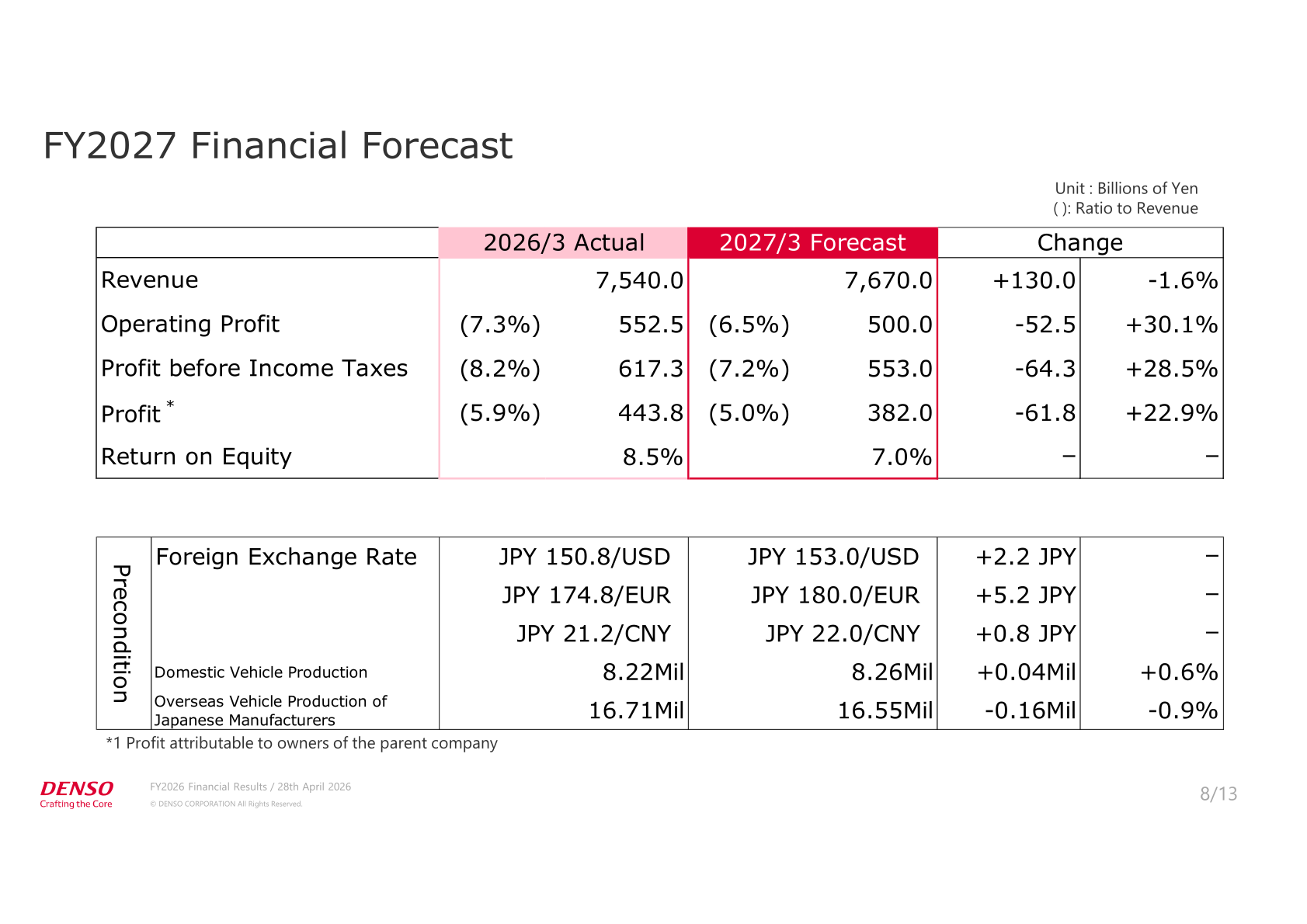
For the fiscal year ending March 31, 2027 (2027/3), DENSO forecasts revenue of 7,670.0 billion yen (+130.0 billion yen from 26/3), operating profit of 500.0 billion yen (-52.5 billion yen), profit before income taxes of 553.0 billion yen (-64.3 billion yen), profit attributable to owners of the parent company of 382.0 billion yen (-61.8 billion yen) and return on equity of 7.0%. The company states the decrease in operating profit reflects strengthened investments aimed at future growth and potential risks associated with a highly uncertain business environment. In the forecast operating profit walk, positives of improvement and business agility enhancement +156.5 billion yen, production volume +22.0 billion yen and F/X rate +10.0 billion yen are outweighed by parts and material costs etc. -74.5 billion yen, investment for human resources (wage increase, including suppliers) -54.5 billion yen, R&D resource investments -40.0 billion yen, reversal of one-time items from the previous fiscal year -11.0 billion yen, value creation foundation resource investment (IT, intellectual property, human capital) -10.0 billion yen and structural reforms -6.0 billion yen, giving 545.0 billion yen before highly uncertain risks (Middle East situation, etc.) of -45.0 billion yen. Exchange rate preconditions are JPY 153.0/USD, JPY 180.0/EUR and JPY 22.0/CNY, with domestic vehicle production of 8.26 million units (+0.6%) and overseas vehicle production of Japanese manufacturers of 16.55 million units (-0.9%).
| Item (billions of yen) | 2026/3 Actual | 2027/3 Forecast | Change |
|---|---|---|---|
| Revenue | 7,540.0 | 7,670.0 | +130.0 |
| Operating Profit | 552.5 (7.3%) | 500.0 (6.5%) | -52.5 |
| Profit before Income Taxes | 617.3 (8.2%) | 553.0 (7.2%) | -64.3 |
| Profit attributable to owners of the parent company | 443.8 (5.9%) | 382.0 (5.0%) | -61.8 |
| Return on Equity | 8.5% | 7.0% | — |
Shareholder Returns
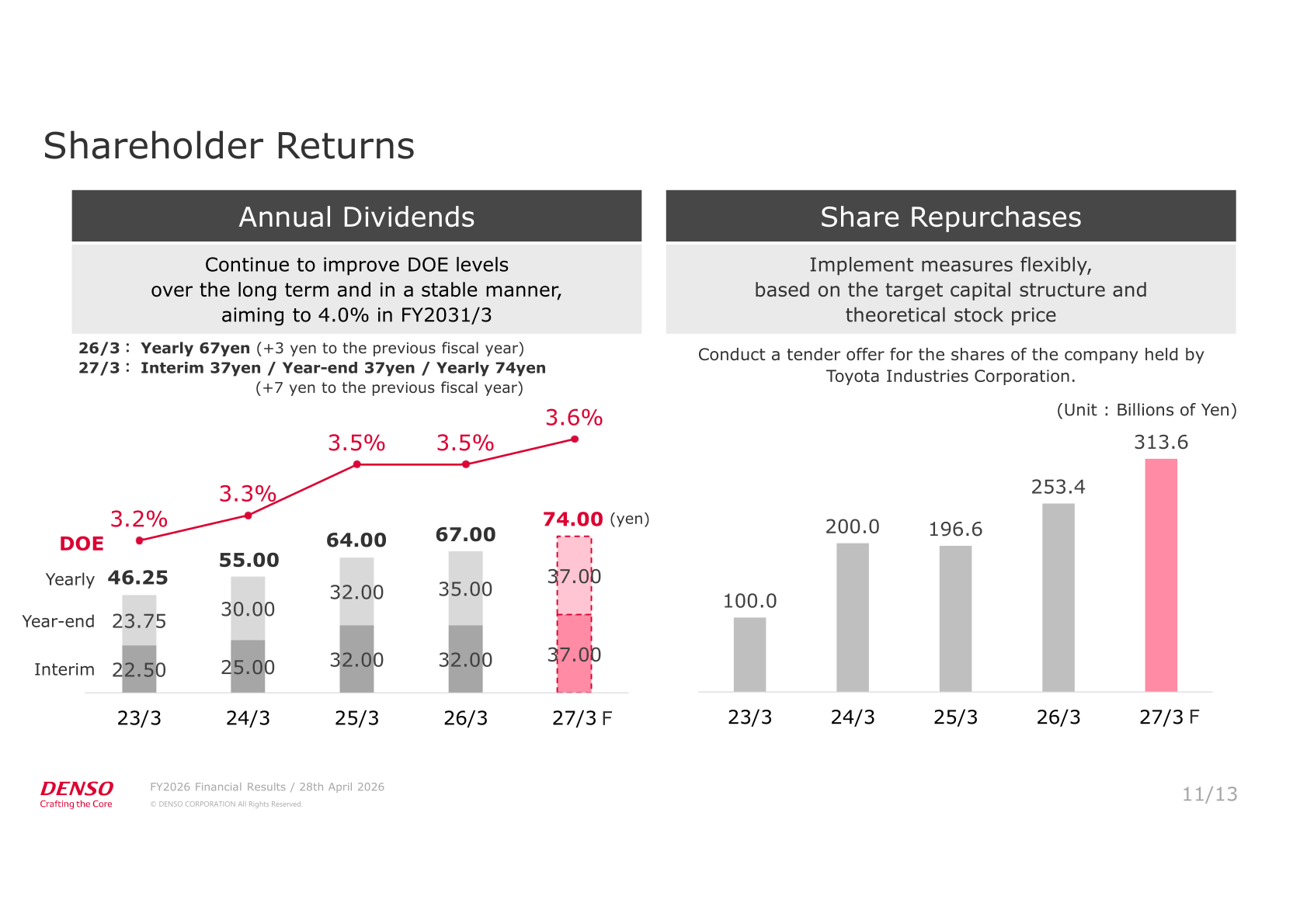
The annual dividend for 26/3 is 67 yen per share (interim 32.00 yen, year-end 35.00 yen), a 3 yen increase from the previous fiscal year’s 64 yen, with a DOE of 3.5%. For 27/3 the company plans an interim dividend of 37 yen and a year-end dividend of 37 yen for a yearly 74 yen, a 7 yen increase from the previous fiscal year, with DOE expected at 3.6%. The company’s policy is to continue to improve DOE levels over the long term and in a stable manner, aiming for 4.0% in FY2031/3. On share repurchases, the policy is to implement measures flexibly based on the target capital structure and theoretical stock price, and the company states it will conduct a tender offer for the shares of the company held by Toyota Industries Corporation. The share repurchase chart shows 253.4 billion yen for 26/3 and 313.6 billion yen for 27/3 F.
| Fiscal year | Interim (yen) | Year-end (yen) | Yearly (yen) | DOE |
|---|---|---|---|---|
| 23/3 | 22.50 | 23.75 | 46.25 | 3.2% |
| 24/3 | 25.00 | 30.00 | 55.00 | 3.3% |
| 25/3 | 32.00 | 32.00 | 64.00 | 3.5% |
| 26/3 | 32.00 | 35.00 | 67.00 | 3.5% |
| 27/3 F | 37.00 | 37.00 | 74.00 | 3.6% |
Medium-Term Plan / Topics
Under “Our Goal for 2030,” DENSO targets sales revenue of over 8 trillion yen, an operating margin of over 10% and ROE of over 11%. Other key financial KPIs are an equity ratio of over 50%, DOE of over 4.0%, ongoing reduction of cross-shareholdings based on the rationale for holdings, and agile execution and reinforcement of share buybacks. Cumulative investments and shareholder returns from FY27-31 are planned at over 8 trillion yen, comprising business investment of 6.6 trillion yen, dividends of 1.0 trillion yen and strategic investments and share repurchases as an additional amount. Key materiality KPIs include electrification sales of 1.9 trillion yen, ADAS sales of 1.0 trillion yen, carbon neutrality for Scope 1/2 CO2 emissions with credits and a 25% reduction in Scope 3 (compared to 2020), and an accident scene coverage ratio of 80%.
The presentation also reports that the Board of Directors resolved at a meeting held 28th April to withdraw the proposal regarding the acquisition of shares of ROHM Co., Ltd. DENSO states that it has not obtained the support of ROHM’s Board of Directors and special committee with respect to the proposal, and decided to withdraw it after comprehensively reviewing the significance of proceeding, its impact on medium- to long-term corporate value and the optimal form of the relationship between the two companies. Even after the withdrawal, the two companies have agreed to further advance their co-creation activities through collaboration measures and enhanced personnel exchanges, and DENSO will continue to proactively explore various forms of collaboration with third parties.
This article is an analysis based on publicly available information and is not a recommendation to buy or sell any specific securities. Investment decisions are your own responsibility.
![[Obayashi] Investors’ Guide 2026 — The Complete 24-Article Breakdown](https://japan-equity.com/wp-content/uploads/2026/07/hub_cover-1024x1024.png)
![[Obayashi] IR & SR Policy — Feeding Dialogue Back into Management](https://japan-equity.com/wp-content/uploads/2026/07/p32_sq-1024x1024.jpg)
![[Obayashi] Real Estate Development — 18.7% Margin, ¥287.7bn Unrealized Gains](https://japan-equity.com/wp-content/uploads/2026/07/p20_sq-1024x1024.jpg)
![[Obayashi] Domestic Civil Engineering — Resilience Spending Supports 9.6% Margin](https://japan-equity.com/wp-content/uploads/2026/07/p11_sq-1024x1024.jpg)
![[Obayashi] Share Price & External Ratings — vs TOPIX, ESG Index Inclusion](https://japan-equity.com/wp-content/uploads/2026/07/p40_sq-1024x1024.jpg)
![[Construction] ¥75.5tn Investment, Shrinking Workforce — Big-5 Market Share](https://japan-equity.com/wp-content/uploads/2026/07/p12_sq-1024x1024.jpg)
![[Obayashi] Capital Policy & Shareholder Returns — ROE 10%+, DOE ~5%, ¥100bn Buyback](https://japan-equity.com/wp-content/uploads/2026/07/p27_sq-1024x1024.jpg)
![[Obayashi] Reducing Cross-Shareholdings — ¥285.2bn Sold in Five Years](https://japan-equity.com/wp-content/uploads/2026/07/p29_sq-1024x1024.jpg)
![[Obayashi] ¥750bn Investment Plan — ¥300bn to Development, ¥190bn to Tech/DX](https://japan-equity.com/wp-content/uploads/2026/07/p30_sq-1024x1024.jpg)
![[Obayashi] MTP2022 KPIs — Operating Profit ~2x Target, ROE 14.4%](https://japan-equity.com/wp-content/uploads/2026/07/p25_sq-1024x1024.jpg)
![[Obayashi] Cash Allocation — ¥420bn Investment CF Over Five Years](https://japan-equity.com/wp-content/uploads/2026/07/p26_sq-1024x1024.jpg)
![[Obayashi] Green Energy — 44 Plants, 344MW, and the Green Hydrogen Challenge](https://japan-equity.com/wp-content/uploads/2026/07/p21_sq-1024x1024.jpg)
![[Obayashi] Tackling the Labor Shortage — Robotics Construction®](https://japan-equity.com/wp-content/uploads/2026/07/p14_sq-1024x1024.jpg)
