
This article is based on publicly available IR materials and is not a recommendation to buy or sell any specific securities.
Note: Fuji Die’s materials label the fiscal year ended March 31, 2026 as “FYE2026”; this site classifies the most recently completed fiscal year as FY2025, and the labels used in the text, tables and segments below are kept as they appear in the source materials.
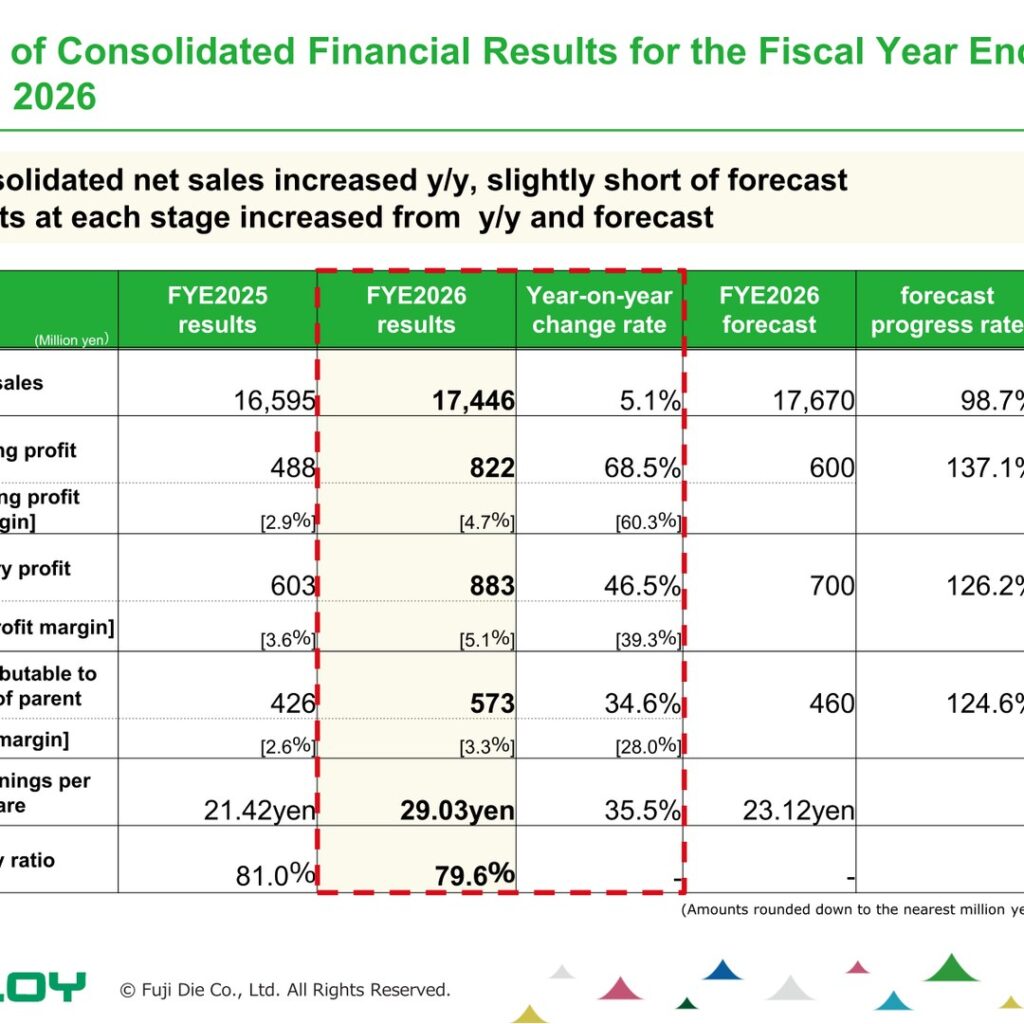
Fuji Die Co., Ltd. (TSE Prime, 6167), a specialist manufacturer of cemented carbide wear-resistant tools and molds, reported net sales of 17,446 million yen (up 5.1% year on year) and operating profit of 822 million yen (up 68.5% year on year) for the fiscal year ended March 31, 2026. Profits at each stage increased year on year and exceeded the forecast, while net sales were slightly short of forecast. For the fiscal year ending March 31, 2027, the company forecasts net sales of 26,000 million yen (up 49.0%) on price revisions to pass on rising raw material costs, but operating profit of 700 million yen (down 14.9%). The company notes that supply-demand conditions and prices of tungsten remain highly susceptible to the impact of China’s export controls.
Consolidated Results (Full-Year Actual)
Consolidated net sales increased year on year, supported by strong sales of carbide materials, despite a slight shortfall versus the forecast. Operating profit increased year on year due to the increase in net sales, reduced outsourcing processing costs through efficiency initiatives, and lower electricity and fuel expenses. The materials cite solid demand for cold rolling tools and tools for ultra high pressure generators, strong sales of can manufacturing molds and motor core molds, and strong sales of carbide materials for overseas markets as sales increase factors, against decreased demand for non-carbide products such as kneading tools for semiconductor applications. Amounts are rounded down to the nearest million yen.
| Item (Million yen) | FYE2025 results | FYE2026 results | Year-on-year change rate | FYE2026 forecast | Forecast progress rate |
|---|---|---|---|---|---|
| Net sales | 16,595 | 17,446 | 5.1% | 17,670 | 98.7% |
| Operating profit | 488 | 822 | 68.5% | 600 | 137.1% |
| [Operating profit margin] | [2.9%] | [4.7%] | [60.3%] | – | – |
| Ordinary profit | 603 | 883 | 46.5% | 700 | 126.2% |
| [Ordinary profit margin] | [3.6%] | [5.1%] | [39.3%] | – | – |
| Profit attributable to owners of parent | 426 | 573 | 34.6% | 460 | 124.6% |
| [Profit margin] | [2.6%] | [3.3%] | [28.0%] | – | – |
| Basic earnings per share | 21.42yen | 29.03yen | 35.5% | 23.12yen | – |
| Equity ratio | 81.0% | 79.6% | – | – | – |
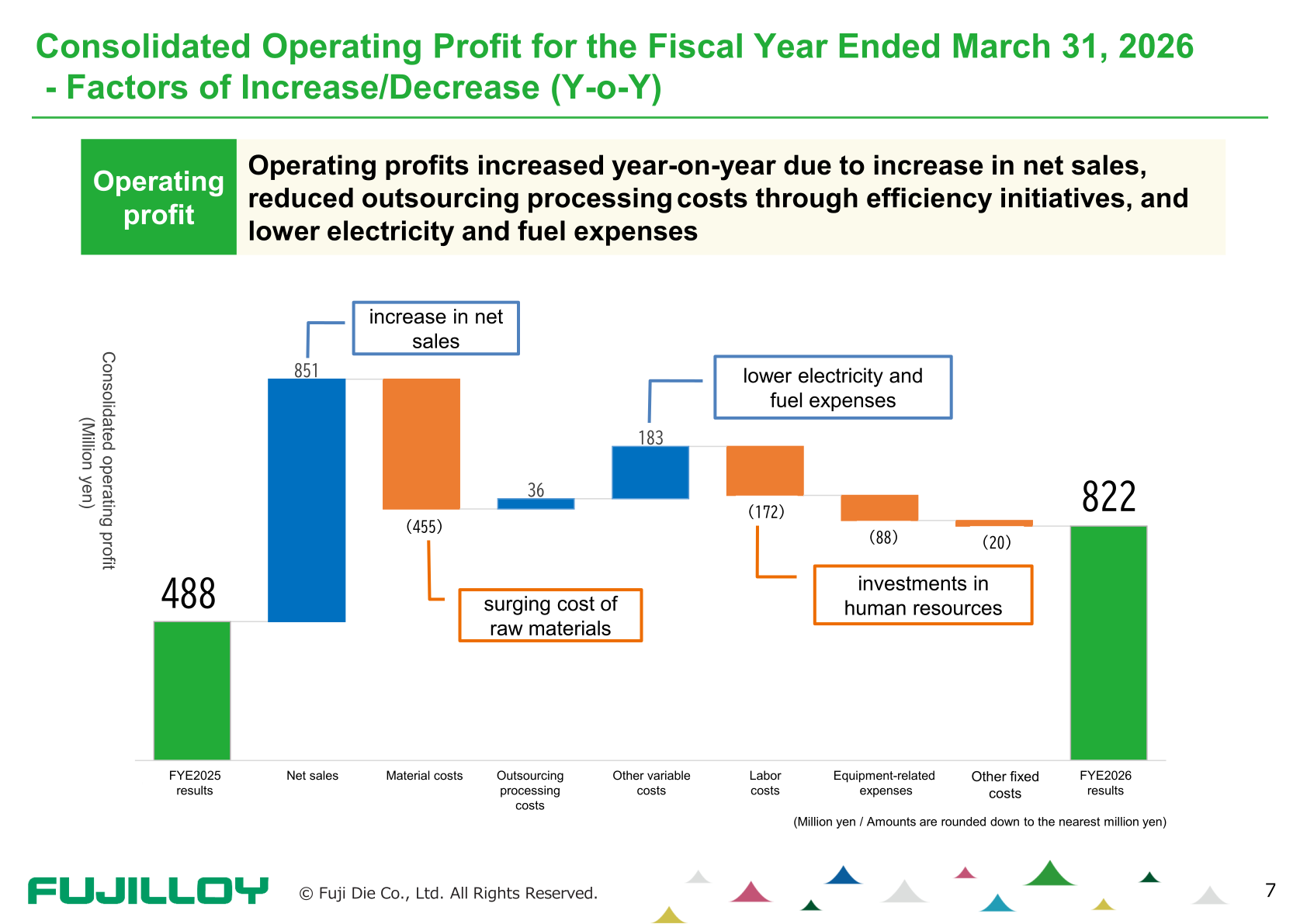
The year-on-year operating profit bridge shows an increase of 851 million yen from net sales, 36 million yen from outsourcing processing costs and 183 million yen from other variable costs (lower electricity and fuel expenses), against decreases of 455 million yen from material costs (surging cost of raw materials), 172 million yen from labor costs (investments in human resources), 88 million yen from equipment-related expenses and 20 million yen from other fixed costs. Against the forecast, operating profit came in 222 million yen higher. The forecast for the fiscal year ended March 31, 2026 assumed an APT (ammonium para tungstate) price of $375/10kg and an exchange rate of 145 yen per U.S. dollar; the actual results were an APT price of $854/10kg (average for FY2026) and an exchange rate of 150 yen per U.S. dollar (average for 2025).
| Operating profit bridge (Million yen) | Amount |
|---|---|
| FYE2025 results | 488 |
| Net sales | 851 |
| Material costs | (455) |
| Outsourcing processing costs | 36 |
| Other variable costs | 183 |
| Labor costs | (172) |
| Equipment-related expenses | (88) |
| Other fixed costs | (20) |
| FYE2026 results | 822 |
Financial Position and Cash Flows
Total assets stood at 25,684 million yen as of March 31, 2026, an increase of 80 million yen, with total liabilities of 5,239 million yen (up 383 million yen) and total net assets of 20,445 million yen (down 302 million yen). Current assets increased by 161 million, due to increases of 546 million in raw materials and supplies, 344 million in accounts receivable and 158 million in work in process – trade, despite a 1,000 million decrease in securities. Non-current assets decreased by 80 million, due to a decrease of 302 million in buildings and structures (net), despite increases of 94 million in machinery and equipment (net), 72 million in investment securities and 64 million in construction in progress. The equity ratio was 79.6%, compared with 81.0% a year earlier.
| Item (Million yen) | FYE2025 results | FYE2026 results | Increase/Decrease |
|---|---|---|---|
| CF from operating activities | 1,800 | 1,159 | (640) |
| CF from investing activities | (849) | (723) | 125 |
| Free CF | 951 | 436 | (514) |
| CF from financing activities | (659) | (1,126) | (466) |
| Total assets | 25,603 | 25,684 | – |
| Total liabilities | 4,855 | 5,239 | – |
| Total net assets | 20,748 | 20,445 | – |
Operating cash flow items cited include profit before income taxes of 885 million yen and depreciation of 1,074 million yen. Investing cash flow items include purchase of property, plant and equipment of 829 million yen, payments into time deposits of 793 million yen and proceeds from withdrawal of time deposits of 980 million yen. Financing cash flow items include dividends paid of 794 million yen and purchase of treasury shares of 310 million yen. The materials also state net cash of 7,107 million yen and free cash flow of 436 million yen as of March 31, 2026.
Status by Major Industry Category (Non-consolidated Basis, Net Sales)
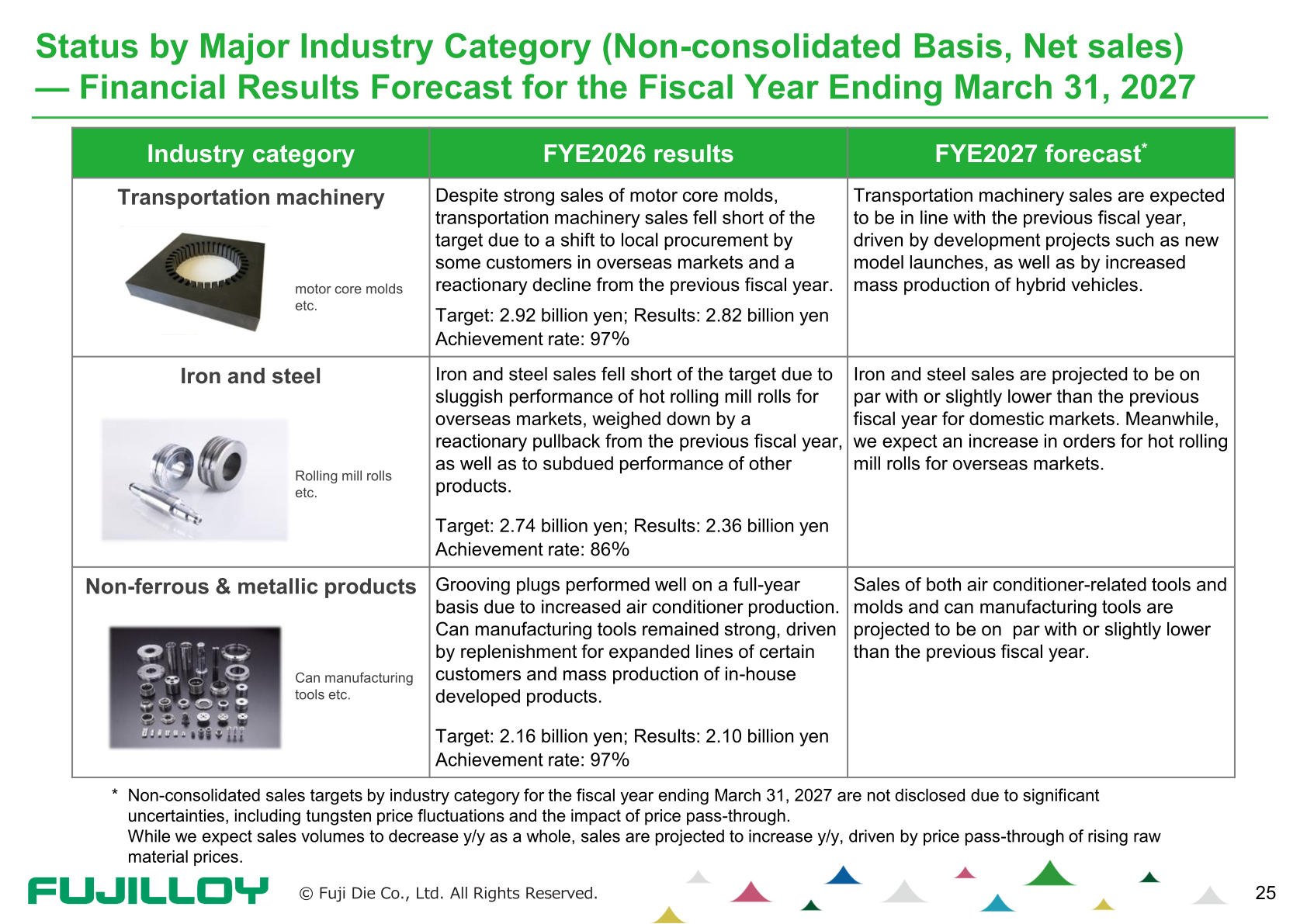
On a non-consolidated basis, materials for mold parts and tools posted the highest achievement rate, with results of 3.38 billion yen against a target of 2.79 billion yen (achievement rate 121%), as sales of carbide materials for overseas markets remained strong on a full-year basis. Electrical and electronic components also beat its target at 1.70 billion yen (110%), helped by battery-related sales for energy storage and data center applications. Iron and steel showed the weakest achievement rate at 86%, weighed down by sluggish hot rolling mill rolls for overseas markets. Non-consolidated sales targets by industry category for the fiscal year ending March 31, 2027 are not disclosed due to significant uncertainties, including tungsten price fluctuations and the impact of price pass-through.
| Industry category | FYE2026 target | FYE2026 results | Achievement rate |
|---|---|---|---|
| Transportation machinery | 2.92 billion yen | 2.82 billion yen | 97% |
| Iron and steel | 2.74 billion yen | 2.36 billion yen | 86% |
| Non-ferrous & metallic products | 2.16 billion yen | 2.10 billion yen | 97% |
| Production and commercial machinery | 2.12 billion yen | 1.93 billion yen | 91% |
| Electrical & electronic components | 1.54 billion yen | 1.70 billion yen | 110% |
| Materials for mold parts and tools | 2.79 billion yen | 3.38 billion yen | 121% |
Forecast for the Fiscal Year Ending March 31, 2027
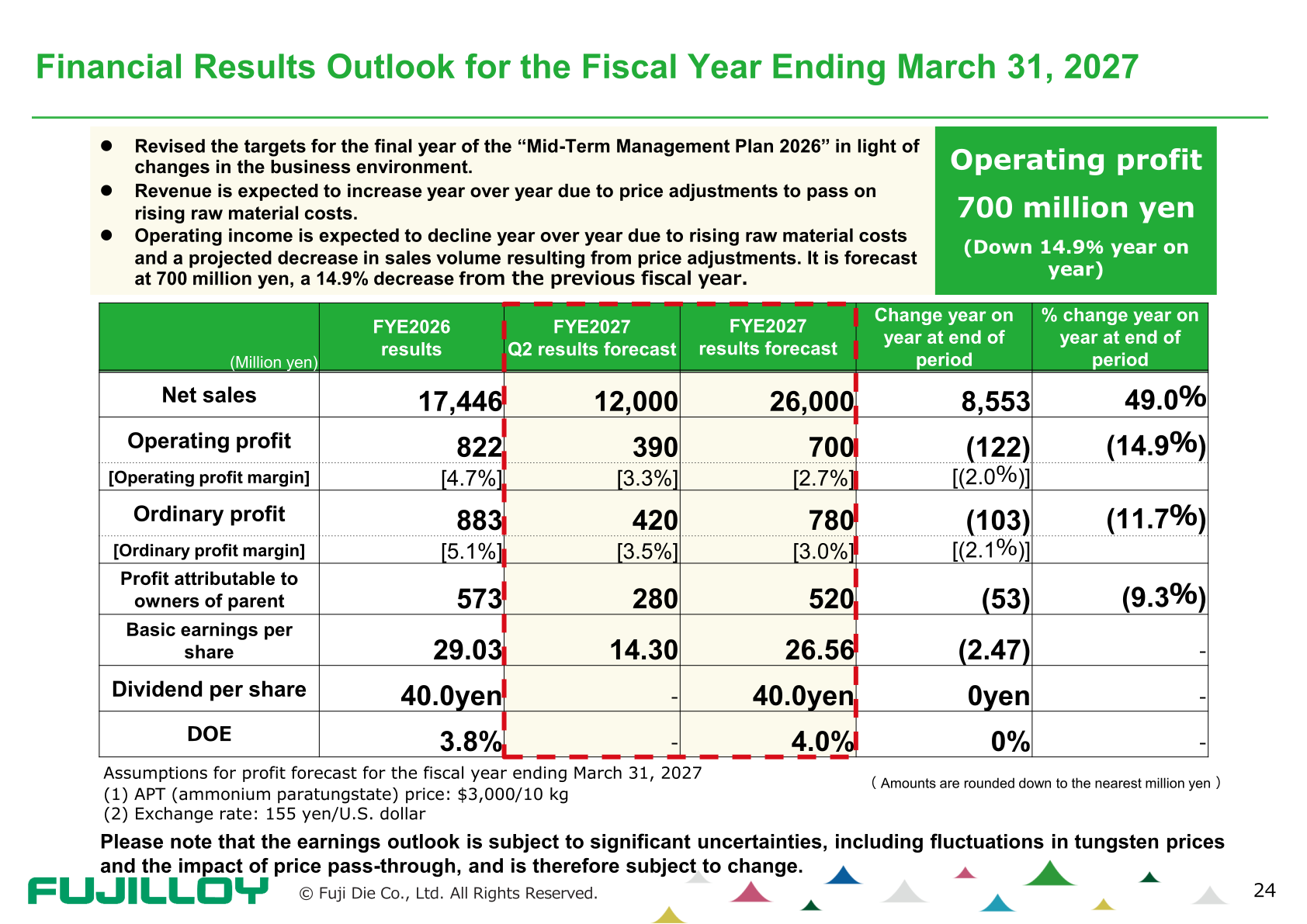
The company revised the targets for the final year of the Medium-Term Management Plan 2026 in light of changes in the business environment. Net sales are expected to increase year on year due to price revisions implemented to pass on rising raw material costs, while operating profit is projected to decrease year on year due to the expected impact of rising raw material costs and a decline in sales volume resulting from the price revisions. Assumptions for the forecast are an APT (ammonium paratungstate) price of $3,000/10 kg and an exchange rate of 155 yen per U.S. dollar. The company notes that the earnings outlook is subject to significant uncertainties, including fluctuations in tungsten prices and the impact of price pass-through, and is therefore subject to change.
| Item (Million yen) | FYE2026 results | FYE2027 Q2 results forecast | FYE2027 results forecast | Change year on year at end of period | % change year on year at end of period |
|---|---|---|---|---|---|
| Net sales | 17,446 | 12,000 | 26,000 | 8,553 | 49.0% |
| Operating profit | 822 | 390 | 700 | (122) | (14.9%) |
| [Operating profit margin] | [4.7%] | [3.3%] | [2.7%] | [(2.0%)] | – |
| Ordinary profit | 883 | 420 | 780 | (103) | (11.7%) |
| [Ordinary profit margin] | [5.1%] | [3.5%] | [3.0%] | [(2.1%)] | – |
| Profit attributable to owners of parent | 573 | 280 | 520 | (53) | (9.3%) |
| Basic earnings per share | 29.03 | 14.30 | 26.56 | (2.47) | – |
| Dividend per share | 40.0yen | – | 40.0yen | 0yen | – |
| DOE | 3.8% | – | 4.0% | 0% | – |
Shareholder Returns
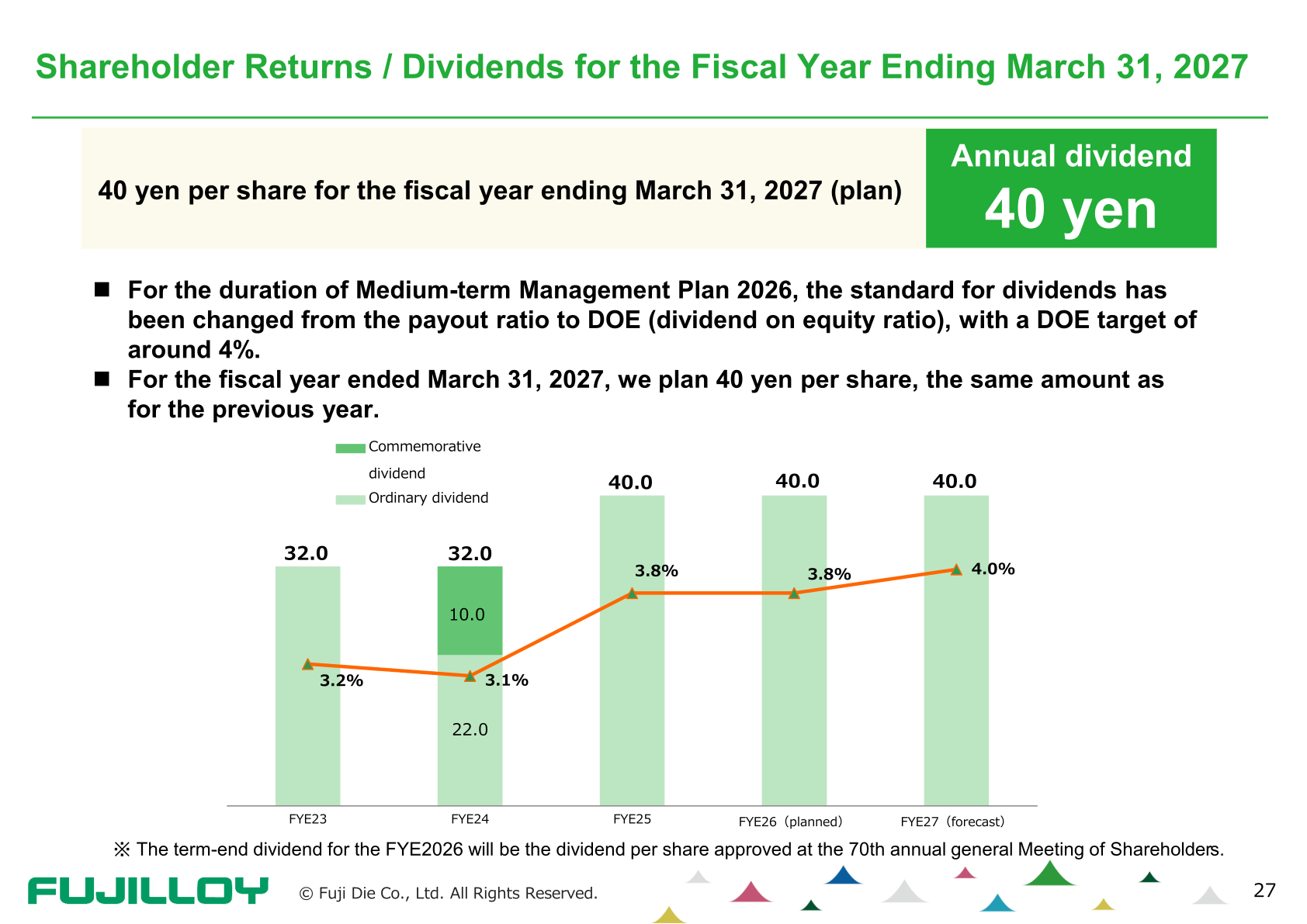
For the fiscal year ended March 31, 2026, an annual dividend of 40 yen per share is planned, unchanged from the previous fiscal year, and 40 yen per share is also planned for the fiscal year ending March 31, 2027. The term-end dividend for FYE2026 will be the dividend per share approved at the 70th annual general meeting of shareholders. For the duration of Medium-term Management Plan 2026, the standard for dividends has been changed from the payout ratio to DOE (dividend on equity ratio), with a DOE target of around 4%; DOE was 3.8% for FYE2025 and FYE2026 (planned) and is forecast at 4.0% for FYE2027. Share repurchases were implemented as a shareholder return measure (announced on August 12, 2025; period of acquisition from August 18, 2025 to December 4, 2025).
Management Conscious of Capital Cost and Share Prices
The company recognizes its shareholders’ equity cost as approximately 4.5-5.0%. Although ROE improved year over year due to increased sales and profit growth driven by efficiency measures, it remains below the cost of capital due to factors such as a deterioration in the profit structure caused by soaring raw material costs. As a result of efforts to enhance shareholder returns, including proactive investor relations activities and share repurchases, the share price has risen and PBR has exceeded 1.0; however, profitability has fallen short of the targets set in the medium-term management plan. The company states that improving profitability is the important issue.
| Indicator | Target (FYE2027) | FYE2024 | FYE2025 | FYE2026 |
|---|---|---|---|---|
| ROE | 7.0% or more | 3.5% | 2.1% | 2.8% |
| PBR | 1x or more | Approx. 0.66x | Approx. 0.72x | Approx. 1.11x |
| DOE | Aim for 4% | 2.1% | 3.8% | 3.8% |
| (Reference) Share price at close on fiscal year-end | – | 687yen | 754yen | 1,156yen |
Medium-Term Management Plan and Topics
Medium-Term Management Plan 2026 (FYE2025-FYE2027) is built on the concept of “Transforming the company structure to adapt business resilience,” with five priority measures: strengthening the management foundation; increasing productivity and improving business efficiency; leaping forward in overseas business; contributing to a zero carbon / recycling-based society; and development of new business. In overseas business, the actual overseas sales ratio for FYE2026 was 22.7%, up 3.2 points from 19.5% in FYE2025, against a target of 25% or more for FYE2027. On automation, all automation investment projects (160 million yen) were completed as planned, with an automation utilization rate for FYE2026 implementation projects of 40%, which the company aims to raise to 100% during H1 FY2027.
In February 2025 China announced export restrictions on critical minerals including tungsten, and in January and February 2026 issued further notices strengthening export controls on military-civilian dual-use items and adding 20 Japanese companies to the export control list. The company states that supply-demand conditions and prices of tungsten remain highly susceptible to the impact of China’s export controls, and that while it is temporarily suspending the acceptance of new orders for its copper tungsten alloy (CE08), its mainstay cemented carbide tools and molds are currently produced and shipped largely as planned. Full-scale sales of the new alloy STN30, which reduces tungsten and cobalt usage by 90%, began in October 2025, and the company has commenced discussions on a business alliance with DIJET INDUSTRIAL CO., LTD. regarding alloys that reduce the use of critical minerals such as tungsten and cobalt. The company also launched a recycling business for cemented carbide wear-resistant tools and molds, aiming to source approximately 10% of its raw materials from recycled sources.
This article is an analysis based on publicly available information and is not a recommendation to buy or sell any specific securities. Investment decisions are your own responsibility.
![[Obayashi] Investors’ Guide 2026 — The Complete 24-Article Breakdown](https://japan-equity.com/wp-content/uploads/2026/07/hub_cover-1024x1024.png)
![[Obayashi] IR & SR Policy — Feeding Dialogue Back into Management](https://japan-equity.com/wp-content/uploads/2026/07/p32_sq-1024x1024.jpg)
![[Obayashi] Real Estate Development — 18.7% Margin, ¥287.7bn Unrealized Gains](https://japan-equity.com/wp-content/uploads/2026/07/p20_sq-1024x1024.jpg)
![[Obayashi] Domestic Civil Engineering — Resilience Spending Supports 9.6% Margin](https://japan-equity.com/wp-content/uploads/2026/07/p11_sq-1024x1024.jpg)
![[Obayashi] Share Price & External Ratings — vs TOPIX, ESG Index Inclusion](https://japan-equity.com/wp-content/uploads/2026/07/p40_sq-1024x1024.jpg)
![[Construction] ¥75.5tn Investment, Shrinking Workforce — Big-5 Market Share](https://japan-equity.com/wp-content/uploads/2026/07/p12_sq-1024x1024.jpg)
![[Obayashi] Capital Policy & Shareholder Returns — ROE 10%+, DOE ~5%, ¥100bn Buyback](https://japan-equity.com/wp-content/uploads/2026/07/p27_sq-1024x1024.jpg)
![[Obayashi] Reducing Cross-Shareholdings — ¥285.2bn Sold in Five Years](https://japan-equity.com/wp-content/uploads/2026/07/p29_sq-1024x1024.jpg)
![[Obayashi] ¥750bn Investment Plan — ¥300bn to Development, ¥190bn to Tech/DX](https://japan-equity.com/wp-content/uploads/2026/07/p30_sq-1024x1024.jpg)
![[Obayashi] MTP2022 KPIs — Operating Profit ~2x Target, ROE 14.4%](https://japan-equity.com/wp-content/uploads/2026/07/p25_sq-1024x1024.jpg)
![[Obayashi] Cash Allocation — ¥420bn Investment CF Over Five Years](https://japan-equity.com/wp-content/uploads/2026/07/p26_sq-1024x1024.jpg)
![[Obayashi] Green Energy — 44 Plants, 344MW, and the Green Hydrogen Challenge](https://japan-equity.com/wp-content/uploads/2026/07/p21_sq-1024x1024.jpg)
![[Obayashi] Tackling the Labor Shortage — Robotics Construction®](https://japan-equity.com/wp-content/uploads/2026/07/p14_sq-1024x1024.jpg)
