
This article is based on publicly available IR materials and is not a recommendation to buy or sell any specific securities.
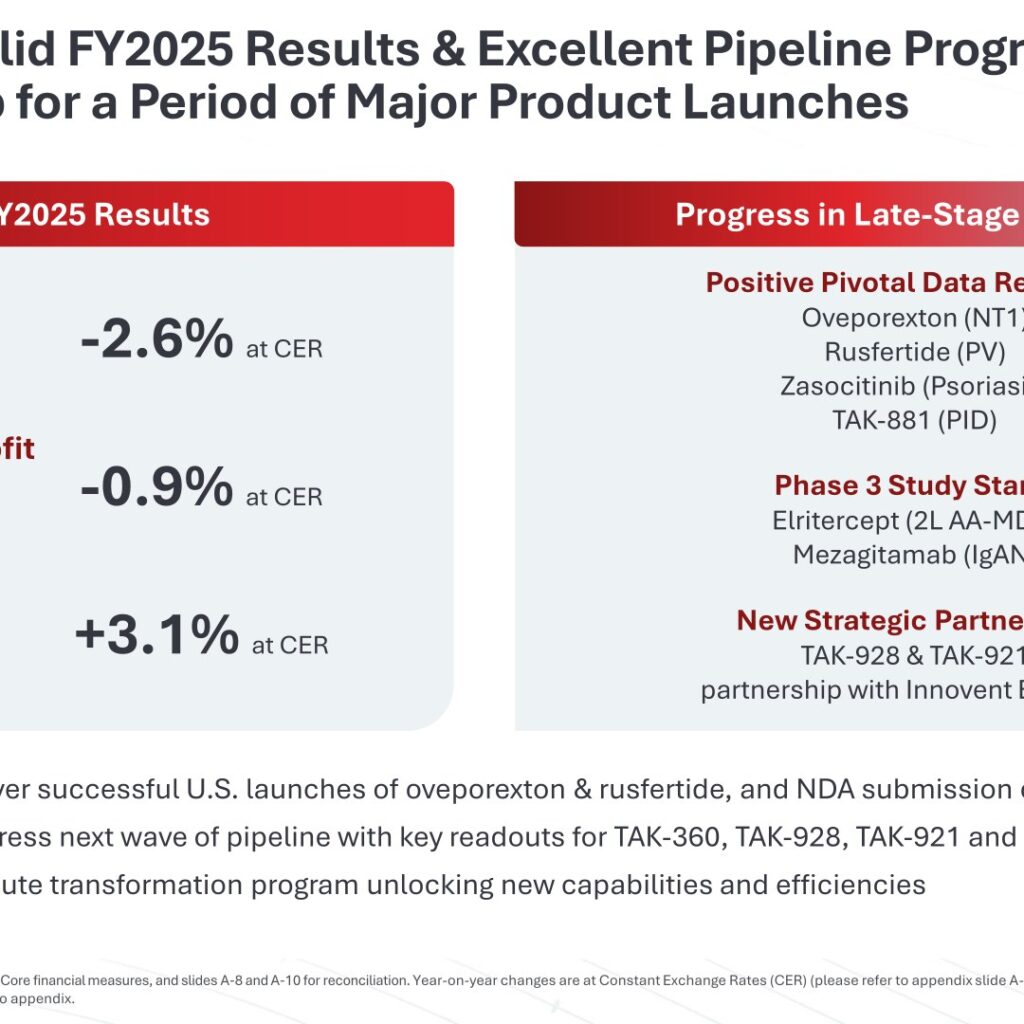
Takeda Pharmaceutical Company Limited reported FY2025 (fiscal year ended March 31, 2026) Core Revenue of JPY 4,505.7 billion (USD 28.3B), down 2.6% at CER, Core Operating Profit of JPY 1,172.5 billion (USD 7.4B, -0.9% at CER), and Core EPS of JPY 517 (USD 3.25, +3.1% at CER) — results the company describes as in line with or exceeding its latest management guidance. Reported results were far weaker: Reported Operating Profit was JPY 6.2 billion (-98.2% YoY) and net profit attributable to owners of the Company was a loss of JPY 152.4 billion, mainly reflecting an additional JPY 402.5 billion provision related to a May 2026 U.S. jury verdict against Takeda in the AMITIZA (lubiprostone) antitrust litigation — a subsequent event that led Takeda to re-file its FY2025 earnings report on June 5, 2026 (with related tax benefits of JPY 58.4 billion also recognized). Growth & Launch Products revenue reached JPY 2,313.3 billion (USD 14.5B), 51% of total revenue, up 4.5% at CER, partially offsetting the substantial revenue impact from VYVANSE’s loss of exclusivity. For FY2026, Takeda guides to revenue growth of 3.0% (AER) while, at constant exchange rates, Core Operating Profit is guided to decline 5%~8% and Core EPS mid-teens %, as the company invests in three anticipated U.S. product launches — oveporexton, rusfertide and zasocitinib.
Consolidated Results (Full-Year Actual)
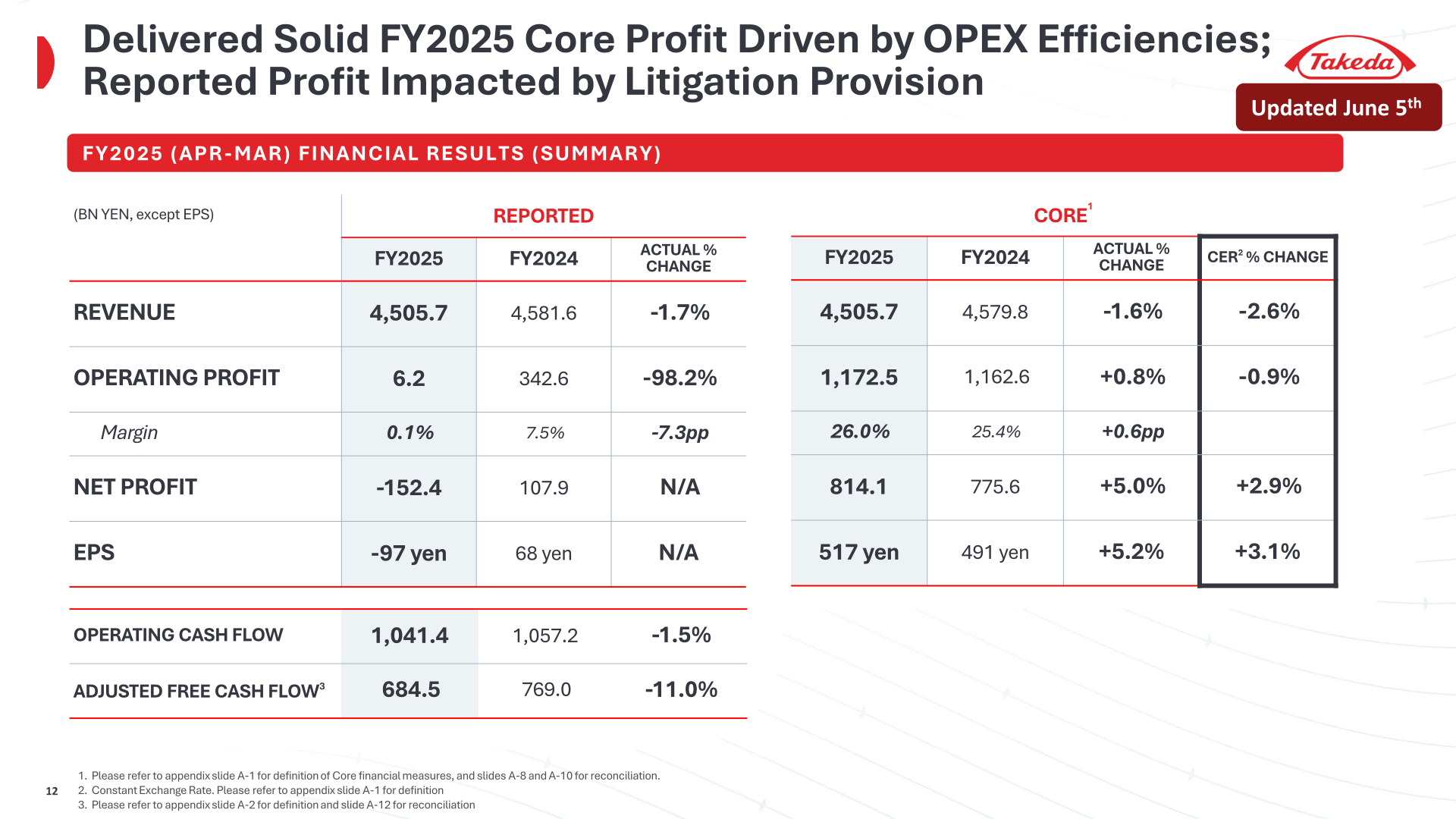
Core Operating Profit was protected through OPEX efficiencies, with over JPY 150.0 billion of cost savings offsetting gross profit pressure from LOE-impacted products while still investing in growth. Reported Operating Profit fell sharply, driven mainly by: (1) the provision for the AMITIZA litigation, partially offset by lower restructuring costs; (2) a JPY 58.2 billion impairment recorded in Q2 related to the decision to discontinue cell therapy efforts; and (3) the completion of the VYVANSE intangible-asset amortization period in January 2026, which reduced amortization expense versus the prior year. Operating Cash Flow was JPY 1,041.4 billion (FY2024: JPY 1,057.2 billion) and Adjusted Free Cash Flow was JPY 684.5 billion, in line with the company’s forecast, versus JPY 769.0 billion in FY2024.
| Item (Reported, BN JPY except EPS) | FY2025 | FY2024 | Change |
|---|---|---|---|
| Revenue | 4,505.7 | 4,581.6 | -1.7% |
| Operating Profit / Margin | 6.2 (0.1%) | 342.6 (7.5%) | -98.2% / -7.3pp |
| Net Profit (Loss) Attributable to Owners | -152.4 | 107.9 | N/A |
| EPS | -97 yen | 68 yen | N/A |
| Operating Cash Flow | 1,041.4 | 1,057.2 | -1.5% |
| Adjusted Free Cash Flow | 684.5 | 769.0 | -11.0% |
| Item (Core, BN JPY except EPS) | FY2025 | FY2024 | Change (AER) | Change (CER) |
|---|---|---|---|---|
| Revenue | 4,505.7 | 4,579.8 | -1.6% | -2.6% |
| Operating Profit / Margin | 1,172.5 (26.0%) | 1,162.6 (25.4%) | +0.8% / +0.6pp | -0.9% |
| Net Profit Attributable to Owners | 814.1 | 775.6 | +5.0% | +2.9% |
| EPS | 517 yen | 491 yen | +5.2% | +3.1% |
Takeda states FY2025 Core Revenue was in-line with its Latest Guidance (issued January 2026), Core Operating Profit came in at the higher end of Latest Guidance due to additional OPEX savings, and Core EPS exceeded Latest Guidance due to a favorable tax position.
| Item (Core, % Change at CER) | FY2025 Results | Latest Guidance (Jan. 2026) | Original Guidance (May 2025) |
|---|---|---|---|
| Core Revenue | -2.6% | Low-single digit % decline | Broadly flat |
| Core Operating Profit | -0.9% | Low-single digit % decline | Broadly flat |
| Core EPS | +3.1% | Low-single digit % decline | Broadly flat |
Business Area Results
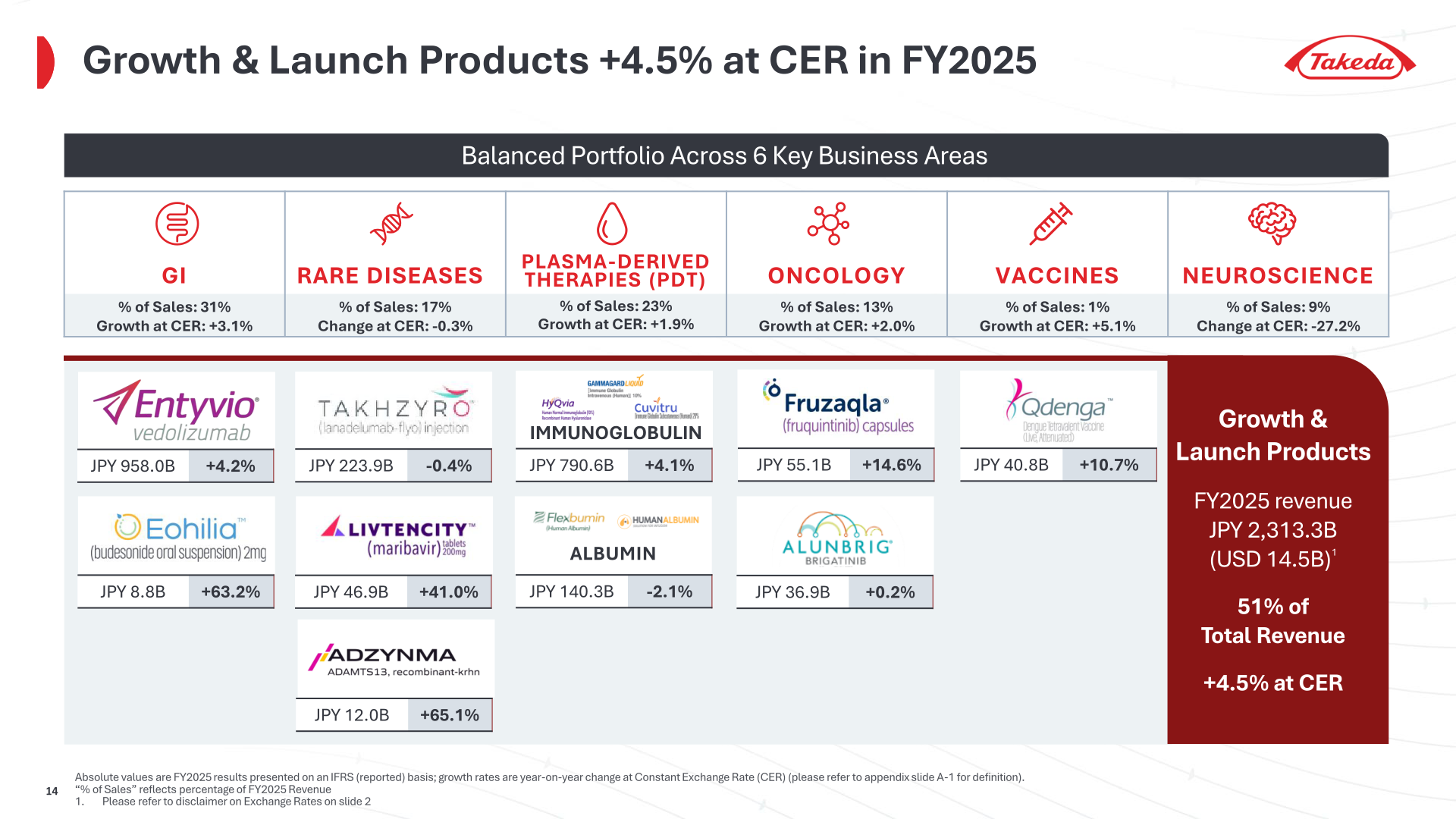
Takeda reports revenue across six key business areas. Growth & Launch Products (a cross-portfolio grouping of newer and expanding brands) totaled JPY 2,313.3 billion, 51% of total revenue, up 4.5% at CER. Within Gastroenterology (GI), ENTYVIO revenue was JPY 958.0 billion (+4.2% at CER), remaining the #1 prescribed IBD brand in the U.S., with U.S. Pen patient volumes growing double-digit QoQ; EOHILIA revenue was JPY 8.8 billion (+63.2% at CER). In Rare Diseases, TAKHZYRO revenue was JPY 223.9 billion (-0.4% at CER) with roughly 6,900 patients treated globally; LIVTENCITY grew to JPY 46.9 billion (+41.0% at CER); ADZYNMA reached JPY 12.0 billion (+65.1% at CER). In Plasma-Derived Therapies (PDT), Immunoglobulin revenue was JPY 790.6 billion (+4.1% at CER) and Albumin was JPY 140.3 billion (-2.1% at CER, impacted by lower China demand). In Oncology, FRUZAQLA revenue was JPY 55.1 billion (+14.6% at CER) and ADCETRIS was JPY 140.2 billion (+5.3% at CER). In Vaccines, QDENGA revenue was JPY 40.8 billion (+10.7% at CER), though Q4 was weaker than expected on delayed Brazil contract signing. In Neuroscience, VYVANSE revenue declined to JPY 203.2 billion (-43.0% at CER, U.S. revenue -63.3% at CER) on broad U.S. generic availability, while TRINTELLIX was JPY 121.8 billion (-1.9% at CER, with Japan growing +14.0%).
| Business Area | % of FY2025 Revenue | FY2025 Change at CER |
|---|---|---|
| Gastroenterology (GI) | 31% | +3.1% |
| Rare Diseases | 17% | -0.3% |
| Plasma-Derived Therapies (PDT) | 23% | +1.9% |
| Oncology | 13% | +2.0% |
| Vaccines | 1% | +5.1% |
| Neuroscience | 9% | -27.2% |
| Key Product | Business Area | FY2025 Revenue (BN JPY) | Change at CER |
|---|---|---|---|
| ENTYVIO | GI | 958.0 | +4.2% |
| EOHILIA | GI | 8.8 | +63.2% |
| TAKHZYRO | Rare Diseases | 223.9 | -0.4% |
| LIVTENCITY | Rare Diseases | 46.9 | +41.0% |
| ADZYNMA | Rare Diseases | 12.0 | +65.1% |
| Immunoglobulin | PDT | 790.6 | +4.1% |
| Albumin | PDT | 140.3 | -2.1% |
| FRUZAQLA | Oncology | 55.1 | +14.6% |
| ADCETRIS | Oncology | 140.2 | +5.3% |
| QDENGA | Vaccines | 40.8 | +10.7% |
| VYVANSE | Neuroscience | 203.2 | -43.0% |
| TRINTELLIX | Neuroscience | 121.8 | -1.9% |
Pipeline and Business Highlights
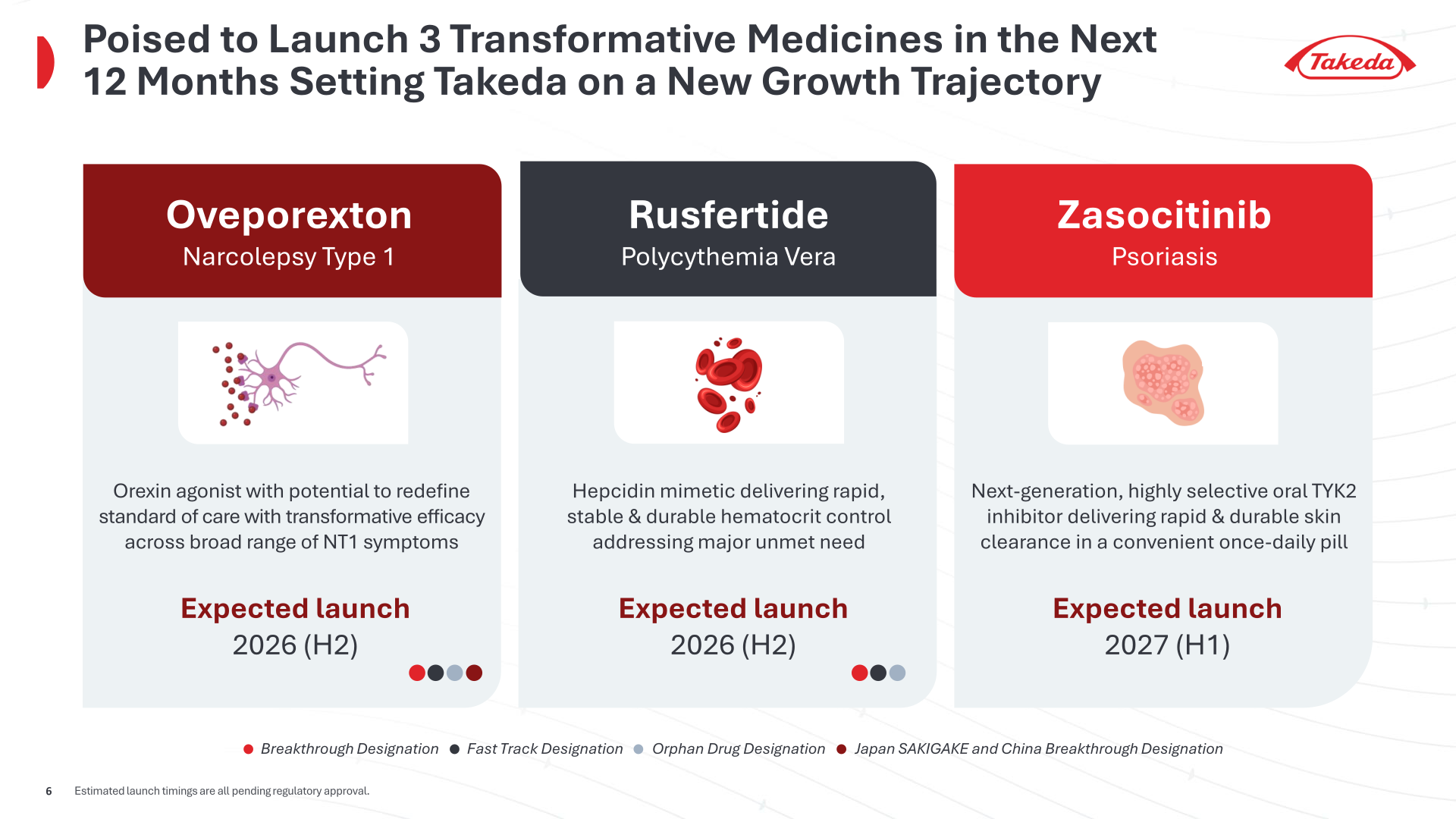
Takeda highlights positive pivotal (Phase 3) data readouts in FY2025 for oveporexton (narcolepsy type 1, NT1), rusfertide (polycythemia vera, PV), zasocitinib (psoriasis) and TAK-881 (primary immunodeficiency, PID), plus Phase 3 study starts for elritercept (2L anemia-associated MDS) and mezagitamab (IgA nephropathy), and a new strategic partnership with Innovent Biologics covering TAK-928 and TAK-921. The company expects to launch three transformative medicines within the next 12 months: oveporexton for NT1 (expected launch 2026 H2), rusfertide for PV (expected launch 2026 H2), and zasocitinib for psoriasis (expected launch 2027 H1, following planned NDA submission), all pending regulatory approval. Beyond these, Takeda cites five additional highly innovative new molecular entities in late-stage development: mezagitamab, elritercept, fazirsiran, TAK-928 and TAK-921. On leadership, Christophe Weber has announced his intention to retire in June 2026, with Julie Kim to be appointed by the Board to succeed him as President & CEO, pending shareholder approval; the proposed Board of Directors comprises 8 independent external directors and 3 internal directors. A Capital Markets Day is planned for later in FY2026.
Transformation Program
Takeda’s FY2024-2025 enterprise-wide efficiency program impacted more than 4,000 positions over two years and delivered cumulative restructuring costs of approximately JPY 200.0 billion (roughly 60% compensation & benefits, 20% procurement savings, 20% other costs such as facilities and equipment), generating annualized cost savings of approximately JPY 300.0 billion as of the FY2025 fiscal year end. A new Transformation Program aligned with the company’s new organizational structure begins in FY2026, targeting more than JPY 200.0 billion of annualized gross savings by FY2028 (approximately JPY 100.0 billion expected in FY2026), with restructuring costs of approximately JPY 170.0 billion in FY2026 (a lower amount expected in FY2027 and FY2028) and approximately 4,500 roles impacted (gross) in FY2026.
FY2026 Forecast
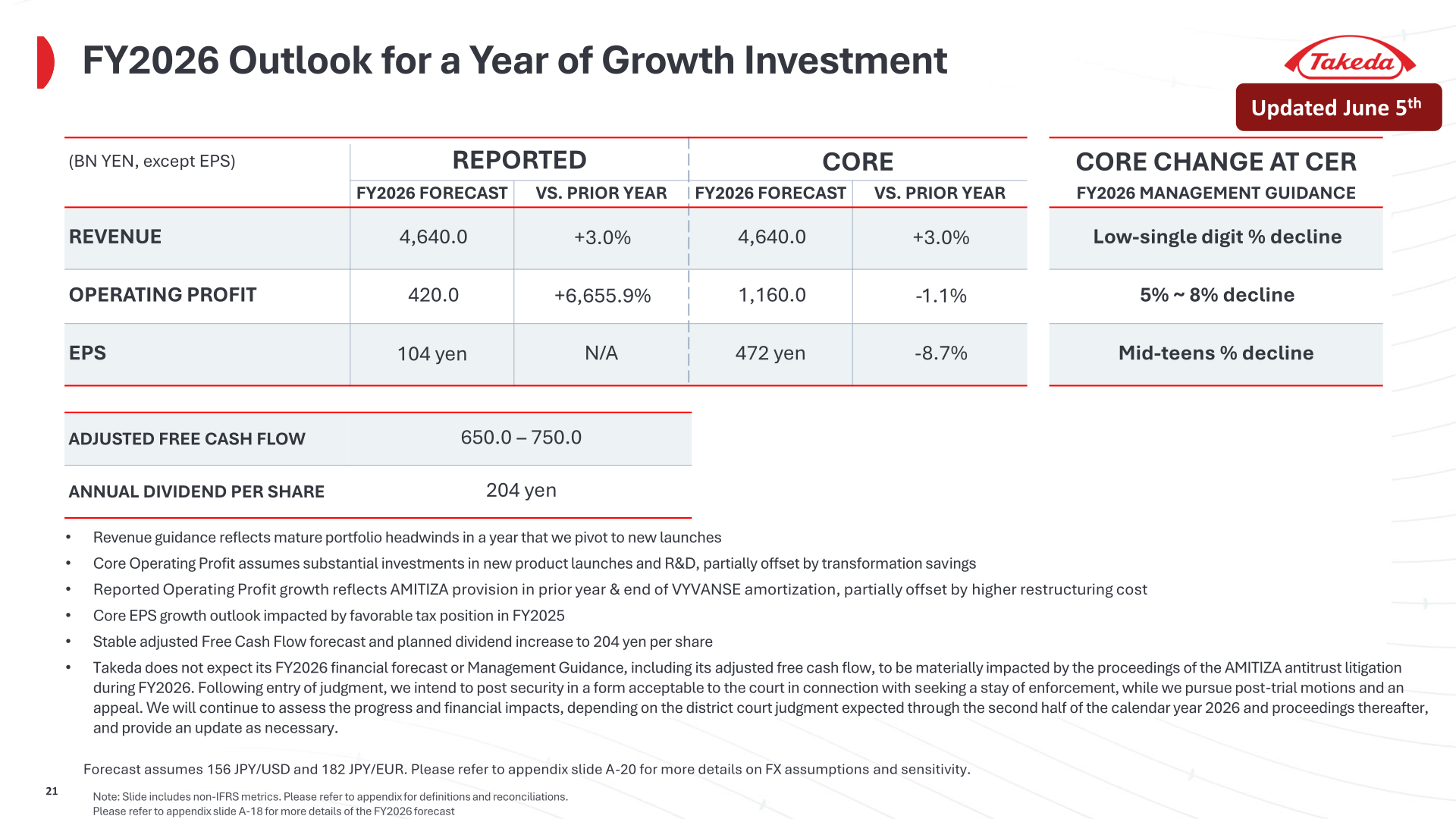
Takeda frames FY2026 as a year of growth investment ahead of new product launches. Reported and Core Revenue are both forecast at JPY 4,640.0 billion, up 3.0% (AER), as FX tailwinds and new-launch contributions more than offset mature-portfolio headwinds including continued LOE impact from VYVANSE and TRINTELLIX in the U.S.; at constant exchange rates, the company’s guidance is for a low-single digit % decline in Core Revenue. Core Operating Profit is forecast at JPY 1,160.0 billion (-1.1% AER; guidance of 5%~8% decline at CER), reflecting substantial investment in new product launches (mainly oveporexton, rusfertide and zasocitinib) and R&D (including the newly added TAK-928 and TAK-921 programs), partially offset by approximately JPY 100.0 billion of Transformation Program savings. Core EPS is forecast at 472 yen (-8.7% AER; guidance of mid-teens % decline at CER), reflecting the absence of the favorable tax position recognized in FY2025. Reported Operating Profit is forecast at JPY 420.0 billion, sharply higher than FY2025’s JPY 6.2 billion, reflecting the absence of the AMITIZA provision and the end of VYVANSE amortization, partially offset by JPY 170.0 billion of Transformation Program restructuring expenses. Adjusted Free Cash Flow is guided at JPY 650.0-750.0 billion. The forecast assumes FX rates of 156 JPY/USD and 182 JPY/EUR. Takeda states it does not expect its FY2026 financial forecast or Management Guidance, including adjusted Free Cash Flow, to be materially impacted by the AMITIZA antitrust litigation proceedings during FY2026, while it pursues post-trial motions and an appeal following entry of judgment.
| Item | FY2026 Forecast | FY2025 Actual | Change / Guidance |
|---|---|---|---|
| Revenue, Reported & Core (BN JPY) | 4,640.0 | 4,505.7 | +3.0% AER; Low-single digit % decline at CER |
| Operating Profit, Reported (BN JPY) | 420.0 | 6.2 | +6,655.9% |
| Operating Profit, Core (BN JPY) | 1,160.0 | 1,172.5 | -1.1% AER; 5%~8% decline at CER |
| EPS, Reported | 104 yen | -97 yen | N/A |
| EPS, Core | 472 yen | 517 yen | -8.7% AER; Mid-teens % decline at CER |
| Adjusted Free Cash Flow (BN JPY) | 650.0 – 750.0 | 684.5 | – |
| Annual Dividend per Share | 204 yen | 100 yen (year-end, unchanged) | Proposed increase |
Shareholder Returns
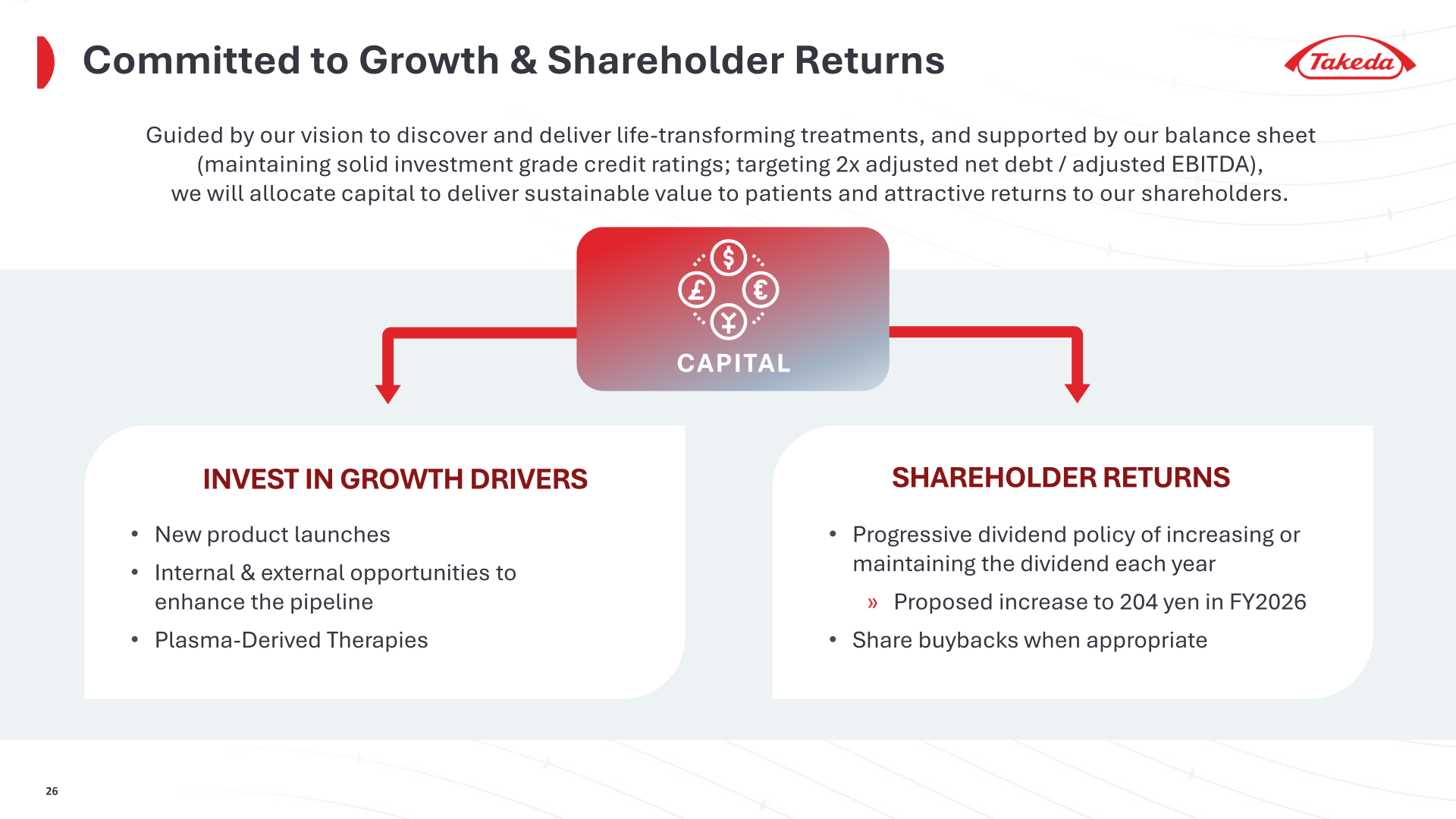
Takeda’s capital allocation policy is guided by a target of maintaining solid investment grade credit ratings and an adjusted net debt / adjusted EBITDA ratio of around 2x; the FY2025 Adjusted Net Debt / Adjusted EBITDA ratio was 2.6x (FY2024: 2.8x). The company’s shareholder return policy is a progressive dividend policy of increasing or maintaining the dividend each year, together with share buybacks when appropriate. The FY2025 year-end dividend remains unchanged at JPY 100 per share, as confirmed in the June 5, 2026 revised disclosure notwithstanding the AMITIZA-related provision. For FY2026, Takeda proposes to increase the annual dividend to JPY 204 per share, with the annual dividend forecast also unchanged following the June 5 revision. In FY2025, Takeda’s cash flow statement shows JPY 51.6 billion used for share buybacks (FY2024: JPY 51.9 billion) and JPY 311.9 billion of dividends paid (FY2024: JPY 302.5 billion).
Medium-Term Plan / Topics
Takeda frames its strategy around two growth horizons. Horizon One, ‘Transforming for Growth,’ focuses on strengthening competitiveness and building the growth engine: establishing new growth drivers starting with the three upcoming launches, advancing the late-stage pipeline through key inflection points, ensuring resilience of core in-line brands, and executing the transformation program. Horizon Two, ‘Growth Acceleration,’ targets long-term profitable growth and patient impact, including compelling revenue growth driven by new launches, Core Operating Profit margin expansion to the low-to-mid 30s%, significant improvement in capital efficiency metrics, and targeted investments to fuel further growth, alongside an ambition to improve reported profits and deliver ROE over 5%. A Capital Markets Day is planned for later in FY2026 to provide further detail on this strategy.
This article is an analysis based on publicly available information and is not a recommendation to buy or sell any specific securities. Investment decisions are your own responsibility.
![[Obayashi] Investors’ Guide 2026 — The Complete 24-Article Breakdown](https://japan-equity.com/wp-content/uploads/2026/07/hub_cover-1024x1024.png)
![[Obayashi] IR & SR Policy — Feeding Dialogue Back into Management](https://japan-equity.com/wp-content/uploads/2026/07/p32_sq-1024x1024.jpg)
![[Obayashi] Real Estate Development — 18.7% Margin, ¥287.7bn Unrealized Gains](https://japan-equity.com/wp-content/uploads/2026/07/p20_sq-1024x1024.jpg)
![[Obayashi] Domestic Civil Engineering — Resilience Spending Supports 9.6% Margin](https://japan-equity.com/wp-content/uploads/2026/07/p11_sq-1024x1024.jpg)
![[Obayashi] Share Price & External Ratings — vs TOPIX, ESG Index Inclusion](https://japan-equity.com/wp-content/uploads/2026/07/p40_sq-1024x1024.jpg)
![[Construction] ¥75.5tn Investment, Shrinking Workforce — Big-5 Market Share](https://japan-equity.com/wp-content/uploads/2026/07/p12_sq-1024x1024.jpg)
![[Obayashi] Capital Policy & Shareholder Returns — ROE 10%+, DOE ~5%, ¥100bn Buyback](https://japan-equity.com/wp-content/uploads/2026/07/p27_sq-1024x1024.jpg)
![[Obayashi] Reducing Cross-Shareholdings — ¥285.2bn Sold in Five Years](https://japan-equity.com/wp-content/uploads/2026/07/p29_sq-1024x1024.jpg)
![[Obayashi] ¥750bn Investment Plan — ¥300bn to Development, ¥190bn to Tech/DX](https://japan-equity.com/wp-content/uploads/2026/07/p30_sq-1024x1024.jpg)
![[Obayashi] MTP2022 KPIs — Operating Profit ~2x Target, ROE 14.4%](https://japan-equity.com/wp-content/uploads/2026/07/p25_sq-1024x1024.jpg)
![[Obayashi] Cash Allocation — ¥420bn Investment CF Over Five Years](https://japan-equity.com/wp-content/uploads/2026/07/p26_sq-1024x1024.jpg)
![[Obayashi] Green Energy — 44 Plants, 344MW, and the Green Hydrogen Challenge](https://japan-equity.com/wp-content/uploads/2026/07/p21_sq-1024x1024.jpg)
![[Obayashi] Tackling the Labor Shortage — Robotics Construction®](https://japan-equity.com/wp-content/uploads/2026/07/p14_sq-1024x1024.jpg)
