This article is based on publicly available IR materials and is not a recommendation to buy or sell any specific securities.
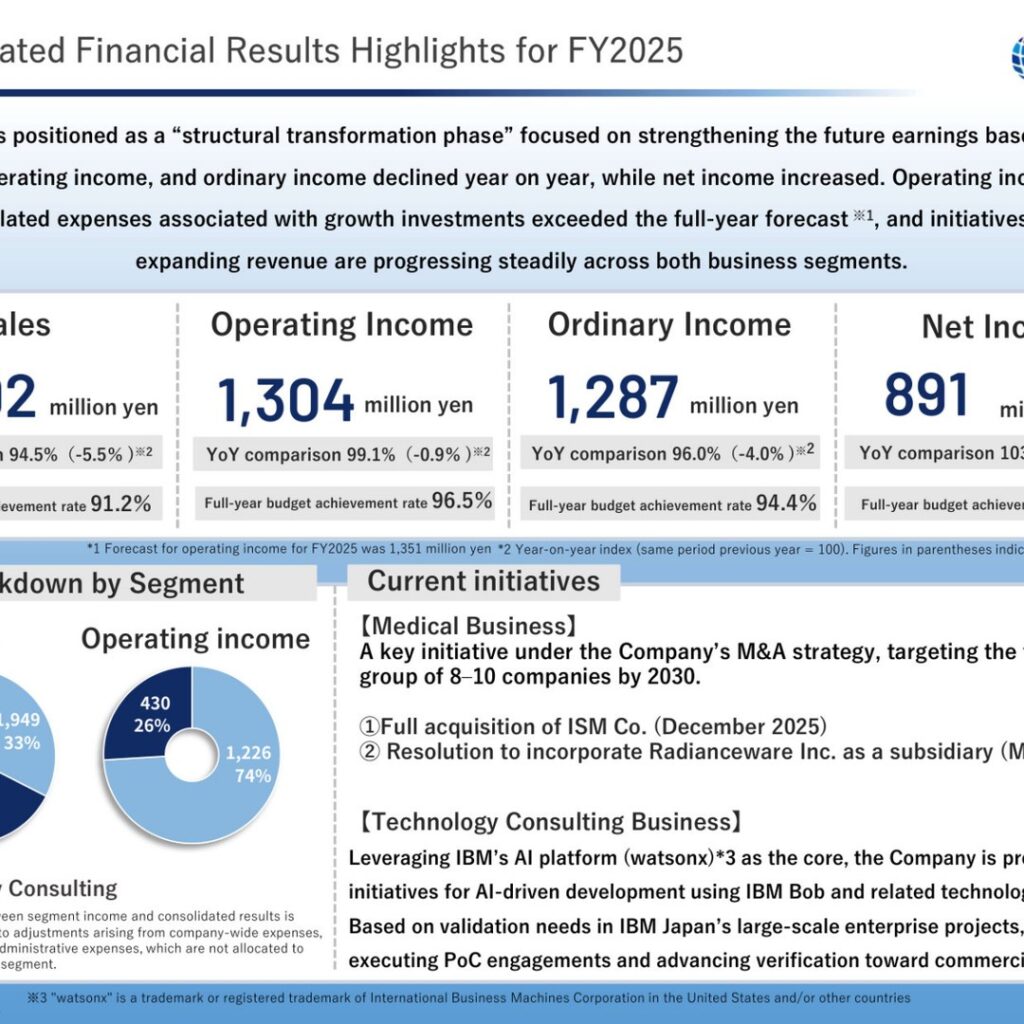
Ubicom Holdings, Inc. (Standard Market of TSE: 3937) reported sales of 5,992 million yen for FY2025 (ended March 31, 2026), down 5.5% year on year, with operating income of 1,304 million yen (down 0.9%) and ordinary income of 1,287 million yen (down 4.0%), while net income attributable to shareholders of the parent company rose 3.9% to 891 million yen. The company positioned FY2025 as a “structural transformation phase” focused on strengthening its future earnings base. The Medical Business posted record sales and operating income, while the Technology Consulting Business saw lower sales and profit as it curtailed small-scale, short-term and low-margin projects to shift toward an AI-driven, high value-added model. For FY2026, the company forecasts sales of 7,383 million yen (+23.2%) and operating income of 1,511 million yen (+15.9%).
Consolidated Results (Full-Year Actual)
Sales declined by 348 million yen to 5,992 million yen, and operating income declined by 11 million yen to 1,304 million yen. Operating income excluding M&A-related expenses was 1,379 million yen, up 4.9% (+64 million yen) year on year, which the company notes exceeded its FY2025 operating income forecast of 1,351 million yen. The one-off M&A-related expenses, including due diligence and advisory fees, were associated with the acquisition of Radianceware Inc. Ordinary income fell 54 million yen to 1,287 million yen, while net income attributable to shareholders of the parent company increased 33 million yen to 891 million yen.
Against the full-year budget, the achievement rates were 91.2% for sales, 96.5% for operating income, 94.4% for ordinary income and 94.0% for net income.
| Item (million yen) | FY2025 Full-Year | Sales Ratio | FY2024 Full-Year | Sales Ratio | YoY Comparison | Variance |
|---|---|---|---|---|---|---|
| Sales | 5,992 | 100.0% | 6,340 | 100.0% | 94.5% (-5.5%) | -348 |
| Operating Income | 1,304 | 21.8% | 1,315 | 20.7% | 99.1% (-0.9%) | -11 |
| Operating Income (Excluding M&A-related expenses) | 1,379 | 23.0% | 1,315 | 20.7% | 104.9% (+4.9%) | +64 |
| Ordinary Income | 1,287 | 21.5% | 1,341 | 21.2% | 96.0% (-4.0%) | -54 |
| Net Income attributable to shareholders of the parent company | 891 | 14.9% | 858 | 13.5% | 103.9% (+3.9%) | +33 |
Segment Results
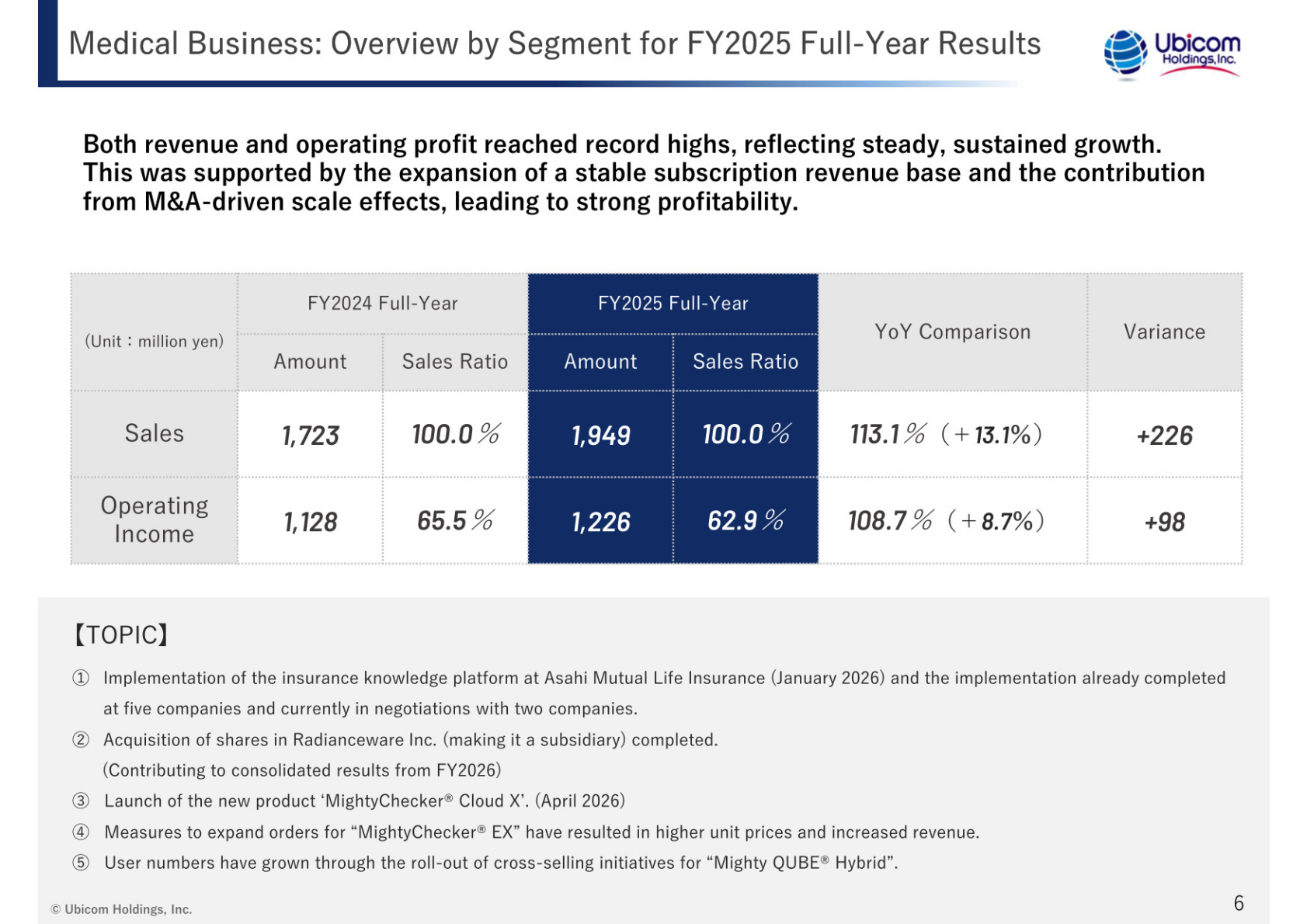
Medical Business: Sales rose 13.1% (+226 million yen) to 1,949 million yen and operating income rose 8.7% (+98 million yen) to 1,226 million yen, both record highs, supported by the expansion of a stable subscription revenue base and scale effects from M&A. The operating margin was 62.9%, compared with 65.5% a year earlier; the company explains that the acquisition of ISM’s distributor business (included in the Group effective July 2025) temporarily reduced profit margins. Topics in the year included implementation of the Insurance Knowledge Platform at Asahi Mutual Life Insurance (January 2026), with implementation completed at five companies and negotiations under way with two companies; completion of the acquisition of Radianceware Inc. (contributing to consolidated results from FY2026); the launch of the new product “MightyChecker® Cloud X” (April 2026); higher unit prices and revenue from order-expansion measures for “MightyChecker® EX”; and user growth from cross-selling “Mighty QUBE® Hybrid”. As of FY2025 4Q, the Mighty series was used by 22,912 facilities nationwide (3,925 hospitals and 18,987 clinics).
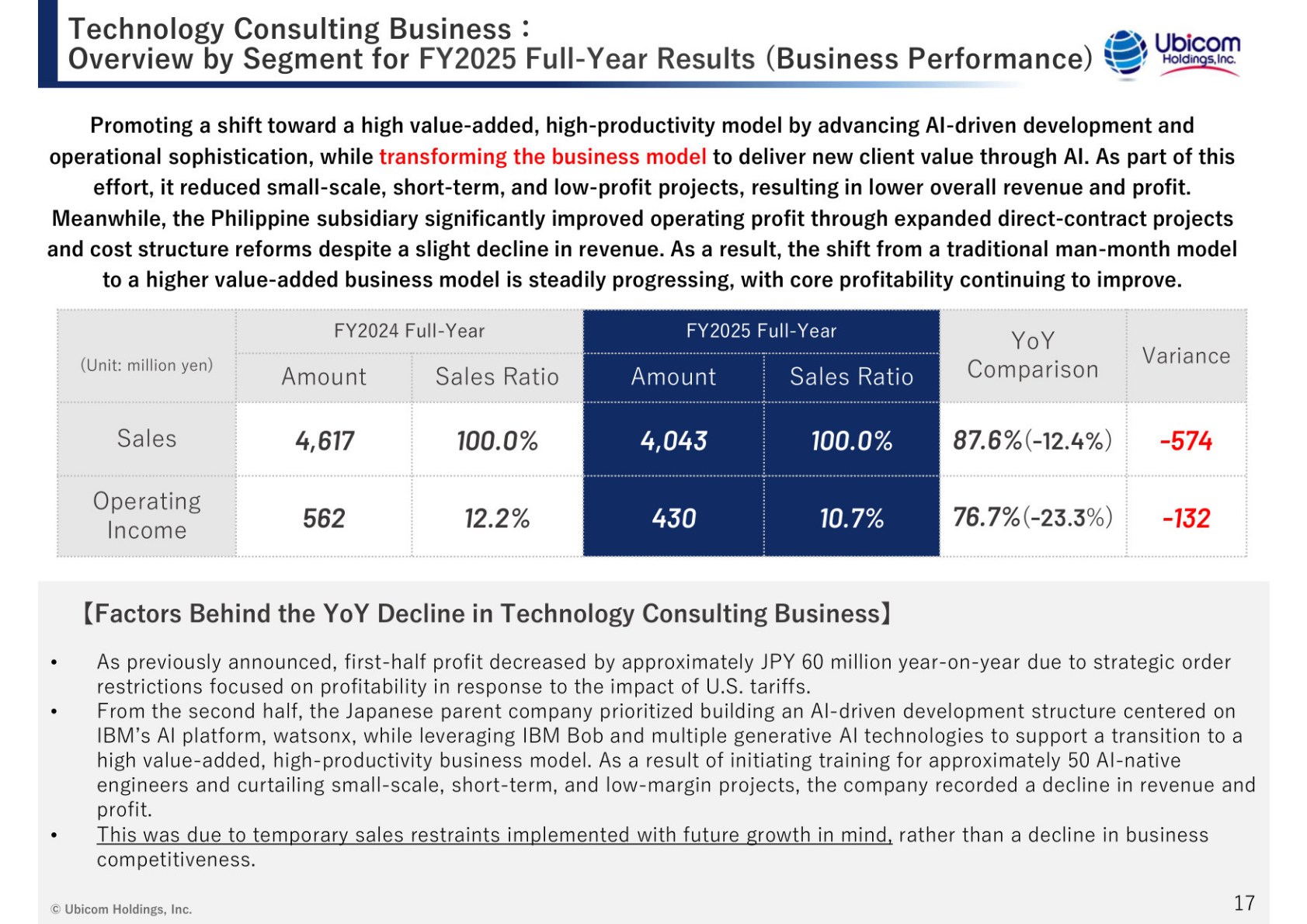
Technology Consulting Business: Sales fell 12.4% (-574 million yen) to 4,043 million yen and operating income fell 23.3% (-132 million yen) to 430 million yen. According to the company, first-half profit decreased by approximately JPY 60 million year on year due to strategic order restrictions focused on profitability in response to the impact of U.S. tariffs. From the second half, the Japanese parent company prioritized building an AI-driven development structure centered on IBM’s AI platform watsonx, leveraging IBM Bob and multiple generative AI technologies, initiated training for approximately 50 AI-native engineers, and curtailed small-scale, short-term and low-margin projects. The company describes the decline as the result of temporary sales restraints implemented with future growth in mind, rather than a decline in business competitiveness. The Philippine subsidiary’s revenue was 97.5% of the prior year (-JPY 74 million), while its operating profit increased 28.9% year on year (+JPY 82 million), supported by expanded direct-contract projects and cost structure reforms.
| Segment | Metric (million yen) | FY2025 Full-Year | FY2024 Full-Year | YoY Comparison | Variance |
|---|---|---|---|---|---|
| Medical Business | Sales | 1,949 | 1,723 | 113.1% (+13.1%) | +226 |
| Medical Business | Operating Income | 1,226 | 1,128 | 108.7% (+8.7%) | +98 |
| Medical Business | Sales Ratio (Operating Income) | 62.9% | 65.5% | — | — |
| Technology Consulting Business | Sales | 4,043 | 4,617 | 87.6% (-12.4%) | -574 |
| Technology Consulting Business | Operating Income | 430 | 562 | 76.7% (-23.3%) | -132 |
| Technology Consulting Business | Sales Ratio (Operating Income) | 10.7% | 12.2% | — | — |
The company notes that the difference between segment income and consolidated results is primarily attributable to adjustments arising from company-wide expenses, such as general and administrative expenses, which are not allocated to any specific reporting segment.
FY2026 Forecast
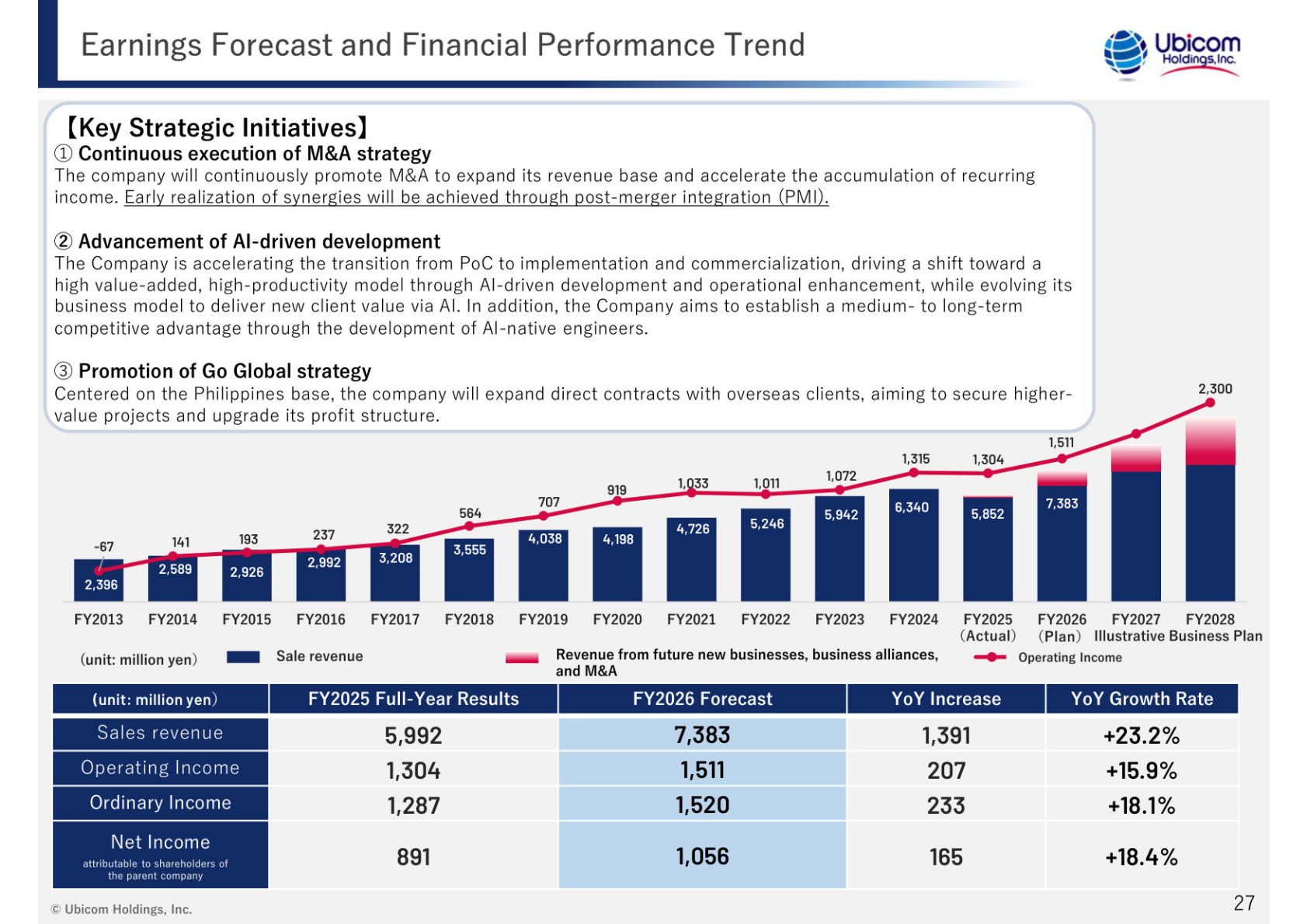
For FY2026, the company forecasts sales revenue of 7,383 million yen (+1,391 million yen, +23.2%), operating income of 1,511 million yen (+207 million yen, +15.9%), ordinary income of 1,520 million yen (+233 million yen, +18.1%) and net income attributable to shareholders of the parent company of 1,056 million yen (+165 million yen, +18.4%). The company expects further expansion of the Medical Business revenue base and contributions from newly acquired subsidiaries. The forecast incorporates higher depreciation related to “MightyChecker® Cloud X”, as well as goodwill amortization and one-time integration costs associated with M&A. Revenue contributions from production-level projects driven by AI-based development in the Technology Consulting Business are not included at this stage due to a conservative outlook. The company states that geopolitical risks, including the situation in the Middle East, are not currently expected to have a material impact on its performance.
| Item (million yen) | FY2026 Forecast | FY2025 Full-Year Results | YoY Increase | YoY Growth Rate |
|---|---|---|---|---|
| Sales revenue | 7,383 | 5,992 | 1,391 | +23.2% |
| Operating Income | 1,511 | 1,304 | 207 | +15.9% |
| Ordinary Income | 1,520 | 1,287 | 233 | +18.1% |
| Net Income attributable to shareholders of the parent company | 1,056 | 891 | 165 | +18.4% |
Shareholder Returns
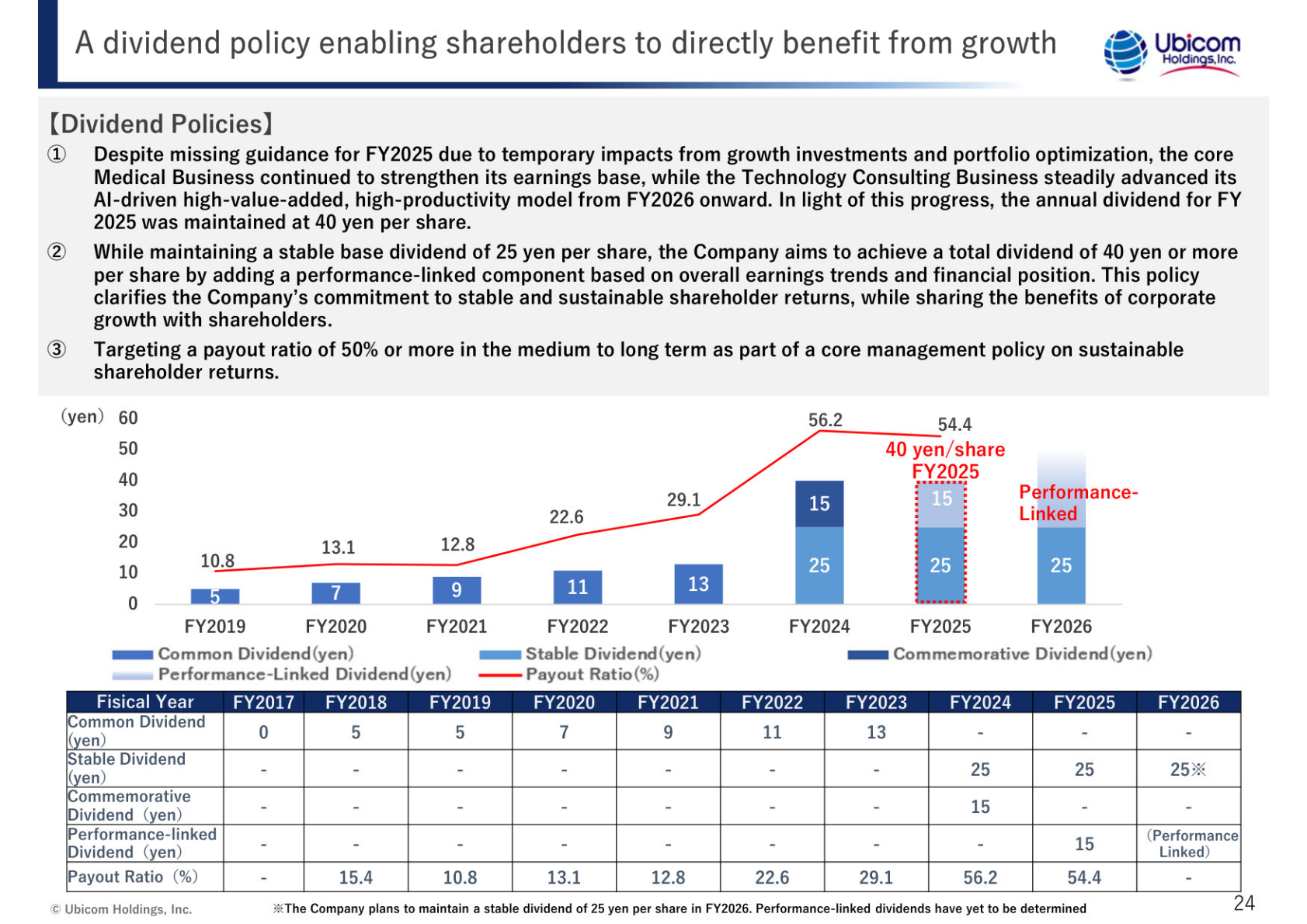
The annual dividend for FY2025 was maintained at 40 yen per share, consisting of a stable dividend of 25 yen and a performance-linked dividend of 15 yen, for a payout ratio of 54.4%. The company states that, despite missing guidance for FY2025 due to temporary impacts from growth investments and portfolio optimization, the dividend was maintained in light of the strengthening earnings base of the Medical Business and progress toward an AI-driven model in the Technology Consulting Business. Under its dividend policy, the company aims to achieve a total dividend of 40 yen or more per share by adding a performance-linked component to a stable base dividend of 25 yen, and targets a payout ratio of 50% or more in the medium to long term. For FY2026, the company plans to maintain the stable dividend of 25 yen per share; the performance-linked dividend has yet to be determined.
| Dividend per share (yen) | FY2026 (Plan) | FY2025 | FY2024 | FY2023 |
|---|---|---|---|---|
| Common Dividend | – | – | – | 13 |
| Stable Dividend | 25※ | 25 | 25 | – |
| Commemorative Dividend | – | – | 15 | – |
| Performance-linked Dividend | (Performance Linked) | 15 | – | – |
| Payout Ratio (%) | – | 54.4 | 56.2 | 29.1 |
※The Company plans to maintain a stable dividend of 25 yen per share in FY2026. Performance-linked dividends have yet to be determined.
Medium- to Long-Term Strategy
In the Medical Business, the company is pursuing an M&A strategy of nationwide distributor acquisitions, targeting a cumulative integration of 8 to 10 companies from 2025 to 2030, primarily self-funded. Distributors account for 95% of Mighty Series sales, and the company aims to move toward a Group direct sales model. Phase 1 was the full acquisition of ISM Corporation as a Kyushu base (December 2025), and Phase 2 is Radianceware Inc., covering the Tokyo Metropolitan and Northern Kanto area, with an existing customer base of approximately 475 clients. Mid- to long-term KPIs for the M&A strategy include raising the Group’s direct sales ratio from 4.8% (2025) to 35% (2030 target), LTV from 1.28 million yen to 1.97 million yen (+54%), and the LTV/CAC ratio from 9.3x to 14.2x. The new “MightyChecker® Cloud X” targets approximately 2,000 small hospitals with fewer than 100 beds that have not yet adopted the Mighty series, with migration of existing users from the previous product scheduled for completion in October 2026.
In the Technology Consulting Business, the company, as a strategic partner of IBM Japan, is establishing an AI center in the Philippines and developing an AI-driven development framework through three stages: validation (Q3 of FY2025), PoC (Q4 of FY2025) and implementation and commercialization (Q4 of FY2026). It reports a total of 15 AI use cases across industries in the validation and PoC phase. Key strategic initiatives for FY2026 are continuous execution of the M&A strategy, advancement of AI-driven development, and promotion of the Go Global strategy centered on the Philippines base.
This article is an analysis based on publicly available information and is not a recommendation to buy or sell any specific securities. Investment decisions are your own responsibility.