This article is based on publicly available IR materials and is not a recommendation to buy or sell any specific securities.
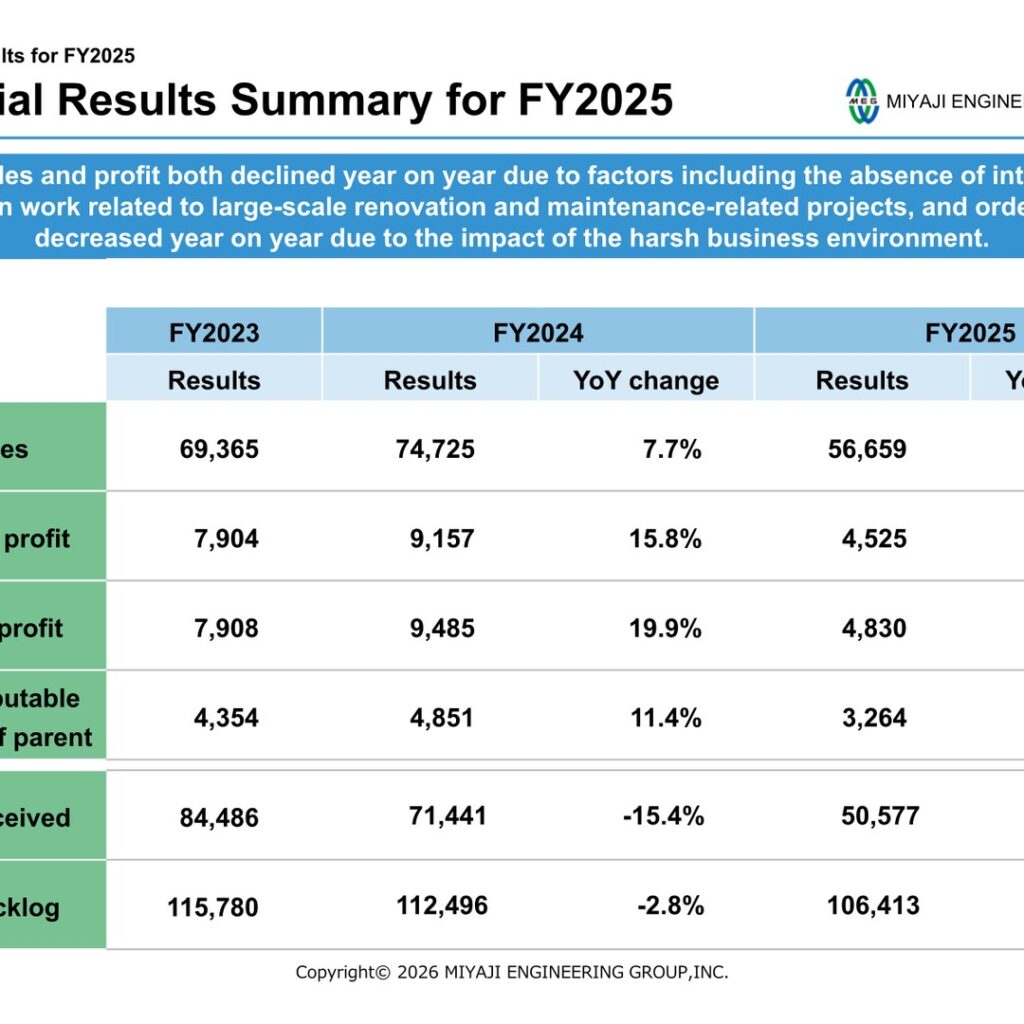
MIYAJI ENGINEERING GROUP, INC. (TSE: 3431), a steel bridge and structural steel group built around MIYAJI ENGINEERING (MEC) and MM BRIDGE (MMB), reported lower sales and profit for FY2025 (fiscal year ended March 31, 2026). Net sales declined 24.2% year on year to 56,659 million yen and operating profit fell 50.6% to 4,525 million yen, mainly due to the absence of intensive construction work on large-scale renovation and maintenance-related projects that had boosted the previous fiscal year. Orders received decreased 29.2% to 50,577 million yen amid a harsh business environment. The annual dividend was maintained at ¥97.5 per share, and for FY2026 the company forecasts net sales of 55,000 million yen and operating profit of 2,300 million yen, with a dividend of ¥75 per share.
Consolidated Results (Full-Year Actual)
The company describes the business environment as follows: although public investment (budget base) remained firm, order volume based on operational volume continued to decline due to soaring per-unit construction costs caused by rising wages and prices. In the mainstay bridge business, new construction-related orders (monetary base) totaled ¥199.0 billion, down from ¥252.5 billion in the previous fiscal year, and order volume based on steel weight fell below 100,000 tons to 96,000 tons. Large-scale renovation and maintenance-related orders totaled ¥210.0 billion, above the ¥180.2 billion of the previous fiscal year, but this was not enough to compensate for the decrease in new construction-related orders (market figures are based on the company’s and the Japan Bridge Association’s aggregate calculations).
Despite initiatives to improve production efficiency and construction profitability, and operational efficiency improvements through work style reforms, ordinary profit decreased 49.1% to 4,830 million yen and profit attributable to owners of parent decreased 32.7% to 3,264 million yen. The order backlog at year-end was 106,413 million yen, down 5.4%. Certain consolidated subsidiaries changed the attribution method of the estimated amount of retirement benefits and the accounting method of unrecognized actuarial differences from the beginning of FY2025; these changes were applied retroactively and figures for the previous fiscal year were restated.
| Item (Million yen) | FY2025 | FY2024 | YoY Change |
|---|---|---|---|
| Net sales | 56,659 | 74,725 | -24.2% |
| Operating profit | 4,525 | 9,157 | -50.6% |
| Ordinary profit | 4,830 | 9,485 | -49.1% |
| Profit attributable to owners of parent | 3,264 | 4,851 | -32.7% |
| Orders received | 50,577 | 71,441 | -29.2% |
| Order backlog | 106,413 | 112,496 | -5.4% |
On the balance sheet, total assets at March 31, 2026 were 82,021 million yen (90,597 million yen a year earlier) and total net assets were 49,988 million yen (48,573 million yen). The equity-to-asset ratio increased to 52.2% from 45.0% on March 31, 2025. Cash flows from operating activities were 10,944 million yen (compared with (2,652) million yen in FY2024), driven by a decrease in trade receivables and an increase in advances received on construction contracts in progress, while cash flows from financing activities were (10,980) million yen due to the repayment of short-term borrowings. Cash and cash equivalents at the end of the period were 12,370 million yen. ROE for FY2025 was 7.8% and ROA was 5.6%.
Segment Results
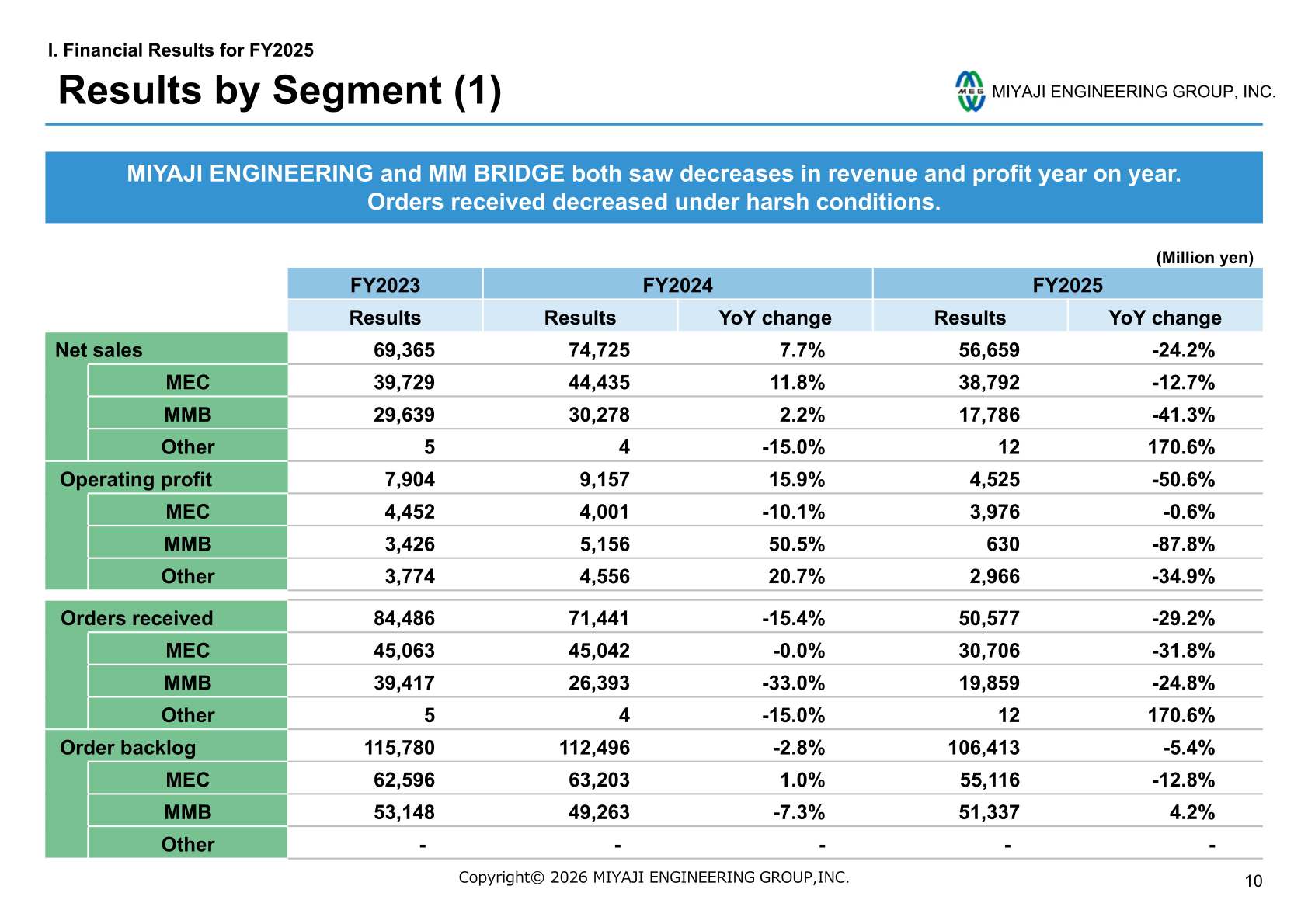
Both MIYAJI ENGINEERING and MM BRIDGE saw decreases in revenue and profit year on year. At MIYAJI ENGINEERING (MEC), net sales were 38,792 million yen (-12.7%), supported by progress on the main bridge superstructure on the Kawasaki Harbor Road Higashi-Ogishima Mizue-cho Line for the Kanto Regional Development Bureau and the Daini-Keihan Expressway Kadoma East viaduct for West Nippon Expressway Company; operating profit was 3,976 million yen (-0.6%) owing to production efficiency, construction profitability and work style reform initiatives. MEC orders received fell 31.8% to 30,706 million yen, including the National route No. 57 Shiohitashigawa bridge superstructure in Kumamoto prefecture.
At MM BRIDGE (MMB), net sales fell 41.3% to 17,786 million yen due to reductions in the scope of work for some construction projects, despite steady progress on the Sasebo Viaduct widening construction and the Somagawa Viaduct for West Nippon Expressway. Operating profit decreased 87.8% to 630 million yen due to soaring materials, equipment and labor costs and the decrease in net sales, despite cost reductions and price improvements. MMB orders received fell 24.8% to 19,859 million yen, although it won a large-scale ECI project for the Sendaimiyagi Dramp bridge on the Tohoku Expressway for East Nippon Expressway. The MMB order backlog rose 4.2% to 51,337 million yen, while the MEC backlog declined 12.8% to 55,116 million yen.
| Segment (Million yen) | Metric | FY2025 | FY2024 | YoY Change |
|---|---|---|---|---|
| MEC | Net sales | 38,792 | 44,435 | -12.7% |
| MEC | Operating profit | 3,976 | 4,001 | -0.6% |
| MEC | Orders received | 30,706 | 45,042 | -31.8% |
| MEC | Order backlog | 55,116 | 63,203 | -12.8% |
| MMB | Net sales | 17,786 | 30,278 | -41.3% |
| MMB | Operating profit | 630 | 5,156 | -87.8% |
| MMB | Orders received | 19,859 | 26,393 | -24.8% |
| MMB | Order backlog | 51,337 | 49,263 | 4.2% |
| Other | Net sales | 12 | 4 | 170.6% |
| Other | Operating profit | 2,966 | 4,556 | -34.9% |
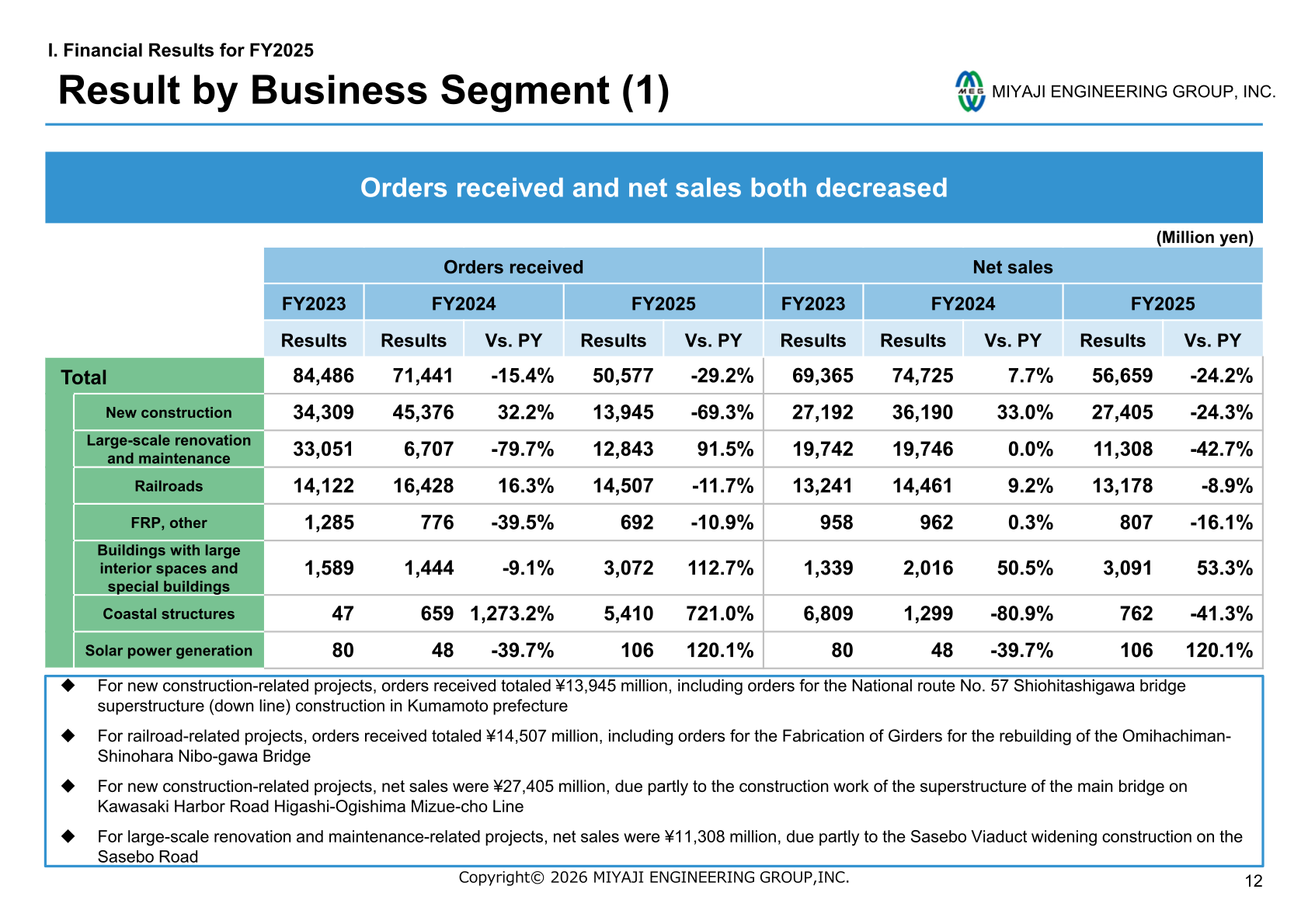
By business field, net sales from new construction-related projects were 27,405 million yen (-24.3%) and from large-scale renovation and maintenance-related projects 11,308 million yen (-42.7%). Orders received for new construction fell 69.3% to 13,945 million yen, while large-scale renovation and maintenance orders rose 91.5% to 12,843 million yen. Railroad-related orders totaled 14,507 million yen, including the fabrication of girders for the rebuilding of the Omihachiman-Shinohara Nibo-gawa Bridge. Bridges accounted for 93% of FY2025 sales.
| Business Field (Million yen) | Orders FY2025 | Orders Vs. PY | Net Sales FY2025 | Net Sales Vs. PY |
|---|---|---|---|---|
| New construction | 13,945 | -69.3% | 27,405 | -24.3% |
| Large-scale renovation and maintenance | 12,843 | 91.5% | 11,308 | -42.7% |
| Railroads | 14,507 | -11.7% | 13,178 | -8.9% |
| FRP, other | 692 | -10.9% | 807 | -16.1% |
| Buildings with large interior spaces and special buildings | 3,072 | 112.7% | 3,091 | 53.3% |
| Coastal structures | 5,410 | 721.0% | 762 | -41.3% |
| Solar power generation | 106 | 120.1% | 106 | 120.1% |
| Total | 50,577 | -29.2% | 56,659 | -24.2% |
FY2026 Forecast
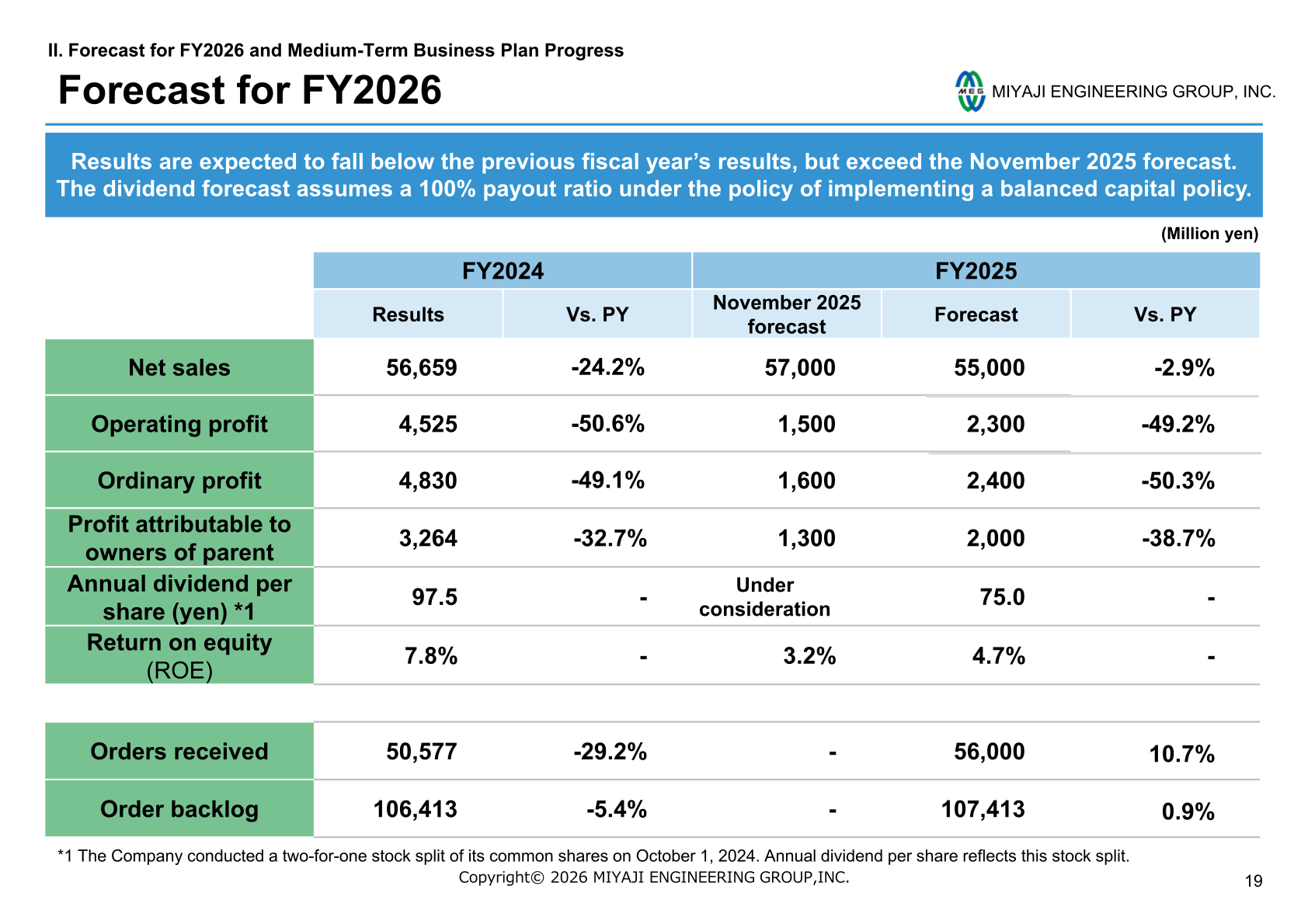
The company expects the challenging business environment in the bridge business to continue through the first half of the next Medium-Term Business Plan period (FY2027 to FY2031), estimating market orders for the fiscal year ending March 31, 2027 at ¥180.0 billion for new construction-related projects and ¥195.0 billion for large-scale renovation and maintenance-related projects, both below the previous year. Against this backdrop, FY2026 results are expected to fall below FY2025 but exceed the November 2025 forecast: net sales of 55,000 million yen (-2.9%), operating profit of 2,300 million yen (-49.2%), ordinary profit of 2,400 million yen (-50.3%) and profit attributable to owners of parent of 2,000 million yen (-38.7%). Orders received are forecast to rise 10.7% to 56,000 million yen, and ROE is forecast at 4.7%. (The column headings on the forecast slide read “FY2024” and “FY2025”; the slide title and the rest of the presentation refer to these figures as FY2025 results and the FY2026 forecast.)
| Item (Million yen) | FY2026 Forecast | Vs. PY | November 2025 Forecast | FY2025 (Actual) |
|---|---|---|---|---|
| Net sales | 55,000 | -2.9% | 57,000 | 56,659 |
| Operating profit | 2,300 | -49.2% | 1,500 | 4,525 |
| Ordinary profit | 2,400 | -50.3% | 1,600 | 4,830 |
| Profit attributable to owners of parent | 2,000 | -38.7% | 1,300 | 3,264 |
| Annual dividend per share (yen) | 75.0 | – | Under consideration | 97.5 |
| Return on equity (ROE) | 4.7% | – | 3.2% | 7.8% |
| Orders received | 56,000 | 10.7% | – | 50,577 |
| Order backlog | 107,413 | 0.9% | – | 106,413 |
Shareholder Returns
The company’s basic policy is to implement a balanced capital policy, including investments for sustainable growth. A payout ratio of 30% was set from the fiscal year ended March 31, 2022, and in August 2023 the dividend policy was revised to flexible shareholder returns in line with performance, with a payout ratio of approximately 60%, while appropriately controlling the level of equity capital. Looking ahead, the company states that maintaining a sound financial structure is the current priority; it will maintain its target of an equity-to-asset ratio of roughly 55% and allocate any remaining profits after necessary growth measures to shareholder returns.
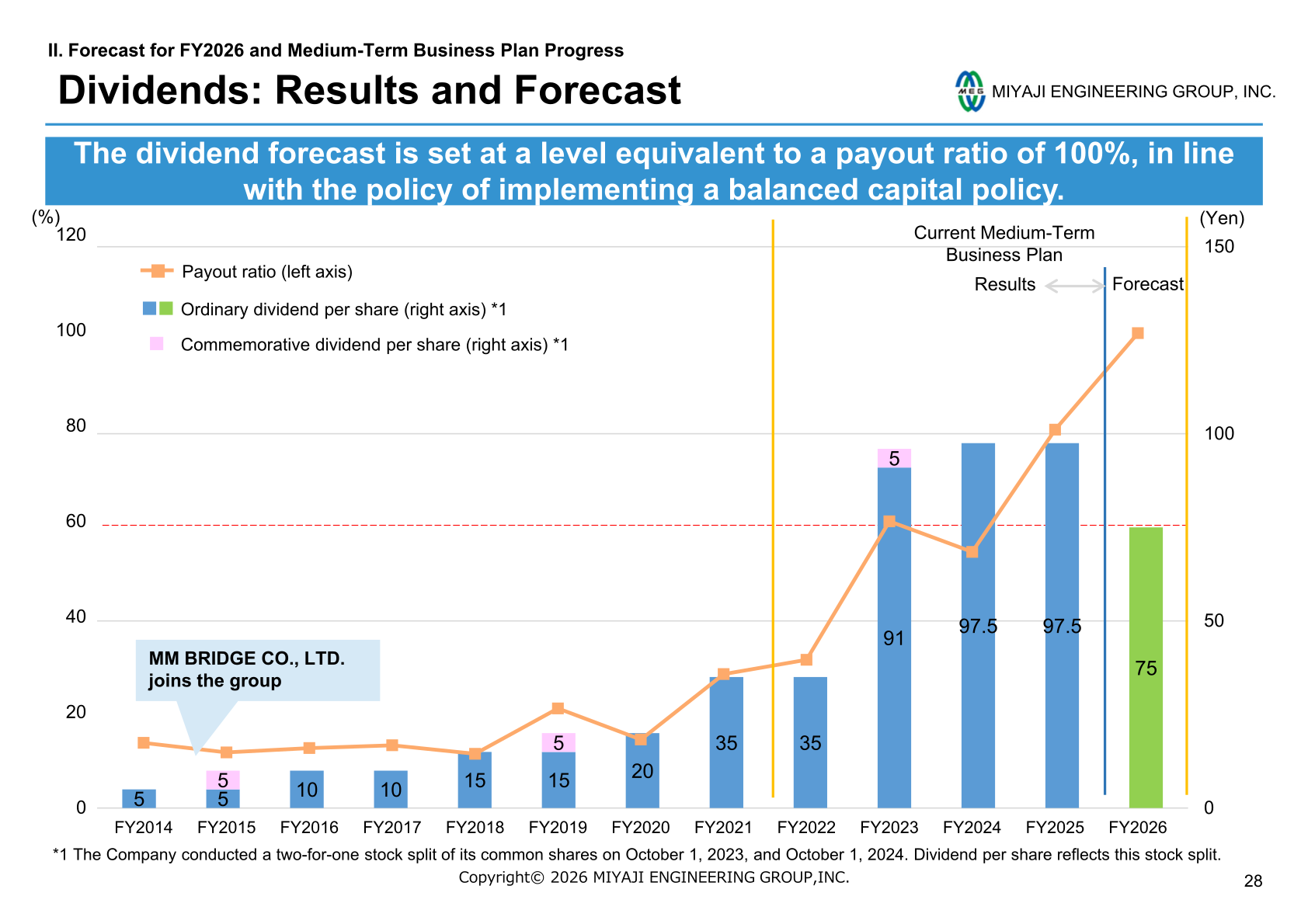
The annual dividend for FY2025 was maintained at ¥97.5 per share. For FY2026, the company plans a dividend of ¥75 per share, set at a level equivalent to a payout ratio of 100%. Over the Medium-Term Business Plan period (FY2022 to FY2026), total shareholder returns are planned at approximately ¥12.2 billion (cumulative result for FY2022 to FY2025: approximately ¥10.2 billion) and growth investments at approximately ¥18.0 billion (approximately ¥10.4 billion).
| Annual Dividend per Share (yen) | FY2022 | FY2023 | FY2024 | FY2025 | FY2026 (Forecast) |
|---|---|---|---|---|---|
| Annual dividend | 35 | 96 | 97.5 | 97.5 | 75 |
Dividend per share figures reflect the two-for-one stock splits conducted on October 1, 2023 and October 1, 2024. The FY2023 figure includes a commemorative dividend of ¥5.
Medium-Term Business Plan Progress
FY2026 is the final year of the current Medium-Term Business Plan (FY2022 to FY2026). In FY2024 (the fiscal year ended March 31, 2025), profit targets for the plan’s final year were exceeded, but delays in detailed design and third-party consultations on technically difficult large-scale renovation projects, a further decline in new construction volumes due to rising prices, and moves to scale back or postpone renovation work led the company to revise its sales and profit targets downward in November 2024 and again in November 2025. The final-year targets as of the November 2025 review were net sales of 57,000 million yen and operating profit of 1,500 million yen, against the current forecast of 55,000 million yen and 2,300 million yen.
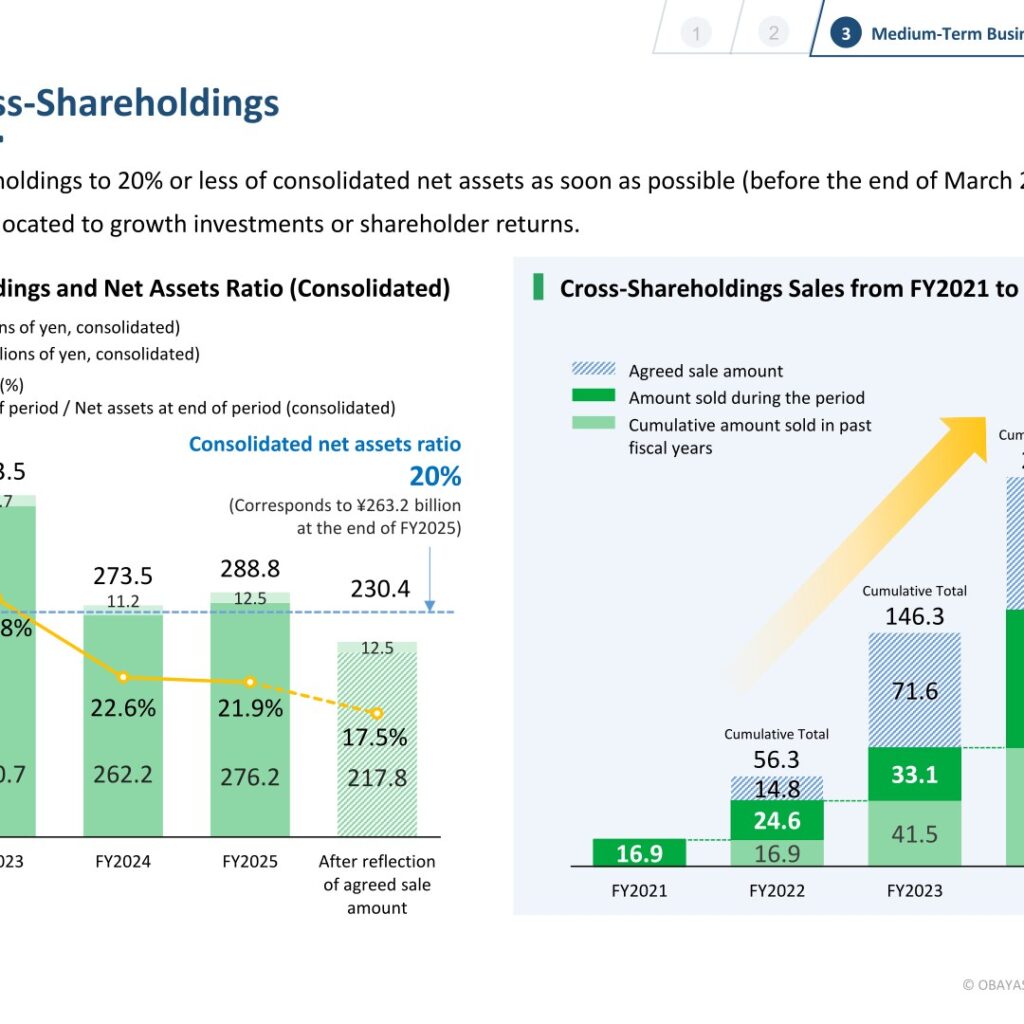
Among its key strategies, the company gives its highest progress evaluation to work on high-difficulty private-sector construction projects (railroads, buildings with large interior spaces and special buildings, and coastal structures), while participation in new large-scale bridge projects, such as the western extension of the Hanshin Expressway Wangan (Osaka Bay) Route, and expansion in large-scale expressway renovation projects are behind initial expectations. Capital investment continues, with construction of a new office building at the Chiba Works starting in January 2026 and site development completed for the Hyogo Equipment Center relocation. The company also aims to reduce its cross-shareholdings book value to net assets ratio to 10% or less with a view toward the next plan period, and sold cross-shareholdings with a book value of ¥0.20 billion in FY2025.
For the next Medium-Term Business Plan (FY2027 to FY2031), MIYAJI ENGINEERING and MM BRIDGE will work as one team, allocating resources across new construction, large-scale renovation and maintenance, and private-sector projects, while improving productivity through technology development and DX. Specific details of the next plan are to be announced during the current plan period. Over the medium term, the company expects orders for large-scale expressway renovation projects (¥7 trillion) to recover gradually and large, highly difficult projects such as the Wangan Route western extension and the Meishin Wangan Route Access Bridge to move forward.
This article is an analysis based on publicly available information and is not a recommendation to buy or sell any specific securities. Investment decisions are your own responsibility.