This article is based on publicly available IR materials and is not a recommendation to buy or sell any specific securities.
Note: Rock Field does not publish an English results presentation; this article is an English translation of the Japanese-language article on our sister site Investalk, which is based on the company’s Japanese-language IR materials, with figures transcribed as reported. The company’s most recently completed fiscal year, which this site classifies as FY2025, is labelled by the company as the fiscal year ended April 2026 (May 1, 2025 to April 30, 2026).
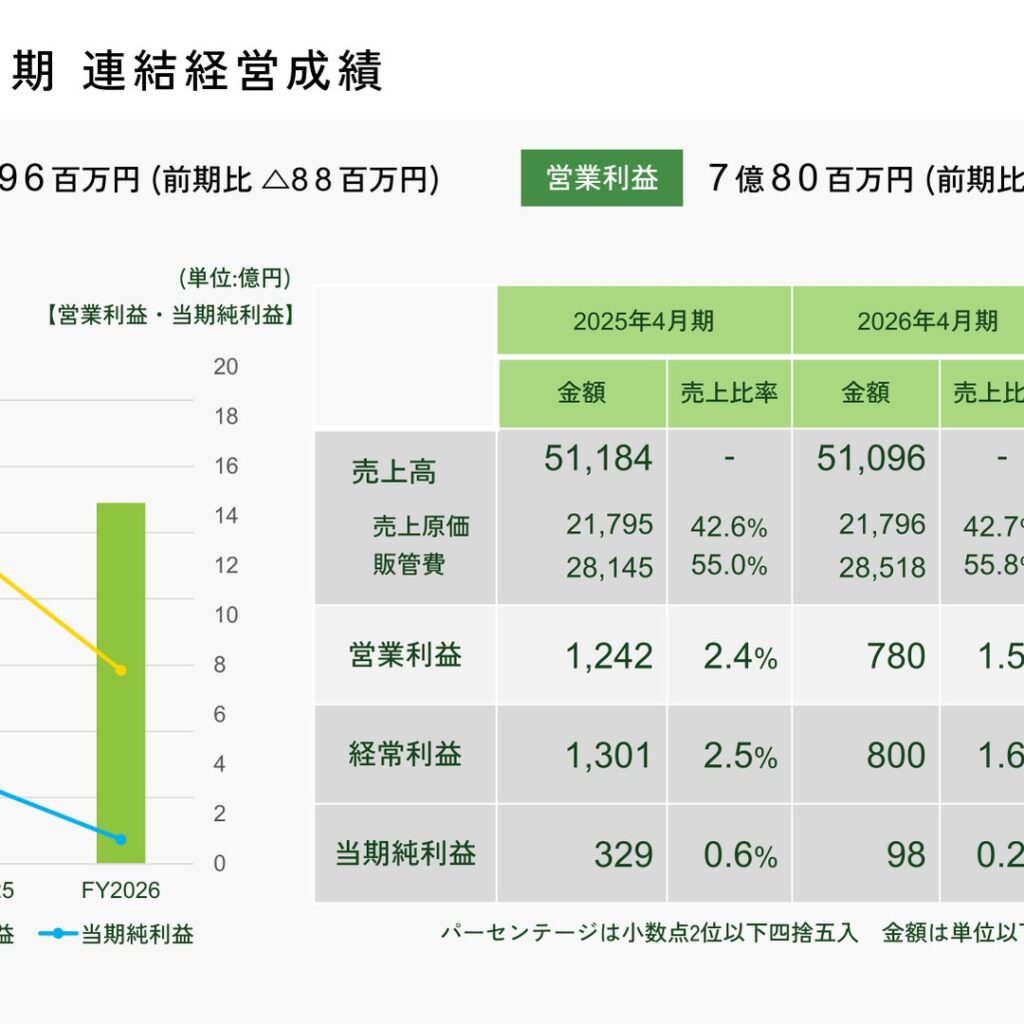
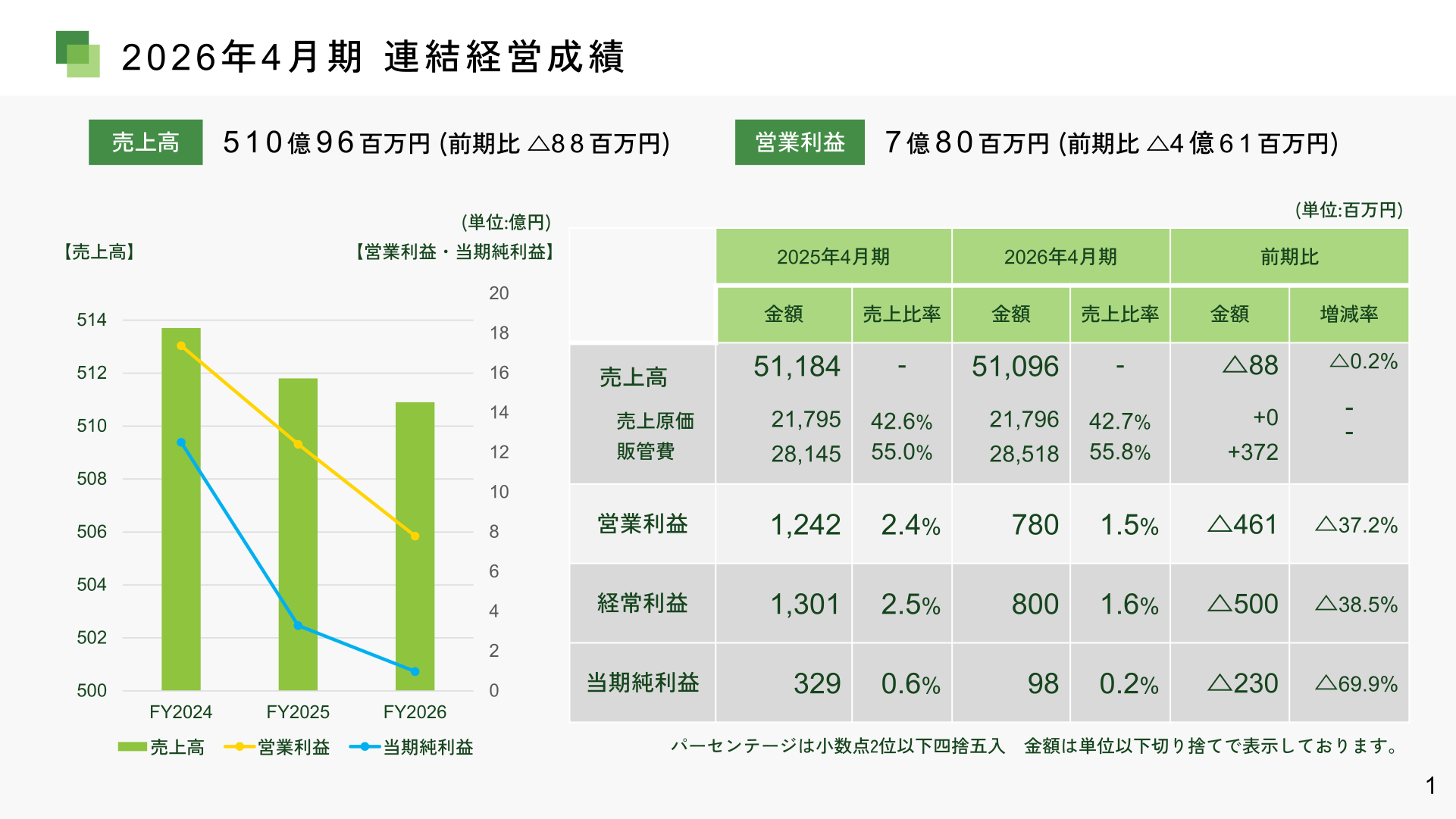
Rock Field’s consolidated results for the fiscal year ended April 2026 (full year) were net sales of 51,096 million yen (△88 million yen, or △0.2%, year on year), operating profit of 780 million yen (△461 million yen, or △37.2%), ordinary profit of 800 million yen (△500 million yen, or △38.5%) and net profit of 98 million yen (△230 million yen, or △69.9%). Although the results fell below the previous fiscal year, net sales, operating profit, ordinary profit and net profit all finished above the revised forecast for the fiscal year ended April 2026. For the fiscal year ending April 2027, the company plans operating profit of 531 million yen (△249 million yen versus the fiscal year ended April 2026 actual), factoring in increases in personnel expenses and packaging material costs.
Consolidated Results (Full-Year Actual)
The cost of sales ratio was 42.7% (up 0.1pt from 42.6% in the previous fiscal year), and selling, general and administrative expenses were 28,518 million yen (55.8% of net sales, widening from 55.0% in the previous fiscal year). The decline in operating profit was driven mainly by higher personnel expenses (△230 million yen) and higher other expenses (△140 million yen); lower net sales (△50 million yen), a higher materials cost ratio (△20 million yen) and higher labor costs (△50 million yen) also contributed to the decline, while restrained manufacturing expenses (+50 million yen) provided support.
| Item | FY Ended April 2025 | FY Ended April 2026 | Year-on-Year Change |
|---|---|---|---|
| Net sales | 51,184 million yen | 51,096 million yen | △88 million yen (△0.2%) |
| Cost of sales | 21,795 million yen | 21,796 million yen | +0 million yen |
| Selling, general and administrative expenses | 28,145 million yen | 28,518 million yen | +372 million yen |
| Operating profit | 1,242 million yen | 780 million yen | △461 million yen (△37.2%) |
| Ordinary profit | 1,301 million yen | 800 million yen | △500 million yen (△38.5%) |
| Net profit | 329 million yen | 98 million yen | △230 million yen (△69.9%) |
Results by Business Format
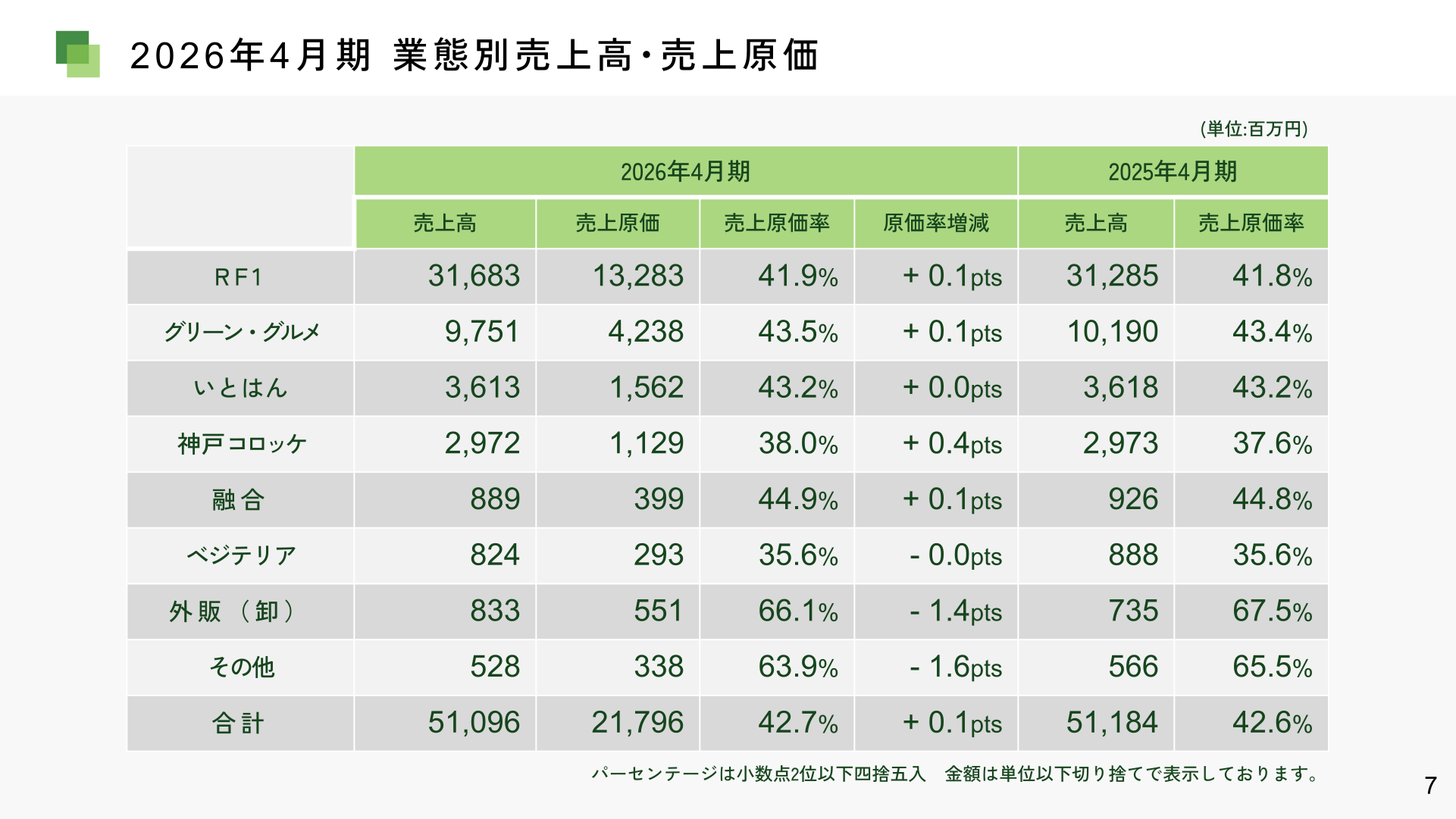
By business format, net sales for the fiscal year ended April 2026 showed mainstay RF1 securing higher sales at 31,683 million yen (+398 million yen year on year), while Green gourmet at 9,751 million yen (△439 million yen), Itohan at 3,613 million yen (△5 million yen), Kobe Croquette at 2,972 million yen (△1 million yen), Yugo at 889 million yen (△37 million yen) and VEGETERIA at 824 million yen (△64 million yen) all came in below the previous fiscal year. Wholesale grew to 833 million yen (+98 million yen). The number of stores was 305 at the end of the fiscal year (303 at the beginning of the fiscal year, with 8 openings and 6 closures).
| Business Format | FY Ended April 2026 Net Sales | Cost of Sales Ratio | FY Ended April 2025 Net Sales |
|---|---|---|---|
| RF1 | 31,683 million yen | 41.9% | 31,285 million yen |
| Green gourmet | 9,751 million yen | 43.5% | 10,190 million yen |
| Itohan | 3,613 million yen | 43.2% | 3,618 million yen |
| Kobe Croquette | 2,972 million yen | 38.0% | 2,973 million yen |
| Yugo | 889 million yen | 44.9% | 926 million yen |
| VEGETERIA | 824 million yen | 35.6% | 888 million yen |
| Wholesale | 833 million yen | 66.1% | 735 million yen |
| Other | 528 million yen | 63.9% | 566 million yen |
| Total | 51,096 million yen | 42.7% | 51,184 million yen |
Full-Year Forecast (Fiscal Year Ending April 2027)
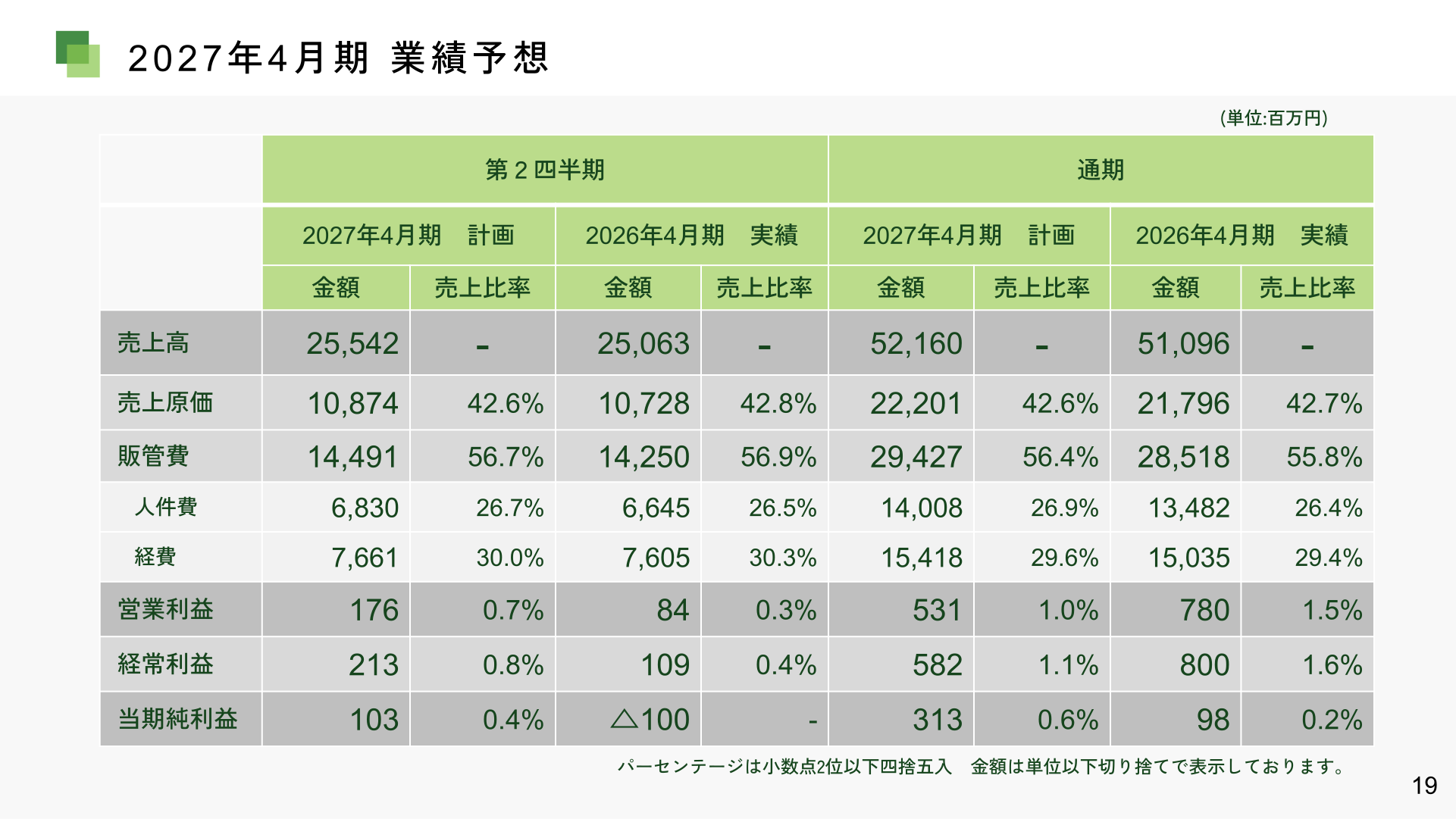
The consolidated plan for the fiscal year ending April 2027 calls for net sales of 52,160 million yen (+1,064 million yen versus the fiscal year ended April 2026 actual), operating profit of 531 million yen (△249 million yen), ordinary profit of 582 million yen (△218 million yen) and net profit of 313 million yen (+215 million yen). While net sales are expected to increase, operating profit is planned below the fiscal year ended April 2026 actual, reflecting higher personnel expenses accompanying a review of the salary structure centered on younger employees (△520 million yen) and higher expenses including rising unit prices for packaging materials (△120 million yen).
| Item | FY Ending April 2027 Plan | FY Ended April 2026 Actual |
|---|---|---|
| Net sales | 52,160 million yen | 51,096 million yen |
| Cost of sales | 22,201 million yen (42.6%) | 21,796 million yen (42.7%) |
| Selling, general and administrative expenses | 29,427 million yen (56.4%) | 28,518 million yen (55.8%) |
| Operating profit | 531 million yen (1.0%) | 780 million yen (1.5%) |
| Ordinary profit | 582 million yen (1.1%) | 800 million yen (1.6%) |
| Net profit | 313 million yen (0.6%) | 98 million yen (0.2%) |
Shareholder Returns
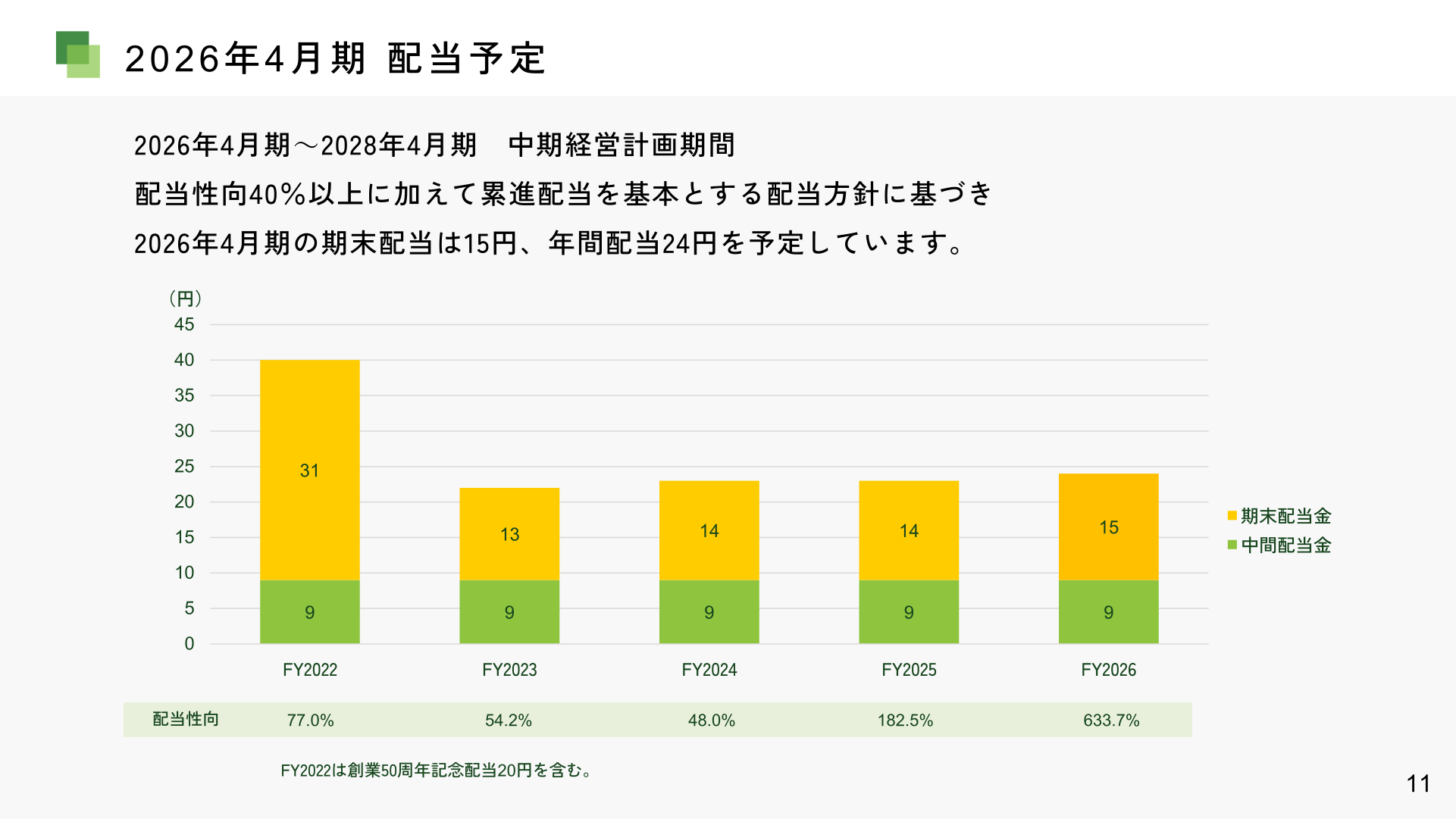
For the fiscal year ended April 2026, the company plans to pay a year-end dividend of 15 yen (24 yen for the full year). Over the medium-term management plan period covering the fiscal years ending April 2026 through April 2028, the company will continue a dividend policy based on a payout ratio of 40% or more together with progressive dividends, and for the fiscal year ending April 2027 it plans an annual dividend of 24 yen and total dividends of 620 million yen.
| Item | FY Ended April 2026 (Actual) | FY Ending April 2027 (Plan) |
|---|---|---|
| Annual dividend per share | 24 yen | 24 yen |
| Year-end dividend | 15 yen | ― |
| Total dividends | ― | 620 million yen |
| Dividend policy | Payout ratio of 40% or more plus progressive dividends | Payout ratio of 40% or more plus progressive dividends |
Management Issues and Initiatives toward Vision 2030
As management issues for the fiscal year ending April 2027, the company cites the widening gap between weekday and weekend sales that accompanies structural changes in demand, deteriorating profitability due to fixed-cost-type operations, and delays in improving profits in the wholesale business. In light of this, in May 2026 the company restructured its organization, placing the Corporate Planning Division under the direct control of the President, assigning the IR function to the Corporate Planning Division and newly establishing a Human Resources Division. At the same time, on May 19, 2026 the company disclosed that it had decided to dissolve and liquidate its consolidated subsidiary Iwata (Shanghai) Restaurant Management Co., Ltd. (established in August 2012, engaged in the manufacture and sale of prepared foods in Shanghai), because there is no prospect of improvement in the business environment against a backdrop of sluggish consumption and intensified competition since the COVID-19 pandemic.
This article is an analysis based on publicly available information and is not a recommendation to buy or sell any specific securities. Investment decisions are your own responsibility.