
This article is based on publicly available IR materials and is not a recommendation to buy or sell any specific securities.
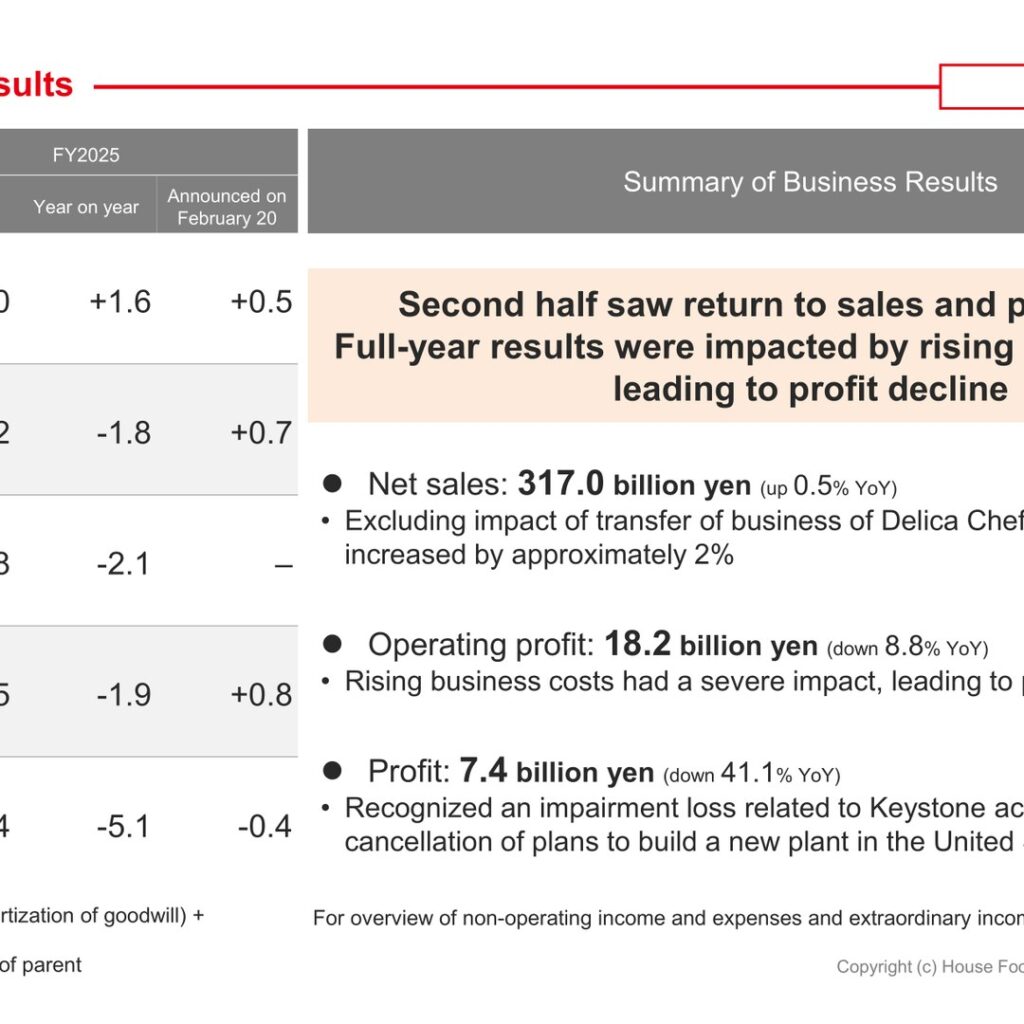
House Foods Group Inc. labels the fiscal year ended March 31, 2026 as FY2025; this article follows the company’s labels. In FY2025, the group posted net sales of 317.0 billion yen (up 0.5% year on year), while operating profit fell 8.8% to 18.2 billion yen as rising business costs had a severe impact. Profit attributable to owners of parent dropped 41.1% to 7.4 billion yen, reflecting an impairment loss related to the Keystone acquisition in the United States and the cancellation of plans to build a new plant there — the second consecutive fiscal year in which an impairment loss was recognized in connection with the Keystone acquisition. Citing a gap between actual results and the Eighth Medium-term Business Plan targets, the company announced a “structural reform” program aimed at accelerating growth and improving capital efficiency, positioning FY2026 as a year for rebuilding the group’s profit base with a target ROE of 6%.
Consolidated Results (Full-Year Actual)
While the second half saw a return to sales and profit growth, full-year results were severely impacted by rising business costs, leading to profit decline despite rising sales. Excluding the impact of the transfer of the business of Delica Chef Corporation, sales increased by approximately 2%. EBITDA (operating profit before amortization of goodwill plus depreciation) was 31.8 billion yen, down 2.1 billion yen year on year. In extraordinary income and losses, the company recognized an impairment loss of 7.5 billion yen — comprising 6.5 billion yen for Keystone’s customer-related intangible assets, goodwill and property, plant and equipment, and 1.0 billion yen for construction in progress for the establishment of a new soybean business base in the United States — alongside a gain on sales of cross-shareholdings of 4.7 billion yen and a gain on sales of businesses of 2.6 billion yen from the transfer of the business of Delica Chef Corporation. Income taxes rose 3.0 billion yen to 8.9 billion yen, including a 0.7 billion yen impact from the reversal of deferred tax assets associated with the impairment loss in the United States.
| Item (billion yen) | FY2025 Results | Year on year | vs. forecast announced on February 20 |
|---|---|---|---|
| Net sales | 317.0 | +1.6 | +0.5 |
| Operating profit | 18.2 | -1.8 | +0.7 |
| EBITDA | 31.8 | -2.1 | – |
| Ordinary profit | 19.5 | -1.9 | +0.8 |
| Profit attributable to owners of parent | 7.4 | -5.1 | -0.4 |
Segment Results
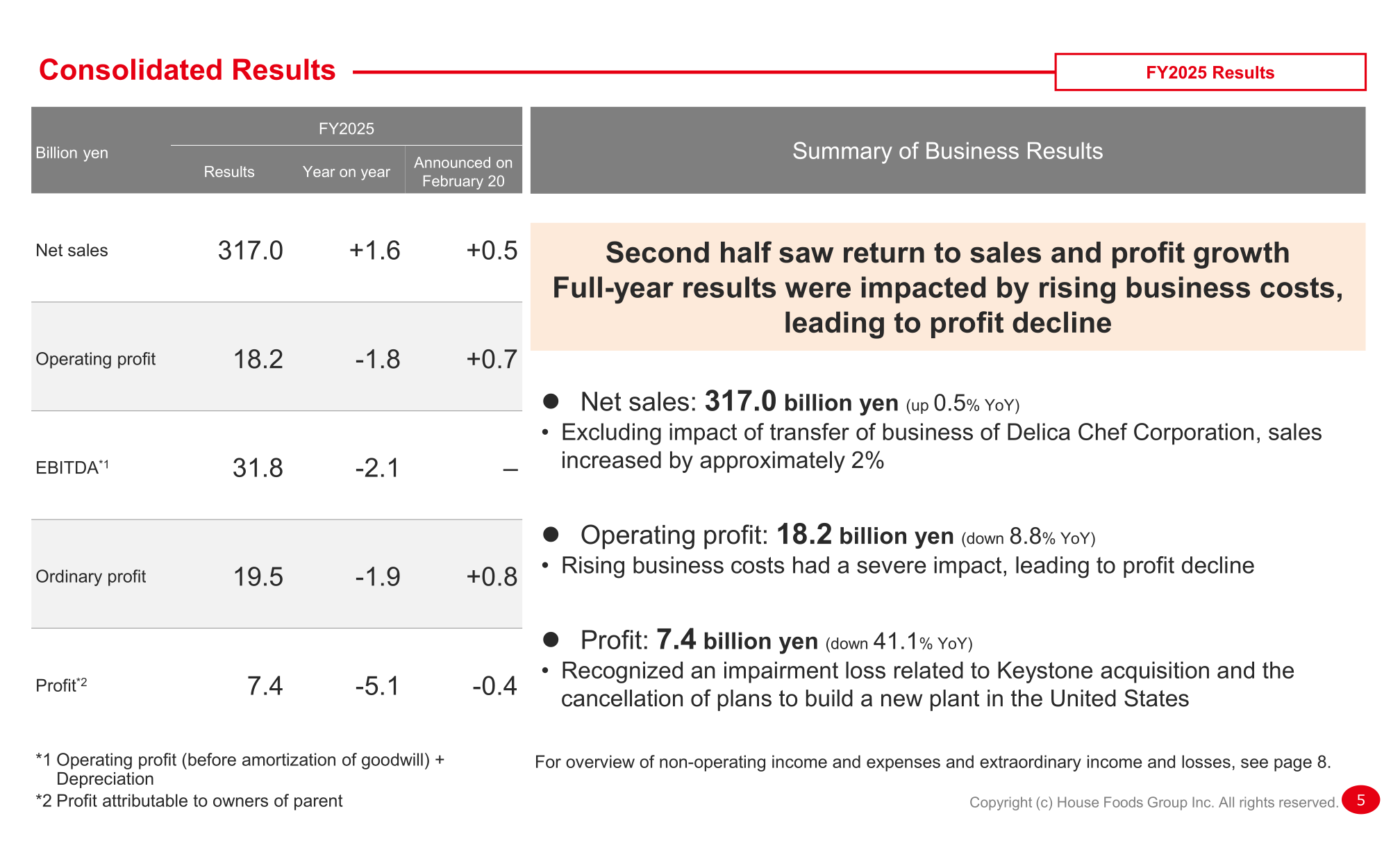
The consolidated operating profit ratio was 5.8%, down 0.6 percentage points. In the Spice / Seasoning / Processed Food Business, the company focused on measures to create demand after price revisions and on tapping into unmet customer needs; although profit fell in the first half, the second half saw a return to sales and profit growth. In the Health Food Business, C1000 and the lactobacillus business achieved sales growth, but jelly products struggled and the segment failed to absorb rising business costs. The International Food Business as a whole achieved gains in sales and profit, driven by the return to growth of the curry business in China, while profit structure reform of the soybean business in the United States still has a way to go. In the Restaurant Business, sales increased due to the effect of price revisions at CoCo Ichibanya restaurants in Japan and the business of overseas and domestic subsidiaries, but rising business costs led to profit decline. In the Other Food Related Business, the group implemented the transfer of the business of Delica Chef Corporation to concentrate management resources on growth areas.
| Segment | Net sales (billion yen) | YoY change | Operating profit (billion yen) | YoY change |
|---|---|---|---|---|
| Spice / Seasoning / Processed Food Business | 132.1 | +0.7 | 12.8 | +0.0 |
| Health Food Business | 16.9 | -0.2 | 1.5 | -0.9 |
| International Food Business | 63.4 | +1.0 | 3.4 | +0.3 |
| Restaurant Business | 65.5 | +4.5 | 3.4 | -0.2 |
| Other Food Related Business | 50.1 | -4.3 | 0.9 | -0.3 |
| Adjustment (elimination) | -11.0 | -0.2 | -3.8 | -0.6 |
| Consolidated | 317.0 | +1.6 | 18.2 | -1.8 |
Within the International Food Business, the business in the United States recorded net sales of 33.4 billion yen (down 4.1% year on year on a Japanese yen basis, down 2.6% on a local currency basis) and an operating loss of 1.1 billion yen. The business in China posted net sales of 12.9 billion yen (up 11.6% on a yen basis, up 13.0% in local currency) and operating profit of 1.5 billion yen (up 0.4 billion yen). Businesses in Southeast Asia recorded net sales of 11.6 billion yen (up 3.2%) and operating profit of 1.8 billion yen, of which the functional drinks business in Thailand accounted for net sales of 10.0 billion yen (up 3.3% on a yen basis, down 2.1% in local currency).
FY2026 Forecast
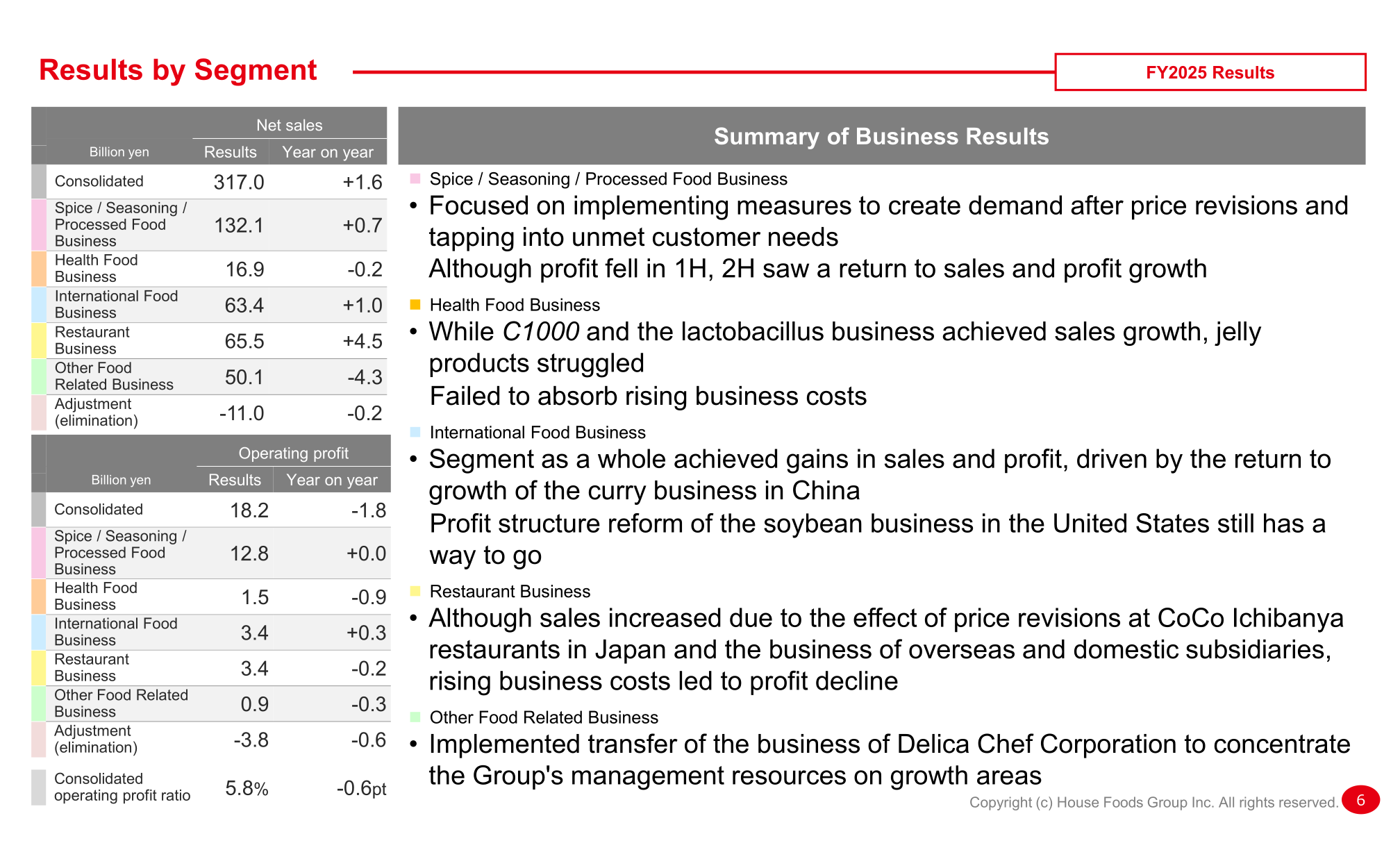
The company positions FY2026 as a year for rebuilding the group’s revenue structure and plans to improve ROE to 6% by reducing non-operating assets and strengthening shareholder returns. The Eighth Medium-term Business Plan targets have been revised: the FY2026 forecast stands 37.5 billion yen below the initial plan target for net sales and 8.5 billion yen below for operating profit. By segment, the Spice / Seasoning / Processed Food Business expects higher business costs to be absorbed by increased sales but lower profit due to an increased depreciation burden, with the Tohoku Factory starting operation in June 2026. The transfer of Delica Chef Corporation reduces Other Food Related Business net sales by approximately 14.0 billion yen, with an insignificant impact on profit. The impact of the Middle East situation is not factored into the FY2026 plan given the uncertainty of the current situation; the company notes procurement costs could rise by around 1.5 to 3.0 billion yen, affecting packaging materials, energy and logistics.
| Item | FY2026 Forecast | Year on year | vs. Eighth Medium-term Business Plan target |
|---|---|---|---|
| Net sales (billion yen) | 322.5 | +5.5 | -37.5 |
| Operating profit (billion yen) | 18.5 | +0.3 | -8.5 |
| Ordinary profit (billion yen) | 19.7 | +0.2 | – |
| Profit attributable to owners of parent (billion yen) | 17.0 | +9.6 | – |
| ROE | 6.0% | +3.5pt | -1.0pt |
Shareholder Returns
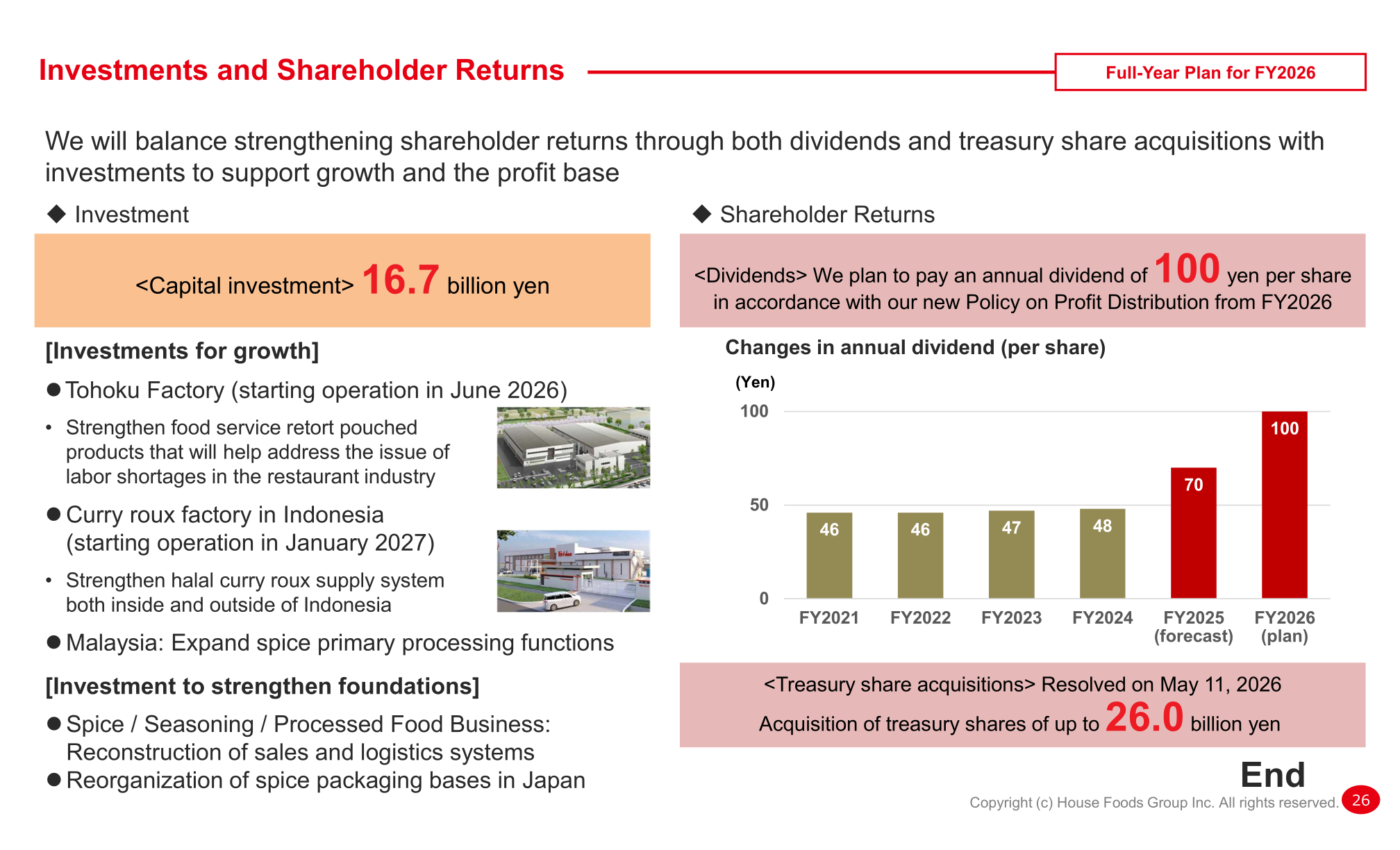
For FY2025, the company plans to pay a year-end dividend of 46 yen and an annual dividend of 70 yen, an increase from the previously planned year-end dividend, taking into consideration factors such as cash-in from the transfer of the business of Delica Chef Corporation that were not factored into the initial Medium-term Business Plan. The consolidated payout ratio for FY2025 is 87.8% (forecast) and the total payout ratio 223.2%. From FY2026, the company is changing its Basic Policy on Profit Distribution: it will aim for DOE (dividend on equity) of 3% or more and pay a progressive dividend in principle, alongside flexible treasury share acquisitions — a shift to a B/S-based dividend policy. Under the new policy, the company plans to pay an annual dividend of 100 yen per share in FY2026, and on May 11, 2026 it resolved the acquisition of treasury shares of up to 26.0 billion yen. Over FY2024 to FY2025 cumulatively, the total return ratio was 135.1% and treasury share acquisitions totaled 16.0 billion yen.
| Dividend per share (yen) | FY2024 | FY2025 (forecast) | FY2026 (plan) |
|---|---|---|---|
| Interim | 24 | 24 | – |
| Year-end | 24 | 46 | – |
| Annual total | 48 | 70 | 100 |
Structural Reform in Light of the Eighth Medium-term Business Plan
Reviewing the first two years of the Eighth Medium-term Business Plan, the company states that sales and profit growth and improvement in capital efficiency have not progressed as expected, leaving a gap between actual results and plan targets: FY2025 net sales of 317.0 billion yen against the initial FY2026 target of 360.0 billion yen (a gap of 43.0 billion yen), operating profit of 18.2 billion yen against 27.0 billion yen (a gap of 8.8 billion yen), ROS of 5.8% against 7.5%, ROIC of 4.1% against 6.0%, and ROE of 2.5% against 7.0%. In response, the structural reform consists of three pillars: [1] concentration on growth areas — concentrating investment of management resources in the Spice value chain to accelerate global growth of the curry and spice business; [2] implementation of organizational reforms — setting up an organizational reform project that reports directly to the President, reviewing the group head office system and formulating a proposal for a new organizational structure during FY2026; and [3] strengthening of financial strategy — improving ROE through a combination of profit growth and shareholders’ equity management. The company aims to improve ROE to 6% in FY2026 and to achieve ROE of 8% early. In the Soybean value chain, it aims to accelerate profit structure reform in the tofu business, targeting a return to profit and growth in FY2027.
This article is an analysis based on publicly available information and is not a recommendation to buy or sell any specific securities. Investment decisions are your own responsibility.
![[Obayashi] Investors’ Guide 2026 — The Complete 24-Article Breakdown](https://japan-equity.com/wp-content/uploads/2026/07/hub_cover-1024x1024.png)
![[Obayashi] IR & SR Policy — Feeding Dialogue Back into Management](https://japan-equity.com/wp-content/uploads/2026/07/p32_sq-1024x1024.jpg)
![[Obayashi] Real Estate Development — 18.7% Margin, ¥287.7bn Unrealized Gains](https://japan-equity.com/wp-content/uploads/2026/07/p20_sq-1024x1024.jpg)
![[Obayashi] Domestic Civil Engineering — Resilience Spending Supports 9.6% Margin](https://japan-equity.com/wp-content/uploads/2026/07/p11_sq-1024x1024.jpg)
![[Obayashi] Share Price & External Ratings — vs TOPIX, ESG Index Inclusion](https://japan-equity.com/wp-content/uploads/2026/07/p40_sq-1024x1024.jpg)
![[Construction] ¥75.5tn Investment, Shrinking Workforce — Big-5 Market Share](https://japan-equity.com/wp-content/uploads/2026/07/p12_sq-1024x1024.jpg)
![[Obayashi] Capital Policy & Shareholder Returns — ROE 10%+, DOE ~5%, ¥100bn Buyback](https://japan-equity.com/wp-content/uploads/2026/07/p27_sq-1024x1024.jpg)
![[Obayashi] Reducing Cross-Shareholdings — ¥285.2bn Sold in Five Years](https://japan-equity.com/wp-content/uploads/2026/07/p29_sq-1024x1024.jpg)
![[Obayashi] ¥750bn Investment Plan — ¥300bn to Development, ¥190bn to Tech/DX](https://japan-equity.com/wp-content/uploads/2026/07/p30_sq-1024x1024.jpg)
![[Obayashi] MTP2022 KPIs — Operating Profit ~2x Target, ROE 14.4%](https://japan-equity.com/wp-content/uploads/2026/07/p25_sq-1024x1024.jpg)
![[Obayashi] Cash Allocation — ¥420bn Investment CF Over Five Years](https://japan-equity.com/wp-content/uploads/2026/07/p26_sq-1024x1024.jpg)
![[Obayashi] Green Energy — 44 Plants, 344MW, and the Green Hydrogen Challenge](https://japan-equity.com/wp-content/uploads/2026/07/p21_sq-1024x1024.jpg)
![[Obayashi] Tackling the Labor Shortage — Robotics Construction®](https://japan-equity.com/wp-content/uploads/2026/07/p14_sq-1024x1024.jpg)
