This article is based on publicly available IR materials and is not a recommendation to buy or sell any specific securities.
Note: dip Corporation’s fiscal year ends at the end of February. This article covers the fiscal year ended February 28, 2026, which the company labels “FY’26/2” and which is classified as FY2025 under this site’s convention; all labels in the text and tables below follow the company’s own presentation.
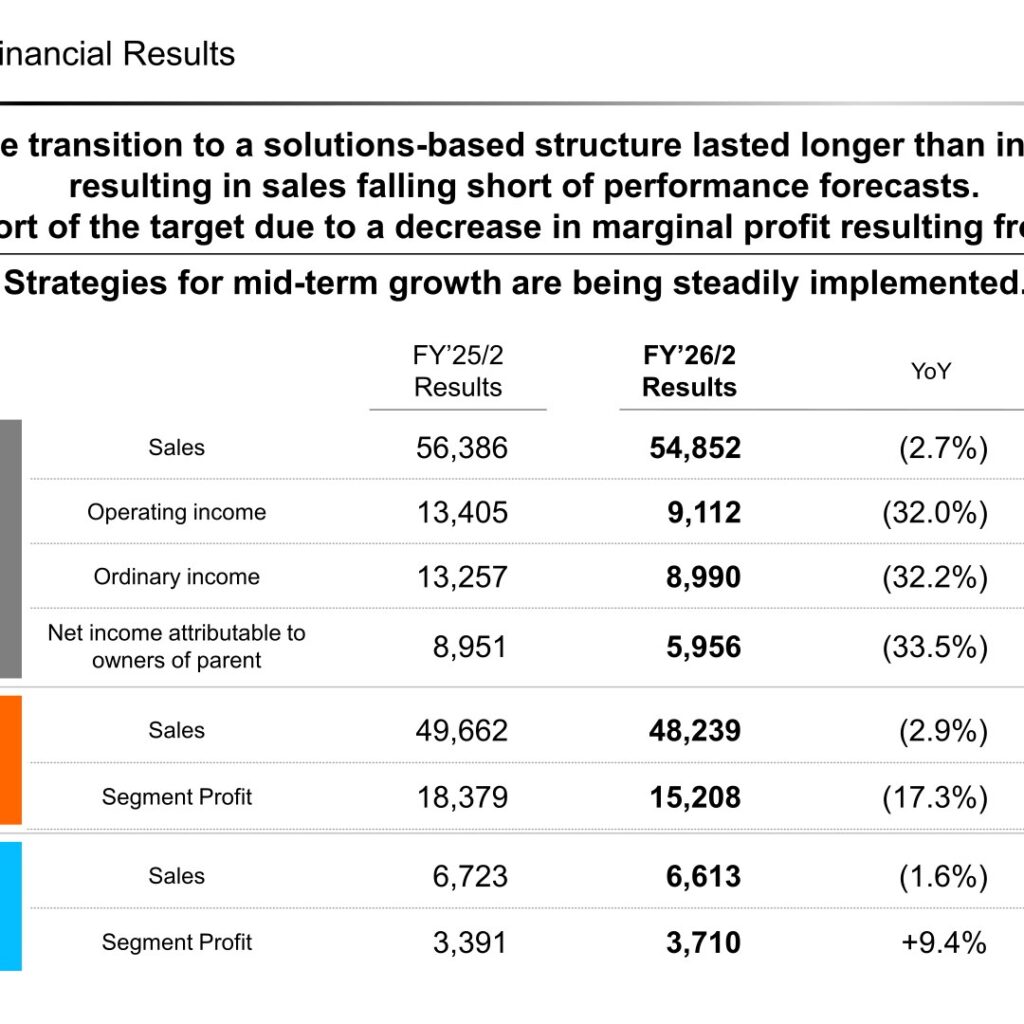
dip Corporation reported sales of 54,852 million yen for FY’26/2, down 2.7% year on year, with operating income of 9,112 million yen (down 32.0%), ordinary income of 8,990 million yen (down 32.2%) and net income attributable to owners of parent of 5,956 million yen (down 33.5%). All four lines came in below the forecast the company issued on April 14, 2025. Management attributes the shortfall to the transition to a solution-based sales structure, whose disruption lasted longer than initially anticipated, and to a decline in marginal profit caused by lower sales. For FY’27/2 the company guides to a range rather than a point estimate, projecting revenue of -2.5% to +5% year on year and operating profit of 5 to 10 billion yen as it introduces cost-per-click (CPC) pricing alongside its existing listing-fee model.
Consolidated Results (Full-Year Actual)
The table below is taken from the company’s full-year results slide, which also carries, for reference, the forecast announced on April 14, 2025. Figures are in millions of yen; parentheses denote a decrease.
| Item (Million Yen) | FY’26/2 Results | FY’25/2 Results | YoY | (Reference) Previous forecast as of Apr. 14, 2025 |
|---|---|---|---|---|
| Sales | 54,852 | 56,386 | (2.7%) | 60,000 |
| Operating income | 9,112 | 13,405 | (32.0%) | 12,000 |
| Ordinary income | 8,990 | 13,257 | (32.2%) | 11,900 |
| Net income attributable to owners of parent | 5,956 | 8,951 | (33.5%) | 8,000 |
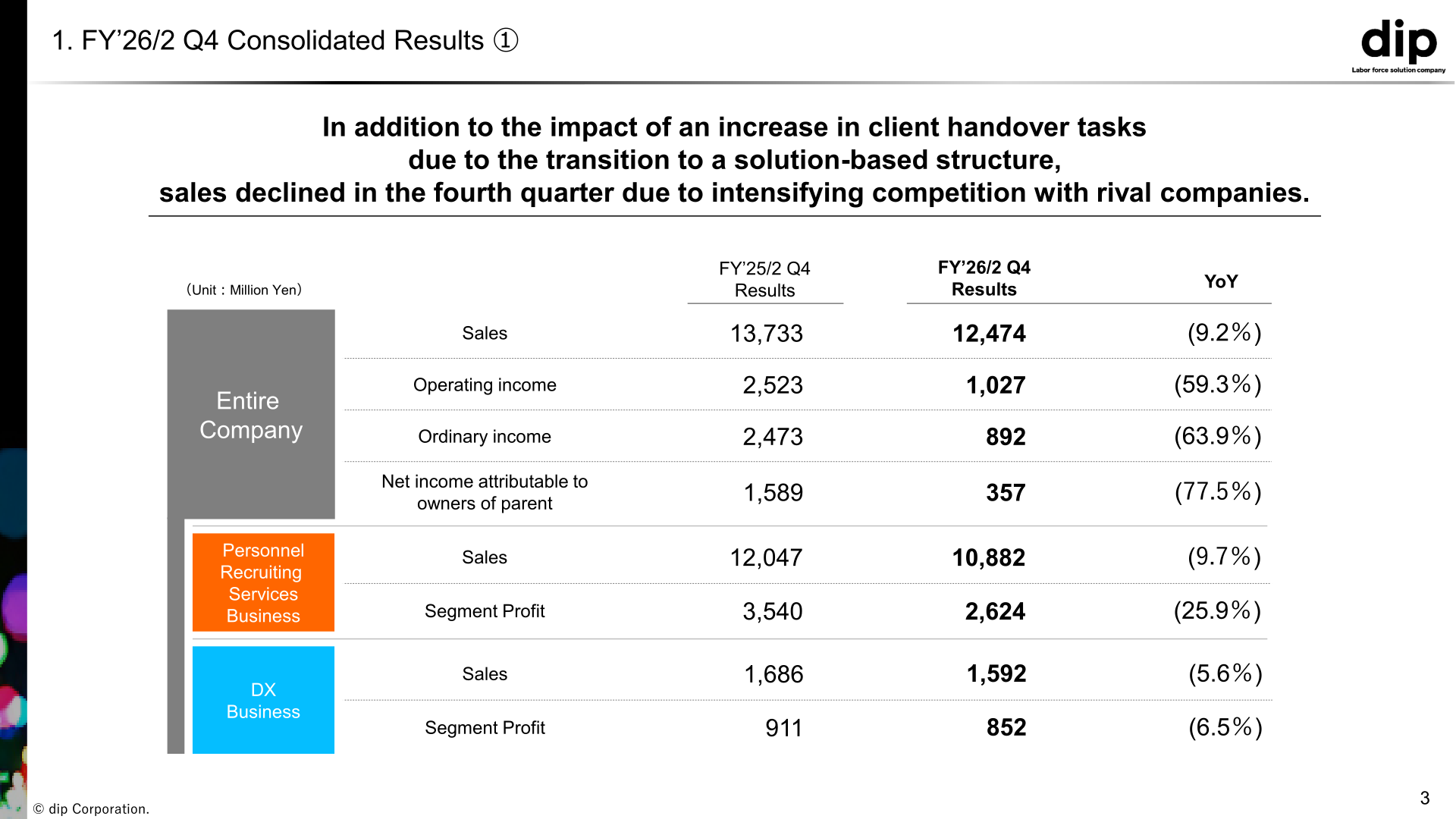
The fourth quarter was the weakest of the year. Quarterly sales were 12,474 million yen against 13,733 million yen a year earlier, a decline of 9.2%, while operating income fell 59.3% to 1,027 million yen, ordinary income fell 63.9% to 892 million yen and net income attributable to owners of parent fell 77.5% to 357 million yen. The company cites an increase in client handover tasks arising from the move to a solution-based structure, plus intensifying competition with rival companies from the fourth quarter onwards, which it estimates cut roughly 2 percentage points from the fourth-quarter sales growth rate.
Segment Results
dip reports two segments. The Personnel Recruiting Services Business, which covers the Baitoru media services and permanent placement, saw both sales and segment profit fall. The DX Business saw sales edge down but segment profit rise 9.4% year on year.
| Segment | Metric (Million Yen) | FY’26/2 Results | FY’25/2 Results | YoY | (Reference) Previous forecast as of Apr. 14, 2025 |
|---|---|---|---|---|---|
| Personnel Recruiting Services Business | Sales | 48,239 | 49,662 | (2.9%) | 52,600 |
| Personnel Recruiting Services Business | Segment Profit | 15,208 | 18,379 | (17.3%) | 17,100 |
| DX Business | Sales | 6,613 | 6,723 | (1.6%) | 7,400 |
| DX Business | Segment Profit | 3,710 | 3,391 | +9.4% | 4,200 |
Within the Personnel Recruiting Services Business, fourth-quarter segment sales were 10,882 million yen versus 12,047 million yen a year earlier, down 9.7%, and segment profit was 2,624 million yen versus 3,540 million yen, down 25.9%. The number of Media Services contracted companies was 15,069 at the end of the fourth quarter against 15,695 a year earlier; the company notes that the rate of decline in client companies has slowed compared with the previous three quarters, while unit prices have fallen, particularly among staffing companies. In the DX Business, fourth-quarter segment sales were 1,592 million yen (down 5.6%) and segment profit 852 million yen (down 6.5%); the quarterly stock sales ratio was 80% in the fourth quarter, with quarterly average ARPU of ¥43,000 and 12,333 billing companies on a quarterly average basis. The company states that the sales promotion support sector has grown to around 1.1 billion yen in ARR.
Cost Structure
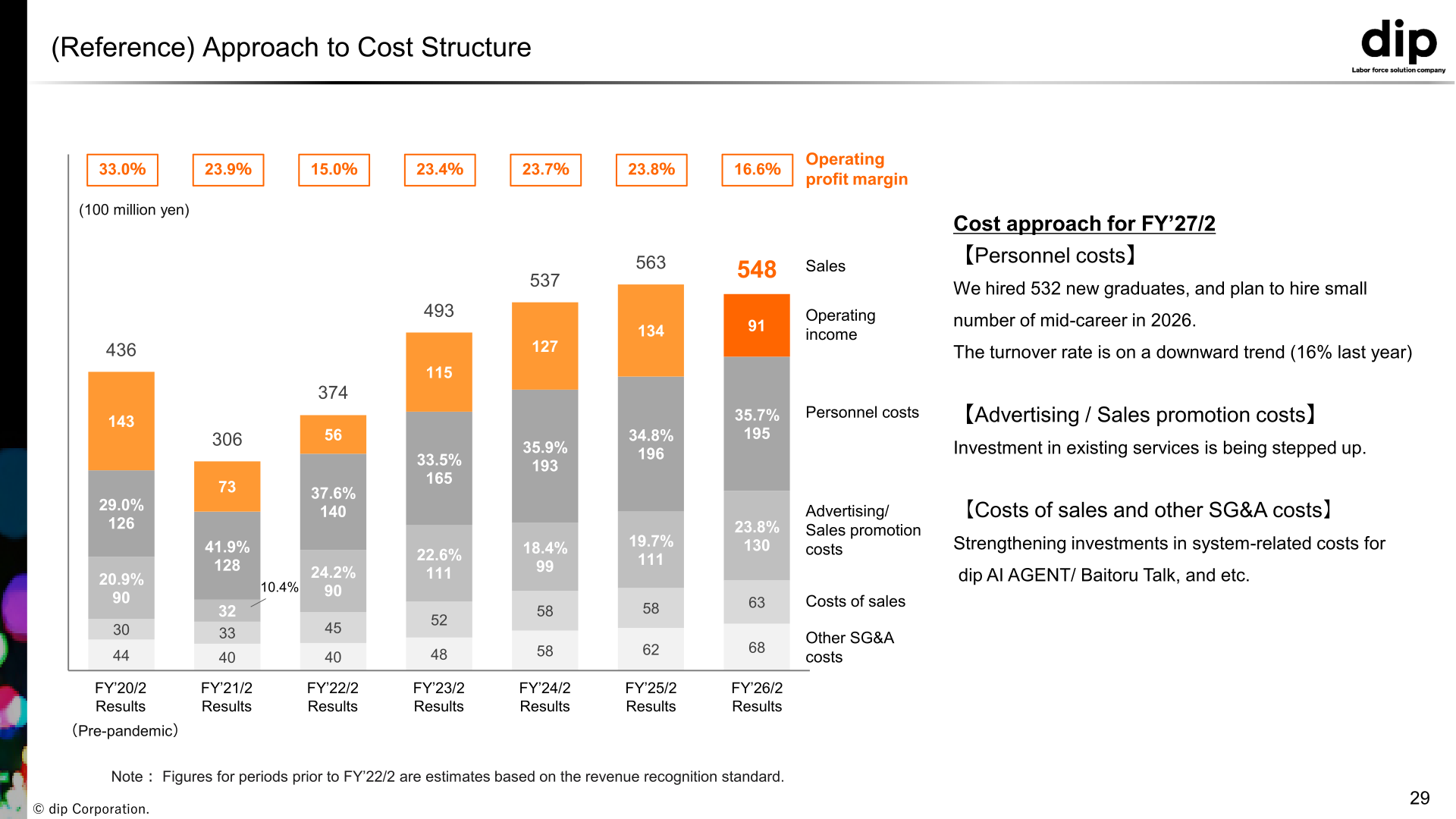
On a quarterly basis, selling, general and administrative expenses in the fourth quarter of FY’26/2 were 9,917 million yen against 9,686 million yen a year earlier. Advertising and sales promotion costs rose to 3,648 million yen from 3,195 million yen as the company stepped up investment in Spot Baitoru and existing services, lifting the ratio to sales by 5.9 percentage points year on year. Personnel costs and related expenses declined to 4,644 million yen from 4,975 million yen because no special bonus was paid this year, despite an increase in employee numbers from measures such as strengthened mid-career hiring; other SG&A costs rose on higher rent following the head office expansion.
Next-Year Forecast
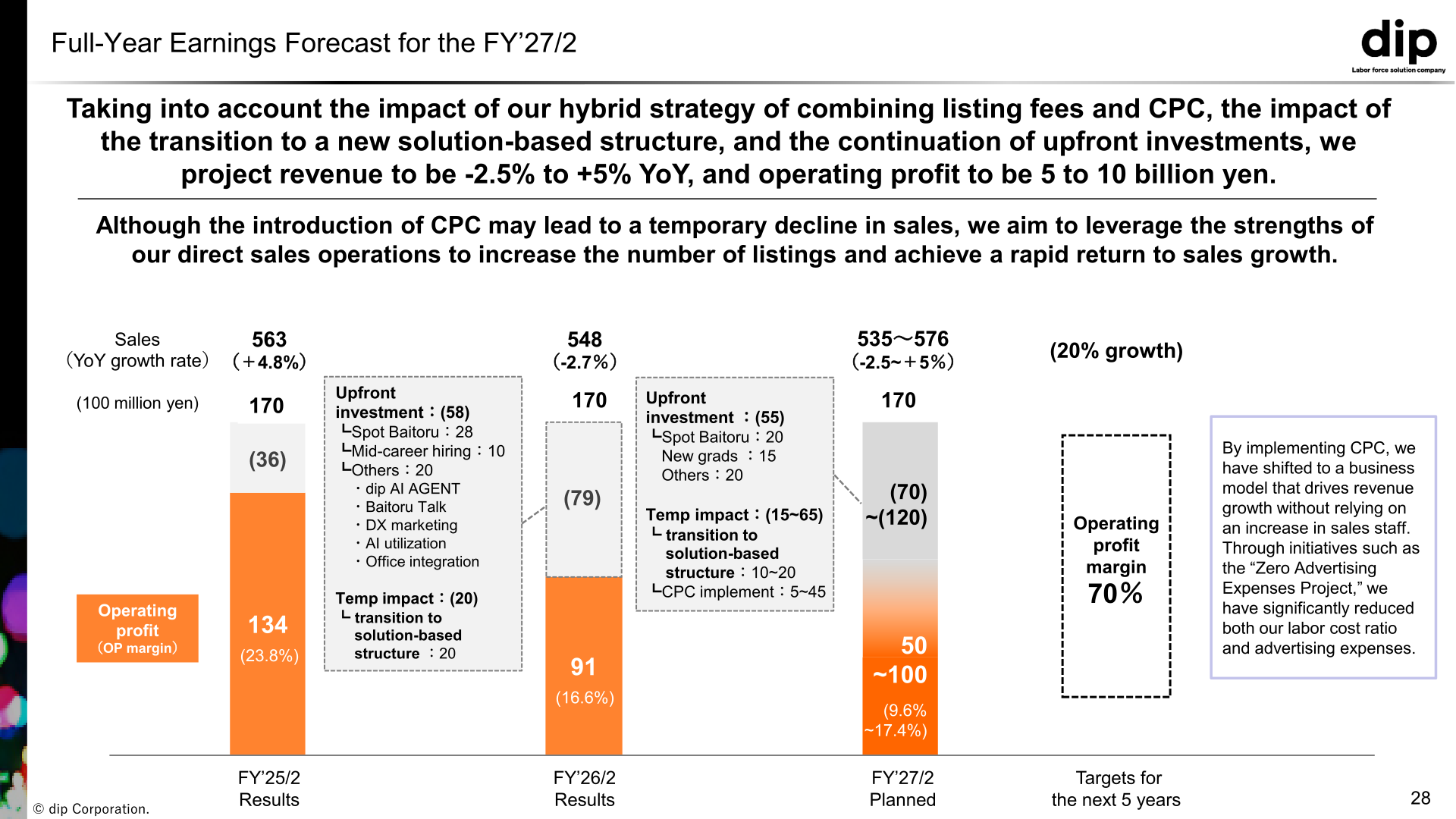
For FY’27/2 the company presents a range. On the forecast slide, stated in units of 100 million yen, sales are planned at 535 to 576 (-2.5% to +5% year on year) against 548 in FY’26/2 and 563 in FY’25/2, and operating profit at 50 to 100 with an operating profit margin of 9.6% to 17.4%, against 91 (16.6%) in FY’26/2 and 134 (23.8%) in FY’25/2. In the company’s own words, it projects “revenue to be -2.5% to +5% YoY, and operating profit to be 5 to 10 billion yen.”
| Item (100 million yen) | FY’27/2 Planned | FY’26/2 Results | FY’25/2 Results |
|---|---|---|---|
| Sales | 535~576 | 548 | 563 |
| Sales (YoY growth rate) | (-2.5~+5%) | (-2.7%) | (+4.8%) |
| Operating profit | 50~100 | 91 | 134 |
| Operating profit (OP margin) | (9.6%~17.4%) | (16.6%) | (23.8%) |
The slide bridges from an underlying operating profit level of 170 in each of the three years. In FY’26/2 that level was reduced by 79, comprising upfront investment of 58 (Spot Baitoru 28, mid-career hiring 10, others 20 covering dip AI AGENT, Baitoru Talk, DX marketing, AI utilization and office integration) and a temporary impact of 20 from the transition to the solution-based structure. For FY’27/2 the planned reduction is 70 to 120, comprising upfront investment of 55 (Spot Baitoru 20, new graduates 15, others 20) and a temporary impact of 15 to 65 (transition to the solution-based structure 10 to 20, CPC implementation 5 to 45). Over the next five years the company targets 20% growth with an operating profit margin of 70%.
Shareholder Returns
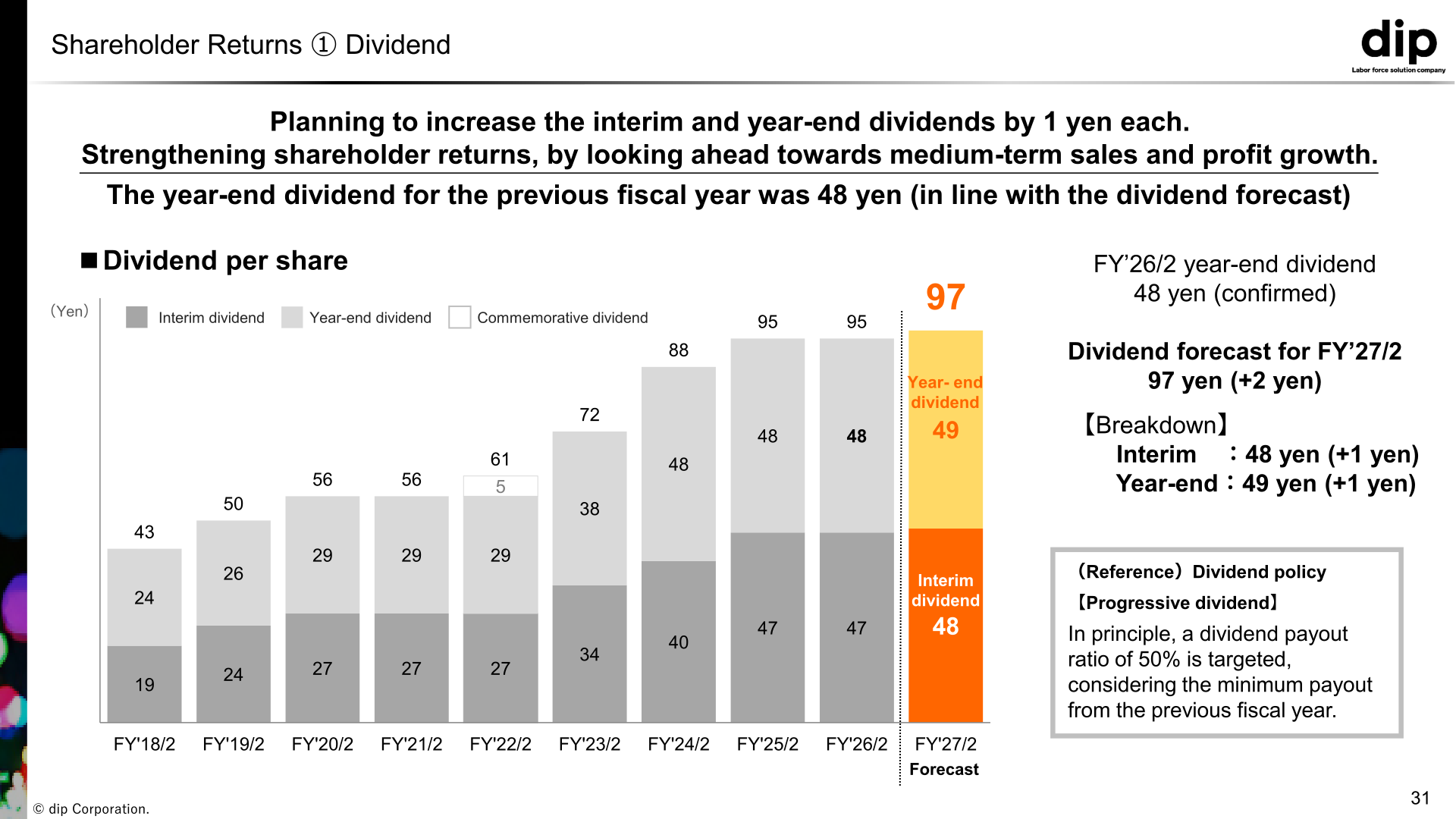
The FY’26/2 year-end dividend was confirmed at 48 yen per share, in line with the dividend forecast, bringing the annual dividend to 95 yen. For FY’27/2 the company plans to raise both the interim and year-end dividends by 1 yen each, to 48 yen and 49 yen respectively, for an annual dividend forecast of 97 yen (+2 yen). The dividend policy is a progressive dividend under which, in principle, a payout ratio of 50% is targeted while considering the minimum payout from the previous fiscal year. Under the cash allocation policy excerpted from the mid-term management plan, a minimum total return ratio guideline of 65% has been established in addition to the 50% payout ratio, and cash and deposits in excess of “Maximum Cash” are in principle returned to shareholders after growth investments.
| Dividend per share (Yen) | FY’27/2 Forecast | FY’26/2 | FY’25/2 |
|---|---|---|---|
| Interim dividend | 48 | 47 | 47 |
| Year-end dividend | 49 | 48 | 48 |
| Annual total | 97 | 95 | 95 |
The shareholder benefit programme remains in place, with record dates at the end of February and the end of August: holders of 100 shares or more but fewer than 500 shares receive an original QUO card with a value of 500 yen, and holders of 500 shares or more receive one with a value of 1,000 yen. A new QUO card featuring Shohei Ohtani is scheduled to be presented; the design for the interim shareholder benefit for FY’27/2 has not yet been determined.
Strategy and Topics
The transition to a solution-based structure, which the company describes as the largest organizational restructuring since its founding, shifted the sales organization from a region- and company-size basis to an industry-sector basis; 41,000 client handoffs were handled company-wide. In a survey of client companies conducted as of October 2025, 79% were satisfied with dip sales staff (34% very satisfied, 45% satisfied). Management expects the impact of the transition to be resolved during the first half of the current fiscal year, and notes that regional units which did not undergo major organizational changes are showing positive sales growth, with an April prospect of +3% year on year.
In the “Othello Project,” the number of job postings and workers on Spot Baitoru continued to increase. Baitoru Talk, a communication app for part-time employees and store managers, reached approximately 2,900 contracted companies at the end of the fourth quarter of FY’26/2, 1.5 times the approximately 1,900 of the previous quarter, and approximately 95,000 users, 1.8 times the approximately 53,000 of the previous quarter; the company is aiming for 2 million users. Under the “Zero Project,” business matching with financial institutions covered 45 banks and 4,351 branches.
On branding, dip was the main sponsor of the 2026 World Baseball Classic Tokyo Pool. As of March 11, 2026, the company puts the advertising equivalent value at approximately 3.5 billion yen, with approximately 130 TV programs covered, approximately 3,080 total exposures and approximately 4.1 hours of total exposure time. A conversation video between brand ambassador Shohei Ohtani and CEO Tomita had approximately 27 million YouTube views; interview videos recorded approximately 6.3 million views and an advertising equivalent value of approximately 400 million yen as of March 26, 2026.
For FY’27/2 the company sets out four new initiatives: the “Zero Advertising and Promotion Costs Project,” data-driven management, a hybrid strategy combining listing fees and CPC, and development of human capital. CPC-based products are scheduled for introduction in the second half of the year, initially in lower-priced plans, and the company aims to increase the number of job listings from 500,000 to 1 million by the end of the fiscal year, leveraging its 2,300-strong direct sales force. It hired 532 new graduates, and reports a turnover rate of 16% last year on a downward trend.
Financial Position
Total assets stood at 49,954 million yen as of February 28, 2026, down 552 million yen from 50,506 million yen a year earlier. Current assets were 25,869 million yen (down 395 million yen) and non-current assets 24,085 million yen (down 157 million yen), within which intangible assets rose 965 million yen to 12,160 million yen while investments and other assets fell 1,335 million yen to 9,044 million yen. Liabilities decreased 1,510 million yen to 12,760 million yen, and net assets rose 958 million yen to 37,193 million yen, with shareholders’ equity up 968 million yen at 36,631 million yen. Capital was 1,085 million yen as of the end of February 2026, and the company had 3,158 full-time employees as of April 1, 2026.
This article is an analysis based on publicly available information and is not a recommendation to buy or sell any specific securities. Investment decisions are your own responsibility.