
This article is based on publicly available IR materials and is not a recommendation to buy or sell any specific securities.
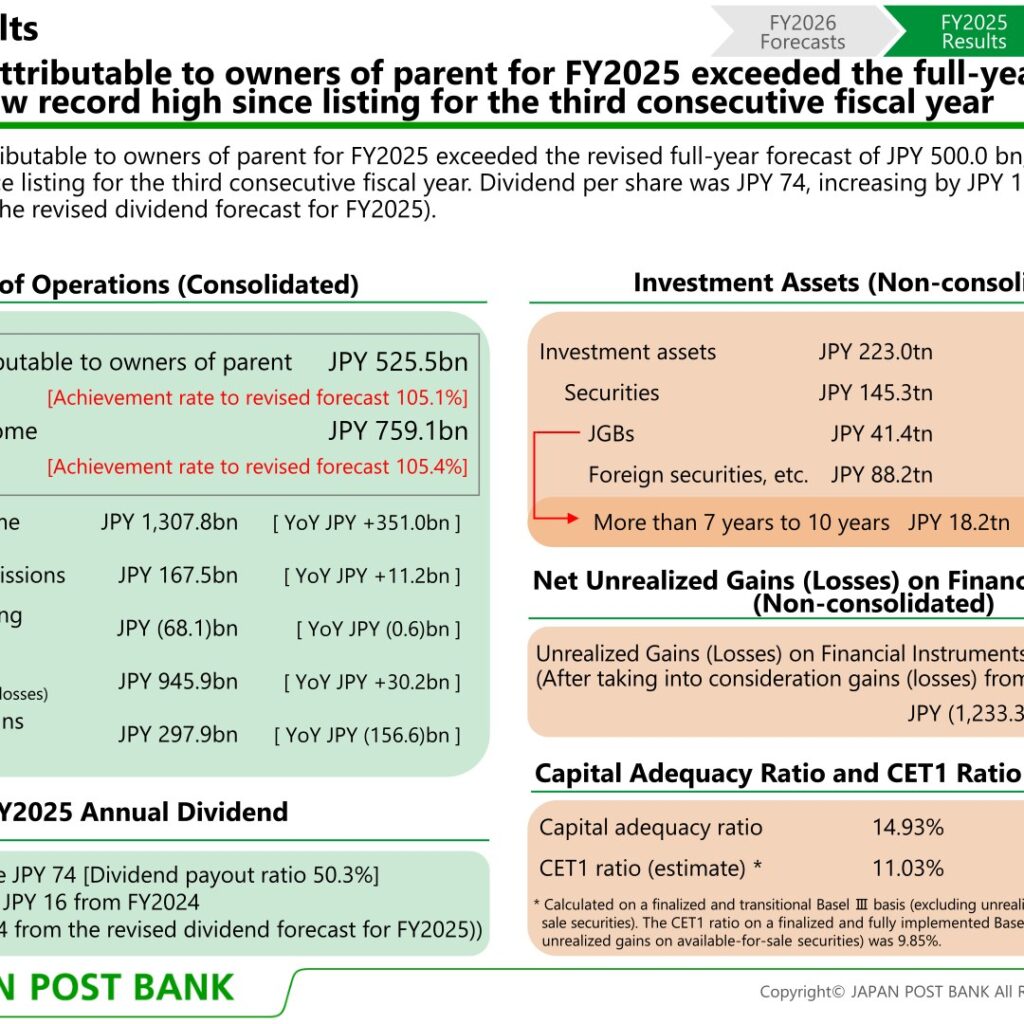
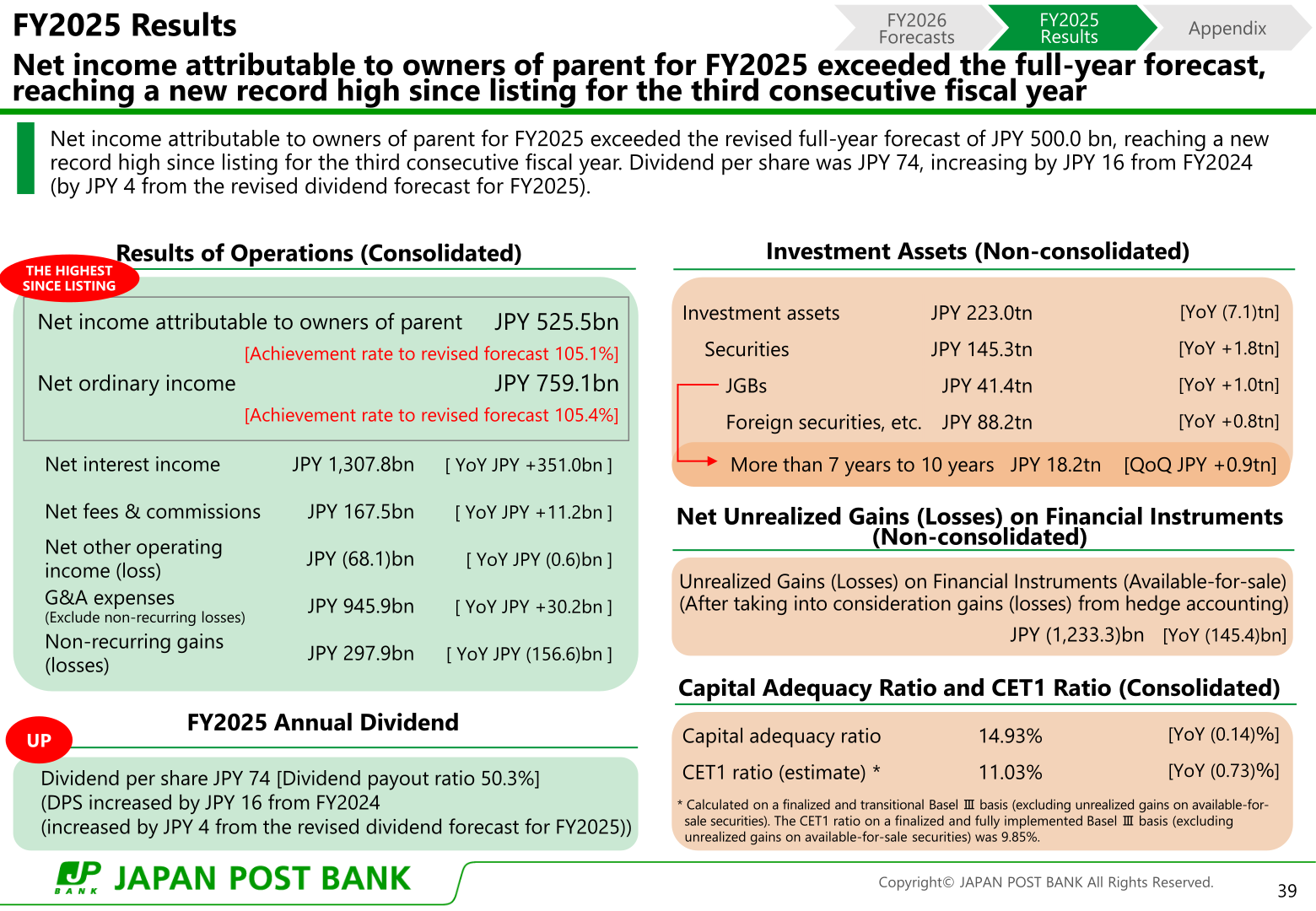
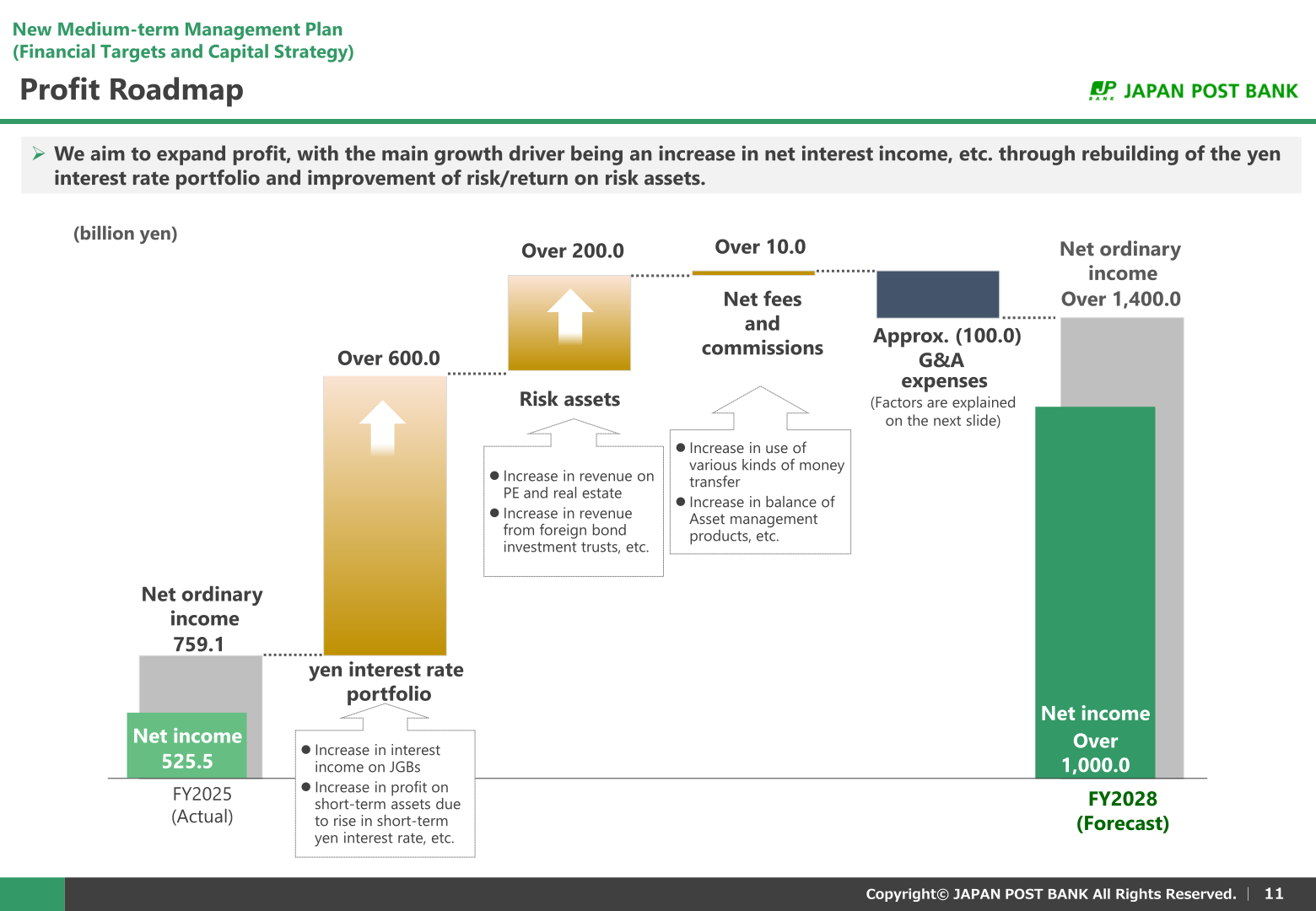
Japan Post Bank Co., Ltd. reported net income attributable to owners of parent of JPY 525.5 billion for FY2025, exceeding its revised full-year forecast of JPY 500.0 billion and marking a new record high since listing for the third consecutive fiscal year. Net ordinary income reached JPY 759.1 billion, an achievement rate of 105.4% versus the revised forecast, driven mainly by an increase in net interest income, etc. from the yen interest rate portfolio and higher short-term yen interest rates. Dividend per share rose to JPY 74, up JPY 16 from FY2024, and the Bank announced a new Medium-term Management Plan (FY2026–FY2028) targeting net income of over JPY 1 trillion and ROE of approximately 10% in the final year.
Consolidated Results (Full-Year Actual)
For FY2025, net interest income, etc. (interest income less interest expenses, including gains/losses on sales) increased JPY 201.0 billion year on year to JPY 1,536.3 billion, and net fees and commissions increased JPY 11.2 billion to JPY 167.5 billion. General and administrative expenses increased JPY 31.6 billion to JPY 946.4 billion. As a result, net ordinary income increased JPY 174.6 billion to JPY 759.1 billion, and net income attributable to owners of parent increased JPY 111.2 billion to JPY 525.5 billion.
| Item (billion yen) | FY2025 (Actual) | FY2024 (Actual) | Change (YoY) |
|---|---|---|---|
| Net interest income, etc. | 1,536.3 | 1,335.3 | 201.0 |
| Net fees and commissions | 167.5 | 156.3 | 11.2 |
| General and administrative expenses | 946.4 | 914.7 | 31.6 |
| Net ordinary income | 759.1 | 584.5 | 174.6 |
| Net income attributable to owners of parent | 525.5 | 414.3 | 111.2 |
| Dividend per share (JPY) | 74 | 58 | 16 |
Net income attributable to owners of parent exceeded the revised forecast of JPY 500.0 billion by JPY 25.5 billion (achievement rate 105.1%), and exceeded the original forecast of JPY 470.0 billion (announced May 15, 2025) by JPY 55.5 billion. Net ordinary income of JPY 759.1 billion exceeded the revised forecast of JPY 680.0 billion by JPY 79.1 billion.
Segment Results
Japan Post Bank does not disclose results by traditional business segment; instead, it breaks down net interest income into domestic (yen-denominated) and overseas (foreign currency-denominated) transactions on a non-consolidated basis. In FY2025, domestic net interest income increased JPY 192.2 billion year on year to JPY 569.6 billion, mainly due to increased interest income from due from banks, etc. and increased interest income from JGBs. Overseas net interest income increased JPY 154.7 billion to JPY 734.1 billion, mainly due to increased profits from foreign bond investment trusts.
| Item (billion yen, Non-consolidated) | FY2025 (Actual) | FY2024 (Actual) | Change (YoY) |
|---|---|---|---|
| Domestic net interest income | 569.6 | 377.4 | 192.2 |
| Domestic interest on Japanese government bonds | 368.3 | 257.9 | 110.4 |
| Overseas net interest income | 734.1 | 579.3 | 154.7 |
| Overseas interest on foreign securities | 1,403.0 | 1,242.0 | 161.0 |
| Total net interest income | 1,303.7 | 956.8 | 346.9 |
Capital Adequacy and Financial Soundness
The Bank’s consolidated capital adequacy ratio (domestic standard) was 14.93% as of March 31, 2026, down 0.14 percentage points from 15.08% a year earlier, mainly due to the impact of the gradual increase in risk weights under the finalized Basel III standards. Total capital increased JPY 198.1 billion to JPY 9,572.0 billion, while risk-weighted assets increased JPY 1,941.7 billion to JPY 64,072.8 billion. The consolidated CET1 ratio (transitional basis) was 11.03%, down 0.73 percentage points from 11.77%; the CET1 ratio on a finalized and fully implemented Basel III basis, excluding unrealized gains on available-for-sale securities, was 9.85%. Net unrealized gains (losses) on financial instruments (available-for-sale, non-consolidated, after hedge accounting) were JPY (1,233.3) billion, a decline of JPY (145.4) billion from a year earlier, as expanding unrealized losses on JGBs from rising yen interest rates were partially offset by valuation gains on foreign bonds and investment trusts.
FY2026 Forecast
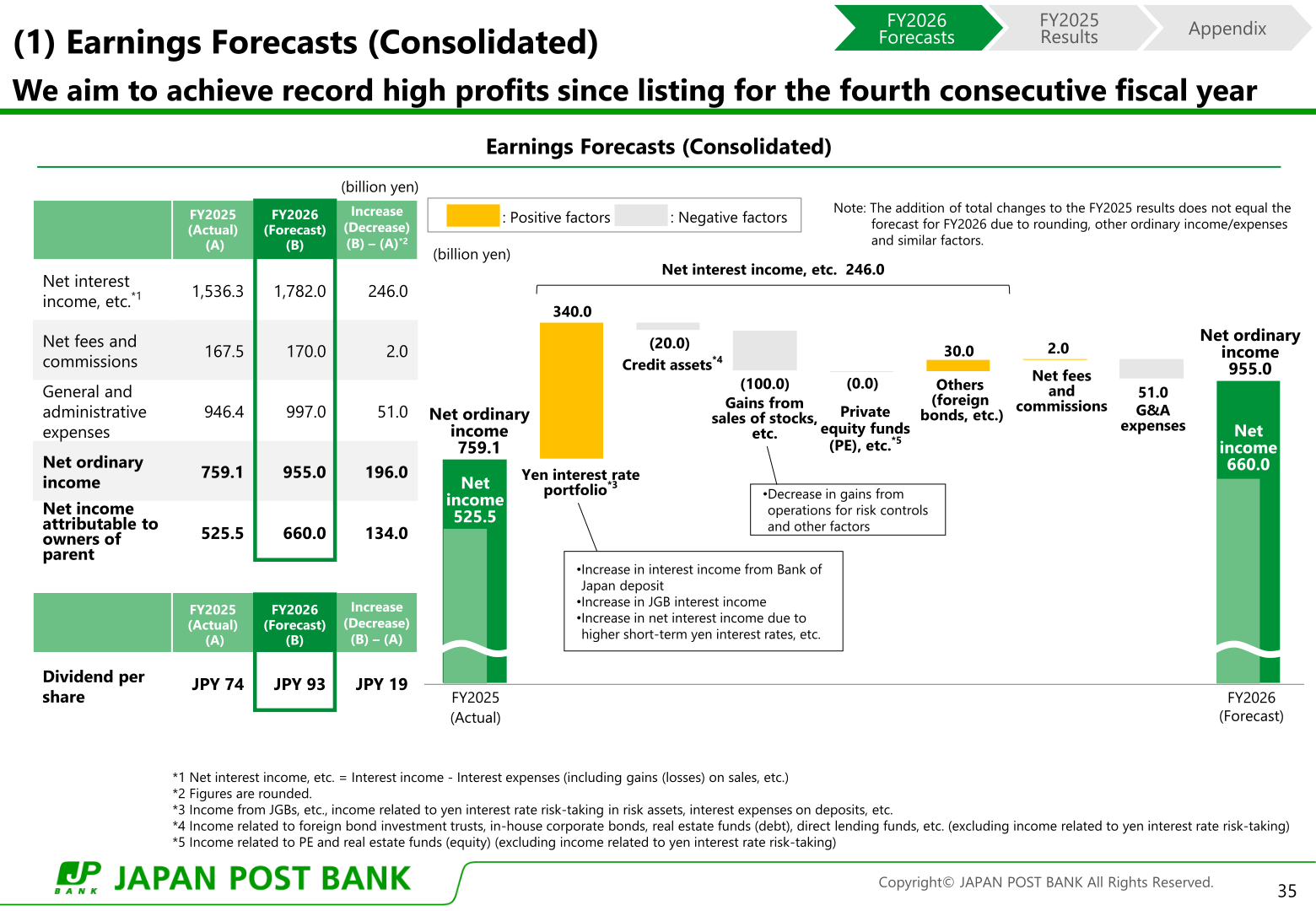
For FY2026, Japan Post Bank forecasts net ordinary income of JPY 955.0 billion, up JPY 196.0 billion from FY2025, and net income attributable to owners of parent of JPY 660.0 billion, up JPY 134.0 billion, aiming to achieve record high profits since listing for the fourth consecutive fiscal year. The forecast assumes net interest income, etc. of JPY 1,782.0 billion (up JPY 246.0 billion), net fees and commissions of JPY 170.0 billion (up JPY 2.0 billion), and general and administrative expenses of JPY 997.0 billion (up JPY 51.0 billion). Two additional BOJ policy interest rate hikes are expected during FY2026, with domestic and foreign interest rates projected to trend in line with implied forward rates as of March 31, 2026, and foreign credit spreads and exchange rates assumed to remain at FY2025 average levels.
| Item (billion yen) | FY2025 (Actual) | FY2026 (Forecast) | Change |
|---|---|---|---|
| Net interest income, etc. | 1,536.3 | 1,782.0 | 246.0 |
| Net fees and commissions | 167.5 | 170.0 | 2.0 |
| General and administrative expenses | 946.4 | 997.0 | 51.0 |
| Net ordinary income | 759.1 | 955.0 | 196.0 |
| Net income attributable to owners of parent | 525.5 | 660.0 | 134.0 |
| Dividend per share (JPY) | 74 | 93 | 19 |
Shareholder Returns
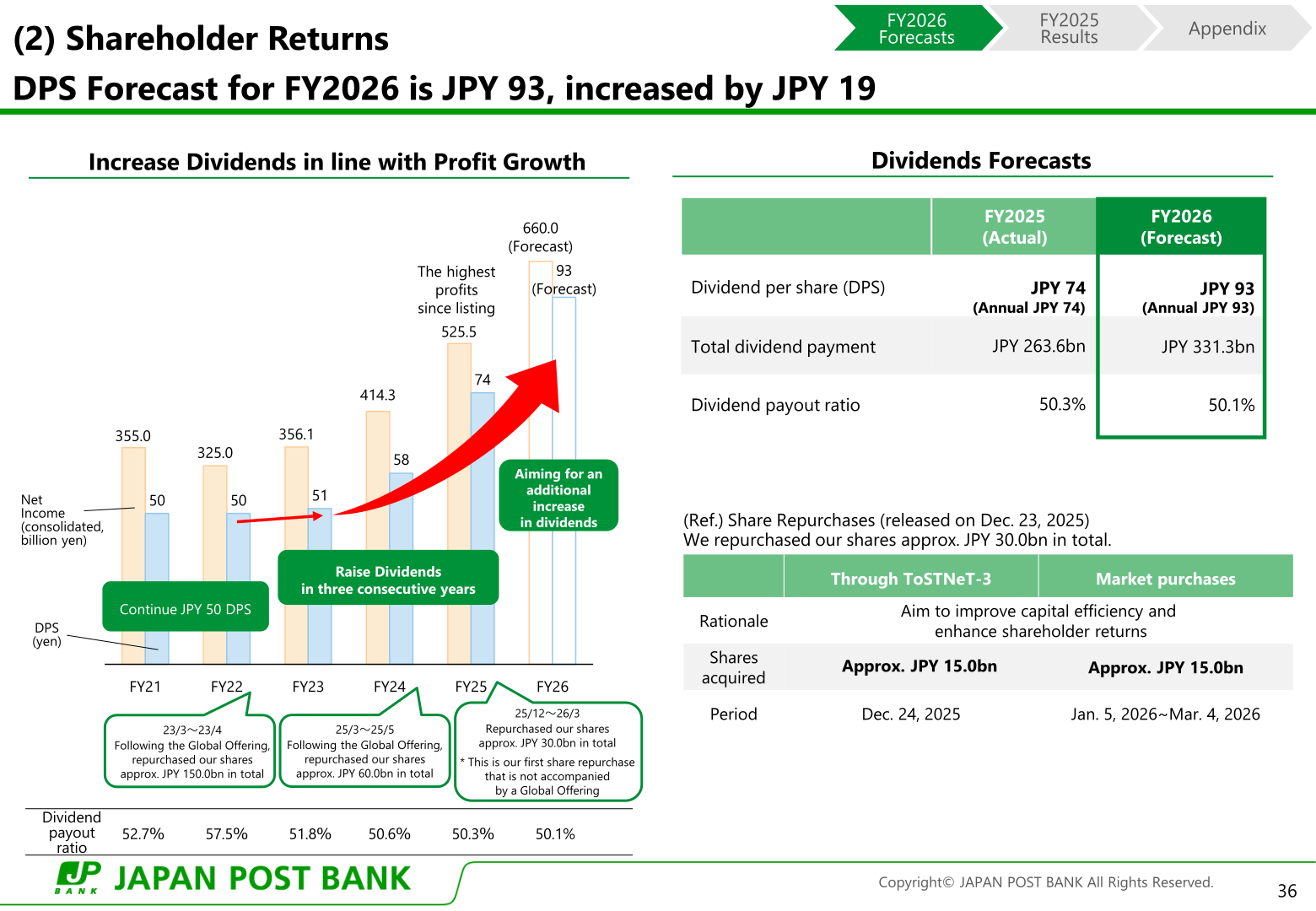
Japan Post Bank forecasts a dividend per share of JPY 93 for FY2026, an increase of JPY 19 from the FY2025 actual dividend of JPY 74, with a dividend payout ratio of 50.1% (50.3% for FY2025). The Bank implements progressive dividends through profit growth with a dividend payout ratio of approximately 50%, currently paying dividends once a year at the end of the fiscal year, and considers share repurchases on an ongoing basis based on market conditions, opportunities for growth investment, and the Japan Post Group’s policy for holding shares in the Bank. In the period from December 2025 to March 2026, the Bank repurchased approximately JPY 30.0 billion of its own shares in total, through ToSTNeT-3 (approx. JPY 15.0 billion, Dec. 24, 2025) and market purchases (approx. JPY 15.0 billion, Jan. 5–Mar. 4, 2026); this was the Bank’s first share repurchase not accompanied by a Global Offering.
| Item | FY2025 (Actual) | FY2026 (Forecast) |
|---|---|---|
| Dividend per share (JPY) | 74 | 93 |
| Total dividend payment | JPY 263.6bn | JPY 331.3bn |
| Dividend payout ratio | 50.3% | 50.1% |
Medium-Term Plan / Topics
In May 2026, Japan Post Bank announced a new Medium-term Management Plan for FY2026 through FY2028, positioned as the first step toward realizing a 15-year medium- to long-term vision of becoming “Japan’s leading comprehensive financial platform” and “a leading global market player.” Under the new plan, for the final year FY2028 the Bank targets net income of over JPY 1 trillion, ROE (based on shareholders’ equity) of approximately 10%, an OHR of approximately 40%, and a CET1 ratio target range of 11–13% in normal times. The main growth driver for the profit roadmap is an increase in net interest income, etc. through rebuilding of the yen interest rate portfolio and improvement of risk/return on risk assets. Key growth strategy KPIs for the end of FY2028 include net interest income, etc. of over JPY 2,300.0 billion (consolidated, management accounting basis), 25 million accounts registered for the Yucho Bankbook App (16.62 million as of March 31, 2026), 1.1 million users of the long-term asset-building system, and approximately 60 deals totaling approximately JPY 60.0 billion in investments executed through the Bank’s subsidiary General Partner. G&A expenses are targeted to rise by approximately JPY 100.0 billion to approximately JPY 1,050.0 billion over the plan period, controlled to around the pace of Japanese inflation (+3%/year), while OHR is expected to fall from 55.5% in FY2025 to approximately 40% in FY2028 through profit growth.
This article is an analysis based on publicly available information and is not a recommendation to buy or sell any specific securities. Investment decisions are your own responsibility.
![[Obayashi] Investors’ Guide 2026 — The Complete 24-Article Breakdown](https://japan-equity.com/wp-content/uploads/2026/07/hub_cover-1024x1024.png)
![[Obayashi] IR & SR Policy — Feeding Dialogue Back into Management](https://japan-equity.com/wp-content/uploads/2026/07/p32_sq-1024x1024.jpg)
![[Obayashi] Domestic Civil Engineering — Resilience Spending Supports 9.6% Margin](https://japan-equity.com/wp-content/uploads/2026/07/p11_sq-1024x1024.jpg)
![[Obayashi] Overseas Construction — Orders Reach ¥1.2tn](https://japan-equity.com/wp-content/uploads/2026/07/p15_sq-1024x1024.jpg)
![[Obayashi] Share Price & External Ratings — vs TOPIX, ESG Index Inclusion](https://japan-equity.com/wp-content/uploads/2026/07/p40_sq-1024x1024.jpg)
![[Construction] ¥75.5tn Investment, Shrinking Workforce — Big-5 Market Share](https://japan-equity.com/wp-content/uploads/2026/07/p12_sq-1024x1024.jpg)
![[Obayashi] Capital Policy & Shareholder Returns — ROE 10%+, DOE ~5%, ¥100bn Buyback](https://japan-equity.com/wp-content/uploads/2026/07/p27_sq-1024x1024.jpg)
![[Obayashi] Reducing Cross-Shareholdings — ¥285.2bn Sold in Five Years](https://japan-equity.com/wp-content/uploads/2026/07/p29_sq-1024x1024.jpg)
![[Obayashi] ¥750bn Investment Plan — ¥300bn to Development, ¥190bn to Tech/DX](https://japan-equity.com/wp-content/uploads/2026/07/p30_sq-1024x1024.jpg)
![[Obayashi] MTP2022 KPIs — Operating Profit ~2x Target, ROE 14.4%](https://japan-equity.com/wp-content/uploads/2026/07/p25_sq-1024x1024.jpg)
![[Obayashi] Cash Allocation — ¥420bn Investment CF Over Five Years](https://japan-equity.com/wp-content/uploads/2026/07/p26_sq-1024x1024.jpg)
![[Obayashi] Green Energy — 44 Plants, 344MW, and the Green Hydrogen Challenge](https://japan-equity.com/wp-content/uploads/2026/07/p21_sq-1024x1024.jpg)
![[Obayashi] Tackling the Labor Shortage — Robotics Construction®](https://japan-equity.com/wp-content/uploads/2026/07/p14_sq-1024x1024.jpg)
