This article is based on publicly available IR materials and is not a recommendation to buy or sell any specific securities.
Note: Okumura Corporation does not publish an English results presentation; this article is an English translation of the Japanese-language article on our sister site Investalk, which is based on the company’s Japanese-language IR materials, with figures transcribed as reported. The company labels the period covered here as the fiscal year ended March 31, 2026; this site classifies the most recently completed fiscal year as FY2025, and the labels used in the text, tables and segment data below follow the source materials.
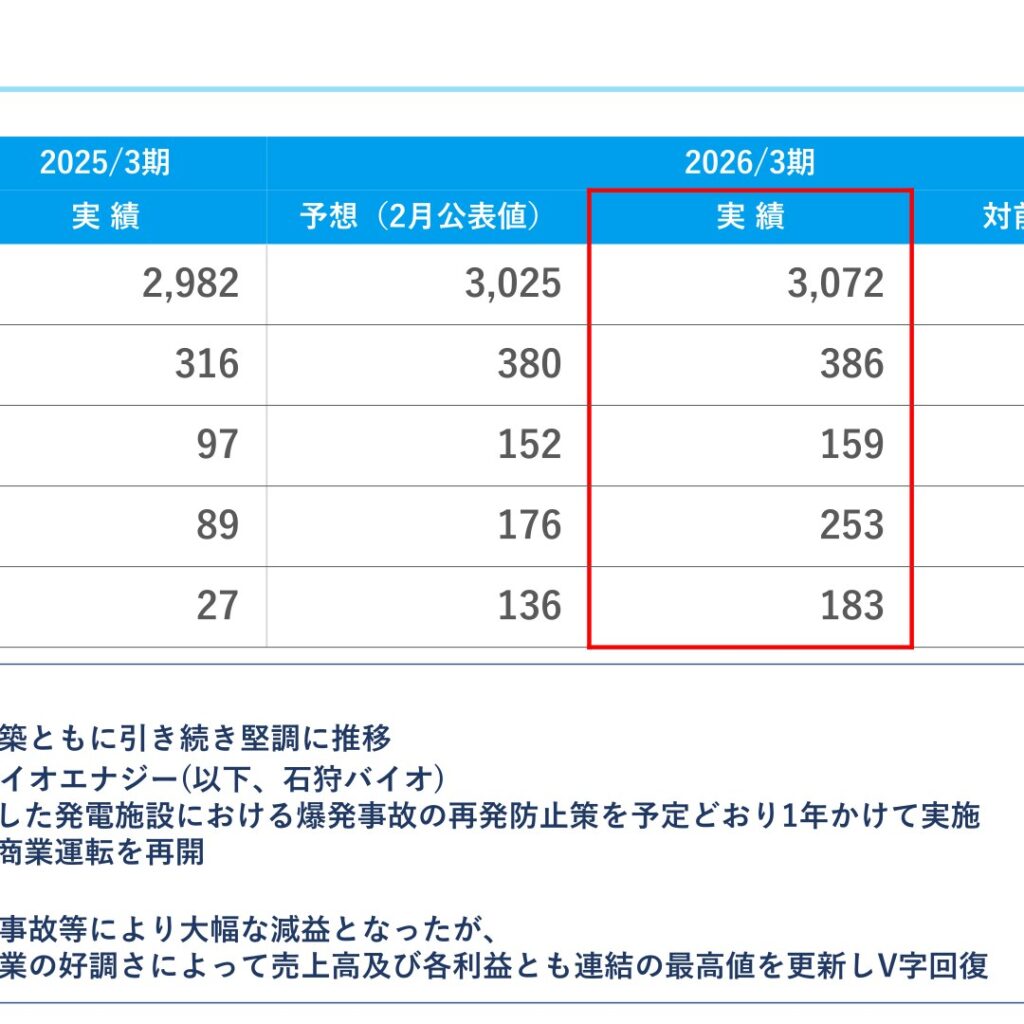
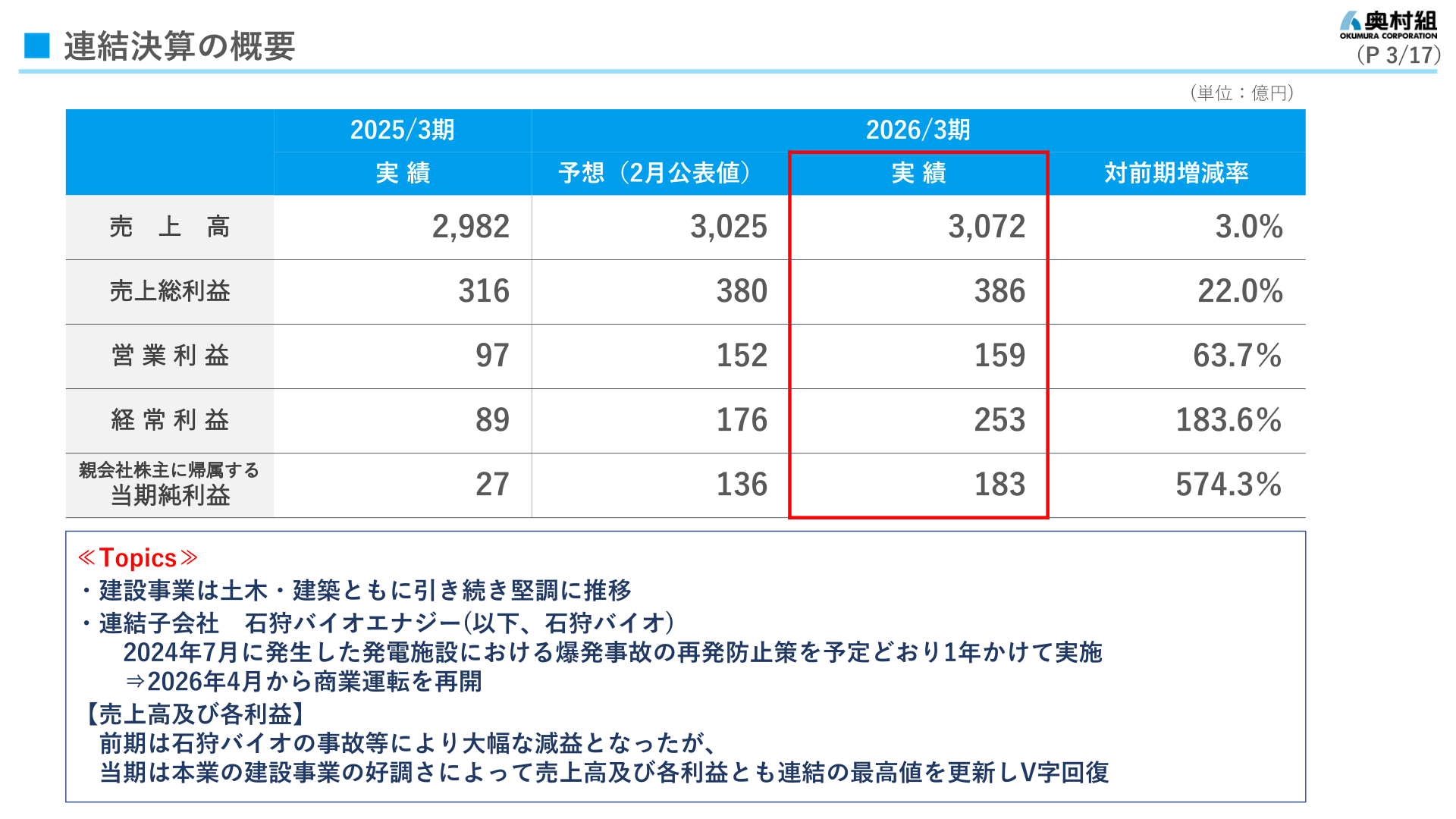
Okumura Corporation’s consolidated results for the fiscal year ended March 31, 2026 were net sales of 307.2 billion yen, up 3.0% year on year, operating profit of 15.9 billion yen, up 63.7%, ordinary profit of 25.3 billion yen, up 183.6%, and profit attributable to owners of parent of 18.3 billion yen, up 574.3%. The materials explain that, whereas the previous fiscal year saw a sharp profit decline caused by factors including the accident at consolidated subsidiary Ishikari Bio Energy (hereafter Ishikari Bio), in the fiscal year under review the strength of the core construction business lifted net sales and every profit line to record consolidated highs, delivering a V-shaped recovery. The construction business continued to perform firmly in both civil engineering and building construction, and Ishikari Bio implemented measures to prevent a recurrence of the explosion accident over a one-year period as planned, resuming commercial operation in April 2026. For the fiscal year ending March 31, 2027, the company expects net sales of 304.0 billion yen, operating profit of 20.5 billion yen and profit attributable to owners of parent of 15.4 billion yen.
Consolidated Results (Fiscal Year Ended March 31, 2026, Actual)
Net sales were 307.2 billion yen (298.2 billion yen in the previous fiscal year) and gross profit was 38.6 billion yen (31.6 billion yen), giving a gross profit margin of 12.6%. Selling, general and administrative expenses were 22.7 billion yen as personnel expenses increased on base pay raises and higher bonus payments. Operating profit increased sharply year on year to 15.9 billion yen (operating profit margin 5.2%), mainly because the gross profit margin of the construction business, and of the civil engineering business in particular, improved. Ordinary profit of 25.3 billion yen (margin 8.2%) was supported by a gain on settlement of forward exchange contracts of 1.2 billion yen, which arose because Ishikari Bio had suspended commercial operation and cancelled forward exchange contracts that were not used to settle fuel transactions, and by a valuation gain on forward exchange contracts of 6.1 billion yen, representing the mark-to-market valuation of the outstanding forward exchange contract balance as of the fiscal year-end date; non-operating income and expenses therefore produced a net inflow of 9.3 billion yen (a net outflow of 0.8 billion yen in the previous fiscal year). Extraordinary income and losses turned to a gain of 1.3 billion yen, in reaction to the impairment loss of 13.2 billion yen related to Ishikari Bio recorded in the previous fiscal year. ROE was 9.8% (1.5% in the previous fiscal year). In consolidated cash flows, operating cash flow was a positive 7.6 billion yen (a negative 11.8 billion yen in the previous fiscal year), investing cash flow was a negative 9.9 billion yen and financing cash flow was a negative 9.7 billion yen, leaving cash and cash equivalents at the end of the period at 15.6 billion yen.
| Item | FY ended March 2026 (Actual) | FY ended March 2025 (Actual) | YoY change |
|---|---|---|---|
| Net sales | 307.2 billion yen | 298.2 billion yen | 3.0% |
| Gross profit | 38.6 billion yen | 31.6 billion yen | 22.0% |
| Operating profit | 15.9 billion yen | 9.7 billion yen | 63.7% |
| Ordinary profit | 25.3 billion yen | 8.9 billion yen | 183.6% |
| Profit attributable to owners of parent | 18.3 billion yen | 2.7 billion yen | 574.3% |
Results by Business
In the civil engineering business, net sales rose 16.4% year on year to 115.2 billion yen and gross profit was 17.7 billion yen (gross profit margin 15.4%, against 12.1% in the previous fiscal year). There were no deterioration factors on specific projects of the kind seen in the previous fiscal year, and profitability improved through the acquisition of additional and design-change work on projects carried over from the previous fiscal year and through cost reductions. The provision for loss on construction contracts was 2.36 billion yen (a decrease of 0.51 billion yen on completion and an additional 1.10 billion yen provided for a shortfall). In the building construction business, net sales fell 2.9% year on year to 180.1 billion yen and gross profit was 19.3 billion yen (gross profit margin 10.7%, against 10.4% in the previous fiscal year), with profit accumulated through the acquisition of additional and design-change work on projects carried over from the previous fiscal year and through cost reductions. The provision for loss on construction contracts was 0.36 billion yen. The investment and development business and others posted net sales of 11.8 billion yen and gross profit of 1.5 billion yen (gross profit margin 13.3%). Within this, the real estate business increased to net sales of 5.2 billion yen and gross profit of 3.4 billion yen on a decline in items such as the large-scale repair work on income-generating properties carried out in the previous fiscal year and an increase in rental income in the fiscal year under review; in the new businesses, net sales fell to 1.9 billion yen as Ishikari Bio operated only on a test-run basis and gross profit was in the red for a second consecutive fiscal year (-2.6 billion yen), although the deficit narrowed on lower depreciation following the impairment loss recorded in the previous fiscal year. Other businesses declined to net sales of 4.6 billion yen and gross profit of 0.7 billion yen owing to the elimination of intra-group transactions and other factors, but performance remained firm. On a non-consolidated basis, construction orders received were 132.2 billion yen in civil engineering, down 31.4% year on year, and 220.0 billion yen in building construction, up 19.7% year on year, for a total of 352.2 billion yen, down 6.5%. The order backlog for civil engineering and building construction combined was 615.6 billion yen (civil engineering 304.6 billion yen, building construction 310.9 billion yen).
| Business | Metric | FY ended March 2026 | FY ended March 2025 |
|---|---|---|---|
| Civil engineering | Net sales | 115.2 billion yen | 99.0 billion yen |
| Civil engineering | Gross profit | 17.7 billion yen | 11.9 billion yen |
| Civil engineering | Gross profit margin | 15.4% | 12.1% |
| Building construction | Net sales | 180.1 billion yen | 185.5 billion yen |
| Building construction | Gross profit | 19.3 billion yen | 19.2 billion yen |
| Building construction | Gross profit margin | 10.7% | 10.4% |
| Investment and development business and others | Net sales | 11.8 billion yen | 13.6 billion yen |
| Investment and development business and others | Gross profit | 1.5 billion yen | 0.4 billion yen |
Full-Year Forecast (Fiscal Year Ending March 31, 2027)
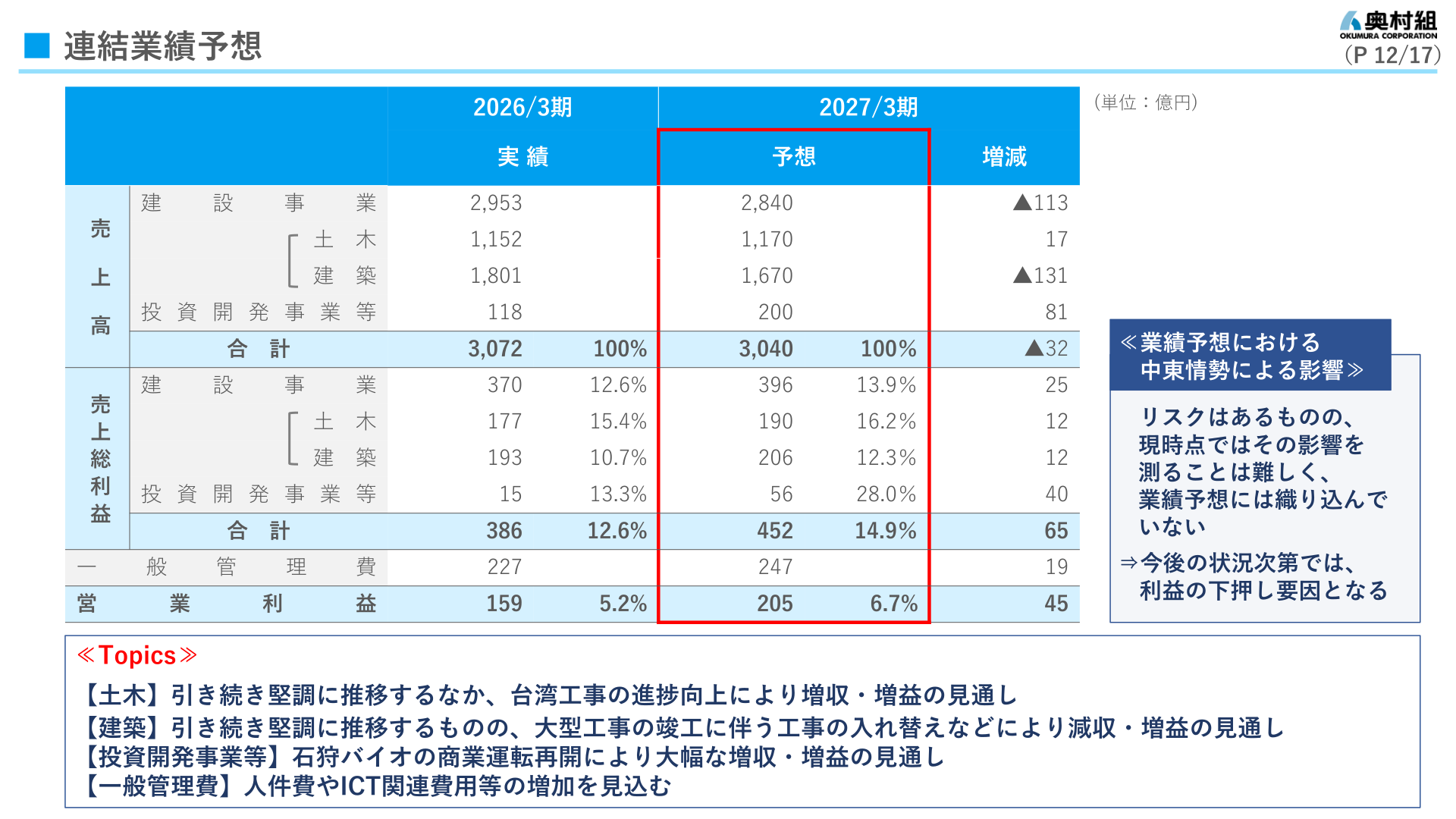
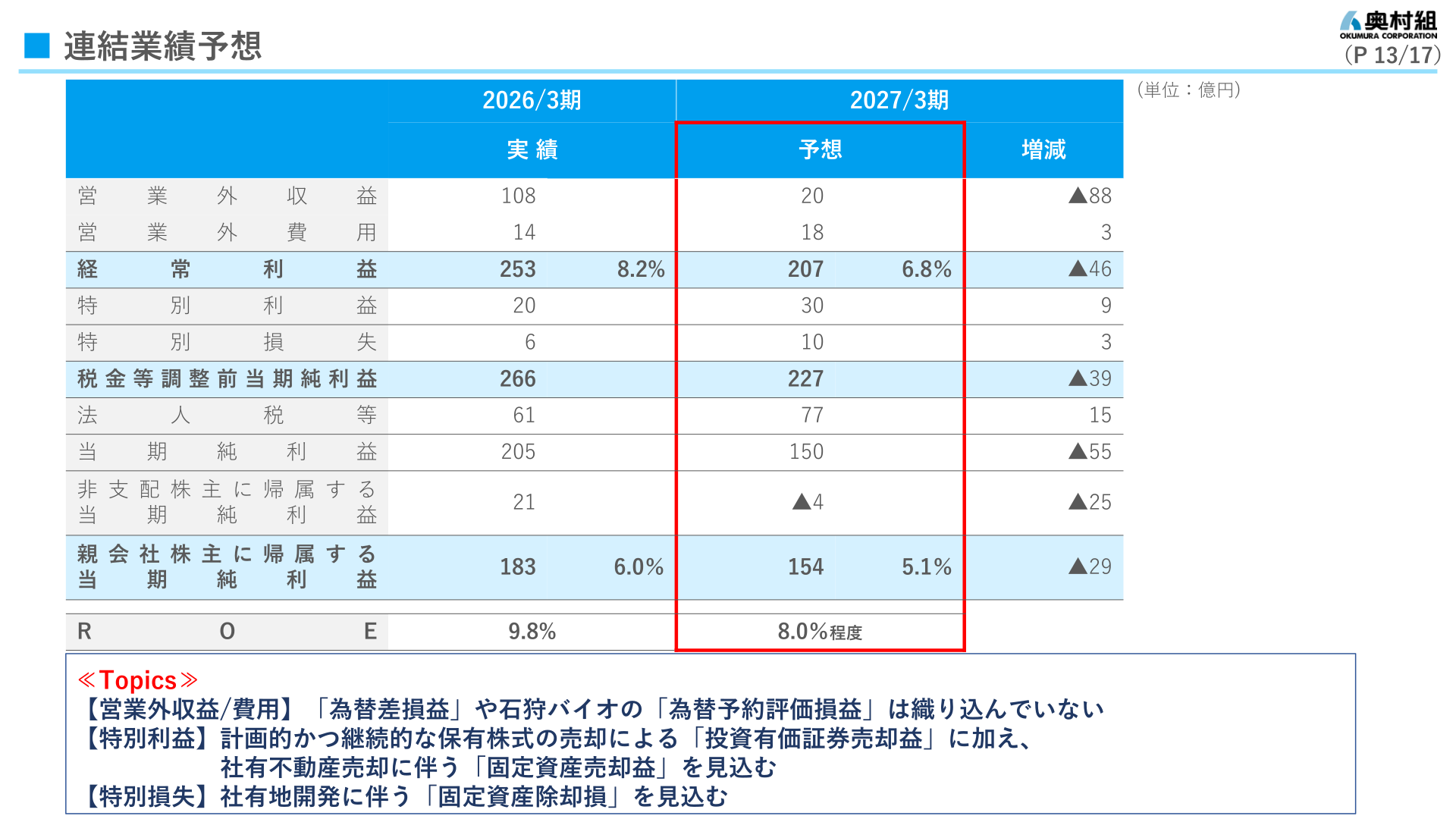
For the fiscal year ending March 31, 2027 the company forecasts net sales of 304.0 billion yen, gross profit of 45.2 billion yen (gross profit margin 14.9%), selling, general and administrative expenses of 24.7 billion yen, operating profit of 20.5 billion yen (operating profit margin 6.7%), ordinary profit of 20.7 billion yen (margin 6.8%), profit attributable to owners of parent of 15.4 billion yen (margin 5.1%) and ROE of around 8%. By business, civil engineering is expected to continue performing firmly and to record higher sales and profit as progress on works in Taiwan improves (net sales of 117.0 billion yen, gross profit of 19.0 billion yen); building construction is expected to continue performing firmly but to record lower sales with higher profit as projects are replaced following the completion of large-scale works (net sales of 167.0 billion yen, gross profit of 20.6 billion yen); and the investment and development business and others is expected to record substantially higher sales and profit as Ishikari Bio resumes commercial operation (net sales of 20.0 billion yen, gross profit of 5.6 billion yen). Selling, general and administrative expenses are expected to increase on higher personnel expenses and ICT-related costs. Non-operating income and expenses do not incorporate foreign exchange gains or losses or valuation gains or losses on Ishikari Bio’s forward exchange contracts. Regarding the situation in the Middle East, the company states that risks exist but that their impact is difficult to gauge at this point, so they have not been incorporated into the earnings forecast, and that depending on future developments they could become a factor pushing profit down. Excluding the 8.2 billion yen of special factors such as the valuation gain on forward exchange contracts recorded in non-operating income in the fiscal year ended March 31, 2026, each profit line from ordinary profit downwards is expected to increase in the fiscal year ending March 31, 2027. On a non-consolidated basis, construction orders received are expected to total 280.0 billion yen, comprising 110.0 billion yen in civil engineering and 170.0 billion yen in building construction, taking construction capacity and other factors into account.
| Item | FY ending March 2027 (Forecast) | FY ended March 2026 (Actual) | Change |
|---|---|---|---|
| Net sales | 304.0 billion yen | 307.2 billion yen | -3.2 billion yen |
| Gross profit | 45.2 billion yen | 38.6 billion yen | 6.5 billion yen |
| Selling, general and administrative expenses | 24.7 billion yen | 22.7 billion yen | 1.9 billion yen |
| Operating profit | 20.5 billion yen | 15.9 billion yen | 4.5 billion yen |
| Ordinary profit | 20.7 billion yen | 25.3 billion yen | -4.6 billion yen |
| Profit attributable to owners of parent | 15.4 billion yen | 18.3 billion yen | -2.9 billion yen |
| ROE | around 8.0% | 9.8% | – |
Shareholder Returns
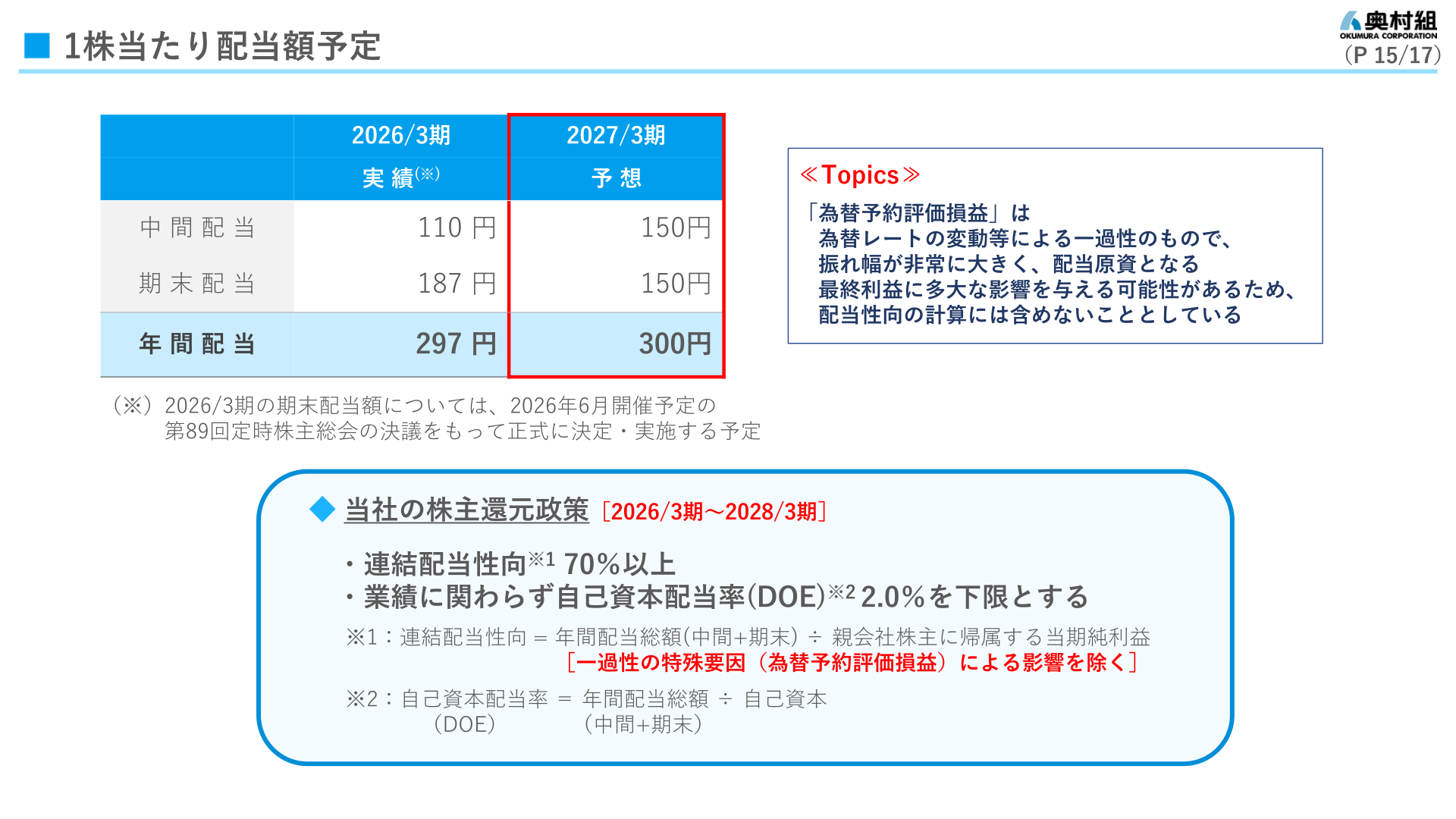
The annual dividend for the fiscal year ended March 31, 2026 is 297 yen per share (interim 110 yen, year-end 187 yen), an increase of 33 yen from the annual figure of 264 yen announced in February 2026. Calculated from a dividend resource of 15.2 billion yen excluding one-off special factors, the consolidated payout ratio is 70.2% and the consolidated total return ratio is 80.7%. The year-end dividend amount is to be formally determined and implemented by resolution of the 89th Ordinary General Meeting of Shareholders scheduled to be held in June 2026. The shareholder return policy is, for the period from the fiscal year ended March 31, 2026 through the fiscal year ending March 31, 2028, a consolidated payout ratio of 70% or more excluding the impact of one-off special factors (valuation gains and losses on forward exchange contracts), with a dividend on equity (DOE) of 2.0% as a floor regardless of performance. Valuation gains and losses on forward exchange contracts are one-off items caused by movements in exchange rates and other factors, with a very large swing that may significantly affect the bottom-line profit that serves as the source of dividends, so they are excluded from the payout ratio calculation. For the fiscal year ending March 31, 2027 the company forecasts an annual dividend of 300 yen (interim 150 yen, year-end 150 yen).
| Item | FY ended March 2026 (Actual) | FY ending March 2027 (Forecast) |
|---|---|---|
| Interim dividend | 110 yen | 150 yen |
| Year-end dividend | 187 yen | 150 yen |
| Annual dividend | 297 yen | 300 yen |
Medium-Term Management Plan / Topics
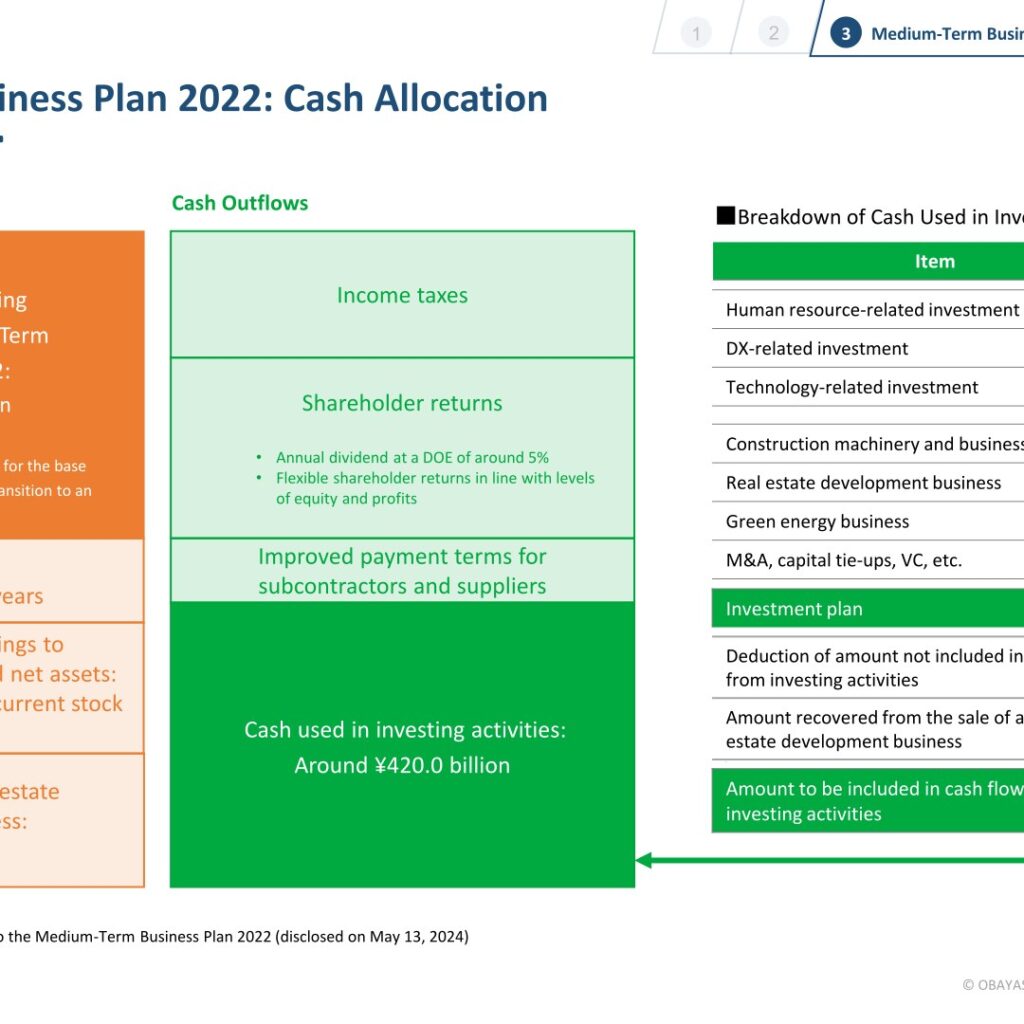
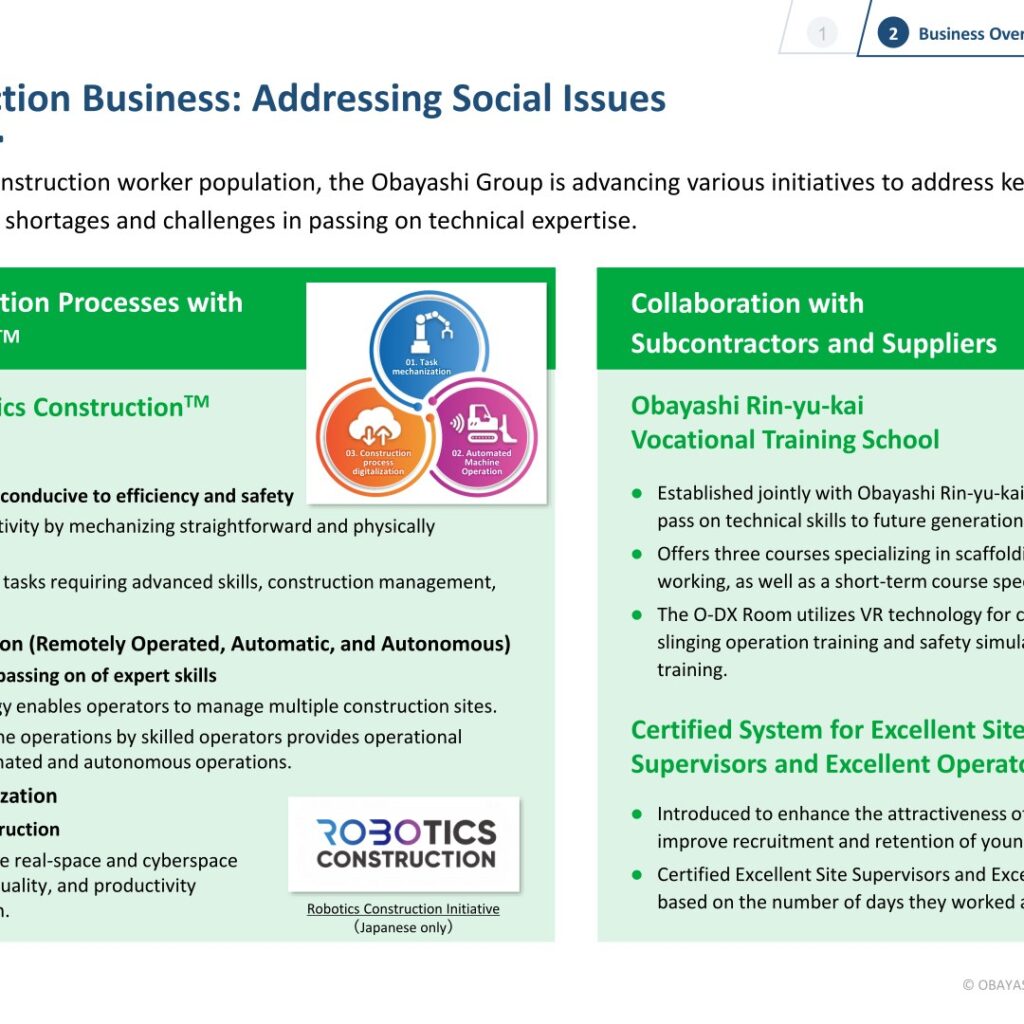
In fiscal 2025, the first year of the medium-term management plan covering fiscal 2025 to fiscal 2027, each item tracked firmly against the plan’s target values, and consolidated net sales exceeded 300.0 billion yen as work on projects carried over in the construction business progressed. The targets for fiscal 2027, the final year, are net sales of 330.0 billion yen, operating profit of 20.0 billion yen (operating profit margin 6.0%) and ROE of 8% or more; because the degree of the impact of higher crude oil prices on the prices of construction materials and equipment and the timing at which it will materialise are both unclear, the company is not revising the plan’s target values at this point. The operating profit of 20.5 billion yen forecast for the fiscal year ending March 31, 2027 is expected to exceed the medium-term management plan target of 20.0 billion yen. On management that is conscious of the cost of capital and the share price, the company recognises its cost of shareholders’ equity as 6-7%, raised by 1% from the level at the time the current medium-term plan was announced (May 2025) to reflect the rise in long-term interest rates, and aims to continue achieving an ROE target that exceeds the cost of shareholders’ equity. Two issues of strategically held shares were reduced in fiscal 2025, but the ratio to consolidated net assets rose because of the large impact of share price increases on the shares held. Against an investment plan totalling 70.0 billion yen over three years (including expense-type investment), the fiscal 2025 result was 17.3 billion yen. In the civil engineering business, the company is enhancing the functionality of a remote operation system for shield machines developed jointly with Okumura Kikai Seisaku, and overseas it is conducting order activities centred on shield tunnel works in Taiwan and Singapore.
This article is an analysis based on publicly available information and is not a recommendation to buy or sell any specific securities. Investment decisions are your own responsibility.