This article is based on publicly available IR materials and is not a recommendation to buy or sell any specific securities.
Note on fiscal-year labelling: this site classifies each company’s most recently completed fiscal year as FY2025, while Matsui Construction itself labels this period the fiscal year ended March 2026; the year labels used in the text, tables and segment data below follow the company’s own materials. Note: Matsui Construction does not publish an English results presentation; this article is an English translation of the Japanese-language article on our sister site Investalk, which is based on the company’s Japanese-language IR materials, with figures transcribed as reported.
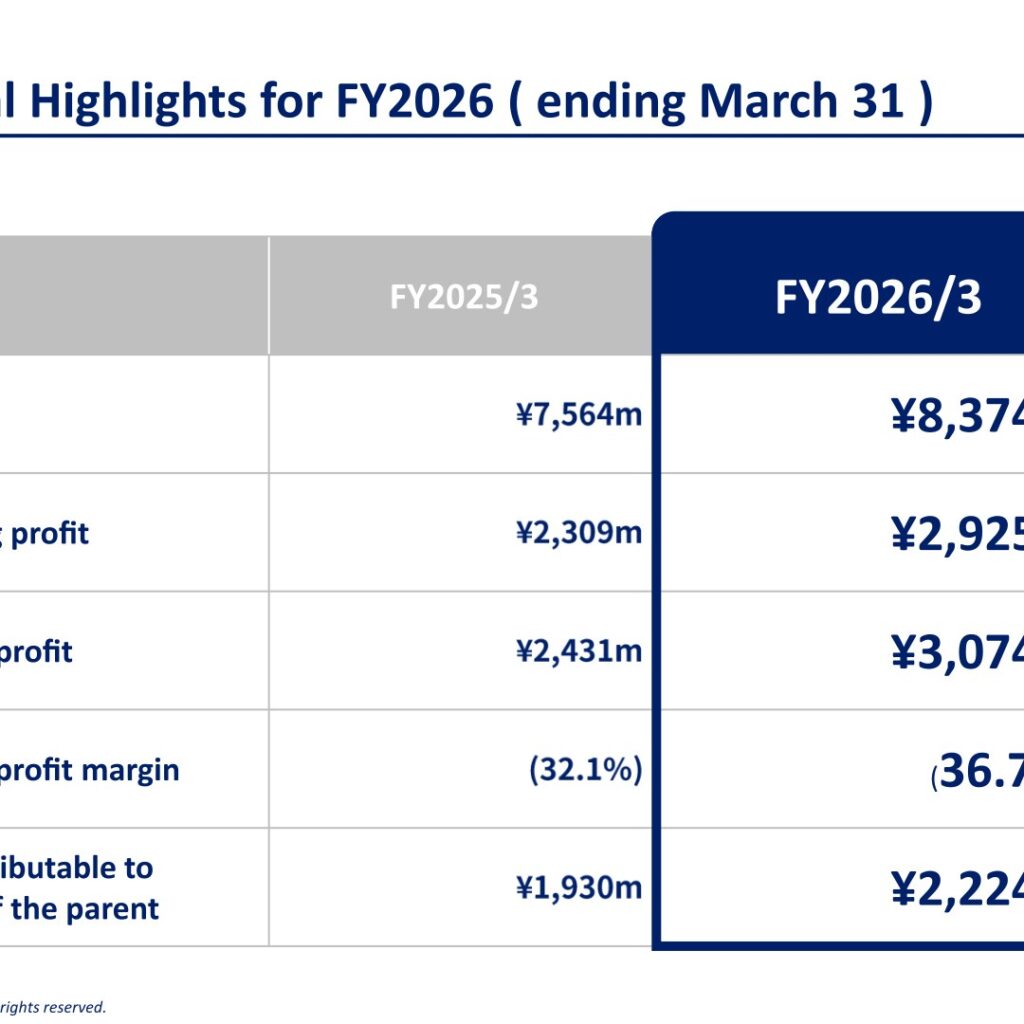
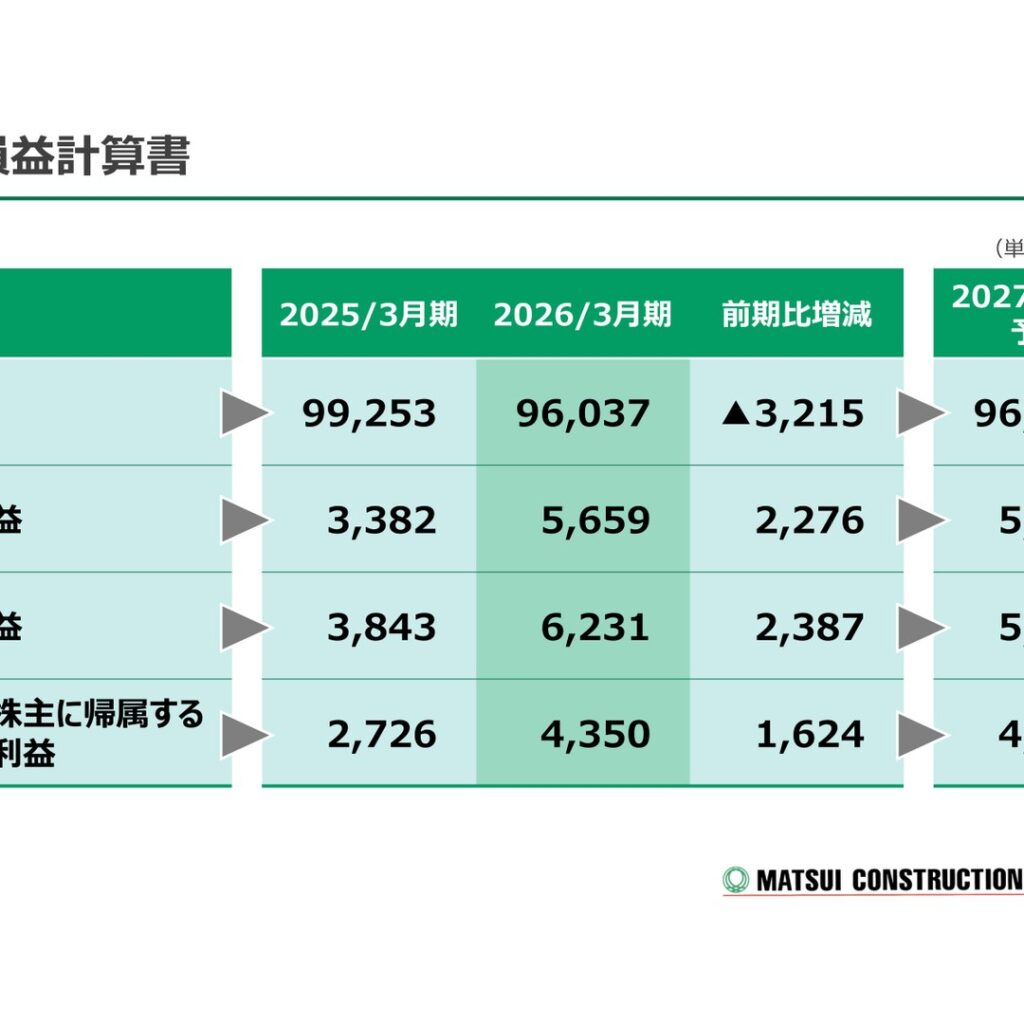
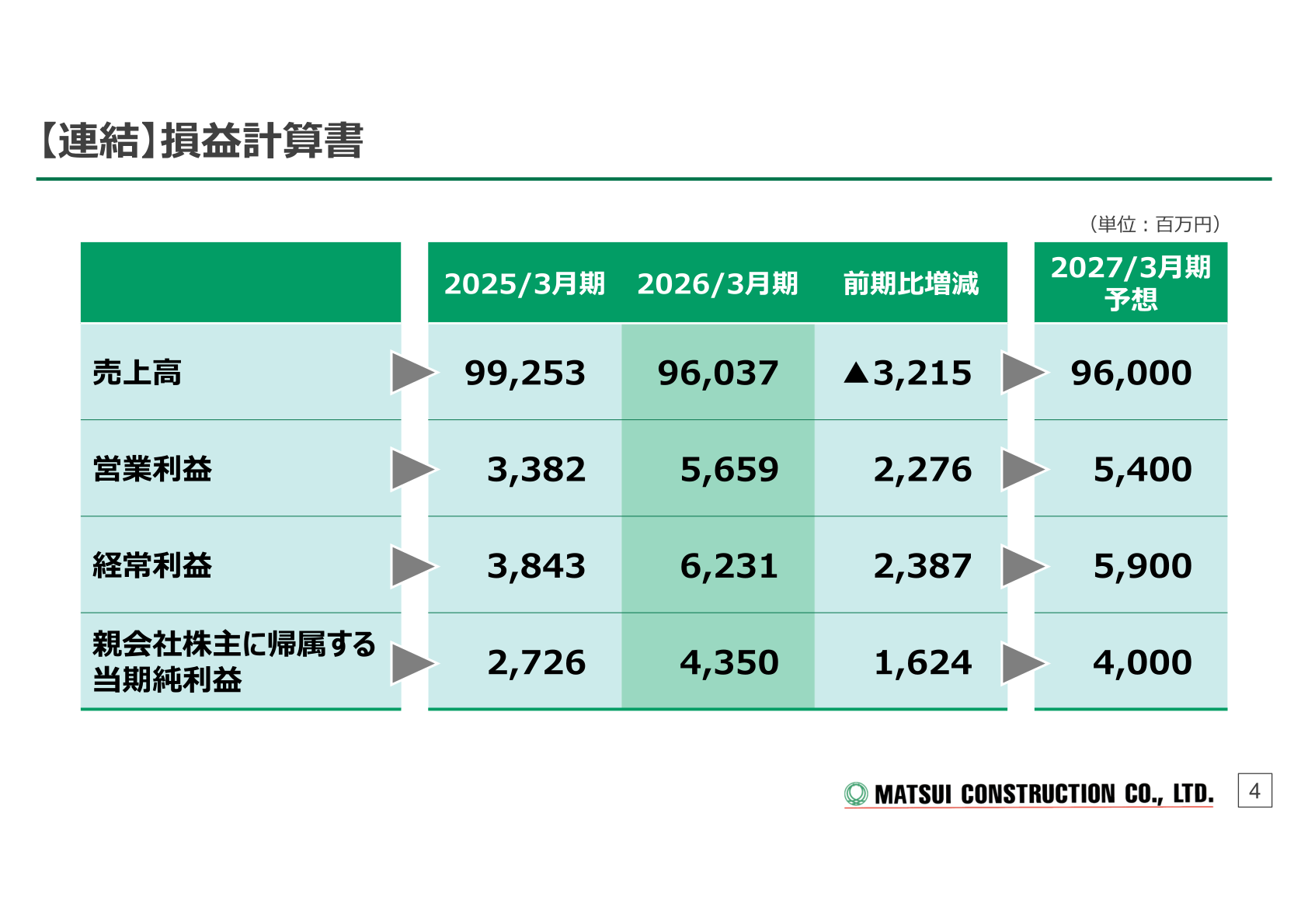
Matsui Construction’s consolidated results for the fiscal year ended March 2026 showed revenue of 96,037 million yen, down 3.2% year on year, while operating profit rose 67.3% to 5,659 million yen, ordinary profit rose 62.1% to 6,231 million yen and profit attributable to owners of parent rose 59.6% to 4,350 million yen, a substantial increase in earnings. The materials state that, as the pass-through of surging construction costs into prices progressed and the company worked to reduce costs further, ROE improved to 8.1%, exceeding the company’s assumed cost of shareholders’ equity. For the fiscal year ending March 2027 the company expects revenue of 96,000 million yen, operating profit of 5,400 million yen and profit attributable to owners of parent of 4,000 million yen.
Consolidated Results (FY March 2026 Actual)
Revenue declined, but every level of profit came in well above the previous year. Operating profit increased 2,276 million yen year on year, ordinary profit increased 2,387 million yen and profit attributable to owners of parent increased 1,624 million yen. (Unit: millions of yen)
| Item | FY March 2026 | FY March 2025 | YoY change |
|---|---|---|---|
| Revenue | 96,037 | 99,253 | ▲3,215 |
| Operating profit | 5,659 | 3,382 | 2,276 |
| Ordinary profit | 6,231 | 3,843 | 2,387 |
| Profit attributable to owners of parent | 4,350 | 2,726 | 1,624 |
On the balance sheet, total assets were 87,637 million yen (up 6,749 million yen from the previous fiscal year-end), net assets were 57,028 million yen (up 6,411 million yen) and total liabilities were 30,609 million yen (up 337 million yen), giving an equity ratio of 65.1%. On the asset side, cash and deposits rose 3,542 million yen to 17,005 million yen and investments and other assets rose 5,644 million yen to 24,612 million yen, while notes receivable, accounts receivable from completed construction contracts and other fell 1,891 million yen to 26,899 million yen. On the liability side, short-term borrowings of 3,000 million yen were eliminated entirely and advances received on construction contracts in progress rose 2,398 million yen to 12,269 million yen.
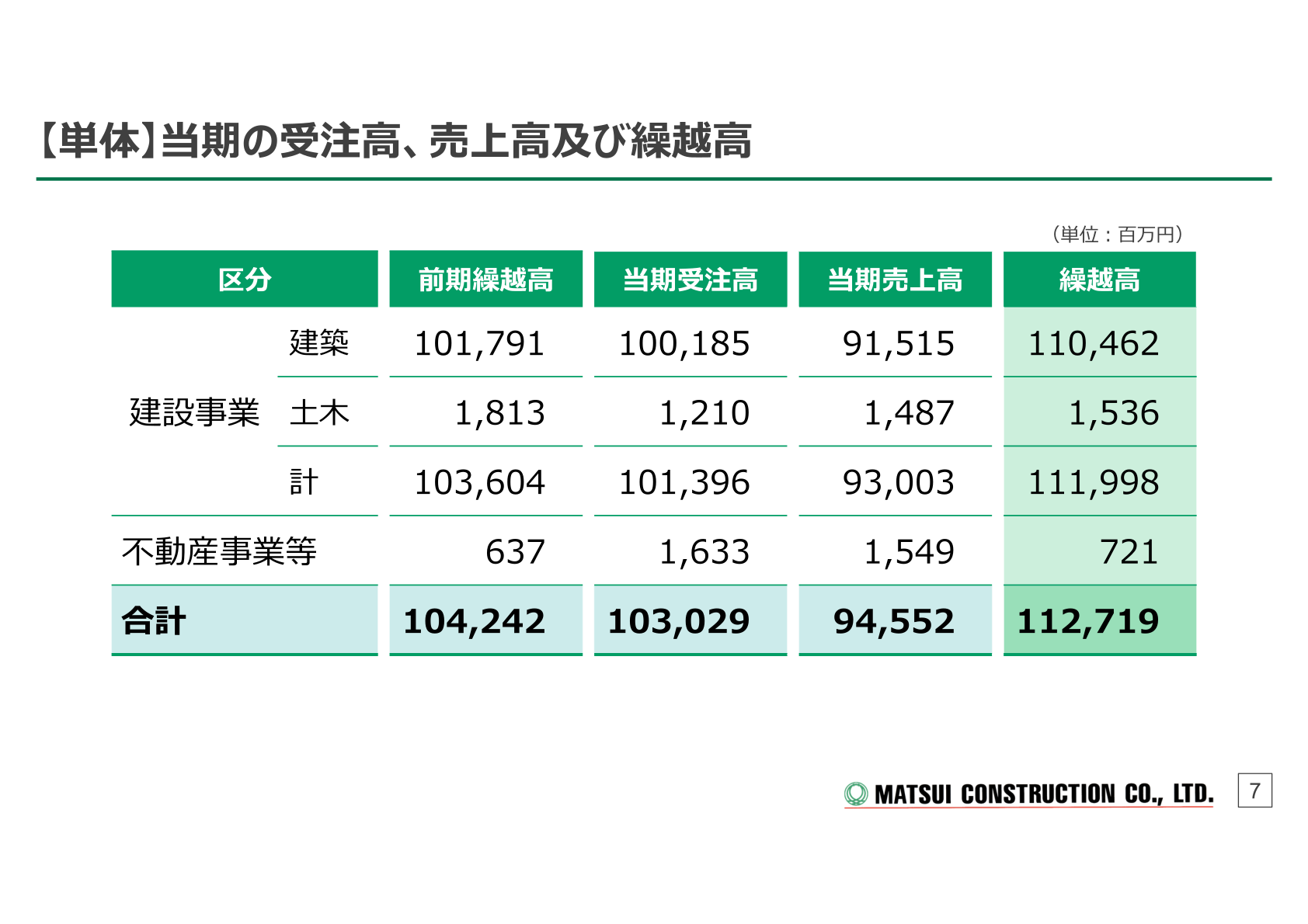
Orders Received, Revenue and Carryover (Non-Consolidated)
On a non-consolidated basis, orders received during the year totalled 103,029 million yen, revenue for the year totalled 94,552 million yen and the carryover balance at the end of the year totalled 112,719 million yen, an increase from the 104,242 million yen carried over from the previous year. In the construction business, building construction recorded orders received of 100,185 million yen, revenue of 91,515 million yen and a carryover of 110,462 million yen. Major orders received during the year cited in the materials include the reconstruction plan for the university library on Musashino University’s Musashino Campus, the new construction of Fukuoka University’s new main building (tentative name), the dismantling and storage work on the Butsuden and other structures within the preservation and repair project for the Daisodo and 16 other buildings of Sojiji Soin (Important Cultural Property), and the first-phase preservation and repair work on Imamura Church and seven other structures (Important Cultural Property). Major completed works include the renovation of the Torodo at Okunoin, Kongobuji Temple on Mount Koya, the second-phase preservation and repair of the main building of the former British Consulate in Nagasaki (Important Cultural Property), and the new construction of the Human Brain Science and Health Innovation Center (tentative name) at Niigata University (Asahimachi). (Unit: millions of yen)
| Category | Carryover from previous year | Orders received during the year | Revenue for the year | Carryover |
|---|---|---|---|---|
| Construction business – Building | 101,791 | 100,185 | 91,515 | 110,462 |
| Construction business – Civil engineering | 1,813 | 1,210 | 1,487 | 1,536 |
| Construction business – Total | 103,604 | 101,396 | 93,003 | 111,998 |
| Real estate business and other | 637 | 1,633 | 1,549 | 721 |
| Total | 104,242 | 103,029 | 94,552 | 112,719 |
FY March 2027 Full-Year Forecast
For the fiscal year ending March 2027 the company forecasts revenue of 96,000 million yen, operating profit of 5,400 million yen, ordinary profit of 5,900 million yen and profit attributable to owners of parent of 4,000 million yen. (Unit: millions of yen)
| Item | FY March 2027 forecast | FY March 2026 actual |
|---|---|---|
| Revenue | 96,000 | 96,037 |
| Operating profit | 5,400 | 5,659 |
| Ordinary profit | 5,900 | 6,231 |
| Profit attributable to owners of parent | 4,000 | 4,350 |
Shareholder Returns
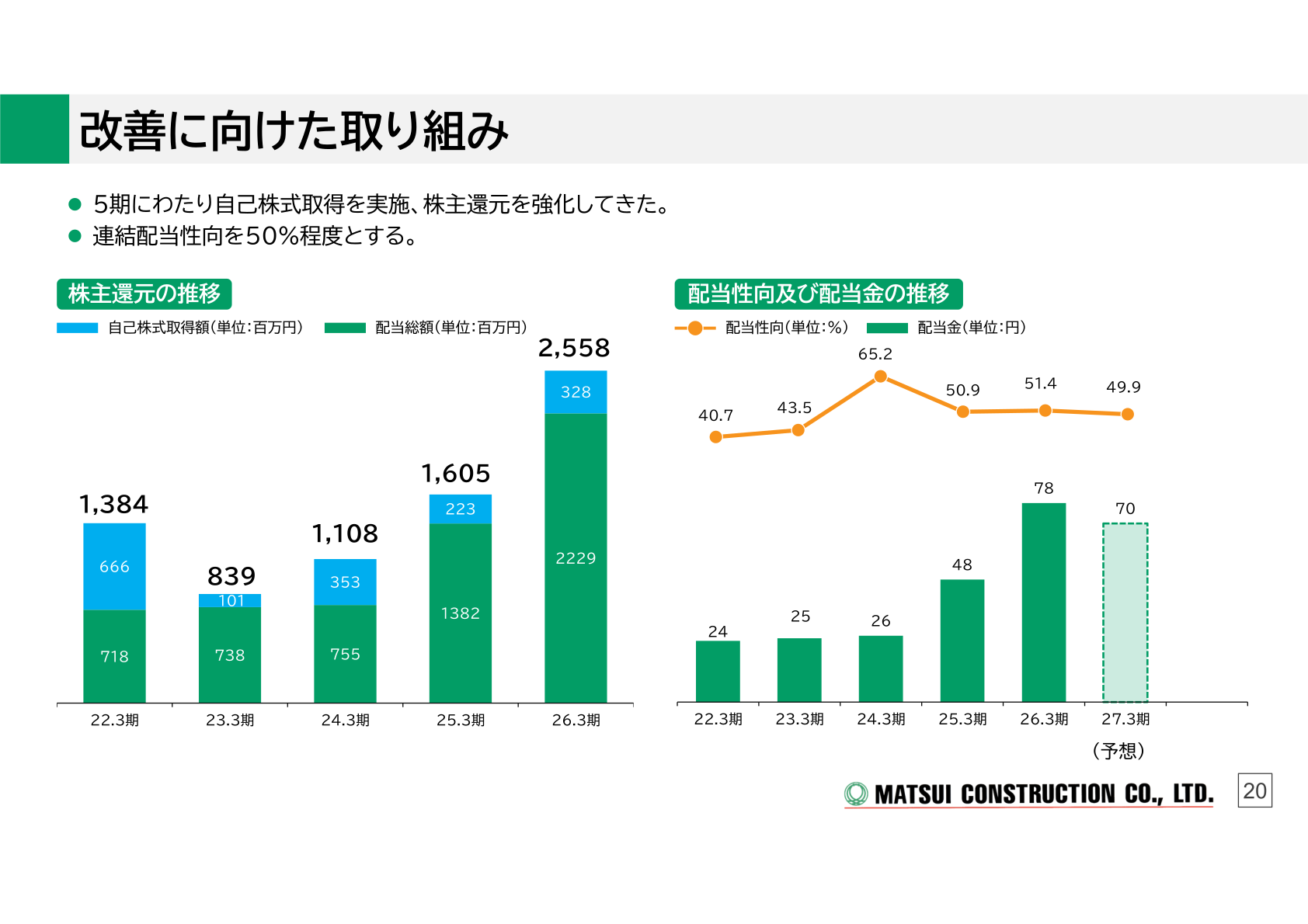
The materials state that the company has strengthened shareholder returns by carrying out share buybacks over five fiscal years, and set out a policy of a consolidated payout ratio of around 50%. The payout ratio for the fiscal year ended March 2026 was 51.4% and the dividend was 78 yen; for the fiscal year ending March 2027 the company forecasts a dividend of 70 yen and a payout ratio of 49.9%. Under the cash allocation of the medium-term management plan, cash generated through business activities is to be applied to continuous shareholder returns and to strengthening the business base through investment. The breakdown of cash outflows comprises dividends and share buybacks (payout ratio of around 50%), an investment plan of 4.0 billion yen over the three years from fiscal 2025 to fiscal 2027, and strengthening of the financial base (restoring cash on hand, preparing for the rebuilding of company-owned real estate, and internal reserves in view of future investment).
Medium-Term Management Plan <2025-2027> and Management Conscious of Cost of Capital and Share Price
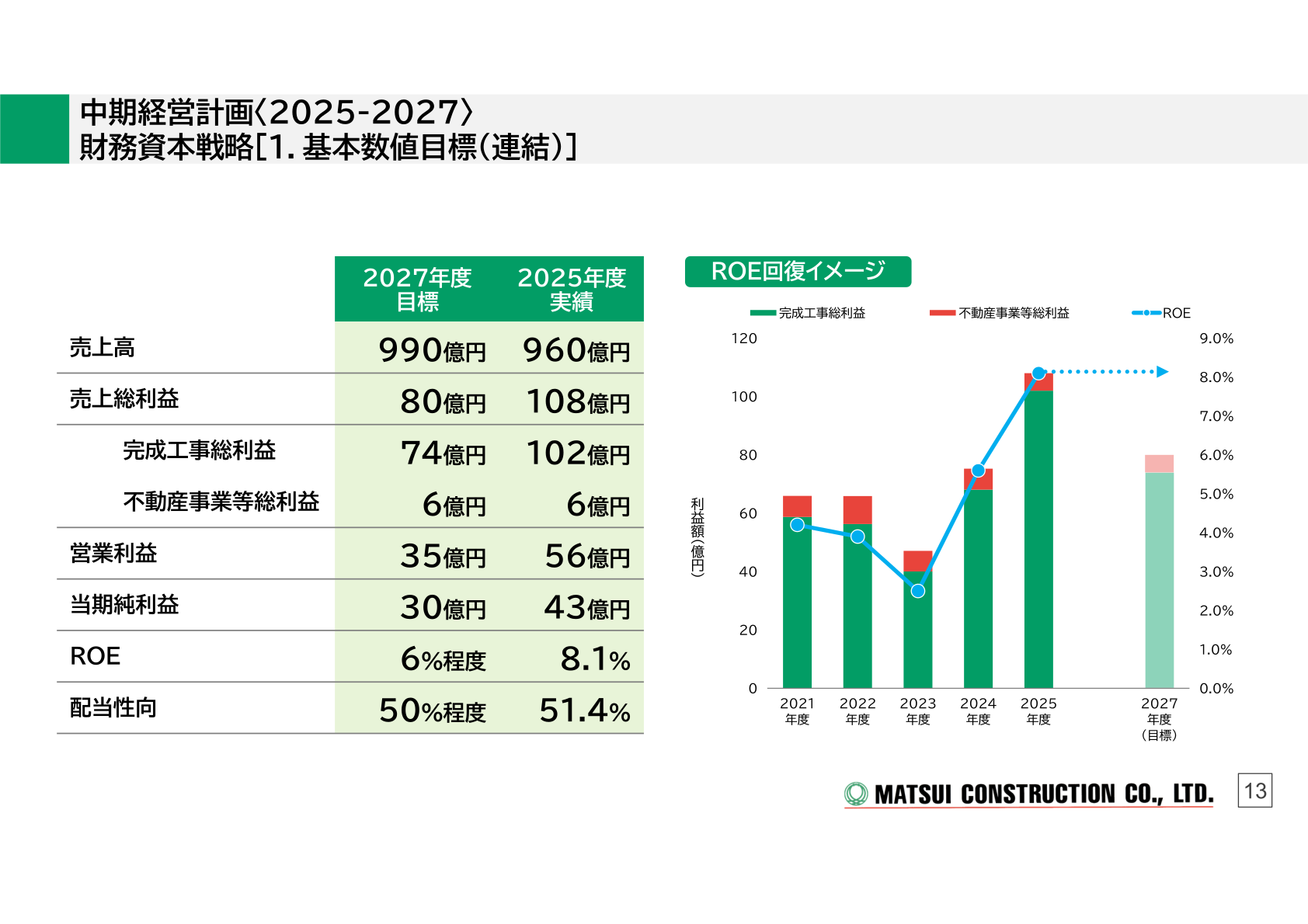
Under the financial and capital strategy of the Medium-Term Management Plan <2025-2027>, the company sets out fiscal 2027 targets of revenue of 99,000 million yen, operating profit of 3,500 million yen, net profit of 3,000 million yen, ROE of around 6% and a payout ratio of around 50%. In fiscal 2025, the first year of the plan, revenue was 96,000 million yen, operating profit 5,600 million yen, net profit 4,300 million yen, ROE 8.1% and the payout ratio 51.4%. The materials state that, although the numerical targets of the financial and capital strategy were broadly achieved in the first year of the medium-term management plan, in light of the company’s steady management policy and the current economic climate, any revision of the medium-term management plan will be examined on the basis of the results of the second year. (Unit: millions of yen, %)
| Item | Fiscal 2025 actual | Fiscal 2027 target |
|---|---|---|
| Revenue | 96,000 | 99,000 |
| Gross profit | 10,800 | 8,000 |
| Gross profit on completed construction contracts | 10,200 | 7,400 |
| Gross profit on real estate business and other | 600 | 600 |
| Operating profit | 5,600 | 3,500 |
| Net profit | 4,300 | 3,000 |
| ROE | 8.1% | Around 6% |
| Payout ratio | 51.4% | Around 50% |
On its response to management conscious of the cost of capital and the share price, the materials state that PBR temporarily exceeded 1.0 times on the back of a rise in the share price but ended the fiscal year at 0.79 times (the cost of shareholders’ equity is a figure calculated on the company’s own CAPM basis, at 6.0% to 7.0%). As its policy for improvement, the company will strengthen relationships across the entire supply chain so that its core construction business can generate profit stably, aiming to recover a PBR of 1.0 times or more in the near future, and targets an ROE of 8.0% or more over time. Its management strategy is built on three pillars – enhancement of the business base, enhancement of the corporate structure and enhancement of corporate responsibility – and non-financial targets include establishing a shrine and temple brand through stronger shrine and temple sales capabilities and the transmission of shrine and temple construction techniques, use of construction BIM (100% at worksites with construction values of 300 million yen or more), full operation of a new core system in fiscal 2026, and annual hiring of 40 or more new graduate and mid-career recruits.
Topics (Sustainability Initiatives)
As part of promoting its solar power generation business, the company plans to install a solar carport at its own Sakaecho parking lot (Funabashi City, Chiba Prefecture) and, from June 2026, to begin self-wheeling under which the electricity generated is consumed in-house at the head office building (Chuo-ku, Tokyo). Expected generation is 91,577 wh per year, which the company says can cover around 20% of the head office building’s annual electricity use and is also expected to deliver cost savings. In addition, as part of decarbonising construction sites, the temporary site office for the Suzette Nishinomiya Hama Plant new construction work obtained ZEB Ready certification, which the company describes as its first such initiative.
This article is an analysis based on publicly available information and is not a recommendation to buy or sell any specific securities. Investment decisions are your own responsibility.