
This article is based on publicly available IR materials and is not a recommendation to buy or sell any specific securities.
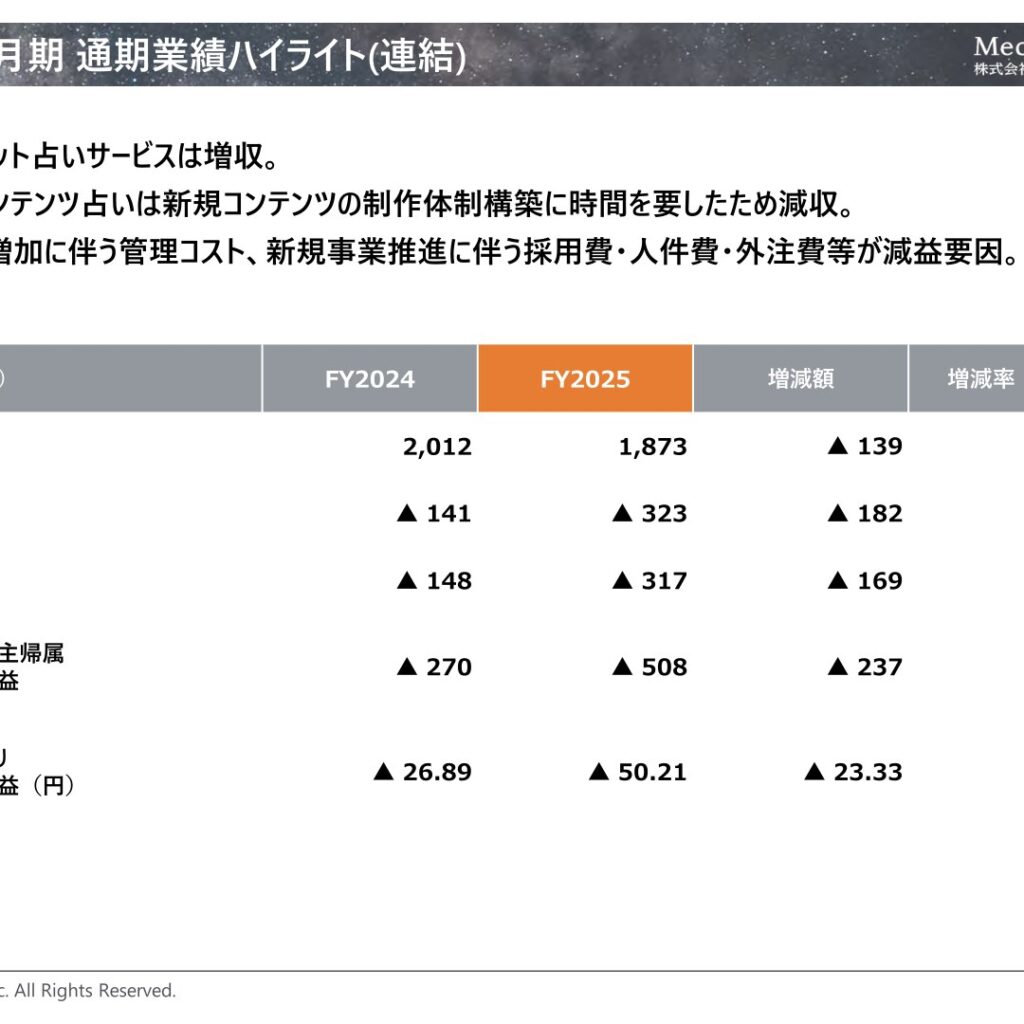
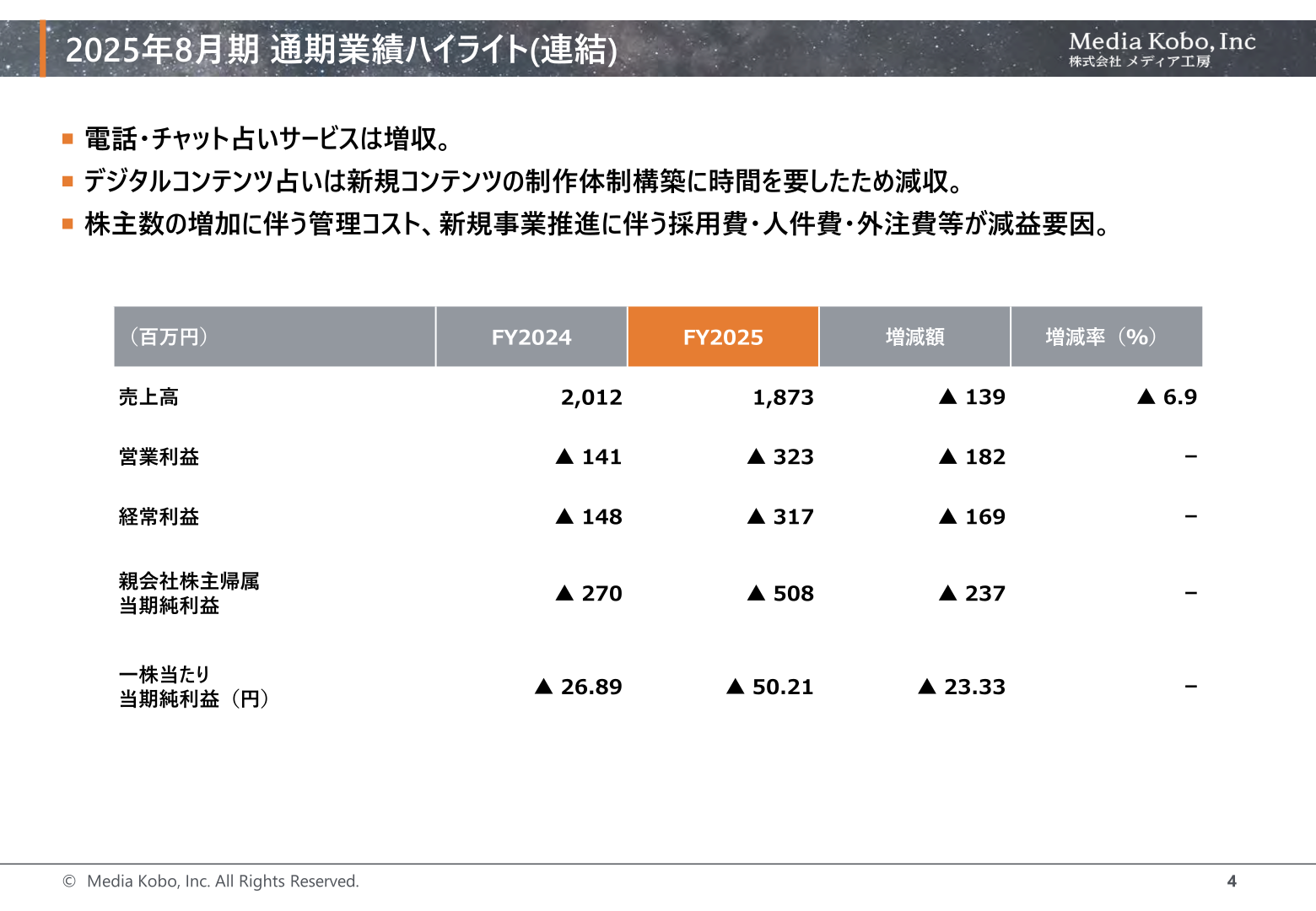
Note: Media Kobo does not publish an English results presentation; this article is based on the company’s Japanese-language results presentation, with figures transcribed as reported. Media Kobo, Inc. (TSE Growth: 3815) closes its books at the end of August, and the presentation labels the fiscal year ended August 2025 as FY2025 and the prior year as FY2024. For FY2025 the company reported net sales of 1,873 million yen (▲6.9% year on year), an operating loss of ▲323 million yen (versus ▲141 million yen a year earlier), an ordinary loss of ▲317 million yen and a net loss attributable to owners of parent of ▲508 million yen. Telephone and chat fortune-telling services grew, while digital content fortune-telling declined because it took time to build a new content production structure; higher administrative costs associated with the increase in the number of shareholders, plus recruiting, personnel and outsourcing expenses for new businesses, were cited as factors behind the wider loss.
Consolidated Results (Full-Year Actual)
The table below shows the consolidated full-year highlights disclosed in the presentation (millions of yen; earnings per share in yen; changes and percentage changes as reported, with “−” where the company does not present a percentage).
| Item | FY2024 | FY2025 | Change | Change (%) |
|---|---|---|---|---|
| Net sales | 2,012 | 1,873 | ▲ 139 | ▲ 6.9 |
| Operating income | ▲ 141 | ▲ 323 | ▲ 182 | − |
| Ordinary income | ▲ 148 | ▲ 317 | ▲ 169 | − |
| Net income attributable to owners of parent | ▲ 270 | ▲ 508 | ▲ 237 | − |
| Earnings per share (yen) | ▲ 26.89 | ▲ 50.21 | ▲ 23.33 | − |
The presentation also breaks down the year-on-year movement in operating income. Starting from the FY2024 operating loss of ▲141 million yen, the decline in digital content sales accounted for ▲130 million yen, telephone fortune-telling and “Chara-Den” added 54 million yen of profit, the withdrawal from loss-making businesses in the prior year reduced costs by 79 million yen, new-business investment cost ▲57 million yen, and administrative and other items accounted for ▲128 million yen, resulting in the FY2025 operating loss of ▲323 million yen. The company attributes the 139 million yen sales decline to a lower number of digital content releases — addressed by moving to a one-title-per-month production structure from March 2025 — and to weak performance of new content, to which it is responding by raising entertainment value, signing popular fortune tellers, expanding on social media and launching its own fortune-telling channel.
FY2025 landed below the company’s forecast. Against a sales forecast of 1,893 million yen, actual net sales were 1,873 million yen; against an operating loss forecast of △356 million yen, the actual operating loss was △323 million yen, which the company explains by a conservative cost estimate worth +30 million yen; and against a net loss forecast of △449 million yen, the actual net loss was △508 million yen, reflecting the recording of extraordinary losses associated with structural reform of △114 million yen. The company identifies the planning and production pace of content needed to acquire a growing fortune-telling user base as the largest factor, followed by costs incurred ahead of the benefits of business alliances and expanded traffic routes.
Segment Results
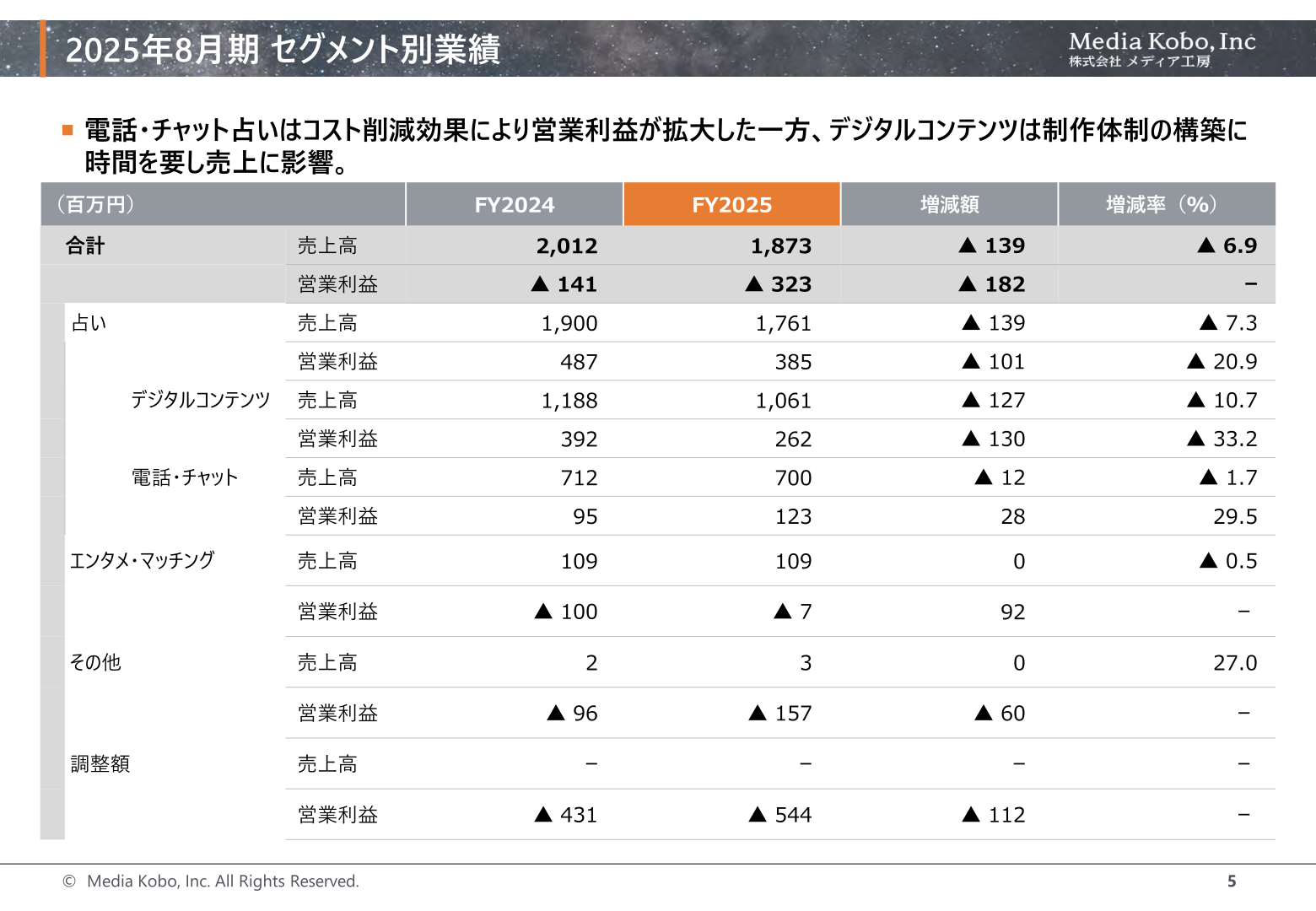
By segment (millions of yen), the Fortune-telling business is split into Digital Content and Telephone/Chat. Telephone and chat fortune-telling expanded operating income on cost reductions, while Digital Content sales were affected by the time required to rebuild its production structure.
| Segment | Metric | FY2024 | FY2025 | Change | Change (%) |
|---|---|---|---|---|---|
| Total | Net sales | 2,012 | 1,873 | ▲ 139 | ▲ 6.9 |
| Total | Operating income | ▲ 141 | ▲ 323 | ▲ 182 | − |
| Fortune-telling | Net sales | 1,900 | 1,761 | ▲ 139 | ▲ 7.3 |
| Fortune-telling | Operating income | 487 | 385 | ▲ 101 | ▲ 20.9 |
| Fortune-telling: Digital Content | Net sales | 1,188 | 1,061 | ▲ 127 | ▲ 10.7 |
| Fortune-telling: Digital Content | Operating income | 392 | 262 | ▲ 130 | ▲ 33.2 |
| Fortune-telling: Telephone/Chat | Net sales | 712 | 700 | ▲ 12 | ▲ 1.7 |
| Fortune-telling: Telephone/Chat | Operating income | 95 | 123 | 28 | 29.5 |
| Entertainment/Matching | Net sales | 109 | 109 | 0 | ▲ 0.5 |
| Entertainment/Matching | Operating income | ▲ 100 | ▲ 7 | 92 | − |
| Other | Net sales | 2 | 3 | 0 | 27.0 |
| Other | Operating income | ▲ 96 | ▲ 157 | ▲ 60 | − |
| Adjustments | Net sales | − | − | − | − |
| Adjustments | Operating income | ▲ 431 | ▲ 544 | ▲ 112 | − |
Selling, General and Administrative Expenses
SG&A expenses rose to 1,232 million yen (+8.0% year on year). The company cites higher outsourcing fees from new-business investment and one-off consulting costs, and higher recruiting expenses related to hiring CXO-class, business development, IP producer and sales personnel. The provision for the shareholder benefit programme also increased.
| Item (millions of yen) | FY2024 | FY2025 | Change | Change (%) |
|---|---|---|---|---|
| SG&A expenses | 1,141 | 1,232 | 91 | 8.0 |
| Personnel expenses | 302 | 312 | 9 | 3.2 |
| Advertising expenses | 307 | 279 | ▲ 28 | ▲ 9.2 |
| Depreciation | 4 | 3 | 0 | ▲ 7.1 |
| Outsourcing fees | 125 | 169 | 34 | 27.6 |
| Recruiting expenses | 27 | 48 | 21 | 79.1 |
| Commission fees | 92 | 104 | 12 | 13.6 |
| Provision for shareholder benefit programme | 74 | 106 | 32 | 43.3 |
| Other | 207 | 216 | 9 | 4.6 |
FY2026 Forecast
For FY2026 (the fiscal year ending August 2026) the presentation shows net sales rising to 2,163 million yen from 1,873 million yen, and the operating loss narrowing to ▲294 million yen from ▲323 million yen. The sales bridge comprises digital content +159 million yen, One to One +60 million yen, effects of new measures +51 million yen and “Chara-Den” +20 million yen. The operating loss bridge comprises the effect of higher sales +72 million yen and reductions in rent and other costs +30 million yen, offset by higher production costs ▲50 million yen and costs for new measures ▲23 million yen. The company expects steady growth in One to One and a recovery in digital content on an improved production structure and ROI-focused marketing, and states that it has not yet factored in any significant earnings effect from generative AI productivity gains or from business alliances.
| Item (millions of yen) | FY2026 Forecast | FY2025 (Actual) |
|---|---|---|
| Net sales | 2,163 | 1,873 |
| Operating income | ▲ 294 | ▲ 323 |
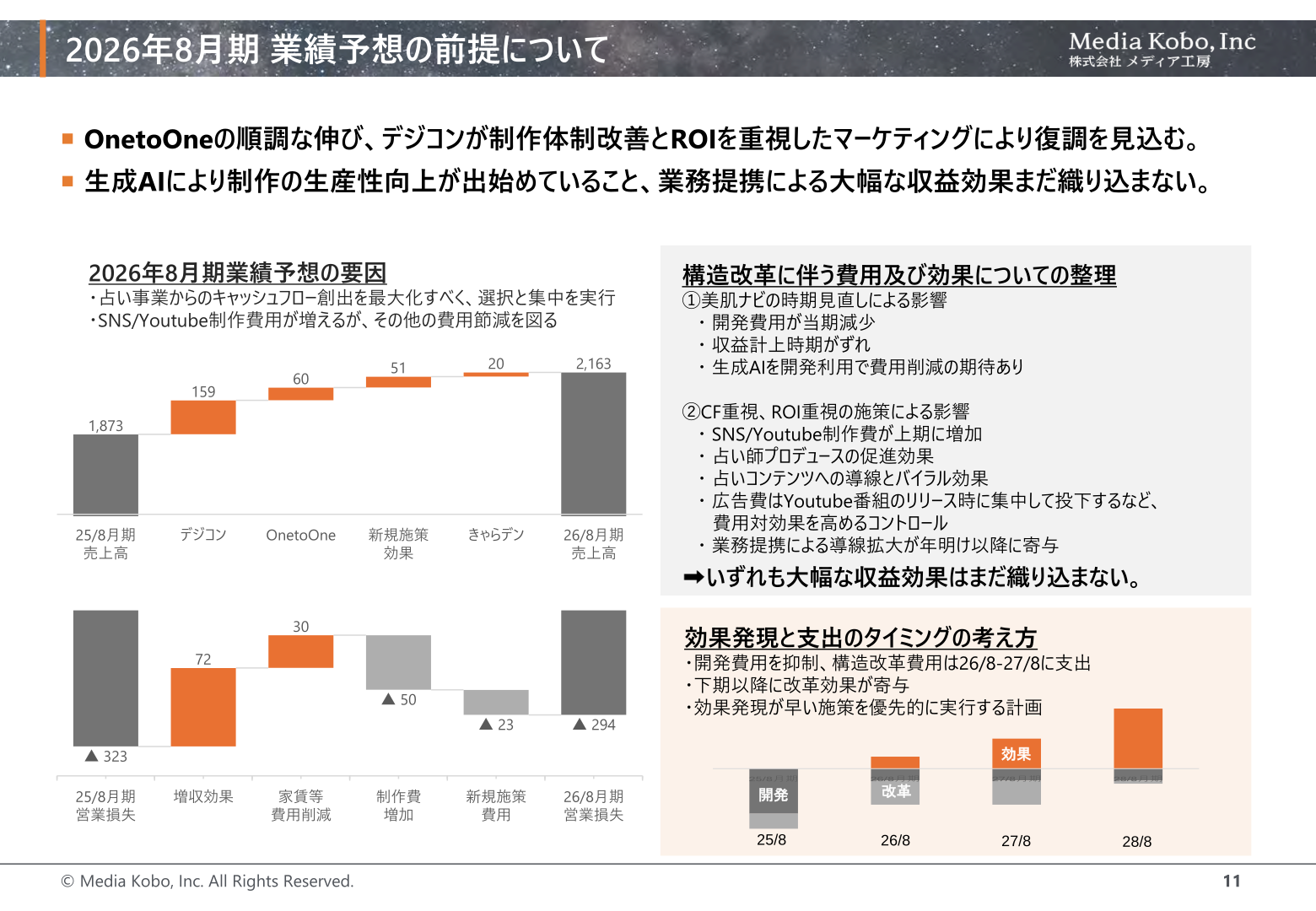
On the timing of structural reform, the company states that development costs are being contained, that structural reform expenditure falls in the fiscal years ending August 2026 and August 2027, that reform effects contribute from the second half onward, and that measures with faster payback are prioritised. The launch timing of the “Bihada Navi” app was pushed back so that advertising spend and monetisation occur from August 2027 onward, in order to direct spending to more immediately effective marketing.
Shareholder Returns
Media Kobo introduced a shareholder benefit programme from FY2024 and positions it as a way to express appreciation to shareholders and to build a relationship of trust with the capital market. Shareholders recorded in the register as of 31 August each year holding 100 shares (one unit) or more receive a digital gift worth 4,000 yen; shareholders holding 100 shares or more continuously for one year or more receive a digital gift worth 5,000 yen. As share-price-conscious measures the presentation lists prioritising initiatives by ease of cash flow generation, continuing the shareholder benefit programme — described as an important item of capital strategy and the measure most requested by individual investors — and pursuing active IR and PR. The presentation puts the cost of the shareholder benefit programme at 110 million yen, and the related provision recorded in SG&A was 106 million yen in FY2025 (74 million yen in FY2024). The presentation does not address dividends. As of the end of August 2025 the company had 11,300,000 shares issued and 24,014 shareholders, and held 871,144 shares of treasury stock (a 7.71% holding ratio).
Structural Reform and Growth Strategy
The company frames FY2025 as a year of upfront investment in building structures and development, and says it will prioritise future measures with an emphasis on cash flow and ROI. Under “selection and concentration”, digital content fortune-telling is expected to contribute profit through expanded traffic routes and social media/influencer marketing, One to One (telephone and chat fortune-telling) is treated as a growth field managed on ROI, and the Data & Technology business continues R&D on generative AI. Progress reported for FY2025 includes the shift to one new title per month from March, strengthened sales and training for telephone and chat services supported by external consulting, and improved production efficiency at “Chara-Den”, which contributed to higher profit; IP production remains under strategic study.
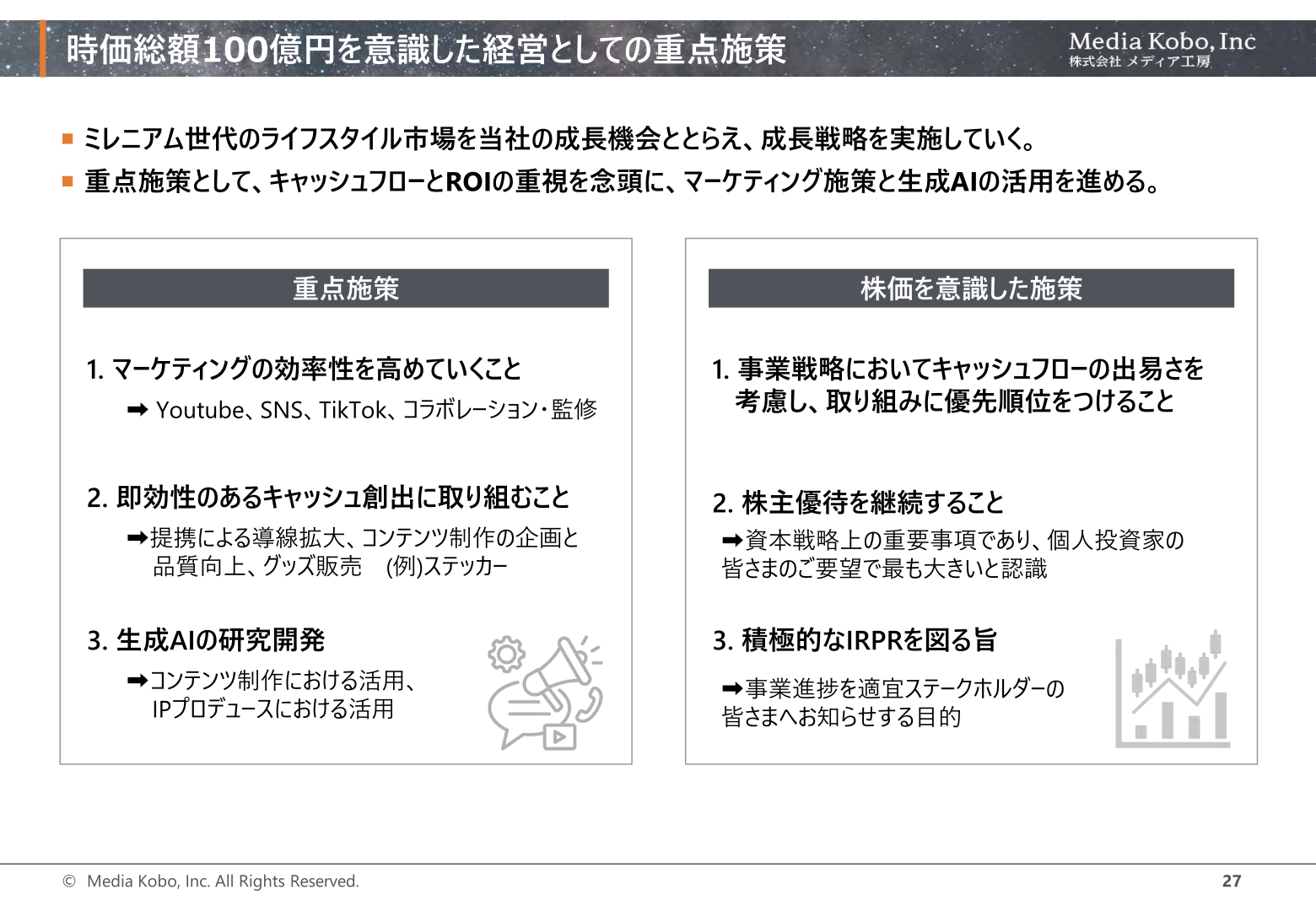
Citing Yano Research Institute data on the domestic spiritual and lifestyle markets, the company puts the overall spiritual-related market at approximately 4.3 trillion yen and labels, among its components, healing at 1.1010 trillion yen, the fortune-telling market at 99.7 billion yen, self-development/mindset education at 67.8 billion yen and power stones at 51.3 billion yen. It states that although the fortune-telling market on its own is 99.7 billion yen, it will widen the market it addresses by expanding into the spiritual x lifestyle domain in line with the lifestyles of millennials and Generation Z. It describes itself as the only listed company in Japan specialising in fortune-telling and says it is in discussions with nine major operators across multiple fields on business alliances. As a marketing update, it reports that an original YouTube programme combining fortune-telling with a dating reality show surpassed 1,000 channel subscribers by its second episode, two weeks after launch, without advertising spend. Management states that it is aiming for a market capitalisation of 10 billion yen. Its priority measures, presented in the chapter on management conscious of a market capitalisation of 10 billion yen, are raising marketing efficiency (YouTube, SNS, TikTok, collaborations and supervision), pursuing immediately effective cash generation through alliance-driven traffic expansion, content planning and quality improvement and goods sales, and R&D in generative AI.
Financial Position and Cash Flow
Total assets stood at 2,277 million yen at the end of FY2025 versus 2,651 million yen a year earlier, with cash and deposits of 1,595 million yen (▲364 million yen) reflecting net repayment of borrowings of ▲386 million yen. Total liabilities were 1,569 million yen and net assets 975 million yen, with retained earnings falling to 177 million yen on the net loss of 508 million yen. Cash decreased from an opening balance of 1,960 million yen to 1,595 million yen, with operating cash flow of ▲220 million yen, investing cash flow of ▲220 million yen and financing cash flow of 76 million yen. The company reports net cash of 694 million yen and free cash flow of ▲440 million yen, against net cash of 673 million yen and free cash flow of ▲194 million yen in FY2024.
This article is an analysis based on publicly available information and is not a recommendation to buy or sell any specific securities. Investment decisions are your own responsibility.
![[Obayashi] Investors’ Guide 2026 — The Complete 24-Article Breakdown](https://japan-equity.com/wp-content/uploads/2026/07/hub_cover-1024x1024.png)
![[Obayashi] IR & SR Policy — Feeding Dialogue Back into Management](https://japan-equity.com/wp-content/uploads/2026/07/p32_sq-1024x1024.jpg)
![[Obayashi] Real Estate Development — 18.7% Margin, ¥287.7bn Unrealized Gains](https://japan-equity.com/wp-content/uploads/2026/07/p20_sq-1024x1024.jpg)
![[Obayashi] Domestic Civil Engineering — Resilience Spending Supports 9.6% Margin](https://japan-equity.com/wp-content/uploads/2026/07/p11_sq-1024x1024.jpg)
![[Obayashi] Share Price & External Ratings — vs TOPIX, ESG Index Inclusion](https://japan-equity.com/wp-content/uploads/2026/07/p40_sq-1024x1024.jpg)
![[Construction] ¥75.5tn Investment, Shrinking Workforce — Big-5 Market Share](https://japan-equity.com/wp-content/uploads/2026/07/p12_sq-1024x1024.jpg)
![[Obayashi] Capital Policy & Shareholder Returns — ROE 10%+, DOE ~5%, ¥100bn Buyback](https://japan-equity.com/wp-content/uploads/2026/07/p27_sq-1024x1024.jpg)
![[Obayashi] Reducing Cross-Shareholdings — ¥285.2bn Sold in Five Years](https://japan-equity.com/wp-content/uploads/2026/07/p29_sq-1024x1024.jpg)
![[Obayashi] ¥750bn Investment Plan — ¥300bn to Development, ¥190bn to Tech/DX](https://japan-equity.com/wp-content/uploads/2026/07/p30_sq-1024x1024.jpg)
![[Obayashi] MTP2022 KPIs — Operating Profit ~2x Target, ROE 14.4%](https://japan-equity.com/wp-content/uploads/2026/07/p25_sq-1024x1024.jpg)
![[Obayashi] Cash Allocation — ¥420bn Investment CF Over Five Years](https://japan-equity.com/wp-content/uploads/2026/07/p26_sq-1024x1024.jpg)
![[Obayashi] Green Energy — 44 Plants, 344MW, and the Green Hydrogen Challenge](https://japan-equity.com/wp-content/uploads/2026/07/p21_sq-1024x1024.jpg)
![[Obayashi] Tackling the Labor Shortage — Robotics Construction®](https://japan-equity.com/wp-content/uploads/2026/07/p14_sq-1024x1024.jpg)
