
*Reading the investment points from the FY2025 (year ended March 31, 2026) financial results materials*
Introduction
In this article, we organize Taisei Corporation’s business, earnings trends, growth strategy, and the points investors should pay attention to, based on the FY2025 financial results materials the company has disclosed (results for the fiscal year ended March 31, 2026, announced on May 14, 2026).
*This article is based on publicly available IR materials and is not a recommendation to buy or sell any specific security.*
1. Company overview
Taisei Corporation is one of Japan’s leading general contractors (“super-general contractors”). Based on the disclosed materials, the group earns gross profit across the following business segments:
- Domestic building construction — the largest profit contributor, covering offices, redevelopment, factories, and other buildings, plus a growing renovation business.
- Domestic civil engineering — infrastructure such as tunnels, disaster-prevention works, and, increasingly, marine construction.
- Domestic real estate development — development and leasing of the group’s own properties.
- Overseas business and engineering business — international construction and specialized engineering (notably for pharmaceutical and semiconductor facilities).
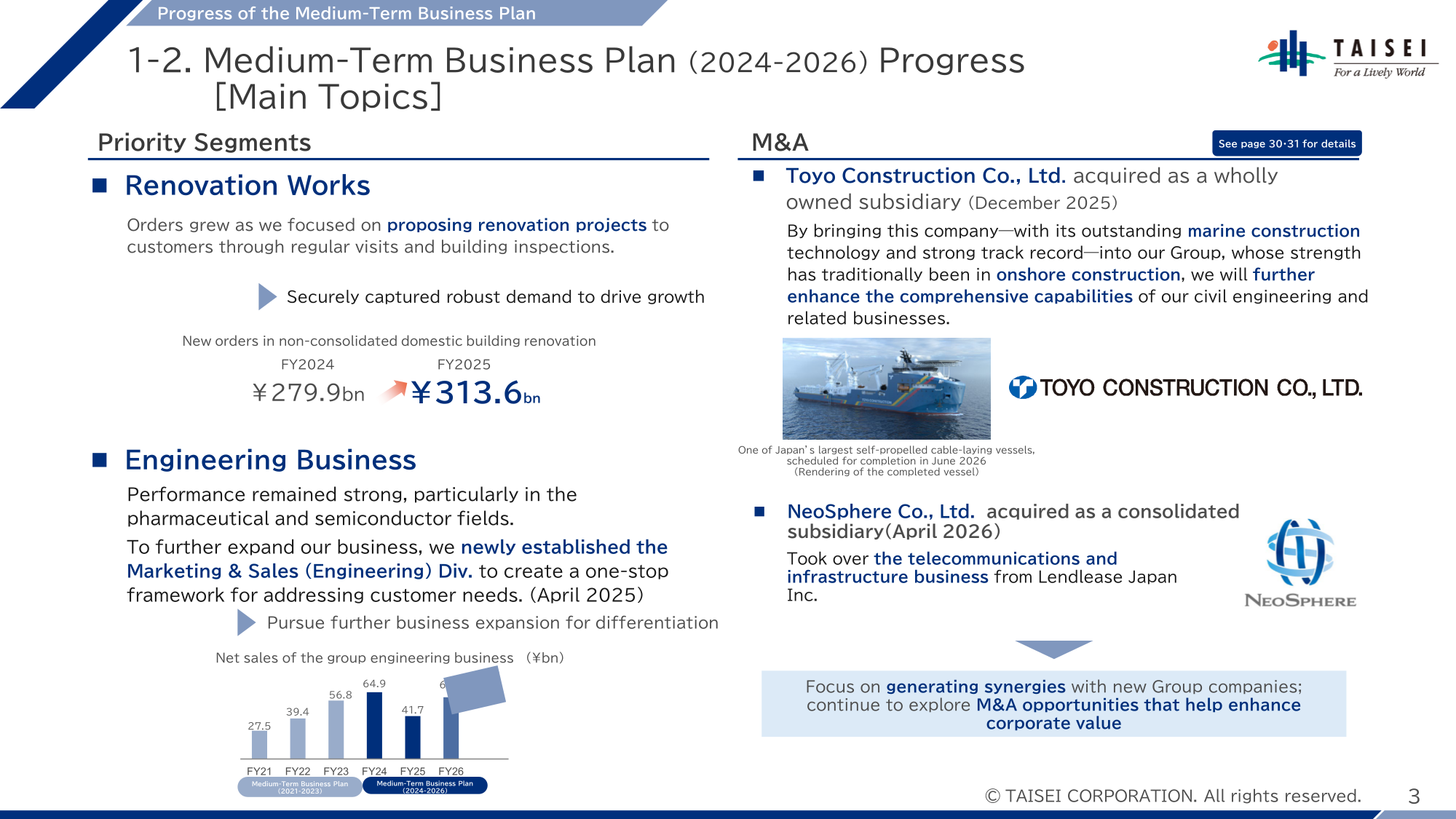
The group is executing a Medium-Term Business Plan (2024–2026) and has expanded through recent M&A, acquiring Toyo Construction (marine construction) as a wholly owned subsidiary in December 2025 and consolidating NeoSphere (telecommunications and infrastructure) in April 2026.
A key point for investors is that Taisei’s FY2025 record profit was driven by a sharp recovery in construction margins, supported additionally by gains on the sale of cross-shareholdings.
2. The most important points in this results release
Reading the materials as a whole, the following points stand out.
Point 1: Record-high profit at every level, despite lower sales
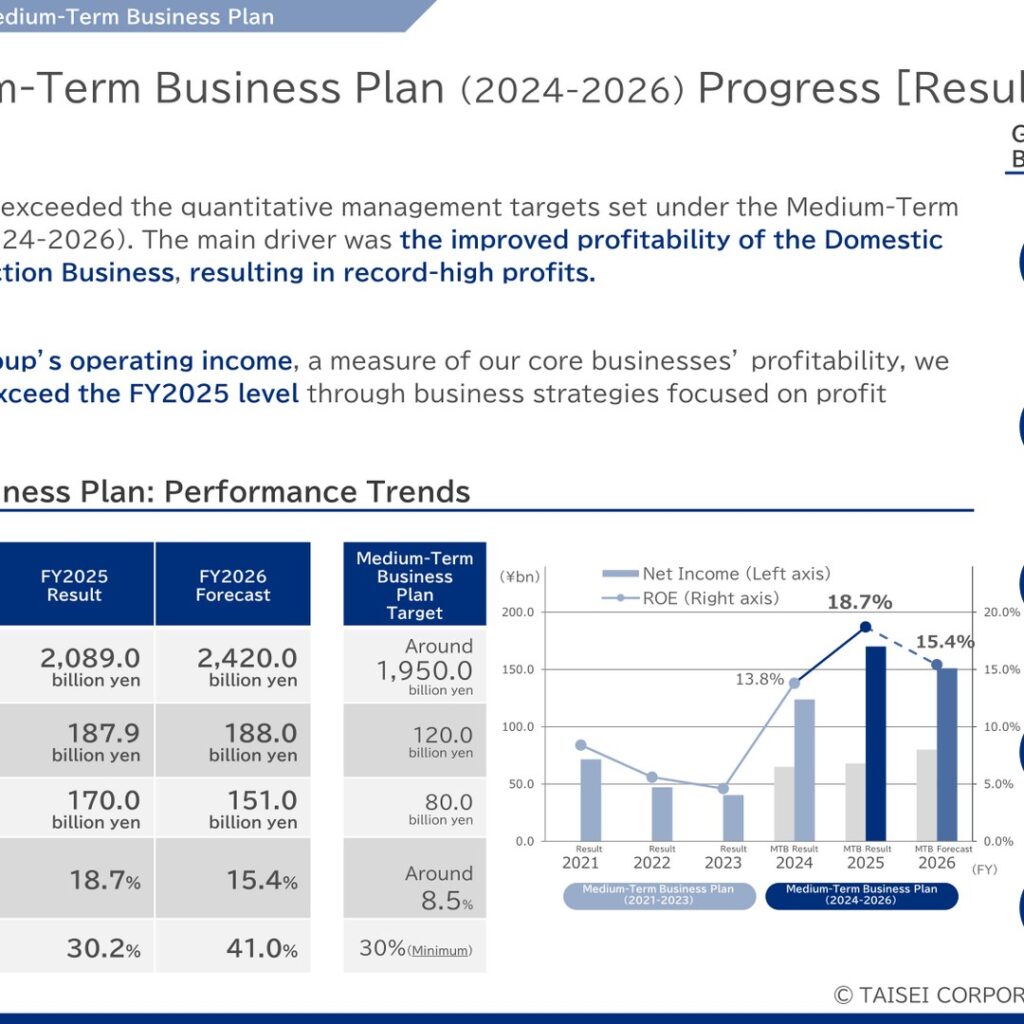
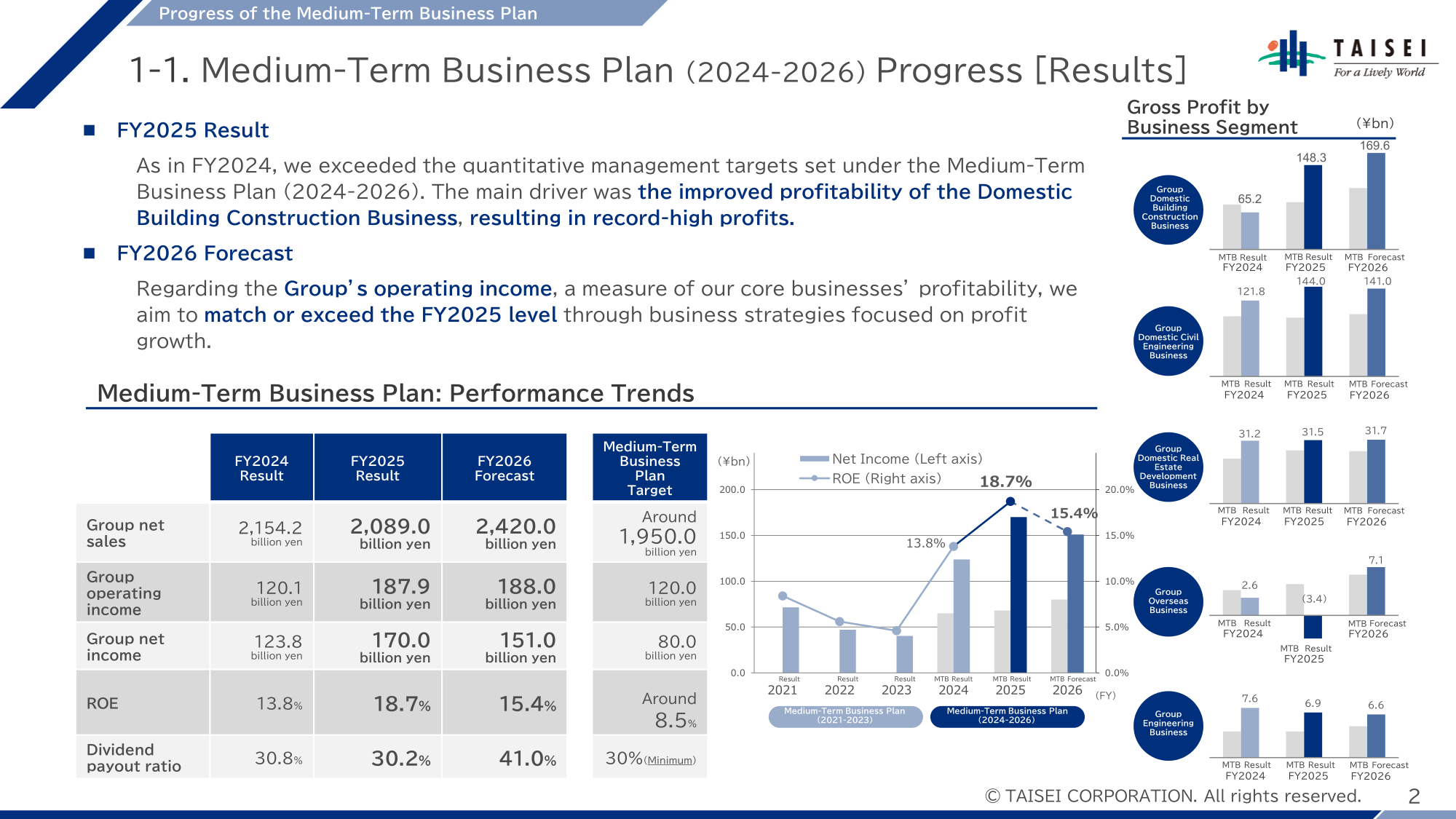
- Even though group net sales declined year on year (to ¥2,089.0 billion), group operating income rose to a record ¥187.9 billion and group net income to a record ¥170.0 billion.
- The main driver was a dramatic improvement in the non-consolidated building construction profit margin, from 4.4% in FY2024 to 11.9% in FY2025.
Point 2: ROE jumped to 18.7%
- ROE improved to 18.7% from 13.8%, far above the Medium-Term Business Plan target of “around 8.5%.” Gains on the sale of cross-shareholdings also boosted performance.
Point 3: The dividend policy was strengthened
- Effective FY2026, the minimum dividend payout ratio is raised from 30% to 40%. The annual dividend rises from ¥310 (FY2025) to a minimum of ¥380 (FY2026), even though profit is forecast to decline.
- The company also plans continuous, flexible share buybacks and cancellations, aiming to reduce shares outstanding to approximately 140 million over the medium to long term (about 160 million at the end of March 2026).
Point 4: FY2026 guides for flat operating income and lower net income
- Group operating income is guided to remain at the FY2025 level (¥188.0 billion), while group net income is forecast to decline to ¥151.0 billion, mainly due to external factors such as rising interest rates.
3. Earnings trends
Consolidated results (FY2025)
| Item | FY2024 | FY2025 | YoY change |
|—|—|—|—|
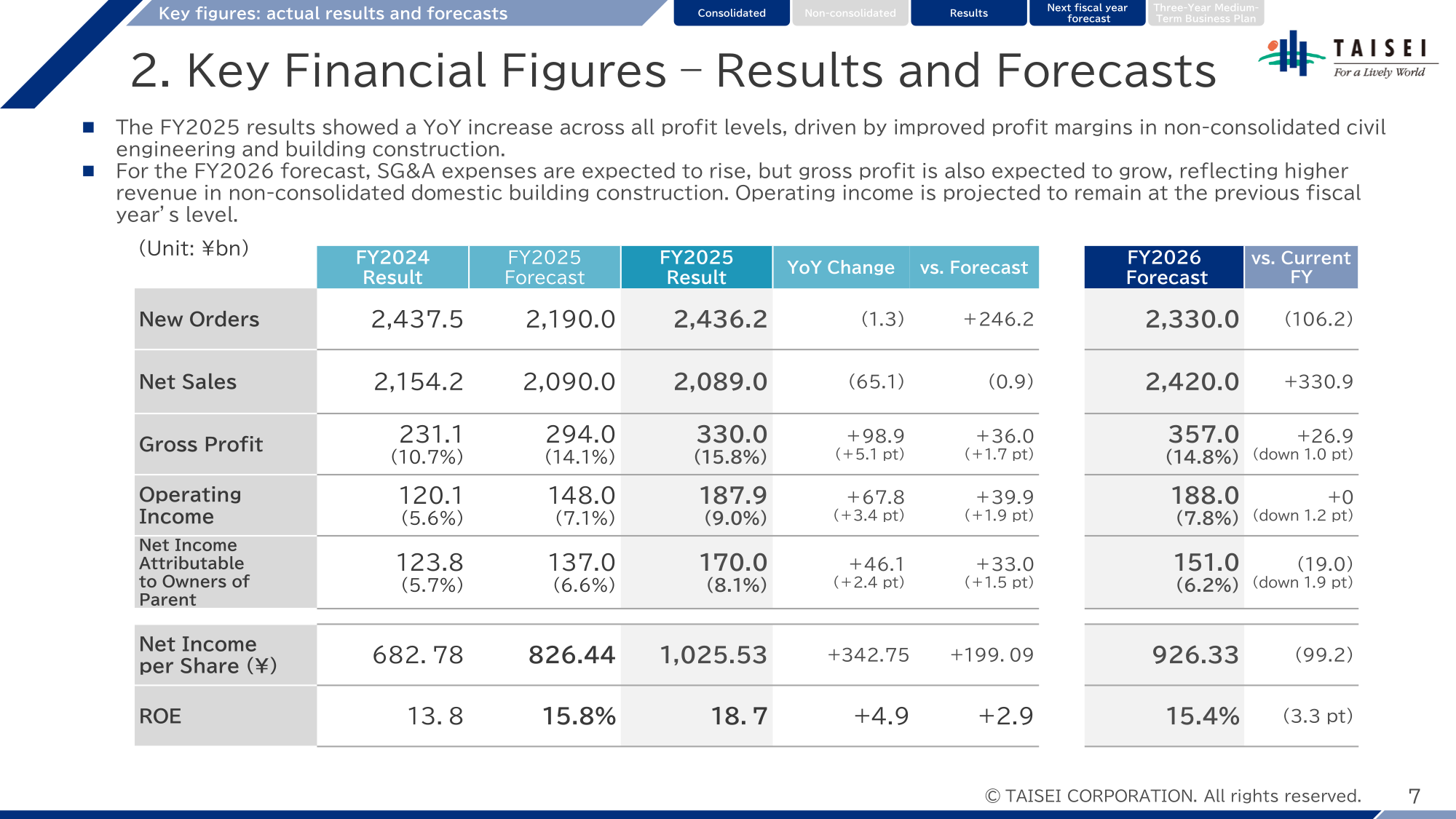
| New orders | 2,437.5 | 2,436.2 | −1.3 |
| Net sales | 2,154.2 | 2,089.0 | −65.1 |
| Gross profit | 231.1 | 330.0 | +98.9 |
| Operating income | 120.1 | 187.9 | +67.8 |
| Net income (owners) | 123.8 | 170.0 | +46.1 |
| ROE | 13.8% | 18.7% | +4.9pt |
*Figures in billions of yen unless noted. The consolidated gross profit margin improved from 10.7% to 15.8%, and EPS rose to ¥1,025.53.*
Segment gross profit (FY2025)
- Domestic building construction: gross profit surged to ¥148.3 billion (from ¥65.2 billion), the single largest driver of the record result.
- Domestic civil engineering: ¥144.0 billion (from ¥121.8 billion), also improving.
- Domestic real estate development: ¥31.5 billion, broadly stable.
- Overseas business: a gross loss of ¥3.4 billion, the weak spot, with a return to profit (¥7.1 billion) guided for FY2026.
Splitting temporary and structural factors
- The recovery in domestic construction margins is the structural core of the result; net sales actually fell, so the profit growth came from profitability rather than volume.
- Gains on the sale of cross-shareholdings provided an additional, non-recurring boost. Investors should note that FY2026 net income is guided lower even as operating income holds — a signal that some FY2025 tailwinds do not repeat and interest costs are rising.
4. Growth strategy and medium-term points to watch
The results are framed against the Medium-Term Business Plan (2024–2026), whose targets Taisei has exceeded for two consecutive years:
- Priority segments. Renovation work orders grew (non-consolidated domestic building renovation orders rose from ¥279.9 billion to ¥313.6 billion), and the engineering business remained strong in pharmaceuticals and semiconductors, supported by a newly established Marketing & Sales (Engineering) Division.
- M&A. Toyo Construction adds marine construction capability (including one of Japan’s largest self-propelled cable-laying vessels), complementing Taisei’s traditional onshore strength; NeoSphere adds a telecommunications and infrastructure business.
- Growth investments. A new HR system, talent development to drive AI adoption, and the construction of Japan’s first zero-carbon administrative/research building (T-FIELD/SATTE).
- Capital policy. The minimum dividend payout ratio is raised to 40% from FY2026, alongside ongoing buybacks and share cancellation.
The most relevant medium-term KPIs are whether the improved building-construction margin is sustainable and whether the overseas business returns to profit as guided.
5. Points investors should watch
Strengths
- Record profit at every level and an ROE of 18.7%, well above the plan target, driven by a genuine margin recovery rather than volume.
- A strengthened shareholder-return policy: a higher minimum payout ratio (40%), a rising dividend, and share buybacks/cancellations.
- Robust demand in civil engineering, renovation, and engineering (pharmaceutical/semiconductor) work, plus new capabilities from M&A.
- Exceeded Medium-Term Business Plan targets two years running.
Concerns
- FY2026 net income is guided down about 11% (to ¥151.0 billion) on rising interest rates and lower one-off gains; operating income is guided flat as SG&A rises.
- Net sales declined year on year in FY2025, and new orders are guided lower for FY2026 (to ¥2,330.0 billion).
- The overseas business posted a gross loss in FY2025; its guided FY2026 recovery carries execution risk.
- Part of FY2025 profit came from non-recurring cross-shareholding sale gains.
- Integration and execution risk from recent M&A (Toyo Construction, NeoSphere).
Indicators to confirm in future disclosures
- Whether operating income holds at or above the FY2025 level (¥187.9 billion) and segment gross profit margins are maintained.
- The sustainability of the non-consolidated building construction margin (11.9% in FY2025).
- The overseas business turnaround and new-order trends.
- ROE relative to the mid-teens level, and the dividend payout ratio moving toward the new 40% minimum.
- Progress on share-count reduction and the earnings contribution of the newly acquired subsidiaries.
6. Summary
Taisei’s FY2025 results delivered record profit at every level and an ROE of 18.7%, driven by a sharp recovery in domestic building construction margins and supported by cross-shareholding sale gains — achieved even as net sales declined. Looking to FY2026, the company guides for flat operating income and lower net income on rising interest rates, while raising its minimum dividend payout ratio to 40% and continuing buybacks.
For investors, the central questions from here are how durable the construction-margin recovery proves, whether the overseas business returns to profit, and how consistently the company delivers on its enhanced shareholder-return and share-reduction commitments.
*This article is an analysis based on publicly available information and is not a recommendation to buy or sell any specific security. Please make investment decisions at your own responsibility.*
![[Obayashi] Investors’ Guide 2026 — The Complete 24-Article Breakdown](https://japan-equity.com/wp-content/uploads/2026/07/hub_cover-1024x1024.png)
![[Obayashi] IR & SR Policy — Feeding Dialogue Back into Management](https://japan-equity.com/wp-content/uploads/2026/07/p32_sq-1024x1024.jpg)
![[Obayashi] Real Estate Development — 18.7% Margin, ¥287.7bn Unrealized Gains](https://japan-equity.com/wp-content/uploads/2026/07/p20_sq-1024x1024.jpg)
![[Obayashi] Domestic Civil Engineering — Resilience Spending Supports 9.6% Margin](https://japan-equity.com/wp-content/uploads/2026/07/p11_sq-1024x1024.jpg)
![[Obayashi] Share Price & External Ratings — vs TOPIX, ESG Index Inclusion](https://japan-equity.com/wp-content/uploads/2026/07/p40_sq-1024x1024.jpg)
![[Construction] ¥75.5tn Investment, Shrinking Workforce — Big-5 Market Share](https://japan-equity.com/wp-content/uploads/2026/07/p12_sq-1024x1024.jpg)
![[Obayashi] Capital Policy & Shareholder Returns — ROE 10%+, DOE ~5%, ¥100bn Buyback](https://japan-equity.com/wp-content/uploads/2026/07/p27_sq-1024x1024.jpg)
![[Obayashi] Reducing Cross-Shareholdings — ¥285.2bn Sold in Five Years](https://japan-equity.com/wp-content/uploads/2026/07/p29_sq-1024x1024.jpg)
![[Obayashi] ¥750bn Investment Plan — ¥300bn to Development, ¥190bn to Tech/DX](https://japan-equity.com/wp-content/uploads/2026/07/p30_sq-1024x1024.jpg)
![[Obayashi] MTP2022 KPIs — Operating Profit ~2x Target, ROE 14.4%](https://japan-equity.com/wp-content/uploads/2026/07/p25_sq-1024x1024.jpg)
![[Obayashi] Cash Allocation — ¥420bn Investment CF Over Five Years](https://japan-equity.com/wp-content/uploads/2026/07/p26_sq-1024x1024.jpg)
![[Obayashi] Green Energy — 44 Plants, 344MW, and the Green Hydrogen Challenge](https://japan-equity.com/wp-content/uploads/2026/07/p21_sq-1024x1024.jpg)
![[Obayashi] Tackling the Labor Shortage — Robotics Construction®](https://japan-equity.com/wp-content/uploads/2026/07/p14_sq-1024x1024.jpg)
