
*Reading the investment points from the FY2025 (year ended March 31, 2026) financial results materials*
Introduction
In this article, we organize Mitsui Fudosan’s business, earnings trends, growth strategy, and the points investors should pay attention to, based on the FY2025 financial results materials the company has disclosed (results for the fiscal year ended March 31, 2026, announced on May 13, 2026).
*This article is based on publicly available IR materials and is not a recommendation to buy or sell any specific security.*
1. Company overview
Mitsui Fudosan is one of Japan’s largest real estate developers, anchored by the Nihonbashi, Yaesu, and Kyobashi areas of central Tokyo and by nationwide retail, logistics, and hotel operations. The company describes its business model as maximizing profit through an optimal, flexible combination of three earnings engines:
- Income Gain Business — stable leasing income and facility operating income from a large base of operating assets.
- Capital Gain Business — realizing added value through the sale of assets and development profit (gains on sale), for both investors and individual buyers.
- Management Business — recurring management, operation, and brokerage fees, including from roughly ¥5.31 trillion of assets under management.
Group total assets are approximately ¥10.1 trillion. The main asset classes span offices, retail facilities, logistics facilities and data centers, housing, hotels and resorts, and sports & entertainment, across both domestic and overseas markets.
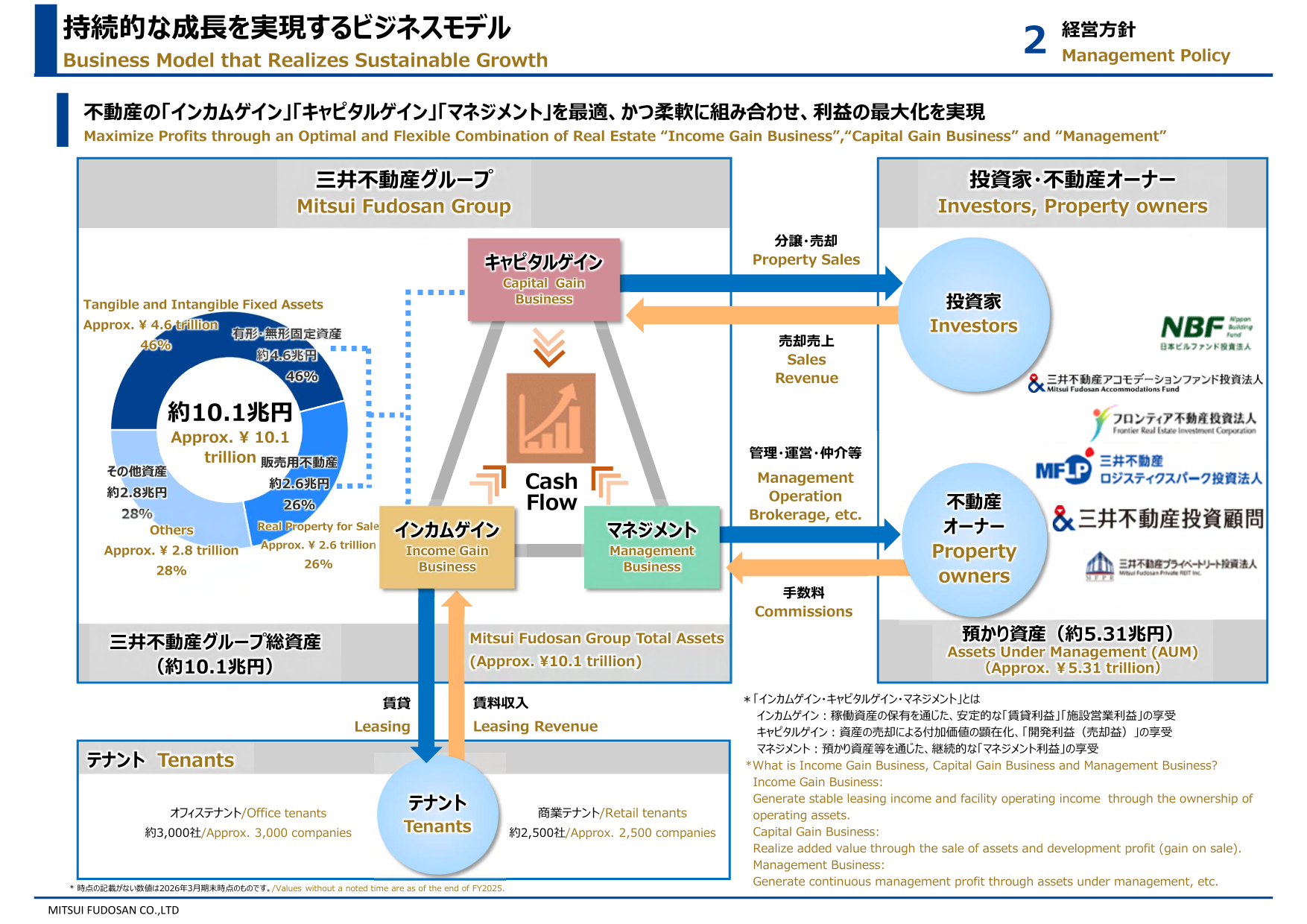
A key characteristic for investors is that Mitsui Fudosan combines relatively stable rental cash flow with lumpier capital gains from asset sales — and it is deliberately accelerating “asset turnover” by treating real property for sale and fixed assets on an integrated basis.
2. The most important points in this results release
Reading the materials as a whole, the following points stand out.
Point 1: Every major profit line reached a record high
- Revenue from operations (¥2,709.7 billion), operating income (¥397.7 billion), business income (¥445.1 billion), ordinary income (¥313.3 billion), and net profit (¥278.6 billion) all set records.
- Business income rose 11.6% and net profit rose 12.0% year on year.
Point 2: The FY2026 profit and ROE targets under “& INNOVATION 2030” were achieved one year early
- Business income of ¥445.1 billion already exceeds the FY2026 goal of “¥440.0 billion or higher,” net profit of ¥278.6 billion exceeds “¥270.0 billion or higher,” and ROE of 8.7% exceeds the “8.5% or higher” target.
- This reflects growth in leasing income, strong property-sales gains, and disciplined balance-sheet management.
Point 3: Operating fundamentals remain strong across segments
- The office vacancy rate (Tokyo metropolitan area, non-consolidated) was 1.6%, well below the central Tokyo market. Domestic retail facility revenue rose 4.5%, hotel RevPAR exceeded 110% year on year, and the domestic condominium profit margin reached a record 25.5%.
Point 4: A sixth consecutive year of dividend increases, plus buybacks
- The FY2025 annual dividend was ¥35 (up ¥4), with ¥57 billion of share repurchases completed and a total return ratio of 54.9%. For FY2026, the company plans a ¥37 dividend (up ¥2) and ¥40 billion of buybacks, with additional repurchases to be considered flexibly.
3. Earnings trends
Consolidated results (FY2025)
| Item | FY2024 | FY2025 | YoY change |
|—|—|—|—|
| Revenue from operations | 2,625.3 | 2,709.7 | +84.3 |
| Operating income | 372.7 | 397.7 | +25.0 |
| Business income | 398.6 | 445.1 | +46.4 |
| Ordinary income | 290.2 | 313.3 | +23.0 |
| Profit attributable to owners of parent | 248.7 | 278.6 | +29.8 |
| ROE | 8.0% | 8.7% | +0.7pt |
*Figures in billions of yen unless noted. Business income marked a second consecutive record high, and revenue from operations a 14th consecutive record high.*
Segment business income (FY2025)
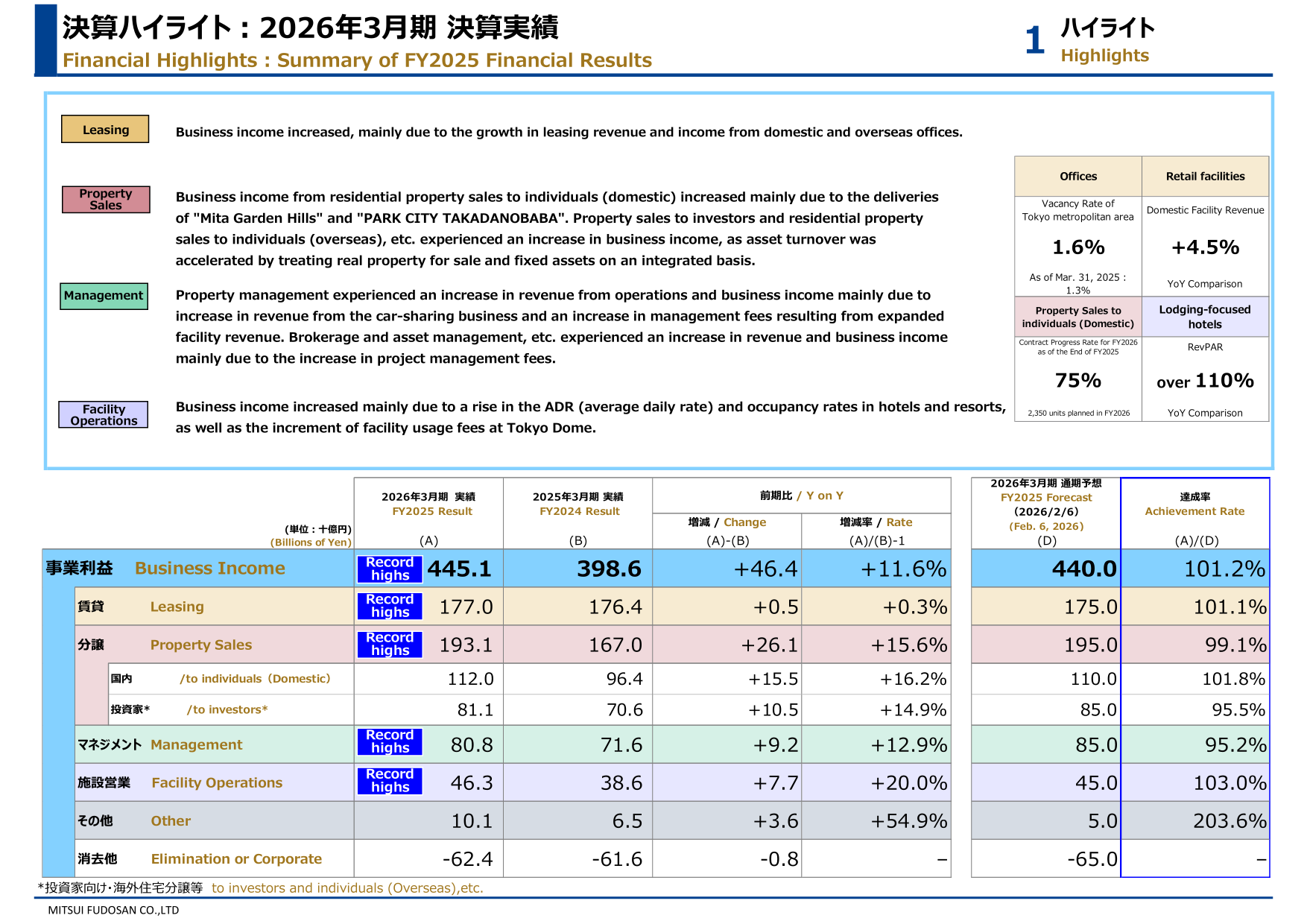
- Leasing: ¥177.0 billion (+¥0.5 billion), a record, supported by upward rent revisions for domestic and overseas offices.
- Property Sales: ¥193.1 billion (+¥26.1 billion, +15.6%), a record — ¥112.0 billion from sales to individuals (domestic, including “Mita Garden Hills” and “PARK CITY TAKADANOBABA”) and ¥81.1 billion from sales to investors, aided by accelerated asset turnover.
- Management: ¥80.8 billion (+¥9.2 billion), a record, on higher project-management and facility-related fees.
- Facility Operations: ¥46.3 billion (+¥7.7 billion, +20.0%), a record, on higher hotel ADR and occupancy and rising Tokyo Dome usage fees.
Splitting temporary and structural factors
- Leasing is the structural, recurring core, underpinned by exceptionally low office vacancy and continued rent increases.
- A meaningful share of the year’s growth came from property-sales gains (¥51.7 billion of gains on sales of fixed assets flowed through extraordinary income), which are inherently lumpier and depend on the timing of asset sales.
4. Growth strategy and medium-term points to watch
The results are framed against the group’s long-term vision “& INNOVATION 2030” (announced April 2024):
- Around FY2030 targets: EPS growth of +8% or higher CAGR and ROE of 10% or higher. FY2025 ROE was 8.7% and net profit ¥278.6 billion, both on an upward trajectory.
- FY2026 targets (business income ¥440.0 billion+, net profit ¥270.0 billion+, ROE 8.5%+, total assets ~¥9 trillion) were essentially reached a year early; the FY2026 forecast now guides revenue of ¥2,800.0 billion, business income of ¥450.0 billion, and net profit of ¥285.0 billion — again record highs.
- Three growth paths: promoting core-business growth, expanding into new asset classes (logistics, data centers, life science), and exploring new business domains, supported by human resources, DX, and ESG.
- Balance-sheet and capital policy: accelerating asset turnover (about ¥2 trillion over FY2024–FY2026), maintaining a D/E ratio of roughly 1.2–1.5x, and reducing strategic shareholdings by 50% on a three-year cumulative basis (about 40% reduction achieved by FY2025). Rental properties carry unrealized gains of approximately ¥5.5 trillion, providing a large reservoir for future capital gains.
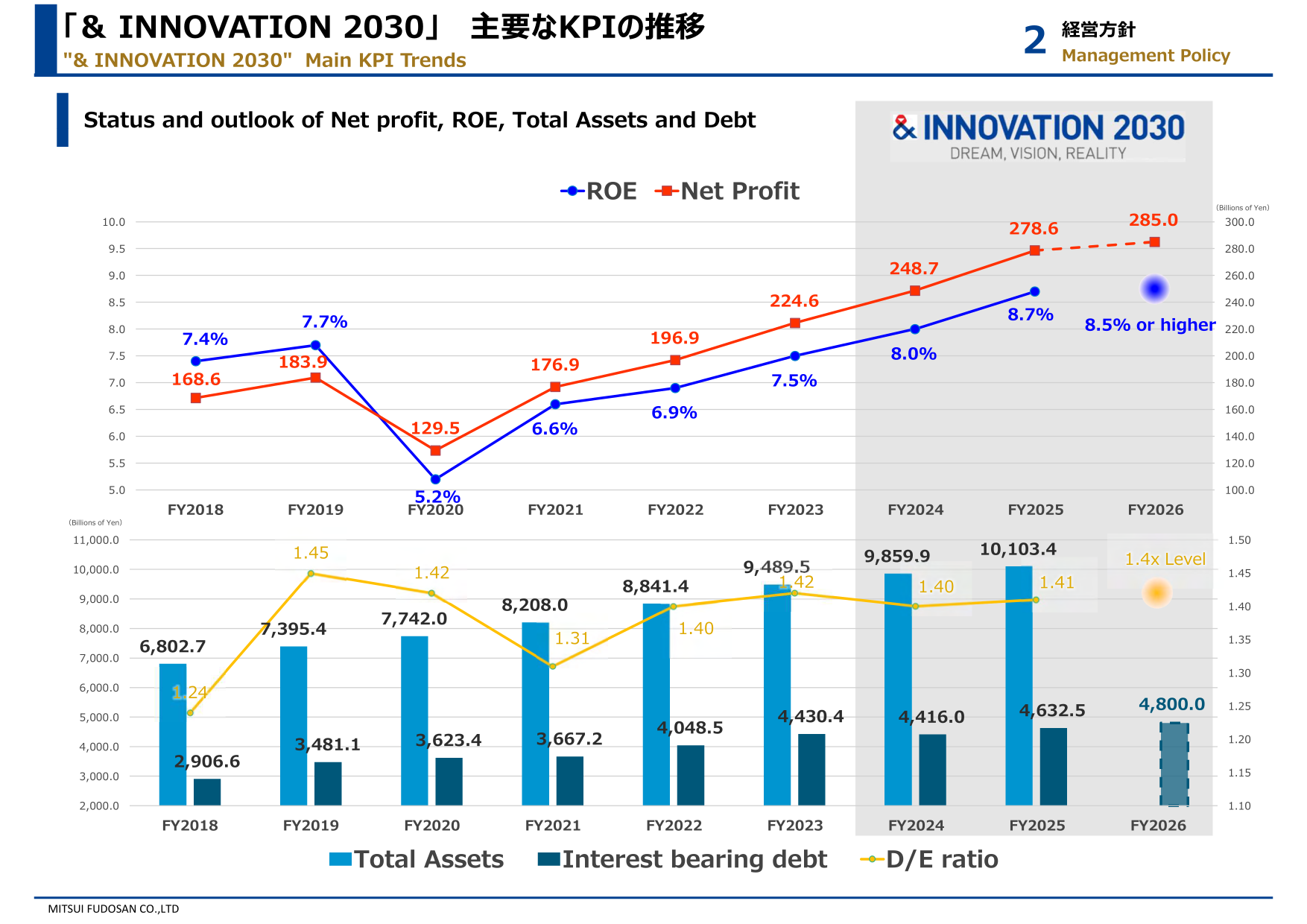
The most relevant medium-term KPIs are the ROE path from 8.7% toward the 10% FY2030 goal, and how much of profit growth is offset by rising interest costs as interest-bearing debt increases.
5. Points investors should watch
Strengths
- Record results across every major profit line, with FY2026 vision targets met a year early.
- An exceptionally tight office base (1.6% vacancy) and market-leading rents in the Yaesu/Nihonbashi/Kyobashi area, underpinning stable, growing leasing income.
- A large unrealized-gain reservoir (~¥5.5 trillion in rental properties) and a clear asset-turnover strategy that can convert it into profit.
- A visible, growing shareholder-return policy: a sixth straight dividend increase, continuous buybacks, and a total return ratio target of 50% or higher each period.
Concerns
- FY2026 net profit growth is modest (+2.3%) and ordinary income is nearly flat (+0.5%), as much of the business-income growth is offset by rising net interest expense (guided to about −¥85.0 billion from −¥73.4 billion) on higher interest-bearing debt (toward ~¥4.8 trillion).
- Earnings quality: a significant portion of profit relies on property-sales gains and asset turnover, which are lumpier than recurring rent. Property sales to individuals (domestic) business income is guided sharply lower in FY2026 (¥65.0 billion from ¥112.0 billion), offset by sales to investors.
- Equity in net income of affiliates was negative (−¥4.4 billion).
- Sensitivity to rising Japanese interest rates, given the group’s scale of debt, and exposure to overseas (US/Europe) real-estate markets and FX.
Indicators to confirm in future disclosures
- ROE progress toward the 10% FY2030 goal, and the trend in net interest expense.
- The mix and margins of property sales (to individuals vs. investors) and the pace of asset turnover.
- Office vacancy and rent-revision trends, hotel RevPAR/ADR, and retail facility revenue.
- Progress on reducing strategic shareholdings toward the 50% (three-year cumulative) target.
- Dividend progression and the scale of additional FY2026 buybacks.
6. Summary
Mitsui Fudosan’s FY2025 results mark record profit across every major line, with the FY2026 profit and ROE targets under “& INNOVATION 2030” achieved a full year ahead of schedule. Strong leasing fundamentals, record hotel and condominium performance, and accelerated asset turnover drove the year, and the company is guiding for further records in FY2026 alongside a sixth consecutive dividend increase.
For investors, the central questions from here are how durable the recurring leasing base proves relative to lumpier property-sales gains, how much rising interest costs offset profit growth, and whether the company can carry ROE from 8.7% toward its 10% FY2030 goal while sustaining its enhanced shareholder-return policy.
*This article is an analysis based on publicly available information and is not a recommendation to buy or sell any specific security. Please make investment decisions at your own responsibility.*
![[Obayashi] Investors’ Guide 2026 — The Complete 24-Article Breakdown](https://japan-equity.com/wp-content/uploads/2026/07/hub_cover-1024x1024.png)
![[Obayashi] IR & SR Policy — Feeding Dialogue Back into Management](https://japan-equity.com/wp-content/uploads/2026/07/p32_sq-1024x1024.jpg)
![[Obayashi] Real Estate Development — 18.7% Margin, ¥287.7bn Unrealized Gains](https://japan-equity.com/wp-content/uploads/2026/07/p20_sq-1024x1024.jpg)
![[Obayashi] Domestic Civil Engineering — Resilience Spending Supports 9.6% Margin](https://japan-equity.com/wp-content/uploads/2026/07/p11_sq-1024x1024.jpg)
![[Obayashi] Share Price & External Ratings — vs TOPIX, ESG Index Inclusion](https://japan-equity.com/wp-content/uploads/2026/07/p40_sq-1024x1024.jpg)
![[Construction] ¥75.5tn Investment, Shrinking Workforce — Big-5 Market Share](https://japan-equity.com/wp-content/uploads/2026/07/p12_sq-1024x1024.jpg)
![[Obayashi] Capital Policy & Shareholder Returns — ROE 10%+, DOE ~5%, ¥100bn Buyback](https://japan-equity.com/wp-content/uploads/2026/07/p27_sq-1024x1024.jpg)
![[Obayashi] Reducing Cross-Shareholdings — ¥285.2bn Sold in Five Years](https://japan-equity.com/wp-content/uploads/2026/07/p29_sq-1024x1024.jpg)
![[Obayashi] ¥750bn Investment Plan — ¥300bn to Development, ¥190bn to Tech/DX](https://japan-equity.com/wp-content/uploads/2026/07/p30_sq-1024x1024.jpg)
![[Obayashi] MTP2022 KPIs — Operating Profit ~2x Target, ROE 14.4%](https://japan-equity.com/wp-content/uploads/2026/07/p25_sq-1024x1024.jpg)
![[Obayashi] Cash Allocation — ¥420bn Investment CF Over Five Years](https://japan-equity.com/wp-content/uploads/2026/07/p26_sq-1024x1024.jpg)
![[Obayashi] Green Energy — 44 Plants, 344MW, and the Green Hydrogen Challenge](https://japan-equity.com/wp-content/uploads/2026/07/p21_sq-1024x1024.jpg)
![[Obayashi] Tackling the Labor Shortage — Robotics Construction®](https://japan-equity.com/wp-content/uploads/2026/07/p14_sq-1024x1024.jpg)
