
This article is based on publicly available IR materials and is not a recommendation to buy or sell any specific securities.
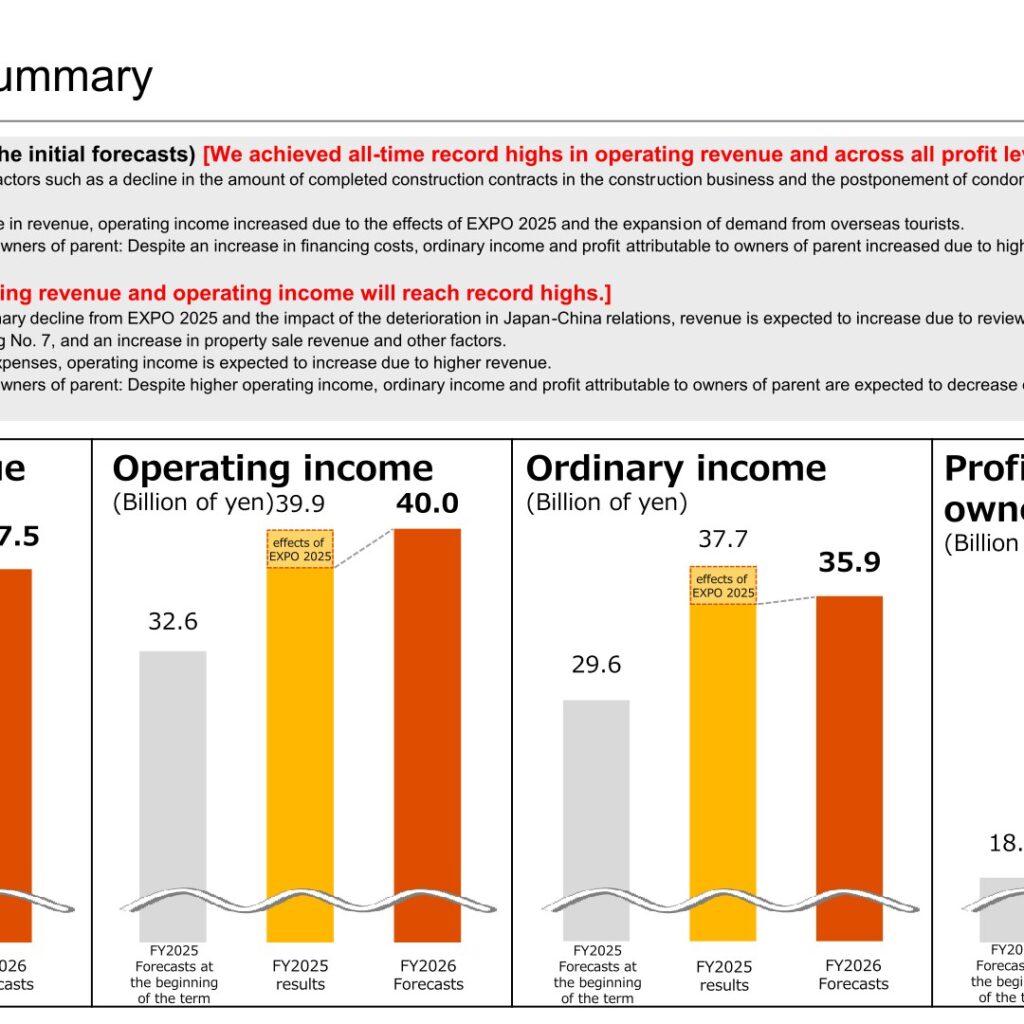
NANKAI Co., Ltd. — the Kansai railway group whose trade name was changed from Nankai Electric Railway Co., Ltd. on April 1, 2026, when the railway business was spun off into a wholly owned subsidiary — reported all-time record highs in operating revenue and across all profit levels for FY2025. Operating revenue was 264,714 million yen (up 1.5% year on year) and operating income was 39,945 million yen (up 15.2%), with ordinary income of 37,763 million yen and profit attributable to owners of parent of 25,135 million yen. The company describes the results as driven by an increase in passengers carried in the transportation business, mainly reflecting the positive impact of EXPO 2025 and growing demand from overseas tourists, together with the full-year contribution of Meiko Bus and Tsutenkaku Kanko, which were acquired as subsidiaries in the previous fiscal year. For FY2026 the company forecasts record operating revenue of 287,500 million yen and operating income of 40,000 million yen, while ordinary income and profit attributable to owners of parent are expected to decrease on higher interest expenses.
Consolidated Results (Full-Year Actual)
Operating revenue rose 3,927 million yen (1.5%) and operating income rose 5,263 million yen (15.2%) against FY2024. The company states that both revenue and income increased mainly due to the rise in passengers carried in the transportation business, driven by factors including the impact of EXPO 2025 and growing demand from overseas tourists, as well as increased condominium sales in the real estate business, and the full-year contribution from Meiko Bus and Tsutenkaku Kanko, acquired as subsidiaries in October 2024 and December 2024 respectively. Ordinary income increased on the back of higher operating income, despite lower dividend income received from a special-purpose company due to a reactionary decrease from the previous period and higher interest expenses.
| Item | FY2025 results | FY2024 results | Change | Percentage change |
|---|---|---|---|---|
| Operating revenue (Millions of yen) | 264,714 | 260,787 | 3,927 | 1.5% |
| Operating income (Millions of yen) | 39,945 | 34,681 | 5,263 | 15.2% |
| Ordinary income (Millions of yen) | 37,763 | 35,599 | 2,164 | 6.1% |
| Profit attributable to owners of parent (Millions of yen) | 25,135 | 22,548 | 2,587 | 11.5% |
| EBITDA (Millions of yen) | 68,672 | 63,235 | 5,436 | 8.6% |
| Investment (Millions of yen) | 99,105 | 47,241 | 51,863 | 109.8% |
| Depreciation and amortization (Millions of yen) | 28,387 | 28,288 | 99 | 0.4% |
| Interest-bearing debt (Millions of yen) | 457,450 | 432,950 | 24,500 | 5.7% |
| Net interest-bearing debt (Millions of yen) | 417,973 | 390,101 | 27,872 | 7.1% |
| Ratio of net interest-bearing debt to EBITDA | 6.1 times | 6.2 times | −0.1 pt | — |
| ROE | 7.8% | 7.5% | 0.3pt | — |
Against the FY2025 forecasts announced in October 2025 (operating revenue of 271,400 million yen and operating income of 38,500 million yen), revenue came in 6,685 million yen lower while operating income came in 1,445 million yen higher. The company attributes the revenue shortfall mainly to a decrease in the amount of completed construction contracts in the construction business and the postponement to the next fiscal period of condominium sales in the real estate sales business, while income rose mainly due to improved profit ratios in the construction business and reduced expenses in the real estate business. Total assets stood at 1,065,100 million yen as of March 31, 2026, against 981,014 million yen a year earlier, and net assets were 354,085 million yen. Cash flows from operating activities were 47,535 million yen.
Segment Results
The group reports six segments — Transportation, Real Estate, Distribution, Leisure and Services, Construction and Other. Operating income rose in every segment except Other. Transportation, the largest revenue segment at 117,329 million yen, generated operating income of 14,908 million yen, while Real Estate produced almost the same level of operating income (14,347 million yen) on roughly half the revenue (53,285 million yen). The EXPO 2025 revenue effect is disclosed as 1.0 billion yen for the railway business, 0.8 billion yen for the bus business and 0.2 billion yen for real estate leasing, for a total revenue increase effect of 2.0 billion yen.
| Segment | Operating revenue FY2025 | Operating revenue FY2024 | Operating income FY2025 | Operating income FY2024 |
|---|---|---|---|---|
| Transportation | 117,329 | 112,738 | 14,908 | 13,261 |
| Real Estate | 53,285 | 49,087 | 14,347 | 12,365 |
| Distribution | 30,464 | 28,879 | 3,935 | 3,657 |
| Leisure and Services | 52,809 | 45,545 | 4,716 | 3,370 |
| Construction | 46,985 | 54,030 | 2,901 | 2,459 |
| Other | 4,389 | 3,694 | 86 | 88 |
| Adjustment | −40,549 | −33,188 | −949 | −521 |
| Total | 264,714 | 260,787 | 39,945 | 34,681 |
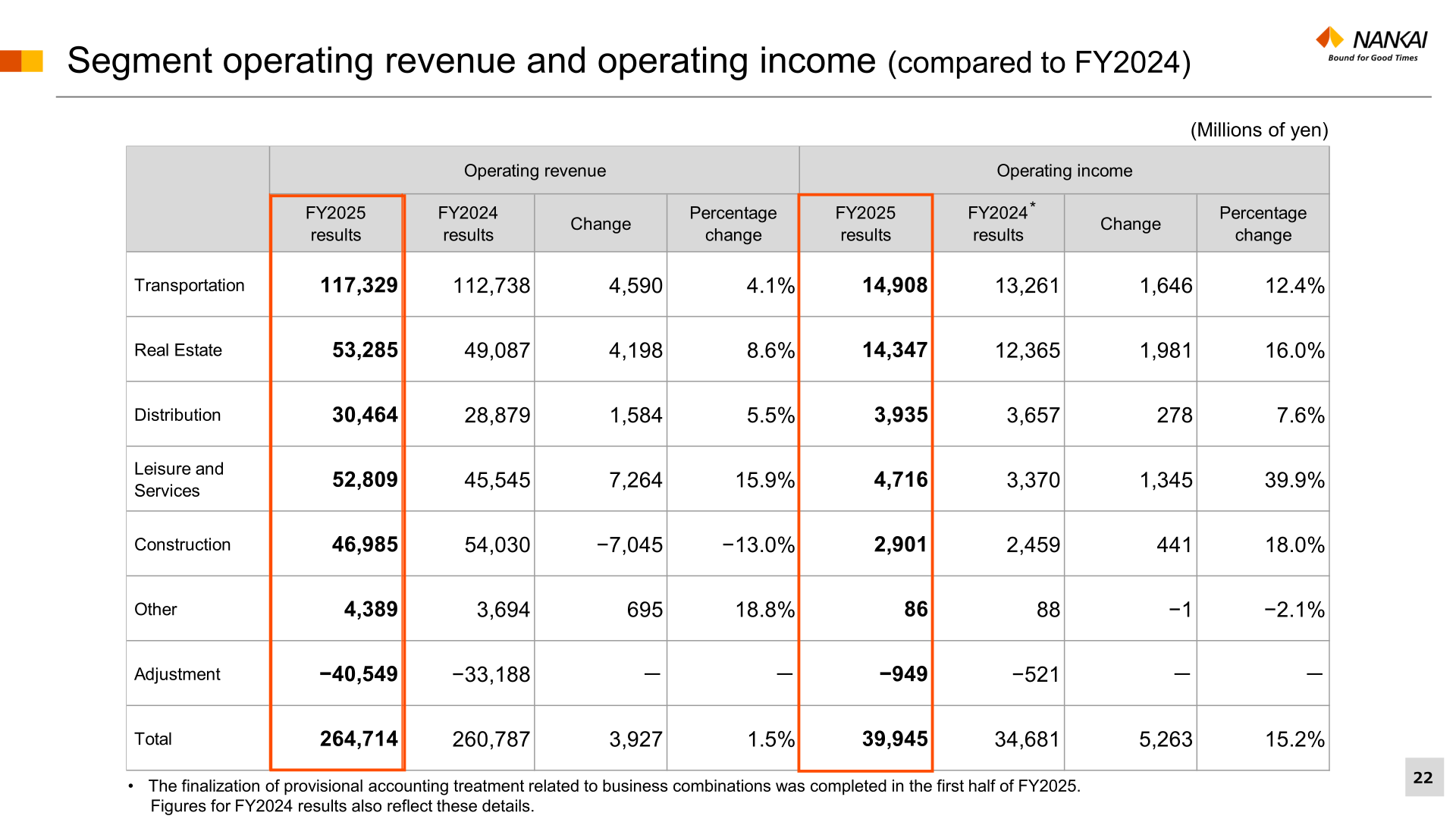
Within Transportation, the railway business posted operating revenue of 72,994 million yen and operating income of 10,511 million yen, and the bus business 28,329 million yen and 4,206 million yen respectively; the company notes that excluding transactions between Nankai Electric Railway and Semboku Rapid Railway included in the FY2024 railway figures, operating revenue increased by 1.4 billion and operating income by 0.5 billion. In Real Estate, the leasing business earned 36,900 million yen of revenue and 12,514 million yen of income on higher dividend income from investments in real estate properties and growth in hotel rental income, while the sales business earned 16,517 million yen of revenue and 1,835 million yen of income as condominiums sold rose to 331 units from 119 units. Distribution grew on steady shopping-centre sales, partly from capturing demand from overseas tourists, and on strong convenience-store sales in the station premises business. Leisure and Services rose 15.9% in revenue on the full-year contribution from Tsutenkaku Kanko and increased construction income in the building management and maintenance business. Construction was the one segment where revenue fell, down 13.0% on a decline in the amount of completed construction contracts, though operating income still rose 18.0% on improved profit ratios. By segment, investment was concentrated in Real Estate at 66,024 million yen of the 99,105 million yen group total.
Railway Passenger Revenue and Passengers Carried
Across all lines (existing lines plus the Airport Line, including figures for the Semboku Line), passenger revenue rose 2.0% to 69,951 million yen and passengers carried rose 2.5% to 246,670 thousand. The Airport Line, which serves Kansai International Airport, was the standout: passenger revenue rose 7.5% and passengers carried rose 7.6%, and the company states that passengers carried and passenger revenue on the Airport Line reached record highs (up 7% year on year). Non-commuter pass revenue rose 4.1% group-wide while commuter pass revenue fell 1.4%.
| Category | Item | FY2025 results | FY2024 results | Change | Percentage change |
|---|---|---|---|---|---|
| All lines | Passenger revenue: Non-commuter passes (Millions of yen) | 45,043 | 43,287 | 1,755 | 4.1% |
| All lines | Passenger revenue: Commuter passes (Millions of yen) | 24,907 | 25,267 | −359 | −1.4% |
| All lines | Passenger revenue: Total (Millions of yen) | 69,951 | 68,555 | 1,396 | 2.0% |
| All lines | Passengers carried: Total (Thousands) | 246,670 | 240,567 | 6,103 | 2.5% |
| Existing lines | Passenger revenue: Total (Millions of yen) | 55,058 | 54,702 | 356 | 0.7% |
| Existing lines | Passengers carried: Total (Thousands) | 226,183 | 221,532 | 4,651 | 2.1% |
| Airport line | Passenger revenue: Total (Millions of yen) | 14,892 | 13,853 | 1,039 | 7.5% |
| Airport line | Passengers carried: Total (Thousands) | 20,487 | 19,035 | 1,452 | 7.6% |
FY2026 Forecast
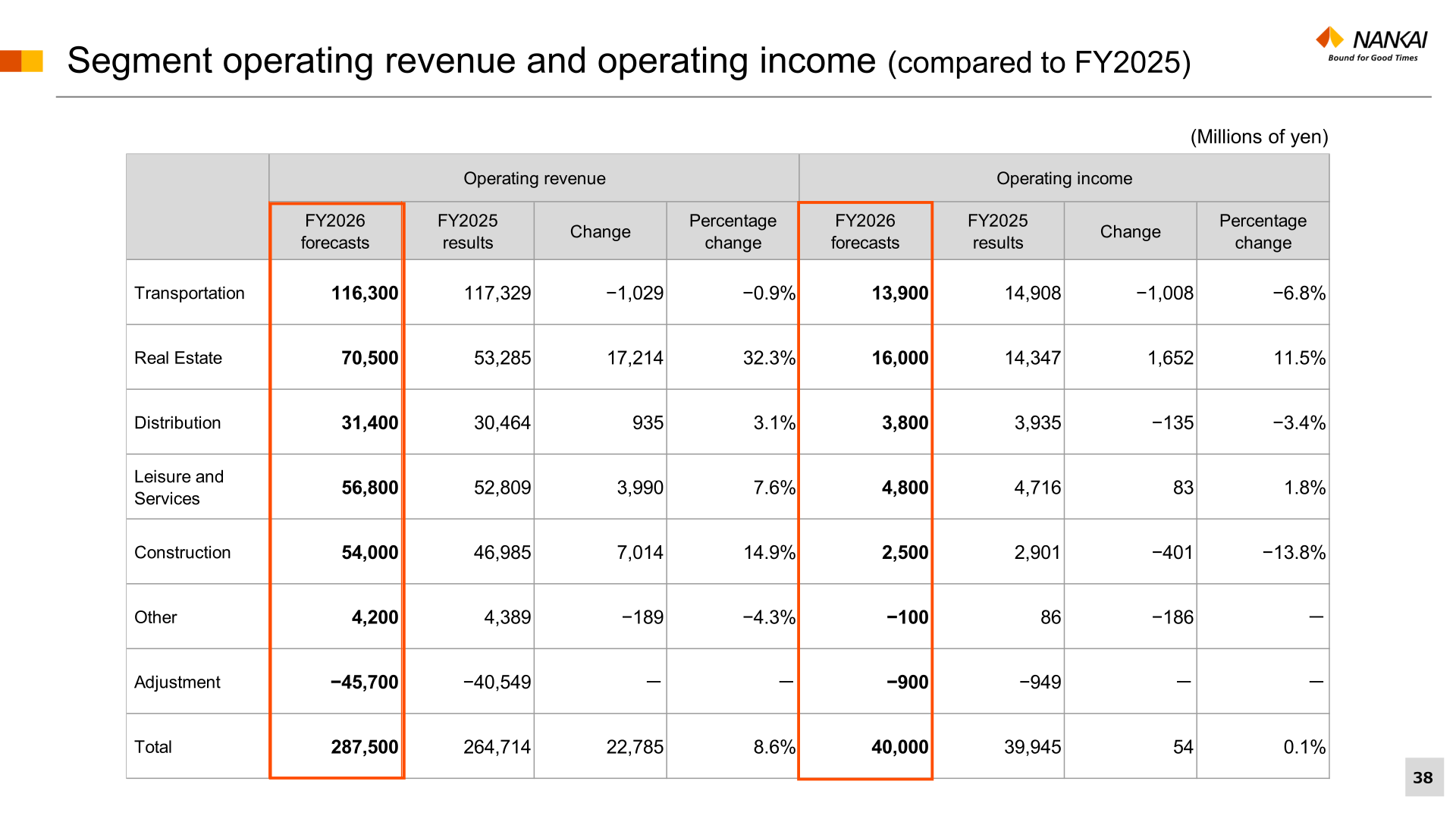
The company forecasts record highs in both operating revenue and operating income for FY2026. Operating revenue is projected at 287,500 million yen (up 22,785 million yen) and operating income at 40,000 million yen (up 54 million yen). Revenue growth is attributed to revisions to limited express fares in the railway business, the commencement of leasing of Building 7 at the Kita Osaka Truck Terminal, and an increase in proceeds from the sale of property, offsetting the diminished impact of EXPO 2025 and deteriorating Japan–China relations. Ordinary income (35,900 million yen) and profit attributable to owners of parent (23,800 million yen) are forecast to decrease mainly on an increase in interest expenses, and the ratio of net interest-bearing debt to EBITDA is expected to rise to 7.4 times as investment expands to 136,200 million yen.
| Item | FY2026 forecasts | FY2025 results | Change |
|---|---|---|---|
| Operating revenue (Millions of yen) | 287,500 | 264,714 | 22,785 |
| Operating income (Millions of yen) | 40,000 | 39,945 | 54 |
| Ordinary income (Millions of yen) | 35,900 | 37,763 | −1,863 |
| Profit attributable to owners of parent (Millions of yen) | 23,800 | 25,135 | −1,335 |
| Investment (Millions of yen) | 136,200 | 99,105 | 37,094 |
| Depreciation and amortization (Millions of yen) | 29,700 | 28,387 | 1,312 |
| EBITDA (Millions of yen) | 70,000 | 68,672 | 1,327 |
| Interest-bearing debt (Millions of yen) | 541,400 | 457,450 | 83,949 |
| Net interest-bearing debt (Millions of yen) | 520,100 | 417,973 | 102,126 |
| Ratio of net interest-bearing debt to EBITDA | 7.4 times | 6.1 times | 1.3 pt |
| ROE | 7.0% | 7.8% | −0.8 pt |
By segment, Real Estate carries the forecast growth with operating revenue up 32.3% to 70,500 million yen and operating income up 11.5% to 16,000 million yen, and Construction revenue is expected to rise 14.9% to 54,000 million yen. Transportation revenue is forecast to slip 0.9% to 116,300 million yen and its operating income to fall 6.8% to 13,900 million yen: within it, the railway business is expected to grow (operating income of 10,900 million yen) on overseas tourist demand and limited express fare revisions, while bus business operating income is forecast to drop 35.8% to 2,700 million yen on the post-EXPO decline, deteriorating Japan–China relations, and higher personnel and depreciation costs associated with vehicle updates. Regarding the external environment, the company notes that since January 2026 the number of international passengers from China at Kansai International Airport has continued to be around 40% of the same month of the previous year, while international passengers excluding China are trending at around 110%; passengers carried on its Airport Line have run around 3% below the previous year since January 2026, and the load factor of Rapi:t is approximately 70%. In the FY2026 wage revision, labour and management agreed to raise the average annual income per employee by about 7%.
Shareholder Returns
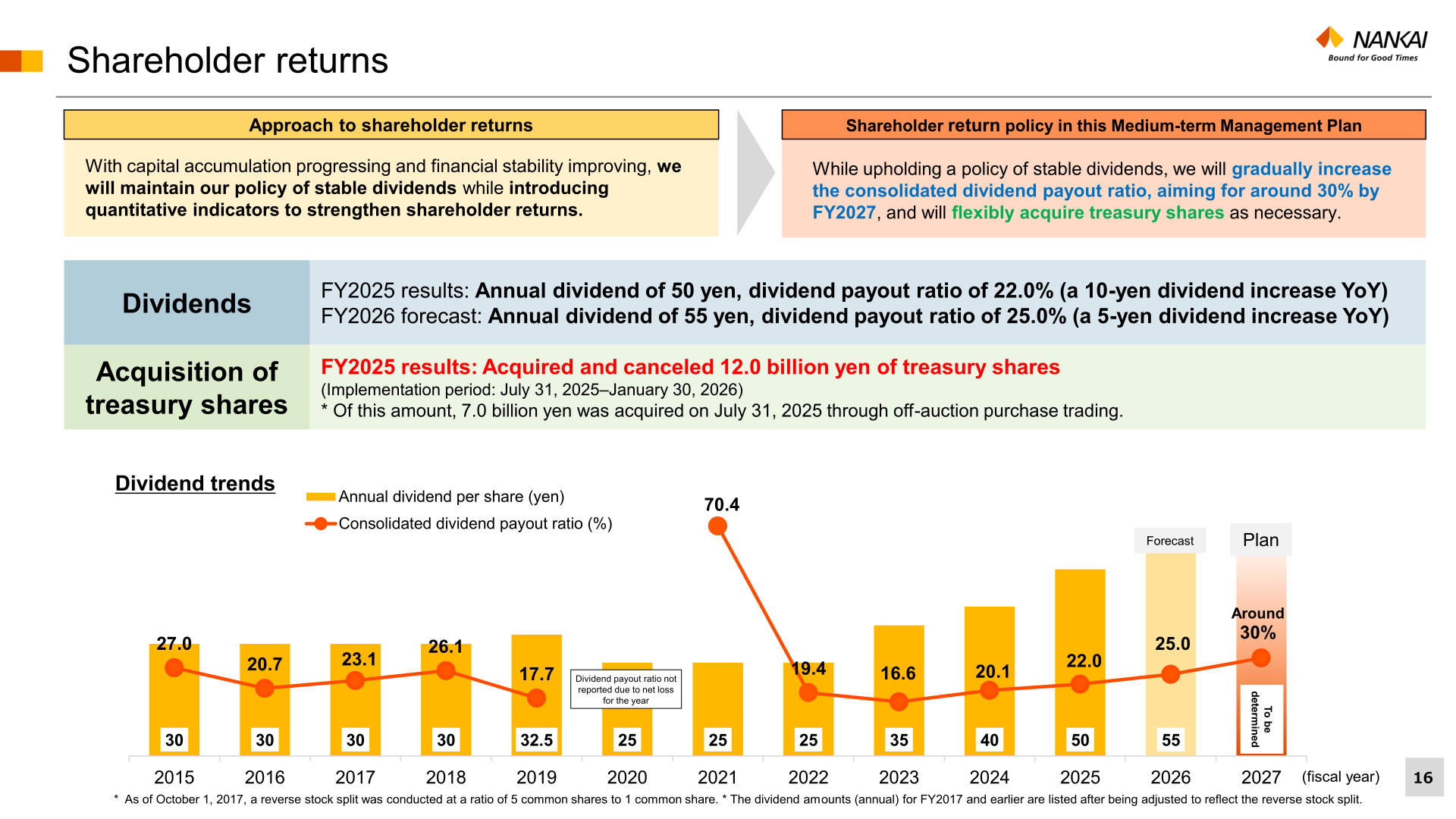
For FY2025 the annual dividend is 50 yen with a dividend payout ratio of 22.0%, a 10-yen increase year on year. For FY2026 the company forecasts an annual dividend of 55 yen and a payout ratio of 25.0%, a further 5-yen increase. In addition, NANKAI acquired and cancelled 12.0 billion yen of treasury shares during FY2025 (implementation period July 31, 2025 to January 30, 2026), of which 7.0 billion yen was acquired on July 31, 2025 through off-auction purchase trading. The stated policy is that, while upholding a policy of stable dividends, the company will gradually increase the consolidated dividend payout ratio, aiming for around 30% by FY2027, and will flexibly acquire treasury shares as necessary.
| Item | FY2024 | FY2025 | FY2026 (Forecast) | FY2027 (Plan) |
|---|---|---|---|---|
| Annual dividend per share (yen) | 40 | 50 | 55 | To be determined |
| Consolidated dividend payout ratio | 20.1% | 22.0% | 25.0% | Around 30% |
Medium-term Management Plan
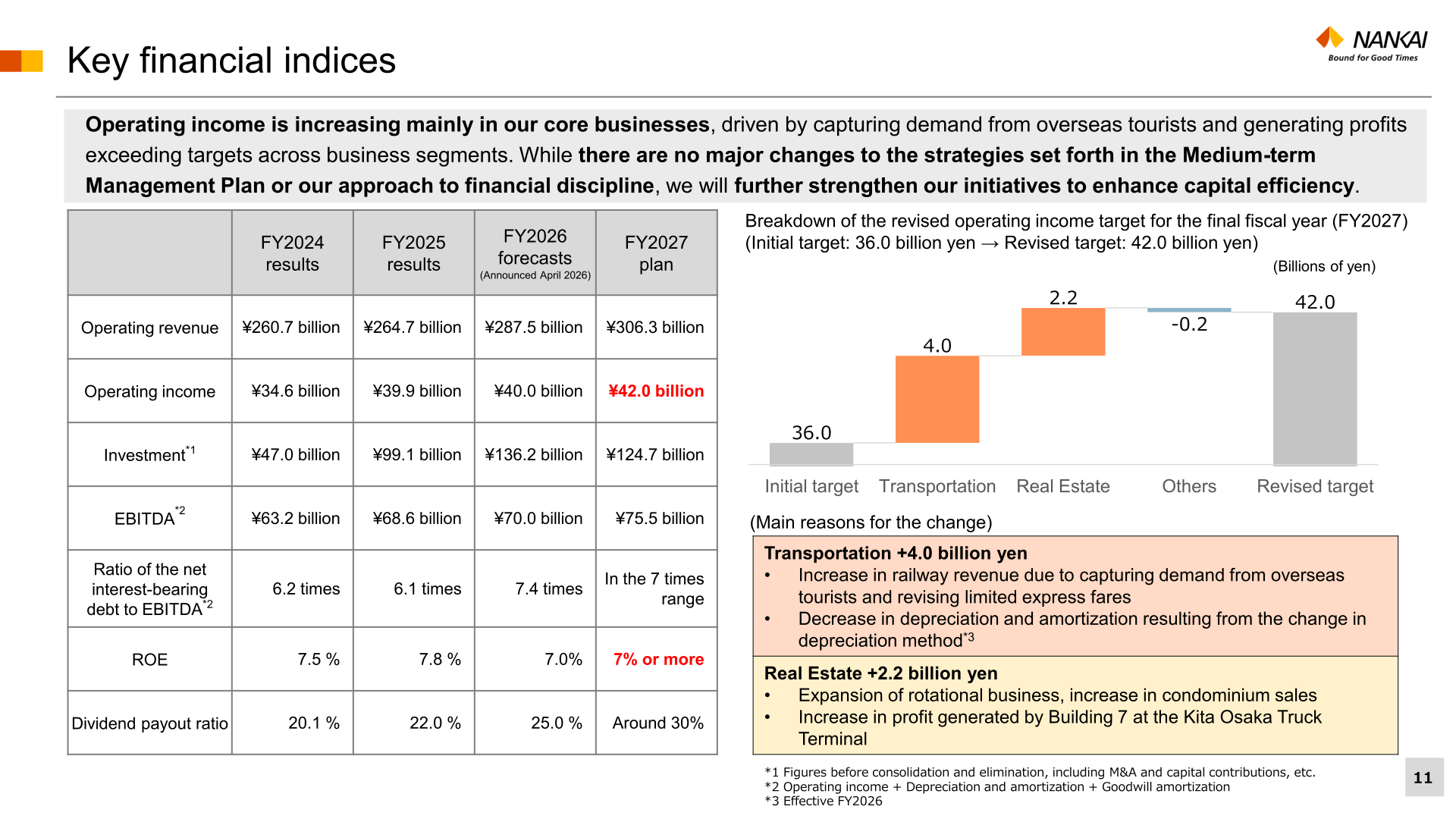
Alongside the results, NANKAI updated the numerical targets of its Medium-term Management Plan 2025–2027. The FY2027 operating income target was revised upward from 36.0 billion yen or more to 42.0 billion yen or more, an increase of 6.0 billion yen against the initial plan, with the breakdown of the revision given as Transportation +4.0 billion yen, Real Estate +2.2 billion yen and Others −0.2 billion yen. The ROE target was revised upward from around 7% to 7% or more, while the ratio of net interest-bearing debt to EBITDA target is maintained in the 7 times range. Target levels for the future are operating income of 46.0 billion yen or more (by FY2035 at the earliest), a debt/EBITDA ratio in the 6 times range and ROE of 8% or more. The FY2027 plan shown in the key financial indices is operating revenue of 306.3 billion yen, operating income of 42.0 billion yen, investment of 124.7 billion yen and EBITDA of 75.5 billion yen. Total investment over the three years of the plan remains up to 360.0 billion yen — up to 150.0 billion yen for safety and renewal and up to 210.0 billion yen for revenue expansion including future exploration — and cash flows from operating activities were revised up from approximately 150.0 billion yen to approximately 160.0 billion yen. The company also notes that its R&I rating was upgraded from A- (Positive) to A (Stable) during FY2025, the first A rating in 28 years.
Topics: Launch of the New NANKAI Group
On April 1, 2026, the railway business was spun off into a 100% subsidiary, Nankai Electric Railway Co., Ltd., and the trade name of the listed company was changed to NANKAI Co., Ltd. (Tokyo Stock Exchange, Prime Market, Securities Code: 9044). The listed parent retains the real estate business, the control-tower function for region development and promotion, group corporate functions and new business, while the railway business is carried out by the new subsidiary. The company states that under the new structure it will increase the execution speed of various strategies and accelerate the materialization of growth opportunities by optimizing the execution structure according to business characteristics. The basic policies of the plan are the accelerated expansion of the real estate business and the transformation into a public transportation business that paves the way for the future, with preparations proceeding for the opening of Osaka IR in 2030 and the Naniwasuji Line in 2031 (both timings tentative).
This article is an analysis based on publicly available information and is not a recommendation to buy or sell any specific securities. Investment decisions are your own responsibility.
![[Obayashi] Investors’ Guide 2026 — The Complete 24-Article Breakdown](https://japan-equity.com/wp-content/uploads/2026/07/hub_cover-1024x1024.png)
![[Obayashi] IR & SR Policy — Feeding Dialogue Back into Management](https://japan-equity.com/wp-content/uploads/2026/07/p32_sq-1024x1024.jpg)
![[Obayashi] Real Estate Development — 18.7% Margin, ¥287.7bn Unrealized Gains](https://japan-equity.com/wp-content/uploads/2026/07/p20_sq-1024x1024.jpg)
![[Obayashi] Domestic Civil Engineering — Resilience Spending Supports 9.6% Margin](https://japan-equity.com/wp-content/uploads/2026/07/p11_sq-1024x1024.jpg)
![[Obayashi] Share Price & External Ratings — vs TOPIX, ESG Index Inclusion](https://japan-equity.com/wp-content/uploads/2026/07/p40_sq-1024x1024.jpg)
![[Construction] ¥75.5tn Investment, Shrinking Workforce — Big-5 Market Share](https://japan-equity.com/wp-content/uploads/2026/07/p12_sq-1024x1024.jpg)
![[Obayashi] Capital Policy & Shareholder Returns — ROE 10%+, DOE ~5%, ¥100bn Buyback](https://japan-equity.com/wp-content/uploads/2026/07/p27_sq-1024x1024.jpg)
![[Obayashi] Reducing Cross-Shareholdings — ¥285.2bn Sold in Five Years](https://japan-equity.com/wp-content/uploads/2026/07/p29_sq-1024x1024.jpg)
![[Obayashi] ¥750bn Investment Plan — ¥300bn to Development, ¥190bn to Tech/DX](https://japan-equity.com/wp-content/uploads/2026/07/p30_sq-1024x1024.jpg)
![[Obayashi] MTP2022 KPIs — Operating Profit ~2x Target, ROE 14.4%](https://japan-equity.com/wp-content/uploads/2026/07/p25_sq-1024x1024.jpg)
![[Obayashi] Cash Allocation — ¥420bn Investment CF Over Five Years](https://japan-equity.com/wp-content/uploads/2026/07/p26_sq-1024x1024.jpg)
![[Obayashi] Green Energy — 44 Plants, 344MW, and the Green Hydrogen Challenge](https://japan-equity.com/wp-content/uploads/2026/07/p21_sq-1024x1024.jpg)
![[Obayashi] Tackling the Labor Shortage — Robotics Construction®](https://japan-equity.com/wp-content/uploads/2026/07/p14_sq-1024x1024.jpg)
