
Introduction
This article organizes the business, earnings trends, growth strategy, and the points investors should watch for Obayashi Corporation (TSE Prime, ticker 1802), based on the IR materials the company has made public — the Presentation on Financial Results for FY2025, released on May 13, 2026.
A note on terminology before we begin. Obayashi defines FY2025 as the year from April 1, 2025 to March 31, 2026. This article follows the presentation’s own convention throughout: “FY2025” refers to the year just reported, and “FY2026” refers to the year for which the company has issued forecasts. All figures are taken from the presentation as published; where the materials do not disclose something, this article says so rather than filling the gap.
※This article is based on publicly available IR materials and is not a recommendation to buy or sell any particular security.
1. Company Overview
Obayashi Corporation is one of Japan’s major general contractors. The group earns its revenue primarily by taking on construction work — designing and building structures under contract — and reports its results across three areas: the construction business, the real estate business, and other businesses. The construction business is further split along two axes that matter a great deal to understanding the company: building construction versus civil engineering, and domestic versus overseas.
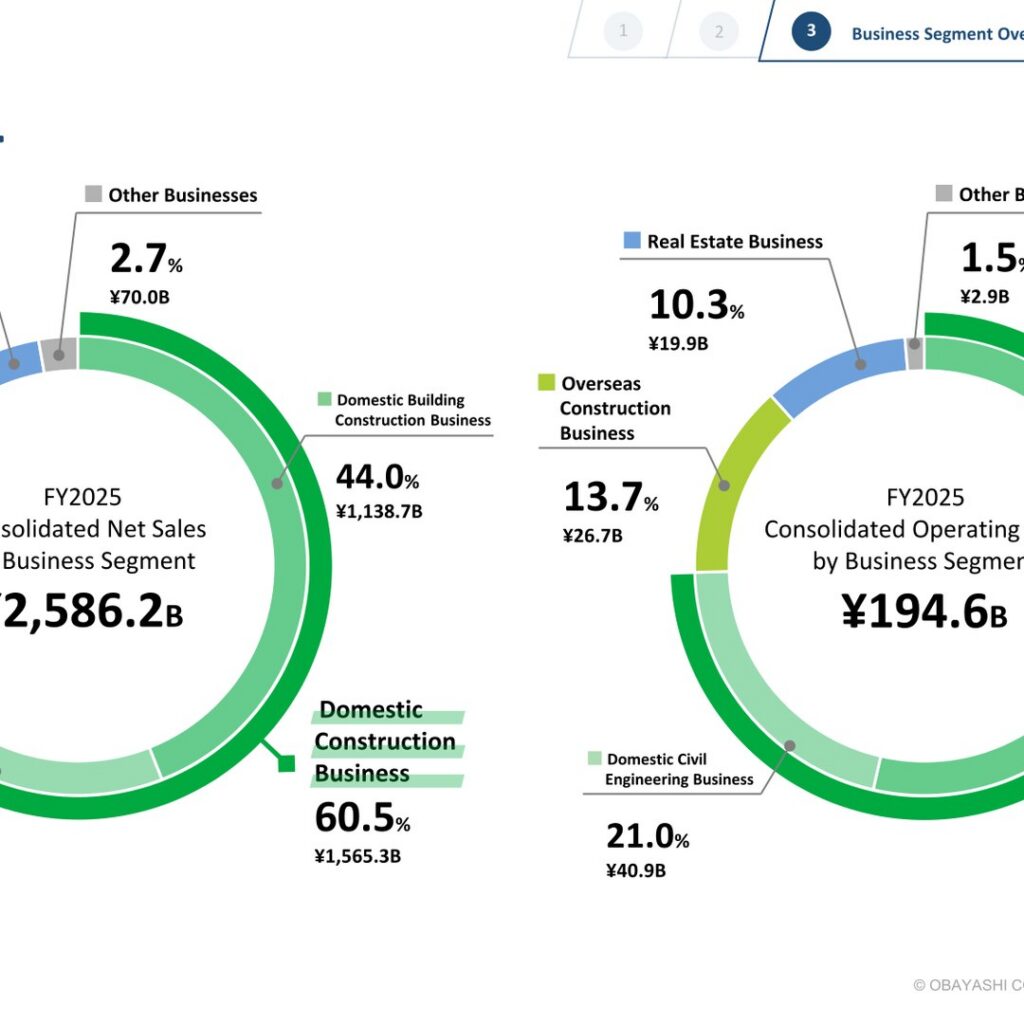
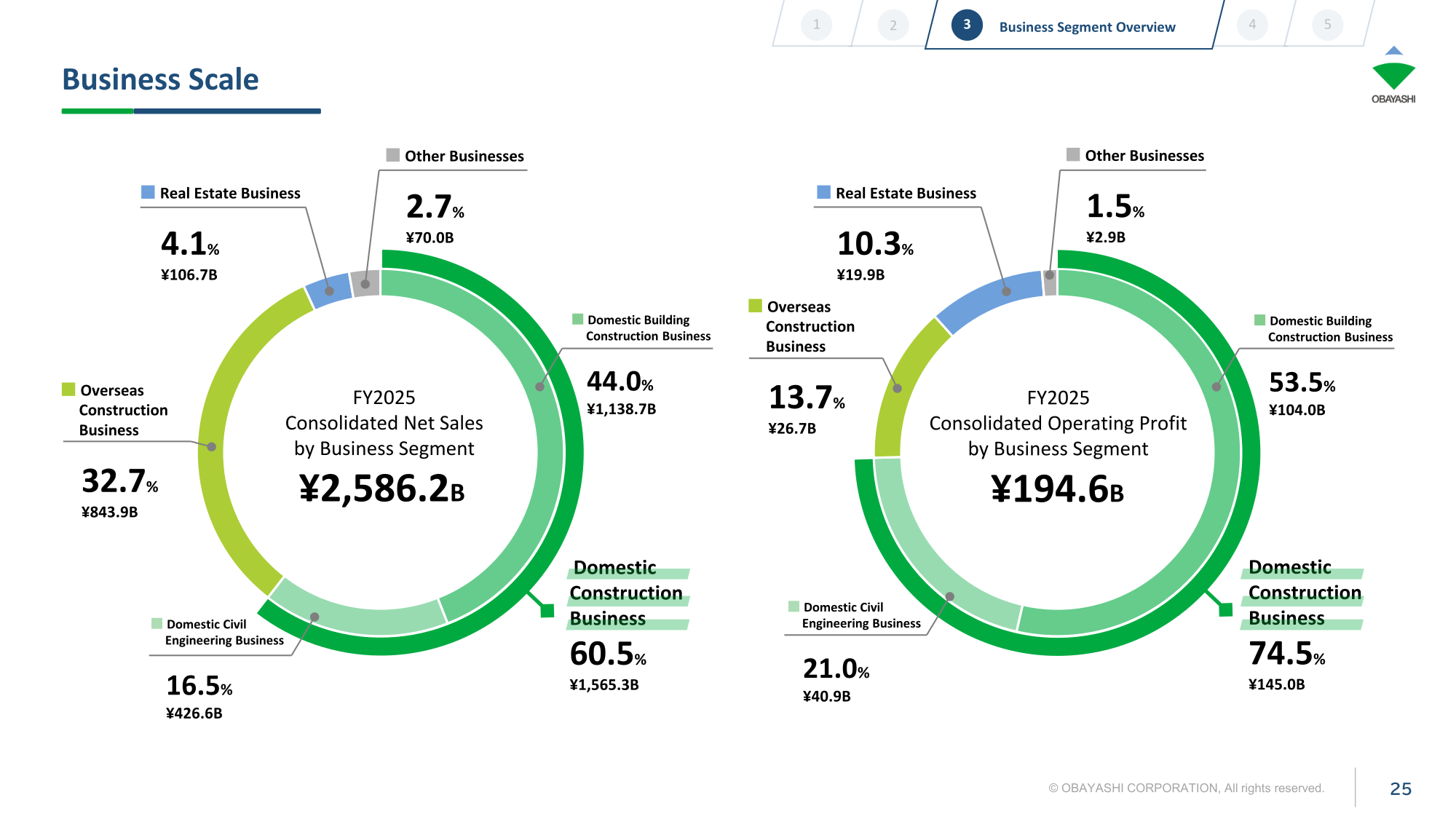
In FY2025, consolidated net sales of ¥2,586.2 billion broke down as domestic building construction at 44.0% (¥1,138.7 billion), domestic civil engineering at 16.5% (¥426.6 billion), overseas construction at 32.7% (¥843.9 billion), the real estate business at 4.1% (¥106.7 billion), and other businesses at 2.7% (¥70.0 billion). Taken together, domestic construction accounts for 60.5% of sales — a majority, but not an overwhelming one. Roughly a third of the top line now comes from overseas.
The profit picture, however, looks quite different from the sales picture, and this gap is the single most useful thing to understand about Obayashi. Of the ¥194.6 billion in consolidated operating profit for FY2025, domestic construction generated 74.5% (¥145.0 billion) — domestic building alone contributed 53.5% (¥104.0 billion) and domestic civil engineering 21.0% (¥40.9 billion). Overseas construction, despite supplying 32.7% of sales, produced only 13.7% of operating profit (¥26.7 billion). The real estate business, at just 4.1% of sales, delivered 10.3% of operating profit (¥19.9 billion).
In other words, the group’s earnings power is concentrated in domestic construction, while the overseas business contributes volume at a much thinner margin, and real estate contributes profit out of proportion to its size. The FY2025 operating margins make the same point numerically: domestic building 9.1%, domestic civil engineering 9.6%, overseas building 2.4%, overseas civil engineering 4.4%, and the real estate business 18.7%.
As for competitive positioning, the presentation notes that the company is accumulating information on upcoming domestic building projects at a level exceeding ¥3 trillion through FY2029, while selecting projects carefully on the basis of construction capacity and supply chain considerations. It also states that annual domestic building construction capacity is approximately ¥1,200.0 billion. The materials describe this as a deliberate policy of receiving orders strategically in alignment with that capacity, rather than maximizing order volume.
2. The Most Important Points in This IR Material
Point 1: A large profit increase on flat sales
Consolidated net sales were essentially unchanged at ¥2,586.2 billion (down ¥4.5 billion, or 0.2%, year on year), yet operating profit rose ¥52.2 billion to ¥194.6 billion — a 36.6% increase. Profit attributable to owners of parent rose 19.5% to ¥173.7 billion. This matters because the improvement came from margin, not volume: consolidated gross profit margin expanded from 11.4% to 14.1%. Investors should look at where that margin came from and whether it is repeatable — a question the company itself answers, in part, in its FY2026 forecast.
Point 2: Orders fell 9.3%, and domestic building drove the decline
Consolidated orders received were ¥3,009.0 billion, down ¥307.5 billion year on year. Domestic building orders fell ¥353.6 billion to ¥1,200.9 billion, and overseas civil engineering fell ¥180.3 billion to ¥416.5 billion, partly offset by overseas building orders rising ¥311.0 billion to ¥788.1 billion. The company attributes the domestic building decline to comparison with FY2024, which benefited from large projects, and to its policy of receiving orders strategically in alignment with construction capacity. Investors should decide for themselves whether to read the decline as deliberate selectivity or as softening demand — the materials present it as the former.
Point 3: Management is guiding to lower profit in FY2026
Despite the FY2025 result, the company forecasts FY2026 operating profit of ¥180.0 billion (down 7.5%) and profit attributable to owners of parent of ¥157.0 billion (down 9.6%), even as net sales are forecast to grow 13.9% to ¥2,945.0 billion. The stated reason is a lower proportion of domestic building projects in the final stages of the construction period, which limits profit improvement from additional claim approvals, change orders, and construction cost reductions. This is the clearest signal in the document about the nature of FY2025’s profit.
Point 4: Every Medium-Term Business Plan 2022 KPI target was met in FY2025
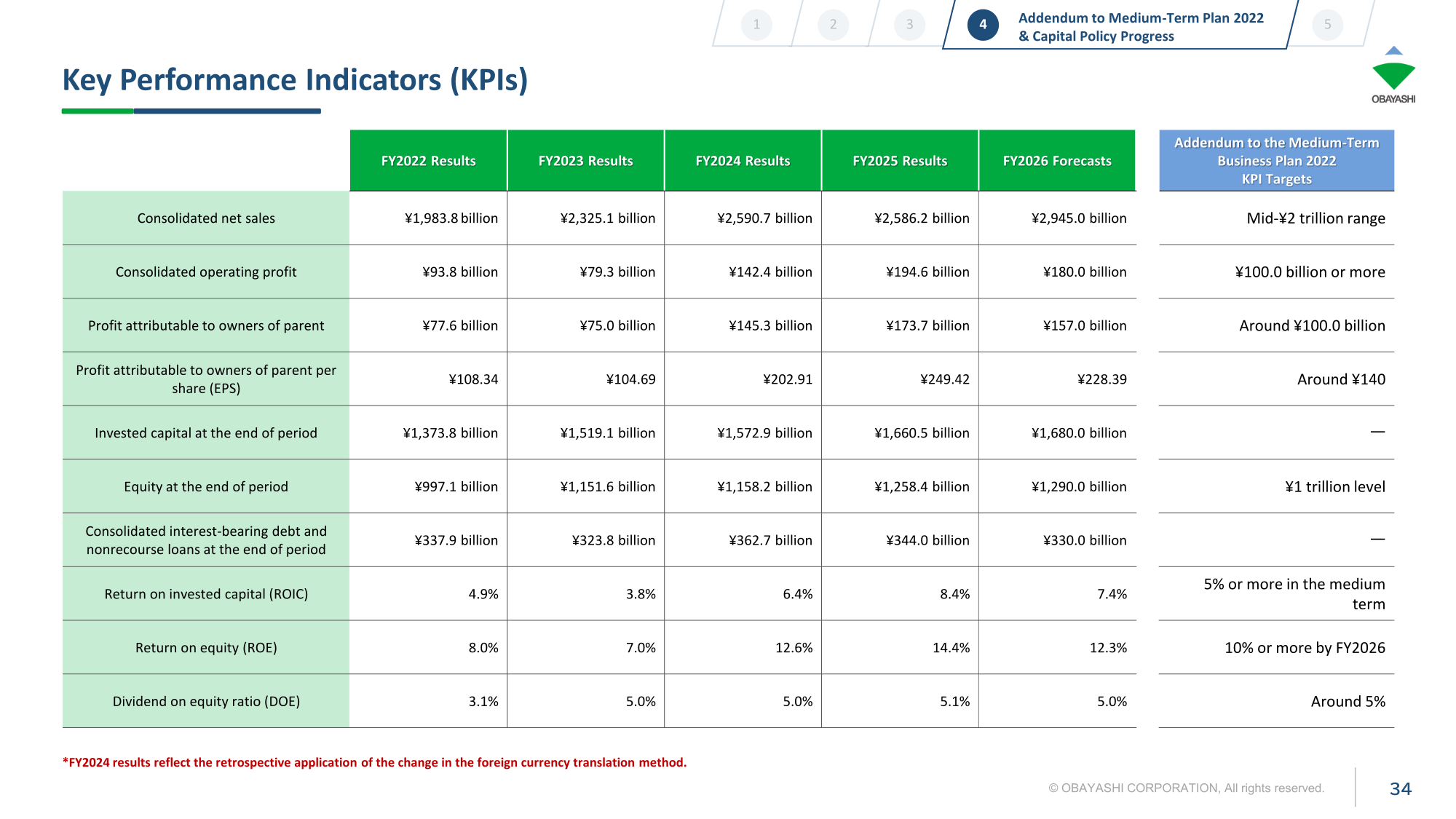
Against the KPI targets set in the Addendum to the Medium-Term Business Plan 2022 (announced May 13, 2024), FY2025 delivered operating profit of ¥194.6 billion (target: ¥100.0 billion or more), profit of ¥173.7 billion (target: around ¥100.0 billion), EPS of ¥249.42 (target: around ¥140), equity of ¥1,258.4 billion (target: ¥1 trillion level), ROIC of 8.4% (target: 5% or more in the medium term), ROE of 14.4% (target: 10% or more by FY2026), and DOE of 5.1% (target: around 5%). The plan runs through FY2026, so investors should watch for what replaces these targets.
Point 5: Shareholder returns and cross-shareholding reduction are both in progress
The company is executing treasury share purchases totaling ¥100.0 billion scheduled through the end of FY2026, of which ¥30.0 billion was purchased by the end of June 2025 and ¥40.0 billion by the end of December 2025, with the remaining ¥30.0 billion scheduled during FY2026. Cross-shareholdings stood at ¥288.8 billion at the end of March 2026 — equivalent to 21.9% of consolidated net assets — against a target of 20% or less by the end of March 2027.
3. Business Performance
FY2025 consolidated results were net sales of ¥2,586.2 billion (down 0.2% year on year), operating profit of ¥194.6 billion (up 36.6%), ordinary profit of ¥204.1 billion (up ¥51.9 billion), and profit attributable to owners of parent of ¥173.7 billion (up 19.5%). Against the full-year forecast revised on February 9, 2026, net sales came in ¥16.2 billion above plan and operating profit ¥0.3 billion below it — essentially in line.
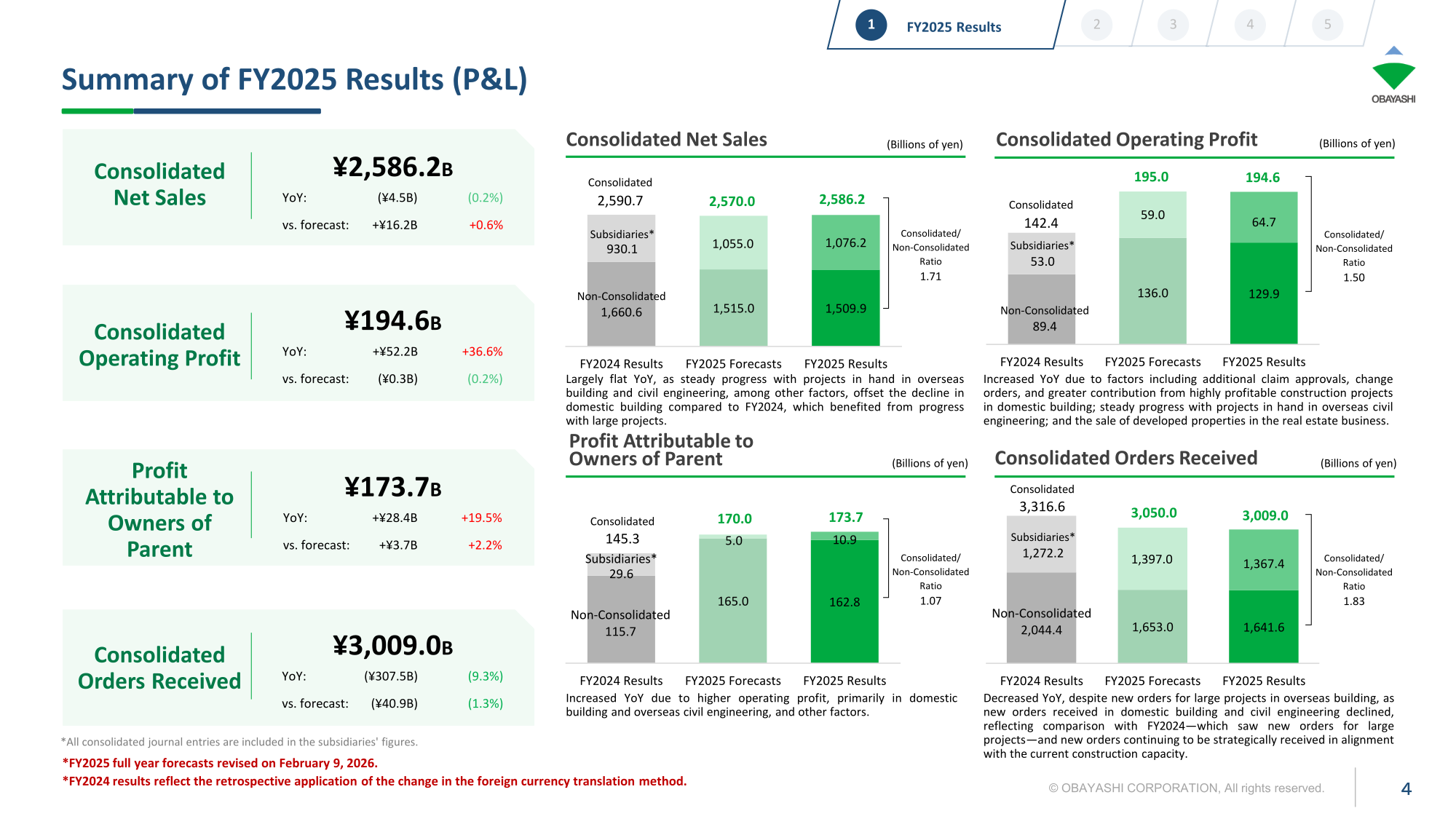
The flat top line conceals a substantial mix shift. Net sales of completed construction contracts in building fell ¥168.2 billion to ¥1,646.7 billion, while civil engineering rose ¥109.9 billion to ¥762.6 billion and the real estate business and other rose ¥53.8 billion to ¥176.8 billion. Within building, the decline was domestic: domestic building sales fell ¥198.4 billion to ¥1,138.7 billion, while overseas building sales rose ¥30.1 billion to ¥507.9 billion.
The profit growth is best understood segment by segment. Domestic building operating profit rose ¥41.3 billion to ¥104.0 billion, with the operating margin nearly doubling from 4.7% to 9.1% — and this happened while sales fell ¥198.4 billion. Overseas civil engineering operating profit rose ¥6.7 billion to ¥14.7 billion (margin 3.2% to 4.4%), the real estate business rose ¥3.9 billion to ¥19.9 billion, and domestic civil engineering was roughly flat at ¥40.9 billion. Overseas building was the one segment to decline, slipping ¥0.8 billion to ¥11.9 billion as its margin narrowed from 2.7% to 2.4%.
On the causes, the company is explicit, and the distinction between temporary and structural factors is worth drawing carefully. The year-on-year operating profit bridge attributes the increase to additional claim approvals, change orders, and a greater contribution from highly profitable construction projects in domestic building (+¥63.1 billion in gross profit terms, against −¥17.5 billion from lower completed-construction sales); steady progress with projects in hand at the overseas civil engineering subsidiaries (+¥15.0 billion); and the sale of developed properties in the real estate business in the second quarter (+¥6.0 billion). Working against these were higher SG&A expenses — personnel and advertising — of ¥9.0 billion non-consolidated and ¥8.0 billion at subsidiaries.
Several of these are, by their nature, not recurring at the same scale. Additional claim approvals and change orders arise as projects reach their final stages, and the sale of developed properties is a discrete event. The company’s own FY2026 guidance confirms this reading: it expects a lower proportion of domestic building projects in the final stages of the construction period, and forecasts domestic building operating profit to fall ¥22.0 billion to ¥82.0 billion with the margin easing from 9.1% to 6.8%. Also worth noting on the negative side, the comparison against the FY2025 forecast records a provision for loss on construction contracts in domestic civil engineering (−¥1.4 billion) and weaker-than-expected profit improvement in non-consolidated civil engineering for final-stage projects (−¥4.5 billion).
Financially, the position strengthened. Consolidated equity rose ¥100.1 billion to ¥1,258.4 billion, interest-bearing debt and nonrecourse loans fell ¥18.6 billion to ¥344.0 billion, ROIC improved 200 basis points to 8.4%, and ROE improved 180 basis points to 14.4%. Operating cash flow was ¥252.9 billion and free cash flow ¥168.5 billion, with cash and cash equivalents ending at ¥416.0 billion, up ¥35.8 billion.
4. Growth Strategy and Medium-Term Focus
The framework here is the Medium-Term Business Plan 2022 and its Addendum, announced on May 13, 2024. The Addendum sets out three directions: continuing thorough measures to strengthen the foundations of the construction business, a partial revision of performance indicator targets, and additional measures to accelerate transformation for sustainable growth. On the first, the presentation is unusually direct — it states that serious accidents have not been eradicated, and that securing safety and quality will be reaffirmed as a top management priority across the group and its supply chain.
The stated direction of the sustainable growth strategy is to position the domestic construction business as the core operation while strengthening other businesses to generate performance that equals or exceeds it. Given the profit concentration described in Section 1 — domestic construction at 74.5% of operating profit — this is a substantial ambition rather than a marginal adjustment.
On investment, the plan for FY2022–FY2026 totals ¥750.0 billion, of which ¥656.6 billion had been invested through FY2025, with ¥188.0 billion planned for FY2026 — an outlook of ¥844.6 billion, which the company expects to exceed the plan. The largest line is the real estate development business at ¥300.0 billion planned against ¥290.6 billion already invested. Other lines include technology-related investment (¥100.0 billion planned), DX-related investment (¥90.0 billion), M&A, capital tie-ups and VC (¥95.0 billion, against ¥88.6 billion invested), construction machinery and business facilities (¥75.0 billion), green energy (¥60.0 billion), and human resource-related investment (¥30.0 billion).
Two concrete moves appear under other topics. The company will acquire shares in PT JTD JAYA PRATAMA, which holds the concession rights to an approximately 31 km toll road crossing central Jakarta with a total project cost of approximately ¥213.0 billion, through PT Obayashi Concession Indonesia — a local subsidiary to be jointly established with PT. JAYA OBAYASHI, scheduled for establishment on July 31, 2026. The share transfer agreement is dated August 25, 2026, with the first acquisition scheduled for September 14, 2026 (12.5% stake) and the second in December 2027 (48.8%), each subject to conditions including approval by the Indonesian authorities and completion of land acquisition. Separately, the company has established a Business Process Re-design Department under the Corporate Strategy Division to redesign business processes and data for AI utilization, aiming at productivity improvement and the maximization of organizational knowledge.
On market environment, the materials describe domestic building demand as supported by the return of production bases to Japan and continued large-scale urban redevelopment, though with some project cancellations and postponements. Domestic civil engineering is described as firm in disaster prevention and national resilience, with anticipated growth in defense-related facility projects, while competition for government works remains intense because contracts are awarded through bidding in principle. In North America, projects delayed by financing conditions are showing signs of recovery following the 2025 interest rate cuts, though the company notes it is closely monitoring receding expectations for further cuts amid inflation concerns. Growth is expected in the North American semiconductor and data center sectors, where GCON — acquired in FY2025 and now a consolidated subsidiary — has strengths.
Regarding capital policy, the company sets a necessary equity level for each business and controls equity through profit generation and strategic shareholder returns, with an ROE target of 10% or more against a stock-market-expected cost of shareholders’ equity of 8–9%. FY2025 delivered ROE of 14.4% against equity of ¥1,258.4 billion, maintaining a positive equity spread. The shareholder return policy prioritizes stable dividends over the long term, using DOE of around 5% as the basis for ordinary dividends and delivering additional returns flexibly. Dividends per share were ¥88 for FY2025 with ¥94 forecast for FY2026, and the company notes it has paid dividends for over 10 years without reduction. The FY2025 dividend payout ratio was 35.3% and the total payout ratio 68.5%.
The KPIs the company itself emphasizes are consolidated net sales, operating profit, profit attributable to owners of parent, EPS, equity, ROIC, ROE, and DOE.
5. Key Points for Investors
Strengths
The clearest strength is demonstrated pricing and project selectivity in domestic building: the segment lifted operating profit ¥41.3 billion and nearly doubled its margin from 4.7% to 9.1% while sales fell ¥198.4 billion. Profitability and capital efficiency both stand well above the medium-term targets — ROE of 14.4% against a 10% target and a cost of equity the company puts at 8–9%, and ROIC of 8.4% against a 5% target. The balance sheet strengthened, with equity up ¥100.1 billion to ¥1,258.4 billion and interest-bearing debt down ¥18.6 billion. Free cash flow of ¥168.5 billion comfortably covered the ¥58.0 billion of treasury share purchases and ¥57.7 billion of dividends paid in the period. Overseas civil engineering is improving from a low base, with operating profit up 84.5% to ¥14.7 billion. And the real estate business, though small, earns an 18.7% operating margin.
Concerns
The company itself guides to lower profit in FY2026 — operating profit down 7.5% and net profit down 9.6% — because fewer domestic building projects will be in the final stages of construction, which is a direct statement that a meaningful share of FY2025’s profit reflected project timing. Orders fell 9.3% overall, with domestic building down ¥353.6 billion, and the company’s approximate ¥1,200.0 billion annual domestic building capacity acts as a ceiling on how much of the stated ¥3 trillion project pipeline it can convert. Overseas construction remains a structural weak spot on profitability: 32.7% of sales for 13.7% of operating profit, with the overseas building margin narrowing to 2.4%. Earnings concentration in domestic construction (74.5% of operating profit) means a domestic downturn would be difficult to offset. The presentation itself flags that serious accidents have not been eradicated. Cross-shareholdings at 21.9% of consolidated net assets remain above the 20% target — and rose ¥15.2 billion year on year despite ¥66.0 billion of sales, because share prices climbed. Domestic civil engineering recorded a provision for loss on construction contracts. Finally, the Medium-Term Business Plan 2022 runs only through FY2026, and the presentation does not disclose what follows it.
Indicators to watch
The domestic building gross profit margin is the central number: on a non-consolidated basis it went from 9.1% in FY2024 to 14.9% in FY2025, with 13.0% forecast for FY2026. Whether it holds near that level or reverts toward historical norms will largely determine the earnings trajectory. Alongside it, watch domestic building orders against the ~¥1,200.0 billion capacity (FY2026 forecast: ¥1,240.0 billion non-consolidated); whether overseas building profitability turns — the FY2026 forecast has the margin narrowing further, from 2.4% to 1.8%, even as segment sales grow 35.8% to ¥690.0 billion; the remaining ¥30.0 billion of treasury share purchases scheduled in FY2026; progress on reducing cross-shareholdings to 20% or less by the end of March 2027; whether ROE holds above the 10% target as it steps down to a forecast 12.3%; the establishment of PT Obayashi Concession Indonesia on July 31, 2026 and the first Jakarta share acquisition scheduled for September 14, 2026; and any announcement of the successor to the Medium-Term Business Plan 2022.
6. Summary
FY2025 was, on the reported numbers, an unusually strong year for Obayashi: operating profit up 36.6% to ¥194.6 billion and net profit up 19.5% to ¥173.7 billion on essentially flat sales, with every Medium-Term Business Plan 2022 KPI target cleared and ROE reaching 14.4%. The quality of that result rests on domestic building, where the operating margin nearly doubled to 9.1% even as sales fell.
What gives the picture its shape is that the company does not present this level as the new baseline. It forecasts FY2026 operating profit down 7.5% to ¥180.0 billion, explicitly because fewer domestic building projects will be in the final stages of construction — the very phase that produced FY2025’s additional claim approvals and change orders. Sales are forecast to grow 13.9% at the same time, so the guidance describes a year of more volume at lower margin. Even so, the forecast still clears the medium-term targets: ¥180.0 billion against a ¥100.0 billion operating profit target, and ROE of 12.3% against 10%.
For investors following the company, three threads run through the materials and are worth tracking together: whether domestic building margins settle at a structurally higher level than the pre-FY2024 period or revert; whether the overseas business — a third of sales for an eighth of profit — can be made to earn its keep, with the North American semiconductor and data center exposure through GCON as the near-term test; and how the company chooses to allocate capital as the Medium-Term Business Plan 2022 reaches its final year, with ¥30.0 billion of treasury share purchases still scheduled, cross-shareholdings still above target, and no successor plan yet disclosed in this document.
※This article is an analysis based on publicly available information and is not a recommendation to buy or sell any particular security. Please make investment decisions at your own responsibility.
![[Obayashi] Capital Policy & Shareholder Returns — ROE 10%+, DOE ~5%, ¥100bn Buyback](https://japan-equity.com/wp-content/uploads/2026/07/p27_sq-768x768.jpg)
![[Obayashi] Reducing Cross-Shareholdings — ¥285.2bn Sold in Five Years](https://japan-equity.com/wp-content/uploads/2026/07/p29_sq-768x768.jpg)
![[Obayashi] ¥750bn Investment Plan — ¥300bn to Development, ¥190bn to Tech/DX](https://japan-equity.com/wp-content/uploads/2026/07/p30_sq-768x768.jpg)
![[Obayashi] IR & SR Policy — Feeding Dialogue Back into Management](https://japan-equity.com/wp-content/uploads/2026/07/p32_sq-768x768.jpg)
![[Obayashi] Financial Data — Operating Profit ¥194.6bn, ROE 14.4%, Five-Year Track](https://japan-equity.com/wp-content/uploads/2026/07/p34_sq-768x768.jpg)
![[Obayashi] Investors’ Guide 2026 — The Complete 24-Article Breakdown](https://japan-equity.com/wp-content/uploads/2026/07/hub_cover-1024x1024.png)
![[Obayashi] IR & SR Policy — Feeding Dialogue Back into Management](https://japan-equity.com/wp-content/uploads/2026/07/p32_sq-1024x1024.jpg)
![[Obayashi] Real Estate Development — 18.7% Margin, ¥287.7bn Unrealized Gains](https://japan-equity.com/wp-content/uploads/2026/07/p20_sq-1024x1024.jpg)
![[Obayashi] Domestic Civil Engineering — Resilience Spending Supports 9.6% Margin](https://japan-equity.com/wp-content/uploads/2026/07/p11_sq-1024x1024.jpg)
![[Obayashi] Share Price & External Ratings — vs TOPIX, ESG Index Inclusion](https://japan-equity.com/wp-content/uploads/2026/07/p40_sq-1024x1024.jpg)
![[Construction] ¥75.5tn Investment, Shrinking Workforce — Big-5 Market Share](https://japan-equity.com/wp-content/uploads/2026/07/p12_sq-1024x1024.jpg)
![[Obayashi] Capital Policy & Shareholder Returns — ROE 10%+, DOE ~5%, ¥100bn Buyback](https://japan-equity.com/wp-content/uploads/2026/07/p27_sq-1024x1024.jpg)
![[Obayashi] Reducing Cross-Shareholdings — ¥285.2bn Sold in Five Years](https://japan-equity.com/wp-content/uploads/2026/07/p29_sq-1024x1024.jpg)
![[Obayashi] ¥750bn Investment Plan — ¥300bn to Development, ¥190bn to Tech/DX](https://japan-equity.com/wp-content/uploads/2026/07/p30_sq-1024x1024.jpg)
![[Obayashi] MTP2022 KPIs — Operating Profit ~2x Target, ROE 14.4%](https://japan-equity.com/wp-content/uploads/2026/07/p25_sq-1024x1024.jpg)
![[Obayashi] Cash Allocation — ¥420bn Investment CF Over Five Years](https://japan-equity.com/wp-content/uploads/2026/07/p26_sq-1024x1024.jpg)
![[Obayashi] Green Energy — 44 Plants, 344MW, and the Green Hydrogen Challenge](https://japan-equity.com/wp-content/uploads/2026/07/p21_sq-1024x1024.jpg)
![[Obayashi] Tackling the Labor Shortage — Robotics Construction®](https://japan-equity.com/wp-content/uploads/2026/07/p14_sq-1024x1024.jpg)
