
This article is based on publicly available IR materials and is not a recommendation to buy or sell any specific securities.
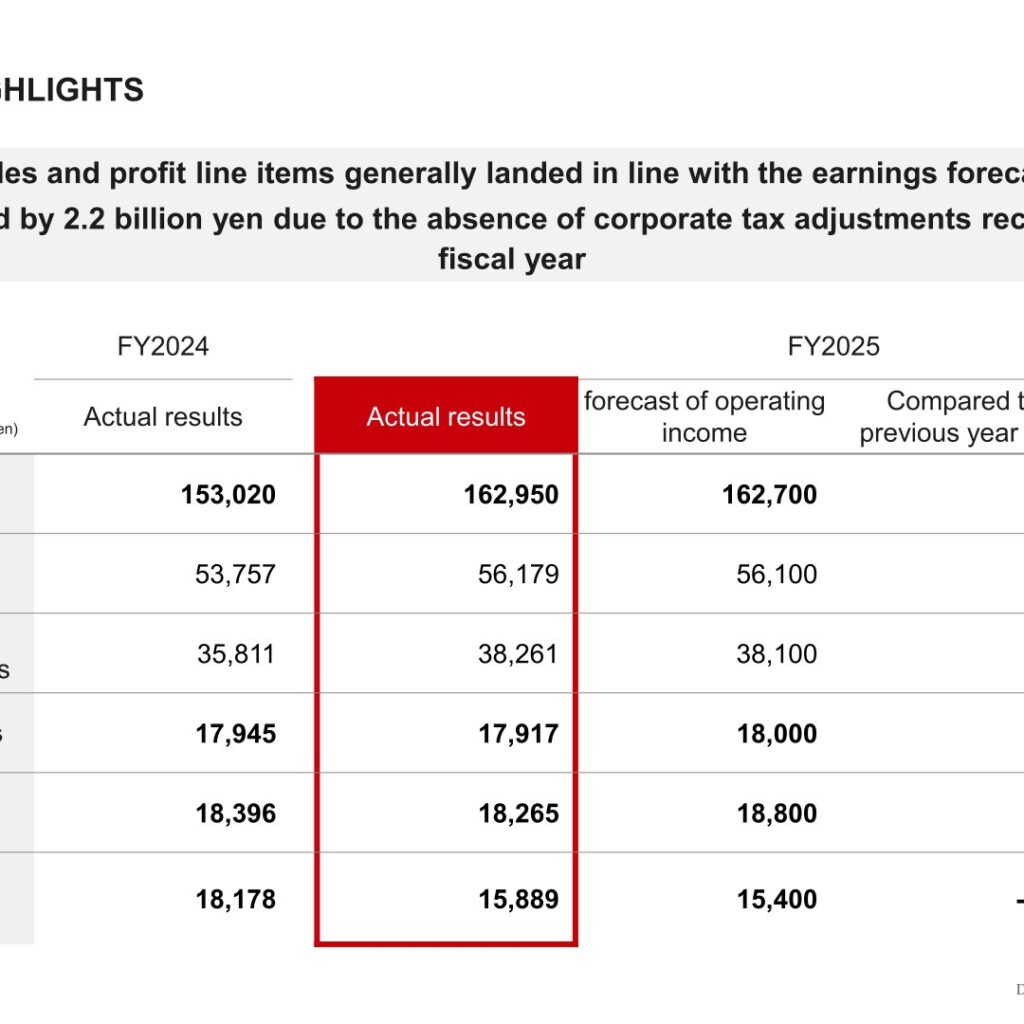
DAIICHIKOSHO CO., LTD. reported results for the fiscal year ended March 2026, which the company labels FY2025. Net sales rose 6.5% year on year to 162,950 million yen, a record high, driven by the launch of the new flagship karaoke system “LIVE DAM WAO!” in April 2025 and strong performance at karaoke stores. Operating profit was roughly flat at 17,917 million yen (-0.2%) as SG&A expenses increased on new product promotion costs, personnel costs and head office relocation expenses, while profit attributable to owners of parent fell 12.6% to 15,889 million yen due to the absence of the deferred tax asset increase recorded in the previous fiscal year. Sales and profit line items generally landed in line with the company’s earnings forecast.
Consolidated Results (Full-Year Actual)
On page 5 of the presentation, the company shows FY2025 actual results against FY2024 actuals and against its own forecast. Net sales of 162,950 million yen came in 0.2% above the 162,700 million yen forecast, and gross profit of 56,179 million yen was 0.1% above forecast. Selling, general and administrative expenses increased 6.8% to 38,261 million yen. Income from operations of 17,917 million yen was 0.5% below the 18,000 million yen forecast, and current profit of 18,265 million yen was 2.8% below the 18,800 million yen forecast. Profit attributable to owners of parent of 15,889 million yen was 3.2% above the 15,400 million yen forecast; the company notes net income decreased by 2.2 billion yen due to the absence of corporate tax adjustments recorded in the previous fiscal year.
| Item (million yen) | FY2025 Actual | FY2024 Actual | Forecast | Change vs. previous year (%) | Versus estimates (%) |
|---|---|---|---|---|---|
| Net sales | 162,950 | 153,020 | 162,700 | 6.5 | 0.2 |
| Gross Profit | 56,179 | 53,757 | 56,100 | 4.5 | 0.1 |
| Selling, general and administrative expenses | 38,261 | 35,811 | 38,100 | 6.8 | 0.4 |
| Income from Operations | 17,917 | 17,945 | 18,000 | -0.2 | -0.5 |
| Current Profit | 18,265 | 18,396 | 18,800 | -0.7 | -2.8 |
| Profit attributable to owners of parent | 15,889 | 18,178 | 15,400 | -12.6 | 3.2 |
On the balance sheet (page 11), total assets increased 5.3% to 220,445 million yen, with current assets up 14.3% to 77,209 million yen on higher cash and cash equivalents following the sale and disposal of owned real estate associated with the head office relocation. Current liabilities decreased 24.0% to 27,351 million yen on lower short-term borrowings and current portion of long-term debt, while non-current liabilities rose 22.1% to 67,744 million yen on an increase of long-term debt. Total net assets increased 6.4% to 125,349 million yen. On the cash flow statement (page 12), cash flow from operating activities was 25,096 million yen, cash flow from investment activities was -11,041 million yen and cash flow from financing activities was -7,196 million yen; free cash flow improved to 14,055 million yen from 13,210 million yen, and cash and cash equivalents at the end of the year rose to 48,475 million yen.
Segment Results
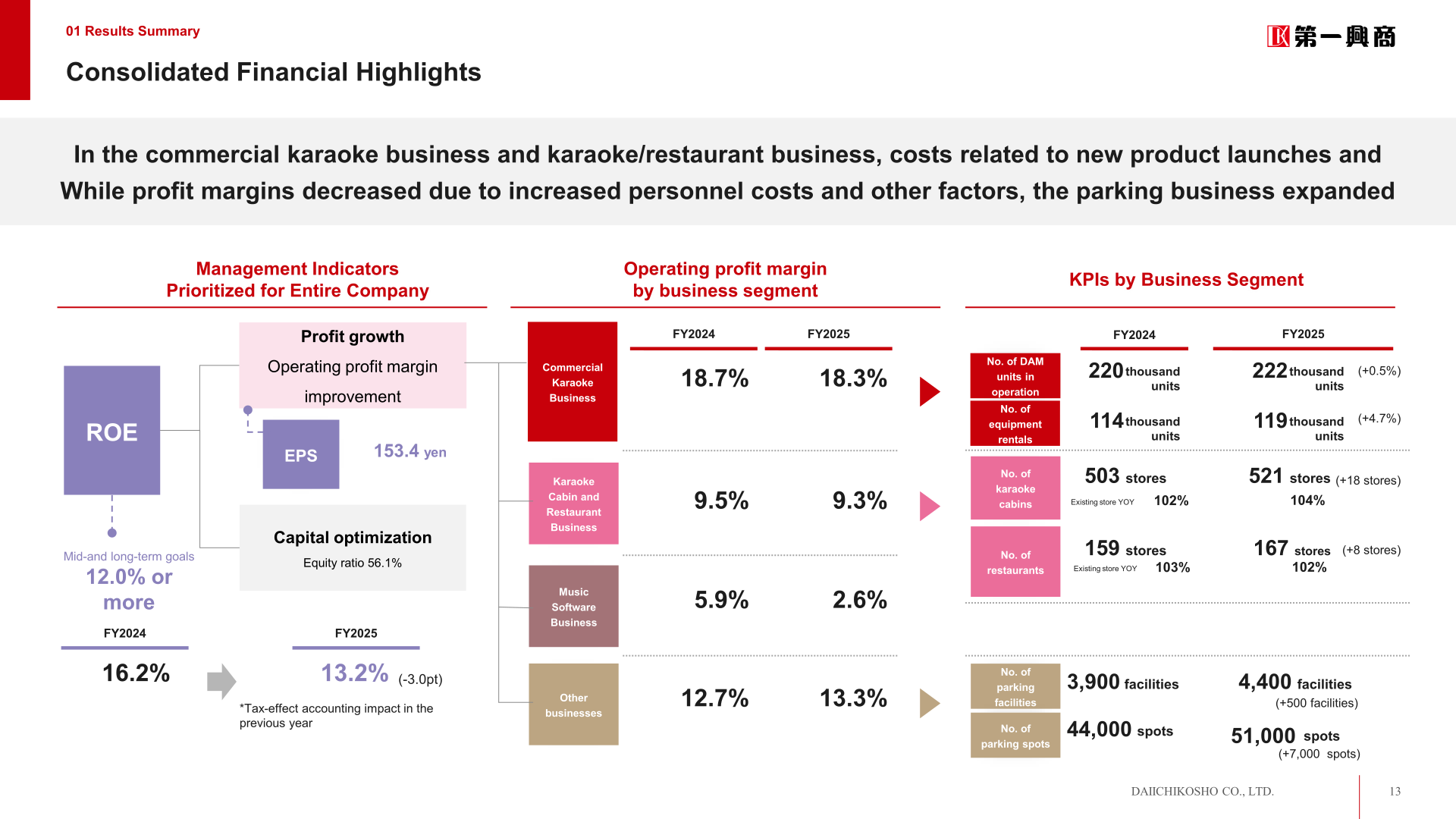
The company reports four business segments. On page 13, operating profit margin by business segment moved from 18.7% to 18.3% in the Commercial Karaoke Business, from 9.5% to 9.3% in the Karaoke Cabin and Restaurant Business, and from 5.9% to 2.6% in the Music Software Business, while Other businesses improved from 12.7% to 13.3%. The presentation explains that in the commercial karaoke business and the karaoke/restaurant business, costs related to new product launches, increased personnel costs and other factors reduced profit margins, while the parking business expanded.
Segment KPIs at fiscal year-end (pages 9 and 13): the number of DAM units in operation rose 0.5% from 220 thousand units to 222 thousand units, and the number of equipment rentals rose 4.7% from 114 thousand units to 119 thousand units. Karaoke cabins increased from 503 stores to 521 stores (+18 stores, including 16 stores acquired through M&A) and restaurants from 159 stores to 167 stores (+8 stores). Parking facilities increased from 3,900 facilities to 4,400 facilities (+500 facilities) and parking spots from 44,000 spots to 51,000 spots (+7,000 spots). Same-store sales for the year were +4% year on year for karaoke cabins and +2% for restaurants. For the whole company, ROE declined from 16.2% to 13.2% (-3.0pt), EPS was 153.4 yen and the equity ratio was 56.1%.
| Segment | Operating profit margin FY2024 | Operating profit margin FY2025 | FY2026 Forecast Net Sales | FY2026 Forecast Operating Income |
|---|---|---|---|---|
| Commercial Karaoke Business | 18.7% | 18.3% | 65,800 million yen (+0.8%) | 12,000 million yen (+0.6%) |
| Karaoke Cabin and Restaurant Business | 9.5% | 9.3% | 74,600 million yen (+5.1%) | 6,800 million yen (+2.5%) |
| Music Software Business | 5.9% | 2.6% | 5,400 million yen (-1.1%) | 250 million yen (+78.1%) |
| Other businesses | 12.7% | 13.3% | 22,900 million yen (+8.0%) | 2,850 million yen (+1.3%) |
FY2026 Forecast
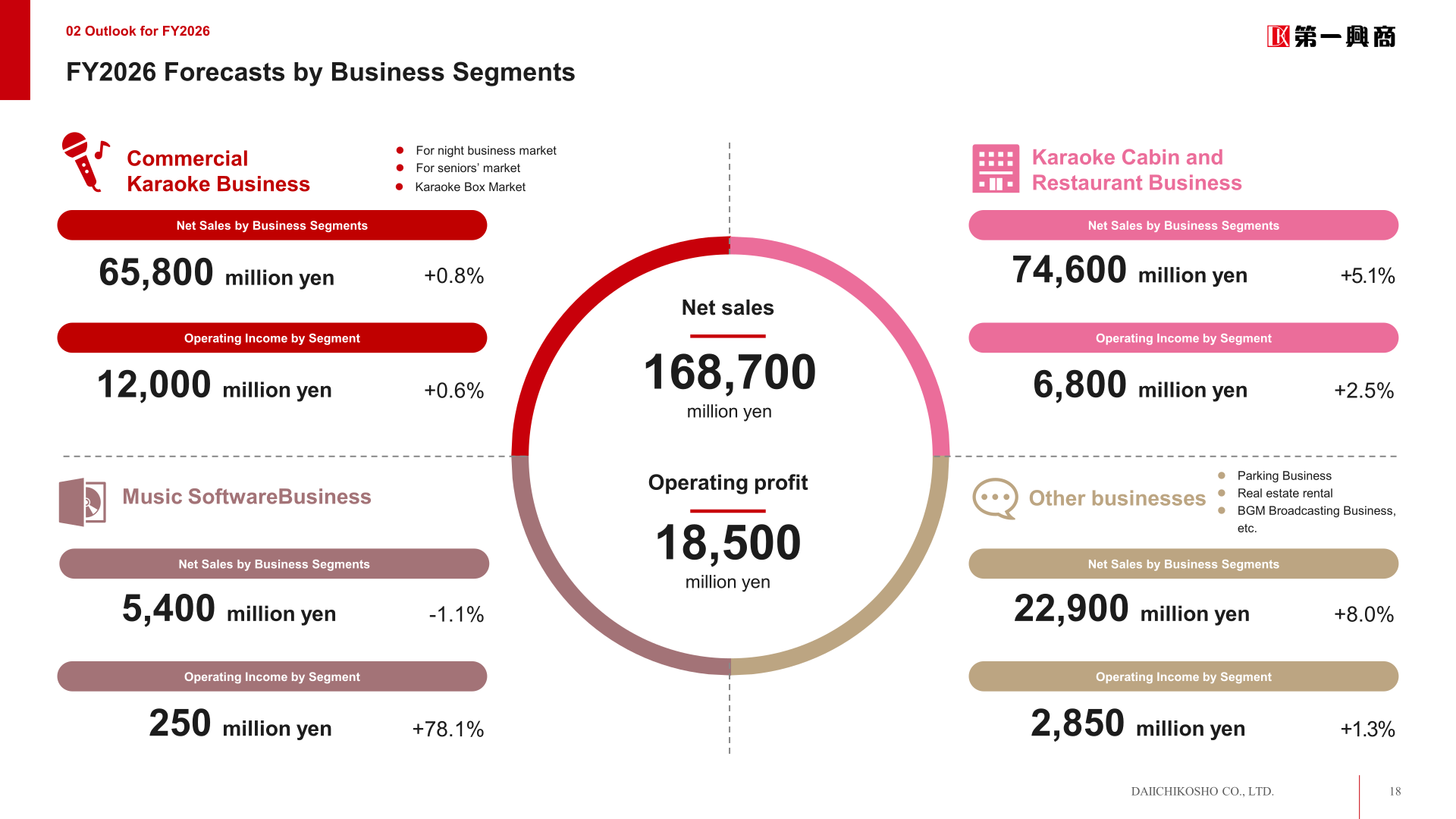
For FY2026, the company forecasts net sales of 168,700 million yen, up 3.5% or 5,749 million yen, and operating profit of 18,500 million yen, up 3.3% or 582 million yen, keeping the operating profit margin at 11.0%. Current profit is forecast at 18,900 million yen (+3.5%, +634 million yen). Profit attributable to owners of parent is forecast to fall 23.2%, or 3,689 million yen, to 12,200 million yen, because extraordinary gains such as the gain on sale of fixed assets will not recur. The presentation states that while product sales from the new product effect fall off, the company expects increased revenue and profit in each main business.
| Item (million yen) | FY2026 Forecast | FY2025 Actual | Compared to previous year (%) | Compared to previous year (amount) |
|---|---|---|---|---|
| Net sales | 168,700 | 162,950 | 3.5% | 5,749 |
| Operating profit | 18,500 | 17,917 | 3.3% | 582 |
| Operating profit margin (%) | 11.0% | 11.0% | — | — |
| Current Profit | 18,900 | 18,265 | 3.5% | 634 |
| Profit attributable to owners of parent | 12,200 | 15,889 | -23.2% | -3,689 |
On the FY2026 financial indicators plan (page 20), ROE is expected to decline from 13.2% to 9.7% (-3.5pt) and EPS to 118.0 yen, reflecting the disappearance of the gain on sale of property, plant and equipment. Segment KPI targets include DAM units in operation of 225 thousand units (+1.4%), equipment rentals of 123 thousand units (+2.9%), 530 karaoke cabins (+9 stores), 180 restaurants (+13 stores), and 4,900 parking facilities (+500 facilities) with 55,000 parking spots (+4,000 spots). Against its mid- to long-term ROE target of 12.0% or more, the company says it expects ROE to remain around 10% for the time being.
Shareholder Returns
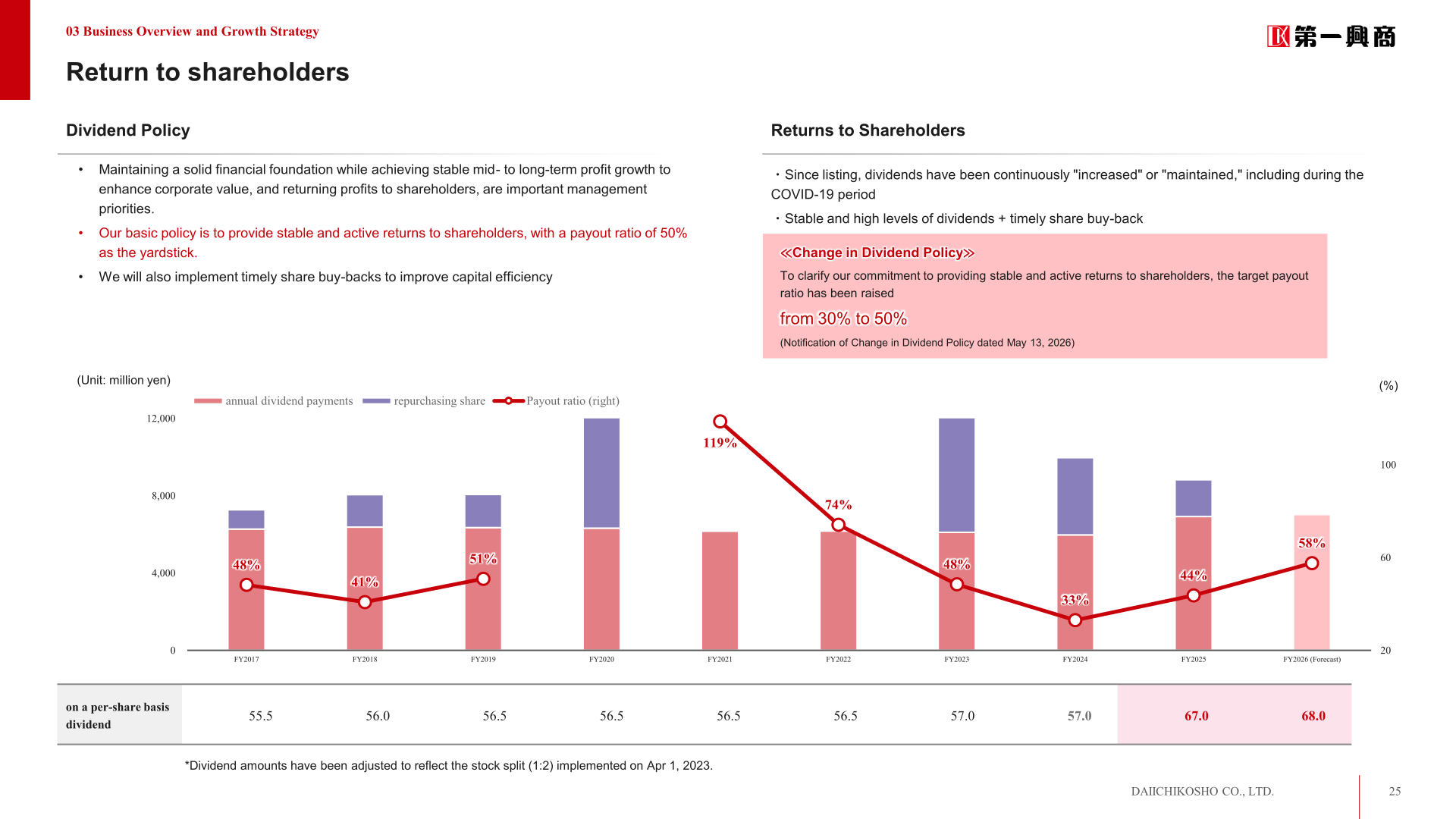
The company states that its basic policy is to provide stable and active returns to shareholders, with a payout ratio of 50% as the yardstick, and that it will also implement timely share buy-backs to improve capital efficiency. In a change in dividend policy announced on May 13, 2026, the target payout ratio was raised from 30% to 50%. The presentation notes that since listing, dividends have been continuously “increased” or “maintained,” including during the COVID-19 period. The dividend per share was 67.0 yen for FY2025, up from 57.0 yen in FY2024, and the FY2026 forecast is 68.0 yen. Dividend amounts have been adjusted to reflect the stock split (1:2) implemented on April 1, 2023.
| Item | FY2024 | FY2025 | FY2026 (Forecast) |
|---|---|---|---|
| Dividend per share | 57.0 yen | 67.0 yen | 68.0 yen |
Growth Strategy and Topics
In the Commercial Karaoke Business, the company is shifting from a conventional sales policy focused on “volume” (product shipments, units in operation and similar measures) to a policy emphasizing improved earnings per DAM unit. In the Karaoke Cabin and Restaurant Business, it will further promote a prime location strategy, opening stores in densely populated areas. The parking business is positioned as a third revenue stream, with net sales of 14.8 billion yen, 4,400 facilities and 51,000 parking spots, and the company aims to grow scale while improving profitability through improvement and consolidation of unprofitable facilities. On cash allocation, the company plans growth investment in existing businesses, returns to shareholders at a payout ratio of 50% plus timely share buy-backs, and a reduction of interest-bearing liabilities, with working capital of approximately 40.0 billion yen assumed to be compressed to about half in the next few years.
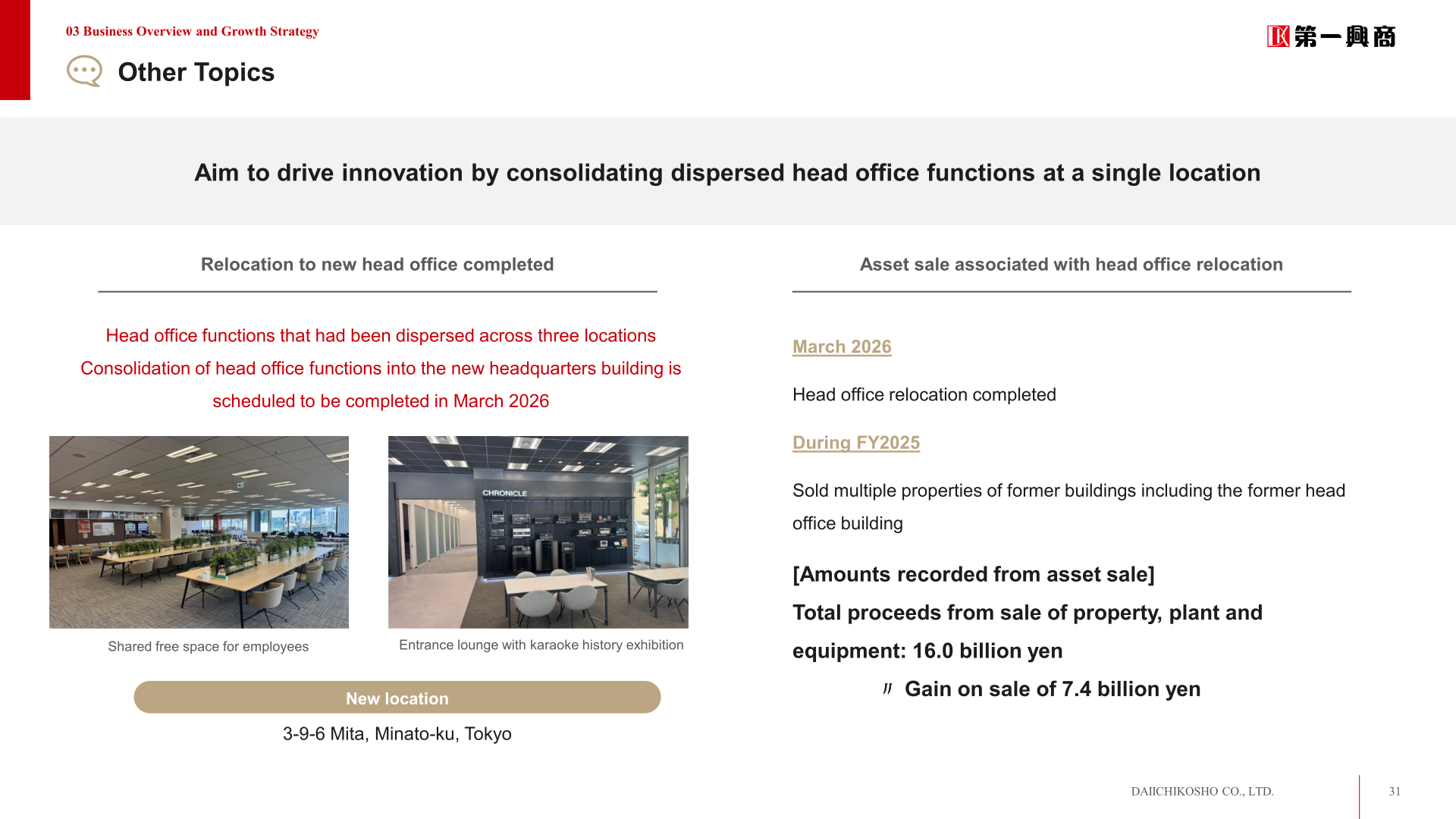
Head office functions that had been dispersed across three locations were consolidated into a new headquarters building at 3-9-6 Mita, Minato-ku, Tokyo, with the relocation completed in March 2026. During FY2025 the company sold multiple properties including the former head office building, recording total proceeds from the sale of property, plant and equipment of 16.0 billion yen and a gain on sale of 7.4 billion yen. The company also joined Toyota Woven City in Susono City, Shizuoka Prefecture as a new Inventor, launching a pilot project to explore the potential of song and music, starting with “Selection-less Karaoke.”
This article is an analysis based on publicly available information and is not a recommendation to buy or sell any specific securities. Investment decisions are your own responsibility.
![[Obayashi] Investors’ Guide 2026 — The Complete 24-Article Breakdown](https://japan-equity.com/wp-content/uploads/2026/07/hub_cover-1024x1024.png)
![[Obayashi] IR & SR Policy — Feeding Dialogue Back into Management](https://japan-equity.com/wp-content/uploads/2026/07/p32_sq-1024x1024.jpg)
![[Obayashi] Real Estate Development — 18.7% Margin, ¥287.7bn Unrealized Gains](https://japan-equity.com/wp-content/uploads/2026/07/p20_sq-1024x1024.jpg)
![[Obayashi] Domestic Civil Engineering — Resilience Spending Supports 9.6% Margin](https://japan-equity.com/wp-content/uploads/2026/07/p11_sq-1024x1024.jpg)
![[Obayashi] Share Price & External Ratings — vs TOPIX, ESG Index Inclusion](https://japan-equity.com/wp-content/uploads/2026/07/p40_sq-1024x1024.jpg)
![[Construction] ¥75.5tn Investment, Shrinking Workforce — Big-5 Market Share](https://japan-equity.com/wp-content/uploads/2026/07/p12_sq-1024x1024.jpg)
![[Obayashi] Capital Policy & Shareholder Returns — ROE 10%+, DOE ~5%, ¥100bn Buyback](https://japan-equity.com/wp-content/uploads/2026/07/p27_sq-1024x1024.jpg)
![[Obayashi] Reducing Cross-Shareholdings — ¥285.2bn Sold in Five Years](https://japan-equity.com/wp-content/uploads/2026/07/p29_sq-1024x1024.jpg)
![[Obayashi] ¥750bn Investment Plan — ¥300bn to Development, ¥190bn to Tech/DX](https://japan-equity.com/wp-content/uploads/2026/07/p30_sq-1024x1024.jpg)
![[Obayashi] MTP2022 KPIs — Operating Profit ~2x Target, ROE 14.4%](https://japan-equity.com/wp-content/uploads/2026/07/p25_sq-1024x1024.jpg)
![[Obayashi] Cash Allocation — ¥420bn Investment CF Over Five Years](https://japan-equity.com/wp-content/uploads/2026/07/p26_sq-1024x1024.jpg)
![[Obayashi] Green Energy — 44 Plants, 344MW, and the Green Hydrogen Challenge](https://japan-equity.com/wp-content/uploads/2026/07/p21_sq-1024x1024.jpg)
![[Obayashi] Tackling the Labor Shortage — Robotics Construction®](https://japan-equity.com/wp-content/uploads/2026/07/p14_sq-1024x1024.jpg)
