
This article is based on publicly available IR materials and is not a recommendation to buy or sell any specific securities.
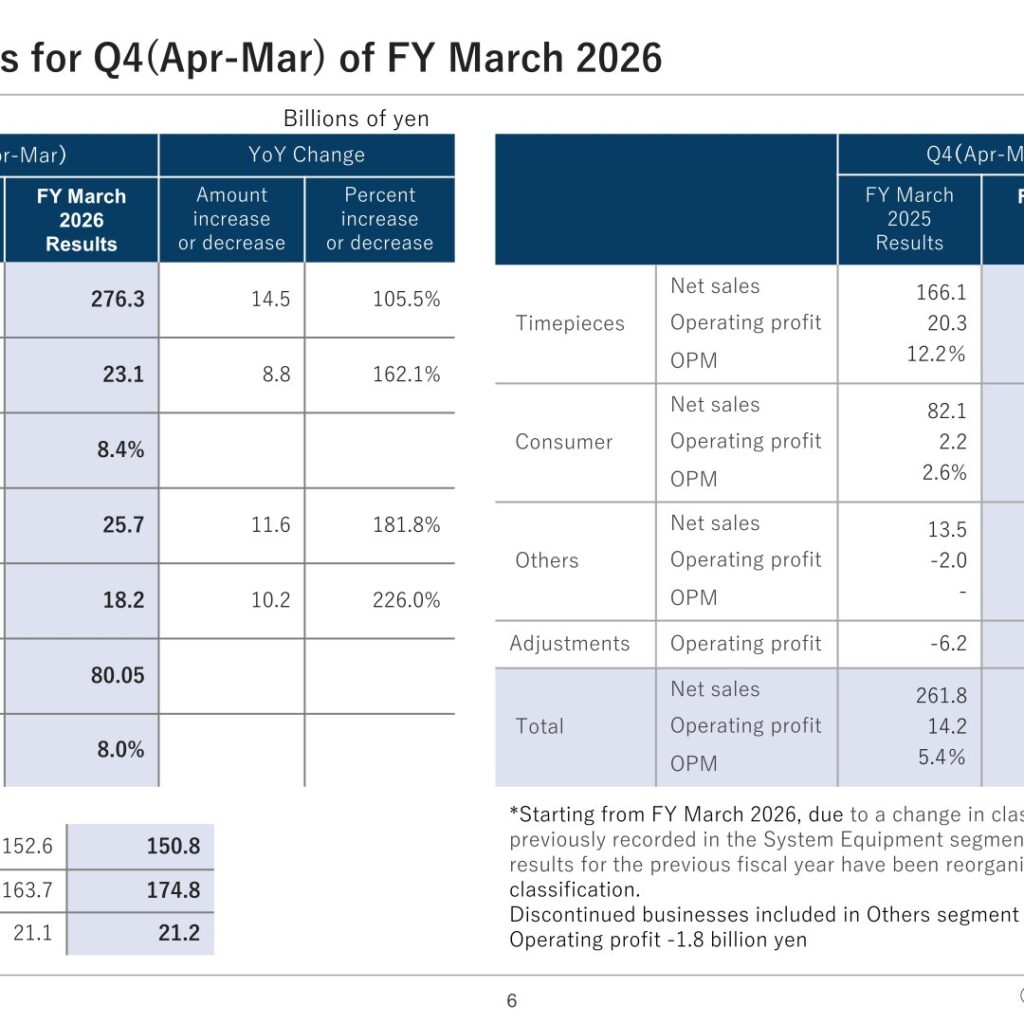
Note: Casio Computer Co., Ltd. labels the fiscal year ended March 31, 2026 as “FY March 2026” and the following year as “FY March 2027”; the text and tables below keep the company’s labels. For FY March 2026, Casio reported consolidated net sales of 276.3 billion yen (105.5% of the prior year), operating profit of 23.1 billion yen (162.1%), ordinary profit of 25.7 billion yen (181.8%) and profit attributable to owners of parent of 18.2 billion yen (226.0%). The operating profit margin improved from 5.4% to 8.4% and ROE rose from 3.6% to 8.0%. Alongside the results, the company announced a new Medium-Term Management Plan covering FY March 2027 to FY March 2029, targeting net sales of 315.0 billion yen, operating profit of 35.0 billion yen and ROE of over 10% in FY March 2029.
Consolidated Results (Full Year)
Full-year net sales rose 14.5 billion yen year on year to 276.3 billion yen, and operating profit increased 8.8 billion yen to 23.1 billion yen. Ordinary profit was 25.7 billion yen and profit attributable to owners of parent was 18.2 billion yen, with EPS of 80.05 yen (35.22 yen in the previous year). The results slightly exceeded the company’s published targets from January (net sales 274.0 billion yen, operating profit 22.0 billion yen, OPM 8.0%): actual OPM was 8.4%, ROE was 8.0% against a target of 7-8%, and ROIC was 5.9% against a target of approximately 6%. Average exchange rates for the full year were 150.8 yen to the U.S. dollar, 174.8 yen to the euro and 21.2 yen to the Chinese yuan. The company described the year as achieving a turnaround to a growth trajectory driven primarily by growth in the Timepiece Business and a steadily strengthening profit base. All amounts below are in billions of yen unless otherwise noted.
| Item | FY March 2026 | FY March 2025 | Change | YoY |
|---|---|---|---|---|
| Net sales | 276.3 | 261.8 | 14.5 | 105.5% |
| Operating profit | 23.1 | 14.2 | 8.8 | 162.1% |
| OPM | 8.4% | 5.4% | – | – |
| Ordinary profit | 25.7 | 14.1 | 11.6 | 181.8% |
| Profit attributable to owners of parent | 18.2 | 8.1 | 10.2 | 226.0% |
| EPS (yen) | 80.05 | 35.22 | – | – |
| ROE | 8.0% | 3.6% | – | – |
Segment Results
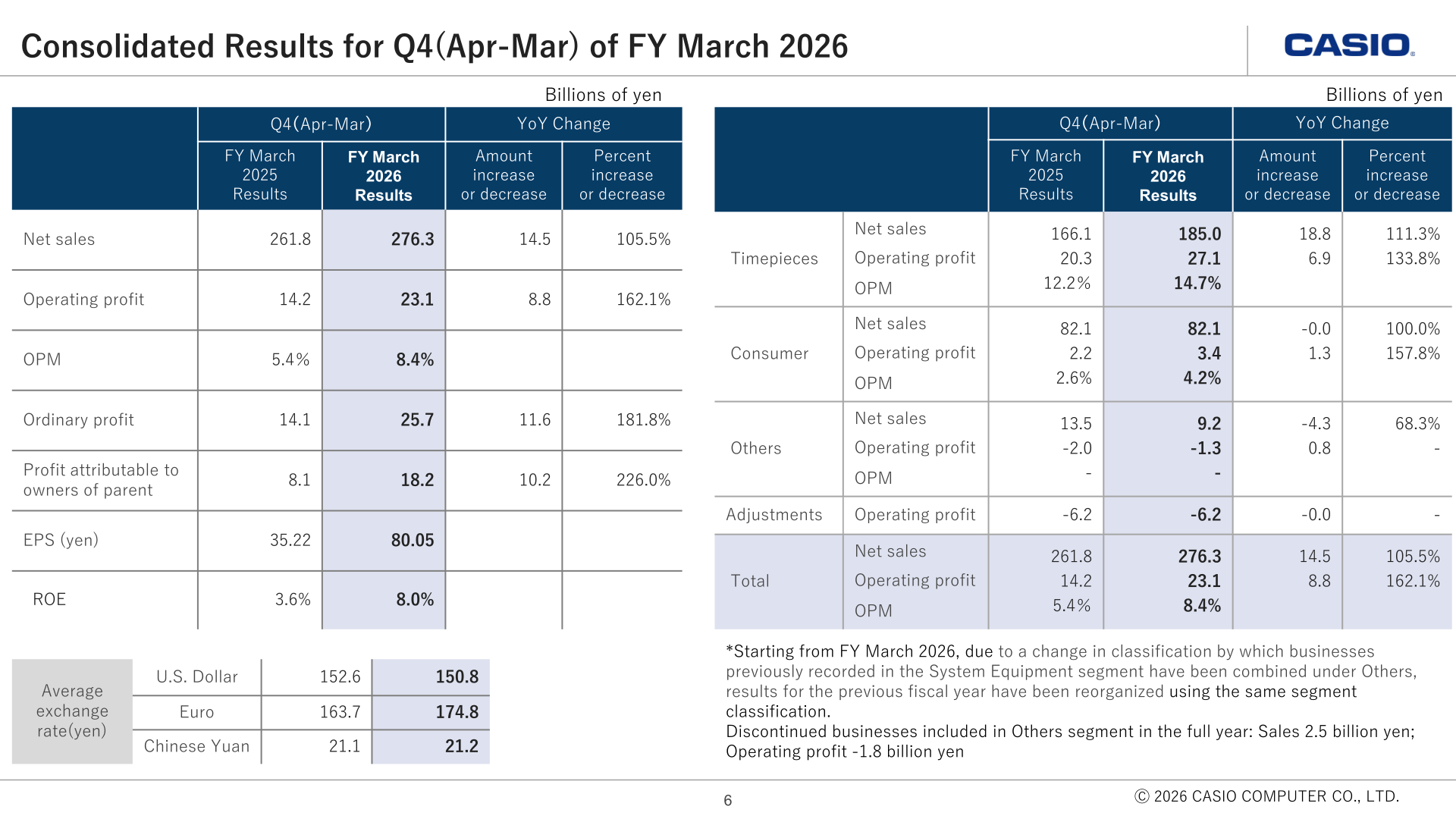
Starting from FY March 2026, due to a change in classification by which businesses previously recorded in the System Equipment segment have been combined under Others, results for the previous fiscal year have been reorganized using the same segment classification. Discontinued businesses included in the Others segment in the full year amounted to sales of 2.5 billion yen and operating profit of -1.8 billion yen. The Timepiece Business grew full-year net sales to 185.0 billion yen from 166.1 billion yen and operating profit to 27.1 billion yen from 20.3 billion yen, with OPM improving from 12.2% to 14.7%. Within the Consumer segment, the EdTech (Education) business posted full-year net sales of 61.0 billion yen with an OPM of 11.1%, while the Sound (Electronic Musical Instrument) business recorded net sales of 21.0 billion yen and an operating loss of 3.4 billion yen.
| Segment | Net sales (FY March 2026) | Operating profit (FY March 2026) | OPM (FY March 2026) | Net sales (FY March 2025) | Operating profit (FY March 2025) |
|---|---|---|---|---|---|
| Timepieces | 185.0 | 27.1 | 14.7% | 166.1 | 20.3 |
| Consumer | 82.1 | 3.4 | 4.2% | 82.1 | 2.2 |
| of which EdTech (Education) | 61.0 | 6.8 | 11.1% | – | – |
| of which Sound (Electronic Musical Instrument) | 21.0 | -3.4 | – | – | – |
| Others | 9.2 | -1.3 | – | 13.5 | -2.0 |
| Adjustments (operating profit) | – | -6.2 | – | – | -6.2 |
| Total | 276.3 | 23.1 | 8.4% | 261.8 | 14.2 |
In the Timepiece Business, fourth-quarter (January-March) sales remained strong and sales of G-SHOCK models were also on a recovery trend. Fourth-quarter sales by region rose 6% year on year overall in local currencies: Japan was up 11%, supported by G-SHOCK metal lines and demand from new students and new company hires; North America was up 10%, with the expanded CASIO WATCH lineup capturing new users; Europe was up 1%; China was down 3%, with both online and offline sales remaining weak despite signs of bottoming out; and Other regions were up 7%, driven by India, Vietnam and Indonesia. G-SHOCK unit sales in the fourth quarter were approximately 1.5 million units, of which approximately 150,000 units were BABY-G. In the EdTech (Education) business, sales of scientific calculators were largely in line with plan, while conditions for the Sound business remain challenging in Japan despite signs of a global bottoming-out.
New Medium-Term Management Plan (FY March 2027 to FY March 2029)
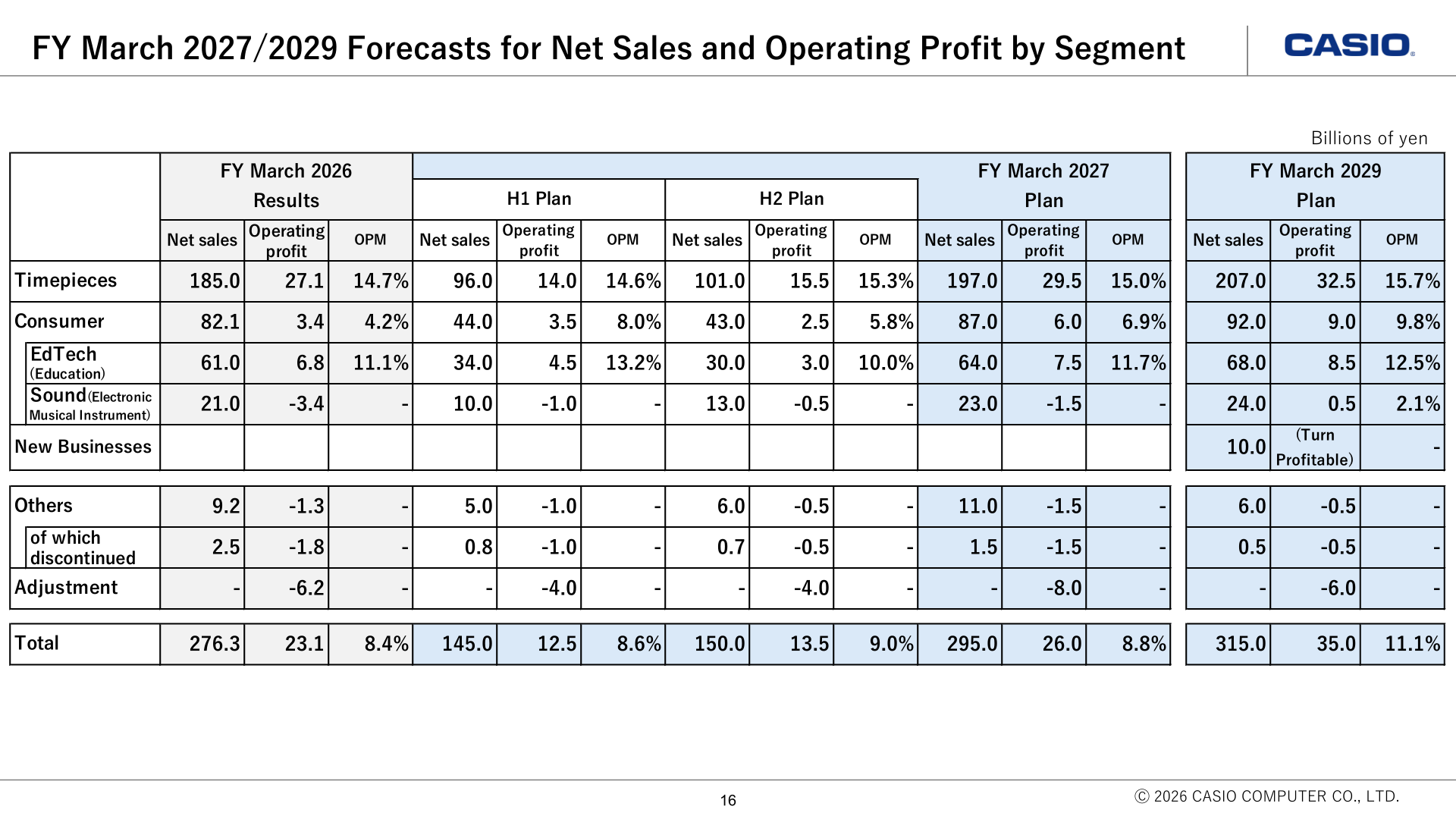
Under the new Medium-Term Management Plan, Casio aims to establish the foundation for sustainable growth by achieving steady business growth driven by core businesses and further reinforcing the profit base. For FY March 2027, the company plans net sales of 295.0 billion yen (first half 145.0 billion yen, second half 150.0 billion yen), operating profit of 26.0 billion yen (first half 12.5 billion yen, second half 13.5 billion yen), ordinary profit of 26.0 billion yen, profit attributable to owners of parent of 18.5 billion yen and EPS of 82.28 yen. The company notes that it plans to address the increased costs resulting from the situation in the Middle East and rising material prices by implementing price increases and other measures. For FY March 2029, the plan targets net sales of 315.0 billion yen, operating profit of 35.0 billion yen and an OPM of 11.1%.
| Item | FY March 2027 Plan | FY March 2029 Plan | FY March 2026 Results |
|---|---|---|---|
| Net sales | 295.0 | 315.0 | 276.3 |
| Operating profit | 26.0 | 35.0 | 23.1 |
| OPM | 8.8% | 11.1% | 8.4% |
| Ordinary profit | 26.0 | – | 25.7 |
| Profit attributable to owners of parent | 18.5 | – | 18.2 |
| EPS (yen) | 82.28 | – | 80.05 |
| Segment | FY March 2027 Plan: Net sales | FY March 2027 Plan: Operating profit | FY March 2029 Plan: Net sales | FY March 2029 Plan: Operating profit |
|---|---|---|---|---|
| Timepieces | 197.0 | 29.5 | 207.0 | 32.5 |
| Consumer | 87.0 | 6.0 | 92.0 | 9.0 |
| of which EdTech (Education) | 64.0 | 7.5 | 68.0 | 8.5 |
| of which Sound (Electronic Musical Instrument) | 23.0 | -1.5 | 24.0 | 0.5 |
| New Businesses | – | – | 10.0 | (Turn Profitable) |
| Others | 11.0 | -1.5 | 6.0 | -0.5 |
| Adjustment (operating profit) | – | -8.0 | – | -6.0 |
| Total | 295.0 | 26.0 | 315.0 | 35.0 |
Strategically, the plan calls for maximizing profit in the Timepiece Business by growing the two core brands: returning the G-SHOCK brand to growth by capturing the youth market, increasing the high value-added of CASIO WATCH models to reach more women users, and strengthening focus on regions with high growth potential such as India and Brazil. In Education, Casio aims to increase the penetration rate and market share of scientific calculators and enhance profitability by capturing demand in emerging markets. The Sound business is to return to profitability as soon as possible by carrying out structural reform. In new businesses, the company will accelerate the worldwide rollout of the Moflin smart companion and seeks to establish a unique position in the wellness field, while strategic investments include expansion into domains adjacent to existing businesses and investment to drive discontinuous growth such as through M&A and alliances.
Shareholder Returns and Capital Allocation
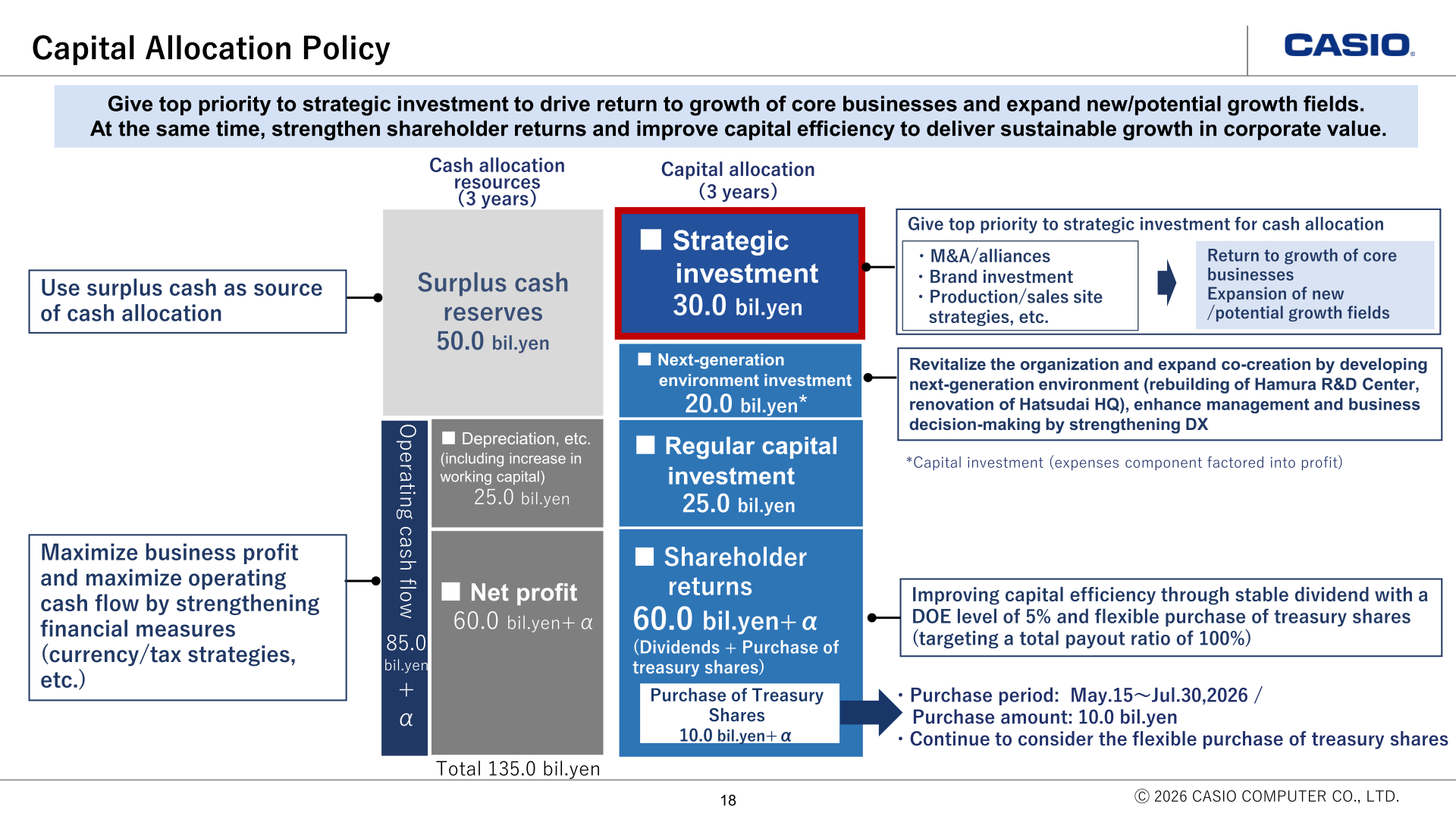
Casio’s policy is to improve capital efficiency through a stable dividend with a DOE level of 5% and flexible purchase of treasury shares, targeting a total payout ratio of 100%. The company announced a purchase of treasury shares with a purchase period of May 15 to July 30, 2026 and a purchase amount of 10.0 billion yen, and will continue to consider the flexible purchase of treasury shares. For FY March 2026, the dividend payout ratio was 56.2%, the total payout ratio was 83.3% and DOE was 4.5%. Over the three years of the plan, cash allocation resources total 135.0 billion yen (operating cash flow of 85.0 billion yen plus alpha and surplus cash reserves of 50.0 billion yen), allocated to strategic investment of 30.0 billion yen, next-generation environment investment of 20.0 billion yen, regular capital investment of 25.0 billion yen and shareholder returns of 60.0 billion yen plus alpha (dividends plus purchase of treasury shares), with top priority given to strategic investment.
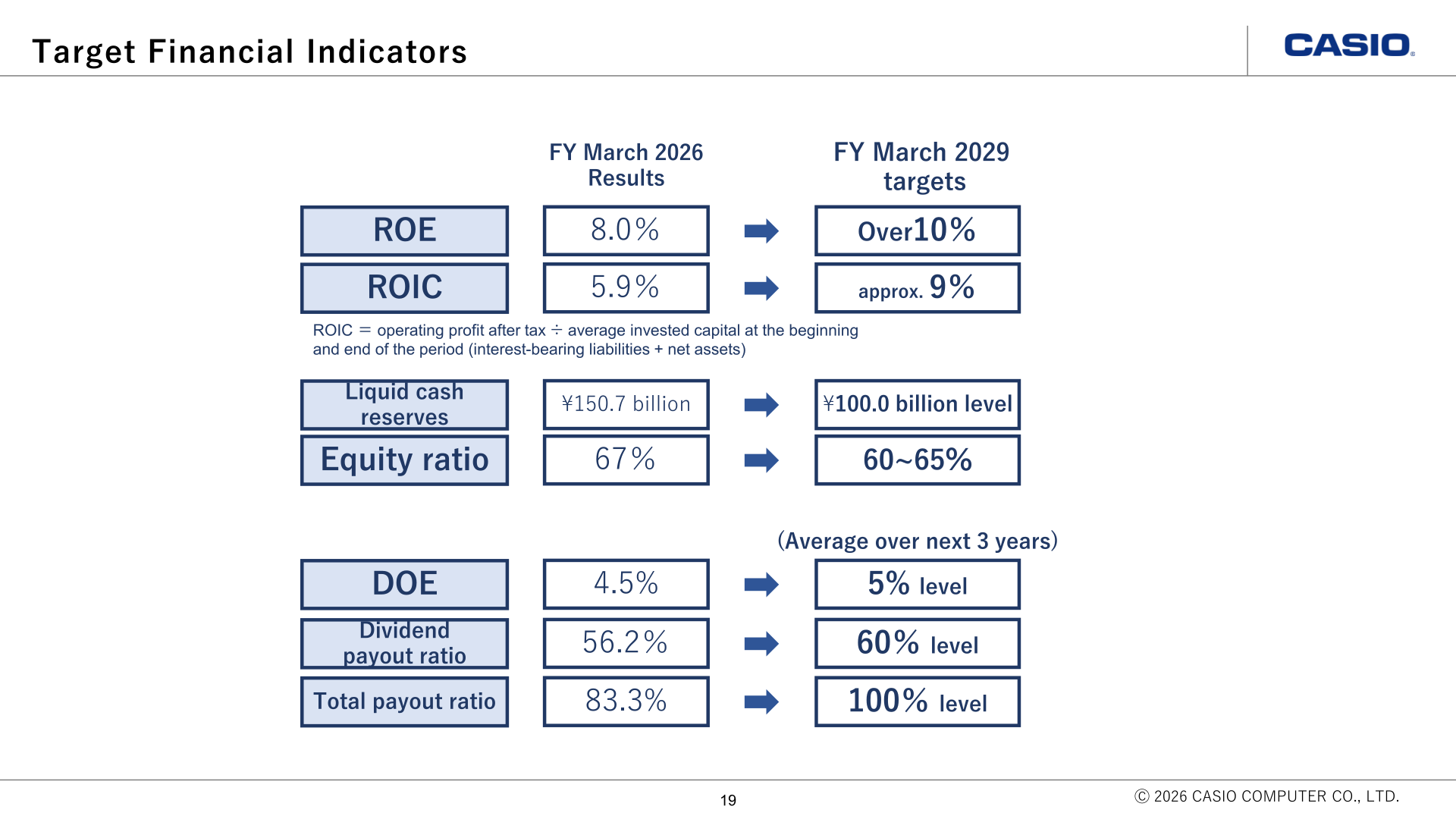
Target financial indicators for FY March 2029 are ROE of over 10% (8.0% in FY March 2026), ROIC of approximately 9% (5.9%), liquid cash reserves at the 100.0 billion yen level (150.7 billion yen), an equity ratio of 60-65% (67%), a dividend payout ratio at the 60% level (56.2%), a total payout ratio at the 100% level (83.3%) and DOE at the 5% level (4.5%). The dividend payout ratio and total payout ratio targets are averages over the next three years.
This article is an analysis based on publicly available information and is not a recommendation to buy or sell any specific securities. Investment decisions are your own responsibility.
![[Obayashi] Investors’ Guide 2026 — The Complete 24-Article Breakdown](https://japan-equity.com/wp-content/uploads/2026/07/hub_cover-1024x1024.png)
![[Obayashi] IR & SR Policy — Feeding Dialogue Back into Management](https://japan-equity.com/wp-content/uploads/2026/07/p32_sq-1024x1024.jpg)
![[Obayashi] Real Estate Development — 18.7% Margin, ¥287.7bn Unrealized Gains](https://japan-equity.com/wp-content/uploads/2026/07/p20_sq-1024x1024.jpg)
![[Obayashi] Domestic Civil Engineering — Resilience Spending Supports 9.6% Margin](https://japan-equity.com/wp-content/uploads/2026/07/p11_sq-1024x1024.jpg)
![[Obayashi] Share Price & External Ratings — vs TOPIX, ESG Index Inclusion](https://japan-equity.com/wp-content/uploads/2026/07/p40_sq-1024x1024.jpg)
![[Construction] ¥75.5tn Investment, Shrinking Workforce — Big-5 Market Share](https://japan-equity.com/wp-content/uploads/2026/07/p12_sq-1024x1024.jpg)
![[Obayashi] Capital Policy & Shareholder Returns — ROE 10%+, DOE ~5%, ¥100bn Buyback](https://japan-equity.com/wp-content/uploads/2026/07/p27_sq-1024x1024.jpg)
![[Obayashi] Reducing Cross-Shareholdings — ¥285.2bn Sold in Five Years](https://japan-equity.com/wp-content/uploads/2026/07/p29_sq-1024x1024.jpg)
![[Obayashi] ¥750bn Investment Plan — ¥300bn to Development, ¥190bn to Tech/DX](https://japan-equity.com/wp-content/uploads/2026/07/p30_sq-1024x1024.jpg)
![[Obayashi] MTP2022 KPIs — Operating Profit ~2x Target, ROE 14.4%](https://japan-equity.com/wp-content/uploads/2026/07/p25_sq-1024x1024.jpg)
![[Obayashi] Cash Allocation — ¥420bn Investment CF Over Five Years](https://japan-equity.com/wp-content/uploads/2026/07/p26_sq-1024x1024.jpg)
![[Obayashi] Green Energy — 44 Plants, 344MW, and the Green Hydrogen Challenge](https://japan-equity.com/wp-content/uploads/2026/07/p21_sq-1024x1024.jpg)
![[Obayashi] Tackling the Labor Shortage — Robotics Construction®](https://japan-equity.com/wp-content/uploads/2026/07/p14_sq-1024x1024.jpg)
