
This article is based on publicly available IR materials and is not a recommendation to buy or sell any specific securities.
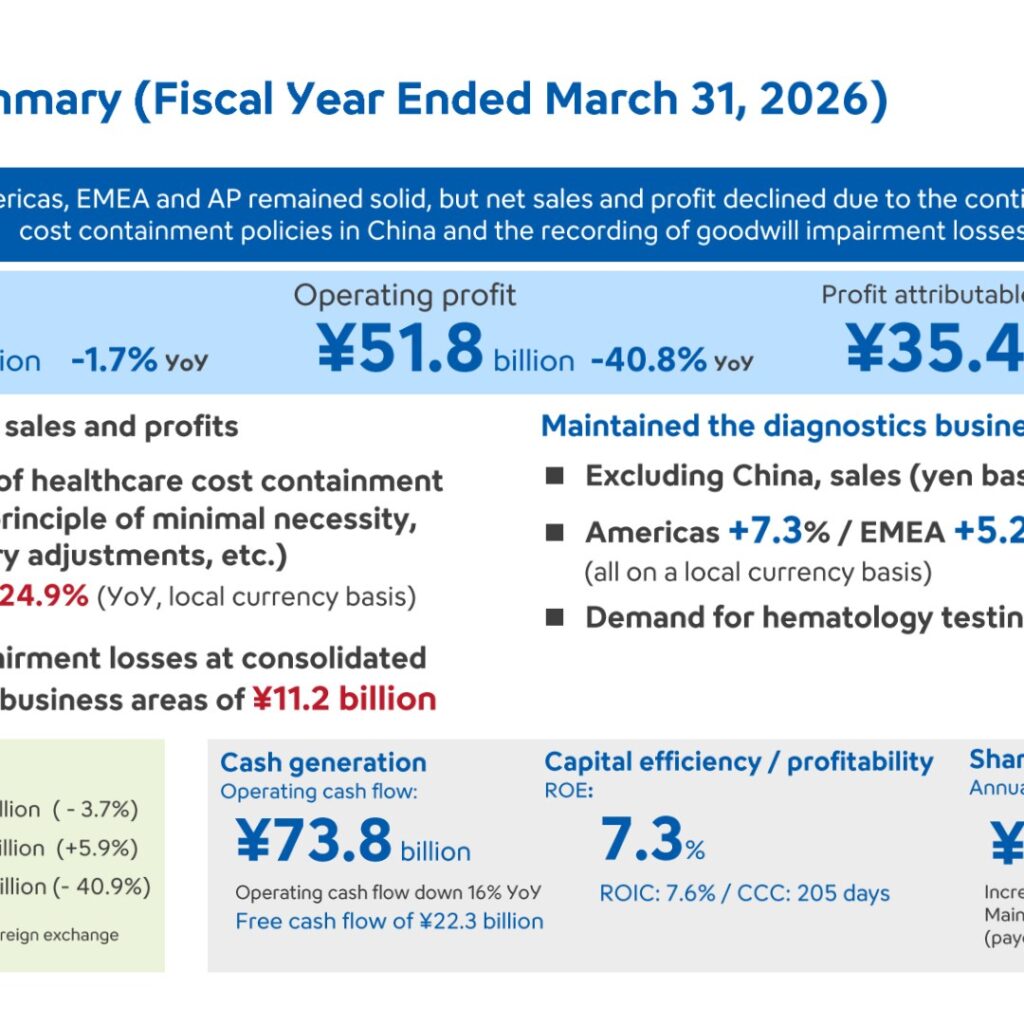
Sysmex Corporation (TSE Prime: 6869) presented its business results for the fiscal year ended March 31, 2026 on May 14, 2026. Net sales were ¥500.0 billion, down 1.7% year on year, operating profit was ¥51.8 billion, down 40.8%, and profit attributable to owners of the parent was ¥35.4 billion, down 33.9%. The company states that performance in the Americas, EMEA and AP remained solid, but net sales and profit declined due to the continued impact of healthcare cost containment policies in China and the recording of goodwill impairment losses. Note: Sysmex labels this period as the fiscal year ended March 31, 2026; this site classifies the most recent completed fiscal year as FY2025, and the labels used in the text, tables and segment data below follow the company’s own materials. Figures are disclosed in compliance with IFRS, which the Sysmex Group adopted in the fiscal year ended March 31, 2017.
Consolidated Results (Full-Year Actual)
Net sales declined from ¥508.6 billion to ¥500.0 billion (98.3% of the previous period). Cost of sales rose to ¥244.3 billion (48.9% of net sales, versus 46.5%) and SG&A expenses rose to ¥164.3 billion (32.9%, versus 29.7%), while R&D expenses declined to ¥29.1 billion (5.8%, versus 6.2%). Other income (expenses) was a net expense of ¥10.3 billion, against ¥2.0 billion in the previous period. Assumed to be the key reasons for lower sales and profits, the company cites the continued impact of healthcare cost containment policies in China (principle of minimal necessity, distributor inventory adjustments, etc.), with sales in China down 24.9% year on year on a local currency basis, and total goodwill impairment losses at consolidated subsidiaries in new business areas of ¥11.2 billion. At the same time, the company states it maintained the diagnostics business competitiveness: excluding China, sales on a yen basis were up 5.1% year on year, with the Americas +7.3%, EMEA +5.2% and AP +6.4% (all on a local currency basis), and demand for hematology testing in China remained firm. Regarding foreign exchange, the company discloses an impact of +¥10.2 billion on net sales (year-on-year change excluding foreign exchange effects: -3.7%), +¥4.63 billion on SG&A expenses (+5.9%) and +¥0.09 billion on operating profit (-40.9%). Average rates for the period were ¥150.8/USD, ¥174.8/EUR and ¥21.2/CNY, against ¥152.6, ¥163.8 and ¥21.1 in the previous period.
| Item (Billions of yen) | FY ended Mar 31, 2026 | Ratio | FY ended Mar 31, 2025 | Ratio | YoY (Previous period = 100%) |
|---|---|---|---|---|---|
| Net sales | 500.0 | 100% | 508.6 | 100% | 98.3% |
| Cost of sales | 244.3 | 48.9% | 236.6 | 46.5% | 103.2% |
| SG&A expenses | 164.3 | 32.9% | 150.8 | 29.7% | 109.0% |
| R&D expenses | 29.1 | 5.8% | 31.4 | 6.2% | 92.7% |
| Other income (expenses) | (10.3) | (2.1)% | (2.0) | (0.4)% | – |
| Operating profit | 51.8 | 10.4% | 87.5 | 17.2% | 59.2% |
| Profit attributable to owners of the parent | 35.4 | 7.1% | 53.6 | 10.6% | 66.1% |
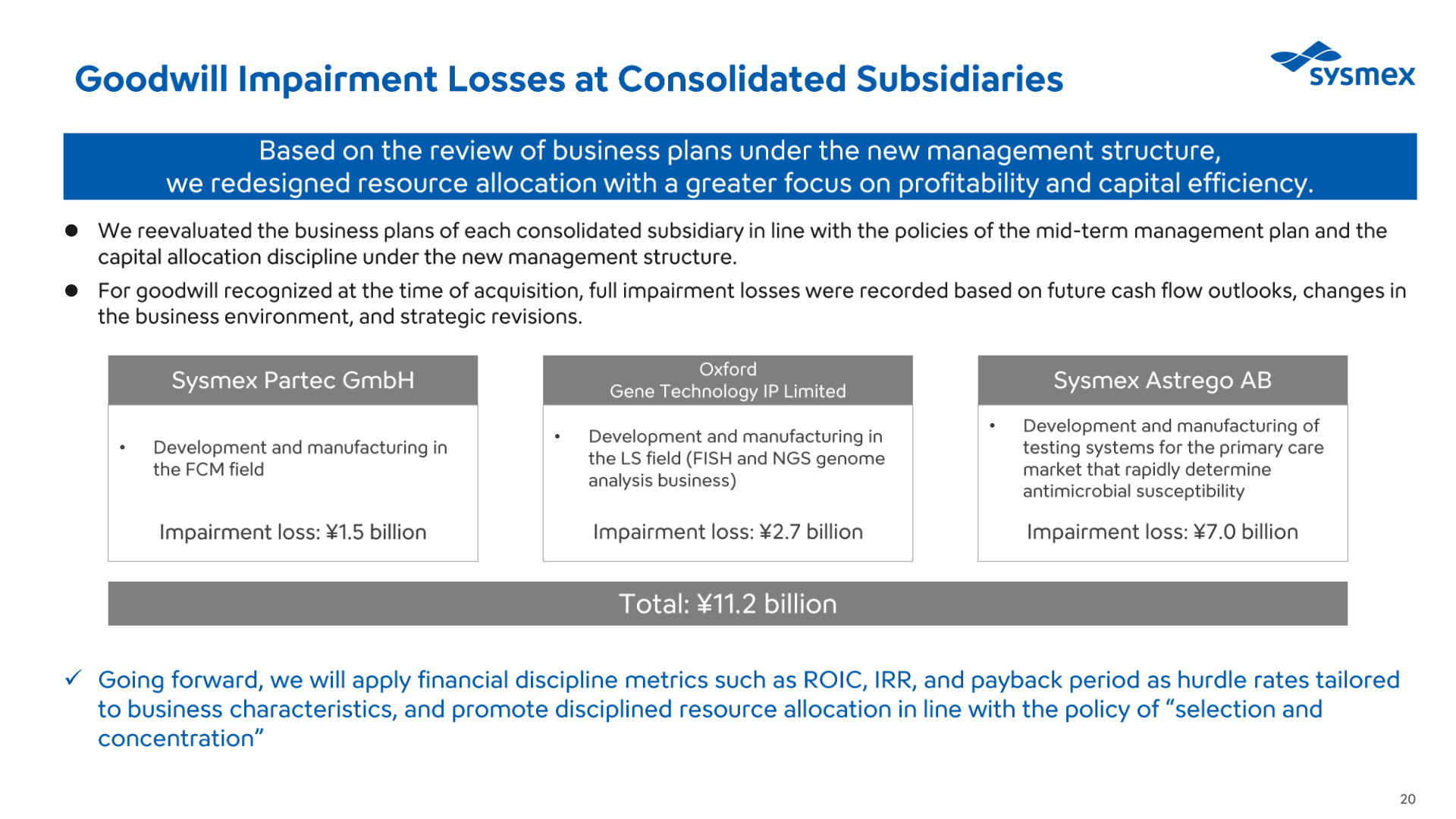
On the breakdown of the ¥35.7 billion year-on-year decline in operating profit, the company lists (excluding the impact of exchange rates) a fluctuation in gross profit due to changes in net sales of -¥10.10 billion, deterioration in the cost of sales ratio of -¥10.89 billion (a 2.2pt deterioration, with negative factors of Q1 inventory revaluations 0.4pt, impact of product mix 0.4pt, deterioration of service costs 0.6pt, tariff impact 0.4pt and deterioration in logistics costs 0.2pt), higher SG&A expenses of -¥8.87 billion (labor costs up ¥2.5 billion, other costs up ¥1.3 billion, depreciation and amortization up ¥2.95 billion owing to the launch of core systems operations), lower R&D expenses of +¥2.29 billion, and a change in other income and expenses of -¥8.27 billion including goodwill impairment losses of -¥11.2 billion. The FX impact was +¥0.09 billion. The goodwill impairment losses were recorded at Sysmex Astrego AB (¥7.0 billion), Oxford Gene Technology IP Limited (¥2.7 billion) and Sysmex Partec GmbH (¥1.5 billion), a total of ¥11.2 billion; the company states that full impairment losses were recorded for goodwill recognized at the time of acquisition, based on future cash flow outlooks, changes in the business environment and strategic revisions.
On cash generation and capital efficiency, operating cash flow was ¥73.8 billion, down 16% year on year, and free cash flow was ¥22.3 billion. ROE was 7.3%, ROIC was 7.6% and CCC was 205 days. In the cash flow statement, operating CF of ¥73.8 billion, investing CF of -¥51.4 billion and financing CF of -¥37.6 billion produced a net decrease in cash and cash equivalents (including translation differences) of ¥5.4 billion, against ¥88.2 billion, -¥52.4 billion, -¥24.3 billion and +¥14.0 billion respectively in the previous period. Total assets increased ¥42.26 billion from ¥665.2 billion to ¥707.5 billion, with current assets up ¥23.78 billion and non-current assets up ¥18.47 billion, while liabilities rose ¥1.12 billion and equity rose ¥41.14 billion.
Segment Results
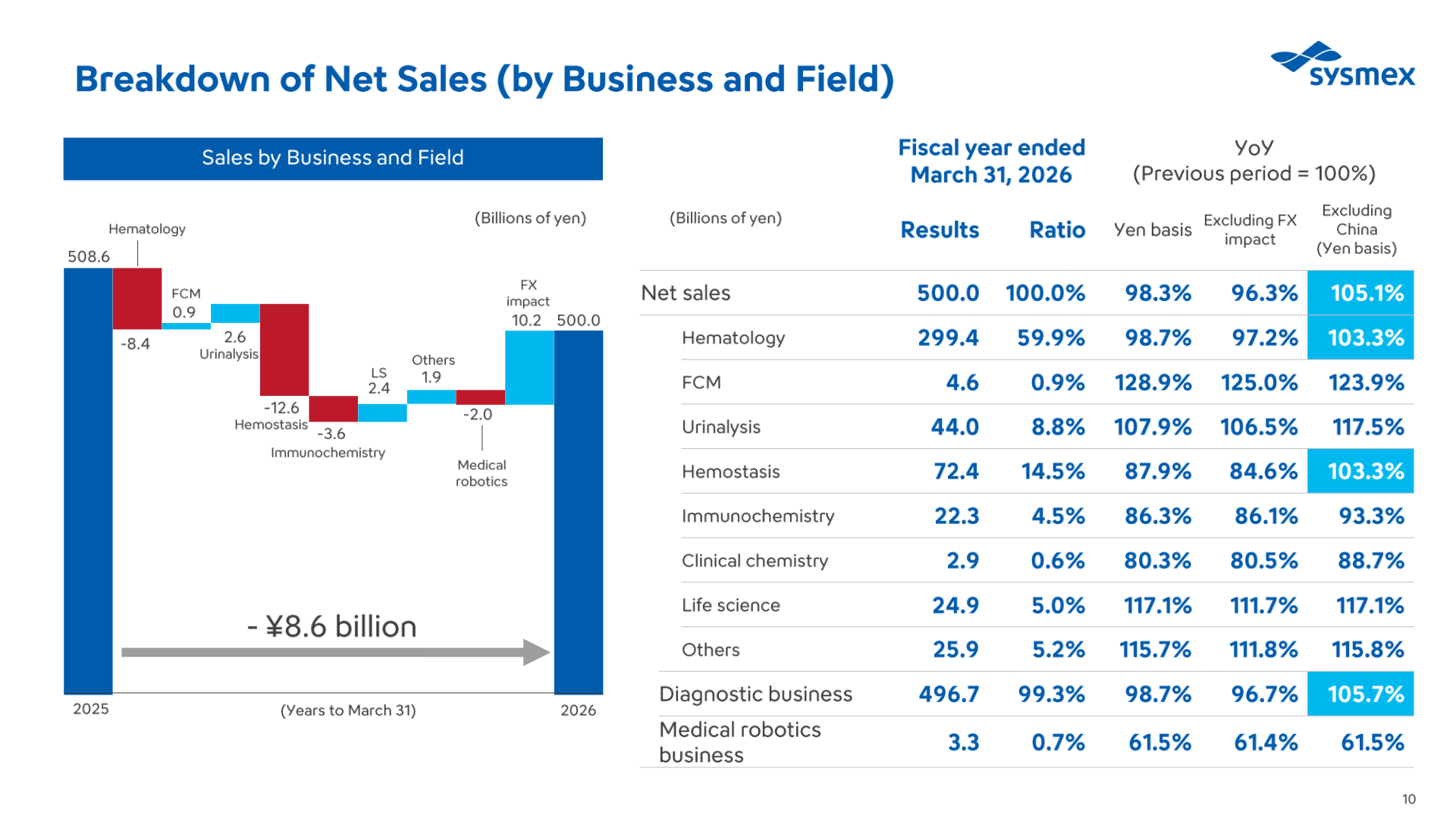
By business and field, the diagnostics business posted net sales of ¥496.7 billion (99.3% of total, 98.7% of the previous period on a yen basis), while the medical robotics business recorded ¥3.3 billion (0.7%, 61.5%). Within the diagnostics business, hematology accounted for ¥299.4 billion (59.9%), followed by hemostasis at ¥72.4 billion (14.5%), urinalysis at ¥44.0 billion (8.8%), others at ¥25.9 billion (5.2%), life science at ¥24.9 billion (5.0%), immunochemistry at ¥22.3 billion (4.5%), FCM at ¥4.6 billion (0.9%) and clinical chemistry at ¥2.9 billion (0.6%). Excluding China on a yen basis, net sales overall were 105.1% of the previous period and the diagnostics business was 105.7%.
| Business / Field (Billions of yen) | FY ended Mar 31, 2026 | Ratio | YoY (yen basis) | YoY excl. FX impact | YoY excl. China (yen basis) |
|---|---|---|---|---|---|
| Net sales | 500.0 | 100.0% | 98.3% | 96.3% | 105.1% |
| Hematology | 299.4 | 59.9% | 98.7% | 97.2% | 103.3% |
| FCM | 4.6 | 0.9% | 128.9% | 125.0% | 123.9% |
| Urinalysis | 44.0 | 8.8% | 107.9% | 106.5% | 117.5% |
| Hemostasis | 72.4 | 14.5% | 87.9% | 84.6% | 103.3% |
| Immunochemistry | 22.3 | 4.5% | 86.3% | 86.1% | 93.3% |
| Clinical chemistry | 2.9 | 0.6% | 80.3% | 80.5% | 88.7% |
| Life science | 24.9 | 5.0% | 117.1% | 111.7% | 117.1% |
| Others | 25.9 | 5.2% | 115.7% | 111.8% | 115.8% |
| Diagnostic business | 496.7 | 99.3% | 98.7% | 96.7% | 105.7% |
| Medical robotics business | 3.3 | 0.7% | 61.5% | 61.4% | 61.5% |
By destination, the Americas recorded ¥139.2 billion (27.9% of total; 106.2% on a yen basis, 107.3% on a local currency basis), EMEA ¥158.0 billion (31.6%; 112.6% / 105.2%), China ¥89.4 billion (17.9%; 75.8% / 75.1%), AP ¥54.6 billion (10.9%; 106.4% / 106.4%) and Japan ¥58.6 billion (11.7%; 86.5% on a yen basis). In local currency terms, the Americas posted net sales of USD 922.1 million against USD 859.8 million, EMEA EUR 902.7 million against EUR 857.9 million (sales figures, including for past fiscal years, exclude Russia), and China CNY 4,207.2 million against CNY 5,605.4 million. By product type, instruments were ¥103.2 billion (20.6%; 99.0% on a yen basis and 96.2% excluding the impact of exchange rate fluctuations), reagents ¥307.9 billion (61.6%; 98.1% / 96.5%), services ¥69.2 billion (13.9%; 101.3% / 99.8%) and others ¥19.5 billion (3.9%; 88.4% / 82.9%).
| Destination (Billions of yen) | FY ended Mar 31, 2026 | Ratio | YoY (yen basis) | YoY (local currency basis) |
|---|---|---|---|---|
| Net sales | 500.0 | 100.0% | 98.3% | 96.3% |
| Americas | 139.2 | 27.9% | 106.2% | 107.3% |
| EMEA | 158.0 | 31.6% | 112.6% | 105.2% |
| China | 89.4 | 17.9% | 75.8% | 75.1% |
| AP | 54.6 | 10.9% | 106.4% | 106.4% |
| Japan | 58.6 | 11.7% | 86.5% | – |
The company explains that in the Americas, favorable performance continued in North America while Central and Latin America achieved strong growth, including double-digit growth in Brazil; amyloid β testing reagents also remained firm, with net sales of USD 9.3 million, up 39.3% year on year. In EMEA, strong performance in hematology and urinalysis across major countries and Eastern Europe offset sales declines in the Middle East. In China, sales declined due to the expanding impact of healthcare cost containment policies including the principle of minimal necessity, as well as expanded inventory adjustments driven by the worsening financial conditions of distributors. In AP, sales increased as major countries including India continued to achieve strong growth, with Q4 alone up 17.8% year on year, and the medical robotics business reached total cumulative installations of four units. In Japan, sales decreased due to the impact of accelerated reagent sales resulting from a system transition in 4Q of the previous fiscal year, a reaction to strong hematology instrument sales in the previous fiscal year, and lower sales in the medical robotics business associated with worsening hospital management; medical robotics units installed during the fiscal year were 20 units (21 units globally), for a cumulative installed base of 106 units (110 units globally).
FY2026 Forecast (Fiscal Year Ending March 31, 2027)
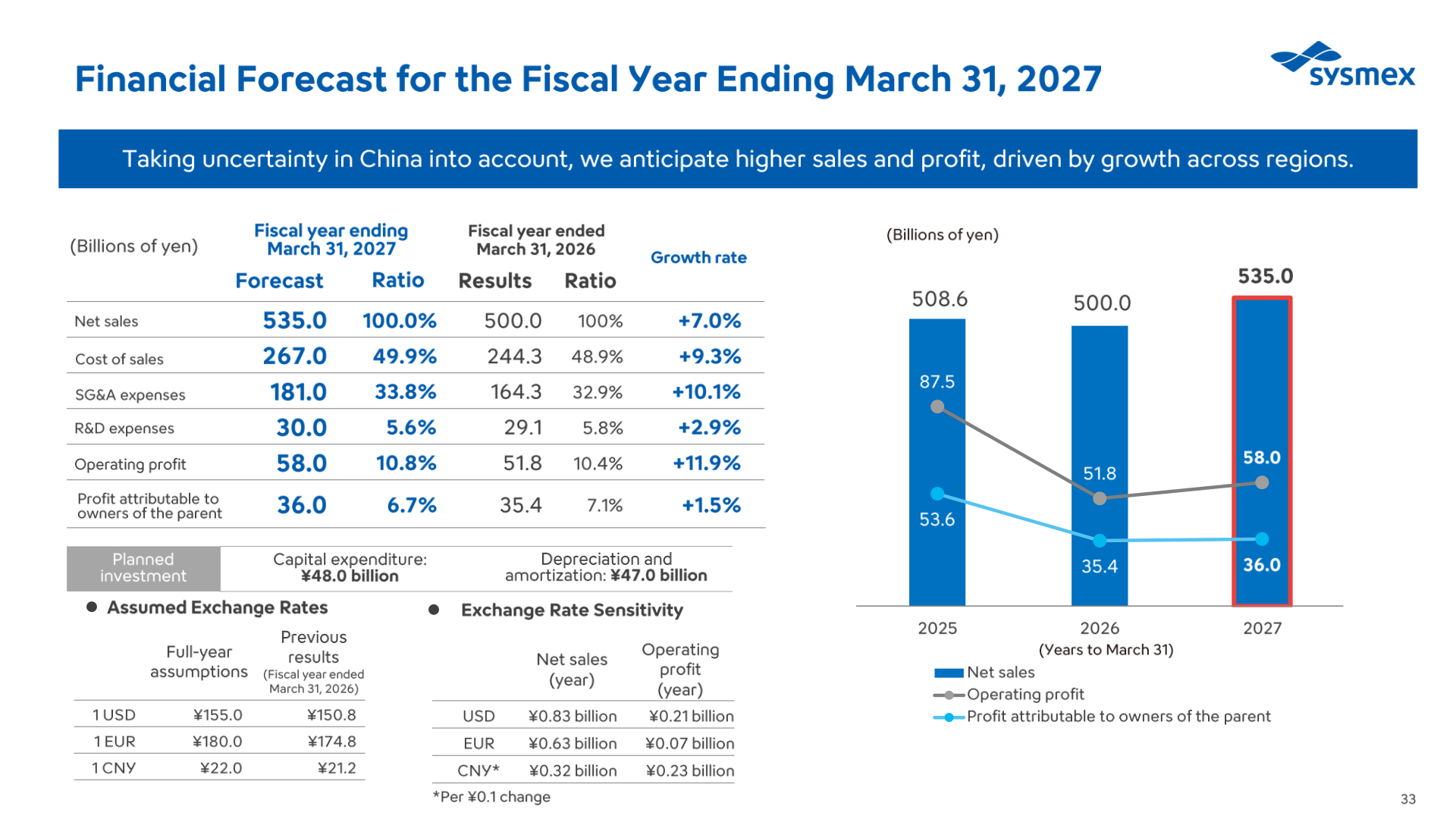
For the fiscal year ending March 31, 2027, Sysmex forecasts net sales of ¥535.0 billion (+7.0% year on year), operating profit of ¥58.0 billion (+11.9%) and profit attributable to owners of the parent of ¥36.0 billion (+1.5%), stating that taking uncertainty in China into account, it anticipates higher sales and profit driven by growth across regions. Assumptions for net sales include China down 20% (incorporating, in addition to the principle of minimal necessity, the impact of a standardization of testing prices), the Americas +6%, EMEA +7% and AP +13% on a local currency basis, and in Japan a contribution from taking over JEOL’s clinical chemistry business (clinical chemistry field: ¥+10.0 billion). For operating profit, the company assumes that the gross profit decline in China will be offset by growth in the diagnostics business and the elimination of one-time factors (goodwill impairment losses), while also assuming increases in raw material and logistics costs associated with U.S. reciprocal tariffs and worsening conditions in the Middle East. Assumed exchange rates are ¥155.0/USD, ¥180.0/EUR and ¥22.0/CNY. Planned investment comprises capital expenditure of ¥48.0 billion and depreciation and amortization of ¥47.0 billion. Operating cash flow is forecast at ¥88.0 billion (+19% year on year) with free cash flow of ¥27.0 billion (+21%), ROE of 7.3% (±0.0pt), ROIC of 7.5% (-0.1pt) and CCC of 200 days (down five days).
| Item (Billions of yen) | FY ending Mar 31, 2027 (Forecast) | Ratio | FY ended Mar 31, 2026 (Results) | Ratio | Growth rate |
|---|---|---|---|---|---|
| Net sales | 535.0 | 100.0% | 500.0 | 100% | +7.0% |
| Cost of sales | 267.0 | 49.9% | 244.3 | 48.9% | +9.3% |
| SG&A expenses | 181.0 | 33.8% | 164.3 | 32.9% | +10.1% |
| R&D expenses | 30.0 | 5.6% | 29.1 | 5.8% | +2.9% |
| Operating profit | 58.0 | 10.8% | 51.8 | 10.4% | +11.9% |
| Profit attributable to owners of the parent | 36.0 | 6.7% | 35.4 | 7.1% | +1.5% |
By business and field, the forecast calls for the diagnostics business at ¥529.5 billion (99.0% of total, 106.6% of the previous period) and the medical robotics business at ¥5.5 billion (1.0%, 166.4%), with hematology at ¥317.0 billion (105.9%), urinalysis at ¥48.5 billion (110.1%), hemostasis at ¥74.0 billion (102.2%), immunochemistry at ¥23.0 billion (103.0%), clinical chemistry at ¥13.0 billion (445.5%), life science at ¥23.5 billion (94.1%), FCM at ¥7.0 billion (149.2%) and others at ¥23.5 billion (90.6%). By destination, the forecast is the Americas ¥152.0 billion (109.2% on a yen basis, 106.3% on a local currency basis), EMEA ¥174.0 billion (110.1% / 107.1%), China ¥75.0 billion (83.8% / 81.0%), AP ¥62.0 billion (113.5% on a yen basis) and Japan ¥72.0 billion (122.9% on a yen basis). On China, the company expects negative growth to continue throughout the fiscal year ending March 31, 2027, at -20% for the full year on a local currency basis after -25% for the fiscal year ended March 31, 2026, and states it will continue to closely monitor developments while incorporating uncertainty associated with the standardization of testing prices.
Shareholder Returns
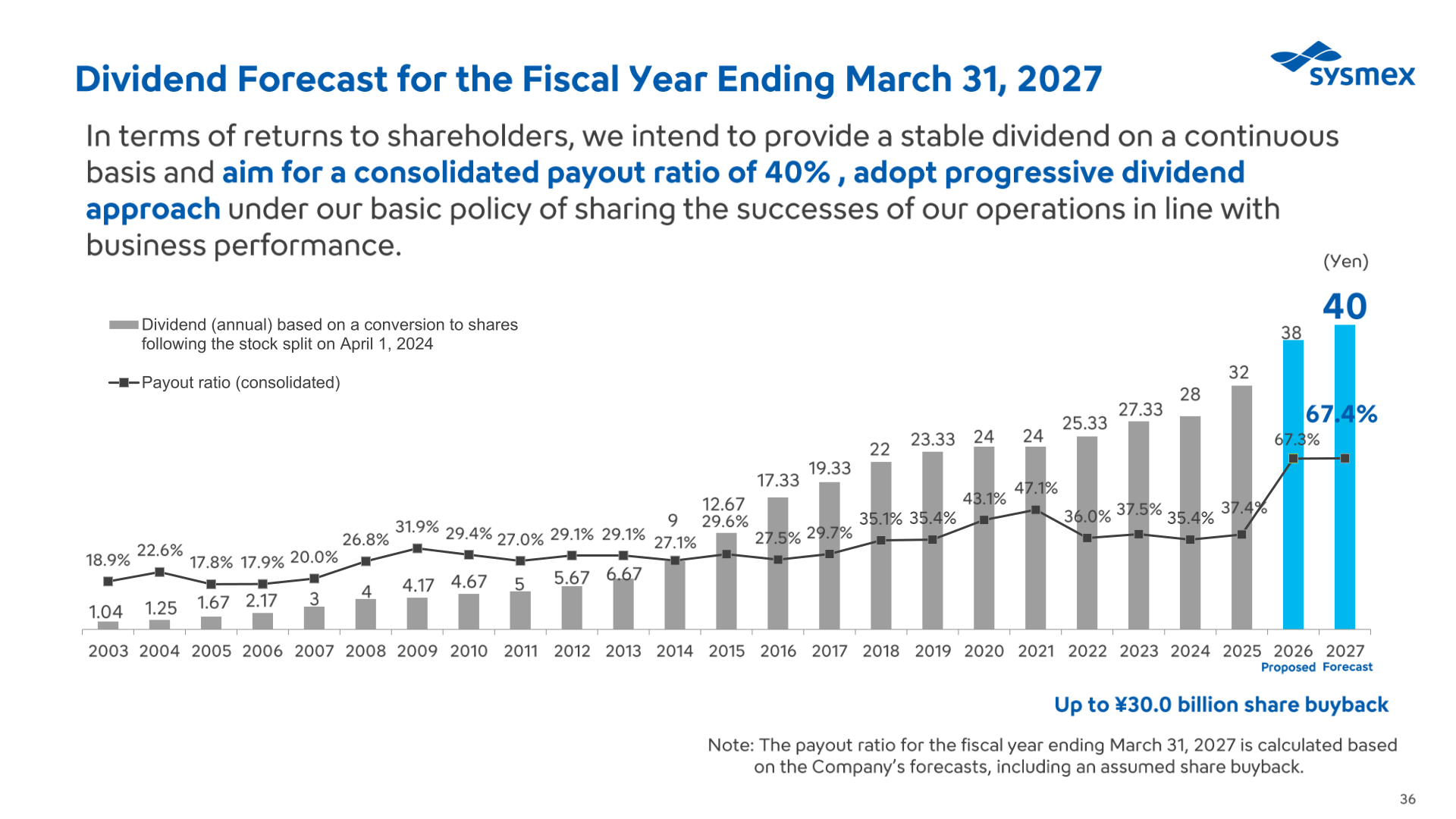
For the fiscal year ended March 31, 2026, Sysmex proposes an interim dividend of ¥19 and a year-end dividend of ¥19, for an annual dividend of ¥38 and a payout ratio of 67.3%, against ¥15, ¥17, ¥32 and 37.4% respectively in the previous fiscal year. The company states it is maintaining the progressive dividend policy and that, as announced at the beginning of the fiscal year, the annual dividend will increase by ¥6 (+18.8%) from the previous fiscal year, including a commemorative dividend marking the 30th anniversary of the Company’s listing. The year-end dividend is planned to be proposed to the 59th Ordinary General Meeting of Shareholders. For the fiscal year ending March 31, 2027, the company forecasts an annual dividend of ¥40, up 5.3% from the previous year’s ¥38, with a payout ratio of 67.4% calculated based on the Company’s forecasts including an assumed share buyback of up to ¥30.0 billion. Its basic policy is to provide a stable dividend on a continuous basis and to aim for a consolidated payout ratio of 40% under a progressive dividend approach. In its capital allocation outlook for the fiscal year ending March 31, 2027, the company shows operating cash flow of ¥88.0 billion before R&D tax credits plus active use of borrowings and other financing, against R&D expenses of ¥50.0 billion (approximately 9% of net sales, including internally generated intangible assets), capital investment of ¥48.0 billion, strategic investments of ¥15.0 billion including consideration paid for the takeover of JEOL’s business, and shareholder returns of ¥52.0 billion.
| Dividend per share | Interim | Year-end | Total | Payout ratio |
|---|---|---|---|---|
| FY ended March 31, 2025 | ¥15 | ¥17 | ¥32 | 37.4% |
| FY ended March 31, 2026 (proposal) | ¥19 | ¥19 | ¥38 | 67.3% |
| FY ending March 31, 2027 (forecast) | – | – | ¥40 | 67.4% |
Mid-Term Management Plan / Topics
This was the first earnings briefing under the new management structure. The company states that the previous mid-term management plan fell short of initial targets, due to factors including structural market changes caused by healthcare cost containment policies in China and divergence between plans and results in certain new business areas, and that it will accelerate initiatives aimed at enhancing corporate value under three policies: selection and concentration with a return to fundamentals, disciplined capital allocation, and expansion of shareholder returns. Strategic themes for the fiscal year ending March 31, 2027 are to strengthen the competitiveness of the diagnostics business through regional expansion and flagship product launches, implement value chain reforms aimed at improving profitability, accelerate expansion in the hemostasis field and in emerging markets, and review the business portfolio, with discussions initiated under the new management structure from April onward.
In the hemostasis field, the company expects growth for the fiscal year ending March 31, 2027 versus the fiscal year ended March 31, 2026 on a local currency basis of 20% or more in EMEA and 70% or more in the Americas for hemostasis-related reagents, following large tender wins in Germany, France and Switzerland and FDA approval of the full reagent lineup including specialty parameters in the Americas. In emerging markets (Asia, Central and South America, the Middle East and Africa), net sales were ¥74.1 billion in the fiscal year ended March 31, 2026 and are forecast at ¥86.5 billion for the fiscal year ending March 31, 2027, up 19.4%, with India at INR 5,327 million rising to a forecast INR 7,000 million (+31.4%) and Brazil at USD 36 million rising to a forecast USD 43 million; a new plant in Brazil is scheduled for completion in the fiscal year ending March 31, 2028 and is expected at full operation to approximately double production capacity compared with the current Brazil plant. In the clinical chemistry field, the company took over JEOL’s clinical chemistry business in April, obtaining a top domestic market share in clinical chemistry analyzers, and plans sales in the field of ¥13.0 billion in the fiscal year ending March 31, 2027 rising to ¥19.0 billion in the fiscal year ending March 31, 2029.
Quarterly results for the fiscal year ended March 31, 2026 were net sales of ¥105.7 billion in Q1, ¥126.7 billion in Q2, ¥128.6 billion in Q3 and ¥138.8 billion in Q4, with operating profit of ¥10.6 billion (10.1%), ¥22.3 billion (17.6%), ¥15.6 billion (12.2%) and ¥3.1 billion (2.3%) respectively, and profit attributable to owners of the parent of ¥4.5 billion, ¥14.4 billion, ¥14.8 billion and ¥1.7 billion. Highlights disclosed for April 2025 to April 2026 include FDA 510(k) clearance for the CN-6000 Automated Blood Coagulation Analyzer and the XR-Series Automated Hematology Analyzer, the establishment of subsidiaries in Kenya and Greece, full-scale operations at the new manufacturing base in India with the launch of Make in India products, the acquisition of JEOL’s clinical chemistry testing business, the launch of the CN-700 Automated Blood Coagulation Analyzer in Japan, and the launch of an assay kit for identifying p-Tau217 in the blood, a biomarker related to Alzheimer’s disease.
This article is an analysis based on publicly available information and is not a recommendation to buy or sell any specific securities. Investment decisions are your own responsibility.
![[Obayashi] Investors’ Guide 2026 — The Complete 24-Article Breakdown](https://japan-equity.com/wp-content/uploads/2026/07/hub_cover-1024x1024.png)
![[Obayashi] IR & SR Policy — Feeding Dialogue Back into Management](https://japan-equity.com/wp-content/uploads/2026/07/p32_sq-1024x1024.jpg)
![[Obayashi] Real Estate Development — 18.7% Margin, ¥287.7bn Unrealized Gains](https://japan-equity.com/wp-content/uploads/2026/07/p20_sq-1024x1024.jpg)
![[Obayashi] Domestic Civil Engineering — Resilience Spending Supports 9.6% Margin](https://japan-equity.com/wp-content/uploads/2026/07/p11_sq-1024x1024.jpg)
![[Obayashi] Share Price & External Ratings — vs TOPIX, ESG Index Inclusion](https://japan-equity.com/wp-content/uploads/2026/07/p40_sq-1024x1024.jpg)
![[Construction] ¥75.5tn Investment, Shrinking Workforce — Big-5 Market Share](https://japan-equity.com/wp-content/uploads/2026/07/p12_sq-1024x1024.jpg)
![[Obayashi] Capital Policy & Shareholder Returns — ROE 10%+, DOE ~5%, ¥100bn Buyback](https://japan-equity.com/wp-content/uploads/2026/07/p27_sq-1024x1024.jpg)
![[Obayashi] Reducing Cross-Shareholdings — ¥285.2bn Sold in Five Years](https://japan-equity.com/wp-content/uploads/2026/07/p29_sq-1024x1024.jpg)
![[Obayashi] ¥750bn Investment Plan — ¥300bn to Development, ¥190bn to Tech/DX](https://japan-equity.com/wp-content/uploads/2026/07/p30_sq-1024x1024.jpg)
![[Obayashi] MTP2022 KPIs — Operating Profit ~2x Target, ROE 14.4%](https://japan-equity.com/wp-content/uploads/2026/07/p25_sq-1024x1024.jpg)
![[Obayashi] Cash Allocation — ¥420bn Investment CF Over Five Years](https://japan-equity.com/wp-content/uploads/2026/07/p26_sq-1024x1024.jpg)
![[Obayashi] Green Energy — 44 Plants, 344MW, and the Green Hydrogen Challenge](https://japan-equity.com/wp-content/uploads/2026/07/p21_sq-1024x1024.jpg)
![[Obayashi] Tackling the Labor Shortage — Robotics Construction®](https://japan-equity.com/wp-content/uploads/2026/07/p14_sq-1024x1024.jpg)
