
This article is based on publicly available IR materials and is not a recommendation to buy or sell any specific securities.
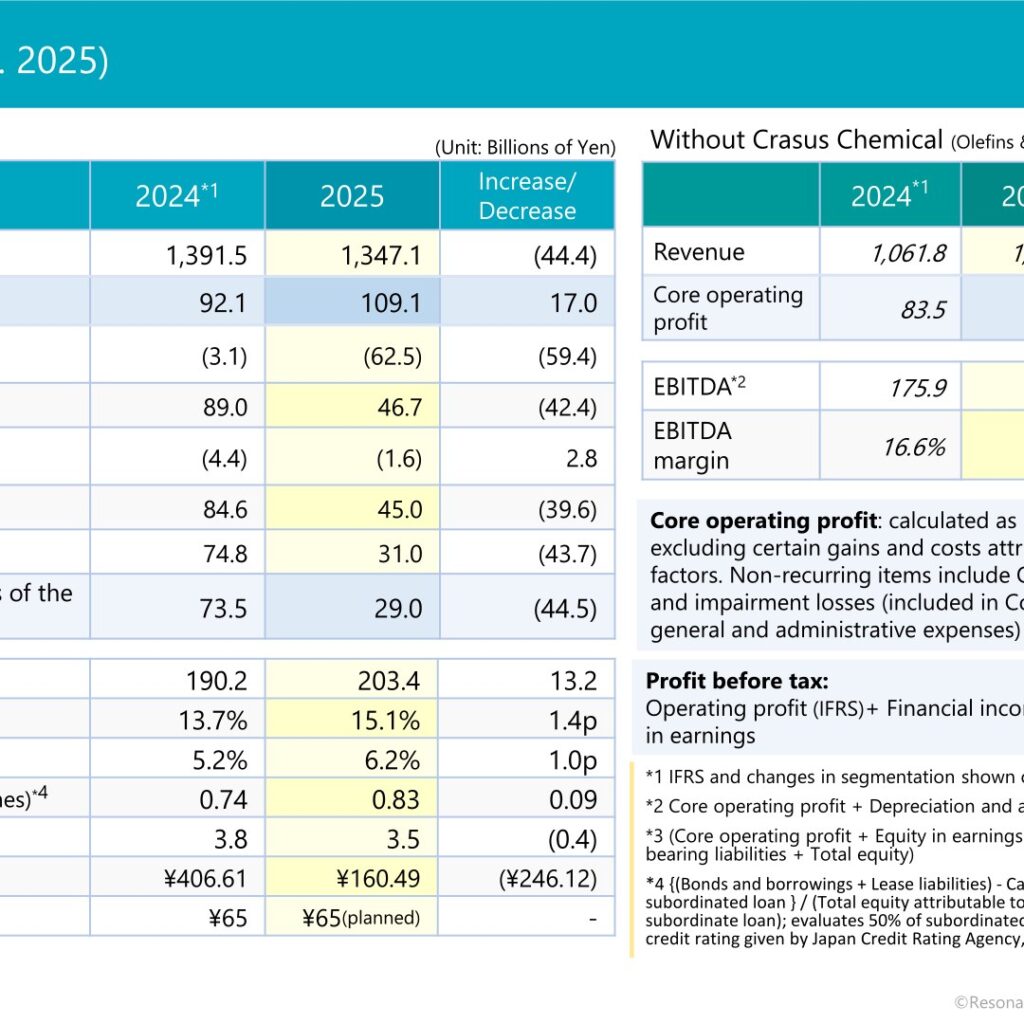
Note: Resonac’s fiscal year is the calendar year ending December 31, and the materials label the latest completed fiscal year simply as “2025” (classified as FY2025 on this site); the text and tables below keep the company’s own labels. On February 13, 2026, Resonac Holdings Corporation announced consolidated financial results for 2025 under IFRS. Revenue decreased by 44.4 billion yen to 1,347.1 billion yen, while core operating profit increased by 17.0 billion yen to 109.1 billion yen, driven by the strong performance of the Semiconductor and Electronic Materials segment, which offset the weakness in the Chemicals segment. Core operating profit in the Semiconductor and Electronic Materials segment reached a record high. Profit attributable to owners of the parent was 29.0 billion yen, down 44.5 billion yen from 2024. For 2026, the company expects core operating profit of 140.0 billion yen.
Consolidated Results (Full-Year Actual)
Revenue for 2025 was 1,347.1 billion yen, a decrease of 44.4 billion yen (3%) from 1,391.5 billion yen in 2024, while core operating profit rose 17.0 billion yen (18%) to 109.1 billion yen. Non-recurring items worsened from a loss of 3.1 billion yen in 2024 to a loss of 62.5 billion yen, including impairment losses of 51.0 billion yen mostly related to the transfer of Fiamm Energy Technology S.p.A. and the automotive molded parts business. As a result, operating profit (IFRS) declined 42.4 billion yen to 46.7 billion yen, and profit attributable to owners of the parent fell 44.5 billion yen to 29.0 billion yen. EBITDA increased 13.2 billion yen to 203.4 billion yen, with the EBITDA margin improving 1.4 points to 15.1%, and ROIC improved 1.0 point to 6.2%. The adjusted net D/E ratio was 0.83 times and Net Debt/EBITDA was 3.5 times.
| Item (Billions of Yen) | 2024 | 2025 | Increase/Decrease |
|---|---|---|---|
| Revenue | 1,391.5 | 1,347.1 | (44.4) |
| Core operating profit | 92.1 | 109.1 | 17.0 |
| Non-recurring items | (3.1) | (62.5) | (59.4) |
| Operating profit (IFRS) | 89.0 | 46.7 | (42.4) |
| Profit before tax | 84.6 | 45.0 | (39.6) |
| Profit attributable to owners of the parent | 73.5 | 29.0 | (44.5) |
| EBITDA | 190.2 | 203.4 | 13.2 |
| EBITDA margin | 13.7% | 15.1% | 1.4p |
| EPS (Basic earnings per share) | ¥406.61 | ¥160.49 | (¥246.12) |
| Cash dividends per share | ¥65 | ¥65 (planned) | – |
Segment Results
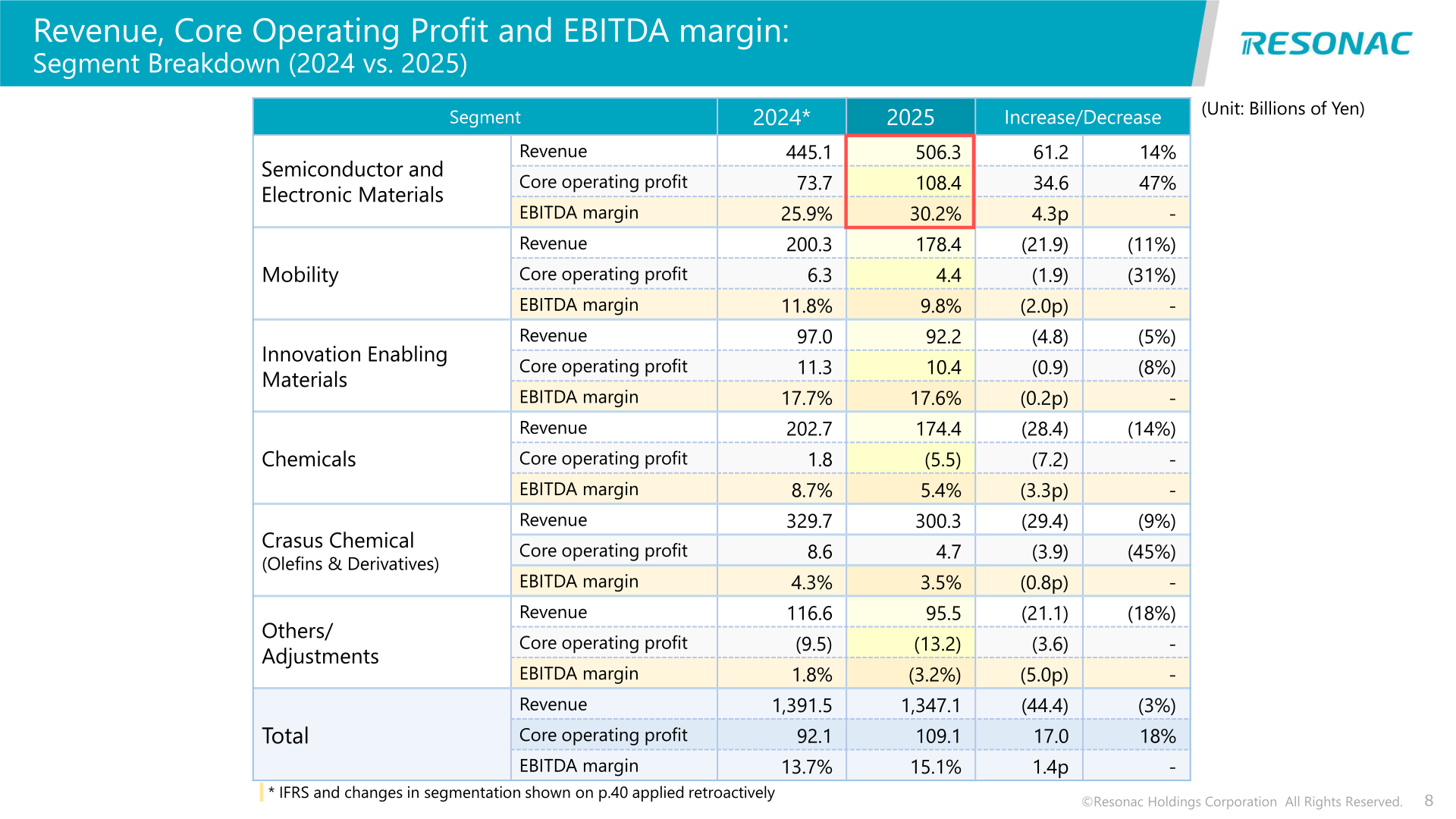
From 2025 the segmentation was changed: the former Olefins & Derivatives subsegment became the independent Crasus Chemical segment, and the former Graphite Electrodes subsegment and Anode Materials were combined into the Graphite subsegment of the Chemicals segment; 2024 figures are restated retroactively. In the Semiconductor and Electronic Materials segment, revenue increased 14% to 506.3 billion yen and core operating profit increased 47% to 108.4 billion yen, thanks to the recovery in demand for semiconductors; back-end semiconductor materials revenue increased mainly due to higher sales volume for advanced semiconductors including AI, with 20% of back-end revenue coming from AI this year, and the segment’s EBITDA margin rose to 30.2%. Mobility revenue and core operating profit both decreased, due to the divestiture of secondary battery packaging materials and food packaging materials in 2025 1Q as well as a decline in demand from certain domestic customers. Innovation Enabling Materials declined on lower demand for certain products impacted by the sluggish automobile market. In Chemicals, market weakness in graphite electrodes led to declines in both sales volumes and prices, resulting in a core operating loss of 5.5 billion yen. Crasus Chemical (Olefins & Derivatives) revenue decreased due to lower selling prices following the drop in naphtha prices.
| Segment (Billions of Yen) | Metric | 2024 | 2025 | Increase/Decrease |
|---|---|---|---|---|
| Semiconductor and Electronic Materials | Revenue | 445.1 | 506.3 | 61.2 (14%) |
| Semiconductor and Electronic Materials | Core operating profit | 73.7 | 108.4 | 34.6 (47%) |
| Mobility | Revenue | 200.3 | 178.4 | (21.9) ((11%)) |
| Mobility | Core operating profit | 6.3 | 4.4 | (1.9) ((31%)) |
| Innovation Enabling Materials | Revenue | 97.0 | 92.2 | (4.8) ((5%)) |
| Innovation Enabling Materials | Core operating profit | 11.3 | 10.4 | (0.9) ((8%)) |
| Chemicals | Revenue | 202.7 | 174.4 | (28.4) ((14%)) |
| Chemicals | Core operating profit | 1.8 | (5.5) | (7.2) |
| Crasus Chemical (Olefins & Derivatives) | Revenue | 329.7 | 300.3 | (29.4) ((9%)) |
| Crasus Chemical (Olefins & Derivatives) | Core operating profit | 8.6 | 4.7 | (3.9) ((45%)) |
| Others/Adjustments | Revenue | 116.6 | 95.5 | (21.1) ((18%)) |
| Others/Adjustments | Core operating profit | (9.5) | (13.2) | (3.6) |
| Total | Revenue | 1,391.5 | 1,347.1 | (44.4) ((3%)) |
| Total | Core operating profit | 92.1 | 109.1 | 17.0 (18%) |
2026 Forecast
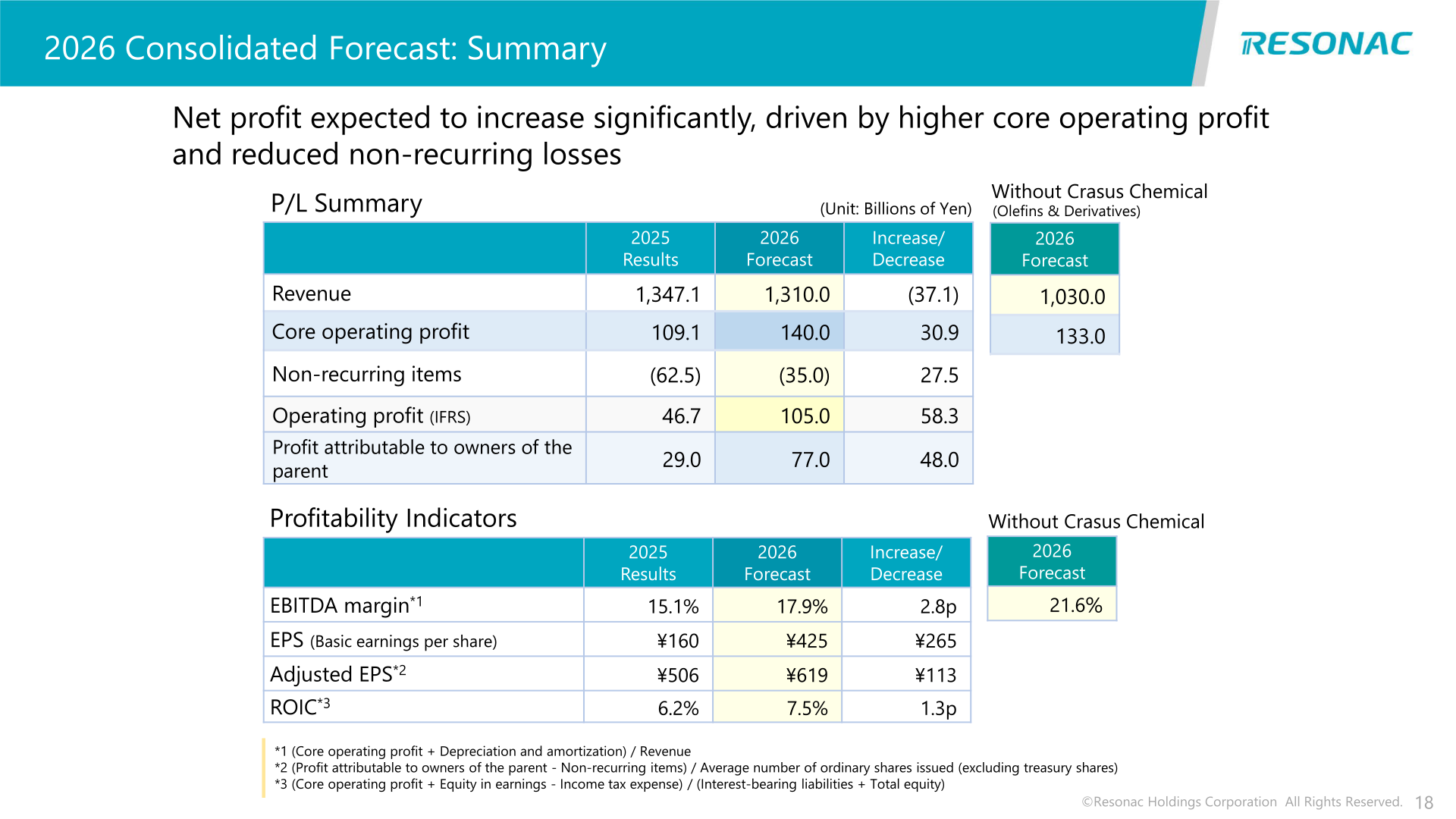
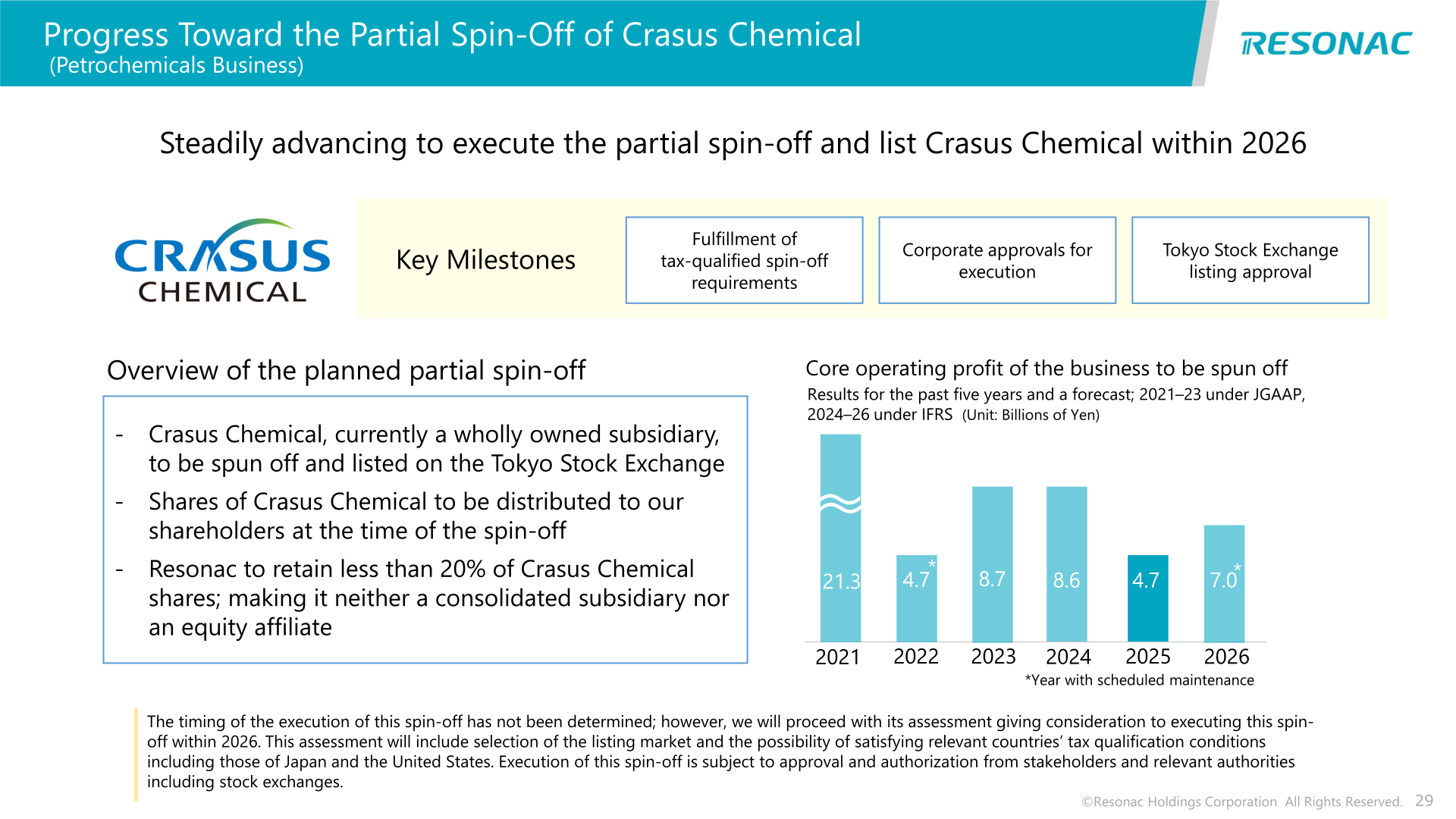
For 2026 (fiscal year ending December 31, 2026), Resonac forecasts revenue of 1,310.0 billion yen, down 37.1 billion yen, and core operating profit of 140.0 billion yen, up 30.9 billion yen. Net profit is expected to increase significantly, driven by higher core operating profit and reduced non-recurring losses; non-recurring items are forecast at a loss of 35.0 billion yen, 27.5 billion yen smaller than in 2025. The Semiconductor and Electronic Materials segment continues to grow steadily, while overall revenue declines due to the impact of business transfers related to Fiamm Energy Technology S.p.A. and the automotive molded parts business (a year-on-year revenue impact of (91.0) billion yen). Core operating profit increases, driven by growth in the Semiconductor and Electronic Materials segment and the return to profitability of the Graphite subsegment. In the Semiconductor and Electronic Materials segment, revenue from AI-related materials is expected to grow by more than 50% from 2025, delivering 13% segment revenue growth. Regarding Crasus Chemical, a partial spin-off is planned to be executed within 2026, after which the business is expected to be classified as discontinued operations; the forecast assumes consolidation on a full-year basis.
| Item (Billions of Yen) | 2026 Forecast | 2025 Results | Increase/Decrease |
|---|---|---|---|
| Revenue | 1,310.0 | 1,347.1 | (37.1) |
| Core operating profit | 140.0 | 109.1 | 30.9 |
| Non-recurring items | (35.0) | (62.5) | 27.5 |
| Operating profit (IFRS) | 105.0 | 46.7 | 58.3 |
| Profit before tax | 103.0 | 45.0 | 58.0 |
| Profit attributable to owners of the parent | 77.0 | 29.0 | 48.0 |
| EBITDA | 234.5 | 203.4 | 31.1 |
| EBITDA margin | 17.9% | 15.1% | 2.8p |
| EPS (Basic earnings per share) | ¥425 | ¥160 | ¥265 |
| Cash dividends per share | ¥65 | ¥65 (planned) | – |
Shareholder Returns
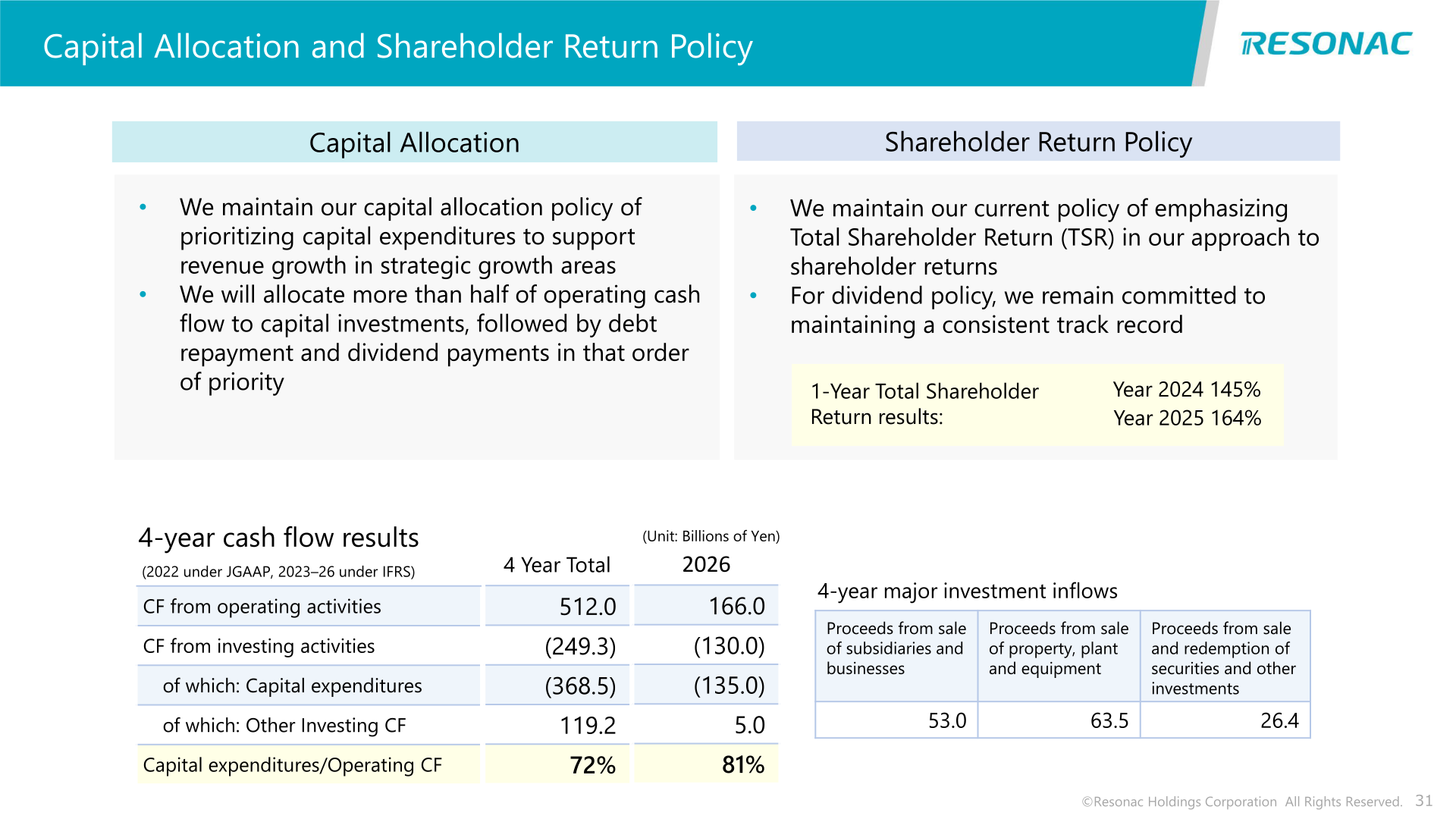
Cash dividends per share are ¥65 (planned) for 2025, unchanged from ¥65 in 2024, and the forecast for 2026 is also ¥65. The company maintains its capital allocation policy of prioritizing capital expenditures to support revenue growth in strategic growth areas, allocating more than half of operating cash flow to capital investments, followed by debt repayment and dividend payments in that order of priority. It also maintains its current policy of emphasizing Total Shareholder Return (TSR) in its approach to shareholder returns, and for dividend policy remains committed to maintaining a consistent track record. One-year TSR results were 145% for 2024 and 164% for 2025.
Medium-Term Targets and Topics
Against its targets of a 20% EBITDA margin (without Olefins & Derivatives), EPS of ¥500, ROIC of 10%, a Net D/E ratio below 1.0x and Net Debt/EBITDA below 3.0x, 2025 results were an EBITDA margin of 15.1% (18.4% without Crasus Chemical), EPS of ¥160 (adjusted EPS of ¥506), ROIC of 6.2%, a Net D/E ratio of 0.83x and Net Debt/EBITDA of 3.5x. The company states that profitability indicators saw significant improvements driven by growth in the Semiconductor and Electronic Materials business, and that the Net D/E ratio, its key debt level indicator, has improved and achieved the target. Regarding the planned partial spin-off of Crasus Chemical (petrochemicals business), the wholly owned subsidiary is to be spun off and listed on the Tokyo Stock Exchange, with shares of Crasus Chemical distributed to Resonac shareholders at the time of the spin-off; Resonac is to retain less than 20% of Crasus Chemical shares, making it neither a consolidated subsidiary nor an equity affiliate. The company is steadily advancing to execute the partial spin-off and list Crasus Chemical within 2026, while noting that the timing of execution has not been determined and execution is subject to approval and authorization from stakeholders and relevant authorities including stock exchanges.
This article is an analysis based on publicly available information and is not a recommendation to buy or sell any specific securities. Investment decisions are your own responsibility.
![[Obayashi] Investors’ Guide 2026 — The Complete 24-Article Breakdown](https://japan-equity.com/wp-content/uploads/2026/07/hub_cover-1024x1024.png)
![[Obayashi] IR & SR Policy — Feeding Dialogue Back into Management](https://japan-equity.com/wp-content/uploads/2026/07/p32_sq-1024x1024.jpg)
![[Obayashi] Real Estate Development — 18.7% Margin, ¥287.7bn Unrealized Gains](https://japan-equity.com/wp-content/uploads/2026/07/p20_sq-1024x1024.jpg)
![[Obayashi] Domestic Civil Engineering — Resilience Spending Supports 9.6% Margin](https://japan-equity.com/wp-content/uploads/2026/07/p11_sq-1024x1024.jpg)
![[Obayashi] Share Price & External Ratings — vs TOPIX, ESG Index Inclusion](https://japan-equity.com/wp-content/uploads/2026/07/p40_sq-1024x1024.jpg)
![[Construction] ¥75.5tn Investment, Shrinking Workforce — Big-5 Market Share](https://japan-equity.com/wp-content/uploads/2026/07/p12_sq-1024x1024.jpg)
![[Obayashi] Capital Policy & Shareholder Returns — ROE 10%+, DOE ~5%, ¥100bn Buyback](https://japan-equity.com/wp-content/uploads/2026/07/p27_sq-1024x1024.jpg)
![[Obayashi] Reducing Cross-Shareholdings — ¥285.2bn Sold in Five Years](https://japan-equity.com/wp-content/uploads/2026/07/p29_sq-1024x1024.jpg)
![[Obayashi] ¥750bn Investment Plan — ¥300bn to Development, ¥190bn to Tech/DX](https://japan-equity.com/wp-content/uploads/2026/07/p30_sq-1024x1024.jpg)
![[Obayashi] MTP2022 KPIs — Operating Profit ~2x Target, ROE 14.4%](https://japan-equity.com/wp-content/uploads/2026/07/p25_sq-1024x1024.jpg)
![[Obayashi] Cash Allocation — ¥420bn Investment CF Over Five Years](https://japan-equity.com/wp-content/uploads/2026/07/p26_sq-1024x1024.jpg)
![[Obayashi] Green Energy — 44 Plants, 344MW, and the Green Hydrogen Challenge](https://japan-equity.com/wp-content/uploads/2026/07/p21_sq-1024x1024.jpg)
![[Obayashi] Tackling the Labor Shortage — Robotics Construction®](https://japan-equity.com/wp-content/uploads/2026/07/p14_sq-1024x1024.jpg)
