
This article is based on publicly available IR materials and is not a recommendation to buy or sell any specific securities.
Note: Nisshin Seifun Group labels the fiscal year ended March 31, 2026 as “Fiscal 2026”; this article follows the site-wide convention of FY2025 for the most recently completed fiscal year in its title and slug, while all figures, period labels and segment names below are kept exactly as they appear in the company’s own presentation.
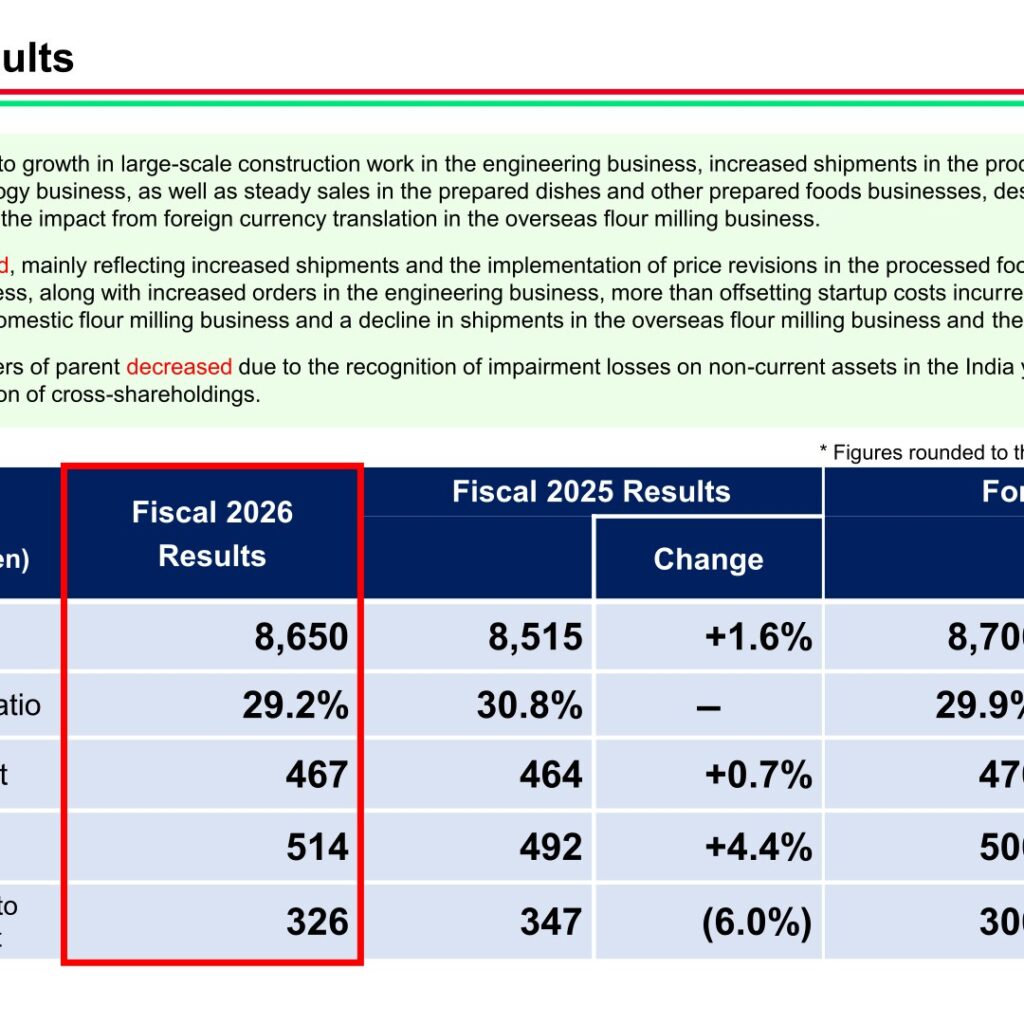
Nisshin Seifun Group Inc. reported Fiscal 2026 net sales of 8,650 (100 millions of yen), a year-on-year change of +1.6%, and operating profit of 467, a change of +0.7%. Ordinary profit rose +4.4% to 514, while profit attributable to owners of parent declined (6.0%) to 326, reflecting the recognition of impairment losses on non-current assets in the India yeast business. For Fiscal 2027, the company forecasts net sales of 8,700 and operating profit of 460, with profit attributable to owners of parent recovering +25.8% to 410. The results briefing was held on May 18, 2026.
Consolidated Results (Full-Year Actual)
Net sales increased due to growth in large-scale construction work in the engineering business, increased shipments in the processed food business and the yeast and biotechnology business, as well as steady sales in the prepared dishes and other prepared foods businesses, despite the impact of falling wheat market prices and the impact from foreign currency translation in the overseas flour milling business. Operating profit increased, mainly reflecting increased shipments and the implementation of price revisions in the processed food business and the yeast and biotechnology business, along with increased orders in the engineering business, more than offsetting startup costs incurred due to operation of the Mizushima Plant in the domestic flour milling business and a decline in shipments in the overseas flour milling business and the mesh cloths business. Figures are rounded to the nearest 100 million yen.
| Item (100 millions of yen) | Fiscal 2026 Results | Fiscal 2025 Results | Change |
|---|---|---|---|
| Net sales | 8,650 | 8,515 | +1.6% |
| Overseas sales ratio | 29.2% | 30.8% | - |
| Operating profit | 467 | 464 | +0.7% |
| Ordinary profit | 514 | 492 | +4.4% |
| Profit attributable to owners of parent | 326 | 347 | (6.0%) |
In the second half (October–March) of Fiscal 2026, net sales were 4,337 versus 4,220 in the same period of Fiscal 2025 (+2.8%), operating profit was 241 versus 204 (+18.1%), ordinary profit was 266 versus 221 (+20.2%), and profit attributable to owners of parent was 223 versus 143 (+55.5%). Below the operating line, extraordinary items included a gain on sale of investment securities of 107 and impairment losses of (88) related to the India yeast business, together with a loss on factory closures of (20).
Segment Results
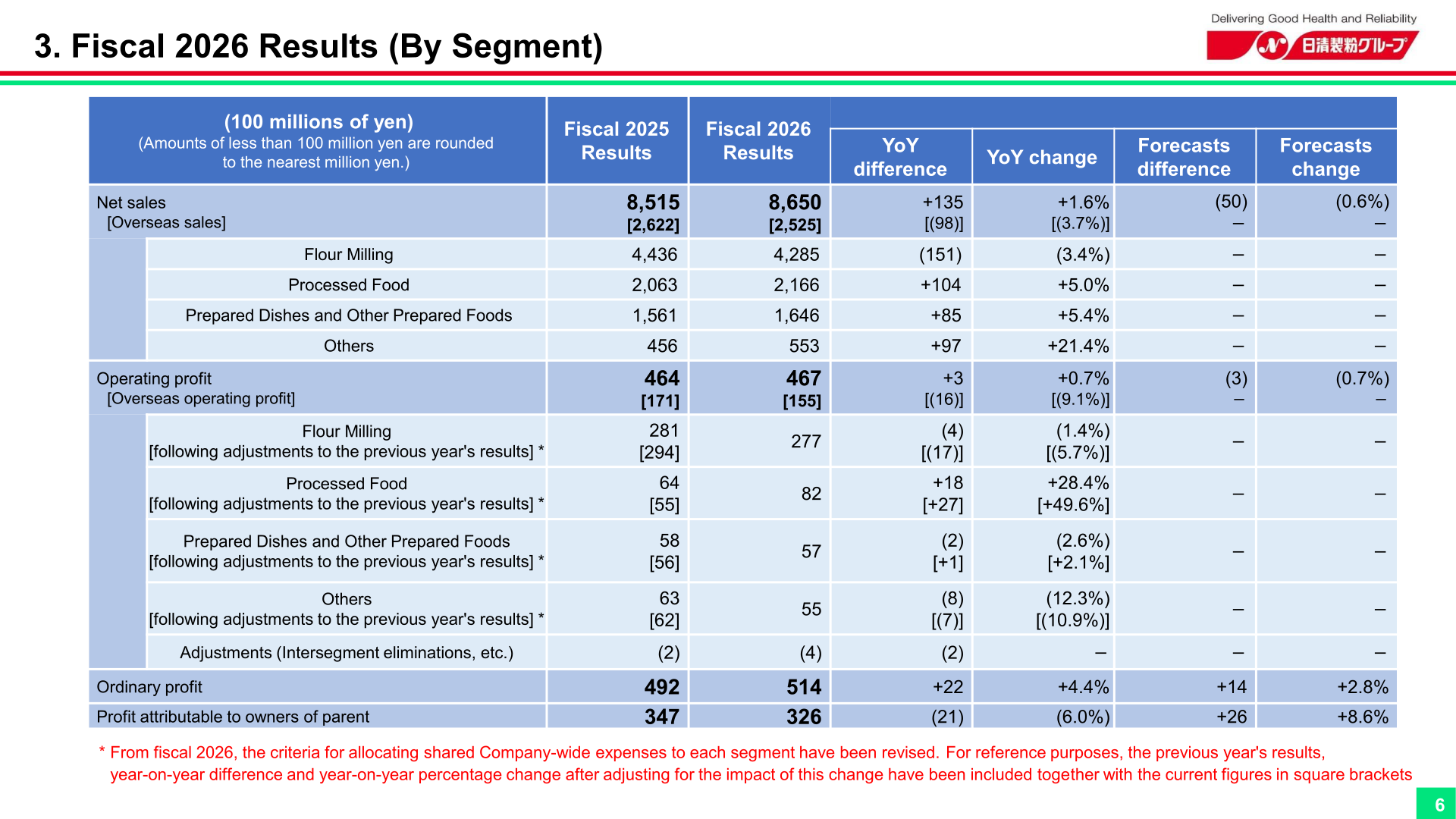
By segment, Flour Milling net sales declined to 4,285 while Processed Food, Prepared Dishes and Other Prepared Foods, and Others all grew. Overseas sales were 2,525 against 2,622 in the prior year, and overseas operating profit was 155 against 171. From fiscal 2026, the criteria for allocating shared Company-wide expenses to each segment have been revised; the company also disclosed prior-year reference figures adjusted for this change in square brackets (Flour Milling 294, Processed Food 55, Prepared Dishes and Other Prepared Foods 56, Others 62).
| Segment (100 millions of yen) | Metric | Fiscal 2026 Results | Fiscal 2025 Results |
|---|---|---|---|
| Flour Milling | Net sales | 4,285 | 4,436 |
| Processed Food | Net sales | 2,166 | 2,063 |
| Prepared Dishes and Other Prepared Foods | Net sales | 1,646 | 1,561 |
| Others | Net sales | 553 | 456 |
| Flour Milling | Operating profit | 277 | 281 |
| Processed Food | Operating profit | 82 | 64 |
| Prepared Dishes and Other Prepared Foods | Operating profit | 57 | 58 |
| Others | Operating profit | 55 | 63 |
| Adjustments (Intersegment eliminations, etc.) | Operating profit | (4) | (2) |
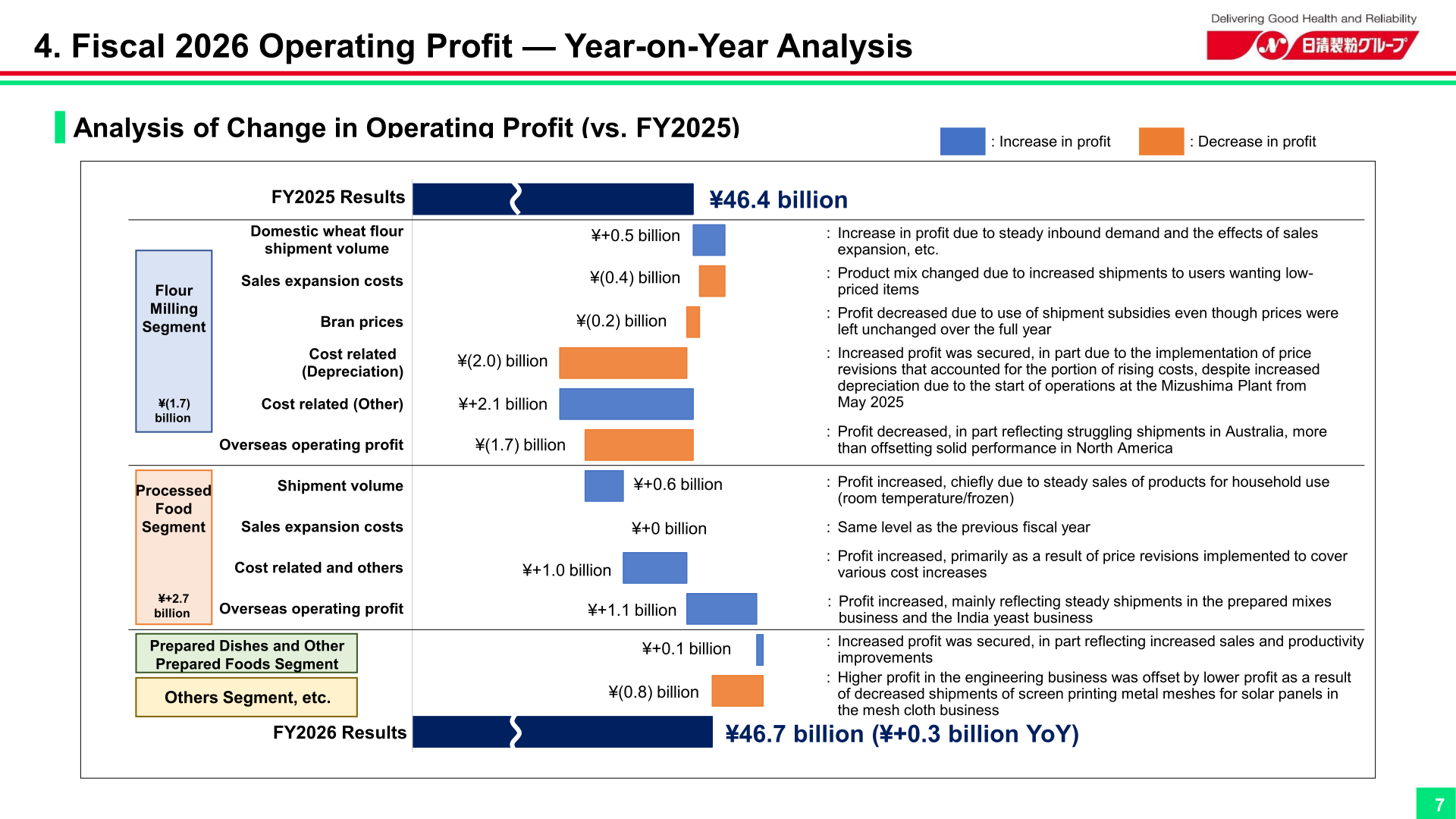
The company presented a year-on-year bridge of operating profit from ¥46.4 billion in FY2025 to ¥46.7 billion in FY2026 (¥+0.3 billion YoY), with the Flour Milling Segment at ¥(1.7) billion, the Processed Food Segment at ¥+2.7 billion, the Prepared Dishes and Other Prepared Foods Segment at ¥+0.1 billion, and Others Segment, etc. at ¥(0.7) billion.
Fiscal 2027 Forecast
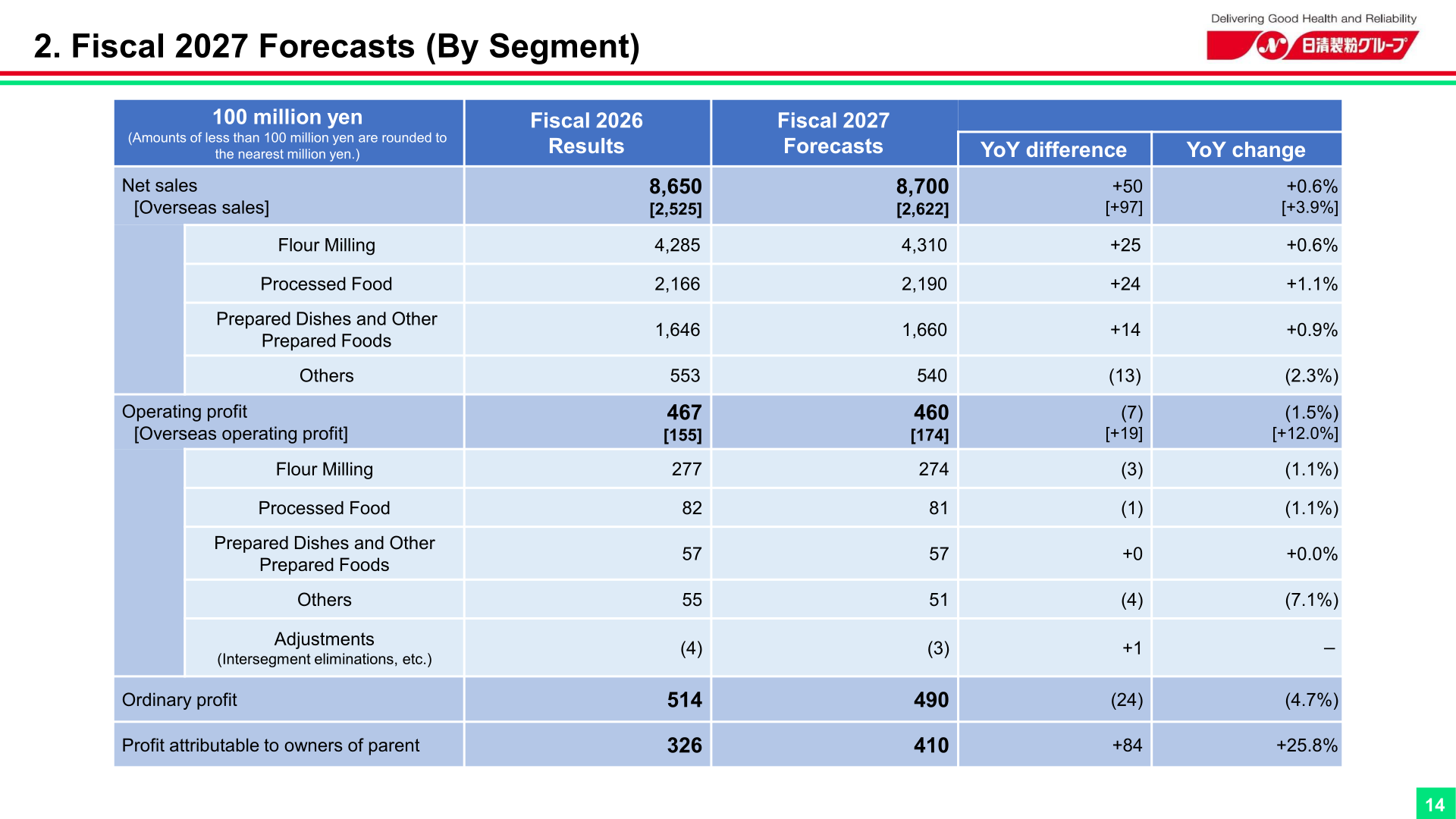
The company projects an increase in net sales, reflecting the effects of price revisions in each business and increased shipments in the Processed Food Segment. It forecasts a decline in operating profit, estimating the impact due to the time lag of passing on cost increases linked with the situation in the Middle East to be ¥(1.5) billion; the operating profit forecast of 460 is stated as including a Middle East impact of (15). Profit attributable to owners of parent is expected to increase, in part due to the absence of impairment losses recognized in the previous fiscal year and further reductions in cross-shareholdings. A forecast ROE of 8.0% is projected for FY2027.
| Item (100 millions of yen) | Fiscal 2027 Forecasts | Fiscal 2026 Results | YoY change |
|---|---|---|---|
| Net sales | 8,700 | 8,650 | +0.6% |
| Overseas sales ratio | 30.1% | 29.2% | - |
| Operating profit | 460 | 467 | (1.5%) |
| Ordinary profit | 490 | 514 | (4.7%) |
| Profit attributable to owners of parent | 410 | 326 | +25.8% |
By segment, the Fiscal 2027 net sales forecast is Flour Milling 4,310, Processed Food 2,190, Prepared Dishes and Other Prepared Foods 1,660 and Others 540. Operating profit is forecast at Flour Milling 274, Processed Food 81, Prepared Dishes and Other Prepared Foods 57, Others 51, with Adjustments of (3).
Shareholder Returns
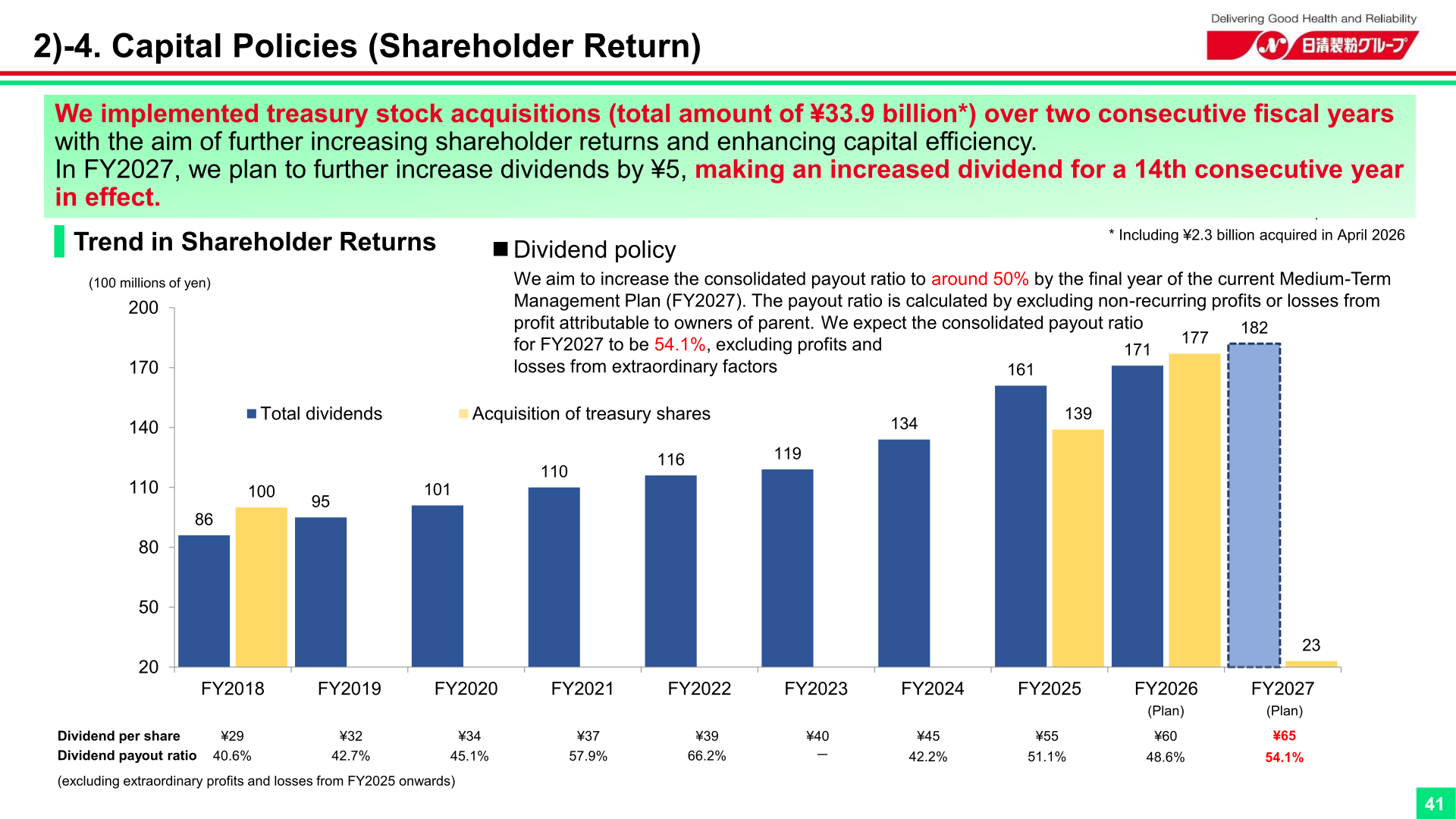
Nisshin Seifun Group aims to increase the consolidated payout ratio to around 50% by the final year of the current Medium-Term Management Plan (FY2027), with the payout ratio calculated by excluding non-recurring profits or losses from profit attributable to owners of parent. It expects the consolidated payout ratio for FY2027 to be 54.1%, excluding profits and losses from extraordinary factors. In FY2027 the company plans to further increase dividends by ¥5, making an increased dividend for a 14th consecutive year in effect. Treasury stock acquisitions totalling ¥33.9 billion (including ¥2.3 billion acquired in April 2026) were implemented over two consecutive fiscal years with the aim of further increasing shareholder returns and enhancing capital efficiency.
| Item | FY2025 | FY2026 (Plan) | FY2027 (Plan) |
|---|---|---|---|
| Dividend per share | ¥55 | ¥60 | ¥65 |
| Dividend payout ratio | 51.1% | 48.6% | 54.1% |
| Total dividends (100 millions of yen) | 161 | 171 | 182 |
| Acquisition of treasury shares (100 millions of yen) | 139 | 177 | 23 |
Capital Policies and Cross-Shareholdings
Under the five-year cash flow plan for Medium-Term Management Plan 2026 (FY2023–FY2027), the company shows cash flows from operating activities of ¥263.0 billion and asset sales and increase/decrease in interest-bearing debt, etc. of ¥50.0 billion as inflows, against growth investment and maintenance and renewal investments of ¥205.0 billion and shareholder returns of ¥108.0 billion as outflows. Group-wide investment was ¥146.1 billion over FY2023–FY2026, with ¥48.0 billion planned for FY2027. On cross-shareholdings, the company will seek a reduction of ¥40.0 billion or more over the five-year period from FY2025 to FY2029; the reduction amount in FY2026 was ¥12.3 billion, which combined with ¥9.0 billion in FY2025 gives a cumulative reduction of ¥21.3 billion over two years. It has adopted a net D/E ratio of 0.3x as a guideline for funding investment.
On a cash flow basis, Fiscal 2026 cash flows from operating activities were 692 versus 552 in Fiscal 2025, cash flows from investing activities were (325) versus (350), and cash flows from financing activities were (408) versus (354), including cash dividends paid of (174) and acquisition of treasury shares of (179). Cash and cash equivalents at end of period were 914. Capital expenditures on a construction basis were 395 versus 416, and depreciation and amortization was 266 versus 238, reflecting operation of the Nisshin Flour Milling Inc. Mizushima Plant.
Medium-Term Plan and Management Direction
FY2027 is the final year of Medium-Term Management Plan 2026 (FY2023 through FY2027). The company announced a change of president: President Takihara will hand over the reins to the next generation under new President Nagaki, believing it preferable for the next management strategies to be considered under the new President. The top priority measures for FY2027 are (1) implementation of multifaceted countermeasures to address inflation, (2) reassessment of the business portfolio and execution of growth strategy, and (3) development of a governance structure with excellent crisis response capabilities.
The direction of management strategy comprises three elements: structural transformation of the earning model by awakening latent competitiveness, redesign of the management infrastructure with a view to maximizing corporate value, and optimization of support functions underpinning the competitive strategy. As part of governance reform, the Board of Directors will shift to a monitoring board structure; following the Ordinary General Meeting of Shareholders in June 2026 the Board is to consist of 14 directors with 8 inside and 6 outside members, versus a previous structure of 11 directors with 5 inside and 6 outside members. A new Group Executive Meeting will be established as the Group’s highest decision-making body for business execution, alongside a new Group Coordination Meeting, and the existing Group Management Meeting will be abolished.
This article is an analysis based on publicly available information and is not a recommendation to buy or sell any specific securities. Investment decisions are your own responsibility.
![[Obayashi] Investors’ Guide 2026 — The Complete 24-Article Breakdown](https://japan-equity.com/wp-content/uploads/2026/07/hub_cover-1024x1024.png)
![[Obayashi] IR & SR Policy — Feeding Dialogue Back into Management](https://japan-equity.com/wp-content/uploads/2026/07/p32_sq-1024x1024.jpg)
![[Obayashi] Real Estate Development — 18.7% Margin, ¥287.7bn Unrealized Gains](https://japan-equity.com/wp-content/uploads/2026/07/p20_sq-1024x1024.jpg)
![[Obayashi] Domestic Civil Engineering — Resilience Spending Supports 9.6% Margin](https://japan-equity.com/wp-content/uploads/2026/07/p11_sq-1024x1024.jpg)
![[Obayashi] Share Price & External Ratings — vs TOPIX, ESG Index Inclusion](https://japan-equity.com/wp-content/uploads/2026/07/p40_sq-1024x1024.jpg)
![[Construction] ¥75.5tn Investment, Shrinking Workforce — Big-5 Market Share](https://japan-equity.com/wp-content/uploads/2026/07/p12_sq-1024x1024.jpg)
![[Obayashi] Capital Policy & Shareholder Returns — ROE 10%+, DOE ~5%, ¥100bn Buyback](https://japan-equity.com/wp-content/uploads/2026/07/p27_sq-1024x1024.jpg)
![[Obayashi] Reducing Cross-Shareholdings — ¥285.2bn Sold in Five Years](https://japan-equity.com/wp-content/uploads/2026/07/p29_sq-1024x1024.jpg)
![[Obayashi] ¥750bn Investment Plan — ¥300bn to Development, ¥190bn to Tech/DX](https://japan-equity.com/wp-content/uploads/2026/07/p30_sq-1024x1024.jpg)
![[Obayashi] MTP2022 KPIs — Operating Profit ~2x Target, ROE 14.4%](https://japan-equity.com/wp-content/uploads/2026/07/p25_sq-1024x1024.jpg)
![[Obayashi] Cash Allocation — ¥420bn Investment CF Over Five Years](https://japan-equity.com/wp-content/uploads/2026/07/p26_sq-1024x1024.jpg)
![[Obayashi] Green Energy — 44 Plants, 344MW, and the Green Hydrogen Challenge](https://japan-equity.com/wp-content/uploads/2026/07/p21_sq-1024x1024.jpg)
![[Obayashi] Tackling the Labor Shortage — Robotics Construction®](https://japan-equity.com/wp-content/uploads/2026/07/p14_sq-1024x1024.jpg)
