
This article is based on publicly available IR materials and is not a recommendation to buy or sell any specific securities.
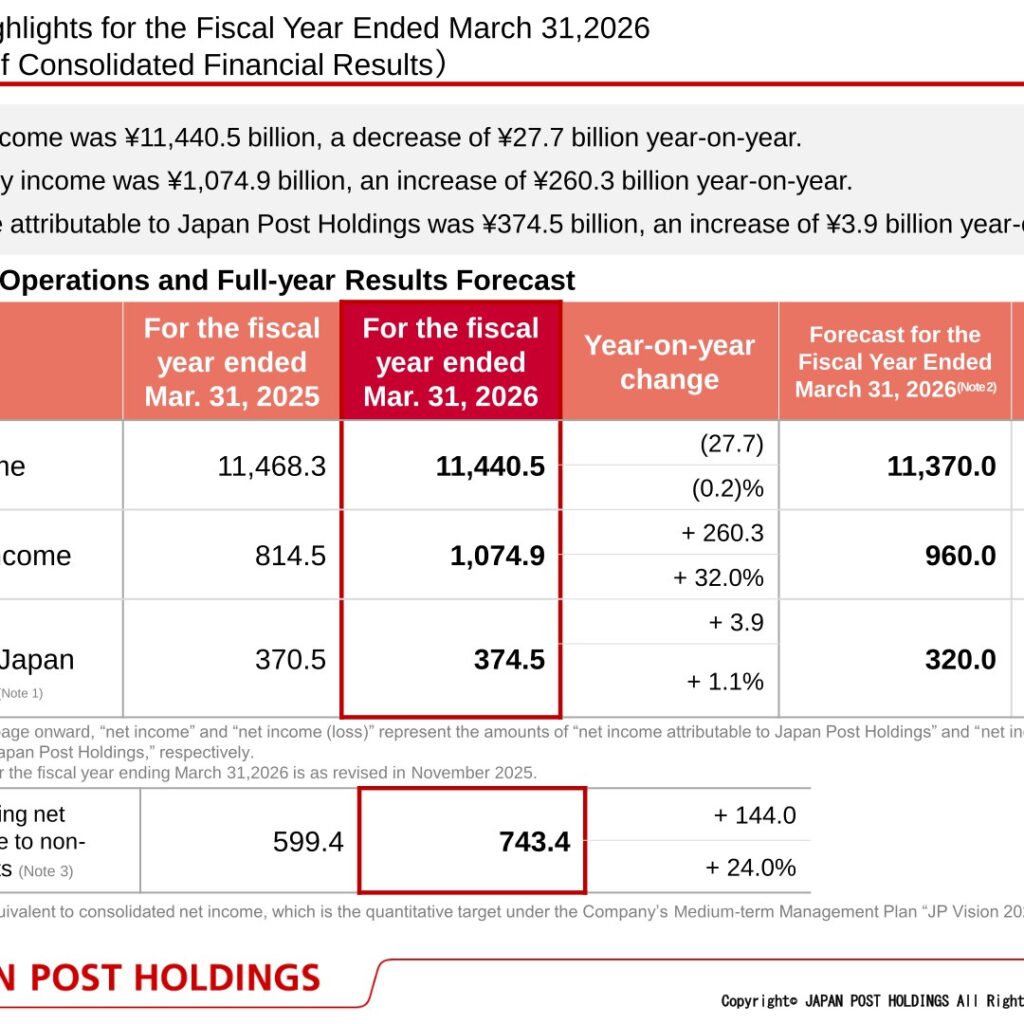
Japan Post Holdings reported ordinary income of ¥11,440.5 billion for the fiscal year ended March 31, 2026, a decrease of ¥27.7 billion (0.2%) year on year, while net ordinary income rose ¥260.3 billion (32.0%) to ¥1,074.9 billion and net income attributable to Japan Post Holdings rose ¥3.9 billion (1.1%) to ¥374.5 billion. All three headline items exceeded the company’s revised full-year forecasts, with net income attributable to Japan Post Holdings reaching 117.0% of the forecast. On May 15, 2026 the group announced a new Medium-term Management Plan, “JP Plan 2028,” covering the three-year period from FY2026, under which the annual dividend is raised to ¥60 and a progressive dividend policy is introduced. Note: Japan Post Holdings labels the fiscal year ended March 31, 2026 as FY2025; the figures and period labels below follow the presentation as reported.
Consolidated Results (Full-Year Actual)
Ordinary income was broadly flat, but net ordinary income increased by ¥260.3 billion, driven by the banking business (net ordinary income up ¥174.6 billion) and the life insurance business (up ¥101.6 billion). Net income including net income attributable to non-controlling interests was ¥743.4 billion, up ¥144.0 billion (24.0%); this is the measure the company defines as the quantitative target under the previous Medium-term Management Plan “JP Vision 2025+.” Amounts are in billions of yen unless stated otherwise, and the FY2026 forecast column is the forecast as revised in November 2025.
| Item | FY ended Mar. 31, 2026 | FY ended Mar. 31, 2025 | Change | Forecast (revised Nov. 2025) | Achievement |
|---|---|---|---|---|---|
| Ordinary income | 11,440.5 | 11,468.3 | (27.7) / (0.2)% | 11,370.0 | 100.6% |
| Net ordinary income | 1,074.9 | 814.5 | + 260.3 / + 32.0% | 960.0 | 112.0% |
| Net income attributable to Japan Post Holdings | 374.5 | 370.5 | + 3.9 / + 1.1% | 320.0 | 117.0% |
| Net income including net income attributable to non-controlling interests | 743.4 | 599.4 | + 144.0 / + 24.0% | – | – |
By principal subsidiary, net income was ¥17.2 billion for Japan Post Co. (consolidated), up ¥21.4 billion year on year; ¥525.5 billion for Japan Post Bank (consolidated), up ¥111.2 billion (26.8%); and ¥168.7 billion for Japan Post Insurance (consolidated), up ¥45.3 billion (36.7%). Ordinary income rose 6.2% to ¥3,666.7 billion at Japan Post Co. and 13.0% to ¥2,852.2 billion at Japan Post Bank, while it fell 8.8% to ¥5,625.7 billion at Japan Post Insurance. Equity method income from Aflac Incorporated was ¥41.6 billion for the fiscal year ended March 31, 2026; the company also recorded a gain on sale of Aflac shares of ¥2.6 billion after its holding ratio exceeded the 10% limit set in the shareholder agreement as a result of Aflac’s own share repurchases. In the company’s five-year indicator table, ROE (based on shareholders’ equity) was 4.5% and PBR was 0.52 times for FY2025.
Segment Results
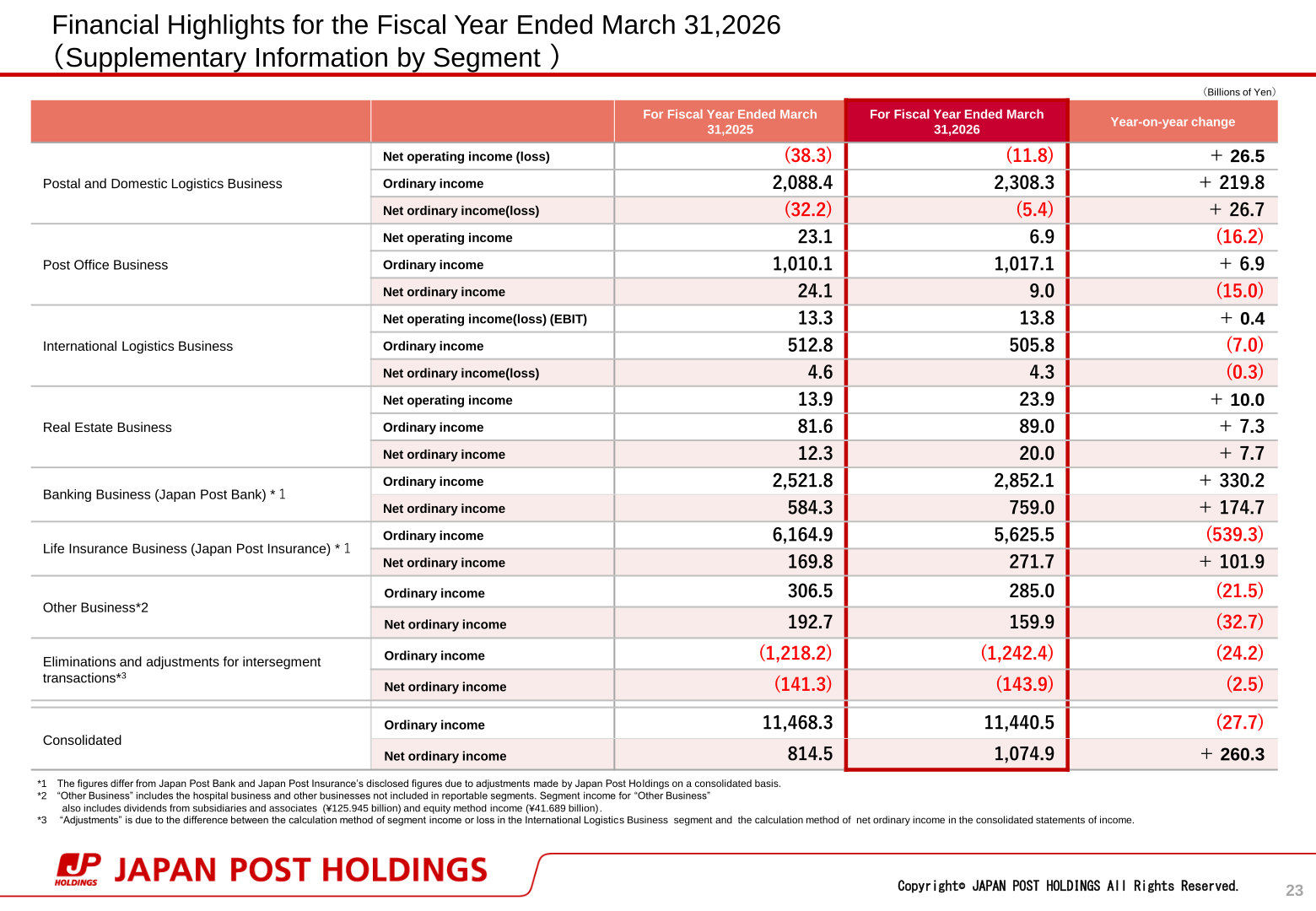
The postal and domestic logistics business narrowed its net operating loss by ¥26.5 billion to ¥(11.8) billion, helped by the October 2024 postage rate revision — whose impact on operating profit in FY2025 the company describes as just under ¥200.0 billion — and by the consolidation of JP Tonami Group, which contributed operating income of ¥163.9 billion, net operating income of ¥7.5 billion and net income of ¥14.2 billion after joining the group. The volume of mail items handled in FY2025 decreased 6.5% year on year. The post office business saw net operating income fall ¥16.2 billion to ¥6.9 billion, while the real estate business grew net operating income by ¥10.0 billion to ¥23.9 billion. Segment figures below are on the group’s supplementary segment basis, which differs from the subsidiaries’ own disclosed figures because of consolidation adjustments.
| Segment | Metric | FY ended Mar. 31, 2026 | FY ended Mar. 31, 2025 | Change |
|---|---|---|---|---|
| Postal and Domestic Logistics Business | Net operating income (loss) | (11.8) | (38.3) | + 26.5 |
| Postal and Domestic Logistics Business | Ordinary income | 2,308.3 | 2,088.4 | + 219.8 |
| Post Office Business | Net operating income | 6.9 | 23.1 | (16.2) |
| Post Office Business | Ordinary income | 1,017.1 | 1,010.1 | + 6.9 |
| International Logistics Business | Net operating income (loss) (EBIT) | 13.8 | 13.3 | + 0.4 |
| International Logistics Business | Ordinary income | 505.8 | 512.8 | (7.0) |
| Real Estate Business | Net operating income | 23.9 | 13.9 | + 10.0 |
| Real Estate Business | Ordinary income | 89.0 | 81.6 | + 7.3 |
| Banking Business (Japan Post Bank) | Net ordinary income | 759.0 | 584.3 | + 174.7 |
| Banking Business (Japan Post Bank) | Ordinary income | 2,852.1 | 2,521.8 | + 330.2 |
| Life Insurance Business (Japan Post Insurance) | Net ordinary income | 271.7 | 169.8 | + 101.9 |
| Life Insurance Business (Japan Post Insurance) | Ordinary income | 5,625.5 | 6,164.9 | (539.3) |
| Other Business | Net ordinary income | 159.9 | 192.7 | (32.7) |
| Eliminations and adjustments for intersegment transactions | Net ordinary income | (143.9) | (141.3) | (2.5) |
| Consolidated | Net ordinary income | 1,074.9 | 814.5 | + 260.3 |
FY2026 Forecast (Fiscal Year Ending March 31, 2027)
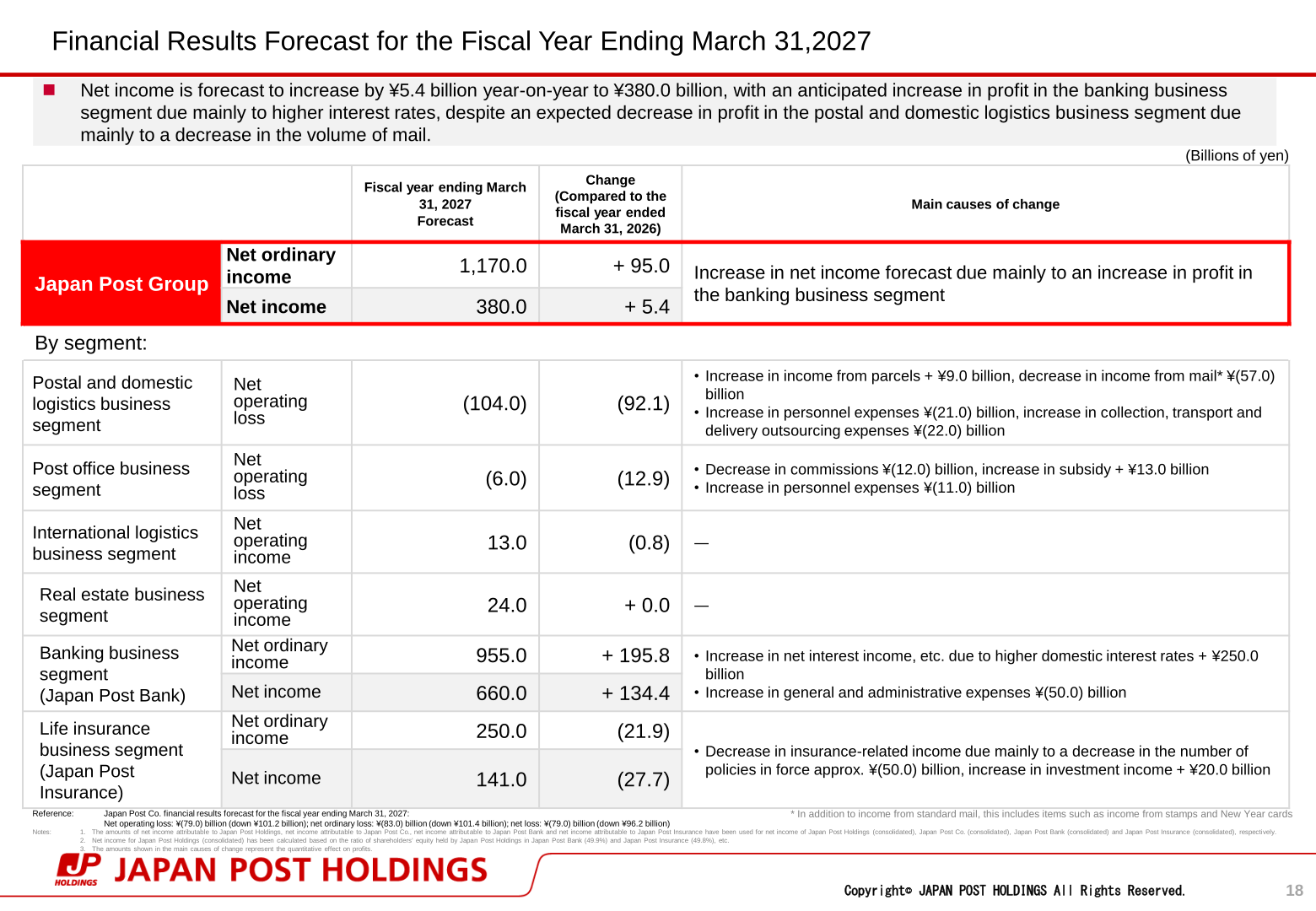
For the fiscal year ending March 31, 2027, the group forecasts net ordinary income of ¥1,170.0 billion, up ¥95.0 billion, and net income of ¥380.0 billion, up ¥5.4 billion. The company attributes the increase mainly to higher profit in the banking business segment on higher interest rates, offsetting an expected decline in the postal and domestic logistics business segment due mainly to a decrease in the volume of mail. In the banking segment, net interest income and related items are expected to rise ¥250.0 billion on higher domestic interest rates, against a ¥50.0 billion increase in general and administrative expenses. The postal and domestic logistics segment forecast assumes a ¥57.0 billion decrease in income from mail against a ¥9.0 billion increase in income from parcels, plus a ¥21.0 billion rise in personnel expenses and a ¥22.0 billion rise in collection, transport and delivery outsourcing expenses. Separately, Japan Post Co. forecasts a net loss of ¥(79.0) billion, down ¥96.2 billion.
| Item | FY ending Mar. 31, 2027 (Forecast) | Change vs FY ended Mar. 31, 2026 |
|---|---|---|
| Japan Post Group — Net ordinary income | 1,170.0 | + 95.0 |
| Japan Post Group — Net income | 380.0 | + 5.4 |
| Postal and domestic logistics business segment — Net operating loss | (104.0) | (92.1) |
| Post office business segment — Net operating loss | (6.0) | (12.9) |
| International logistics business segment — Net operating income | 13.0 | (0.8) |
| Real estate business segment — Net operating income | 24.0 | + 0.0 |
| Banking business segment (Japan Post Bank) — Net ordinary income | 955.0 | + 195.8 |
| Banking business segment (Japan Post Bank) — Net income | 660.0 | + 134.4 |
| Life insurance business segment (Japan Post Insurance) — Net ordinary income | 250.0 | (21.9) |
| Life insurance business segment (Japan Post Insurance) — Net income | 141.0 | (27.7) |
Shareholder Returns
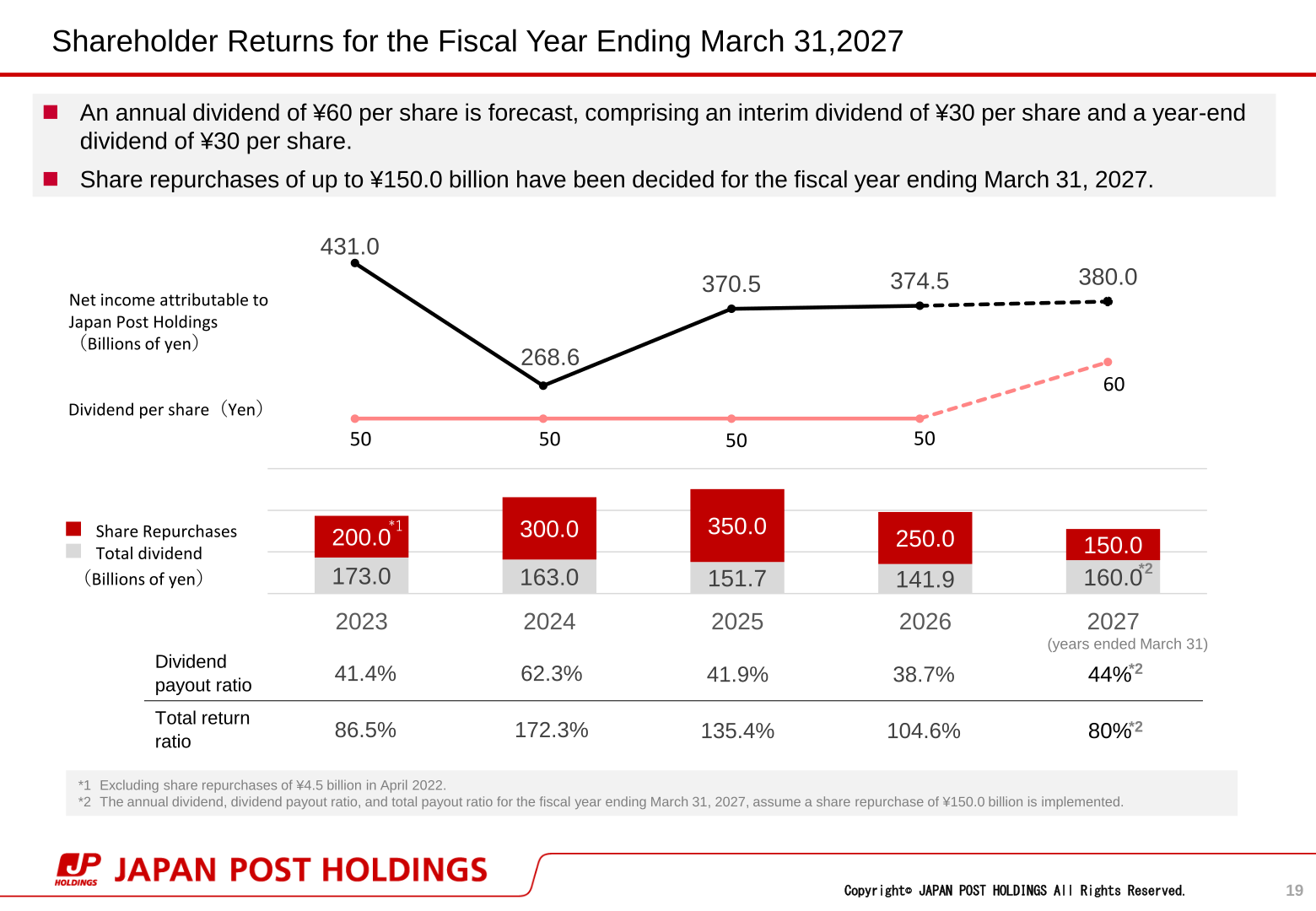
For the fiscal year ending March 31, 2027, an annual dividend of ¥60 per share is forecast, comprising an interim dividend of ¥30 per share and a year-end dividend of ¥30 per share, and share repurchases of up to ¥150.0 billion have been decided. On that basis the company expects a dividend payout ratio of approximately 44% and a total return ratio of approximately 80%. For the fiscal year ended March 31, 2026 the annual dividend was ¥50 per share, total dividends were ¥141.9 billion and share repurchases were ¥250.0 billion, giving a dividend payout ratio of 38.7% and a total return ratio of 104.6%. The annual dividend, dividend payout ratio and total payout ratio for the fiscal year ending March 31, 2027 assume the ¥150.0 billion share repurchase is implemented.
| Item | FY ended Mar. 31, 2025 | FY ended Mar. 31, 2026 | FY ending Mar. 31, 2027 (Forecast) |
|---|---|---|---|
| Dividend per share (yen) | 50 | 50 | 60 |
| Total dividend (billions of yen) | 151.7 | 141.9 | 160.0 |
| Share repurchases (billions of yen) | 350.0 | 250.0 | 150.0 |
| Dividend payout ratio | 41.9% | 38.7% | 44% |
| Total return ratio | 135.4% | 104.6% | 80% |
| Net income attributable to Japan Post Holdings (billions of yen) | 370.5 | 374.5 | 380.0 |
Medium-Term Management Plan: JP Plan 2028
On May 15, 2026 the company announced a new Medium-term Management Plan, “JP Plan 2028,” covering the three-year period from FY2026. The plan’s stated aim is to simultaneously ensure the sustainability of universal service and achieve growth in new business areas and other fields, and it is organised around three key points: materialization of shifting management resources to growth areas; proactive information disclosure in light of market feedback; and strengthening governance. Under the first point, the group will carry out structural reform of the postal and post office businesses, including consolidating collection and delivery post offices from approximately 3,200 to approximately 2,700 — a reduction of about 500 bases that the company expects to generate efficiency gains of approximately ¥5.0 billion — while investing in growth areas including the real estate and logistics businesses. Under the third point, a new organization will be established at branches and other locations to provide detailed guidance and support on compliance and business quality, with new functions at approximately 50 locations throughout Japan.
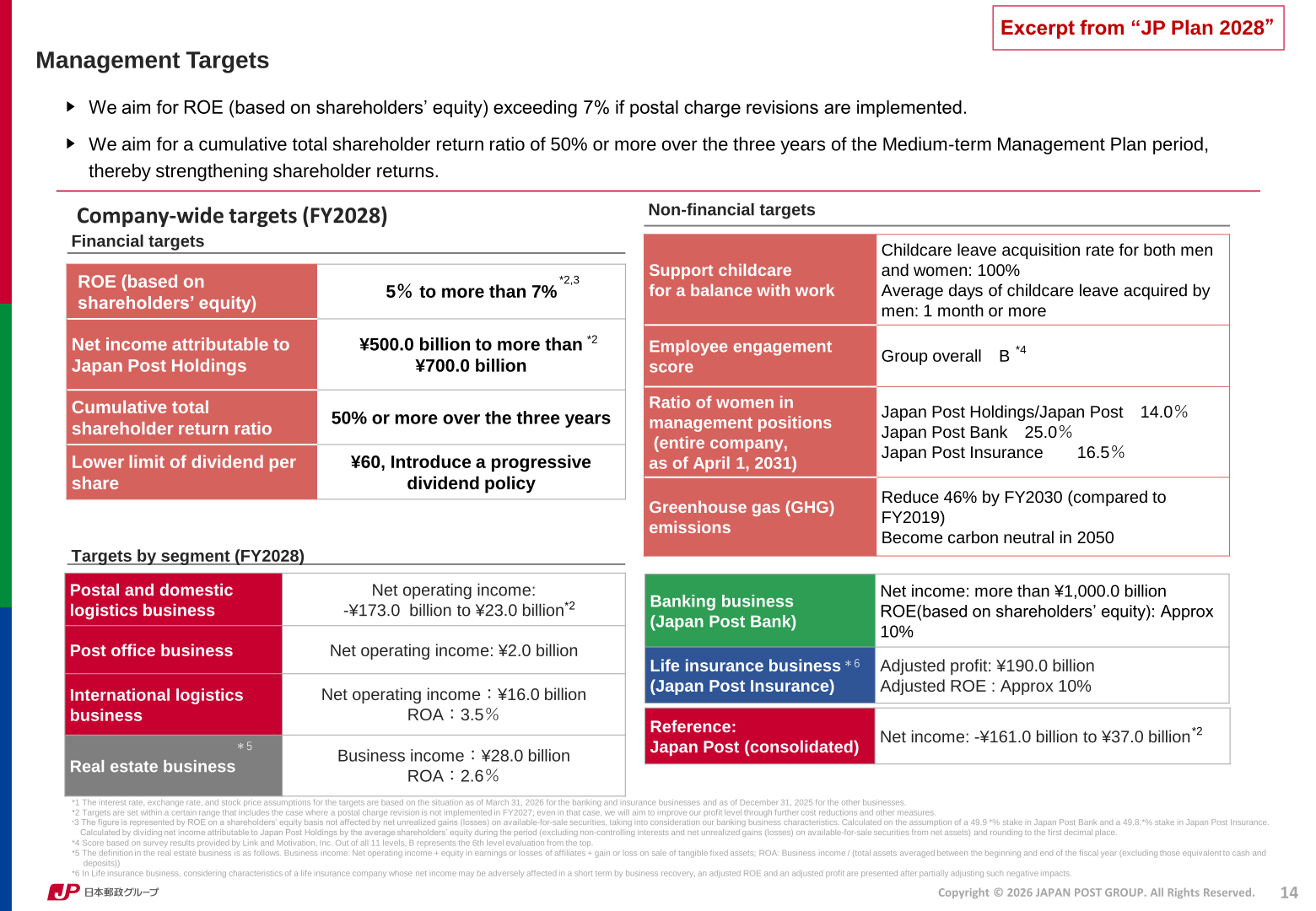
The company-wide FY2028 financial targets are ROE (based on shareholders’ equity) of 5% to more than 7%, net income attributable to Japan Post Holdings of ¥500.0 billion to more than ¥700.0 billion, a cumulative total shareholder return ratio of 50% or more over the three years, and a lower limit of dividend per share of ¥60 with a progressive dividend policy. The company states that it aims for ROE (based on shareholders’ equity) exceeding 7% if postal charge revisions are implemented, and that the targets are set within a range that includes the case where a postal charge revision is not implemented in FY2027. Segment targets for FY2028 are net operating income of ¥(173.0) billion to ¥23.0 billion for the postal and domestic logistics business, ¥2.0 billion for the post office business, ¥16.0 billion (ROA 3.5%) for the international logistics business, and business income of ¥28.0 billion (ROA 2.6%) for the real estate business. Japan Post Bank targets net income of more than ¥1,000.0 billion and ROE (based on shareholders’ equity) of approximately 10%, and Japan Post Insurance targets adjusted profit of ¥190.0 billion and adjusted ROE of approximately 10%.
As part of the plan’s proactive disclosure commitment, the company published a cash allocation framework excluding the two financial subsidiaries for FY2026–FY2028. Cash-in comprises operating cash flow plus dividends received and other items of ¥300.0 billion to ¥600.0 billion, proceeds from the sale of shares of ¥300.0 billion, and funds from balance sheet control and interest-bearing debt. Cash-out comprises investment of ¥900.0 billion, including strategic investment of ¥300.0 billion for M&A for inorganic growth, and shareholder returns of ¥650.0 billion to ¥800.0 billion. Non-financial FY2028 targets include a 100% childcare leave utilization rate for both men and women, a group-wide engagement score of grade B, ratios of women in management positions of 14.0% at Japan Post Holdings and Japan Post Co., 25.0% at Japan Post Bank and 16.5% at Japan Post Insurance (as of April 1, 2031), and a 46% reduction in greenhouse gas emissions by FY2030 compared with FY2019, with carbon neutrality in 2050.
This article is an analysis based on publicly available information and is not a recommendation to buy or sell any specific securities. Investment decisions are your own responsibility.
![[Obayashi] Investors’ Guide 2026 — The Complete 24-Article Breakdown](https://japan-equity.com/wp-content/uploads/2026/07/hub_cover-1024x1024.png)
![[Obayashi] IR & SR Policy — Feeding Dialogue Back into Management](https://japan-equity.com/wp-content/uploads/2026/07/p32_sq-1024x1024.jpg)
![[Obayashi] Real Estate Development — 18.7% Margin, ¥287.7bn Unrealized Gains](https://japan-equity.com/wp-content/uploads/2026/07/p20_sq-1024x1024.jpg)
![[Obayashi] Domestic Civil Engineering — Resilience Spending Supports 9.6% Margin](https://japan-equity.com/wp-content/uploads/2026/07/p11_sq-1024x1024.jpg)
![[Obayashi] Share Price & External Ratings — vs TOPIX, ESG Index Inclusion](https://japan-equity.com/wp-content/uploads/2026/07/p40_sq-1024x1024.jpg)
![[Construction] ¥75.5tn Investment, Shrinking Workforce — Big-5 Market Share](https://japan-equity.com/wp-content/uploads/2026/07/p12_sq-1024x1024.jpg)
![[Obayashi] Capital Policy & Shareholder Returns — ROE 10%+, DOE ~5%, ¥100bn Buyback](https://japan-equity.com/wp-content/uploads/2026/07/p27_sq-1024x1024.jpg)
![[Obayashi] Reducing Cross-Shareholdings — ¥285.2bn Sold in Five Years](https://japan-equity.com/wp-content/uploads/2026/07/p29_sq-1024x1024.jpg)
![[Obayashi] ¥750bn Investment Plan — ¥300bn to Development, ¥190bn to Tech/DX](https://japan-equity.com/wp-content/uploads/2026/07/p30_sq-1024x1024.jpg)
![[Obayashi] MTP2022 KPIs — Operating Profit ~2x Target, ROE 14.4%](https://japan-equity.com/wp-content/uploads/2026/07/p25_sq-1024x1024.jpg)
![[Obayashi] Cash Allocation — ¥420bn Investment CF Over Five Years](https://japan-equity.com/wp-content/uploads/2026/07/p26_sq-1024x1024.jpg)
![[Obayashi] Green Energy — 44 Plants, 344MW, and the Green Hydrogen Challenge](https://japan-equity.com/wp-content/uploads/2026/07/p21_sq-1024x1024.jpg)
![[Obayashi] Tackling the Labor Shortage — Robotics Construction®](https://japan-equity.com/wp-content/uploads/2026/07/p14_sq-1024x1024.jpg)
