This article is based on publicly available IR materials and is not a recommendation to buy or sell any specific securities.
Note: The Fukui Bank does not publish an English results presentation; this article is an English translation of the Japanese-language article on our sister site Investalk, which is based on the company’s Japanese-language IR materials, with figures transcribed as reported. The company refers to the fiscal year ended March 31, 2026 as “the fiscal year ended March 2026” (2026年3月期); this site classifies it as FY2025.
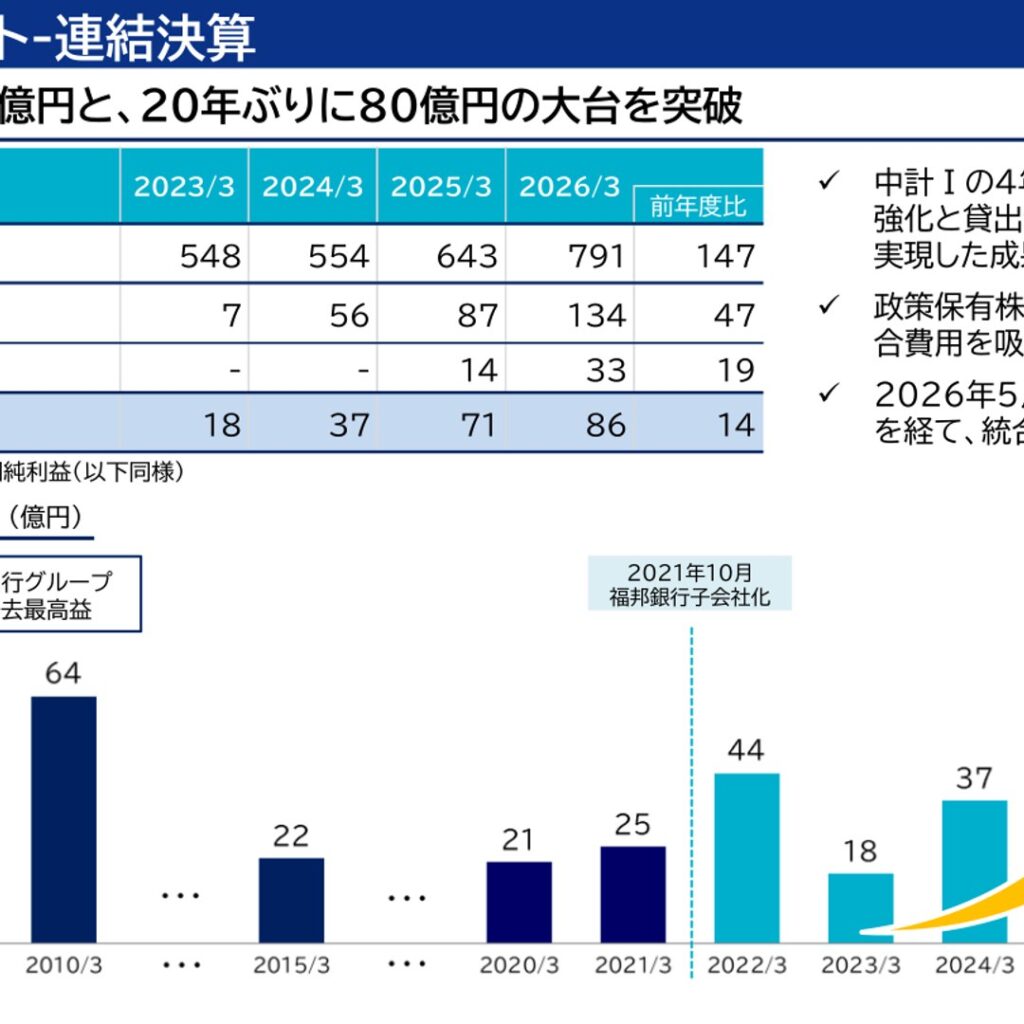
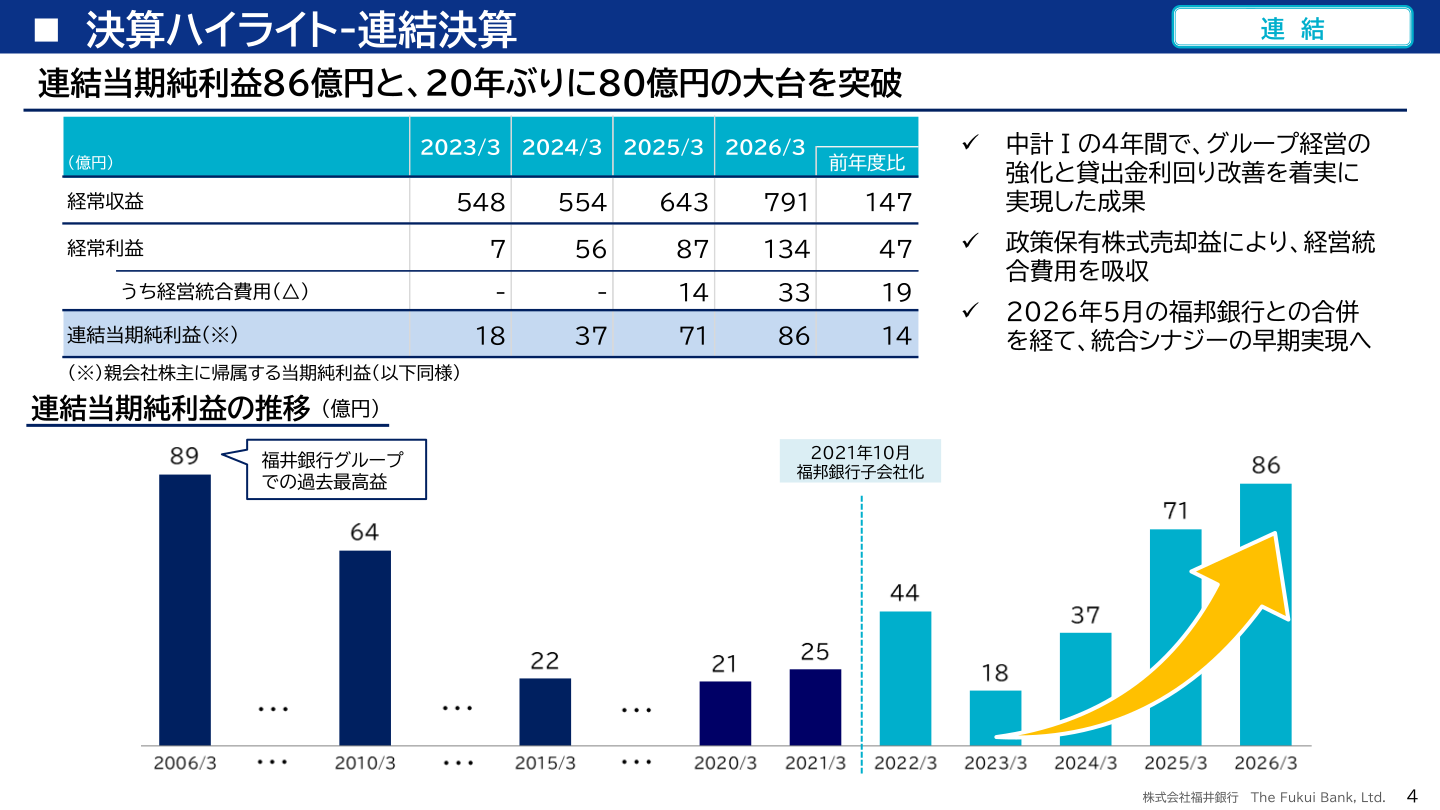
For the fiscal year ended March 31, 2026 (FY2025), The Fukui Bank, Ltd. posted consolidated net income attributable to owners of parent of ¥8.6 billion (up ¥1.4 billion year on year), surpassing the ¥8.0 billion level for the first time in 20 years, since the fiscal year ended March 2006. Non-consolidated net income reached a record ¥10.5 billion (up ¥3.7 billion year on year). Top-line revenue expanded, centered on higher interest income on loans, while gains on sales of policy-holding stocks absorbed the costs of business integration. In May 2026, the Bank carried out its merger with subsidiary THE FUKUHO BANK, LTD., and stated it will work to achieve integration synergies at an early stage.
Results (FY ended March 31, 2026, Actual)
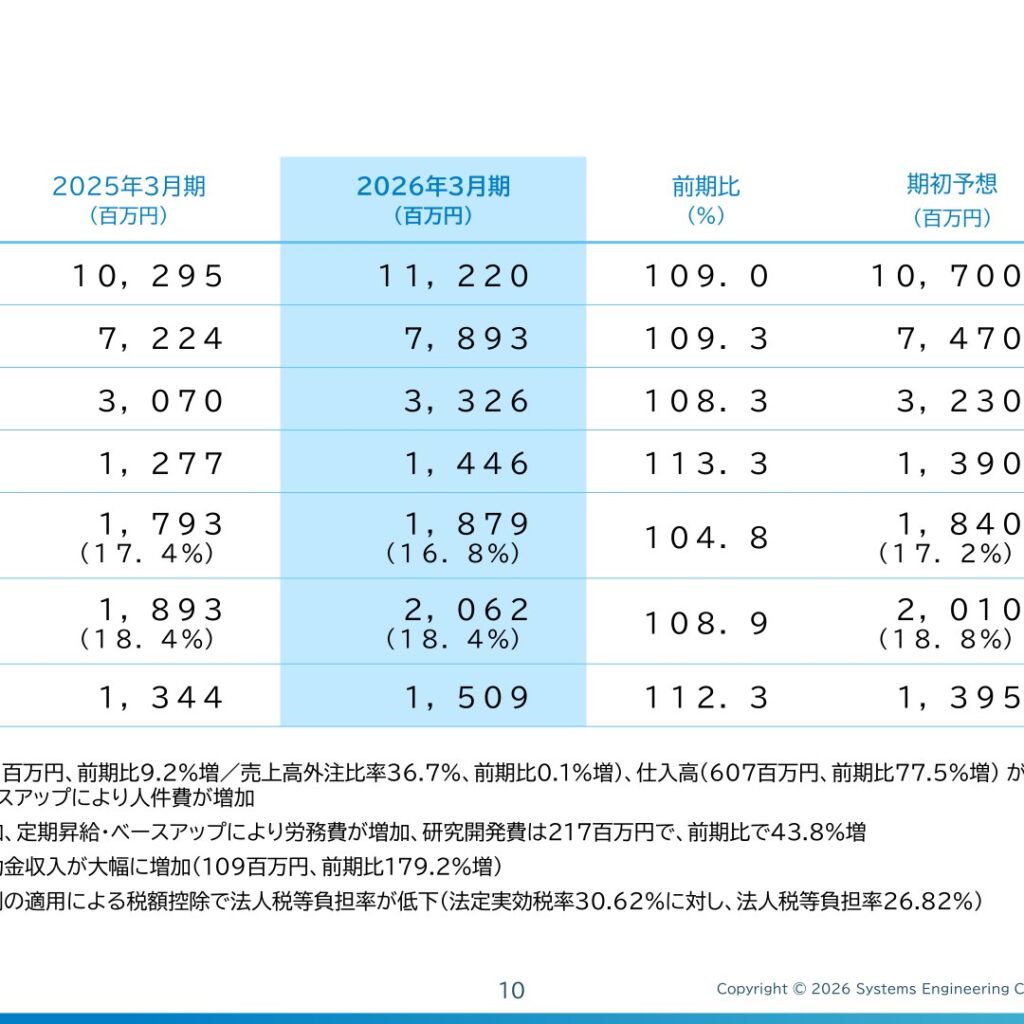
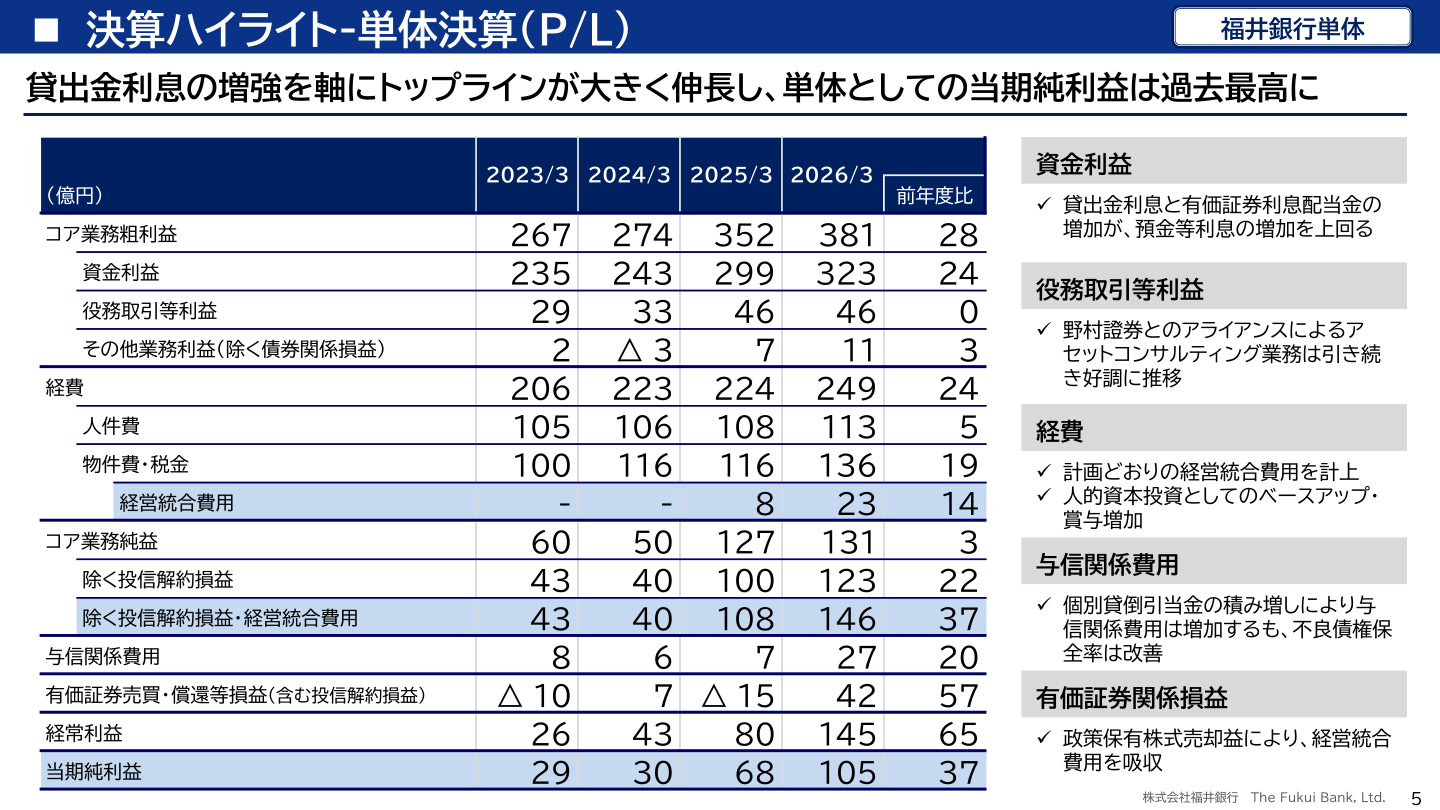
On a non-consolidated basis, net interest income rose to ¥32.3 billion (up ¥2.4 billion year on year), as the increase in interest income on loans and interest and dividends on securities exceeded the increase in interest paid on deposits and other. Core gross business profit was ¥38.1 billion (up ¥2.8 billion). Expenses increased to ¥24.9 billion (up ¥2.4 billion, of which business integration costs were ¥2.3 billion), reflecting base-pay and bonus increases as part of human capital investment and business integration costs booked as planned. Credit-related costs rose to ¥2.7 billion (up ¥2.0 billion) due to an increase in individual provisions for loan losses, although the coverage ratio for non-performing loans improved, according to the materials. Gains/losses on sales and redemption of securities (including gains/losses on cancellation of investment trusts) came to a gain of ¥4.2 billion (versus a loss of ¥1.5 billion in the previous fiscal year) on gains on sales of policy-holding stocks, which absorbed business integration costs.
| Item (Consolidated) | FY ended March 31, 2026 | FY ended March 31, 2025 | Change |
|---|---|---|---|
| Ordinary income | ¥79.1 billion | ¥64.3 billion | +¥14.7 billion |
| Ordinary profit | ¥13.4 billion | ¥8.7 billion | +¥4.7 billion |
| — of which: business integration costs | ¥3.3 billion | ¥1.4 billion | +¥1.9 billion |
| Consolidated net income attributable to owners of parent | ¥8.6 billion | ¥7.1 billion | +¥1.4 billion |
| Item (Non-Consolidated) | FY ended March 31, 2026 | FY ended March 31, 2025 | Change |
|---|---|---|---|
| Core gross business profit | ¥38.1 billion | ¥35.2 billion | +¥2.8 billion |
| Net interest income | ¥32.3 billion | ¥29.9 billion | +¥2.4 billion |
| Net fee and commission income | ¥4.6 billion | ¥4.6 billion | +¥0.0 billion |
| Expenses | ¥24.9 billion | ¥22.4 billion | +¥2.4 billion |
| — of which: business integration costs | ¥2.3 billion | ¥0.8 billion | +¥1.4 billion |
| Core net business profit | ¥13.1 billion | ¥12.7 billion | +¥0.3 billion |
| Core net business profit (excl. gains/losses on cancellation of investment trusts and business integration costs) | ¥14.6 billion | ¥10.8 billion | +¥3.7 billion |
| Credit-related costs | ¥2.7 billion | ¥0.7 billion | +¥2.0 billion |
| Gains/losses on sales and redemption of securities (incl. gains/losses on cancellation of investment trusts) | ¥4.2 billion | -¥1.5 billion | +¥5.7 billion |
| Ordinary profit | ¥14.5 billion | ¥8.0 billion | +¥6.5 billion |
| Net income | ¥10.5 billion | ¥6.8 billion | +¥3.7 billion |
Business Integration with THE FUKUHO BANK
The Fukui Bank made THE FUKUHO BANK, LTD. a subsidiary in October 2021 and carried out its merger with FUKUHO BANK in May 2026. On a non-consolidated basis, FUKUHO BANK booked business integration costs of ¥1.0 billion (up ¥0.4 billion year on year) related to system integration ahead of the merger and branch consolidation, among other factors, for the fiscal year ended March 31, 2026; as a result, ordinary profit decreased by ¥1.2 billion year on year to a loss of ¥0.9 billion, and net income decreased by ¥1.8 billion year on year to a loss of ¥1.4 billion.
Full-Year Forecast (FY ending March 31, 2027)
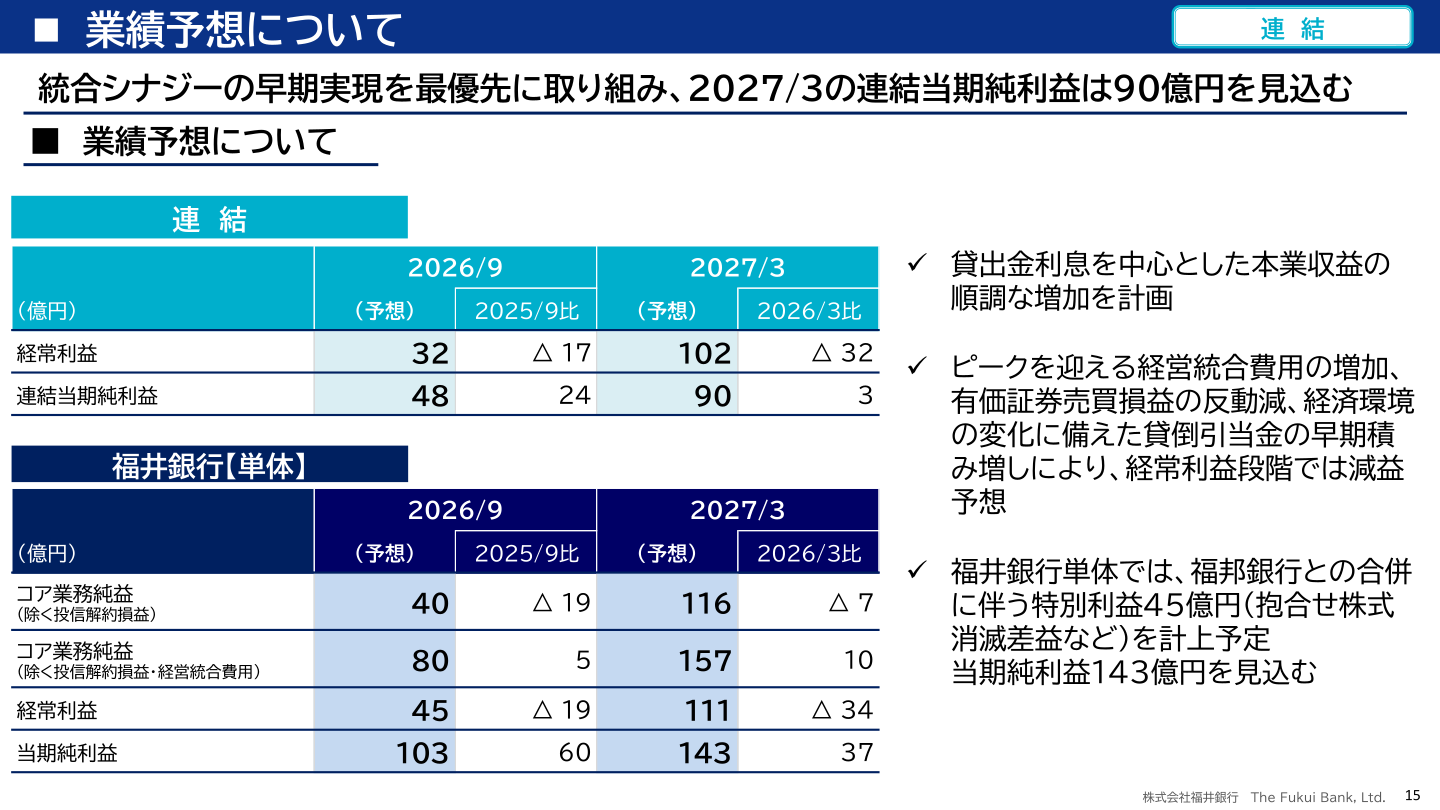
For the fiscal year ending March 31, 2027, the Bank plans steady growth in core banking revenue, centered on interest income on loans, but expects a decline in ordinary profit due to business integration costs peaking, a reactionary decrease in gains on securities transactions, and early additional provisioning for loan losses in preparation for changes in the economic environment. On a non-consolidated basis, The Fukui Bank plans to record an extraordinary gain of ¥4.5 billion (including gain on extinguishment of investment in subsidiary through merger, etc.) associated with the merger with FUKUHO BANK, and expects net income of ¥14.3 billion (up ¥3.7 billion from FY ended March 31, 2026). Prioritizing the early realization of integration synergies, the Bank expects consolidated net income attributable to owners of parent of ¥9.0 billion for the fiscal year ending March 31, 2027.
| Item | Category | FY ending March 31, 2027 (Forecast) | Change from FY ended March 31, 2026 |
|---|---|---|---|
| Ordinary profit | Consolidated | ¥10.2 billion | -¥3.2 billion |
| Consolidated net income attributable to owners of parent | Consolidated | ¥9.0 billion | +¥0.3 billion |
| Ordinary profit | Non-Consolidated | ¥11.1 billion | -¥3.4 billion |
| Net income | Non-Consolidated | ¥14.3 billion | +¥3.7 billion |
| Core net business profit (excl. gains/losses on cancellation of investment trusts and business integration costs) | Non-Consolidated | ¥15.7 billion | +¥1.0 billion |
Shareholder Returns
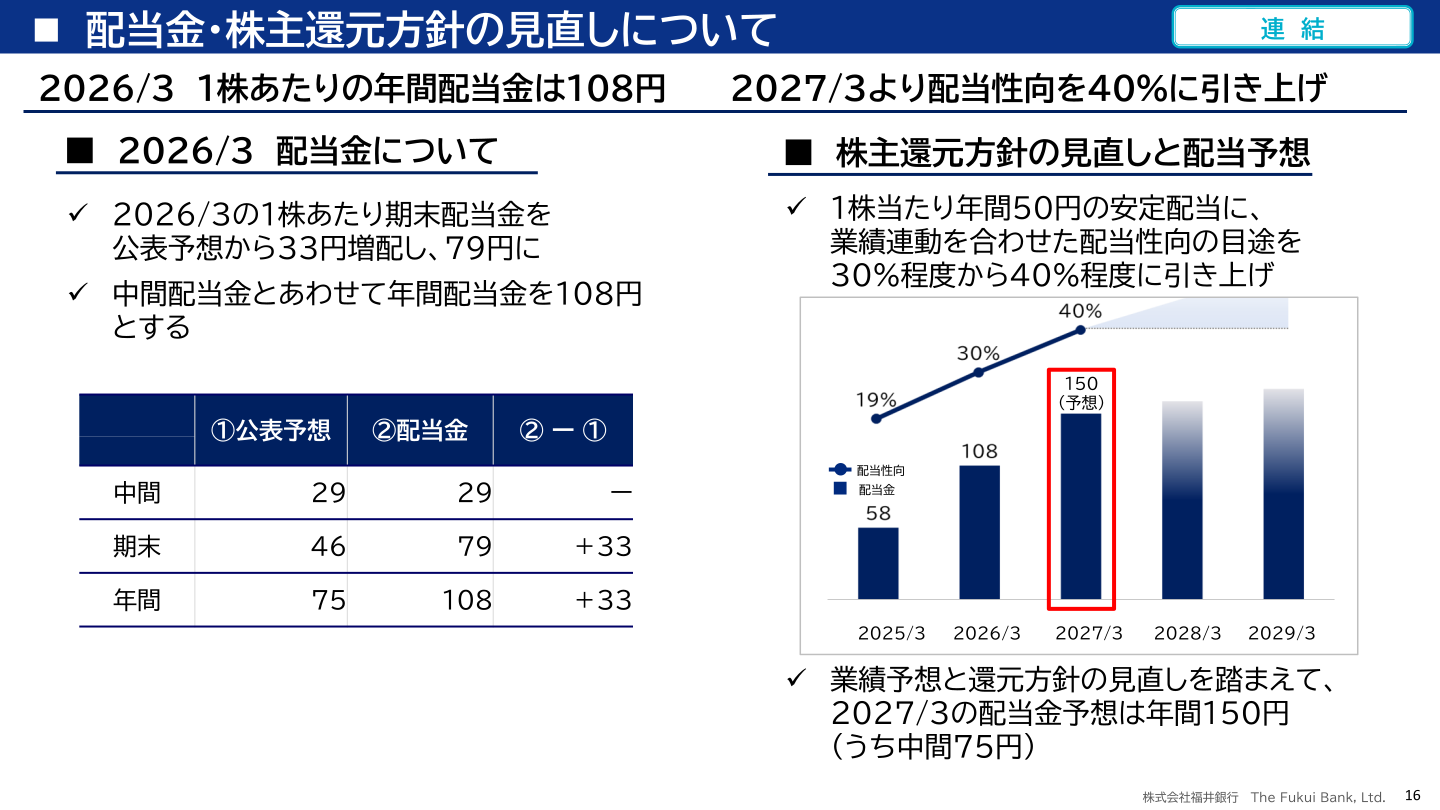
The year-end dividend per share for FY ended March 31, 2026 was set at ¥79, an increase of ¥33 from the ¥46 forecast announced in October 2025. Combined with the interim dividend of ¥29, the annual dividend totaled ¥108. The Bank has revised its shareholder return policy, raising its target payout ratio — combining a stable annual dividend of ¥50 per share with a performance-linked component — from around 30% to around 40%. The dividend forecast for the fiscal year ending March 31, 2027 is an annual ¥150 (including an interim dividend of ¥75). The Bank also stated it will expand its shareholder benefit program by establishing new shareholding-tier categories and introducing preferential treatment for long-term continuous shareholders.
| Fiscal Year | Dividend per Share | Payout Ratio |
|---|---|---|
| FY ended March 31, 2025 | ¥58 | 19% |
| FY ended March 31, 2026 | ¥108 (interim ¥29, year-end ¥79) | 30% |
| FY ending March 31, 2027 (Forecast) | ¥150 (incl. interim ¥75) | 40% (target) |
Medium-Term Management Plan
According to the materials, the Bank achieved all of the target management indicators set out in Medium-Term Management Plan I (consolidated). Medium-Term Management Plan II began in FY2025 (fiscal year ended March 31, 2026), under which the Bank will pursue “three growth strategies.” The Bank plans to achieve ahead of schedule, by the fiscal year ending March 31, 2029, the consolidated net income of ¥10.0 billion set as the challenge goal under Medium-Term Management Plan II.
This article is an analysis based on publicly available information and is not a recommendation to buy or sell any specific securities. Investment decisions are your own responsibility.