
This article is based on publicly available IR materials and is not a recommendation to buy or sell any specific securities.
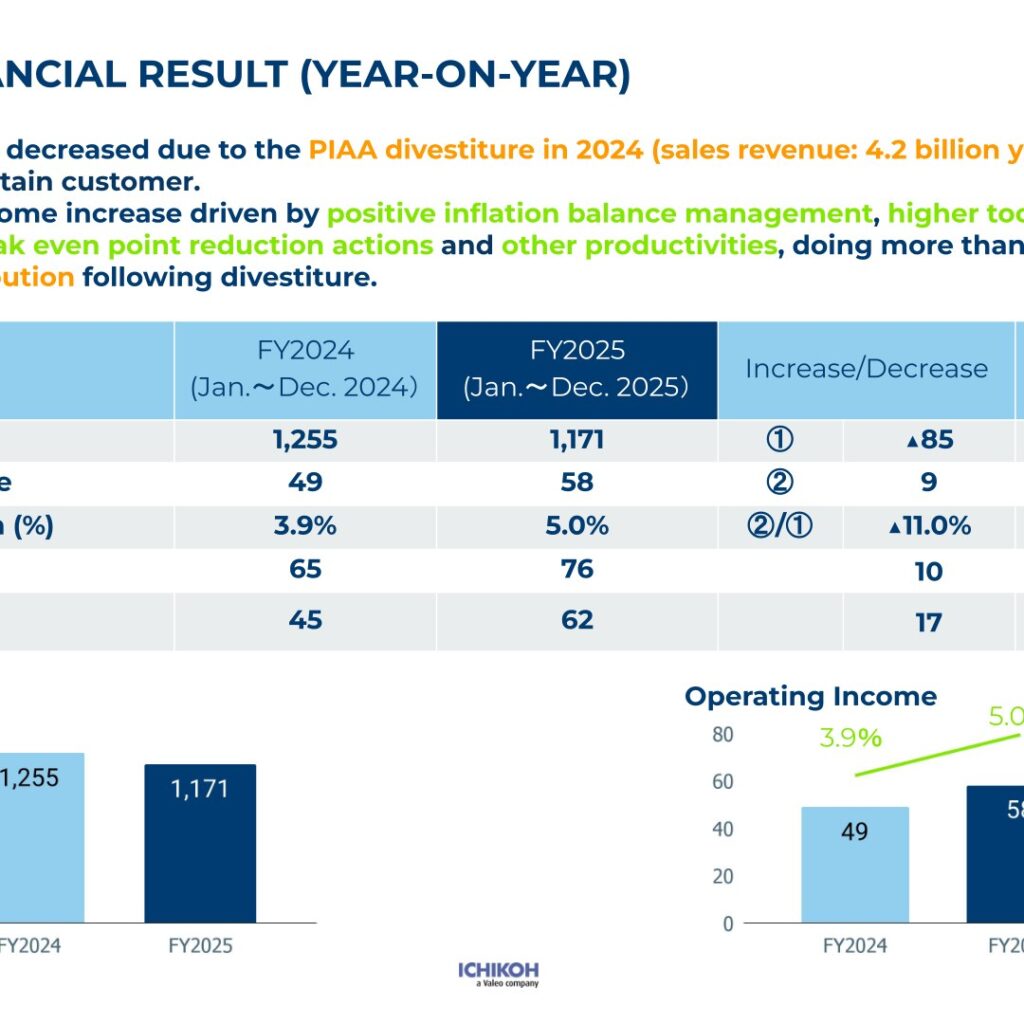
Ichikoh Industries closed FY2025 (January to December 2025) with sales of 1,171 hundreds million yen, down 6.7% year on year, while operating income rose 19.1% to 58 hundreds million yen and the operating margin improved from 3.9% to 5.0%. Ordinary income reached 76 hundreds million yen and net income 62 hundreds million yen. The company also raised its FY2025 annual dividend to 14 yen per share and plans a further increase to 18 yen for FY2026.
Consolidated Results (Full-Year Actual)
The company reports that sales revenue decreased due to the PIAA divestiture in 2024 (sales revenue: 4.2 billion yen) and lower demand specific to certain customer. Operating income increase was driven by positive inflation balance management, higher tooling income from new launches, break even point reduction actions and other productivities, doing more than offsetting decrease of PIAA’s contribution following divestiture. Figures below are in hundreds million yen, as presented in the materials.
| Item | FY2024 (Jan.-Dec. 2024) | FY2025 (Jan.-Dec. 2025) | Increase/Decrease | Increase/Decrease % |
|---|---|---|---|---|
| Sales | 1,255 | 1,171 | ▲85 | ▲6.7% |
| Operating Income | 49 | 58 | 9 | 19.1% |
| Operating Margin (%) | 3.9% | 5.0% | 1.1 pt | |
| Ordinary Income | 65 | 76 | 10 | 16.1% |
| Net Income | 45 | 62 | 17 | 38.8% |
Against the FY2025 forecast announced in TSE on Nov. 14th, 2025 (sales 1,210, operating income 54, ordinary income 62, net income 39), sales came in 39 lower (▲3.2%) while operating income was 4 higher (7.7%), ordinary income 14 higher (22.0%) and net income 23 higher (59.1%). The company states that sales fell short of expectations due to the contraction of the ASEAN market while specific customers are facing headwinds and slower launch of new models, whereas profits benefited from operational productivities, self-help measures, good inflation management, customer compensations for cancelled programs, equity contribution from Chinese JVs and real estate sales.
The operating income bridge from FY2024 to FY2025 shows FY2024 operating income of 49, perimeter change ▲2, sales decrease ▲19 and R&D ▲2 (impact from decreased sales -23), offset by inflation balance +12, direct costs of non quality +3 and productivity improvement +7 (recurring improvements +22), plus non recurring +10, arriving at FY2025 operating income of 58. From operating income to net income, equity in earnings of affiliates added 20 (the lighting joint ventures with Valeo in China), foreign exchange losses ▲4 and others 1 led to ordinary income of 76; gain on sale of fixed assets 2, business structure improvement expenses ▲5, others ▲1 and current tax ▲10 led to net income of 62.
Results by Region
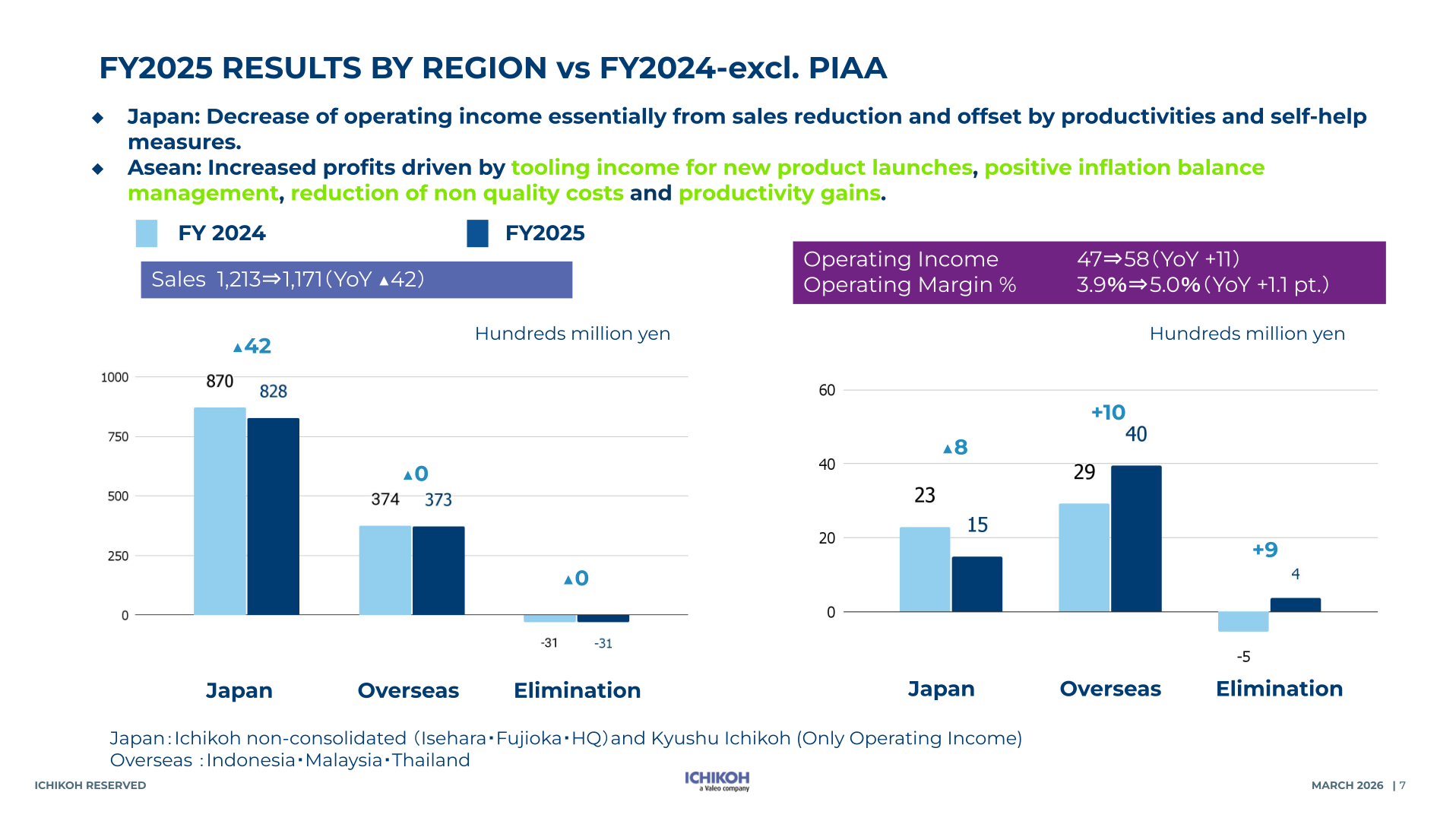
The materials break FY2025 down into Japan (Ichikoh non-consolidated — Isehara, Fujioka, HQ — and Kyushu Ichikoh for operating income only), Overseas (Indonesia, Malaysia, Thailand) and Elimination, compared with FY2024 excluding PIAA. Japan saw a decrease of operating income essentially from sales reduction, offset by productivities and self-help measures, while ASEAN increased profits driven by tooling income for new product launches, positive inflation balance management, reduction of non quality costs and productivity gains.
| Region | Metric | FY2024 (excl. PIAA) | FY2025 | Increase/Decrease |
|---|---|---|---|---|
| Japan | Sales | 870 | 828 | ▲42 |
| Overseas | Sales | 374 | 373 | ▲0 |
| Elimination | Sales | -31 | -31 | ▲0 |
| Total | Sales | 1,213 | 1,171 | ▲42 |
| Japan | Operating Income | 23 | 15 | ▲8 |
| Overseas | Operating Income | 29 | 40 | +10 |
| Elimination | Operating Income | -5 | 4 | +9 |
| Total | Operating Income | 47 | 58 | +11 |
FY2026 Forecast
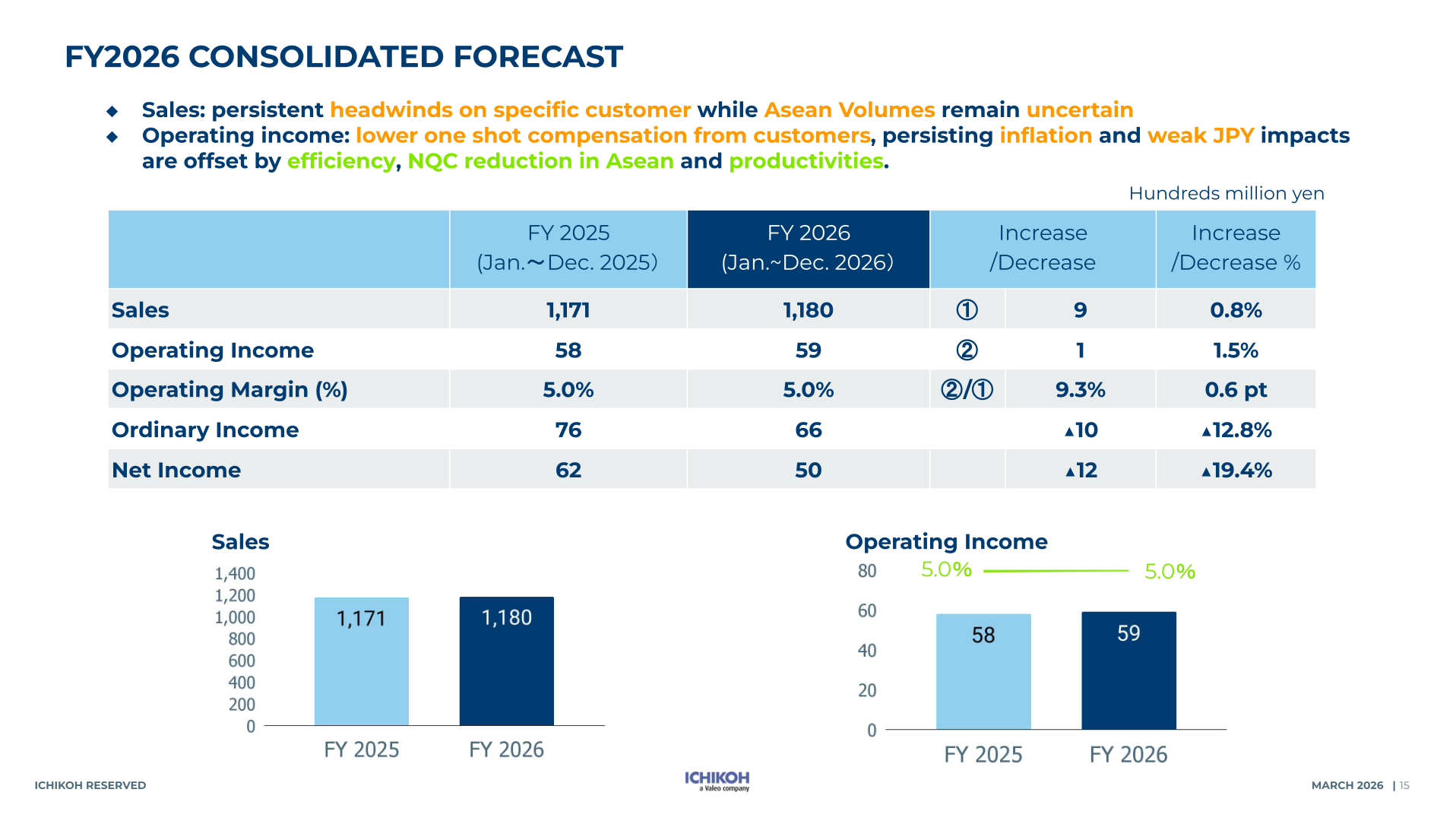
For FY2026 (January to December 2026) the company guides for sales of 1,180 and operating income of 59, with the operating margin held at 5.0%. It cites persistent headwinds on specific customer while ASEAN volumes remain uncertain for sales, and notes that lower one shot compensation from customers, persisting inflation and weak JPY impacts are offset by efficiency, NQC reduction in ASEAN and productivities.
| Item | FY2025 (Jan.-Dec. 2025) | FY2026 (Jan.-Dec. 2026) | Increase/Decrease | Increase/Decrease % |
|---|---|---|---|---|
| Sales | 1,171 | 1,180 | 9 | 0.8% |
| Operating Income | 58 | 59 | 1 | 1.5% |
| Operating Margin (%) | 5.0% | 5.0% | ||
| Ordinary Income | 76 | 66 | ▲10 | ▲12.8% |
| Net Income | 62 | 50 | ▲12 | ▲19.4% |
On the FY2026 plan for spending, R&D is set at 51 (56 in FY2025 actual, 58 in FY2024 actual), depreciation at 62 (58 and 60) and capex at 38 (32 and 41). The company says R&D spending will be reduced thanks to AI efficiency following the FY2025 increase to enhance development of high-end products and preparation of the product evolution for the next BEV generation; depreciation will increase due to refurbishment of building to host production for new SOPs and large products; and capex is increasing in FY2026 to accompany Nissan in its footprint reallocation, new technology and productivities. R&D does not include prototype costs and PJ development costs, depreciation does not include leased assets depreciation, and capex does not include investment resulting from leases.
Shareholder Returns
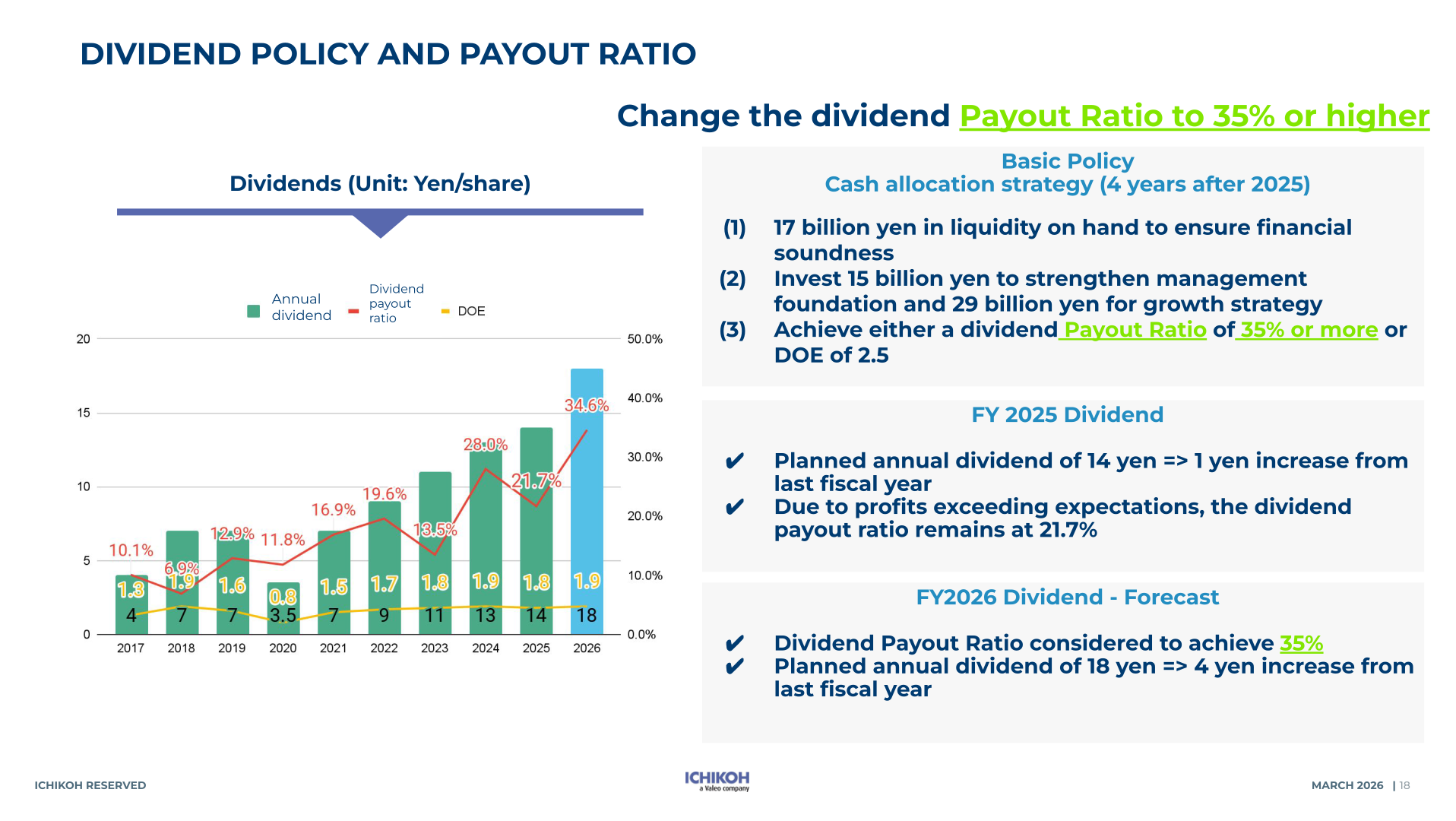
The materials state that the company is changing the dividend payout ratio target to 35% or higher. Its basic policy on cash allocation strategy for the four years after 2025 is (1) 17 billion yen in liquidity on hand to ensure financial soundness, (2) invest 15 billion yen to strengthen management foundation and 29 billion yen for growth strategy, and (3) achieve either a dividend payout ratio of 35% or more or DOE of 2.5.
For FY2025 the planned annual dividend is 14 yen, a 1 yen increase from last fiscal year, and due to profits exceeding expectations the dividend payout ratio remains at 21.7%. For FY2026 the planned annual dividend is 18 yen, a 4 yen increase from last fiscal year, with the dividend payout ratio considered to achieve 35%. The company describes a stable and increasing dividend policy rewarding shareholders, citing five years consecutive dividend increase and a 35% payout ratio as target for 2026.
Medium-Term Plan and Corporate Value
Excluding the Indian business, the mid-term plan outline shows total sales of 1,180 with an operating margin of 5.0% in FY2026, 1,290 with approximately 6.0% in the FY2028 forecast and 1,350 with approximately 7.0% in the FY2030 forecast, a 3.4% CAGR for 2026-2030. New business fields are shown as 140 in FY2028 and 200 in FY2030, split 40% new technologies and 60% new customers and new projects. Under the growth strategy transformation plan, target impact is 12 billion JPY from new customers and new projects, 8 billion JPY from new technology and 9 billion JPY from new territory #1 (not included in the 2028 target sales of 129 billion JPY), with new territory #2 under consideration. The company reports 9.0 B JPY secured with FORD and HYUNDAI in 2028, 5.0 B JPY secured with HD Lighting and Drivers in 2028, and for new territory #1 a business transfer agreement to be signed shortly, targeting commencement of JV activity in Q3 2026 — the schedule for the India business shows the joint venture agreement executed in August 2025, a business transfer agreement to acquire the lighting business of Valeo India scheduled for March/April 2026, establishment of a J.V. company scheduled for August 2026 and profit contribution from 2028.
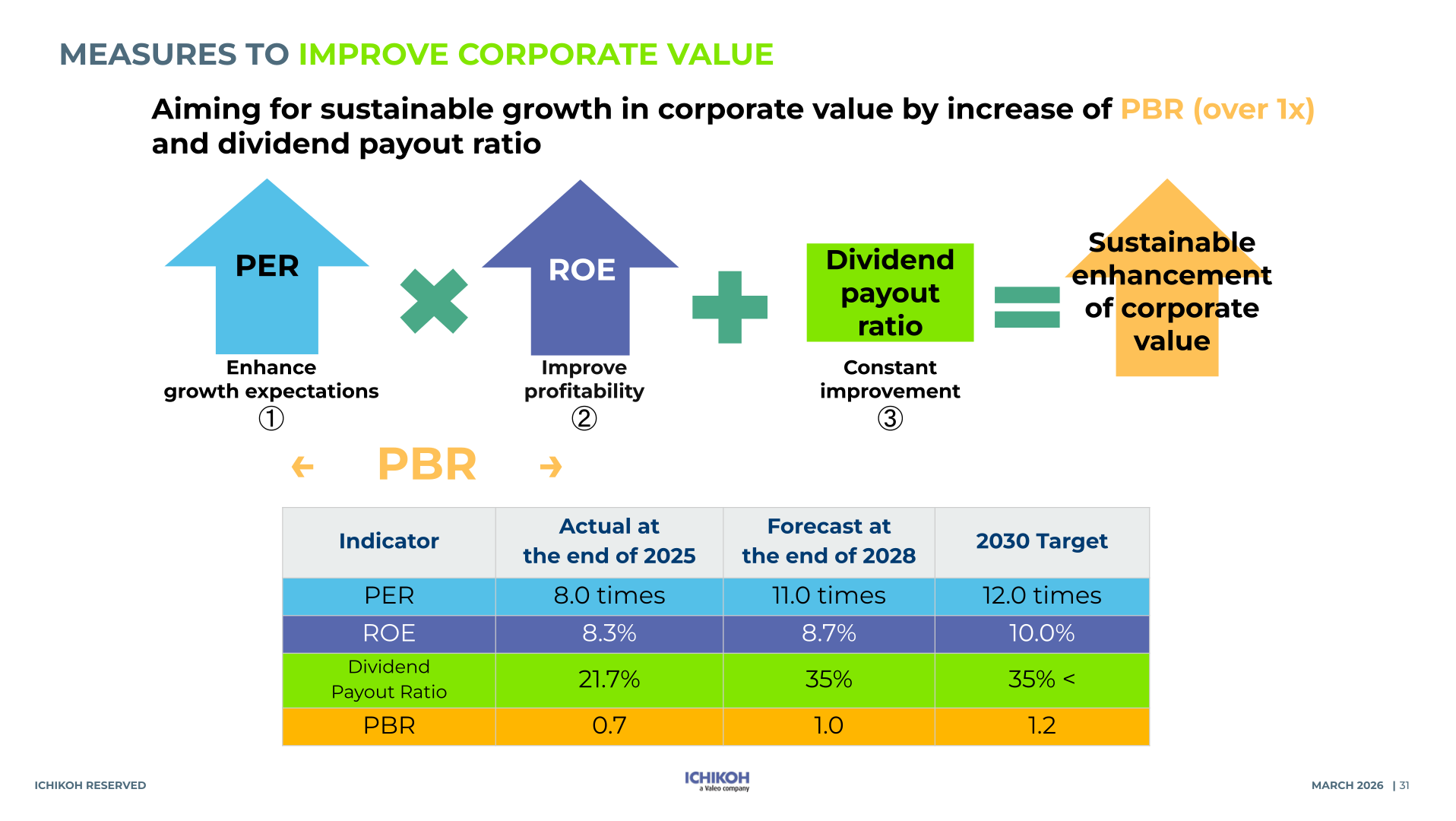
The company frames corporate value improvement as PER multiplied by ROE plus dividend payout ratio, aiming for sustainable growth in corporate value by increase of PBR (over 1x) and dividend payout ratio.
| Indicator | Actual at the end of 2025 | Forecast at the end of 2028 | 2030 Target |
|---|---|---|---|
| PER | 8.0 times | 11.0 times | 12.0 times |
| ROE | 8.3% | 8.7% | 10.0% |
| Dividend Payout Ratio | 21.7% | 35% | 35% < |
| PBR | 0.7 | 1.0 | 1.2 |
This article is an analysis based on publicly available information and is not a recommendation to buy or sell any specific securities. Investment decisions are your own responsibility.
![[Obayashi] Investors’ Guide 2026 — The Complete 24-Article Breakdown](https://japan-equity.com/wp-content/uploads/2026/07/hub_cover-1024x1024.png)
![[Obayashi] IR & SR Policy — Feeding Dialogue Back into Management](https://japan-equity.com/wp-content/uploads/2026/07/p32_sq-1024x1024.jpg)
![[Obayashi] Domestic Civil Engineering — Resilience Spending Supports 9.6% Margin](https://japan-equity.com/wp-content/uploads/2026/07/p11_sq-1024x1024.jpg)
![[Obayashi] Overseas Construction — Orders Reach ¥1.2tn](https://japan-equity.com/wp-content/uploads/2026/07/p15_sq-1024x1024.jpg)
![[Obayashi] Share Price & External Ratings — vs TOPIX, ESG Index Inclusion](https://japan-equity.com/wp-content/uploads/2026/07/p40_sq-1024x1024.jpg)
![[Construction] ¥75.5tn Investment, Shrinking Workforce — Big-5 Market Share](https://japan-equity.com/wp-content/uploads/2026/07/p12_sq-1024x1024.jpg)
![[Obayashi] Capital Policy & Shareholder Returns — ROE 10%+, DOE ~5%, ¥100bn Buyback](https://japan-equity.com/wp-content/uploads/2026/07/p27_sq-1024x1024.jpg)
![[Obayashi] Reducing Cross-Shareholdings — ¥285.2bn Sold in Five Years](https://japan-equity.com/wp-content/uploads/2026/07/p29_sq-1024x1024.jpg)
![[Obayashi] ¥750bn Investment Plan — ¥300bn to Development, ¥190bn to Tech/DX](https://japan-equity.com/wp-content/uploads/2026/07/p30_sq-1024x1024.jpg)
![[Obayashi] MTP2022 KPIs — Operating Profit ~2x Target, ROE 14.4%](https://japan-equity.com/wp-content/uploads/2026/07/p25_sq-1024x1024.jpg)
![[Obayashi] Cash Allocation — ¥420bn Investment CF Over Five Years](https://japan-equity.com/wp-content/uploads/2026/07/p26_sq-1024x1024.jpg)
![[Obayashi] Green Energy — 44 Plants, 344MW, and the Green Hydrogen Challenge](https://japan-equity.com/wp-content/uploads/2026/07/p21_sq-1024x1024.jpg)
![[Obayashi] Tackling the Labor Shortage — Robotics Construction®](https://japan-equity.com/wp-content/uploads/2026/07/p14_sq-1024x1024.jpg)
