
This article is based on publicly available IR materials and is not a recommendation to buy or sell any specific securities.
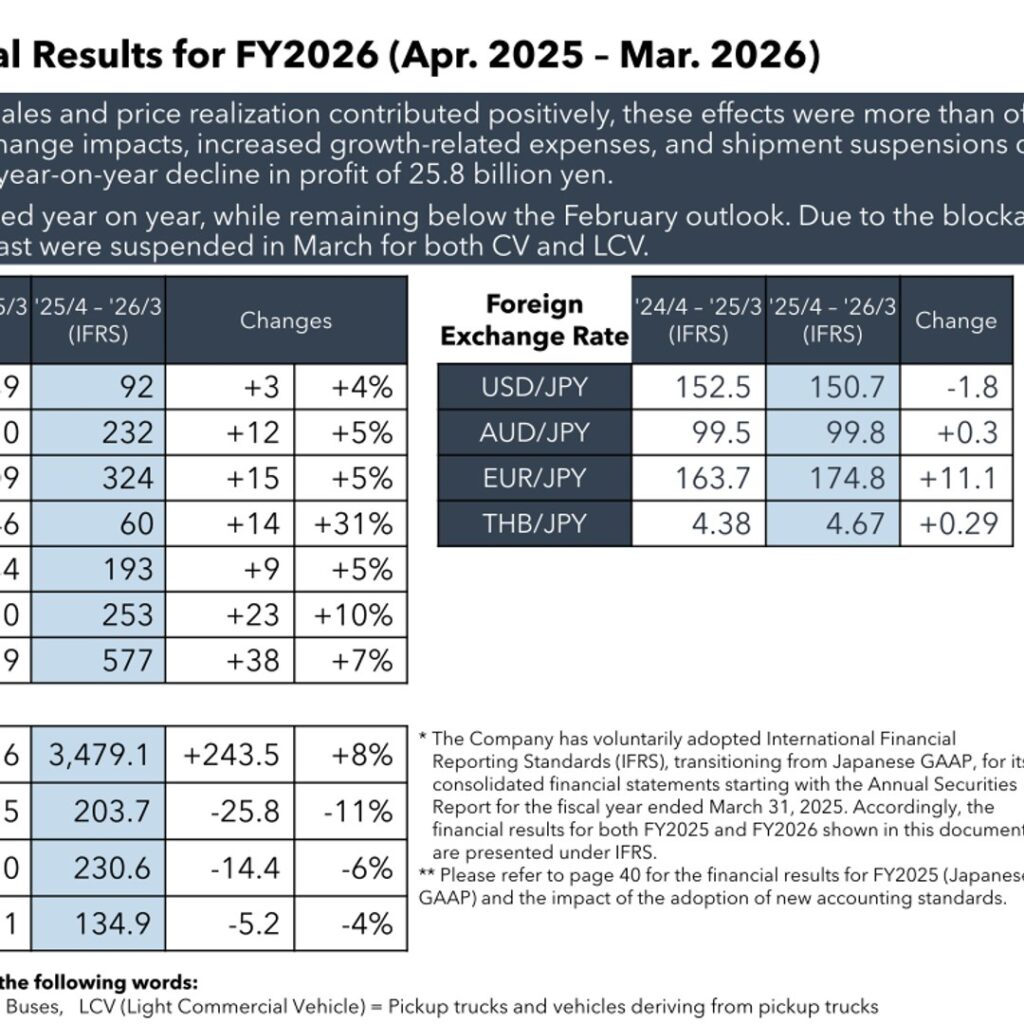
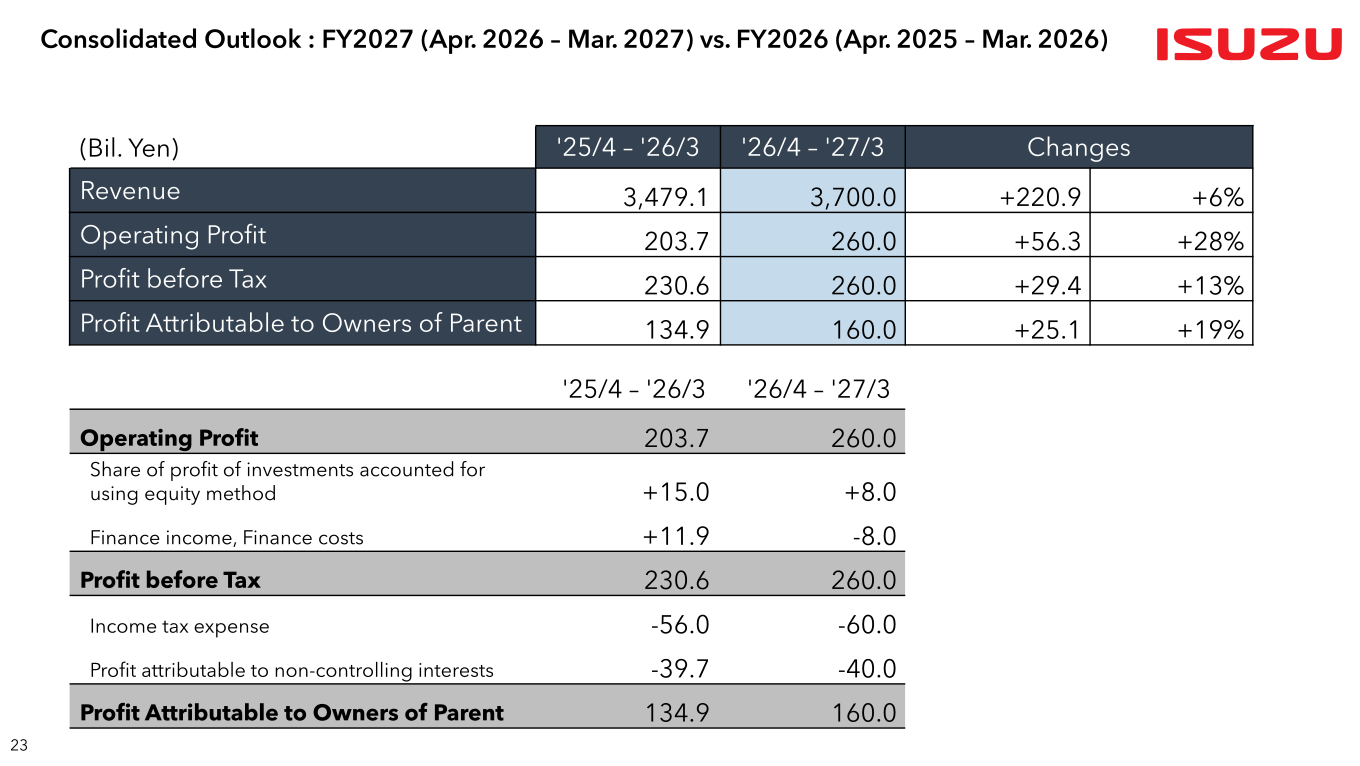
Note on year labels: Isuzu calls the fiscal year ended March 31, 2026 “FY2026” and the preceding year “FY2025”, so this article keeps the company’s labels in the text and tables even though this site classifies the most recent completed fiscal year as FY2025. For the year ended March 31, 2026 (FY2026, Apr. 2025 – Mar. 2026), Isuzu Motors reported revenue of 3,479.1 billion yen, up 243.5 billion yen or +8% year on year, while operating profit fell 25.8 billion yen or -11% to 203.7 billion yen and profit attributable to owners of parent declined 5.2 billion yen or -4% to 134.9 billion yen. The company states that higher unit sales and price realization contributed positively, but were more than offset by U.S. tariffs, rising material costs, foreign exchange impacts, increased growth-related expenses, and shipment suspensions due to the situation in the Middle East. For FY2027 (Apr. 2026 – Mar. 2027) Isuzu guides to revenue of 3,700.0 billion yen and operating profit of 260.0 billion yen after factoring in an estimated negative impact of approximately 40.0 billion yen related to the Middle East situation.
Consolidated Results (Full-Year Actual)
The materials are the “FY2026 Financial Results (Apr. 2025 – Mar. 2026)” presentation dated May 13, 2026. The Company has voluntarily adopted International Financial Reporting Standards (IFRS), transitioning from Japanese GAAP, for its consolidated financial statements starting with the Annual Securities Report for the fiscal year ended March 31, 2025, so the results for both FY2025 and FY2026 shown in the document are presented under IFRS. Results also came in below the outlook announced in February 2026: revenue exceeded that outlook by 179.1 billion yen (3,300.0 billion yen), but operating profit was 6.3 billion yen below the 210.0 billion yen guided, while profit before tax and profit attributable to owners of parent beat their 220.0 billion yen and 130.0 billion yen outlooks.
| Item (Bil. Yen) | FY2026 (’25/4–’26/3, IFRS) | FY2025 (’24/4–’25/3, IFRS) | Change |
|---|---|---|---|
| Revenue | 3,479.1 | 3,235.6 | +243.5 (+8%) |
| Operating Profit | 203.7 | 229.5 | -25.8 (-11%) |
| Profit before Tax | 230.6 | 245.0 | -14.4 (-6%) |
| Profit Attributable to Owners of Parent | 134.9 | 140.1 | -5.2 (-4%) |
| Share of profit of investments accounted for using equity method | +15.0 | +9.2 | – |
| Finance income, Finance costs | +11.9 | +6.3 | – |
| Income tax expense | -56.0 | -64.0 | – |
| Profit attributable to non-controlling interests | -39.7 | -40.9 | – |
Average exchange rates used were 150.7 yen to the U.S. dollar (152.5 yen in FY2025), 99.8 yen to the Australian dollar (99.5 yen), 174.8 yen to the euro (163.7 yen) and 4.67 yen to the Thai baht (4.38 yen). Isuzu’s main financial index page shows an equity ratio of 40.4% and ROE of 9.5% at the end of March 2026, with R&D costs of 158.0 billion yen, capital expenditures of 151.2 billion yen and depreciation cost of 83.5 billion yen.
Operating Profit Bridge: FY2026 vs. FY2025
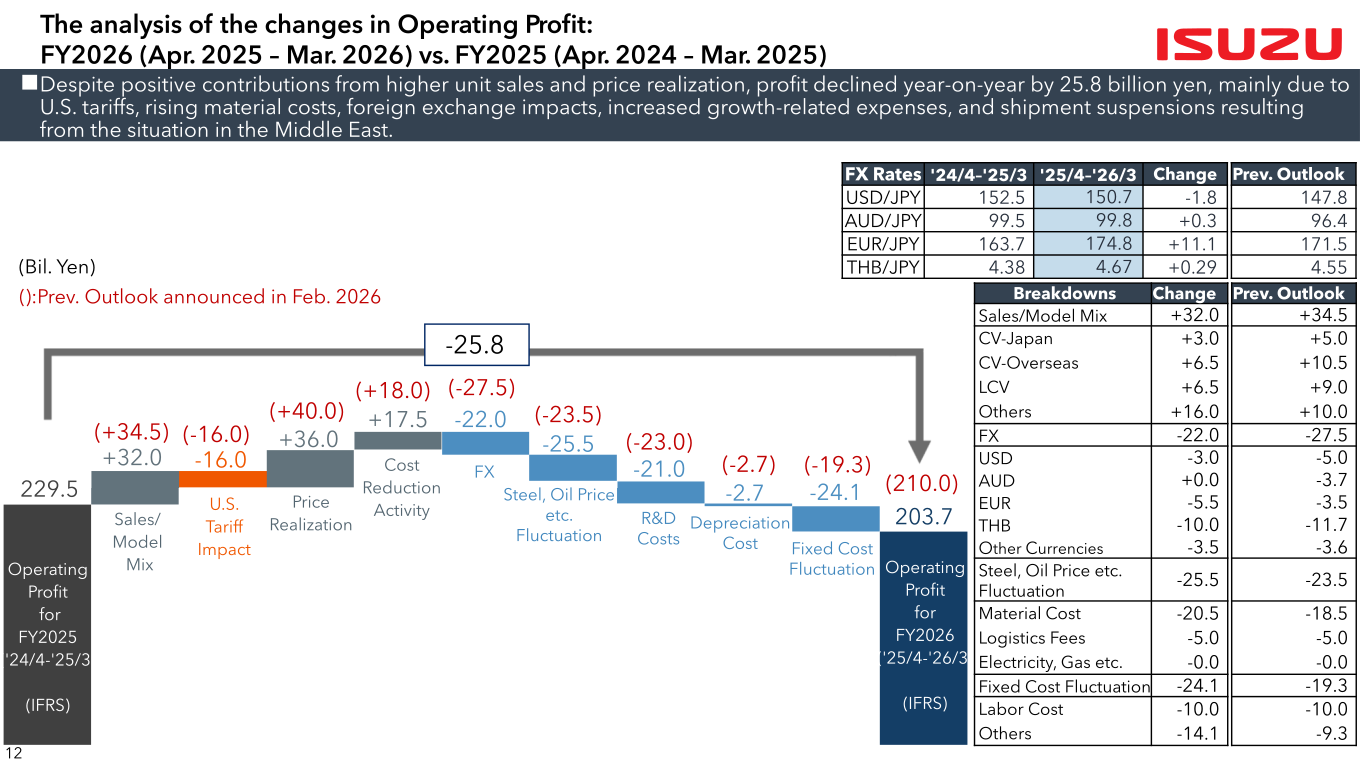
Isuzu’s analysis of the 25.8 billion yen year-on-year decline in operating profit is shown below. The figures in parentheses in the presentation are the previous outlook announced in February 2026, which pointed to 210.0 billion yen.
| Factor | Change (Bil. Yen) |
|---|---|
| Sales/Model Mix | +32.0 |
| CV-Japan | +3.0 |
| CV-Overseas | +6.5 |
| LCV | +6.5 |
| Others | +16.0 |
| Price Realization | +36.0 |
| Cost Reduction Activity | +17.5 |
| U.S. Tariff Impact | -16.0 |
| FX | -22.0 |
| Steel, Oil Price etc. Fluctuation | -25.5 |
| Fixed Cost Fluctuation | -24.1 |
| R&D Costs | -21.0 |
| Depreciation Cost | -2.7 |
| Total change (229.5 to 203.7) | -25.8 |
Segment Results
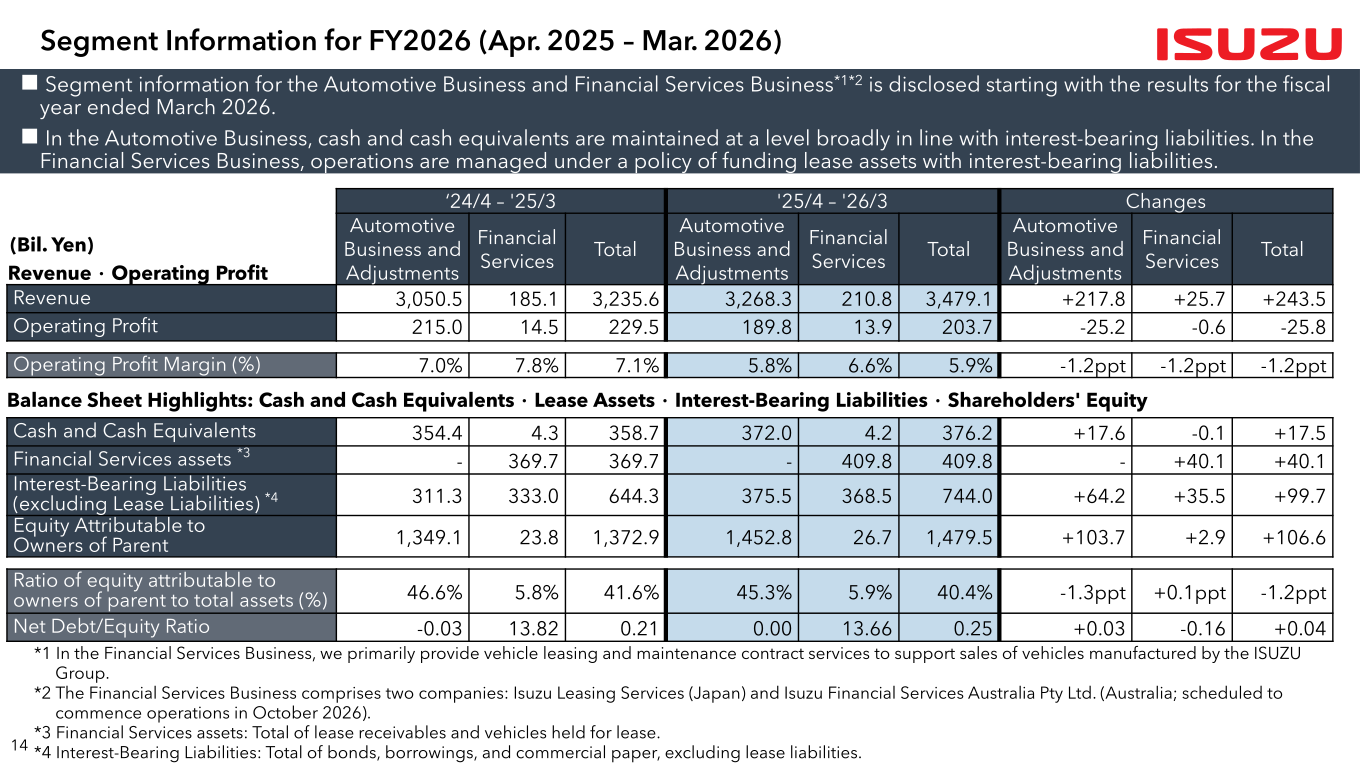
Segment information for the Automotive Business and the Financial Services Business is disclosed starting with the results for the fiscal year ended March 2026. The Financial Services Business comprises two companies, Isuzu Leasing Services (Japan) and Isuzu Financial Services Australia Pty Ltd. (Australia; scheduled to commence operations in October 2026). In the Automotive Business, cash and cash equivalents are maintained at a level broadly in line with interest-bearing liabilities, while in the Financial Services Business operations are managed under a policy of funding lease assets with interest-bearing liabilities.
| Item (Bil. Yen) | Automotive Business and Adjustments | Financial Services | Total |
|---|---|---|---|
| Revenue FY2026 | 3,268.3 | 210.8 | 3,479.1 |
| Revenue FY2025 | 3,050.5 | 185.1 | 3,235.6 |
| Operating Profit FY2026 | 189.8 | 13.9 | 203.7 |
| Operating Profit FY2025 | 215.0 | 14.5 | 229.5 |
| Operating Profit Margin FY2026 | 5.8% | 6.6% | 5.9% |
| Operating Profit Margin FY2025 | 7.0% | 7.8% | 7.1% |
| Cash and Cash Equivalents FY2026 | 372.0 | 4.2 | 376.2 |
| Financial Services assets FY2026 | – | 409.8 | 409.8 |
| Interest-Bearing Liabilities (excluding Lease Liabilities) FY2026 | 375.5 | 368.5 | 744.0 |
| Equity Attributable to Owners of Parent FY2026 | 1,452.8 | 26.7 | 1,479.5 |
Unit Sales and Business Trends
Global unit sales rose to 577 thousand units from 539 thousand, up 38 thousand or +7%, although this was 13 thousand units below the February 2026 outlook of 590 thousand. In Japan, CV unit sales increased on solid market conditions; overseas CV sales increased despite the impact of U.S. tariffs and weaker market conditions in the U.S. In LCV, Thailand unit sales increased from the previous fiscal year, when inventory reduction was implemented by dealers and distributors, while export sales rose mainly in Africa and Oceania but declined in the Middle East on lower demand in Saudi Arabia and the suspension of shipments in March. Due to the blockade of the Strait of Hormuz, shipments to the Middle East were suspended in March for both CV and LCV.
| Global Unit Sales (K-units) | FY2026 (’25/4–’26/3) | FY2025 (’24/4–’25/3) | Change |
|---|---|---|---|
| CV – Japan | 92 | 89 | +3 |
| CV – Overseas | 232 | 220 | +12 |
| CV Total | 324 | 309 | +15 |
| LCV – Thailand | 60 | 46 | +14 |
| LCV – Export | 193 | 184 | +9 |
| LCV Total | 253 | 230 | +23 |
| Total | 577 | 539 | +38 |
In Japan, the presentation notes that for heavy- and medium-duty trucks combined, ISUZU sold 32.2 thousand units for a market share of 42.2% in ’25/4–’26/3 (30.5 thousand units, 41.0% in ’24/4–’25/3) and UD Trucks sold 12.1 thousand units for a share of 15.9% (11.3 thousand units, 15.1%). In North America, wholesale CV volume was 19 thousand units in ’26/3, after 27 thousand in ’25/3 and 44 thousand in ’24/3, as retail unit sales fell short of expectations on an uncertain economic outlook, the impact of tariffs and a decline in freight volumes. In Thailand, LCV production units totalled 253 thousand (Vehicle-Thailand 60, Vehicle-Export 125, KD Set 68) against 230 thousand a year earlier (46, 121 and 63). Global shipments of industrial engines rose to 127 thousand units from 108 thousand, and revenue from the aftersales business reached 621.0 billion yen (Japan 416.0 billion yen, Overseas 205.0 billion yen) from 578.0 billion yen (383.0 billion yen and 195.0 billion yen), achieving the FY2027 Medium-term Business Plan revenue target of 600.0 billion yen one year ahead of schedule.
FY2027 Forecast
For FY2027 (Apr. 2026 – Mar. 2027), Isuzu aims for CV unit sales of 100 thousand units in Japan and expects overseas CV sales to increase primarily in North America despite the impact of the situation in the Middle East, while LCV unit sales in both Thailand and export markets are expected to remain at the FY2026 level. The company states that it initially aimed to achieve record-high operating profit, with positive factors such as higher unit sales, price realization and foreign exchange effects more than offsetting soaring material and other costs, but operating profit is now expected to be 260.0 billion yen after factoring in an estimated negative impact of approximately 40.0 billion yen related to the Middle East situation. Assumed rates are 155.0 yen/USD, 110.0 yen/AUD, 185.0 yen/EUR and 4.95 yen/THB.
| Item | FY2027 Outlook (’26/4–’27/3) | FY2026 (’25/4–’26/3) | Change |
|---|---|---|---|
| Revenue (Bil. Yen) | 3,700.0 | 3,479.1 | +220.9 (+6%) |
| Operating Profit (Bil. Yen) | 260.0 | 203.7 | +56.3 (+28%) |
| Profit before Tax (Bil. Yen) | 260.0 | 230.6 | +29.4 (+13%) |
| Profit Attributable to Owners of Parent (Bil. Yen) | 160.0 | 134.9 | +25.1 (+19%) |
| Dividends per Share | 94 Yen | 92 Yen | +2 Yen |
| CV – Japan (K-units) | 100 | 92 | +8 |
| CV – Overseas (K-units) | 250 | 232 | +18 |
| CV Total (K-units) | 350 | 324 | +26 |
| LCV – Thailand (K-units) | 63 | 60 | +3 |
| LCV – Export (K-units) | 190 | 193 | -3 |
| LCV Total (K-units) | 253 | 253 | +0 |
| Total units (K-units) | 603 | 577 | +26 (+4%) |
The presentation breaks out the approximately 40.0 billion yen of Middle East-related impact incorporated into the FY2027 operating profit outlook as procurement -10.0 billion yen (naphtha prices have surged to approximately 1.8 times the pre-conflict level), logistics -10.0 billion yen, CV/LCV production and shipment-related sales -3.5 billion yen, overseas CV sales -13.5 billion yen, LCV in Thailand -4.0 billion yen, LCV in export markets -4.0 billion yen and pricing measures +5.0 billion yen. Alternative logistics routes are under consideration, with freight costs expected to exceed five times normal levels. Shipments of completely built-up CV/LCV vehicles to the Middle East are scheduled to resume in June, with production scheduled to resume in July. Other FY2027 assumptions include R&D costs of 170.0 billion yen, capital expenditures of 160.0 billion yen, depreciation cost of 90.0 billion yen, industrial engine shipments of 145 thousand units and aftersales revenue of 645.0 billion yen.
Shareholder Returns
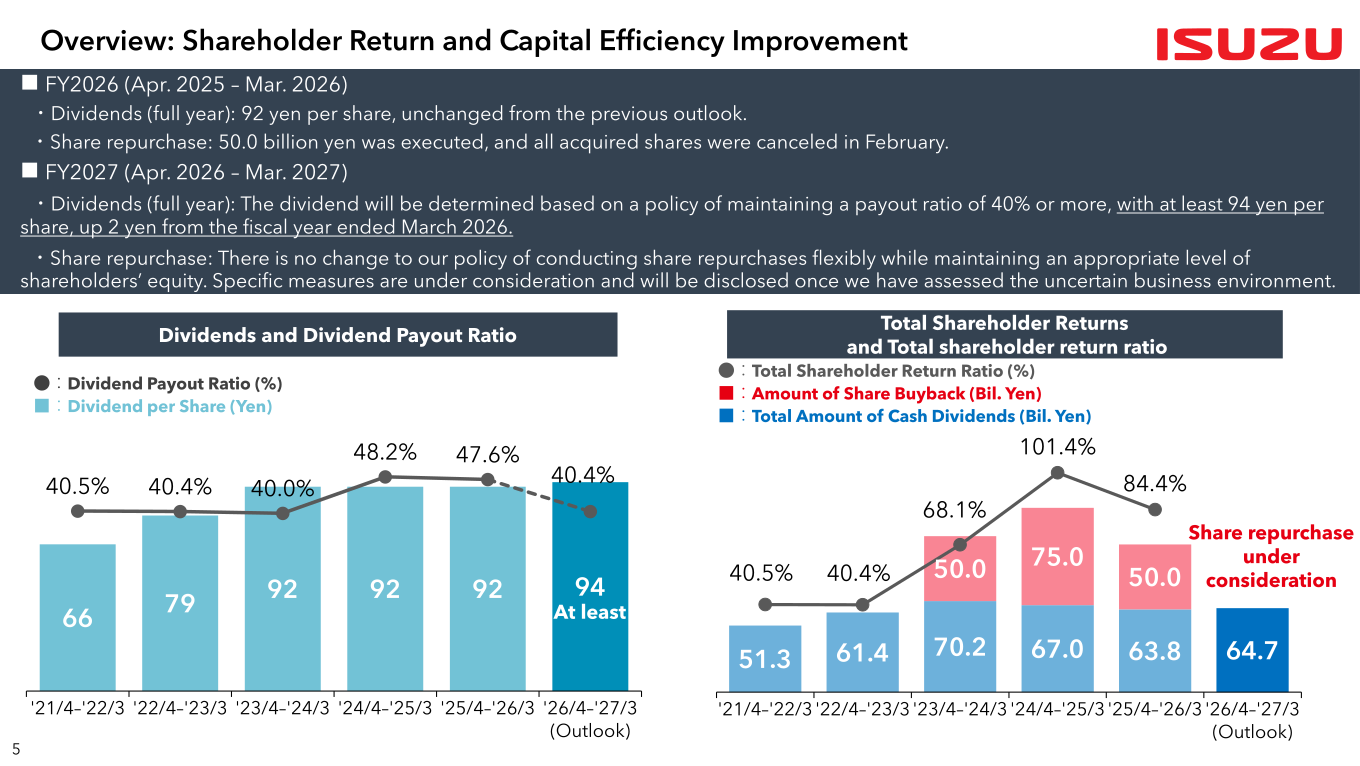
For FY2026, the full-year dividend was 92 yen per share, unchanged from the previous outlook, giving a dividend payout ratio of 47.6% and total cash dividends of 63.8 billion yen. A share repurchase of 50.0 billion yen was executed, and all acquired shares were canceled in February. For FY2027, the dividend will be determined based on a policy of maintaining a payout ratio of 40% or more, with at least 94 yen per share, up 2 yen from the fiscal year ended March 2026; dividends are expected to total approximately 65.0 billion yen on that assumption. There is no change to the policy of conducting share repurchases flexibly while maintaining an appropriate level of shareholders’ equity, with specific measures under consideration to be disclosed once the uncertain business environment has been assessed.
| Item | FY2026 (’25/4–’26/3) | FY2027 Outlook (’26/4–’27/3) |
|---|---|---|
| Dividends per Share | 92 Yen | At least 94 Yen |
| Dividend Payout Ratio | 47.6% | Policy: 40% or more |
| Total Amount of Cash Dividends (Bil. Yen) | 63.8 | Approx. 65.0 |
| Share Repurchase (Bil. Yen) | 50.0 (all acquired shares canceled in February) | Under consideration |
On cash allocation for the Automotive Business in FY2027, Isuzu says it will steadily execute 160.0 billion yen in various growth investments, such as the enhancement of domestic sales networks, the new CV plant in North America and the transfer of heavy-duty truck production to the UD Trucks Ageo Plant in Japan, while optimizing payment terms is intended to help ease the working capital requirements of suppliers by approximately 100.0 billion yen.
Medium-Term Plan and Topics
Under “ISUZU Transformation – Growth to 2030 (IX)”, the management policy is unchanged, with a 2030 vision of sales of 6 trillion yen, an operating income ratio of over 10% and new vehicle sales of over 850,000 units. Progress items for ’26/3 include a full model change of the light-duty truck 4×4 and an expanded medium-duty lineup in Japan; sequential launches of new medium- and light-duty models in North America, Europe and Australia; and planned launches in the Middle East, Africa and Latin America from 2026 and ASEAN from 2027. Isuzu has begun a review of a merger with UD Trucks and decided on the integration of consolidated domestic sales companies; synergy effects reached 23.0 billion yen in ’26/3, after 19.0 billion yen in ’25/3 and 14.0 billion yen in ’24/3.
On investment, aftersales in Japan involves new site development and facility renewal focused on the Greater Tokyo Area, Tokai and Kinki regions, with total investment of JPY 205.0 billion through 2030. Heavy-duty truck production will be transferred from the Fujisawa Plant to UD Trucks’ Ageo Plant (investment JPY 40.0 billion, operation start in 2028 onward), and Isuzu will invest in the LCV plant in Thailand through automation and production line integration (investment JPY 35.0 billion, operation start in 2027 onward). In North America, the new production facility in South Carolina decided in February 2025 is targeted to come on stream in 2027 with annual production of 50,000 units by 2030, at a total investment of approximately US$280 million (approximately 43.0 billion yen); the presentation states ISUZU holds an 82% share of the North American low cab forward truck market for the ISUZU brand alone (98% including OEM supply), within an overall Class 3-5 market of 112 thousand units in CY25.
This article is an analysis based on publicly available information and is not a recommendation to buy or sell any specific securities. Investment decisions are your own responsibility.
![[Obayashi] Investors’ Guide 2026 — The Complete 24-Article Breakdown](https://japan-equity.com/wp-content/uploads/2026/07/hub_cover-1024x1024.png)
![[Obayashi] IR & SR Policy — Feeding Dialogue Back into Management](https://japan-equity.com/wp-content/uploads/2026/07/p32_sq-1024x1024.jpg)
![[Obayashi] Domestic Civil Engineering — Resilience Spending Supports 9.6% Margin](https://japan-equity.com/wp-content/uploads/2026/07/p11_sq-1024x1024.jpg)
![[Obayashi] Overseas Construction — Orders Reach ¥1.2tn](https://japan-equity.com/wp-content/uploads/2026/07/p15_sq-1024x1024.jpg)
![[Obayashi] Share Price & External Ratings — vs TOPIX, ESG Index Inclusion](https://japan-equity.com/wp-content/uploads/2026/07/p40_sq-1024x1024.jpg)
![[Construction] ¥75.5tn Investment, Shrinking Workforce — Big-5 Market Share](https://japan-equity.com/wp-content/uploads/2026/07/p12_sq-1024x1024.jpg)
![[Obayashi] Capital Policy & Shareholder Returns — ROE 10%+, DOE ~5%, ¥100bn Buyback](https://japan-equity.com/wp-content/uploads/2026/07/p27_sq-1024x1024.jpg)
![[Obayashi] Reducing Cross-Shareholdings — ¥285.2bn Sold in Five Years](https://japan-equity.com/wp-content/uploads/2026/07/p29_sq-1024x1024.jpg)
![[Obayashi] ¥750bn Investment Plan — ¥300bn to Development, ¥190bn to Tech/DX](https://japan-equity.com/wp-content/uploads/2026/07/p30_sq-1024x1024.jpg)
![[Obayashi] MTP2022 KPIs — Operating Profit ~2x Target, ROE 14.4%](https://japan-equity.com/wp-content/uploads/2026/07/p25_sq-1024x1024.jpg)
![[Obayashi] Cash Allocation — ¥420bn Investment CF Over Five Years](https://japan-equity.com/wp-content/uploads/2026/07/p26_sq-1024x1024.jpg)
![[Obayashi] Green Energy — 44 Plants, 344MW, and the Green Hydrogen Challenge](https://japan-equity.com/wp-content/uploads/2026/07/p21_sq-1024x1024.jpg)
![[Obayashi] Tackling the Labor Shortage — Robotics Construction®](https://japan-equity.com/wp-content/uploads/2026/07/p14_sq-1024x1024.jpg)
