
This article is based on publicly available IR materials and is not a recommendation to buy or sell any specific securities.
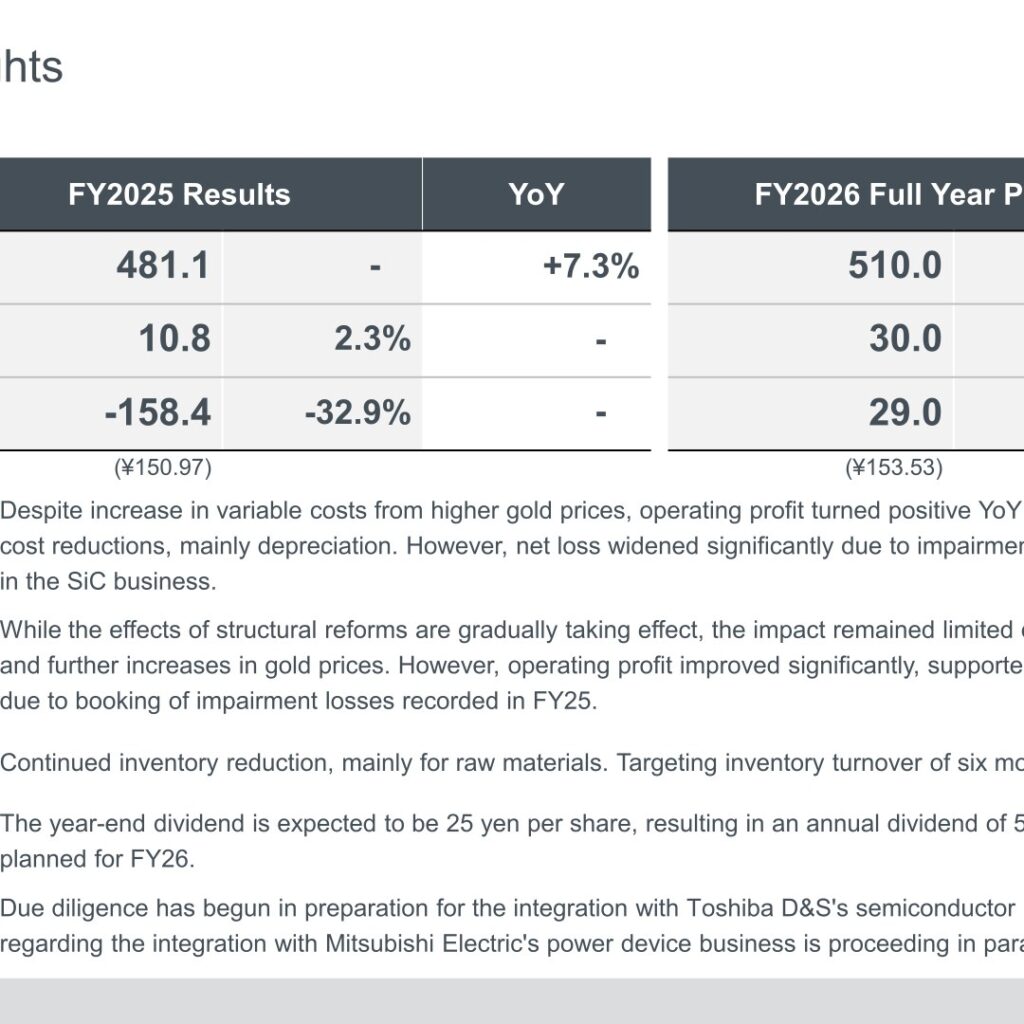
ROHM Co., Ltd. reported FY2025 (April 1, 2025 to March 31, 2026) net sales of 481.1 billion yen, up 7.3% year on year, and an operating profit of 10.8 billion yen (a margin of 2.3%), which turned positive from an operating loss of 40.0 billion yen in FY2024. At the net level, however, the company posted a net loss of 158.4 billion yen (a ratio of -32.9%) against a net loss of 50.0 billion yen in FY2024, as impairment losses were recorded primarily on fixed assets in the SiC business. For FY2026 the company plans net sales of 510.0 billion yen (+6.0%), operating profit of 30.0 billion yen (+176.1%, a margin of 5.9%) and a return to net profit of 29.0 billion yen (a ratio of 5.7%).
Consolidated Results (Full-Year Actual)
According to the Financial Highlights slide, despite an increase in variable costs from higher gold prices, operating profit turned positive year on year, driven by higher sales and fixed cost reductions, mainly depreciation. However, the net loss widened significantly due to impairment losses, primarily on fixed assets in the SiC business. The average exchange rate was 150.97 yen per US dollar in FY2025 against 152.48 yen per US dollar in FY2024.
| Item (Billion ¥) | FY2025 | FY2024 | Change |
|---|---|---|---|
| Net sales | 481.1 | 448.4 | +7.3% |
| Operating profit | 10.8 | -40.0 | +50.9 |
| Operating profit ratio | 2.3% | – | – |
| Net profit | -158.4 | -50.0 | -108.4 |
| Net profit ratio | -32.9% | – | – |
| Average exchange rate (¥/US$) | ¥150.97 | ¥152.48 | – |
The operating profit bridge shows a sales increase of +32.7 billion yen (organic increase +35.6, forex impact -2.9), a material costs and inventory impact of -10.9 billion yen (material costs -26.8, inventory impact +15.9), a fixed cost decrease of +29.0 billion yen (organic decrease +31.3, inventory impact -2.3) and a forex impact, for a total year-on-year improvement of +50.9 billion yen. Within manufacturing costs and SG&A, depreciation contributed +21.1 billion yen and R&D costs +10.6 billion yen, while labor costs were -1.4 billion yen, expenses -0.6 billion yen and others -0.7 billion yen. The materials explain that depreciation decreased significantly due to a change in the depreciation method and that R&D costs for the SiC business peaked out. By market, the sales increase broke down into Automotive +13.1, Industrial +4.0, Consumer +12.1, Communication -1.4 and Computer & Storage +4.9 billion yen.
Impairment Losses on Fixed Assets and the Net Loss Bridge
The net profit bridge attributes the year-on-year deterioration mainly to extraordinary items. The extraordinary gain (loss) impact was -163.1 billion yen, consisting of an impairment loss impact of -163.2 billion yen and others of +0.1 billion yen. This was partly offset by the operating profit impact of +50.9 billion yen and an income taxes impact of +5.8 billion yen (pre-tax profit at the standard tax rate +34.8, valuation allowance -32.2, others +3.2), while the non-operating income (loss) impact was -2.0 billion yen (interest and dividend income -1.6, forex gain (loss) -1.3, others +0.9).
| Net profit bridge (Billion ¥) | YoY impact |
|---|---|
| FY2024 net profit | -50.0 |
| Operating profit impact | +50.9 |
| Non-operating income (loss) impact | -2.0 |
| Extraordinary gain (loss) impact | -163.1 |
| of which impairment loss | -163.2 |
| of which others | +0.1 |
| Income taxes impact | +5.8 |
| FY2025 net profit | -158.4 |
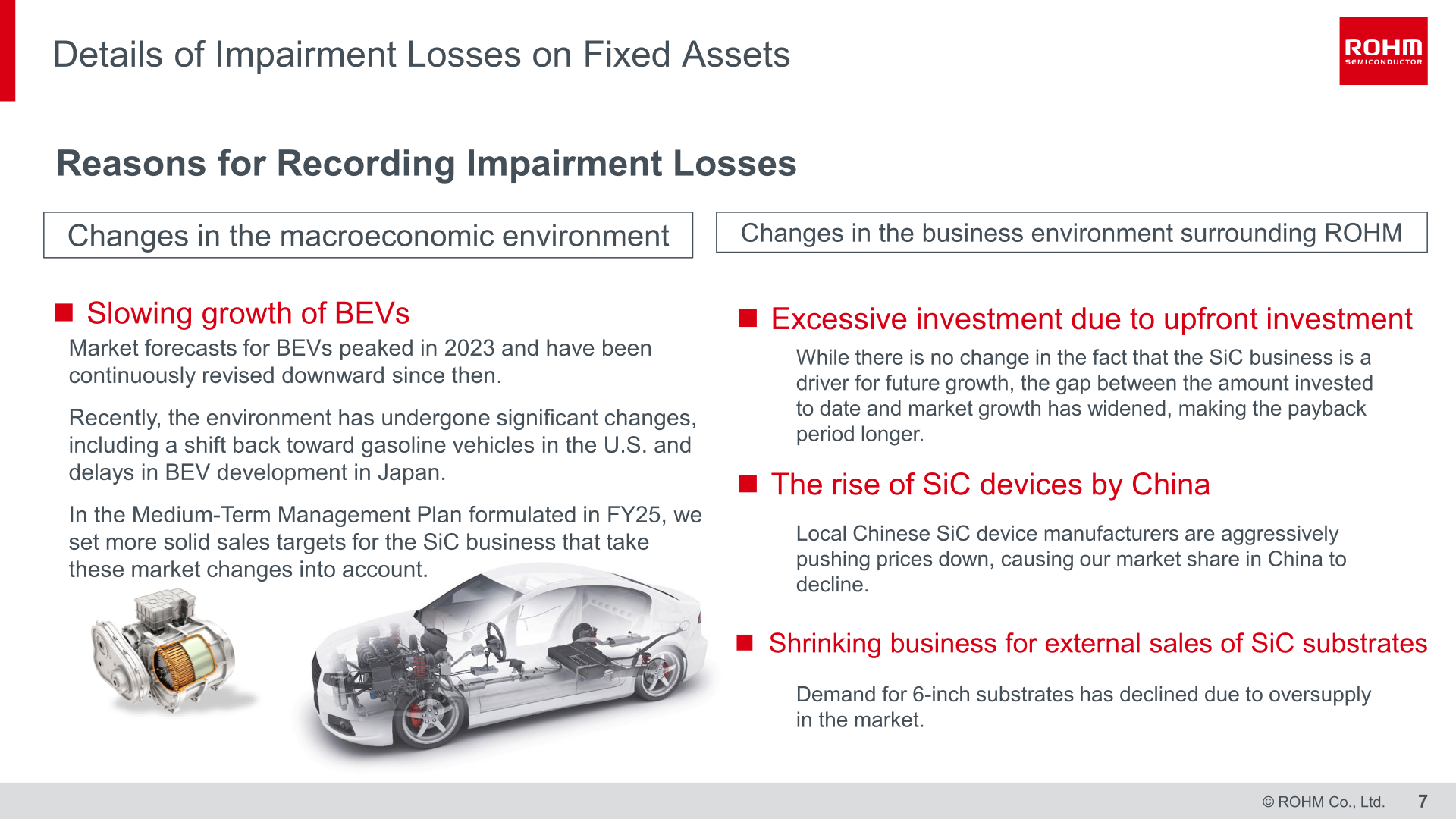
The materials give four reasons for recording the impairment losses. On the macroeconomic side, market forecasts for BEVs peaked in 2023 and have been continuously revised downward since, with a shift back toward gasoline vehicles in the U.S. and delays in BEV development in Japan; in the Medium-Term Management Plan formulated in FY25, ROHM set more solid sales targets for the SiC business reflecting these changes. On the company-specific side, the gap between the amount invested to date and market growth has widened due to upfront investment, making the payback period longer; local Chinese SiC device manufacturers are aggressively pushing prices down, causing ROHM’s market share in China to decline; and demand for 6-inch substrates has declined due to oversupply, shrinking the business for external sales of SiC substrates. ROHM states that there is no change in the fact that the SiC business is a driver for future growth.
Segment Results
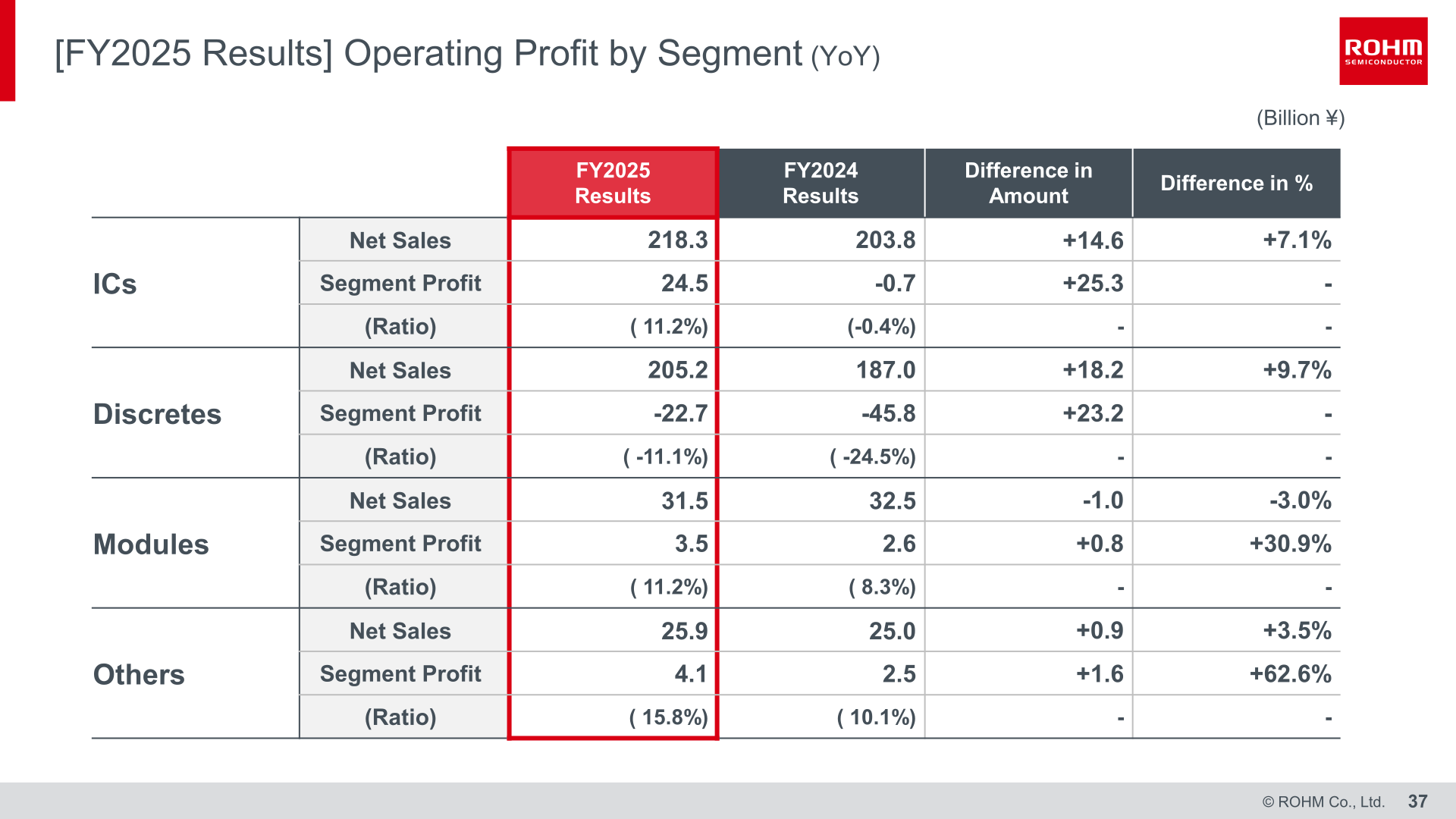
By reporting segment, ICs recorded net sales of 218.3 billion yen (+7.1%) and a segment profit of 24.5 billion yen (a ratio of 11.2%), swinging from a segment loss of 0.7 billion yen in FY2024. Discretes posted net sales of 205.2 billion yen (+9.7%) and a segment loss of 22.7 billion yen (a ratio of -11.1%), an improvement of 23.2 billion yen from a loss of 45.8 billion yen. Modules had net sales of 31.5 billion yen (-3.0%) and a segment profit of 3.5 billion yen (+30.9%), while Others had net sales of 25.9 billion yen (+3.5%) and a segment profit of 4.1 billion yen (+62.6%).
| Segment (Billion ¥) | Item | FY2025 | FY2024 | Change |
|---|---|---|---|---|
| ICs | Net sales | 218.3 | 203.8 | +7.1% |
| ICs | Segment profit | 24.5 | -0.7 | +25.3 |
| ICs | (Ratio) | 11.2% | -0.4% | – |
| Discretes | Net sales | 205.2 | 187.0 | +9.7% |
| Discretes | Segment profit | -22.7 | -45.8 | +23.2 |
| Discretes | (Ratio) | -11.1% | -24.5% | – |
| Modules | Net sales | 31.5 | 32.5 | -3.0% |
| Modules | Segment profit | 3.5 | 2.6 | +30.9% |
| Modules | (Ratio) | 11.2% | 8.3% | – |
| Others | Net sales | 25.9 | 25.0 | +3.5% |
| Others | Segment profit | 4.1 | 2.5 | +62.6% |
| Others | (Ratio) | 15.8% | 10.1% | – |
By market, Automotive sales were 236.8 billion yen (+5.8%), Industrial 61.3 billion yen (+7.0%), Consumer 105.4 billion yen (+13.0%), Communication 18.3 billion yen (-7.0%) and Computer & Storage 59.3 billion yen (+8.9%). Automotive accounted for 49.2% of sales, Consumer 21.9%, Industrial 12.7%, Computer & Storage 12.3% and Communication 3.8%. The sales ratio outside of Japan was 47.6% in FY2025 against 47.7% in FY2024.
FY2026 Forecast
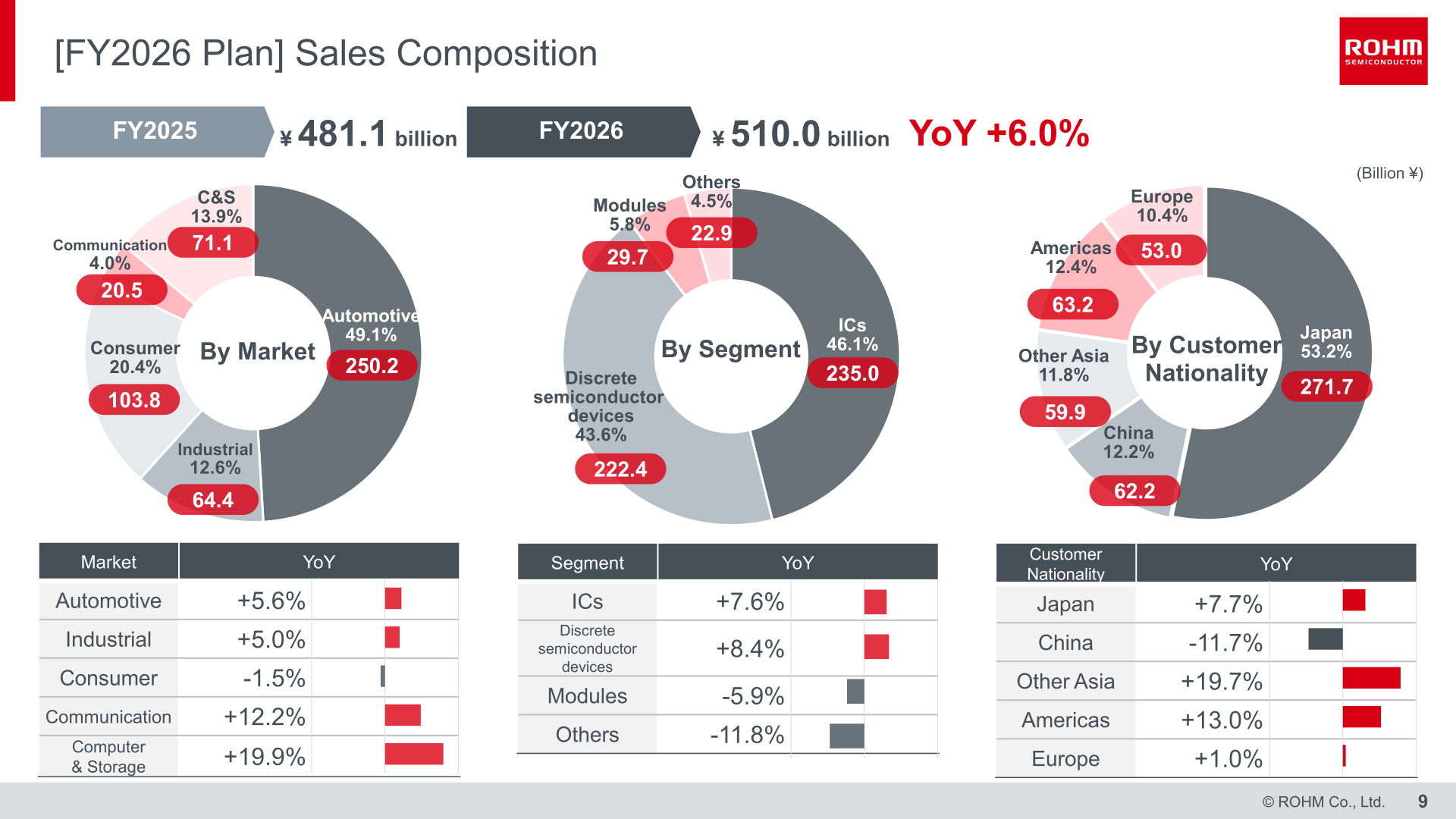
For FY2026 ROHM plans net sales of 510.0 billion yen and operating profit of 30.0 billion yen, with net profit returning to 29.0 billion yen. The assumed average exchange rate is 153.53 yen per US dollar. The company notes that while the effects of structural reforms are gradually taking effect, the impact remained limited due to Middle East tensions and further increases in gold prices; however, operating profit is expected to improve significantly, supported by a reduction in depreciation following the impairment losses recorded in FY25.
| Item (Billion ¥) | FY2026 Plan | FY2025 (Actual) | YoY |
|---|---|---|---|
| Net sales | 510.0 | 481.1 | +6.0% |
| Operating profit | 30.0 | 10.8 | +176.1% |
| Operating profit ratio | 5.9% | 2.3% | – |
| Net profit | 29.0 | -158.4 | – |
| Net profit ratio | 5.7% | -32.9% | – |
| Average exchange rate (¥/US$) | ¥153.53 | ¥150.97 | – |
| Automotive (net sales) | 250.2 | 236.8 | +5.6% |
| Industrial (net sales) | 64.4 | 61.3 | +5.0% |
| Consumer (net sales) | 103.8 | 105.4 | -1.5% |
| Communication (net sales) | 20.5 | 18.3 | +12.2% |
| Computer & Storage (net sales) | 71.1 | 59.3 | +19.9% |
The operating profit bridge for the plan shows a sales increase of +28.9 billion yen (organic increase +24.0, forex impact +4.9), a material costs and inventory impact of -10.0 billion yen (material costs -11.0, inventory impact +1.0) and a fixed costs decrease of +0.3 billion yen, plus a forex impact, for a total increase of +19.1 billion yen. Depreciation is expected to contribute +15.4 billion yen and will decrease significantly due to the impairment losses recorded in FY25, while expenses are -8.1 billion yen, labor costs -2.0 billion yen, R&D costs -1.2 billion yen and others -3.7 billion yen. Capital expenditure is planned at 60.0 billion yen in FY2026 against 82.4 billion yen in FY2025, and the company describes the end of the up-front investment period. On inventory, ROHM plans to continue reduction mainly for raw materials, targeting inventory turnover of six months or less by the end of FY26.
Shareholder Returns
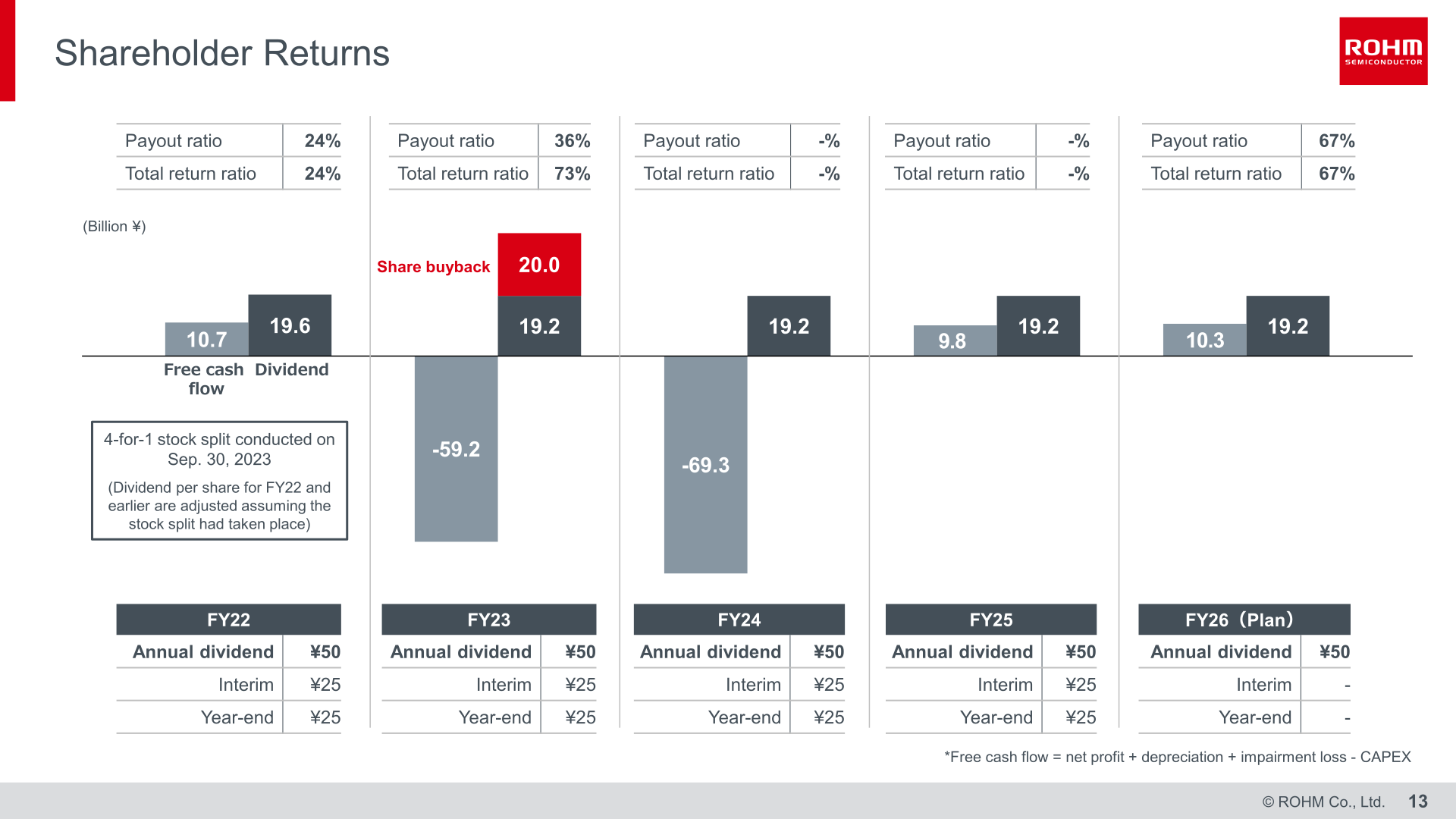
The year-end dividend for FY2025 is expected to be 25 yen per share, resulting in an annual dividend of 50 yen (interim 25 yen). The same annual amount of 50 yen per share is planned for FY2026, with the interim and year-end split not disclosed in the materials. Total dividends were 19.2 billion yen in FY2025 and are planned at 19.2 billion yen in FY2026. The payout ratio and total return ratio are shown as “-%” for FY2025 and 67% for the FY2026 plan. Free cash flow, defined in the materials as net profit plus depreciation plus impairment loss minus CAPEX, was 9.8 billion yen in FY2025 and is planned at 10.3 billion yen in FY2026.
| Item | FY2025 | FY2026 (Plan) |
|---|---|---|
| Annual dividend per share | ¥50 | ¥50 |
| Interim | ¥25 | – |
| Year-end | ¥25 | – |
| Dividend (Billion ¥) | 19.2 | 19.2 |
| Payout ratio | -% | 67% |
| Total return ratio | -% | 67% |
| Free cash flow (Billion ¥) | 9.8 | 10.3 |
Medium-Term Management Plan and Structural Reforms
The management goals for FY2028 are net sales of over 500 billion yen, an operating profit margin of over 20% (shown in the materials as “Operating profit: Over 20%”) and ROE of over 9%. Non-financial targets include a 50.5% reduction of GHG emissions by FY2030 versus FY2018, an aim for 100% renewable energy adoption by FY2050 and zero waste emissions, along with a 300% succession plan fulfillment rate and a 100% participation rate of core personnel in transformation execution training.
ROHM states that structural reforms have entered the execution phase and profit improvements are steadily becoming apparent. The planned operating profit improvement from FY25 to FY2028 totals 100 billion yen, broken down into profitability improvement in SiC of 34 to 40 billion yen, manufacturing site reorganization and business portfolio optimization of 18 to 22 billion yen, manufacturing cost reduction and procurement cost optimization of 9 to 12 billion yen, price optimization and business efficiency improvement of 7 to 10 billion yen, and sales growth excluding SiC of 14 to 20 billion yen. In manufacturing site reorganization, both front-end and back-end processes have entered the execution phase; ICs and transistors at the Headquarters as well as ICs in Kasaoka will be transferred to other locations with production scheduled to end, and the transfer agreement for the Dalian plant has been completed. Capital expenditure over the second Mid-Term Plan period is planned at approximately 150 billion yen over three years, against total CAPEX of 608.2 billion yen during the first Mid-Term Plan period.
In the SiC business, sales grew +14% in FY25 and are expected to grow more than +30% in FY26, while the SiC device and module business excluding the SiC wafer business grew +41% in FY25 and is expected to grow more than +55% in FY26. Mass production shipments of 5th-generation 8-inch SiC MOSFETs have begun, the NEDO Green Innovation Fund project for next-generation 8-inch SiC MOSFETs was completed two years ahead of schedule, and the external sales business for substrates will be downsized. The roadmap targets a break-even point for SiC devices in FY2028. In the AI server business, sales of power devices for servers were 17.0 billion yen in FY25 with a plan of 25.0 billion yen for FY26, and the company targets over 100 billion yen by FY30, a CAGR of +42%. Sales for the computer and storage segment for AI server power supplies are projected to grow 2.5 times year on year in FY26.
Business and Management Integration
Released on March 27, ROHM announced the initiation of discussions regarding the business and management integration of Toshiba Electronic Devices & Storage Corporation’s semiconductor business and Mitsubishi Electric Corporation’s power devices business, under a vision of becoming one of the world’s top 10 in power and analog semiconductors by 2035. As of this presentation, due diligence has begun in preparation for the integration with Toshiba D&S’s semiconductor business, and discussions regarding the integration with Mitsubishi Electric’s power device business are proceeding in parallel. If a definitive agreement is reached, ROHM will revise the Medium-Term Management Plan accordingly, including its capital policy. Separately, released on April 28, ROHM disclosed that following a comprehensive review by DENSO, DENSO’s proposal to acquire shares was withdrawn and ROHM also concluded reviewing the proposal, with both companies agreeing to further advance co-creation activities based on the ongoing Strategic Partnership.
On cash allocation for the FY26 to FY28 three-year total, the materials show inflows of operating cash flow of over 300 billion yen, cash on hand of approximately 430 billion yen as of the end of FY2025, and financing plus investing cash flow of 100 to 200 billion yen. Outflows comprise CAPEX of approximately 150 billion yen, debt repayment of 100 billion yen, strategic investment (M&A), shareholder returns and cash on hand of approximately 150 billion yen. The capital policy sets a dividend payout ratio of over 30%, a target D/E ratio of 0.5 with temporary exceedance permitted (D/E below 0.7), and a reduction of cash on hand to approximately three months’ worth of sales.
This article is an analysis based on publicly available information and is not a recommendation to buy or sell any specific securities. Investment decisions are your own responsibility.
![[Obayashi] Investors’ Guide 2026 — The Complete 24-Article Breakdown](https://japan-equity.com/wp-content/uploads/2026/07/hub_cover-1024x1024.png)
![[Obayashi] IR & SR Policy — Feeding Dialogue Back into Management](https://japan-equity.com/wp-content/uploads/2026/07/p32_sq-1024x1024.jpg)
![[Obayashi] Real Estate Development — 18.7% Margin, ¥287.7bn Unrealized Gains](https://japan-equity.com/wp-content/uploads/2026/07/p20_sq-1024x1024.jpg)
![[Obayashi] Domestic Civil Engineering — Resilience Spending Supports 9.6% Margin](https://japan-equity.com/wp-content/uploads/2026/07/p11_sq-1024x1024.jpg)
![[Obayashi] Share Price & External Ratings — vs TOPIX, ESG Index Inclusion](https://japan-equity.com/wp-content/uploads/2026/07/p40_sq-1024x1024.jpg)
![[Construction] ¥75.5tn Investment, Shrinking Workforce — Big-5 Market Share](https://japan-equity.com/wp-content/uploads/2026/07/p12_sq-1024x1024.jpg)
![[Obayashi] Capital Policy & Shareholder Returns — ROE 10%+, DOE ~5%, ¥100bn Buyback](https://japan-equity.com/wp-content/uploads/2026/07/p27_sq-1024x1024.jpg)
![[Obayashi] Reducing Cross-Shareholdings — ¥285.2bn Sold in Five Years](https://japan-equity.com/wp-content/uploads/2026/07/p29_sq-1024x1024.jpg)
![[Obayashi] ¥750bn Investment Plan — ¥300bn to Development, ¥190bn to Tech/DX](https://japan-equity.com/wp-content/uploads/2026/07/p30_sq-1024x1024.jpg)
![[Obayashi] MTP2022 KPIs — Operating Profit ~2x Target, ROE 14.4%](https://japan-equity.com/wp-content/uploads/2026/07/p25_sq-1024x1024.jpg)
![[Obayashi] Cash Allocation — ¥420bn Investment CF Over Five Years](https://japan-equity.com/wp-content/uploads/2026/07/p26_sq-1024x1024.jpg)
![[Obayashi] Green Energy — 44 Plants, 344MW, and the Green Hydrogen Challenge](https://japan-equity.com/wp-content/uploads/2026/07/p21_sq-1024x1024.jpg)
![[Obayashi] Tackling the Labor Shortage — Robotics Construction®](https://japan-equity.com/wp-content/uploads/2026/07/p14_sq-1024x1024.jpg)
