
This article is based on publicly available IR materials and is not a recommendation to buy or sell any specific securities.
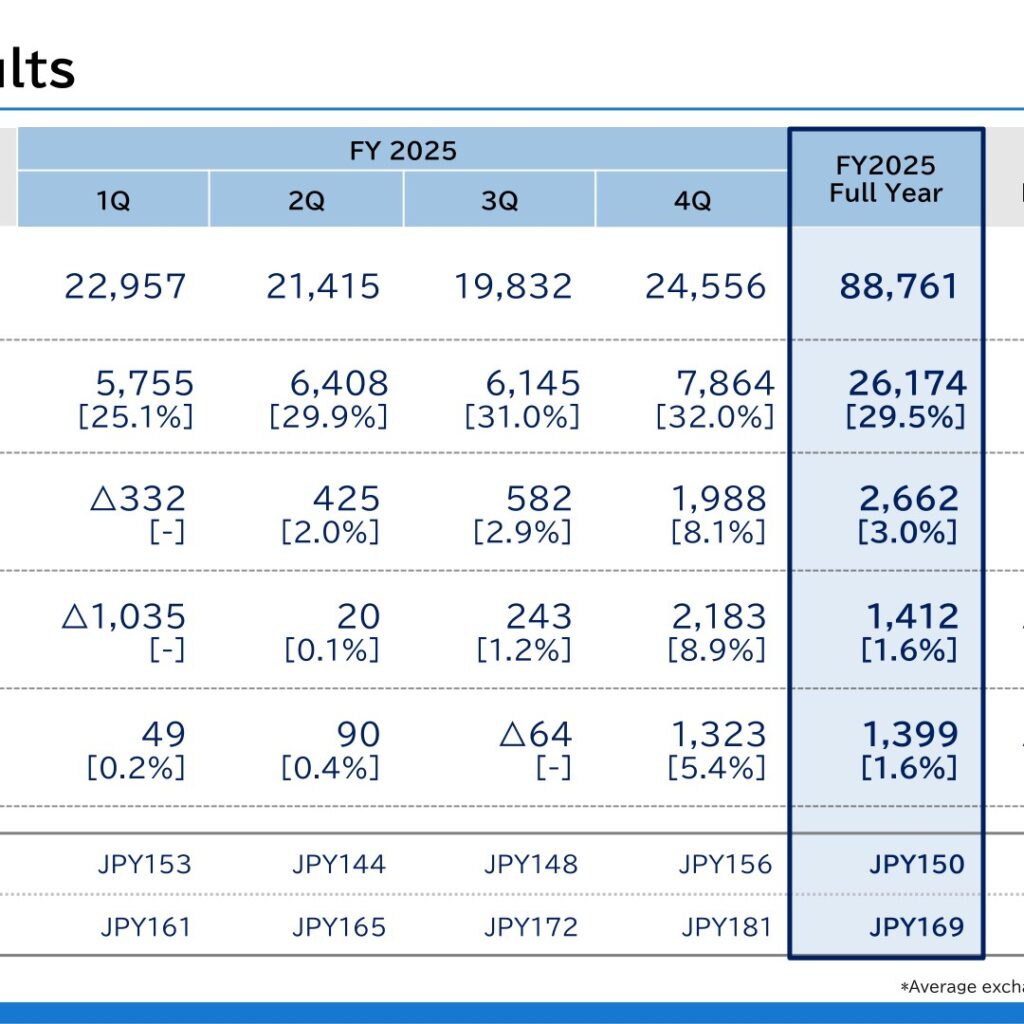
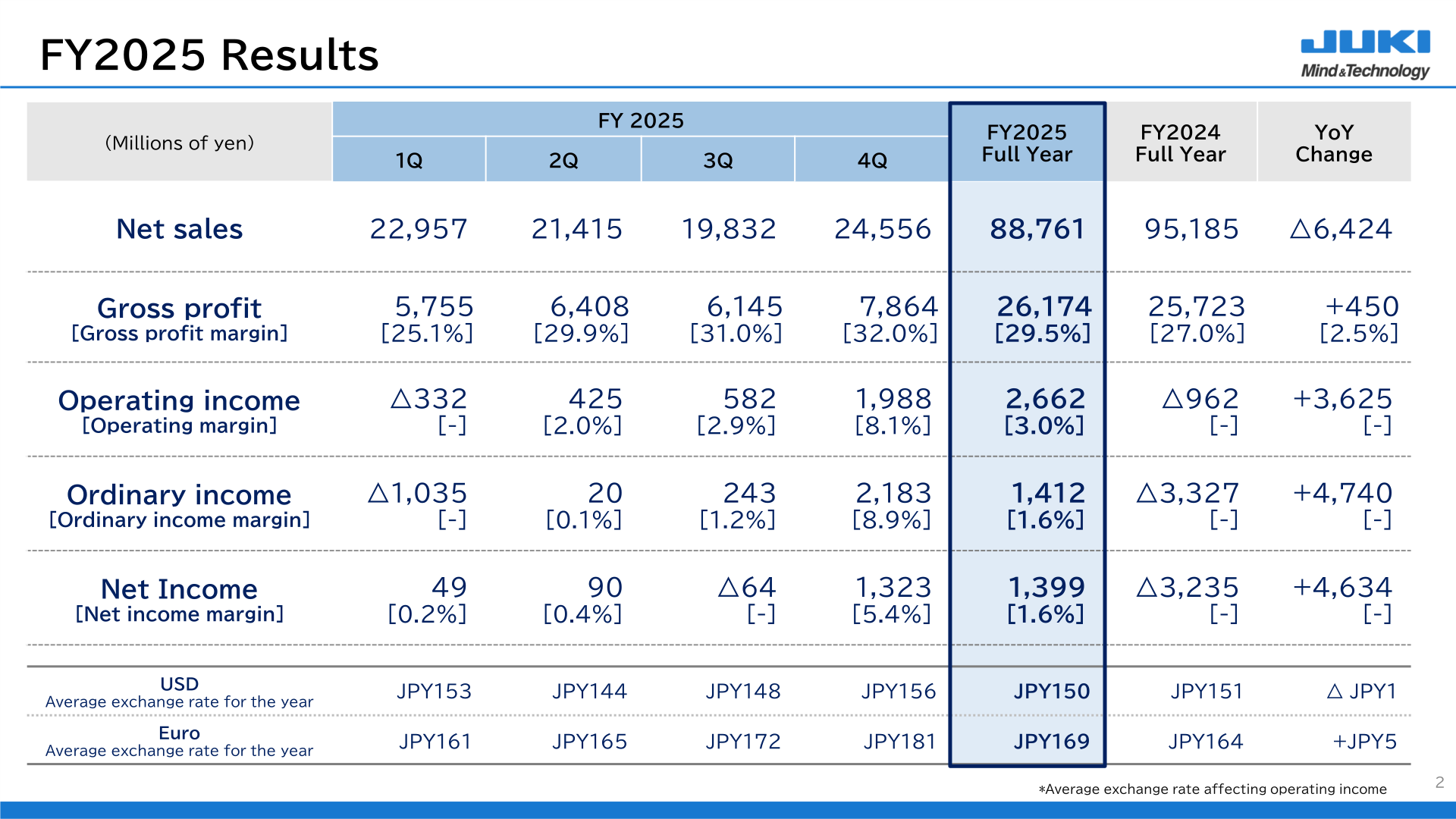
JUKI CORPORATION (Securities code: 6440), the world’s leading supplier of industrial sewing machines that also provides electronics assembly and systems equipment such as mounters for PCB production, announced its financial results for the full year of 2025 (ended December 31, 2025). Net sales declined to ¥88,761 million from ¥95,185 million in FY2024, but operating income returned to a positive ¥2,662 million from an operating loss of ¥962 million a year earlier, an improvement of ¥3,625 million. The company attributes the improvement to initiatives focused on profitability, such as shifting its emphasis toward the high-end market and optimizing production capacity through product lineup consolidation.
Consolidated Results (Full Year)
For FY2025, gross profit rose to ¥26,174 million (gross profit margin 29.5%) from ¥25,723 million (27.0%) in FY2024, even as net sales fell by ¥6,424 million. Operating income of ¥2,662 million (operating margin 3.0%) marked a ¥3,625 million improvement year on year, and the company states that operating profit for fiscal year 2025 increased by ¥3.7 billion year on year, returning to a positive ¥2.7 billion. Ordinary income was ¥1,412 million (versus an ordinary loss of ¥3,327 million in FY2024), and net income was ¥1,399 million (versus a net loss of ¥3,235 million). The average exchange rate for the year was JPY150 to the U.S. dollar (JPY151 in FY2024) and JPY169 to the euro (JPY164 in FY2024).
| Item (Millions of yen) | FY2025 Full Year | FY2024 Full Year | YoY Change |
|---|---|---|---|
| Net sales | 88,761 | 95,185 | △6,424 |
| Gross profit [Gross profit margin] | 26,174 [29.5%] | 25,723 [27.0%] | +450 [2.5%] |
| Operating income [Operating margin] | 2,662 [3.0%] | △962 [-] | +3,625 [-] |
| Ordinary income [Ordinary income margin] | 1,412 [1.6%] | △3,327 [-] | +4,740 [-] |
| Net Income [Net income margin] | 1,399 [1.6%] | △3,235 [-] | +4,634 [-] |
Segment Results
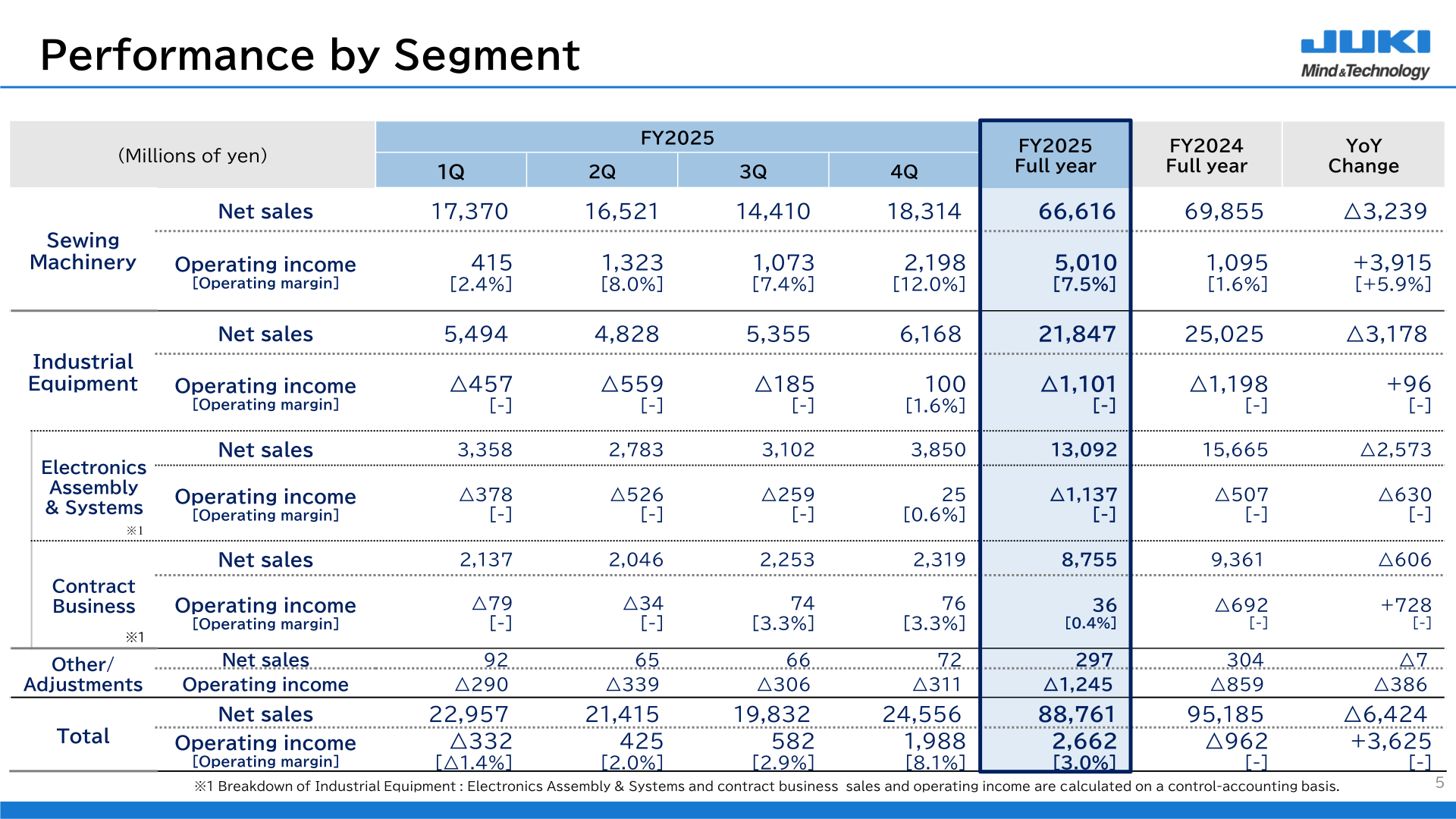
In the Sewing Machinery segment, demand was firm from the area between India and Africa and through China distributors, while Asian countries, which saw some cautious moves to invest due to the U.S. mutual duty impact, seemed to have bottomed out; demand for automotive-related products in Europe and the United States recovered rapidly in the fourth quarter. Segment operating income rose to ¥5,010 million (operating margin 7.5%) from ¥1,095 million (1.6%) in FY2024, which the company attributes to optimization of production capacity by focusing on high-end markets and reducing the number of models.
In the Industrial Equipment segment, conditions in China, the major market for Electronics Assembly & Systems, showed signs of bottoming out, while sales in Europe and the Americas remained sluggish; in the Americas, caution remained due to tariffs and high costs, but there were signs of recovery as companies began to adapt to the environment. Since mid-year the company has shifted Electronics Assembly & Systems to a “Global Niche Strategy” that focuses on key areas and regions, and states it has almost completed structural reforms such as organizational restructuring and optimization of plant size. The Contract Business shifted its business model from sales volume to profitability and achieved operating profitability in the second half of FY2025.
| Segment (Millions of yen) | Net sales FY2025 | Net sales FY2024 | Operating income FY2025 | Operating income FY2024 |
|---|---|---|---|---|
| Sewing Machinery | 66,616 | 69,855 | 5,010 [7.5%] | 1,095 [1.6%] |
| Industrial Equipment | 21,847 | 25,025 | △1,101 [-] | △1,198 [-] |
| — Electronics Assembly & Systems* | 13,092 | 15,665 | △1,137 [-] | △507 [-] |
| — Contract Business* | 8,755 | 9,361 | 36 [0.4%] | △692 [-] |
| Other/Adjustments | 297 | 304 | △1,245 | △859 |
| Total | 88,761 | 95,185 | 2,662 [3.0%] | △962 [-] |
*Breakdown of Industrial Equipment: Electronics Assembly & Systems and Contract Business sales and operating income are calculated on a control-accounting basis. Note that from FY2025 the “Parts, Service, System, and Automation Division” related to the Sewing Machinery Business, previously included in the Industrial Equipment and Systems Business segment, was moved to the Sewing Machinery segment, and FY2024 figures reflect this change.
By region, FY2025 industrial sewing machine sales (monthly aggregate base, calculated on a management accounting basis) were led by India and nearby countries (India, Bangladesh, the Middle East and Africa), followed by China, which includes sales to Asia end users through China distributors. Electronics Assembly & Systems sales by region (including parts and services) on the same basis totaled 131 (100 million yen), with China the largest region.
| Region (100 million yen) | Industrial sewing machines FY2025 total | Electronics Assembly & Systems 2025 total |
|---|---|---|
| China | 121 | 45 |
| Asia | 93 | 11 |
| India and Nearby countries | 162 | — |
| Japan | 20 | 15 |
| Europe | 54 | 26 |
| Americas | 68 | 34 |
| Total | 517 | 131 |
(Sales by region are calculated on a management accounting basis. “India and Nearby countries” covers India, Bangladesh, the Middle East and Africa; China includes sales to Asia end users through China distributors. Electronics Assembly & Systems figures include parts and services; the regional breakdown for that business does not include an India row in the materials.)
Financial Position and Cash Flow
Total assets at the end of December 2025 were ¥120,594 million, down ¥21,625 million from a year earlier, while net assets increased by ¥453 million to ¥32,687 million and the equity ratio improved by 4.9 percentage points to 26.8%. ROE increased by 14.7% year on year to 4.4% (from △10.3%). The company reports that the cash conversion cycle improved by 0.9 months, inventory was reduced by ¥7.8 billion, trade receivables were reduced by ¥7.7 billion, and interest-bearing debt was reduced by ¥14.8 billion; cash flow from operations increased by ¥11.7 billion per year due to working capital reduction. Full-year cash flow from operations was ¥11,712 million (¥3,956 million in the first half and ¥7,756 million in the second half).
FY2026 Forecast
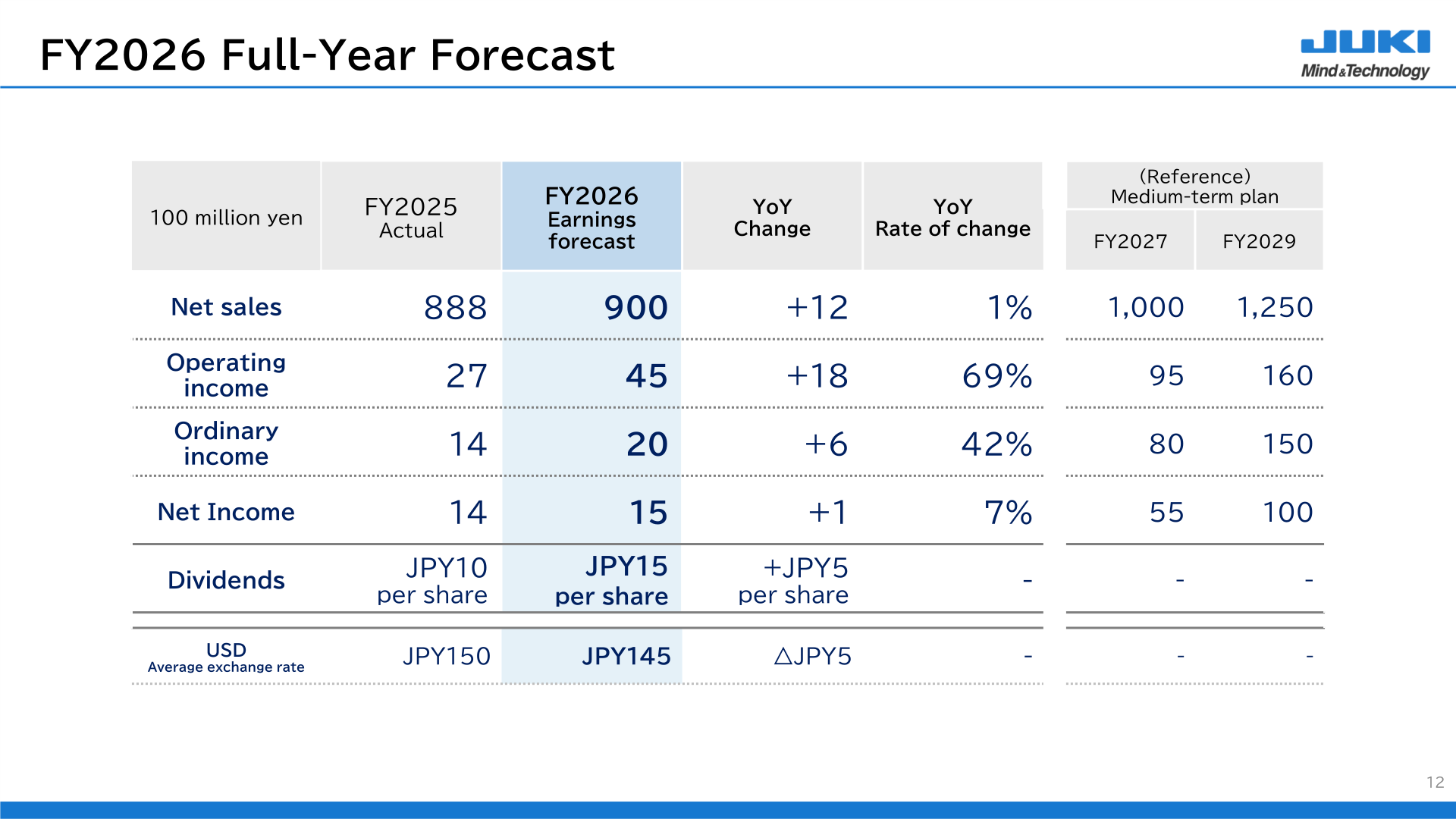
For FY2026, JUKI forecasts a 1% year-on-year increase in net sales, with operating income of ¥4.5 billion (up 69%), ordinary income of ¥2.0 billion (up 42%) and net income of ¥1.5 billion (up 7%), assuming an average exchange rate of JPY145 to the U.S. dollar. The company is targeting operating income of ¥6 billion through “last year’s measures now taking hold and continuing” in Sewing Machinery and rationalization of size in Electronics Assembly & Systems, with the operating profit forecast of ¥4.5 billion arrived at after factoring in ¥1.5 billion of costs such as inventory contingency expenses. The forecast gross margin is 31.7%, versus 29.5% in FY2025 (32.0% in Q4 FY2025), and the FY2026 forecast includes an unrealized profit impact of △0.3 billion yen.
| Item (100 million yen) | FY2025 Actual | FY2026 Earnings forecast | YoY Change | YoY Rate of change |
|---|---|---|---|---|
| Net sales | 888 | 900 | +12 | 1% |
| Operating income | 27 | 45 | +18 | 69% |
| Ordinary income | 14 | 20 | +6 | 42% |
| Net Income | 14 | 15 | +1 | 7% |
| Dividends | JPY10 per share | JPY15 per share | +JPY5 per share | – |
| USD average exchange rate | JPY150 | JPY145 | △JPY5 | – |
Shareholder Returns
The dividend for FY2025 was JPY10 per share, and the company plans JPY15 per share for FY2026, an increase of JPY5 per share. Under its management focused on capital cost and share price, JUKI notes that its cost of equity is around 8-10%, ROE is 4.4% and PBR is 0.5 times, and states that although ROE has been improving, it is not yet generating returns that sufficiently exceed the cost of equity. The company positions profit growth as the top priority for improving ROE and achieving a PBR above 1.0, and lists payment of dividends to increase shareholder value among its capital rationalization measures.
Medium-Term Plan “Building Sustainable JUKI”
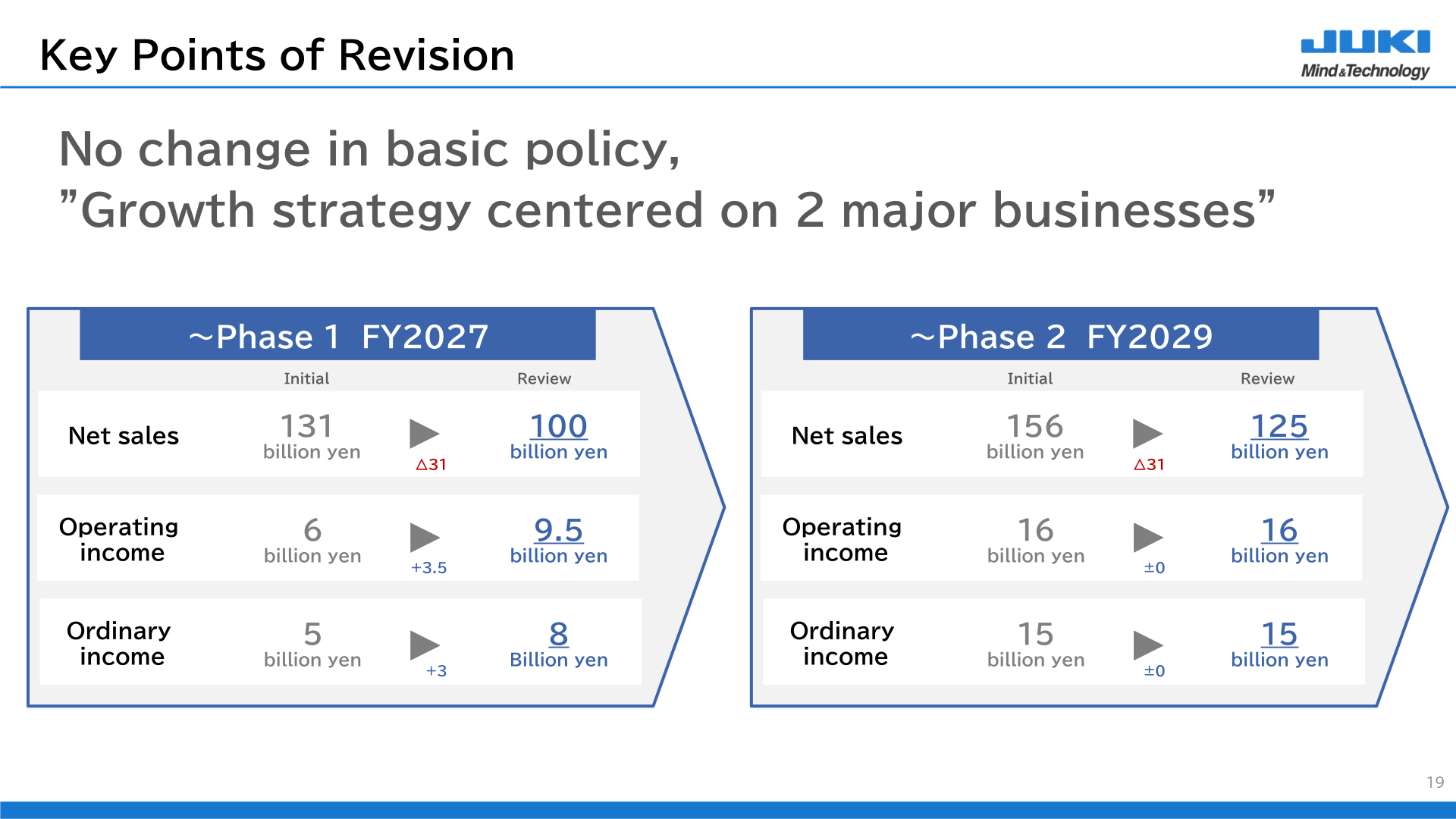
The company reviewed its 5-year medium-term management plan “Building Sustainable JUKI” (2025-2029). There is no change in the basic policy of a “growth strategy centered on 2 major businesses.” For Phase 1 (through FY2027), the net sales target was revised from an initial ¥131 billion to ¥100 billion (△¥31 billion), while the operating income target was raised from ¥6 billion to ¥9.5 billion (+¥3.5 billion) and the ordinary income target from ¥5 billion to ¥8 billion (+¥3 billion). For Phase 2 (through FY2029), the net sales target was revised from ¥156 billion to ¥125 billion, with operating income of ¥16 billion and ordinary income of ¥15 billion unchanged. ROE target values are 16.0% for FY2027 (Phase 1) and 23.0% for FY2029 (Phase 2).
Measures taken in FY2024-FY2025 include a reduction of models (about one-third of the total), reduction of excess capacity (50% in Sewing Machinery, 60% in Electronics Assembly & Systems and 60% in the Contract business), a headcount reduction of 700 plant personnel (with an extraordinary loss of ¥800 million), transfer of factories and businesses, sale of cross-shareholdings (total ¥6.8 billion, extraordinary gain ¥3.2 billion), and financing through a headquarters leaseback. Growth strategies include accelerating integration with IoT and strategies centered around the “Global 100” key accounts in Sewing Machinery, and the shift of Electronics Assembly & Systems to a “Global Niche Strategy” concentrating resources on the large-scale, irregular circuit board area, with the server board market (priority regions: U.S.A. and Taiwan) and the energy storage equipment market (priority regions: China, Southeast Asia and Mexico) identified as target markets.
This article is an analysis based on publicly available information and is not a recommendation to buy or sell any specific securities. Investment decisions are your own responsibility.
![[Obayashi] Investors’ Guide 2026 — The Complete 24-Article Breakdown](https://japan-equity.com/wp-content/uploads/2026/07/hub_cover-1024x1024.png)
![[Obayashi] IR & SR Policy — Feeding Dialogue Back into Management](https://japan-equity.com/wp-content/uploads/2026/07/p32_sq-1024x1024.jpg)
![[Obayashi] Domestic Civil Engineering — Resilience Spending Supports 9.6% Margin](https://japan-equity.com/wp-content/uploads/2026/07/p11_sq-1024x1024.jpg)
![[Obayashi] Overseas Construction — Orders Reach ¥1.2tn](https://japan-equity.com/wp-content/uploads/2026/07/p15_sq-1024x1024.jpg)
![[Obayashi] Share Price & External Ratings — vs TOPIX, ESG Index Inclusion](https://japan-equity.com/wp-content/uploads/2026/07/p40_sq-1024x1024.jpg)
![[Construction] ¥75.5tn Investment, Shrinking Workforce — Big-5 Market Share](https://japan-equity.com/wp-content/uploads/2026/07/p12_sq-1024x1024.jpg)
![[Obayashi] Capital Policy & Shareholder Returns — ROE 10%+, DOE ~5%, ¥100bn Buyback](https://japan-equity.com/wp-content/uploads/2026/07/p27_sq-1024x1024.jpg)
![[Obayashi] Reducing Cross-Shareholdings — ¥285.2bn Sold in Five Years](https://japan-equity.com/wp-content/uploads/2026/07/p29_sq-1024x1024.jpg)
![[Obayashi] ¥750bn Investment Plan — ¥300bn to Development, ¥190bn to Tech/DX](https://japan-equity.com/wp-content/uploads/2026/07/p30_sq-1024x1024.jpg)
![[Obayashi] MTP2022 KPIs — Operating Profit ~2x Target, ROE 14.4%](https://japan-equity.com/wp-content/uploads/2026/07/p25_sq-1024x1024.jpg)
![[Obayashi] Cash Allocation — ¥420bn Investment CF Over Five Years](https://japan-equity.com/wp-content/uploads/2026/07/p26_sq-1024x1024.jpg)
![[Obayashi] Green Energy — 44 Plants, 344MW, and the Green Hydrogen Challenge](https://japan-equity.com/wp-content/uploads/2026/07/p21_sq-1024x1024.jpg)
![[Obayashi] Tackling the Labor Shortage — Robotics Construction®](https://japan-equity.com/wp-content/uploads/2026/07/p14_sq-1024x1024.jpg)
