
This article is based on publicly available IR materials and is not a recommendation to buy or sell any specific securities.
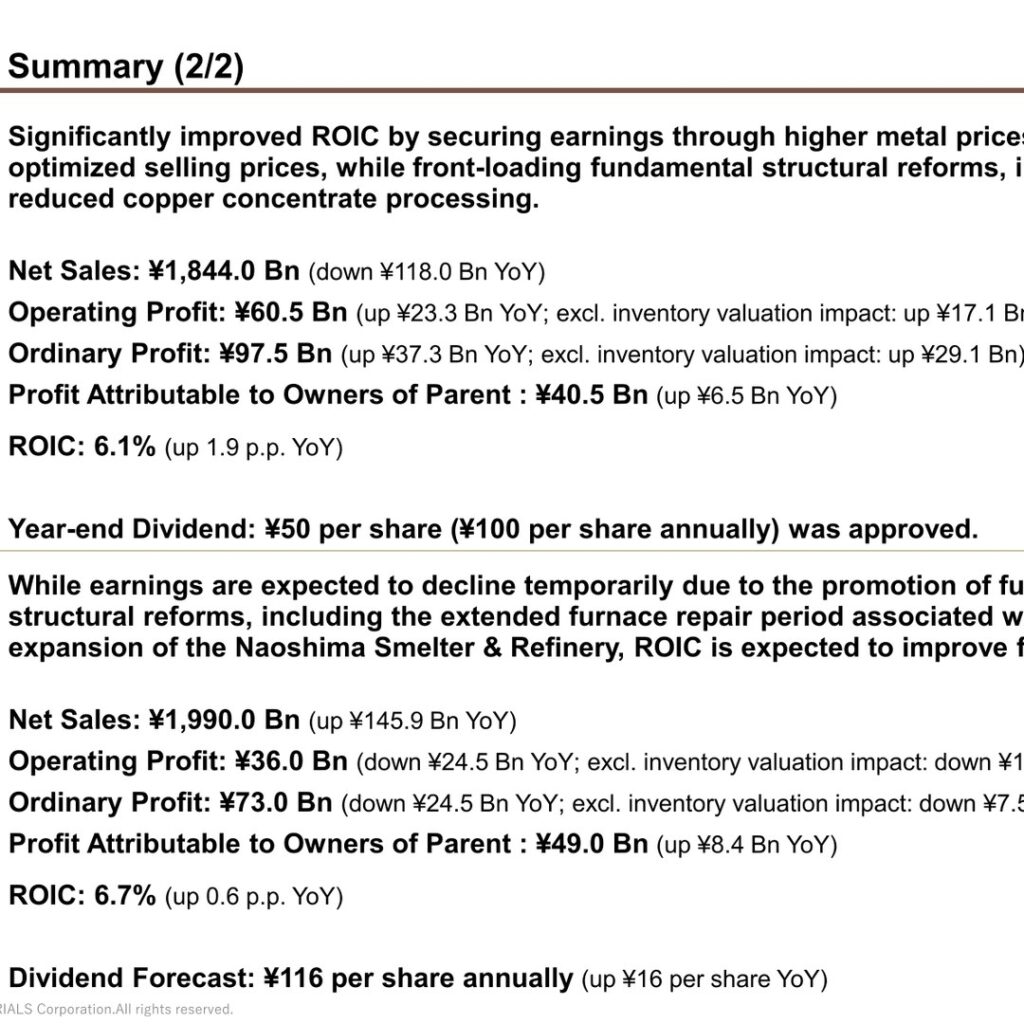
Mitsubishi Materials Corporation reported net sales of ¥1,844.0 billion for the fiscal year ended March 31, 2026, down ¥118.0 billion year on year, while operating profit rose ¥23.3 billion to ¥60.5 billion and ordinary profit rose ¥37.3 billion to ¥97.5 billion. Profit attributable to owners of parent increased ¥6.5 billion to ¥40.5 billion despite extraordinary losses related to fundamental structural reforms. The company describes the year as one in which it significantly improved ROIC by securing earnings through higher metal prices and optimized selling prices, while front-loading fundamental structural reforms including reduced copper concentrate processing. ROIC improved 1.9 points to 6.1%.
Note: The company labels this fiscal year “FYE March 2026”; this article follows the site convention of classifying the most recent completed fiscal year as FY2025 in the title and URL, while the body text, tables and segment data retain the labels used in the source materials.
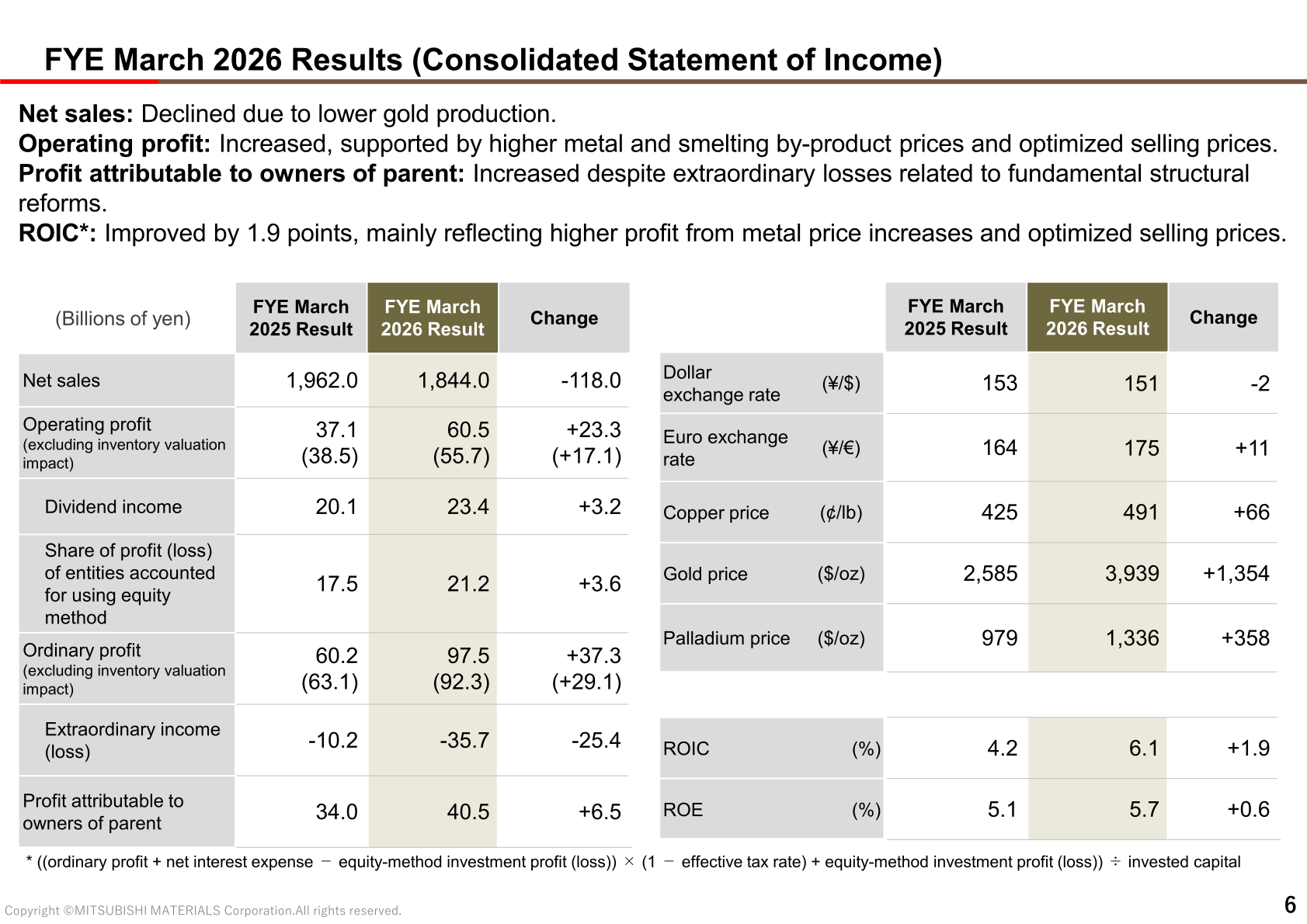
Consolidated Results (Full-Year Actual)
Net sales declined due to lower gold production. Operating profit increased, supported by higher metal and smelting by-product prices and optimized selling prices; the company notes that the impact of weaker concentrate purchase terms (TC/RC) and higher raw material costs was offset by these factors. Ordinary profit increased, driven by higher dividend income, improved equity-method earnings, and foreign exchange gains on foreign currency-denominated receivables and payables. ROIC improved by 1.9 points, mainly reflecting higher profit from metal price increases and optimized selling prices.
| Item (Billions of yen) | FYE March 2025 Result | FYE March 2026 Result | Change |
|---|---|---|---|
| Net sales | 1,962.0 | 1,844.0 | -118.0 |
| Operating profit (excluding inventory valuation impact) | 37.1 (38.5) | 60.5 (55.7) | +23.3 (+17.1) |
| Dividend income | 20.1 | 23.4 | +3.2 |
| Share of profit (loss) of entities accounted for using equity method | 17.5 | 21.2 | +3.6 |
| Ordinary profit (excluding inventory valuation impact) | 60.2 (63.1) | 97.5 (92.3) | +37.3 (+29.1) |
| Extraordinary income (loss) | -10.2 | -35.7 | -25.4 |
| Profit attributable to owners of parent | 34.0 | 40.5 | +6.5 |
| ROIC (%) | 4.2 | 6.1 | +1.9 |
| ROE (%) | 5.1 | 5.7 | +0.6 |
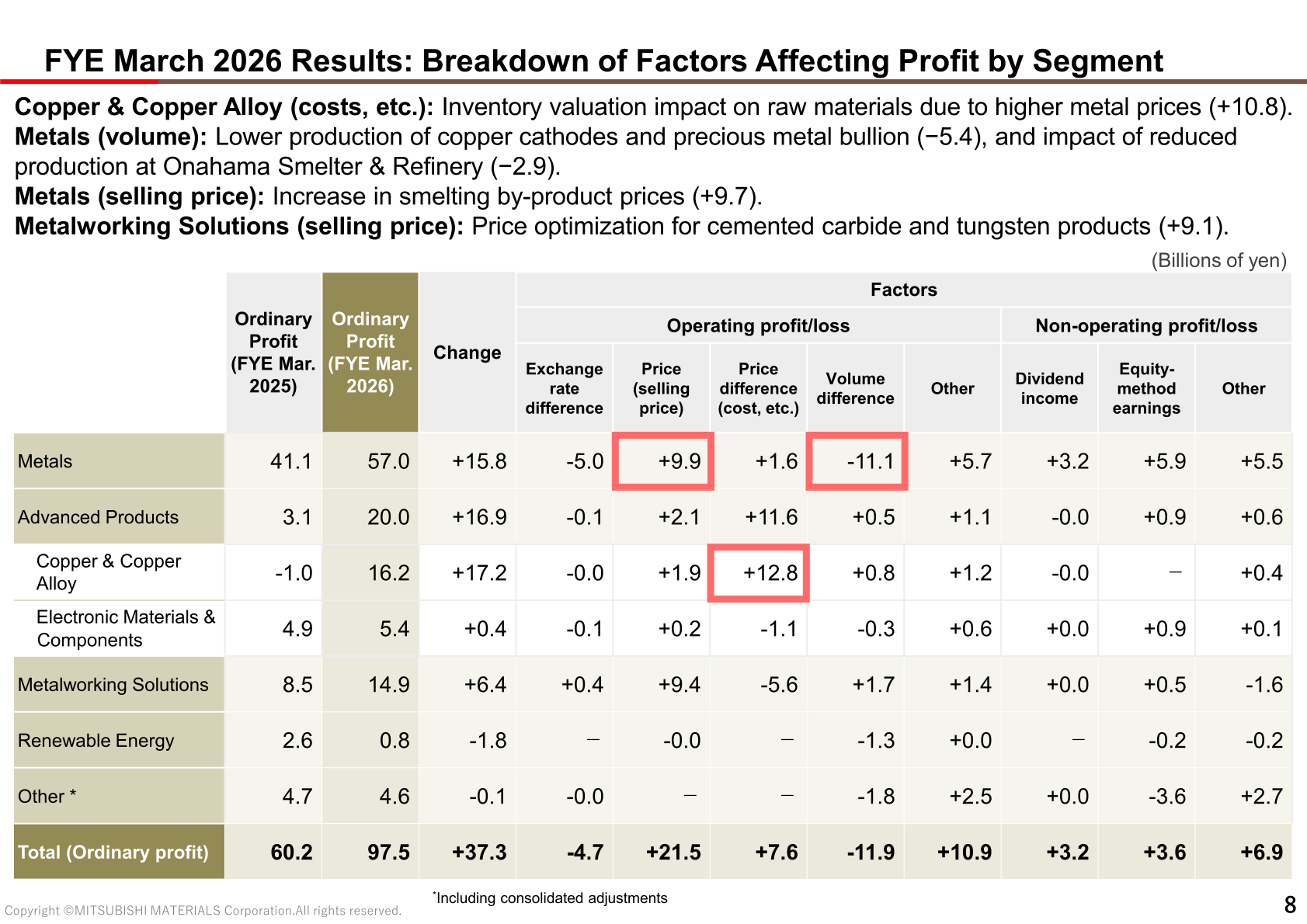
Market assumptions moved in the company’s favor: the copper price rose from 425 ¢/lb to 491 ¢/lb, the gold price from 2,585 $/oz to 3,939 $/oz, and the palladium price from 979 $/oz to 1,336 $/oz. The dollar exchange rate was 151 ¥/$ against 153 ¥/$ a year earlier, while the euro rate rose from 164 ¥/€ to 175 ¥/€. Within the change in ordinary profit, the company identifies a price difference (selling price) of +21.5 including an increase in smelting by-product prices of +9.7 and price optimization for cemented carbide and tungsten products of +9.1, a price difference (cost, etc.) of +7.6, a volume difference of -11.9, and an exchange rate difference of -4.7.
Segment Results
On the segment classification used for the reporting year, ordinary profit rose in every segment except Renewable Energy and Other. In the Metals segment, net sales fell from ¥1,433.6 billion to ¥1,235.6 billion while ordinary profit rose from ¥41.1 billion to ¥57.0 billion, as deteriorating concentrate purchase terms (TC/RC) were offset by higher prices of smelting by-products. Copper & Copper Alloy net sales rose from ¥433.6 billion to ¥509.3 billion and ordinary profit turned from -¥1.0 billion to ¥16.2 billion on inventory valuation gains on raw materials resulting from higher metal prices. Metalworking Solutions net sales rose from ¥148.8 billion to ¥234.7 billion following the consolidation of H.C. Starck, with ordinary profit up from ¥8.5 billion to ¥14.9 billion as higher raw material costs were offset by sales price optimization. Electronic Materials & Components net sales rose from ¥77.9 billion to ¥84.0 billion; operating profit fell from ¥3.2 billion to ¥2.6 billion on lower sales of seal products, while ordinary profit increased from ¥4.9 billion to ¥5.4 billion on improved equity-method earnings.
| Segment (classification used for the reporting year) | Ordinary profit FYE March 2025 | Ordinary profit FYE March 2026 | Change |
|---|---|---|---|
| Metals | 41.1 | 57.0 | +15.8 |
| Advanced Products | 3.1 | 20.0 | +16.9 |
| Copper & Copper Alloy | -1.0 | 16.2 | +17.2 |
| Electronic Materials & Components | 4.9 | 5.4 | +0.4 |
| Metalworking Solutions | 8.5 | 14.9 | +6.4 |
| Renewable Energy | 2.6 | 0.8 | -1.8 |
| Other (including consolidated adjustments) | 4.7 | 4.6 | -0.1 |
| Total (Ordinary profit) | 60.2 | 97.5 | +37.3 |
As a result of the organizational restructuring effective April 1, 2026, segment names were revised and the business classifications for Luvata, Tungsten, and Mineral Resources were reorganized. On the new classification, the ¥97.5 billion of ordinary profit for the fiscal year ended March 2026 maps to Metals/Resources Circulation ¥29.6 billion, Copper & Copper Alloy Products ¥14.2 billion, Metalworking Solutions ¥15.1 billion, Advanced Products ¥5.5 billion, Mineral Resources ¥28.6 billion, Renewable Energy ¥0.8 billion and Other ¥3.5 billion.
Financial Position and Cash Flow
Total assets increased from ¥2,379.4 billion to ¥2,999.7 billion, due to higher inventories and leased metal bullion driven by higher metal prices. The net D/E ratio was 0.72 against 0.74 at the previous fiscal year-end, which the company describes as remaining at the same level and reflecting continued disciplined financial management. The equity ratio was 24.5% (42% excluding deposited gold bullion). Free cash flow totaled ¥4.6 billion, up ¥25.1 billion year on year, as an increase in ordinary profit offset a rise in working capital driven by higher metal prices. Under the Medium-term Management Strategy FY2031, the company achieved cumulative cost reductions of ¥23.5 billion over three years, exceeding the target of ¥8.8 billion.
Forecast for the Fiscal Year Ending March 2027
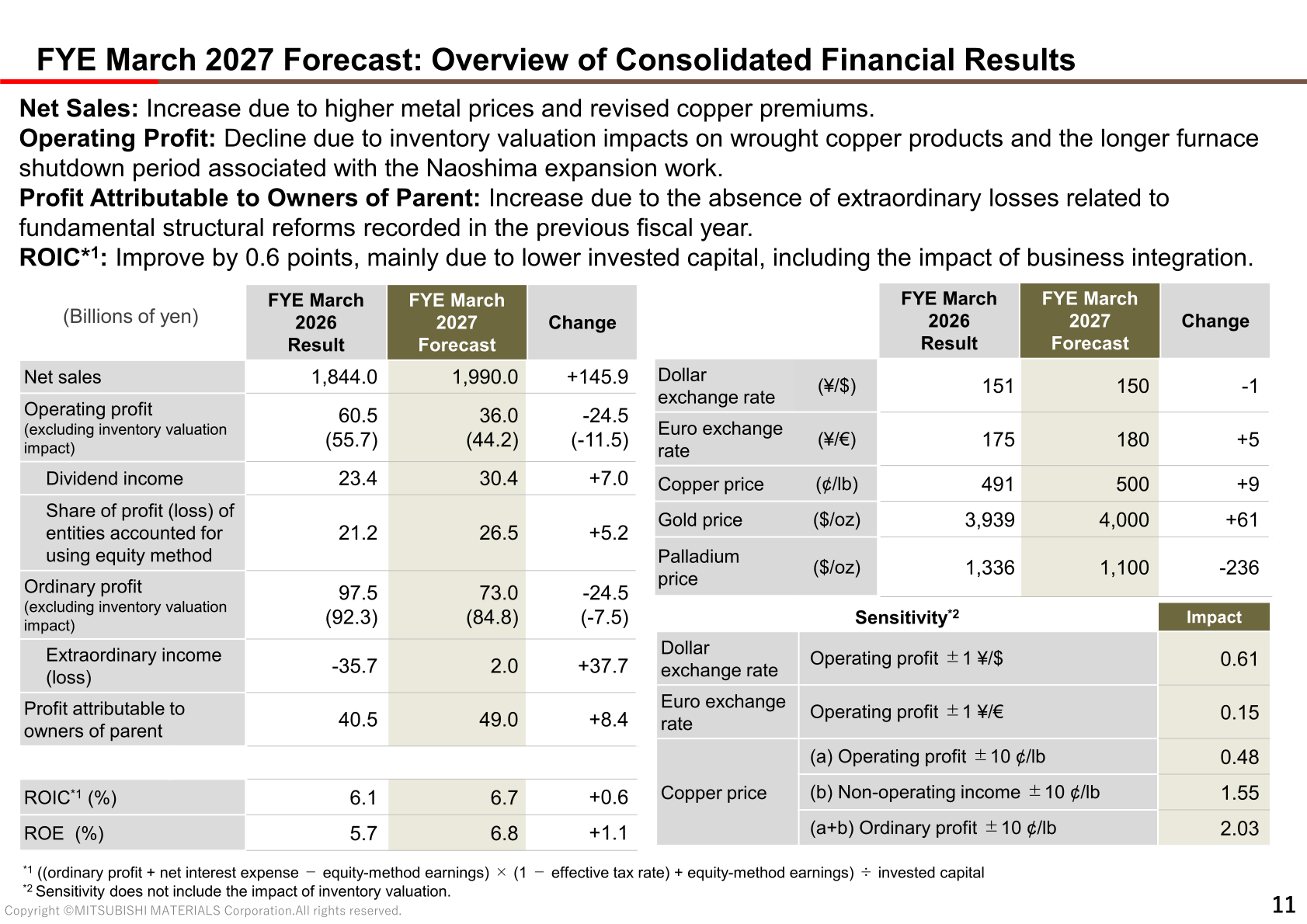
For the fiscal year ending March 31, 2027, the company forecasts net sales of ¥1,990.0 billion, up ¥145.9 billion, on higher metal prices and revised copper premiums. Operating profit is expected to decline ¥24.5 billion to ¥36.0 billion due to inventory valuation impacts on wrought copper products and the longer furnace shutdown period associated with the Naoshima expansion work, and ordinary profit is expected to fall ¥24.5 billion to ¥73.0 billion. Profit attributable to owners of parent is nonetheless forecast to rise ¥8.4 billion to ¥49.0 billion, due to the absence of extraordinary losses related to fundamental structural reforms recorded in the previous fiscal year. ROIC is expected to improve 0.6 points to 6.7%, mainly due to lower invested capital including the impact of business integration. Assumptions are 150 ¥/$, 180 ¥/€, a copper price of 500 ¢/lb, a gold price of 4,000 $/oz and a palladium price of 1,100 $/oz. Free cash flow is expected to be ¥46.0 billion, up ¥41.3 billion, mainly due to proceeds from business divestitures.
| Item (Billions of yen) | FYE March 2026 Result | FYE March 2027 Forecast | Change |
|---|---|---|---|
| Net sales | 1,844.0 | 1,990.0 | +145.9 |
| Operating profit (excluding inventory valuation impact) | 60.5 (55.7) | 36.0 (44.2) | -24.5 (-11.5) |
| Dividend income | 23.4 | 30.4 | +7.0 |
| Share of profit (loss) of entities accounted for using equity method | 21.2 | 26.5 | +5.2 |
| Ordinary profit (excluding inventory valuation impact) | 97.5 (92.3) | 73.0 (84.8) | -24.5 (-7.5) |
| Extraordinary income (loss) | -35.7 | 2.0 | +37.7 |
| Profit attributable to owners of parent | 40.5 | 49.0 | +8.4 |
| ROIC (%) | 6.1 | 6.7 | +0.6 |
| ROE (%) | 5.7 | 6.8 | +1.1 |
| Segment (new classification, Billions of yen) | Net sales FYE March 2026 | Ordinary profit FYE March 2026 | Net sales FYE March 2027 Forecast | Ordinary profit FYE March 2027 Forecast |
|---|---|---|---|---|
| Materials Business Area | 1,427.0 | 44.8 | 1,549.8 | 21.5 |
| Metals/Resources Circulation | 1,329.0 | 29.6 | 1,428.8 | 21.3 |
| Copper & Copper Alloy Products | 358.1 | 14.2 | 387.9 | 0.7 |
| Products Business Area | 381.8 | 20.6 | 416.7 | 18.2 |
| Metalworking Solutions | 147.2 | 15.1 | 157.8 | 12.9 |
| Advanced Products | 234.5 | 5.5 | 258.8 | 5.3 |
| Mineral Resources | - | 28.6 | - | 33.7 |
| Renewable Energy | 6.2 | 0.8 | 7.8 | 1.4 |
| Other (including consolidation adjustments) | 29.0 | 2.5 | 15.3 | -2.0 |
| Total | 1,844.0 | 97.5 | 1,990.0 | 73.0 |
By segment, Metals/Resources Circulation profit is expected to decline as the deterioration in TC/RC is offset by higher copper premiums but the impact of expansion work weighs on results, including a volume difference of -5.6. Copper & Copper Alloy Products is expected to fall sharply on a rebound decline following inventory valuation gains recorded in the previous fiscal year, with a price difference (cost, etc.) of -13.5. Metalworking Solutions profit is expected to decline as the impact of rising raw material prices (-9.9) outweighs the effects of price optimization (+8.4). In Advanced Products, operating profit is expected to increase from ¥5.5 billion to ¥7.3 billion, mainly driven by higher sales of products for AI applications.
Shareholder Returns
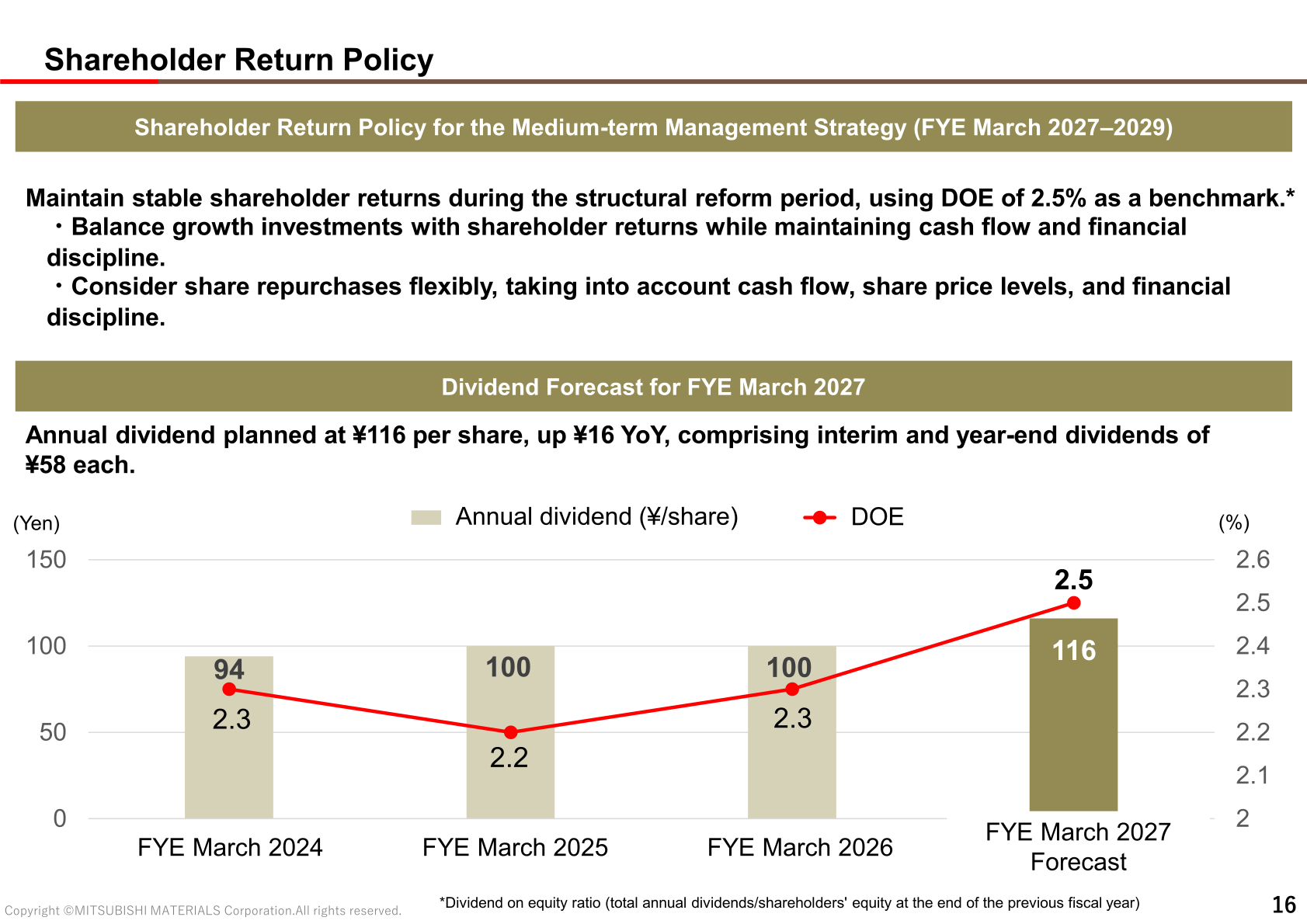
A year-end dividend of ¥50 per share was approved for the fiscal year ended March 2026, bringing the annual dividend to ¥100 per share, unchanged from the ¥100 paid for the fiscal year ended March 2025. For the fiscal year ending March 2027, the company plans an annual dividend of ¥116 per share, up ¥16 year on year, comprising interim and year-end dividends of ¥58 each.
Medium-Term Strategy and Topics
Under the shareholder return policy for the Medium-term Management Strategy covering the fiscal years ending March 2027 to March 2029, the company will maintain stable shareholder returns during the structural reform period, using DOE of 2.5% as a benchmark, balance growth investments with shareholder returns while maintaining cash flow and financial discipline, and consider share repurchases flexibly taking into account cash flow, share price levels, and financial discipline. Initiatives announced under the strategy include the decision to suspend the operation of smelting facilities at the Onahama Smelter & Refinery due to a reduction in copper concentrate processing, the decision to acquire shares of ReElement Technologies, the launch of the Osaka Plant to optimize the production structure of the Copper & Copper Alloy Products business, and the completion of the Kumagaya Works No. 2 to support the provision of high value-added seal products. On the business environment, the company notes that automotive-related demand continues to be strong in China and Southeast Asia while demand in Japan, the U.S. and Europe remains generally flat and is showing a gradual recovery, and that semiconductor-related demand for AI applications remains strong while demand for other applications continues to be weak.
This article is an analysis based on publicly available information and is not a recommendation to buy or sell any specific securities. Investment decisions are your own responsibility.
![[Obayashi] Investors’ Guide 2026 — The Complete 24-Article Breakdown](https://japan-equity.com/wp-content/uploads/2026/07/hub_cover-1024x1024.png)
![[Obayashi] IR & SR Policy — Feeding Dialogue Back into Management](https://japan-equity.com/wp-content/uploads/2026/07/p32_sq-1024x1024.jpg)
![[Obayashi] Real Estate Development — 18.7% Margin, ¥287.7bn Unrealized Gains](https://japan-equity.com/wp-content/uploads/2026/07/p20_sq-1024x1024.jpg)
![[Obayashi] Domestic Civil Engineering — Resilience Spending Supports 9.6% Margin](https://japan-equity.com/wp-content/uploads/2026/07/p11_sq-1024x1024.jpg)
![[Obayashi] Share Price & External Ratings — vs TOPIX, ESG Index Inclusion](https://japan-equity.com/wp-content/uploads/2026/07/p40_sq-1024x1024.jpg)
![[Construction] ¥75.5tn Investment, Shrinking Workforce — Big-5 Market Share](https://japan-equity.com/wp-content/uploads/2026/07/p12_sq-1024x1024.jpg)
![[Obayashi] Capital Policy & Shareholder Returns — ROE 10%+, DOE ~5%, ¥100bn Buyback](https://japan-equity.com/wp-content/uploads/2026/07/p27_sq-1024x1024.jpg)
![[Obayashi] Reducing Cross-Shareholdings — ¥285.2bn Sold in Five Years](https://japan-equity.com/wp-content/uploads/2026/07/p29_sq-1024x1024.jpg)
![[Obayashi] ¥750bn Investment Plan — ¥300bn to Development, ¥190bn to Tech/DX](https://japan-equity.com/wp-content/uploads/2026/07/p30_sq-1024x1024.jpg)
![[Obayashi] MTP2022 KPIs — Operating Profit ~2x Target, ROE 14.4%](https://japan-equity.com/wp-content/uploads/2026/07/p25_sq-1024x1024.jpg)
![[Obayashi] Cash Allocation — ¥420bn Investment CF Over Five Years](https://japan-equity.com/wp-content/uploads/2026/07/p26_sq-1024x1024.jpg)
![[Obayashi] Green Energy — 44 Plants, 344MW, and the Green Hydrogen Challenge](https://japan-equity.com/wp-content/uploads/2026/07/p21_sq-1024x1024.jpg)
![[Obayashi] Tackling the Labor Shortage — Robotics Construction®](https://japan-equity.com/wp-content/uploads/2026/07/p14_sq-1024x1024.jpg)
