This article is based on publicly available IR materials and is not a recommendation to buy or sell any specific securities.
Note: Digital Information Technologies Corporation’s fiscal year ends on June 30. This article covers the fiscal year ended June 30, 2026 — which the company labels “FY6/26” and is its most recently completed full year. In line with this site’s convention it is classified here as “FY2025”; all figures, tables and labels below follow the company’s own “FY6/25” (prior year), “FY6/26” (results) and “FY6/27” (forecast) notation.
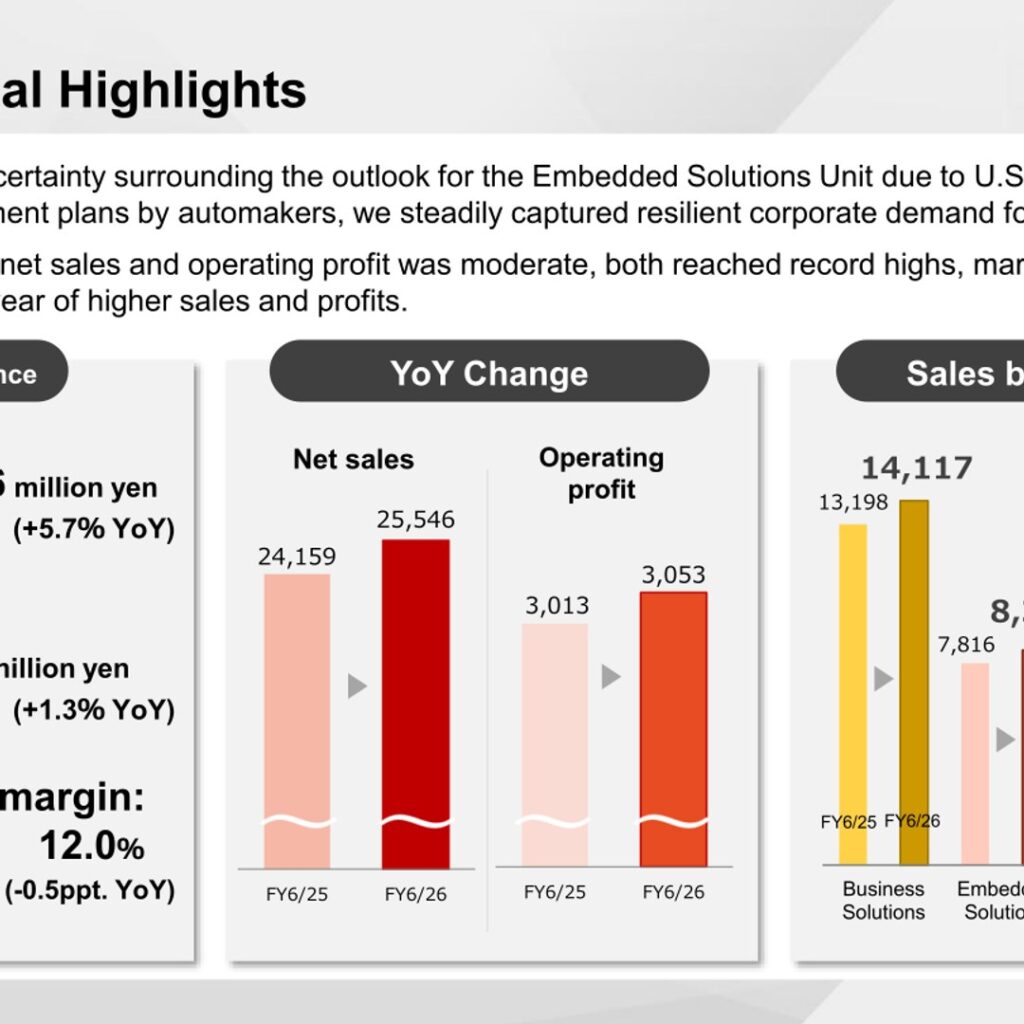
Digital Information Technologies (DIT) reported FY6/26 net sales of 25,546 million yen (+5.7% YoY) and operating profit of 3,053 million yen (+1.3% YoY), with an operating profit margin of 12.0% (-0.5ppt. YoY). According to the company, amid continued uncertainty surrounding the outlook for the Embedded Solutions Unit due to U.S. trade policies and revisions to investment plans by automakers, it steadily captured resilient corporate demand for IT investment. Although growth in net sales and operating profit was moderate, both reached record highs, marking the 16th consecutive fiscal year of higher sales and profits. For FY6/27 the company forecasts net sales of 26,700 million yen and operating profit of 3,200 million yen, aiming for a 17th consecutive year of higher sales and profits.
Consolidated Results (Full-Year Actual)
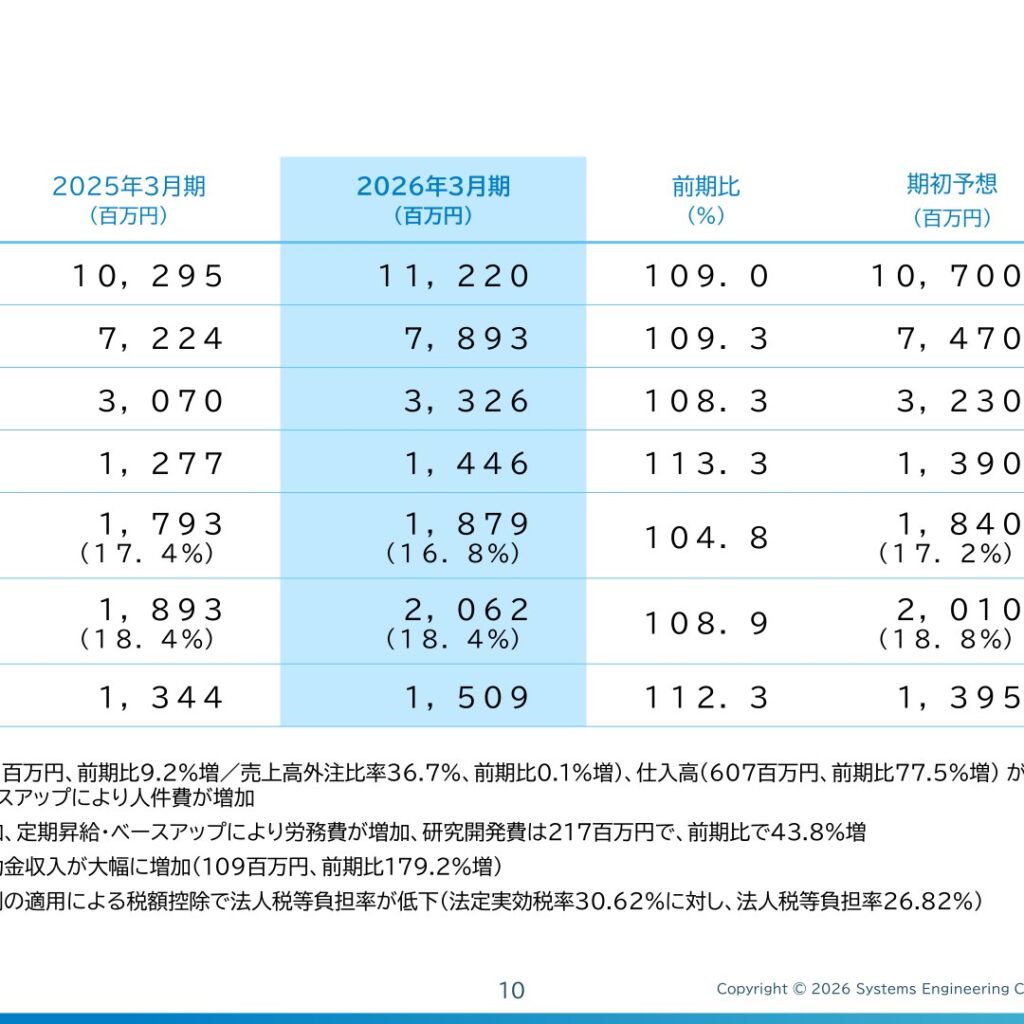
Net sales, operating profit and ordinary profit all exceeded the previous fiscal year’s results. In line with its initial plan, the company increased growth investments in the development of AI and strategic products, resulting in a 0.5 percentage point year-on-year decline in the operating profit margin. Compared with the plan, net sales fell slightly short of target, while operating profit came in as planned despite absorbing an increase in SG&A expenses associated with strategic investments. Profit attributable to owners of parent fell below plan, mainly due to the recording of an impairment loss of 77 million yen on investment securities held in a capital and business alliance partner as an extraordinary loss.
| Item (Millions of yen) | FY6/25 Result | FY6/26 Result | YoY % | FY6/26 Forecast | Vs. Forecast % |
|---|---|---|---|---|---|
| Net sales | 24,159 | 25,546 | +5.7% | 26,000 | -1.7% |
| Gross profit | 6,145 | 6,425 | +4.5% | – | – |
| SG&A | 3,131 | 3,372 | +7.7% | – | – |
| Operating profit | 3,013 | 3,053 | +1.3% | 3,050 | +0.1% |
| Ordinary profit | 3,027 | 3,076 | +1.6% | 3,050 | +0.9% |
| Profit attributable to owners of parent | 2,178 | 2,092 | -3.9% | 2,200 | -4.9% |
The gross profit margin declined by 0.2 percentage points to 25.2%, reflecting a decrease in highly profitable projects in the Embedded Solutions Unit amid changes in the automotive market, as well as higher costs in the Product Solutions Unit. The SG&A ratio rose by 0.2 percentage points to 13.2% as the company stepped up investments for future growth; strategic investment expenses for the fiscal year were 193 million yen. Operating profit increased despite absorbing strategic investments in R&D and the expansion of head office floor space.
On the balance sheet, total assets rose to 12,290 million yen (End-Jun. 2025: 11,271 million yen) and total net assets to 9,181 million yen (8,182 million yen), driven by growth in cash and deposits and retained earnings. The equity ratio remained high at 73.7%. Operating cash flow was 2,531 million yen and investing cash flow was a net outflow of 736 million yen, mainly due to purchases of investment securities, bringing the year-end cash balance to 5,900 million yen. ROE declined 4.6 percentage points year on year to 24.4%, reflecting an increase in shareholders’ equity and a decrease in net income due to extraordinary losses, but remained at a high level.
Segment Results
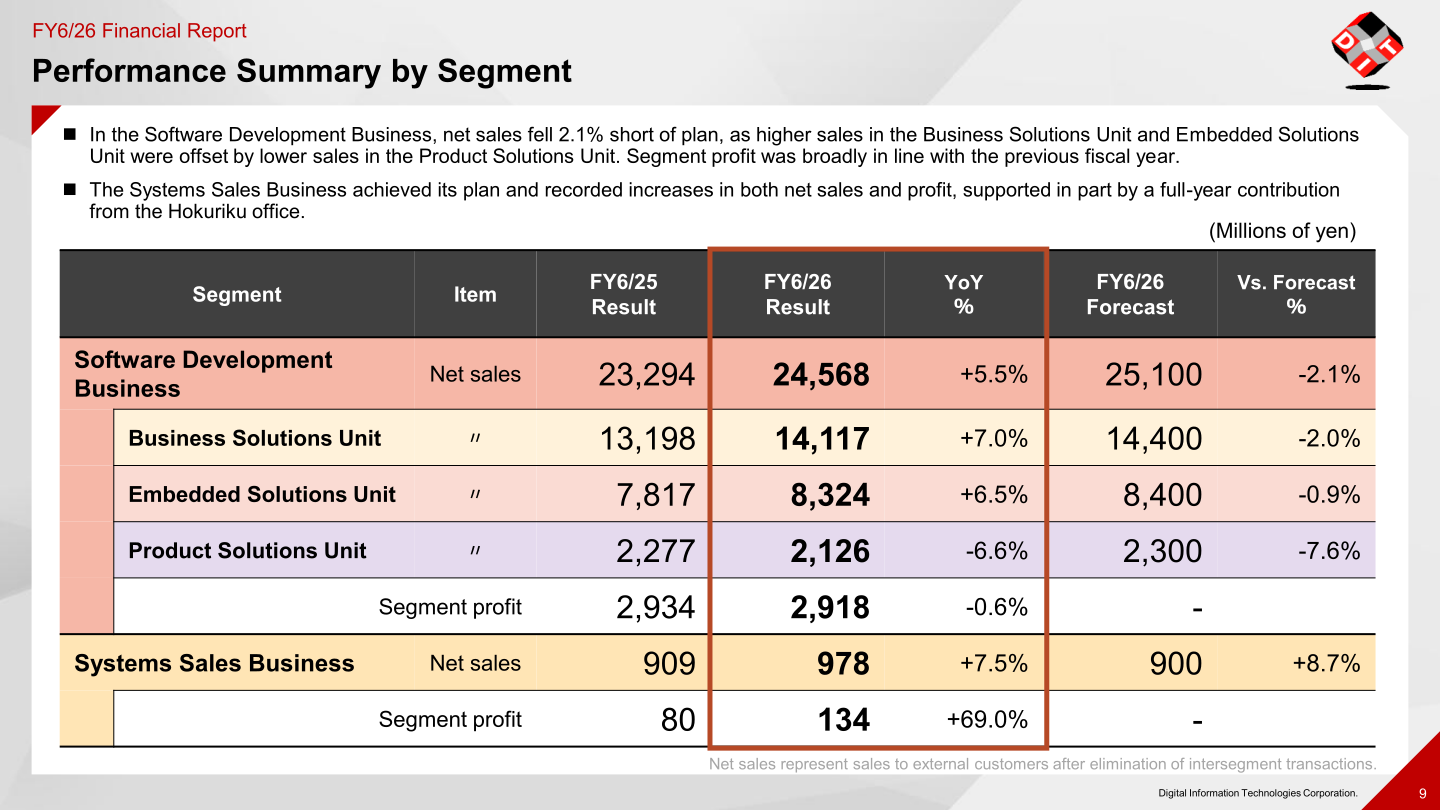
In the Software Development Business, net sales fell 2.1% short of plan, as higher sales in the Business Solutions Unit and Embedded Solutions Unit were offset by lower sales in the Product Solutions Unit; segment profit was broadly in line with the previous fiscal year. The Systems Sales Business achieved its plan and recorded increases in both net sales and profit, supported in part by a full-year contribution from the Hokuriku office.
| Segment (Millions of yen) | Item | FY6/25 Result | FY6/26 Result | YoY % | FY6/26 Forecast | Vs. Forecast % |
|---|---|---|---|---|---|---|
| Software Development Business | Net sales | 23,294 | 24,568 | +5.5% | 25,100 | -2.1% |
| Business Solutions Unit | Net sales | 13,198 | 14,117 | +7.0% | 14,400 | -2.0% |
| Embedded Solutions Unit | Net sales | 7,817 | 8,324 | +6.5% | 8,400 | -0.9% |
| Product Solutions Unit | Net sales | 2,277 | 2,126 | -6.6% | 2,300 | -7.6% |
| Software Development Business | Segment profit | 2,934 | 2,918 | -0.6% | – | |
| Systems Sales Business | Net sales | 909 | 978 | +7.5% | 900 | +8.7% |
| Systems Sales Business | Segment profit | 80 | 134 | +69.0% | – |
Business Solutions Unit: net sales rose 7.0% to 14,117 million yen and gross profit rose 10.9%, outpacing net sales growth; the unit’s gross margin was 26.3%. In Business System Development (net sales 8,371 million yen), growth in telecommunications projects and a recovery in ERP- and pharmaceutical-related projects offset the impact of a decline following high-value public-sector projects in the previous fiscal year. In Operational Support (net sales 5,746 million yen), value-added services such as cloud infrastructure development, data analytics and Microsoft Power Platform-related services grew, significantly improving the gross profit margin.
Embedded Solutions Unit: net sales rose 6.5% to 8,324 million yen. Despite a further weakening in demand from the core automotive sector from Q3 onward, the unit built up projects in non-automotive fields and achieved higher sales and profit, while the gross profit margin declined by 1.7 percentage points year on year to 30.4% due to a change in the project mix. In Embedded System Verification, the early completion of a large-scale automotive testing project and the effect on the U.S. subsidiary of Japanese companies reviewing their EV investment plans left net sales broadly in line with the previous year, while gross profit declined.
Product Solutions Unit: net sales decreased 6.6% to 2,126 million yen, reflecting the discontinuation of New Year’s card software sales and a pullback following sales of perpetual xoBlos licenses in the previous fiscal year. Additional work related to electronic contract system integration also weighed on earnings, resulting in a 10.2% decline in gross profit and a 1.5 percentage point decrease in the gross profit margin. Sales of WebARGUS licenses and vulnerability assessment services increased, and in April the company launched “xFormly,” a data structuring tool. Systems Sales Business: net sales increased 12.9% to 978 million yen and gross profit rose 20.4%, helped by the Hokuriku sales office, PC demand associated with the migration to Windows 11, and revisions to maintenance fees for “Rakuichi.”
FY6/27 Forecast
The company expects to steadily capture resilient DX demand across its business domains, projecting net sales and profits at each level to grow by around 4% year on year and aiming for a 17th consecutive fiscal year of higher sales and profits. It is moving its “AI-Integrated Model” into the implementation phase and will continue investing at a level comparable to the previous fiscal year in the utilization of generative AI and the development of strategic products. For the first half, taking into account adjustments to automotive software investment budgets associated with Japanese automakers’ revisions to development plans for next-generation vehicle models, net sales are forecast to increase 1.9% year on year to 13,000 million yen, while operating profit is forecast to decrease 6.1% to 1,475 million yen.
| Item (Millions of yen) | FY6/26 Result | FY6/27 Forecast | YoY % | H1 FY6/27 Forecast |
|---|---|---|---|---|
| Net sales | 25,546 | 26,700 | +4.5% | 13,000 |
| Operating profit | 3,053 | 3,200 | +4.8% | 1,475 |
| Ordinary profit | 3,076 | 3,200 | +4.0% | 1,475 |
| Profit attributable to owners of parent | 2,092 | 2,190 | +4.6% | 1,010 |
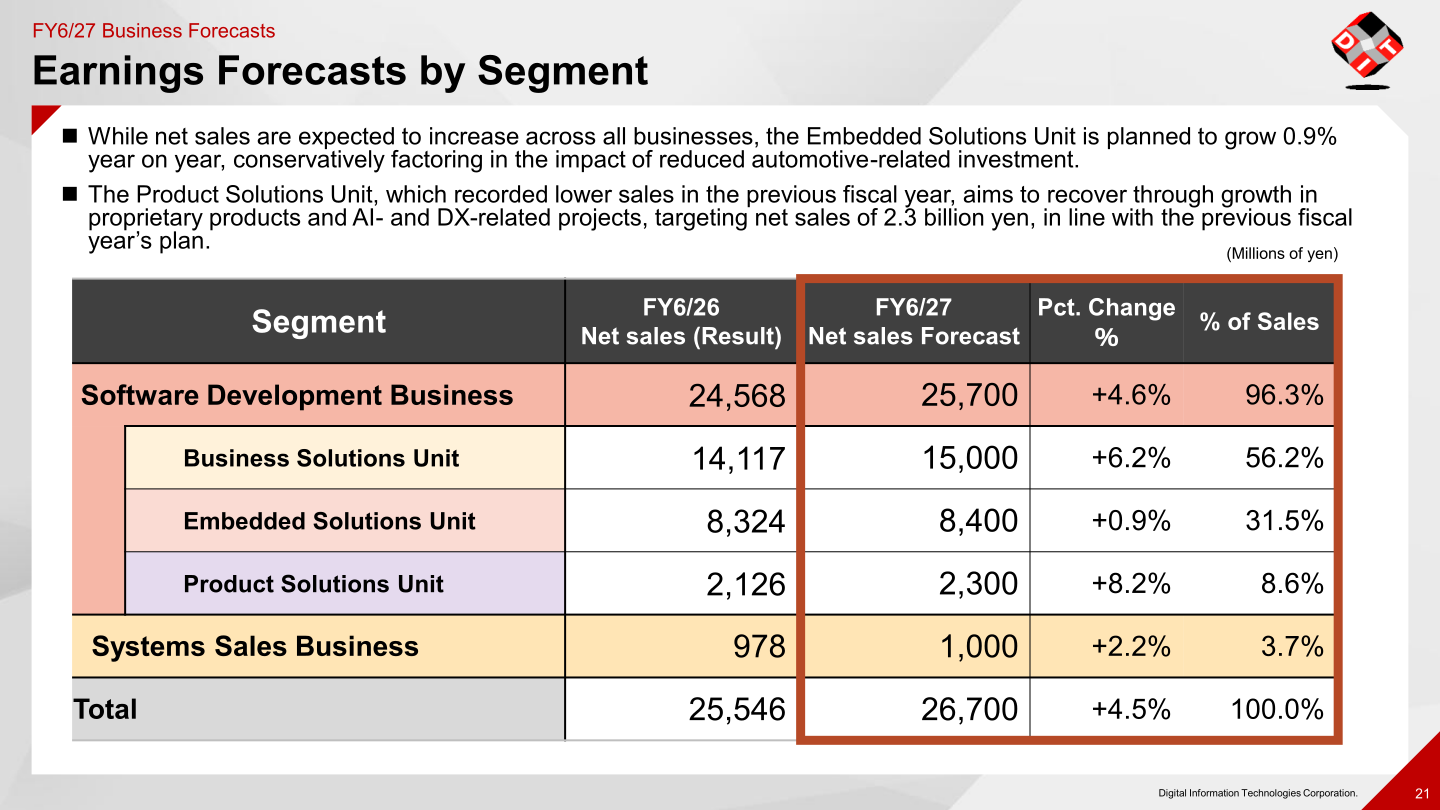
By segment, net sales are expected to increase across all businesses. The Embedded Solutions Unit is planned to grow 0.9% year on year, conservatively factoring in the impact of reduced automotive-related investment, while the Product Solutions Unit aims to recover through growth in proprietary products and AI- and DX-related projects, targeting net sales of 2.3 billion yen.
| Segment (Millions of yen) | FY6/26 Net sales (Result) | FY6/27 Net sales Forecast | Pct. Change % | % of Sales |
|---|---|---|---|---|
| Software Development Business | 24,568 | 25,700 | +4.6% | 96.3% |
| Business Solutions Unit | 14,117 | 15,000 | +6.2% | 56.2% |
| Embedded Solutions Unit | 8,324 | 8,400 | +0.9% | 31.5% |
| Product Solutions Unit | 2,126 | 2,300 | +8.2% | 8.6% |
| Systems Sales Business | 978 | 1,000 | +2.2% | 3.7% |
| Total | 25,546 | 26,700 | +4.5% | 100.0% |
Shareholder Returns
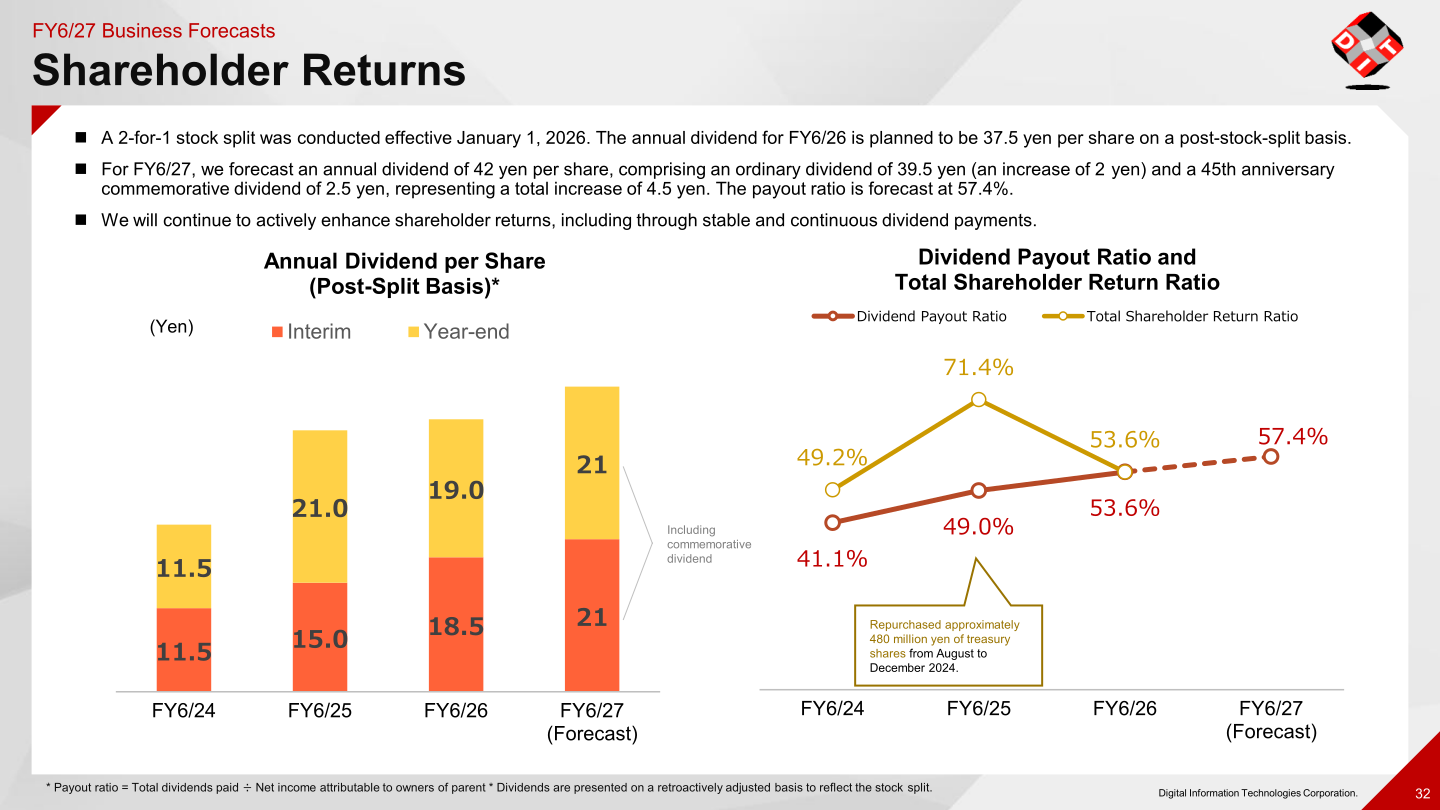
A 2-for-1 stock split was conducted effective January 1, 2026. The annual dividend for FY6/26 is planned to be 37.5 yen per share on a post-stock-split basis (interim 18.5 yen, year-end 19.0 yen), with a dividend payout ratio of 53.6%. For FY6/27, the company forecasts an annual dividend of 42 yen per share, comprising an ordinary dividend of 39.5 yen (an increase of 2 yen) and a 45th anniversary commemorative dividend of 2.5 yen, representing a total increase of 4.5 yen; the payout ratio is forecast at 57.4%. The company states it will continue to actively enhance shareholder returns, including through stable and continuous dividend payments.
| Dividend per share (Yen, post-split basis) | FY6/24 | FY6/25 | FY6/26 | FY6/27 (Forecast) |
|---|---|---|---|---|
| Interim | 11.5 | 15.0 | 18.5 | 21 |
| Year-end | 11.5 | 21.0 | 19.0 | 21 |
| Dividend payout ratio | 41.1% | 49.0% | 53.6% | 57.4% |
| Total shareholder return ratio | 49.2% | 71.4% | 53.6% | – |
Medium-Term Plan and AI Strategy
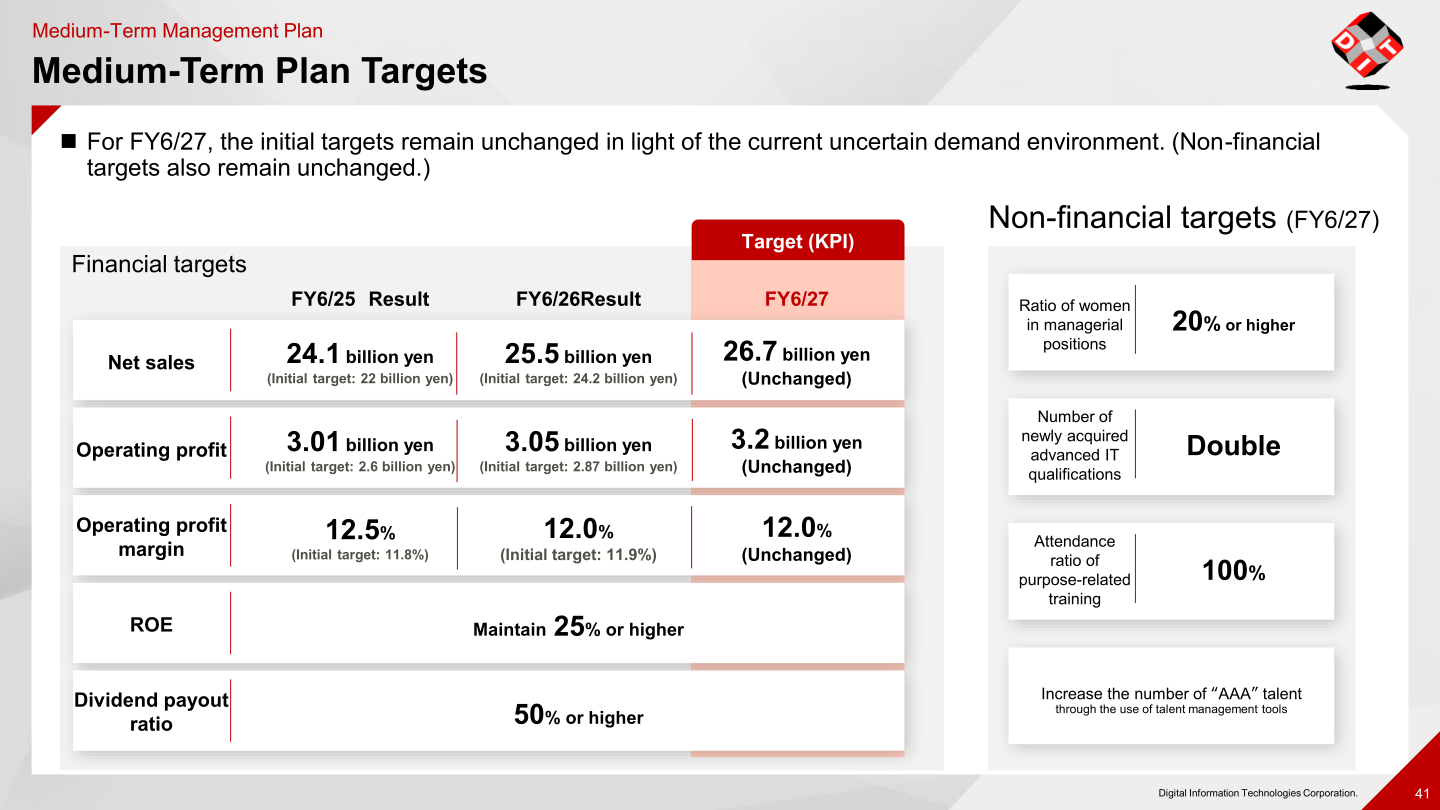
Under the current Medium-Term Management Plan (FY6/25 to FY6/27), FY6/26 results of net sales of 25.5 billion yen (initial target: 24.2 billion yen), operating profit of 3.05 billion yen (initial target: 2.87 billion yen) and an operating profit margin of 12.0% (initial target: 11.9%) exceeded the initial targets. For FY6/27, the targets of net sales of 26.7 billion yen, operating profit of 3.2 billion yen and an operating profit margin of 12.0% remain unchanged in light of the current uncertain demand environment. The plan also targets ROE of 25% or higher and a dividend payout ratio of 50% or higher.
Under the theme “AI-Integrated Model in Action,” DIT aims to restructure its business around AI and accelerate monetization as a hands-on AI/DX integrator, focusing on four priority areas: AI-driven development, data utilization platforms, quality assurance and testing, and cybersecurity technologies. Initiatives include “Q-Compass,” a standardized testing framework, “Qualicia,” an AI-powered testing platform, and “RezOT,” a security solution for embedded devices. The Vision 2030 goal of “Three 50s” — aiming to break 50 in net sales, operating profit and the dividend payout ratio — remains unchanged for the current fiscal year, although the company plans to consider revisions to certain targets when formulating the next Medium-Term Management Plan in light of rapid advances in AI technology.
This article is an analysis based on publicly available information and is not a recommendation to buy or sell any specific securities. Investment decisions are your own responsibility.