
This article is based on publicly available IR materials and is not a recommendation to buy or sell any specific securities.
Note: Kobe Bussan’s fiscal year runs from November 1 to October 31 of the following year. The latest completed fiscal year (FY2025) ended on October 31, 2025, and the company itself labels it “FY2025” (or “FY25”) in its materials; figures and period labels below follow the company’s English-language results presentation dated December 12, 2025.
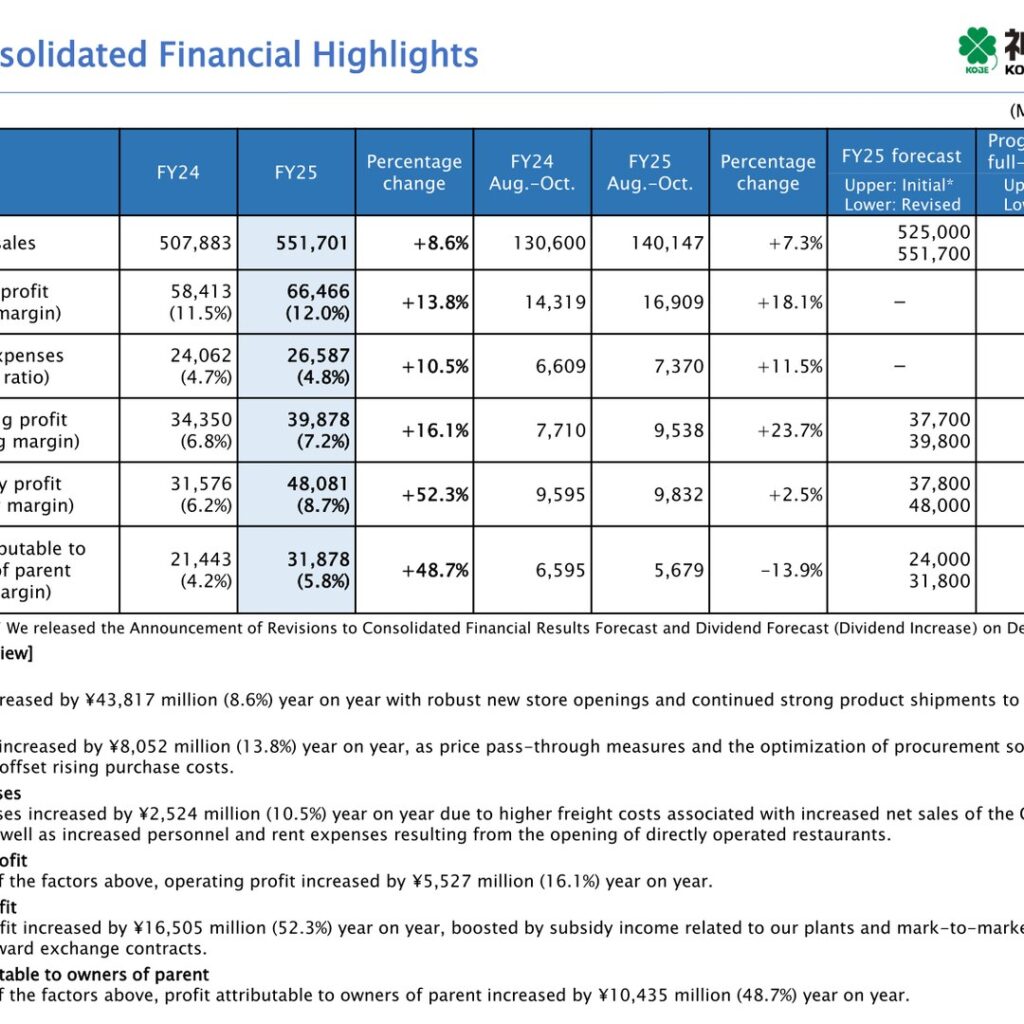
Kobe Bussan Co., Ltd., the operator and franchisor of the Gyomu Super discount food store chain, reported consolidated net sales of ¥551,701 million for FY2025, up 8.6% year on year, driven by robust new store openings and continued strong product shipments to existing stores. Operating profit rose 16.1% to ¥39,878 million, ordinary profit jumped 52.3% to ¥48,081 million — boosted by subsidy income related to the company’s plants and mark-to-market valuation gains on forward exchange contracts — and profit attributable to owners of parent increased 48.7% to ¥31,878 million. Results landed at 100.0%–100.2% of the forecast revised on December 8, 2025.
Consolidated Results (Full-Year Actual)
Gross profit increased by ¥8,052 million (13.8%) year on year to ¥66,466 million, as price pass-through measures and the optimization of procurement sources successfully offset rising purchase costs; the gross margin improved from 11.5% to 12.0%. SG&A expenses rose 10.5% to ¥26,587 million on higher freight costs associated with increased net sales of the Gyomu Super Business, as well as increased personnel and rent expenses from the opening of directly operated restaurants. Against the initial FY2025 forecast, net sales achieved 105.1% progress, operating profit 105.8%, ordinary profit 127.2%, and profit attributable to owners of parent 132.8%.
| Item (millions of yen) | FY25 | FY24 | Change |
|---|---|---|---|
| Net sales | 551,701 | 507,883 | +8.6% |
| Gross profit (gross margin) | 66,466 (12.0%) | 58,413 (11.5%) | +13.8% |
| SG&A expenses (SG&A ratio) | 26,587 (4.8%) | 24,062 (4.7%) | +10.5% |
| Operating profit (operating margin) | 39,878 (7.2%) | 34,350 (6.8%) | +16.1% |
| Ordinary profit (ordinary margin) | 48,081 (8.7%) | 31,576 (6.2%) | +52.3% |
| Profit attributable to owners of parent (net margin) | 31,878 (5.8%) | 21,443 (4.2%) | +48.7% |
On the balance sheet, total assets grew to ¥260,193 million (FY2024: ¥233,392 million) and net assets to ¥161,400 million (FY2024: ¥132,773 million), with the equity ratio rising from 55.4% to 60.5%. For FY2025 the company recorded ROE of 22.2%, ROIC of 16.9%, and a dividend payout ratio of 20.8%, against a WACC recognized to be approximately 2.6%.
Segment Results
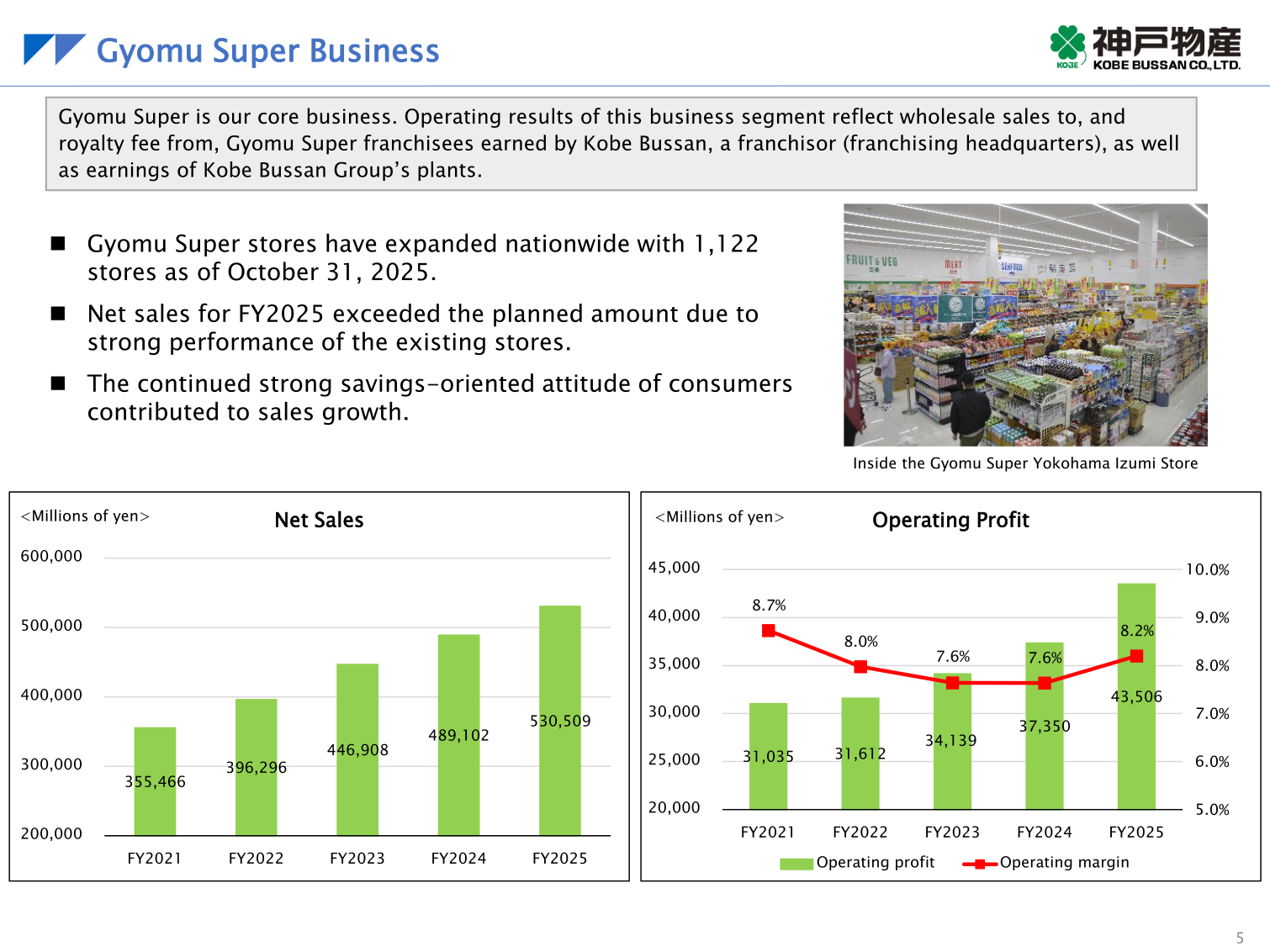
The core Gyomu Super Business posted net sales of ¥530,509 million (FY2024: ¥489,102 million) and operating profit of ¥43,506 million (FY2024: ¥37,350 million), with the operating margin improving from 7.6% to 8.2%. Net sales exceeded the planned amount on strong existing-store performance, helped by consumers’ continued strong savings-oriented attitude. The chain opened 49 stores and closed 11 during FY2025, a net increase of 38 stores — four more than the full-year target of a net increase of 34 — bringing the total to 1,122 stores as of October 31, 2025. Product shipments to existing stores exceeded the previous year’s level, supported by recovering customer visits nationwide: full-year shipments came to 105.1% of the prior year for existing stores in directly managed areas and 108.3% for all stores nationwide.
| Segment (millions of yen) | Metric | FY2025 | FY2024 |
|---|---|---|---|
| Gyomu Super Business | Net sales | 530,509 | 489,102 |
| Gyomu Super Business | Operating profit (margin) | 43,506 (8.2%) | 37,350 (7.6%) |
| Restaurant & Delicatessen Business | Net sales | 16,474 | 14,149 |
| Restaurant & Delicatessen Business | Operating profit (margin) | 1,105 (6.7%) | 1,038 (7.3%) |
| Eco Renewable Energy Business | Net sales | 4,669 | 4,575 |
| Eco Renewable Energy Business | Operating profit (margin) | 1,088 (23.3%) | 1,144 (25.0%) |
In the Restaurant & Delicatessen Business, all three brands worked to address the sharp increase in procurement costs, including rice. Kobe Cook World Buffet grew to 19 restaurants (a net increase of 3 during FY2025), Premium Karubi operated 22 restaurants and finalized plans to open its first franchise location in early March 2026, and the Chisouna delicatessen chain expanded by a net 19 shops to 149 shops, all as of October 31, 2025. In the Eco Renewable Energy Business — 19 solar power plant locations (81.0 MW) and 1 woody biomass power plant (6.2 MW) — electricity sales revenues exceeded the FY2024 level on safe, accident-free operations, while operating profit still reflected the impact of cost accounting method revisions implemented in Q1. In the Gyomu Super Business, Uehara Foods Industry Co., Ltd. joined the group on April 1, 2025, bringing the total number of domestic plants to 27.
FY2026 Forecast
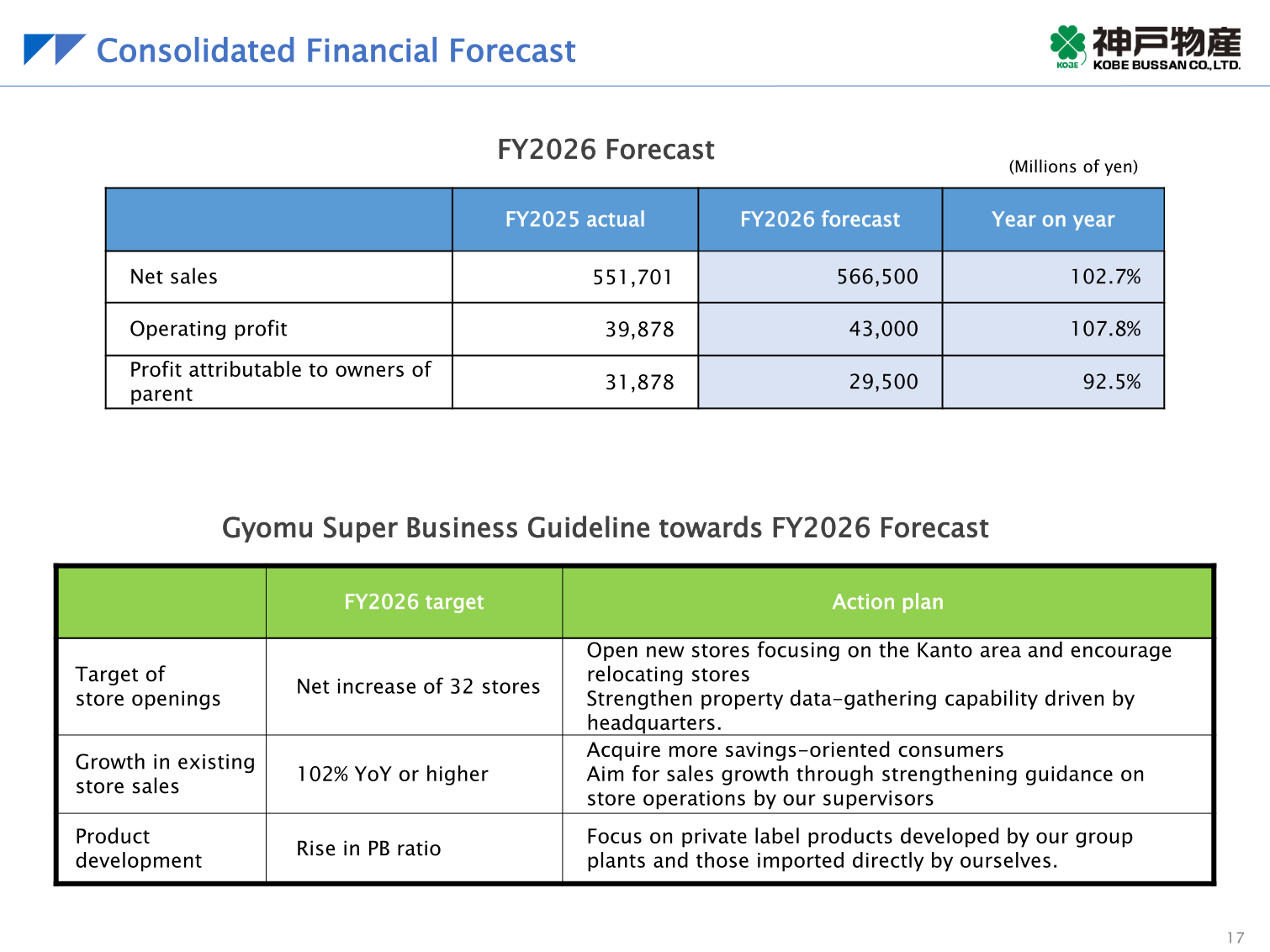
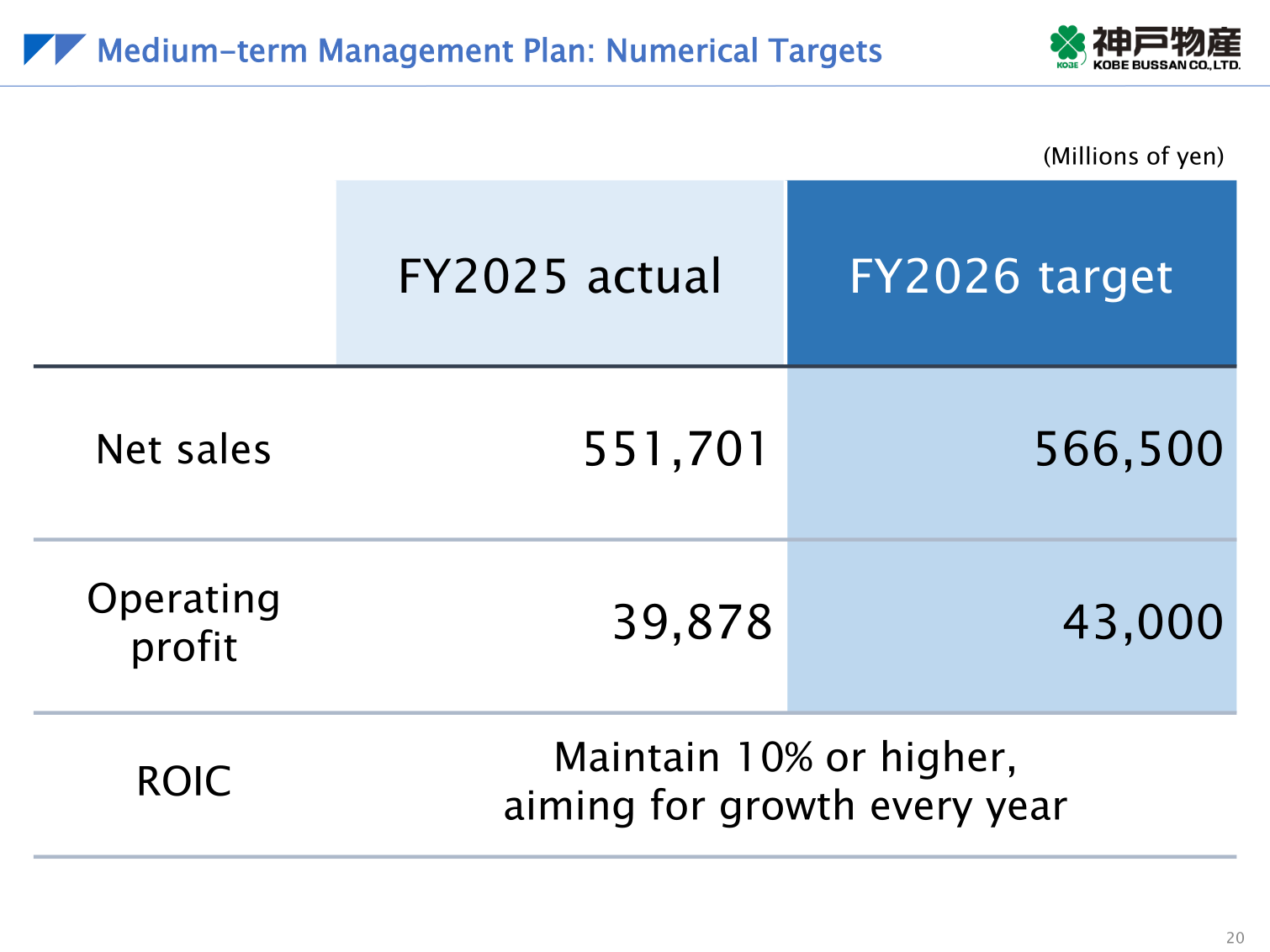
For FY2026 (ending October 31, 2026), Kobe Bussan forecasts net sales of ¥566,500 million (102.7% of FY2025), operating profit of ¥43,000 million (107.8%), and profit attributable to owners of parent of ¥29,500 million (92.5%). The Gyomu Super Business guideline toward the forecast targets a net increase of 32 stores — focusing new openings on the Kanto area — growth in existing store sales of 102% year on year or higher, and a rise in the private label (PB) ratio.
| Item (millions of yen) | FY2026 forecast | FY2025 actual | Year on year |
|---|---|---|---|
| Net sales | 566,500 | 551,701 | 102.7% |
| Operating profit | 43,000 | 39,878 | 107.8% |
| Profit attributable to owners of parent | 29,500 | 31,878 | 92.5% |
Shareholder Returns
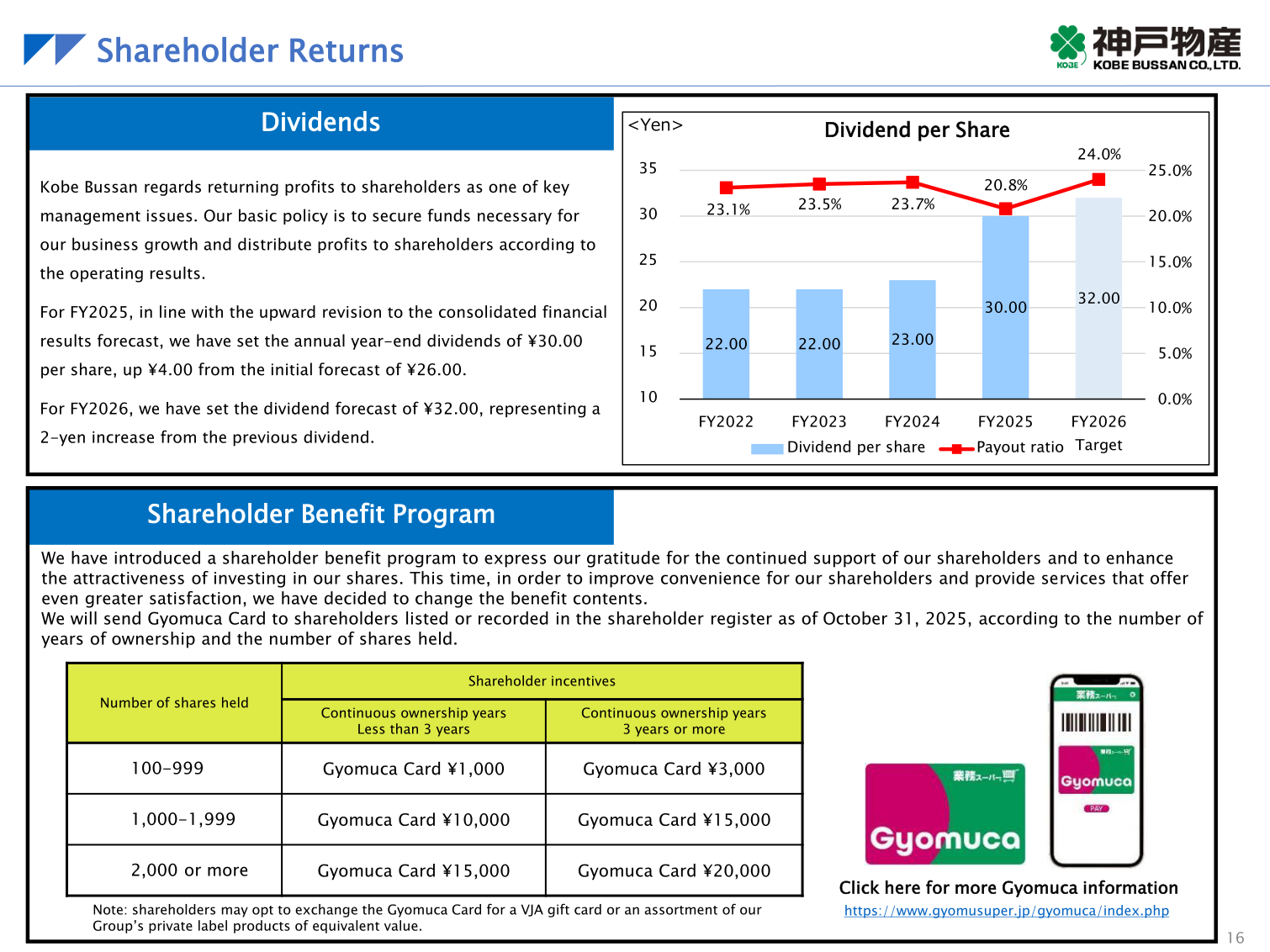
Kobe Bussan regards returning profits to shareholders as one of its key management issues; its basic policy is to secure funds necessary for business growth and distribute profits according to operating results. For FY2025, in line with the upward revision to the consolidated financial results forecast, the company set annual year-end dividends of ¥30.00 per share, up ¥4.00 from the initial forecast of ¥26.00 (payout ratio: 20.8%). For FY2026, the dividend forecast is ¥32.00, a 2-yen increase from the previous dividend. The company also revamped its shareholder benefit program, sending Gyomuca Cards worth ¥1,000 to ¥20,000 to shareholders of record as of October 31, 2025, depending on the number of shares held and years of continuous ownership. Under the FY2024–FY2026 cumulative cash allocation approach, shareholder returns amount to approximately 17 billion yen (dividends) and investment for growth to approximately 50 billion yen.
| Item | FY2022 | FY2023 | FY2024 | FY2025 | FY2026 target |
|---|---|---|---|---|---|
| Dividend per share | ¥22.00 | ¥22.00 | ¥23.00 | ¥30.00 | ¥32.00 |
| Payout ratio | 23.1% | 23.5% | 23.7% | 20.8% | 24.0% |
Medium-Term Plan / Topics
The three-year medium-term management plan starting from FY2024 targets annual capital investment of 10 billion yen or more and an increase in the PB ratio to 37%. Numerical targets for FY2026 are net sales of ¥566,500 million and operating profit of ¥43,000 million, while maintaining ROIC of 10% or higher and aiming for growth every year. Key measures include opening new Gyomu Super stores consistently to exceed 1,130 stores, increasing product shipments to existing stores by 2% or higher year on year, and starting to franchise Premium Karubi. The long-term vision calls for expanding the Gyomu Super chain to over 1,500 stores, raising the PB ratio to 40% or higher, achieving a total of over 500 shops across all Restaurant & Delicatessen brands, reducing the SG&A ratio by investing in distribution centers, and raising the consolidated operating margin to 10% or higher.
This article is an analysis based on publicly available information and is not a recommendation to buy or sell any specific securities. Investment decisions are your own responsibility.
![[Obayashi] Investors’ Guide 2026 — The Complete 24-Article Breakdown](https://japan-equity.com/wp-content/uploads/2026/07/hub_cover-1024x1024.png)
![[Obayashi] IR & SR Policy — Feeding Dialogue Back into Management](https://japan-equity.com/wp-content/uploads/2026/07/p32_sq-1024x1024.jpg)
![[Obayashi] Real Estate Development — 18.7% Margin, ¥287.7bn Unrealized Gains](https://japan-equity.com/wp-content/uploads/2026/07/p20_sq-1024x1024.jpg)
![[Obayashi] Domestic Civil Engineering — Resilience Spending Supports 9.6% Margin](https://japan-equity.com/wp-content/uploads/2026/07/p11_sq-1024x1024.jpg)
![[Obayashi] Share Price & External Ratings — vs TOPIX, ESG Index Inclusion](https://japan-equity.com/wp-content/uploads/2026/07/p40_sq-1024x1024.jpg)
![[Construction] ¥75.5tn Investment, Shrinking Workforce — Big-5 Market Share](https://japan-equity.com/wp-content/uploads/2026/07/p12_sq-1024x1024.jpg)
![[Obayashi] Capital Policy & Shareholder Returns — ROE 10%+, DOE ~5%, ¥100bn Buyback](https://japan-equity.com/wp-content/uploads/2026/07/p27_sq-1024x1024.jpg)
![[Obayashi] Reducing Cross-Shareholdings — ¥285.2bn Sold in Five Years](https://japan-equity.com/wp-content/uploads/2026/07/p29_sq-1024x1024.jpg)
![[Obayashi] ¥750bn Investment Plan — ¥300bn to Development, ¥190bn to Tech/DX](https://japan-equity.com/wp-content/uploads/2026/07/p30_sq-1024x1024.jpg)
![[Obayashi] MTP2022 KPIs — Operating Profit ~2x Target, ROE 14.4%](https://japan-equity.com/wp-content/uploads/2026/07/p25_sq-1024x1024.jpg)
![[Obayashi] Cash Allocation — ¥420bn Investment CF Over Five Years](https://japan-equity.com/wp-content/uploads/2026/07/p26_sq-1024x1024.jpg)
![[Obayashi] Green Energy — 44 Plants, 344MW, and the Green Hydrogen Challenge](https://japan-equity.com/wp-content/uploads/2026/07/p21_sq-1024x1024.jpg)
![[Obayashi] Tackling the Labor Shortage — Robotics Construction®](https://japan-equity.com/wp-content/uploads/2026/07/p14_sq-1024x1024.jpg)
