This article is based on publicly available IR materials and is not a recommendation to buy or sell any specific securities.
Note: Yoshimura Food Holdings does not publish an English results presentation; this article is an English translation of the Japanese-language article on our sister site Investalk, which is based on the company’s Japanese-language IR materials, with figures transcribed as reported. This site classifies the most recent completed fiscal year as “FY2025”; the company’s own label for this period is the fiscal year ended February 2026 (FY2/2026), and the labels used in the text, tables and images below follow the source materials.
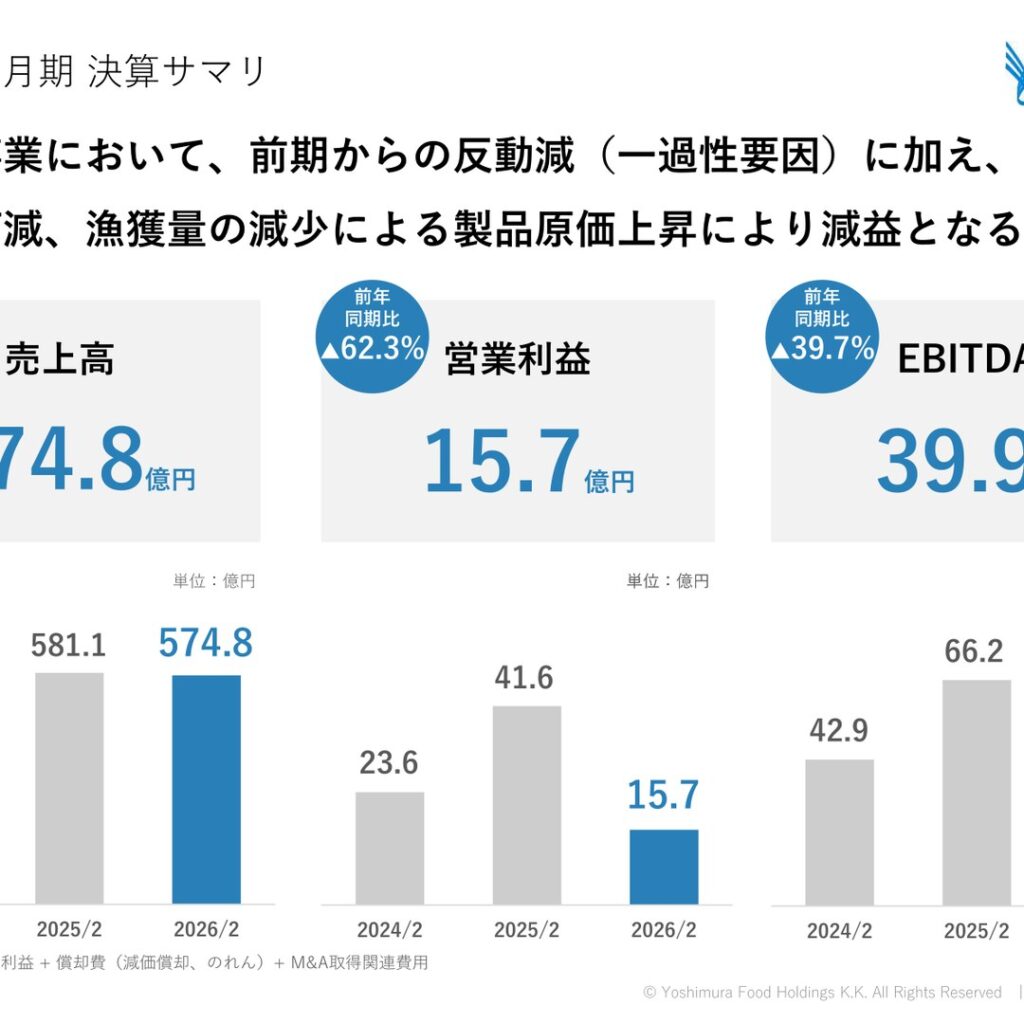
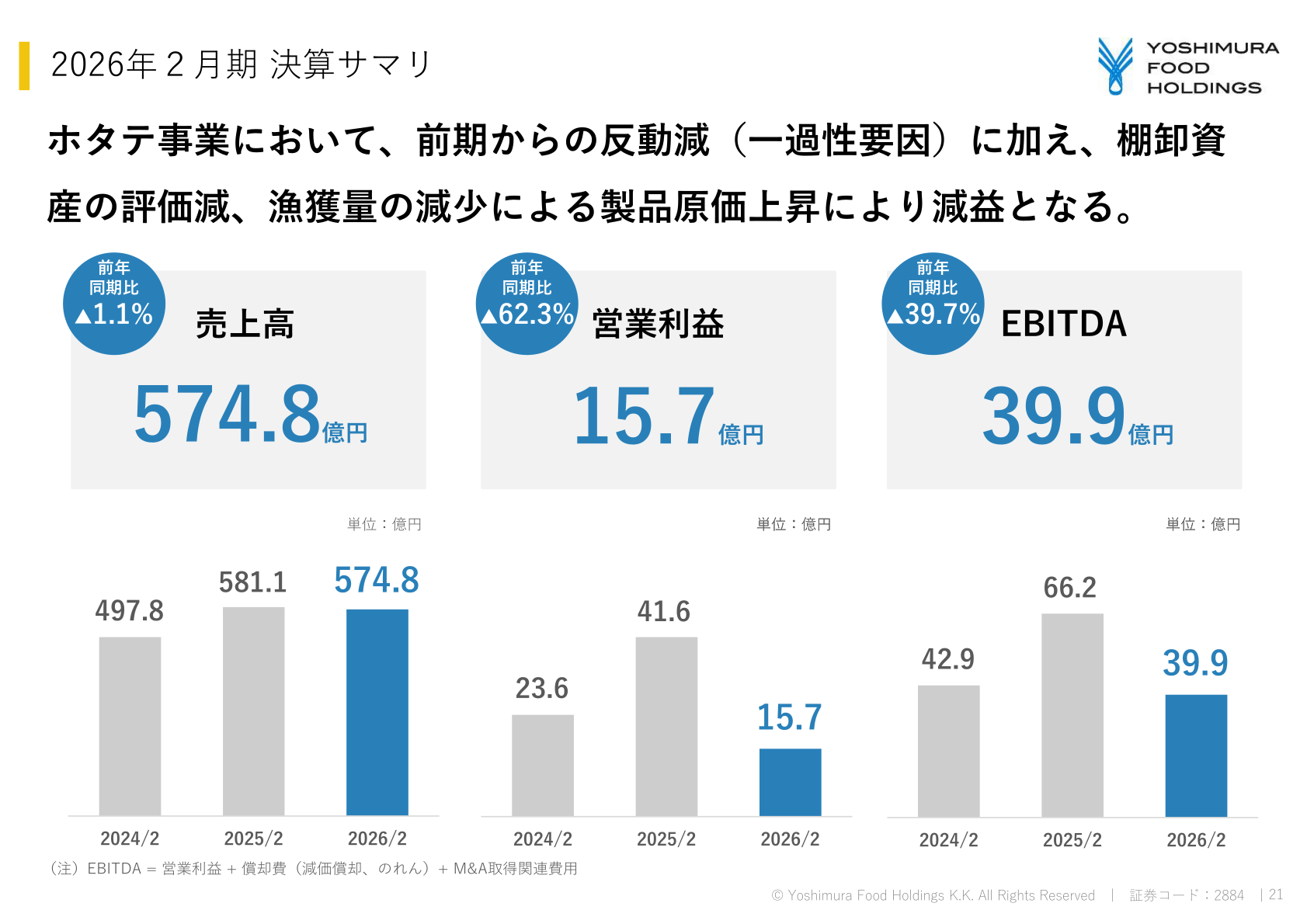
Yoshimura Food Holdings (securities code: 2884) released its results presentation for the fiscal year ended February 2026 (full year) on April 15, 2026. Consolidated net sales were 57.48 billion yen (▲1.1% YoY), operating profit was 1.57 billion yen (▲62.3%), ordinary profit was 1.69 billion yen (▲60.2%) and EBITDA was 3.99 billion yen (▲39.7%), with both sales and profit declining. In the scallop business, a reaction to the prior fiscal year (a one-off factor) was compounded by a write-down of inventories and higher product costs caused by a decline in the catch, and the result also fell short of the revised full-year earnings outlook disclosed at the third quarter.
Consolidated Results (Full-Year Actual)
In the domestic business, non-scallop-related operations posted higher sales and profit on the back of price revisions in response to rising raw material prices. In contrast, the domestic scallop-related business saw a sharp profit decline, as the reaction to the write-down of inventories recorded in the previous fiscal year in connection with China’s ban on imports of Japanese marine products (a one-off factor) was compounded by higher purchase prices due to a decline in the scallop catch and a conservative write-down of year-end inventories (boiled scallops) of 480 million yen. The overseas business also saw lower profit due to sluggish sales to restaurants, hotels and retailers in Singapore and to soaring purchase prices. Profit attributable to owners of parent was 0.92 billion yen (1.86 billion yen in the previous fiscal year).
| Item | FY ended Feb 2026 | FY ended Feb 2025 | Change |
|---|---|---|---|
| Net sales | 57.48 billion yen | 58.11 billion yen | ▲1.1% |
| Operating profit | 1.57 billion yen | 4.16 billion yen | ▲62.3% |
| Ordinary profit | 1.69 billion yen | 4.25 billion yen | ▲60.2% |
| Profit attributable to owners of parent | 0.92 billion yen | 1.86 billion yen | ▲0.94 billion yen |
| EBITDA | 3.99 billion yen | 6.62 billion yen | ▲39.7% |
Segment Results (by Business)
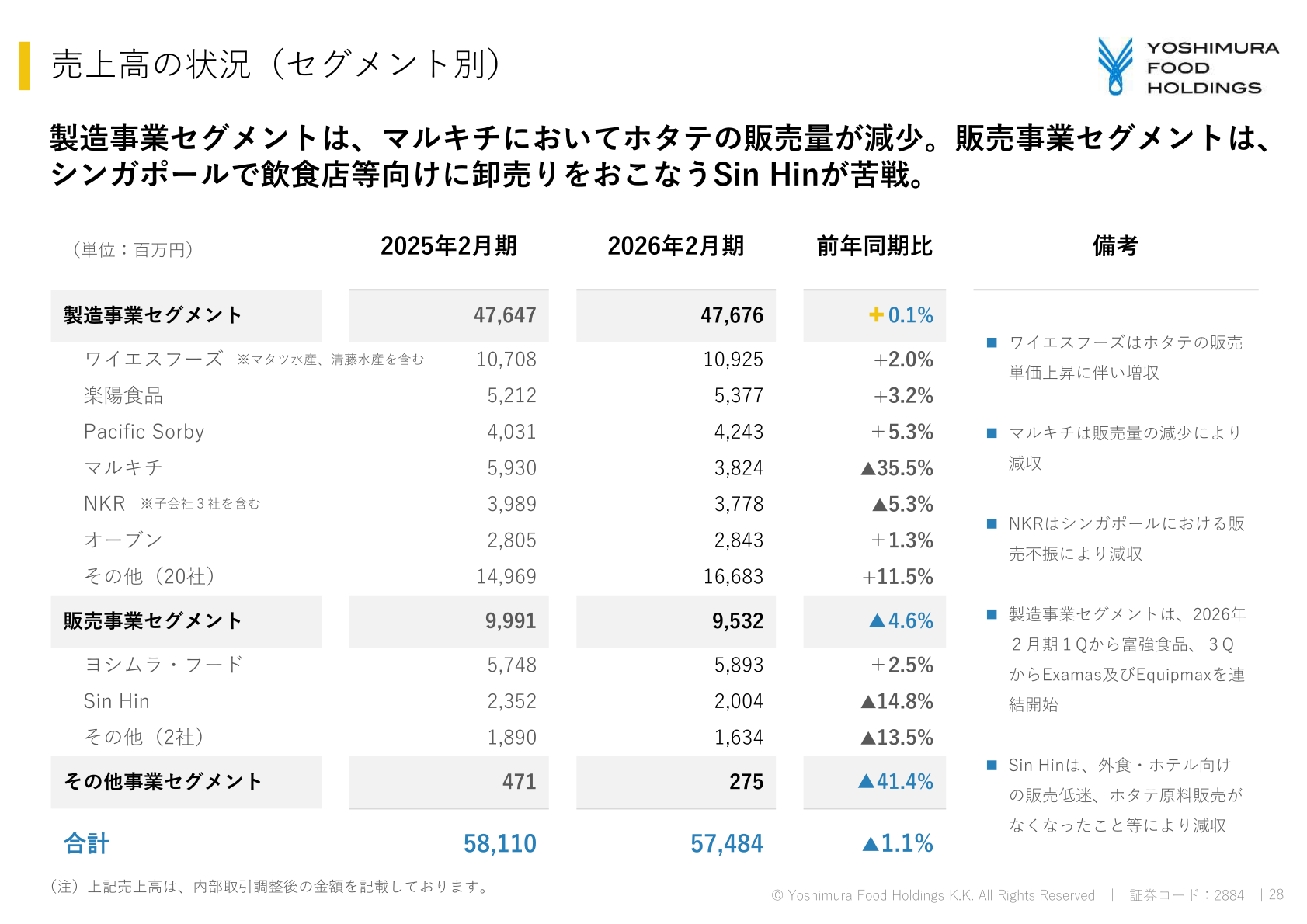
By segment, net sales (after adjustment for intersegment transactions) in the Manufacturing Business segment were 47,676 million yen (+0.1% YoY), essentially flat. Among the main subsidiaries, YS Foods increased sales to 10,925 million yen (+2.0%) on a higher scallop unit selling price, while Marukichi posted 3,824 million yen (▲35.5%) on lower sales volume. The Sales Business segment recorded 9,532 million yen (▲4.6%); Yoshimura Food grew to 5,893 million yen (+2.5%), while Sin Hin, which wholesales to restaurants and hotels in Singapore, declined to 2,004 million yen (▲14.8%) on weak sales. The Other Business segment was 275 million yen (▲41.4%).
| Segment | FY ended Feb 2026 | FY ended Feb 2025 | Change |
|---|---|---|---|
| Manufacturing Business segment | 47,676 million yen | 47,647 million yen | +0.1% |
| YS Foods | 10,925 million yen | 10,708 million yen | +2.0% |
| Marukichi | 3,824 million yen | 5,930 million yen | ▲35.5% |
| Sales Business segment | 9,532 million yen | 9,991 million yen | ▲4.6% |
| Yoshimura Food | 5,893 million yen | 5,748 million yen | +2.5% |
| Sin Hin | 2,004 million yen | 2,352 million yen | ▲14.8% |
| Other Business segment | 275 million yen | 471 million yen | ▲41.4% |
| Total | 57,484 million yen | 58,110 million yen | ▲1.1% |
Topics for the Fiscal Year Ended February 2026
The unit selling price of scallop adductor muscle has remained at a high level against a backdrop of expanding global demand, but a decline in the catch pushed up purchase prices and became a factor raising manufacturing costs. In November 2025 China once again suspended imports of Japanese marine products; however, since the import ban began in August 2023 the market has been open for only a very short period, and as selling prices have remained high the company states that this latest suspension has no impact (it has no export track record). As for overseas subsidiaries, earnings at Sin Hin Frozen Food in Singapore had deteriorated due to loss-making sales associated with higher scallop prices and rising personnel expenses, but the company has recently returned it to profitability through price revisions and a review toward an appropriate staffing structure. JSTT Singapore, also in Singapore, likewise turned profitable during the fiscal year ended February 2026 through strengthened store management and organizational changes, and remains profitable at present.
Full-Year Forecast
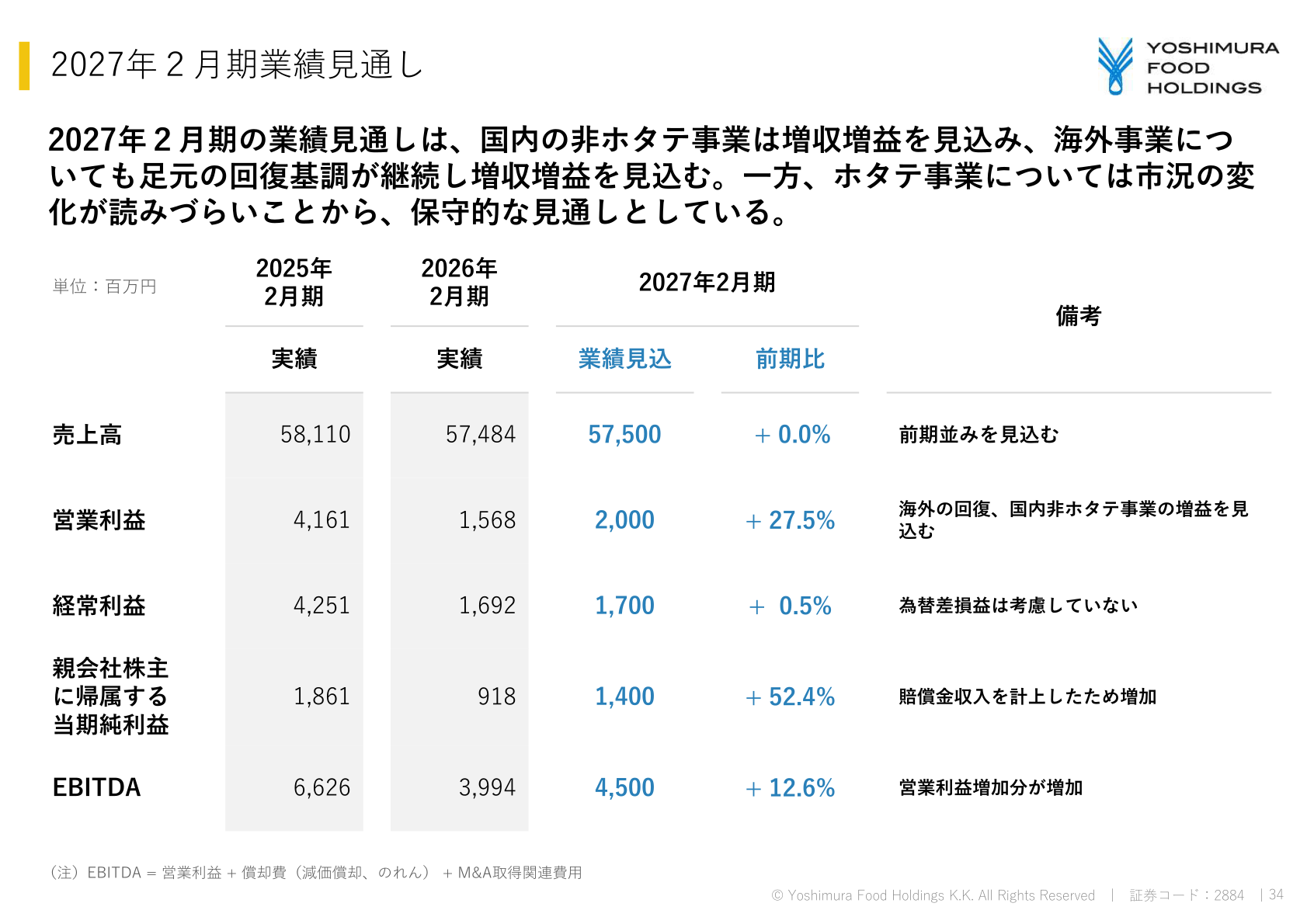
For the fiscal year ending February 2027, the company expects higher sales and profit in the domestic non-scallop business, and also higher sales and profit in the overseas business as the recent recovery trend continues, while it takes a conservative view of the scallop business because market conditions are difficult to read. Operating profit is forecast at 2.00 billion yen, up 27.5% year on year, and profit attributable to owners of parent at 1.40 billion yen, up 52.4%, reflecting the recognition of compensation income. These are company forecasts. The ordinary profit outlook does not take foreign exchange gains or losses into account.
| Item | FY ending Feb 2027 (Forecast) | FY ended Feb 2026 (Actual) | YoY |
|---|---|---|---|
| Net sales | 57,500 million yen | 57,484 million yen | +0.0% |
| Operating profit | 2,000 million yen | 1,568 million yen | +27.5% |
| Ordinary profit | 1,700 million yen | 1,692 million yen | +0.5% |
| Profit attributable to owners of parent | 1,400 million yen | 918 million yen | +52.4% |
| EBITDA | 4,500 million yen | 3,994 million yen | +12.6% |
Shareholder Returns
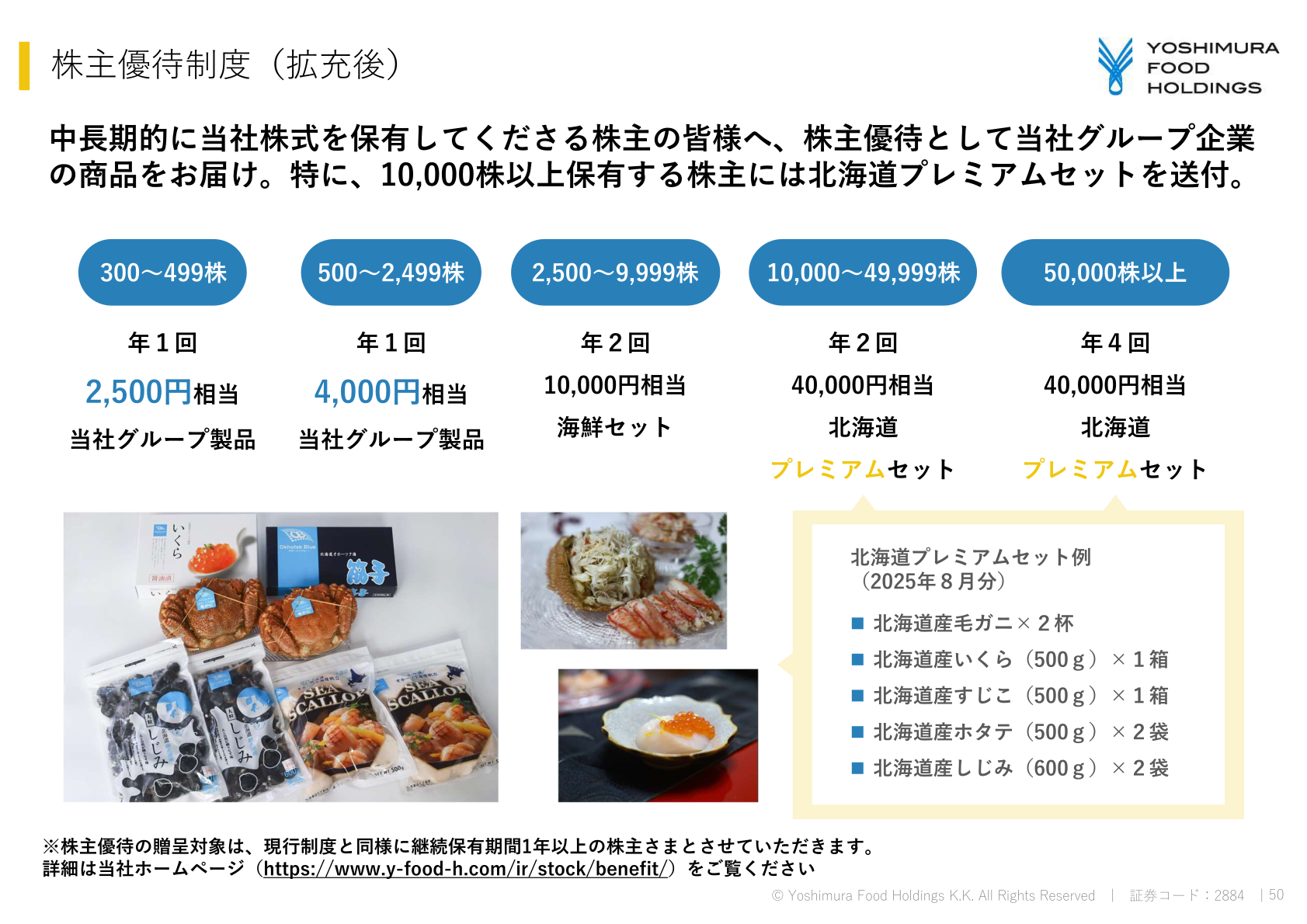
As its basic policy on shareholder returns, the company states that it will continue to allocate the cash flow generated by its businesses to growth investment, primarily M&A, while creating loyal shareholders through the shareholder benefit program and considering share buybacks and dividends in line with its stage of growth. For the shareholder benefit program, it has expanded the benefits for the 300-share and 500-share tiers, strengthening incentives for long-term holding and for increasing holdings in order to stabilize its shareholder base.
| Shares held | Frequency | Benefit |
|---|---|---|
| 300–499 shares | Once a year | Group products worth 2,500 yen |
| 500–2,499 shares | Once a year | Group products worth 4,000 yen |
| 2,500–9,999 shares | Twice a year | Seafood set worth 10,000 yen |
| 10,000–49,999 shares | Twice a year | Hokkaido Premium Set worth 40,000 yen |
| 50,000 shares or more | Four times a year | Hokkaido Premium Set worth 40,000 yen |
Medium-Term Management Plan
Under its medium-term management plan, the company aims to become a global producer for small and mid-sized food companies, built on two pillars: “growth through continuous M&A” (a roll-up strategy and a niche strategy) and “growth support” (organic growth and overseas expansion). Under the roll-up strategy it is pursuing roll-ups such as marine product processing in Hokkaido, centered on Marukichi and YS Foods, while under the niche strategy it has brought into the group companies such as Fukyo Food, which has long held the top share in wrappers for commercial-use spring rolls, and Mori Yougyojou, which ranks No.1 nationwide in land-based ayu (sweetfish) aquaculture production (700 tons in Reiwa 6). The roadmap for FY2/2026 to FY2/2030 sets out overseas expansion through exports of high-value-added products centered on scallops to Europe and the United States, and expanded sales in Asian markets such as Singapore and Malaysia. The company states that the summary of the medium-term management plan is “under reconsideration in light of the current situation.”
This article is an analysis based on publicly available information and is not a recommendation to buy or sell any specific securities. Investment decisions are your own responsibility.