
*Reading the investment points from the FY2025 (year ended March 31, 2026) financial results materials*
Introduction
In this article, we organize Kajima Corporation’s business, earnings trends, growth strategy, and the points investors should pay attention to, based on the FY2025 financial results materials the company has disclosed (results for the fiscal year ended March 31, 2026, announced on May 14, 2026).
*This article is based on publicly available IR materials and is not a recommendation to buy or sell any specific security.*
1. Company overview
Kajima Corporation is one of Japan’s leading general contractors (“super-general contractors”). Based on the disclosed materials, the group generates earnings from the following main pillars:
- Civil engineering — public and private infrastructure work such as dams, tunnels, and other large-scale civil projects.
- Building construction — the largest business by revenue, covering production facilities, redevelopment, accommodation, and other buildings.
- Real estate development — development, leasing, and sale of properties, pursued both in Japan and overseas.
- Overseas business — construction and real estate development carried out through subsidiaries and affiliates in North America, Europe, and Asia.
The results are managed across four layers: the consolidated group, the non-consolidated parent (Kajima Corporation), domestic subsidiaries and affiliates, and overseas subsidiaries and affiliates. This structure is helpful to keep in mind, because the drivers differ meaningfully between the steady domestic construction business and the more volatile real estate development business.
2. The most important points in this results release
Reading the materials as a whole, the following points stand out.
Point 1: Revenues and income reached record highs for the fifth consecutive year
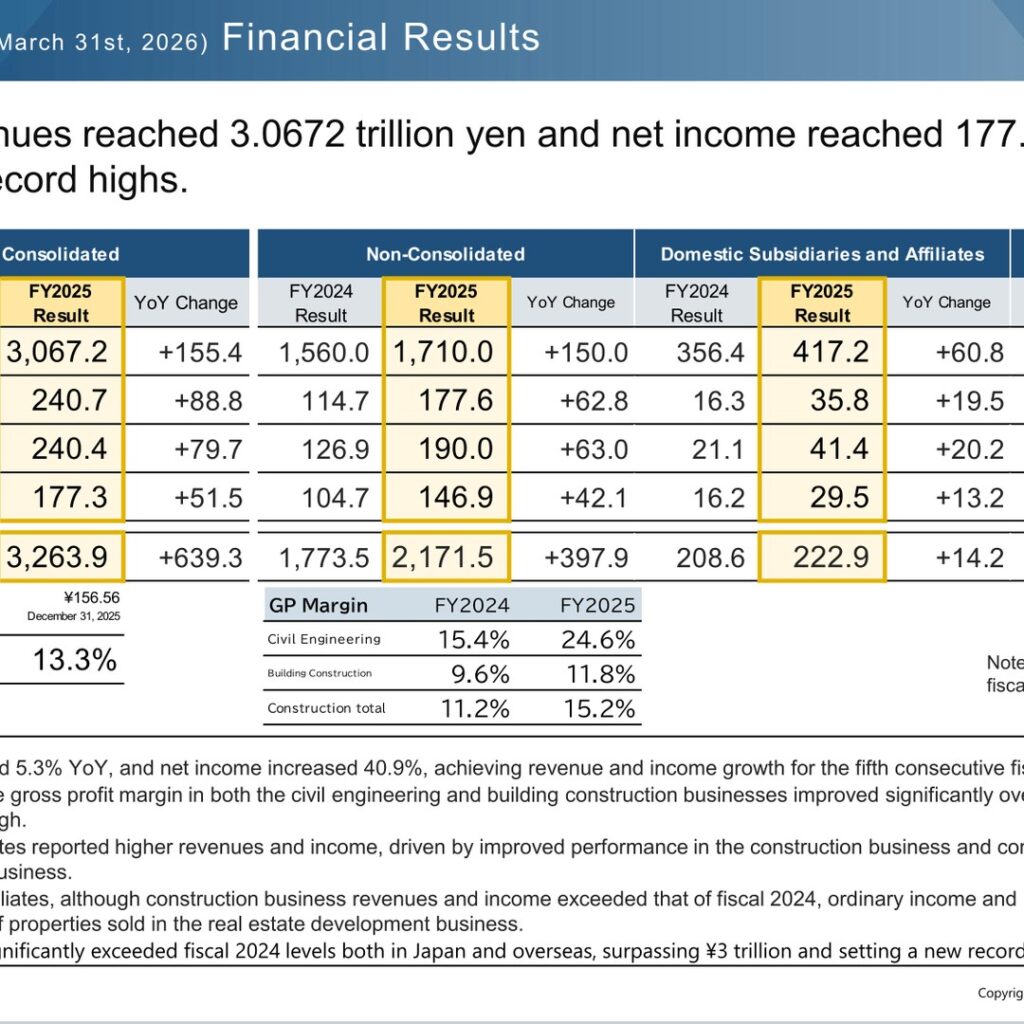
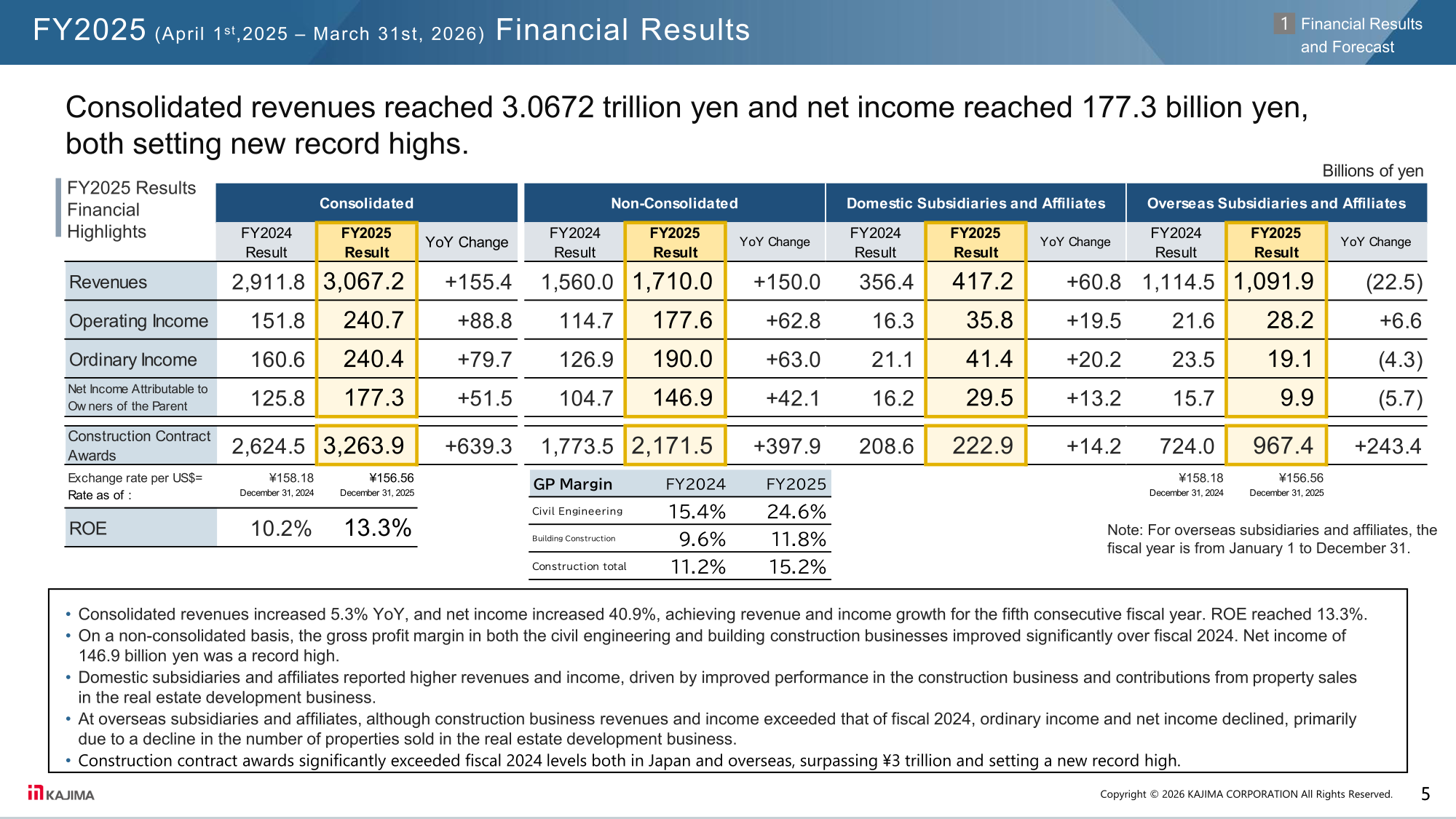
- Consolidated revenues of ¥3,067.2 billion, operating income of ¥240.7 billion, and net income of ¥177.3 billion all set new record highs.
- The primary driver was steady construction progress and improved profit margins in the domestic construction business.
- Investors should confirm whether this is structural margin improvement or a temporary convergence of favorable factors — management itself describes FY2025 as a year “when multiple performance-boosting factors converged.”
Point 2: ROE rose to 13.3%, comfortably above the cost of equity
- ROE improved by 3.1 points from 10.2% to 13.3%.
- The company recognizes its cost of shareholders’ equity at approximately 8% (verified using CAPM and other methods) and targets maintaining ROE above 10%.
- As of the end of March 2025, the share price had risen significantly year on year, with PBR exceeding 2.
Point 3: Shareholder returns were enhanced
- The FY2025 annual dividend was raised from the previous forecast of ¥132 to ¥146.
- For FY2026, the company plans a ¥146 dividend (flat), ¥40.0 billion of share buybacks, and cancellation of treasury shares to reduce holdings to approximately 5% of shares outstanding.
Point 4: The FY2026 forecast points to a deliberate step-down from a record year
- FY2026 revenues, operating income, and ordinary income are forecast to decline, while net income is guided at ¥170.0 billion — still far above the Medium-Term Business Plan target of “¥130.0 billion or more.”
- Management cites an “unstable international situation” as a factor requiring careful monitoring.
3. Earnings trends
Consolidated results (FY2025)
| Item | FY2024 | FY2025 | YoY change |
|—|—|—|—|
| Revenues | 2,911.8 | 3,067.2 | +155.4 |
| Operating income | 151.8 | 240.7 | +88.8 |
| Ordinary income | 160.6 | 240.4 | +79.7 |
| Net income (owners of parent) | 125.8 | 177.3 | +51.5 |
| Construction contract awards | 2,624.5 | 3,263.9 | +639.3 |
| ROE | 10.2% | 13.3% | +3.1pt |
*Figures in billions of yen unless noted. Net income increased 40.9% year on year, and consolidated construction contract awards surpassed ¥3 trillion for the first time.*
Segment picture (non-consolidated Kajima Corporation)
- Civil engineering: the gross profit margin improved sharply from 15.4% to 24.6%, with gross profit topping ¥100 billion and contract awards reaching a record high above ¥600 billion.
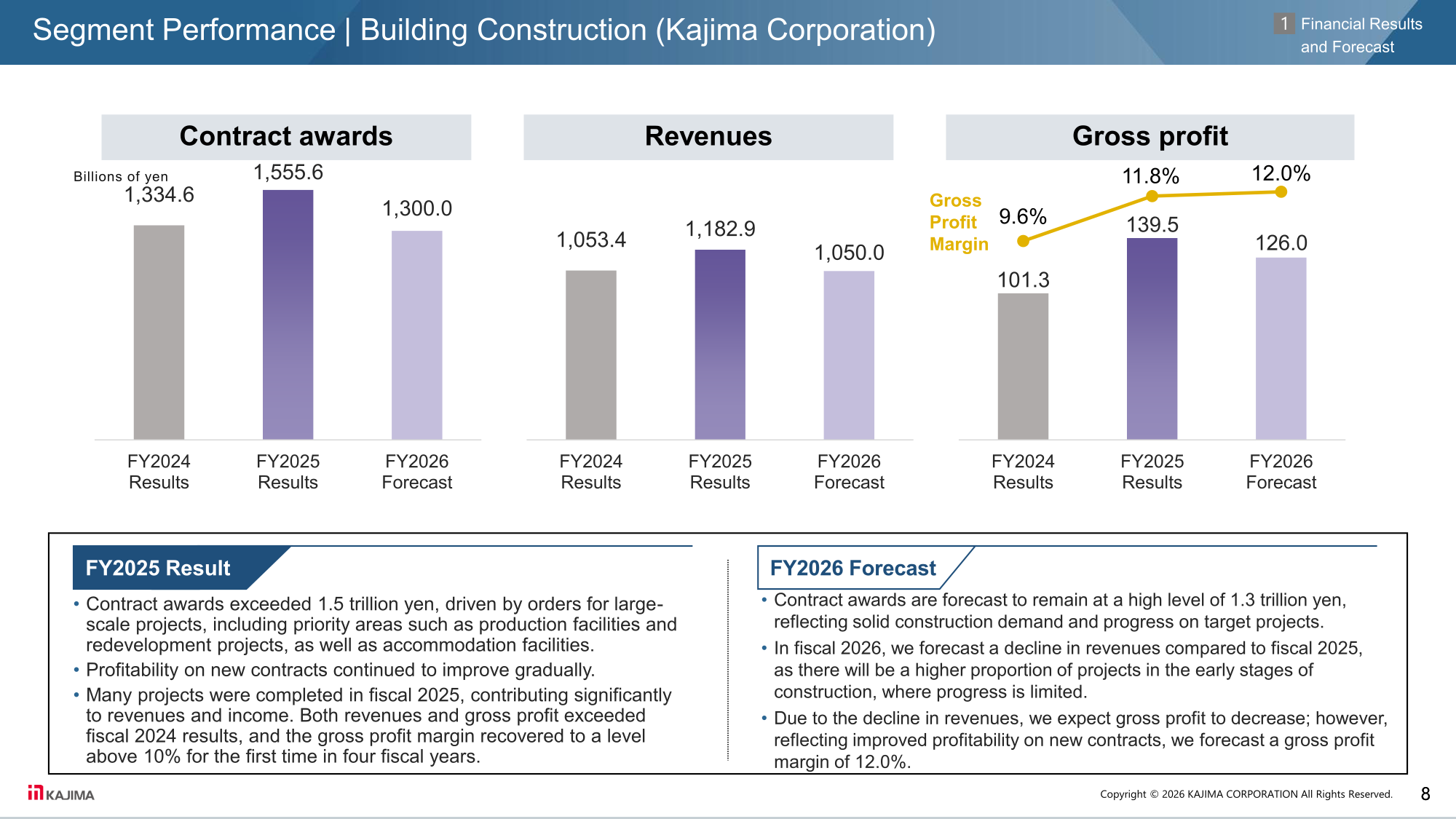
- Building construction: the largest segment by revenue (¥1,182.9 billion). Its gross profit margin recovered to 11.8%, above 10% for the first time in four fiscal years.
- Construction total non-consolidated gross profit margin rose from 11.2% to 15.2%, and non-consolidated net income of ¥146.9 billion was a record high.
The building construction segment illustrates the recovery in the core domestic construction business.
Splitting temporary and structural factors
- The improvement in construction gross profit margins reflects both better profitability on newly signed contracts and contributions from large-scale projects progressing through their peak phase — a mix of structural and stage-of-completion effects.
- Domestic and overseas real estate development is inherently lumpier: FY2025 domestic real estate income declined versus FY2024 (which had benefited from large condominium deliveries), and the overseas real estate development business recorded a net loss as certain property sales were rescheduled to FY2026 or later.
4. Growth strategy and medium-term points to watch
The materials describe a Medium-Term Business Plan (FY2024–FY2026) whose financial strategy was updated in May 2026. Key elements:
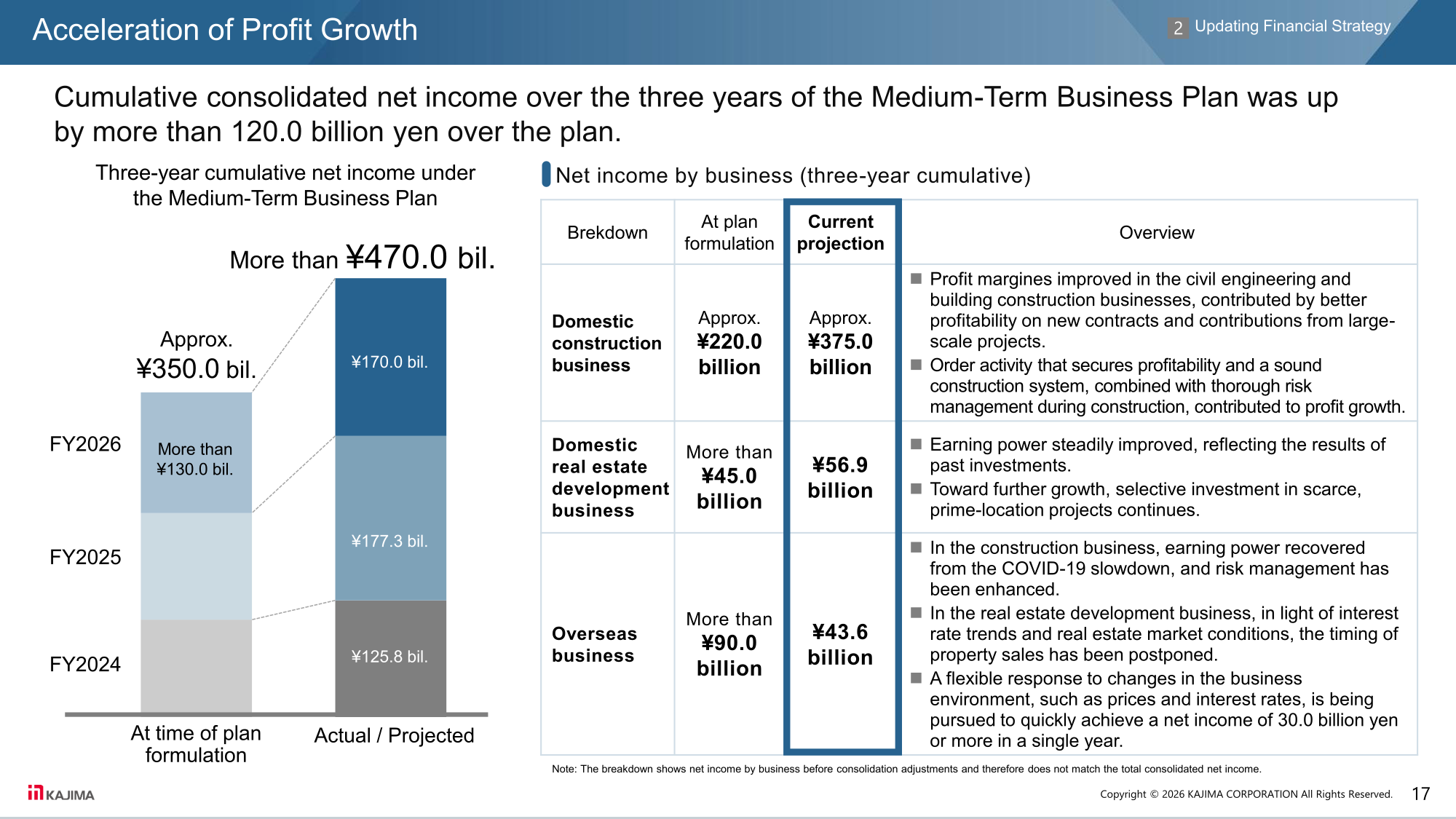
- Profit growth ahead of plan. Three-year cumulative consolidated net income under the plan is now expected to exceed ¥470.0 billion — more than ¥120.0 billion above the original plan.
- Growth investment of approximately ¥1.16 trillion, with an intensified focus on R&D, digital, and human capital investment to raise productivity. Net investment is running about ¥20.0 billion below plan, largely due to joint ventures aimed at improving capital efficiency and shifts in investment and recoupment timing.
- Capital efficiency and balance-sheet discipline. The company is reducing strategic shareholdings toward a target of “less than 20% of consolidated net assets” by the end of FY2026 (the balance was ¥304.1 billion, or 21.2%, at the end of FY2025), while maintaining a D/E ratio guideline of around 0.7x.
- Supply chain strengthening of approximately ¥100.0 billion, including earlier and higher cash payments to subcontractors — a response to the structural decline in Japan’s construction workforce (down roughly 23% versus 2002).
- Technology and new business areas, including AI-based bridge inspection, fully automated construction-layout robots, overseas logistics-warehouse development, public-private hybrid dam power generation, and low-carbon and carbon-negative concrete.
The most relevant KPI for medium-term investors is management’s commitment to keep ROE above 10% while returning to profit growth after the FY2026 step-down.
5. Points investors should watch
Strengths
- Record consolidated revenues and income, with a fifth consecutive year of growth and ROE of 13.3% against a roughly 8% cost of equity.
- A record consolidated order backlog (contract awards above ¥3 trillion) supporting future domestic construction revenues.
- A clearly articulated capital policy: a 40% dividend payout ratio target, flexible buybacks, treasury-share cancellation, and reduction of strategic shareholdings.
Concerns
- FY2026 guidance calls for declines in revenues, operating income, and ordinary income as the FY2025 one-off boosts fade; consolidated contract awards are also forecast to fall (¥2,670.0 billion vs. ¥3,263.9 billion).
- The overseas real estate development business swung to a net loss in FY2025, with a forecast recovery in FY2026 that depends on executing postponed property sales amid interest-rate and real-estate-market uncertainty.
- Overseas subsidiaries and affiliates saw ordinary and net income decline, and management repeatedly flags an “unstable international situation.”
- Sustained margin strength depends on continued disciplined, profitability-focused order-taking rather than volume.
Indicators to confirm in future disclosures
- Progress of ROE relative to the “above 10%” target.
- Segment gross profit margins (civil engineering guided down to 20.4% and building construction to 12.0% for FY2026) and whether they hold.
- Execution of overseas real estate property sales and the recovery in overseas net income.
- Progress on reducing strategic shareholdings toward the “less than 20%” target and on treasury-share cancellation.
- The dividend payout ratio trending to the 40% target, and the size of FY2026 buybacks.
6. Summary
Kajima’s FY2025 results mark a record year driven by a genuine recovery in domestic construction profitability, supported by disciplined order-taking and risk management. The company enters FY2026 guiding for a deliberate step-down from that peak, while still targeting net income well above its Medium-Term Business Plan and committing to maintain ROE above 10%.
For investors, the central questions from here are whether the improvement in construction margins proves durable, whether the volatile overseas real estate development business delivers its forecast recovery, and how consistently the company executes its enhanced shareholder-return and capital-efficiency policies.
*This article is an analysis based on publicly available information and is not a recommendation to buy or sell any specific security. Please make investment decisions at your own responsibility.*
![[Obayashi] Investors’ Guide 2026 — The Complete 24-Article Breakdown](https://japan-equity.com/wp-content/uploads/2026/07/hub_cover-1024x1024.png)
![[Obayashi] IR & SR Policy — Feeding Dialogue Back into Management](https://japan-equity.com/wp-content/uploads/2026/07/p32_sq-1024x1024.jpg)
![[Obayashi] Domestic Civil Engineering — Resilience Spending Supports 9.6% Margin](https://japan-equity.com/wp-content/uploads/2026/07/p11_sq-1024x1024.jpg)
![[Obayashi] Overseas Construction — Orders Reach ¥1.2tn](https://japan-equity.com/wp-content/uploads/2026/07/p15_sq-1024x1024.jpg)
![[Obayashi] Share Price & External Ratings — vs TOPIX, ESG Index Inclusion](https://japan-equity.com/wp-content/uploads/2026/07/p40_sq-1024x1024.jpg)
![[Construction] ¥75.5tn Investment, Shrinking Workforce — Big-5 Market Share](https://japan-equity.com/wp-content/uploads/2026/07/p12_sq-1024x1024.jpg)
![[Obayashi] Capital Policy & Shareholder Returns — ROE 10%+, DOE ~5%, ¥100bn Buyback](https://japan-equity.com/wp-content/uploads/2026/07/p27_sq-1024x1024.jpg)
![[Obayashi] Reducing Cross-Shareholdings — ¥285.2bn Sold in Five Years](https://japan-equity.com/wp-content/uploads/2026/07/p29_sq-1024x1024.jpg)
![[Obayashi] ¥750bn Investment Plan — ¥300bn to Development, ¥190bn to Tech/DX](https://japan-equity.com/wp-content/uploads/2026/07/p30_sq-1024x1024.jpg)
![[Obayashi] MTP2022 KPIs — Operating Profit ~2x Target, ROE 14.4%](https://japan-equity.com/wp-content/uploads/2026/07/p25_sq-1024x1024.jpg)
![[Obayashi] Cash Allocation — ¥420bn Investment CF Over Five Years](https://japan-equity.com/wp-content/uploads/2026/07/p26_sq-1024x1024.jpg)
![[Obayashi] Green Energy — 44 Plants, 344MW, and the Green Hydrogen Challenge](https://japan-equity.com/wp-content/uploads/2026/07/p21_sq-1024x1024.jpg)
![[Obayashi] Tackling the Labor Shortage — Robotics Construction®](https://japan-equity.com/wp-content/uploads/2026/07/p14_sq-1024x1024.jpg)
