
*Reading the investment points from the FY2025 (year ended March 31, 2026) financial results materials*
Introduction
In this article, we organize Shimizu Corporation’s business, earnings trends, growth strategy, and the points investors should pay attention to, based on the FY2025 financial results materials the company has disclosed (results for the fiscal year ended March 31, 2026, announced on May 12, 2026).
*This article is based on publicly available IR materials and is not a recommendation to buy or sell any specific security.*
1. Company overview
Shimizu Corporation is one of Japan’s leading general contractors (“super-general contractors”). Based on the disclosed materials, the group earns revenue from the following main areas:
- Architectural construction — the largest business, covering offices, factories, redevelopment, data centers, and hotels, both in Japan and overseas.
- Civil engineering — infrastructure such as tunnels, flood-control and disaster-prevention works, and, increasingly, offshore wind and marine civil projects.
- Real estate and other — real estate development and related businesses, plus newer areas such as green energy.
Results are managed across the consolidated group, the non-consolidated parent (Shimizu Corporation), and subsidiaries. In FY2025 the group also expanded through M&A, consolidating Aomi Construction (marine and onshore civil engineering, offshore wind) and agreeing to acquire American Engineering Corporation (Okinawa), which operates across the Asia-Pacific region including Guam.
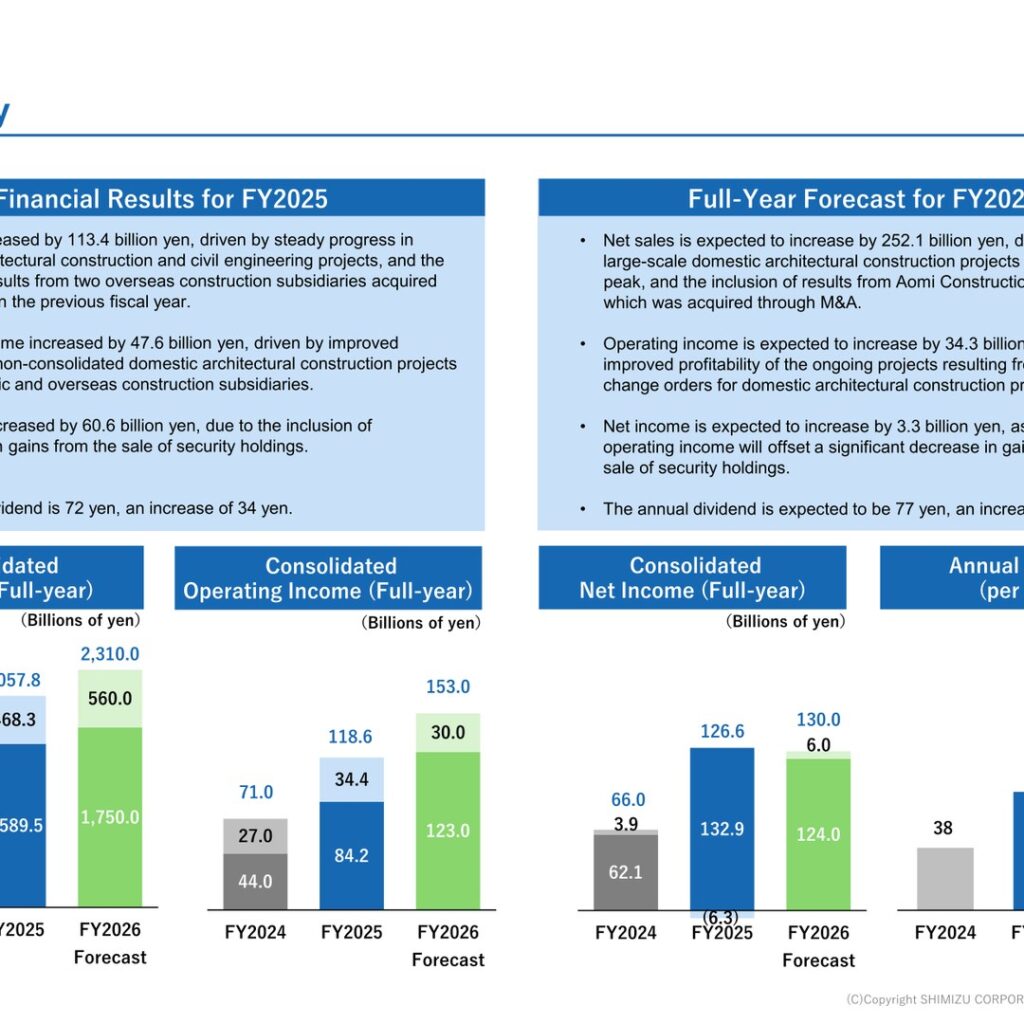
A key point for investors is that FY2025 profit was boosted both by a genuine recovery in construction margins and by large one-off gains from selling cross-shareholdings — two very different sources that behave differently going forward.
2. The most important points in this results release
Reading the materials as a whole, the following points stand out.
Point 1: A strong recovery in construction profitability
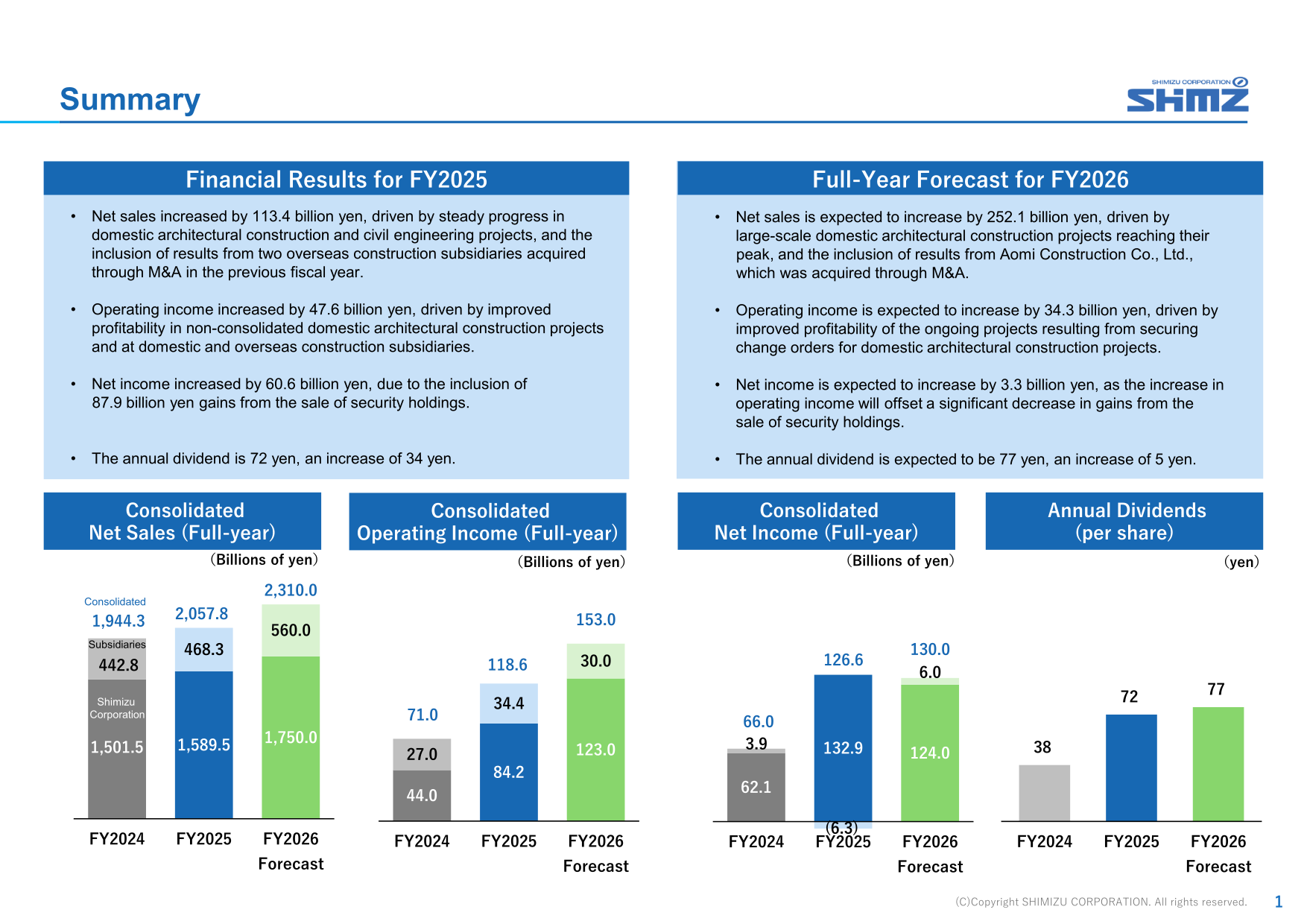
- Consolidated operating income rose ¥47.6 billion to ¥118.6 billion, with the operating margin improving from 3.7% to 5.8%.
- The main driver was improved profitability in domestic architectural construction (the non-consolidated architectural profit rate rose from 7.6% to 11.6%), reflecting better project margins and change orders.
Point 2: Net income surged, but largely on one-off gains
- Net income rose ¥60.6 billion to ¥126.6 billion, lifting ROE to 13.8% from 7.6%.
- However, this included about ¥87.9 billion of gains from the sale of security holdings (plus ¥5.9 billion of gain on negative goodwill), which are non-recurring. Investors should separate this from the underlying operating recovery.
Point 3: The dividend was raised sharply
- The FY2025 annual dividend is ¥72, up ¥34 from ¥38, with a further increase to ¥77 forecast for FY2026. The company’s policy sets a minimum dividend of ¥20 and a consolidated dividend payout ratio of 40% on growth profits.
Point 4: Orders are guided lower for FY2026
- Consolidated construction orders reached ¥2,158.5 billion in FY2025 (up ¥570.5 billion) but are forecast to decline to ¥1,910.0 billion in FY2026, reflecting selective, profitability-focused order-taking amid a tight subcontractor market.
3. Earnings trends
Consolidated results (FY2025)
| Item | FY2024 | FY2025 | YoY change |
|—|—|—|—|
| Net sales | 1,944.3 | 2,057.8 | +113.4 |
| Gross profit | 195.4 | 258.0 | +62.6 |
| Operating income | 71.0 | 118.6 | +47.6 |
| Ordinary income | 71.6 | 122.3 | +50.6 |
| Net income (owners) | 66.0 | 126.6 | +60.6 |
| ROE | 7.6% | 13.8% | +6.2pt |
*Figures in billions of yen unless noted. The consolidated gross profit margin improved from 10.1% to 12.5%.*
Where the profit came from
- Operating income growth of ¥47.6 billion was led by non-consolidated architectural construction (+¥48.9 billion) and subsidiaries’ construction contracts (+¥12.3 billion), partly offset by higher SG&A (−¥14.9 billion).
- Below operating income, net income was further lifted by ¥88.1 billion of net gains on sales of investment securities (up ¥48.8 billion year on year), against a ¥24.4 billion impairment loss on fixed assets.
Splitting temporary and structural factors
- The recovery in construction margins is the structural, repeatable part of the story and is expected to continue: FY2026 operating income is guided up a further ¥34.3 billion to ¥153.0 billion.
- The security-sale gains are the temporary part. Because they are largely non-recurring, FY2026 net income is guided up only ¥3.3 billion to ¥130.0 billion, even as operating income rises strongly — an important nuance behind the headline numbers.
4. Growth strategy and medium-term points to watch
The results are framed against the group’s Mid-Term Business Plan (2024–2026):
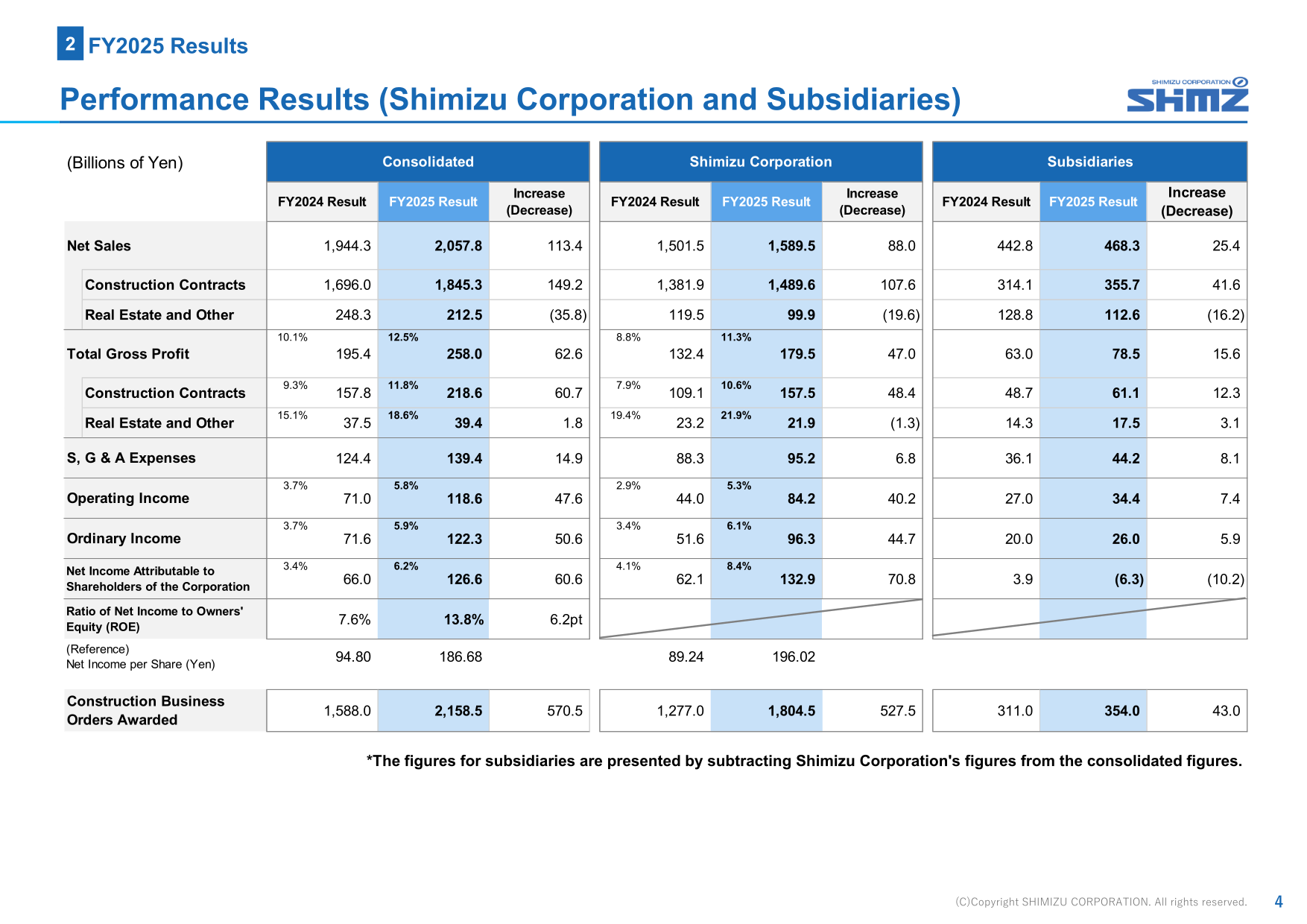
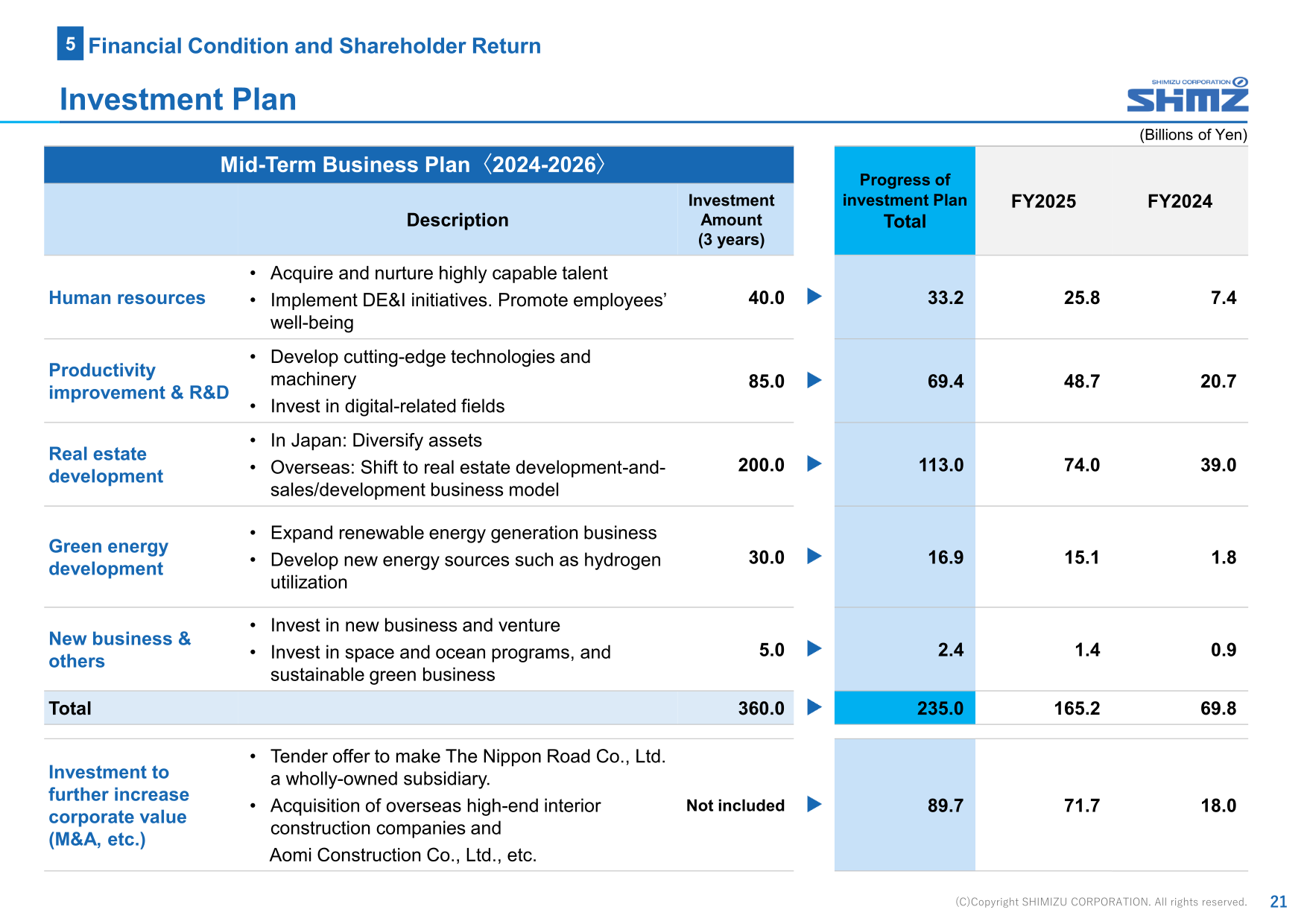
- Investment plan of ¥360 billion over three years (about ¥235 billion deployed so far), weighted toward real estate development (¥200 billion), productivity and R&D (¥85 billion), human resources (¥40 billion), and green energy (¥30 billion), plus separate M&A investment (about ¥89.7 billion, including Aomi Construction and overseas interior-construction companies).
- Portfolio expansion through M&A into offshore wind (Aomi Construction) and the Asia-Pacific / US-military-base and data-center markets (American Engineering Corporation).
- Balance-sheet strengthening. Interest-bearing debt fell to ¥567.4 billion and the D/E ratio improved to 0.58x, while the owners’ equity ratio rose to 36.8%.
- Reduction of cross-shareholdings. The company targets reducing securities holdings to less than 20% of consolidated net assets by the end of FY2027 (or less than 10% including holdings already agreed to be sold) and less than 10% by the end of FY2029. It disposed of 39 listed stocks (¥109.1 billion) in FY2025, and the ratio excluding “agreed-to-be-sold” holdings is already 9.1%.
The most relevant medium-term KPIs are the sustainability of the improved construction margin and how the proceeds from cross-shareholding sales are redeployed into growth and shareholder returns.
5. Points investors should watch
Strengths
- A clear recovery in construction profitability, with the operating margin up to 5.8% and further operating-income growth guided for FY2026.
- A firm domestic demand backdrop — large-scale redevelopment, factories (semiconductors, pharmaceuticals), data centers, luxury hotels, and government resilience investment.
- A strengthened balance sheet (D/E 0.58x, equity ratio 36.8%) and a rising dividend supported by an explicit payout policy.
- Ongoing reduction of cross-shareholdings, releasing capital and improving capital efficiency.
Concerns
- FY2025 net income and ROE (13.8%) were significantly inflated by non-recurring security-sale gains; on an underlying basis, profitability is lower, and FY2026 net income is guided up only marginally (+¥3.3 billion).
- Construction orders are forecast to decline in FY2026 (to ¥1,910.0 billion), and management flags that busy subcontractors and labor shortages are leading to project reconsideration and some orders being turned down.
- External risks include a global economic slowdown, the situation in the Middle East, and US tariff policies.
- Integration and execution risk from recent M&A (Aomi Construction, American Engineering Corporation).
Indicators to confirm in future disclosures
- The operating margin trend and whether the improved construction profitability holds.
- Construction orders awarded and the domestic/overseas order mix.
- The pace and proceeds of cross-shareholding reductions toward the FY2027/FY2029 targets.
- The dividend payout ratio (targeted around 40%) and any buybacks.
- Progress and earnings contribution from the newly acquired subsidiaries.
6. Summary
Shimizu’s FY2025 results combine a genuine, margin-driven recovery in construction profitability with a large one-off boost from selling cross-shareholdings. The former is the more durable story — operating income is guided higher again in FY2026 — while the latter explains why net income is set to be broadly flat next year despite rising operating profit. Alongside this, the company has sharply increased its dividend, strengthened its balance sheet, and continued to unwind cross-shareholdings.
For investors, the central questions from here are how sustainable the improved construction margins prove, how selectively the company takes orders in a capacity-constrained market, and how the proceeds from cross-shareholding sales are redeployed into growth and shareholder returns.
*This article is an analysis based on publicly available information and is not a recommendation to buy or sell any specific security. Please make investment decisions at your own responsibility.*
![[Obayashi] Investors’ Guide 2026 — The Complete 24-Article Breakdown](https://japan-equity.com/wp-content/uploads/2026/07/hub_cover-1024x1024.png)
![[Obayashi] IR & SR Policy — Feeding Dialogue Back into Management](https://japan-equity.com/wp-content/uploads/2026/07/p32_sq-1024x1024.jpg)
![[Obayashi] Real Estate Development — 18.7% Margin, ¥287.7bn Unrealized Gains](https://japan-equity.com/wp-content/uploads/2026/07/p20_sq-1024x1024.jpg)
![[Obayashi] Domestic Civil Engineering — Resilience Spending Supports 9.6% Margin](https://japan-equity.com/wp-content/uploads/2026/07/p11_sq-1024x1024.jpg)
![[Obayashi] Share Price & External Ratings — vs TOPIX, ESG Index Inclusion](https://japan-equity.com/wp-content/uploads/2026/07/p40_sq-1024x1024.jpg)
![[Construction] ¥75.5tn Investment, Shrinking Workforce — Big-5 Market Share](https://japan-equity.com/wp-content/uploads/2026/07/p12_sq-1024x1024.jpg)
![[Obayashi] Capital Policy & Shareholder Returns — ROE 10%+, DOE ~5%, ¥100bn Buyback](https://japan-equity.com/wp-content/uploads/2026/07/p27_sq-1024x1024.jpg)
![[Obayashi] Reducing Cross-Shareholdings — ¥285.2bn Sold in Five Years](https://japan-equity.com/wp-content/uploads/2026/07/p29_sq-1024x1024.jpg)
![[Obayashi] ¥750bn Investment Plan — ¥300bn to Development, ¥190bn to Tech/DX](https://japan-equity.com/wp-content/uploads/2026/07/p30_sq-1024x1024.jpg)
![[Obayashi] MTP2022 KPIs — Operating Profit ~2x Target, ROE 14.4%](https://japan-equity.com/wp-content/uploads/2026/07/p25_sq-1024x1024.jpg)
![[Obayashi] Cash Allocation — ¥420bn Investment CF Over Five Years](https://japan-equity.com/wp-content/uploads/2026/07/p26_sq-1024x1024.jpg)
![[Obayashi] Green Energy — 44 Plants, 344MW, and the Green Hydrogen Challenge](https://japan-equity.com/wp-content/uploads/2026/07/p21_sq-1024x1024.jpg)
![[Obayashi] Tackling the Labor Shortage — Robotics Construction®](https://japan-equity.com/wp-content/uploads/2026/07/p14_sq-1024x1024.jpg)
