
This article is based on publicly available IR materials and is not a recommendation to buy or sell any specific securities.
Note on fiscal-year labels: Kyocera refers to the year ended March 31, 2026 as “Fiscal 2026” and the year ending March 31, 2027 as “Fiscal 2027”; this site classifies the latest completed full year as FY2025, and all figures, tables and segment labels below follow the company’s own naming as presented in the materials.
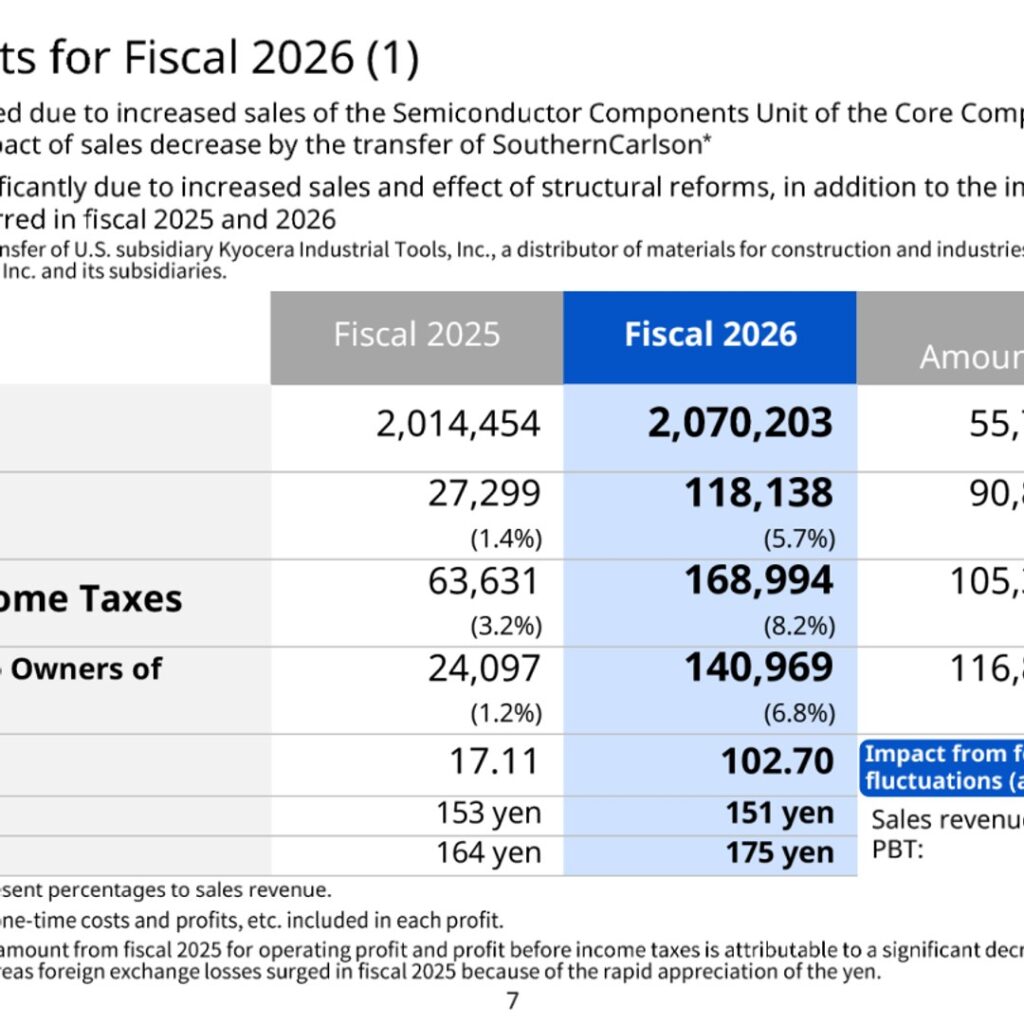
Kyocera Corporation reported sales revenue of 2,070,203 million yen for fiscal 2026 (the year ended March 31, 2026), up 2.8% year on year, while operating profit rose 332.8% to 118,138 million yen and profit before income taxes rose 165.6% to 168,994 million yen. Profit attributable to owners of the parent increased 485.0% to 140,969 million yen, and EPS was 102.70 yen against 17.11 yen a year earlier. The company attributes the sales increase to the Semiconductor Components Unit of the Core Components Business, despite the loss of sales from the transfer of SouthernCarlson, and the profit increase to higher sales, the effect of structural reforms and the swing in one-time costs and profits recorded in fiscal 2025 and fiscal 2026. For fiscal 2027 Kyocera forecasts lower sales revenue of 1,940,000 million yen but slightly higher profit before income taxes of 170,000 million yen, and it has also disclosed a management plan for fiscal 2028 together with a new dividend policy.
Consolidated Results for Fiscal 2026 (Full-Year Actual)
Figures in parentheses represent percentages to sales revenue, as presented in the materials. The company notes that the gap between the change in operating profit and the change in profit before income taxes is attributable to a significant decrease in foreign exchange losses of approximately 14.0 billion yen, after foreign exchange losses surged in fiscal 2025 because of the rapid appreciation of the yen. Foreign exchange rate fluctuations versus fiscal 2025 had an impact of approximately +9.0 billion yen on sales revenue and approximately +6.5 billion yen on profit before income taxes.
| Item (Yen in millions) | Fiscal 2026 | Fiscal 2025 | Change (Amount / %) |
|---|---|---|---|
| Sales Revenue | 2,070,203 | 2,014,454 | 55,749 / 2.8% |
| Operating Profit | 118,138 (5.7%) | 27,299 (1.4%) | 90,839 / 332.8% |
| Profit Before Income Taxes | 168,994 (8.2%) | 63,631 (3.2%) | 105,363 / 165.6% |
| Profit Attributable to Owners of the Parent | 140,969 (6.8%) | 24,097 (1.2%) | 116,872 / 485.0% |
| EPS (Yen) | 102.70 | 17.11 | — |
| Capital Expenditures | 149,099 | 141,932 | — |
| Depreciation Charge of PPE | 110,924 | 112,077 | — |
| R&D Expenses | 115,701 | 116,087 | — |
| Average Exchange Rate: US$ | 151 yen | 153 yen | — |
| Average Exchange Rate: Euro | 175 yen | 164 yen | — |
One-time items were a major swing factor. Within operating profit and profit before income taxes, one-time costs and profits totaled -43.0 billion yen in fiscal 2025 and +5.5 billion yen in fiscal 2026, a change of +48.5 billion yen. The fiscal 2026 items were a write-down of idle assets of -5.0 billion yen in the Organic Packages and Boards Business, a loss of -1.5 billion yen in connection with the transfer of the silicon diode power semiconductor business, an impairment loss on property, plant and equipment of the former Displays Business of -5.0 billion yen in the Automotive Systems Business, and a gain of +17.0 billion yen from the transfer of SouthernCarlson. At the level of profit attributable to owners of the parent, one-time items totaled -48.0 billion yen in fiscal 2025 and +20.0 billion yen in fiscal 2026, including a decrease in tax expenses of +12.0 billion yen due mainly to an adjustment in tax amount in consequence of the sale of KDDI Corporation shares. All of these figures are approximate as stated in the materials.
Segment Results for Fiscal 2026
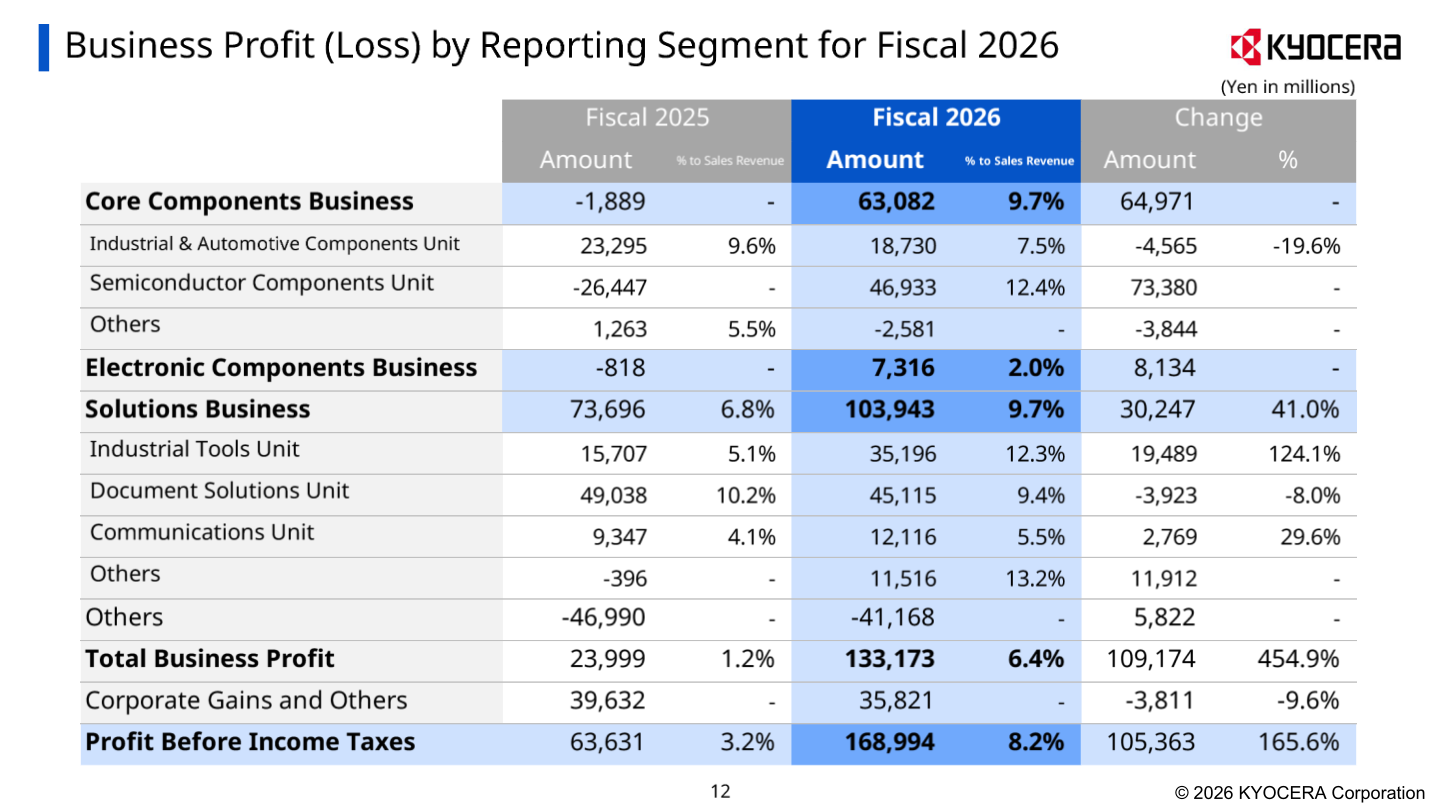
Kyocera changed the classification of certain businesses from the beginning of fiscal 2026 and from January 1, 2026, and fiscal 2025 results have been reclassified in the same manner. Sales revenue by reporting segment is shown on page 11 of the presentation and business profit by reporting segment on page 12.
| Segment (Yen in millions) | Sales Revenue Fiscal 2026 | Sales Revenue Fiscal 2025 | Business Profit Fiscal 2026 | Business Profit Fiscal 2025 |
|---|---|---|---|---|
| Core Components Business | 653,429 | 591,720 | 63,082 (9.7%) | -1,889 |
| — Industrial & Automotive Components Unit | 250,069 | 241,871 | 18,730 (7.5%) | 23,295 (9.6%) |
| — Semiconductor Components Unit | 379,432 | 327,049 | 46,933 (12.4%) | -26,447 |
| — Others | 23,928 | 22,800 | -2,581 | 1,263 (5.5%) |
| Electronic Components Business | 363,486 | 354,646 | 7,316 (2.0%) | -818 |
| Solutions Business | 1,070,919 | 1,086,367 | 103,943 (9.7%) | 73,696 (6.8%) |
| — Industrial Tools Unit | 285,936 | 305,876 | 35,196 (12.3%) | 15,707 (5.1%) |
| — Document Solutions Unit | 478,479 | 479,964 | 45,115 (9.4%) | 49,038 (10.2%) |
| — Communications Unit | 219,158 | 225,497 | 12,116 (5.5%) | 9,347 (4.1%) |
| — Others | 87,346 | 75,030 | 11,516 (13.2%) | -396 |
| Others | 14,196 | 17,114 | -41,168 | -46,990 |
| Adjustments and Eliminations | -31,827 | -35,393 | — | — |
| Total Business Profit | — | — | 133,173 (6.4%) | 23,999 (1.2%) |
| Corporate Gains and Others | — | — | 35,821 | 39,632 |
| Total Sales Revenue / Profit Before Income Taxes | 2,070,203 | 2,014,454 | 168,994 (8.2%) | 63,631 (3.2%) |
In the Core Components Business, sales revenue rose 10.4% mainly on increased sales in the Semiconductor Components Unit, including ceramic packages for information and telecommunication-related markets and organic packages for data centers, and business profit swung to 63,082 million yen on higher sales, the positive effect of structural reforms and a smaller amount of one-time costs. The Electronic Components Business grew sales 2.5%, driven mainly by capacitors for automotive and information and telecommunication-related markets in the KAVX Group, and returned to a business profit of 7,316 million yen. The Solutions Business saw sales decline 1.4% because of the completion of the transfer of SouthernCarlson, which the company says had a negative impact of approximately 27 billion yen, while business profit rose 41.0% helped by a one-time gain of approximately 17 billion yen from that transfer and profit improvement efforts across the businesses.
The company also highlighted progress in two previously loss-making areas. In the Organic Packages and Boards Business, profitability for the full year of fiscal 2026 was achieved excluding the impact of the write-down of idle assets of approximately 5 billion yen, with business profit up approximately 18.5 billion yen versus fiscal 2025 excluding the impact of one-time costs; drivers cited include scaling down low-margin products, optimization of the production workforce, an increase in orders of high-layer-count substrates for network ASICs, and a decrease in depreciation of approximately 7 billion yen. The KAVX Group achieved profitability for the full year in fiscal 2026, with business profit up approximately 12.6 billion yen, through enhanced production technology and equipment effectiveness. On the portfolio side, Kyocera completed the transfer of the silicon diode power semiconductor business to Shindengen Electric Manufacturing and of SouthernCarlson to TL Sapphire Holdings, both in January 2026, and plans to transfer the Chemical Business to Sumitomo Bakelite at the end of October 2026 (fiscal 2027).
Financial Forecasts for Fiscal 2027
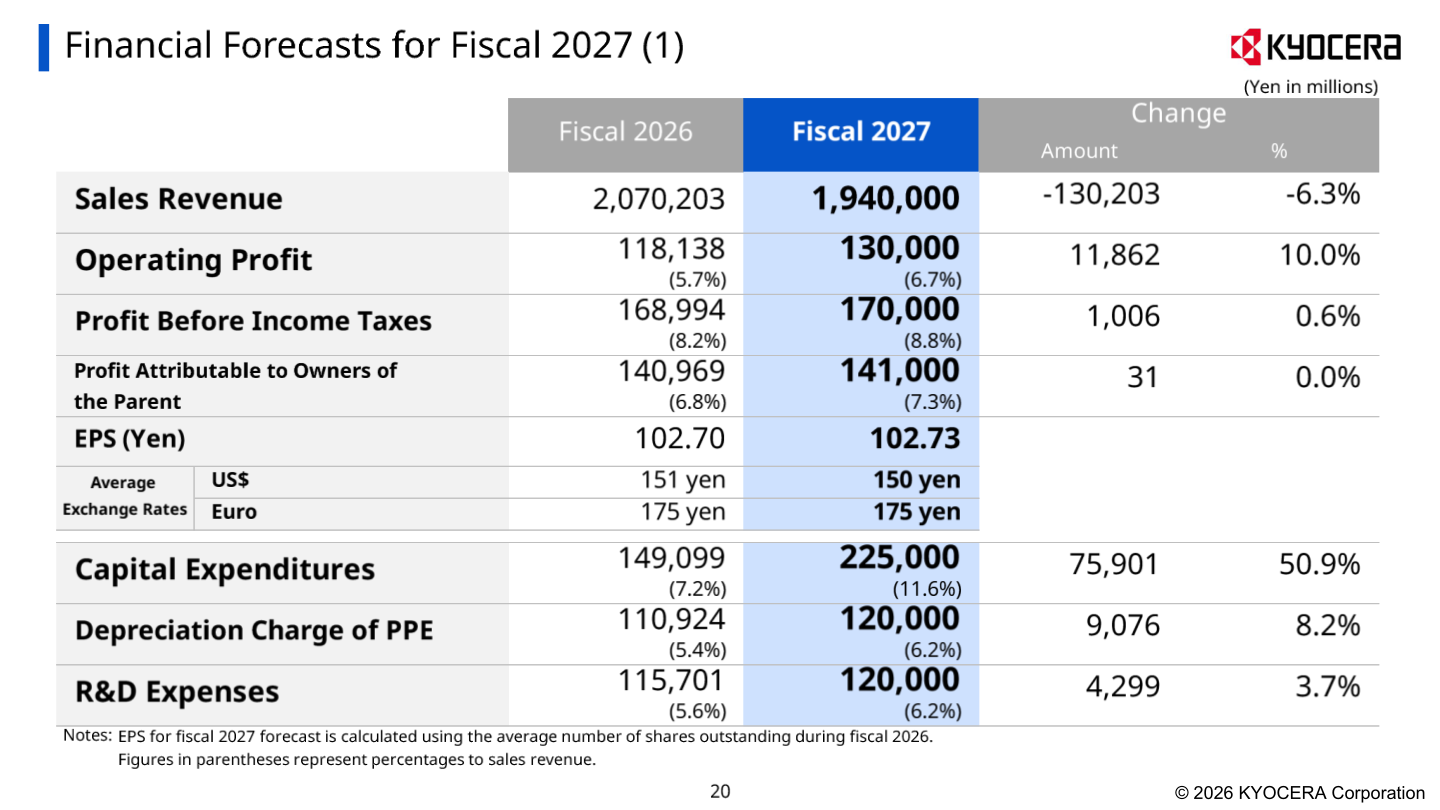
Kyocera forecasts lower sales revenue in fiscal 2027, mainly reflecting the transfer of SouthernCarlson in the Solutions Business, while profit lines are expected to be broadly flat to higher. EPS for the fiscal 2027 forecast is calculated using the average number of shares outstanding during fiscal 2026.
| Item (Yen in millions) | Fiscal 2027 Forecast | Fiscal 2026 (Actual) | Change (Amount / %) |
|---|---|---|---|
| Sales Revenue | 1,940,000 | 2,070,203 | -130,203 / -6.3% |
| Operating Profit | 130,000 (6.7%) | 118,138 (5.7%) | 11,862 / 10.0% |
| Profit Before Income Taxes | 170,000 (8.8%) | 168,994 (8.2%) | 1,006 / 0.6% |
| Profit Attributable to Owners of the Parent | 141,000 (7.3%) | 140,969 (6.8%) | 31 / 0.0% |
| EPS (Yen) | 102.73 | 102.70 | — |
| Capital Expenditures | 225,000 (11.6%) | 149,099 (7.2%) | 75,901 / 50.9% |
| Depreciation Charge of PPE | 120,000 (6.2%) | 110,924 (5.4%) | 9,076 / 8.2% |
| R&D Expenses | 120,000 (6.2%) | 115,701 (5.6%) | 4,299 / 3.7% |
| Average Exchange Rate: US$ | 150 yen | 151 yen | — |
| Average Exchange Rate: Euro | 175 yen | 175 yen | — |
By segment, the fiscal 2027 sales forecast is 654,000 million yen for the Core Components Business (+0.1%), 364,000 million yen for the Electronic Components Business (+0.1%) and 932,800 million yen for the Solutions Business (-12.9%), within which the Industrial Tools Unit is forecast at 170,000 million yen (-40.5%) and the Communications Unit at 188,000 million yen (-14.2%). Business profit is forecast at 80,500 million yen for the Core Components Business (+27.6%), 21,000 million yen for the Electronic Components Business (+187.0%) and 87,600 million yen for the Solutions Business (-15.7%). Note that from fiscal 2027 elemental technology research was reclassified from “Others” to “Corporate gains and others,” and the fiscal 2026 figures used for comparison on pages 23 and 24 of the presentation have been reclassified in the same manner.
Regarding the premises for the forecast, Kyocera states that it incorporated the impact of rising raw material prices based on second-half fiscal 2026 conditions, and lists rare metals and rare earth elements, gold, and memory semiconductors as materials facing tight supply and/or rising prices, affecting the Semiconductor Components Unit, the Industrial Tools Unit, the Electronic Components Business, the Document Solutions Unit and the Telecommunication Equipment Business among others. The company notes that difficulty in obtaining petroleum-derived products due to the deteriorating situation in the Middle East has not been incorporated into the forecasts because calculating the impact is difficult at this moment. On markets, AI-related investment in semiconductor-related markets is expected to accelerate while automotive-related markets are expected to slow.
Shareholder Returns
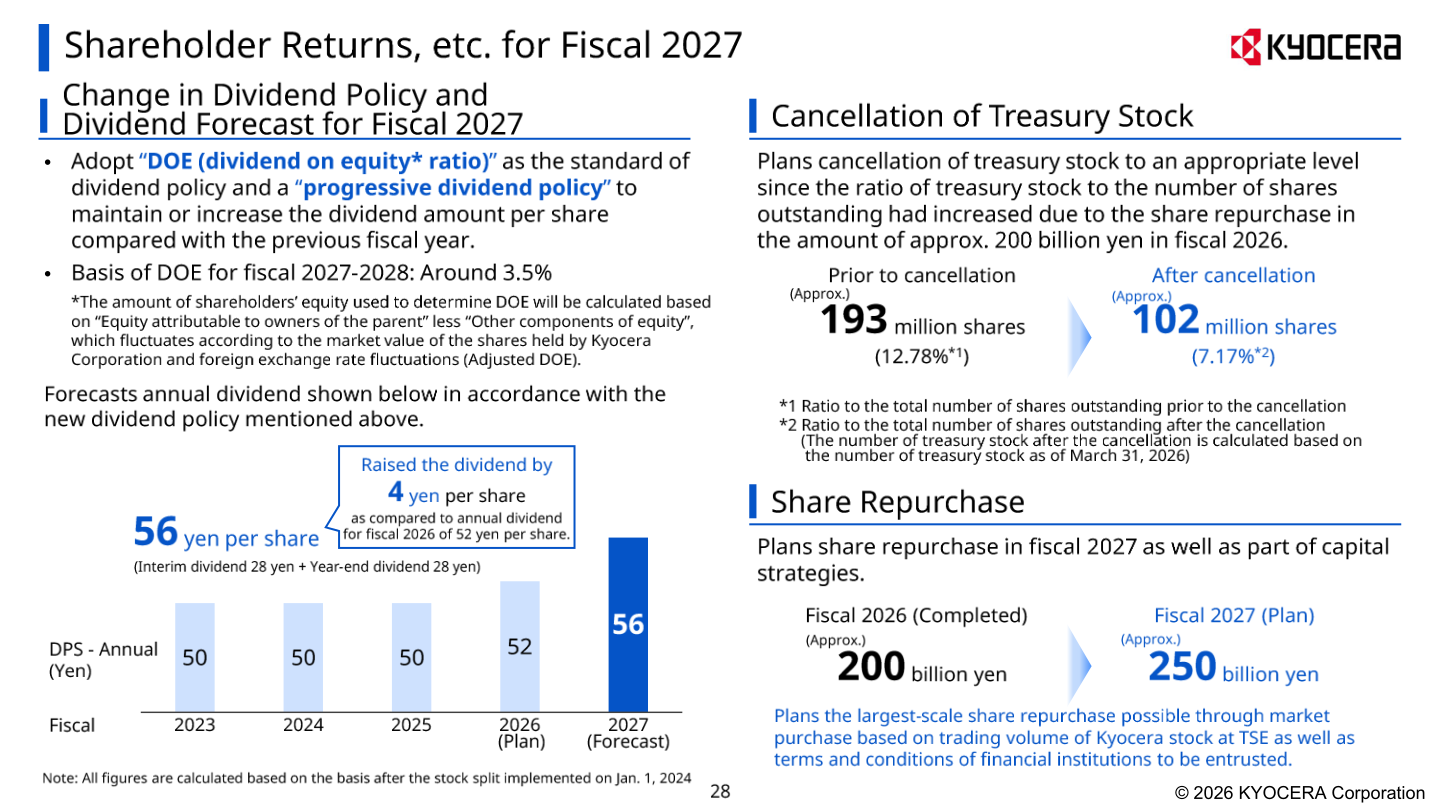
For fiscal 2026 Kyocera paid an annual dividend of 52 yen per share (interim 25 yen plus year-end 27 yen), a 2 yen increase versus the previous forecast made in October 2025, for a payout ratio of 50.6%. It resolved in May 2025 to repurchase shares up to 200 billion yen and completed the repurchase in March 2026, acquiring 91 million shares for 200 billion yen. In June 2025 it sold KDDI shares through KDDI’s tender offer, disposing of 108 million shares for 250 billion yen; the ratio of cross-shareholdings to net assets fell from 51.6% at the end of fiscal 2025 to 48.3% at the end of fiscal 2026, against a target of less than 20.0% around the end of fiscal 2031, with reduction to continue from fiscal 2027 onward. All figures are as stated in the materials, with share and yen amounts shown as approximate where the company indicates so.
| Item | Fiscal 2026 (Result) | Fiscal 2027 (Plan / Forecast) |
|---|---|---|
| Annual dividend per share | 52 yen (interim 25 yen + year-end 27 yen) | 56 yen (interim 28 yen + year-end 28 yen) |
| Payout ratio | 50.6% | — |
| Dividend policy | Payout ratio of around 50% of profit attributable to owners of the parent | DOE (dividend on equity ratio) as the standard plus a progressive dividend policy; DOE basis for fiscal 2027-2028 around 3.5% |
| Share repurchase | 200 billion yen / 91 million shares (completed Mar. 2026) | 250 billion yen (approx.), largest-scale market purchase possible |
| Treasury stock | 193 million shares (12.78%) prior to cancellation | 102 million shares (7.17%) after planned cancellation |
| Cross-shareholdings to net assets | 48.3% (end of fiscal 2026) | Less than 20.0% around the end of fiscal 2031 |
For fiscal 2027 the company changed its dividend policy, adopting DOE (dividend on equity ratio) as the standard together with a progressive dividend policy to maintain or increase the dividend per share versus the previous fiscal year, with the DOE basis for fiscal 2027-2028 set at around 3.5%. The shareholders’ equity used to determine DOE is calculated as “Equity attributable to owners of the parent” less “Other components of equity” (Adjusted DOE). On that basis the annual dividend forecast for fiscal 2027 is 56 yen per share (interim 28 yen plus year-end 28 yen), a 4 yen increase versus fiscal 2026. Annual dividends per share on a post-stock-split basis were 50 yen in fiscal 2023, 50 yen in fiscal 2024, 50 yen in fiscal 2025 and 52 yen in fiscal 2026. Kyocera also plans a share repurchase in fiscal 2027 of approximately 250 billion yen and the cancellation of treasury stock, which would reduce treasury shares from approximately 193 million shares (12.78% of total shares outstanding prior to cancellation) to approximately 102 million shares (7.17% after cancellation).
Management Plan for Fiscal 2028 and Capital Policies
Kyocera presented a management plan for fiscal 2028, stating that it expects to largely complete the reorganization of its management foundation by fiscal 2027 and to return to a growth trajectory from fiscal 2028.
| Item (Yen in billions) | Fiscal 2026 | Fiscal 2027 (Forecast) | Fiscal 2028 (Plan) |
|---|---|---|---|
| Sales Revenue | 2,070.2 | 1,940.0 | 2,050.0 |
| Operating Profit | 118.1 (5.7%) | 130.0 (6.7%) | 160.0 (7.8%) |
| Profit Before Income Taxes | 169.0 (8.2%) | 170.0 (8.8%) | 192.0 (9.4%) |
| Profit Attributable to Owners of the Parent | 141.0 (6.8%) | 141.0 (7.3%) | 150.0 (7.3%) |
| Capital Expenditures | 149.1 (7.2%) | 225.0 (11.6%) | 176.0 (8.6%) |
| Depreciation Charge of PPE | 110.9 (5.4%) | 120.0 (6.2%) | 130.0 (6.3%) |
| R&D Expenses | 115.7 (5.6%) | 120.0 (6.2%) | 130.0 (6.3%) |
| ROE | 4.3% | 4.3% | 5.0% |
For the Components Businesses (Core Components and Electronic Components combined), the plan shows sales revenue of 1,016.9 billion yen in fiscal 2026, 1,018.0 billion yen in fiscal 2027 and 1,084.0 billion yen in fiscal 2028, with business profit of 70.4 billion yen, 101.5 billion yen and 122.0 billion yen and a business profit ratio of 6.9%, 10.0% and 11.3% respectively; ROIC is shown at 4.6%, 6.4% and 7.3%. For the Solutions Business, business profit is planned at 103.9 billion yen, 87.6 billion yen and 100.0 billion yen with profit ratios of 9.7%, 9.4% and 10.2%, and ROIC of 10.7%, 8.8% and 10.0%, with sales revenue of 1,070.9 billion yen, 932.8 billion yen and 977.0 billion yen. The Solutions Business targets 10% ROIC through expanding sales of high-margin products and services, cost reduction and productivity improvement, and withdrawing from or downsizing unprofitable businesses, sites and products.
In the Components Businesses, Kyocera is prioritizing advanced semiconductors and AI-related areas, citing components for advanced semiconductor processing equipment (stages for exposure, electrostatic chucks, heaters, wafer hands, sapphire windows and lenses for inspection equipment) and components for AI data center applications (ceramic packages for optical communications and optical switches, organic packages for network applications, high-capacitance MLCCs and tantalum capacitors). The presentation shows the ratio of sales related to advanced semiconductors or the semiconductor business rising from approximately 40% in fiscal 2026 to approximately 55% in fiscal 2031, with the related sales expansion plan indicating 2.8x growth over that period.
On capital policies, capital structure at the end of fiscal 2026 comprised assets of 4.6 trillion yen, liabilities of 1.3 trillion yen and shareholders’ equity, etc. of 3.3 trillion yen, with the targeted structure at the end of fiscal 2028 being shareholders’ equity, etc. of around 3.0 trillion yen. The two-year capital allocation target for fiscal 2027-2028 is operating cash flow of 800 billion yen (before deducting R&D expenses) and 600 billion yen from divestment of shareholdings and debt funding, against investment in businesses of 750 billion yen (capital expenditures 400 billion yen, R&D expenses 250 billion yen, investments for growth 100 billion yen) and shareholder returns, etc. of 650 billion yen (share repurchases of up to 500 billion yen and dividends of 150 billion yen). These targets were updated from the announcement of February 3, 2026.
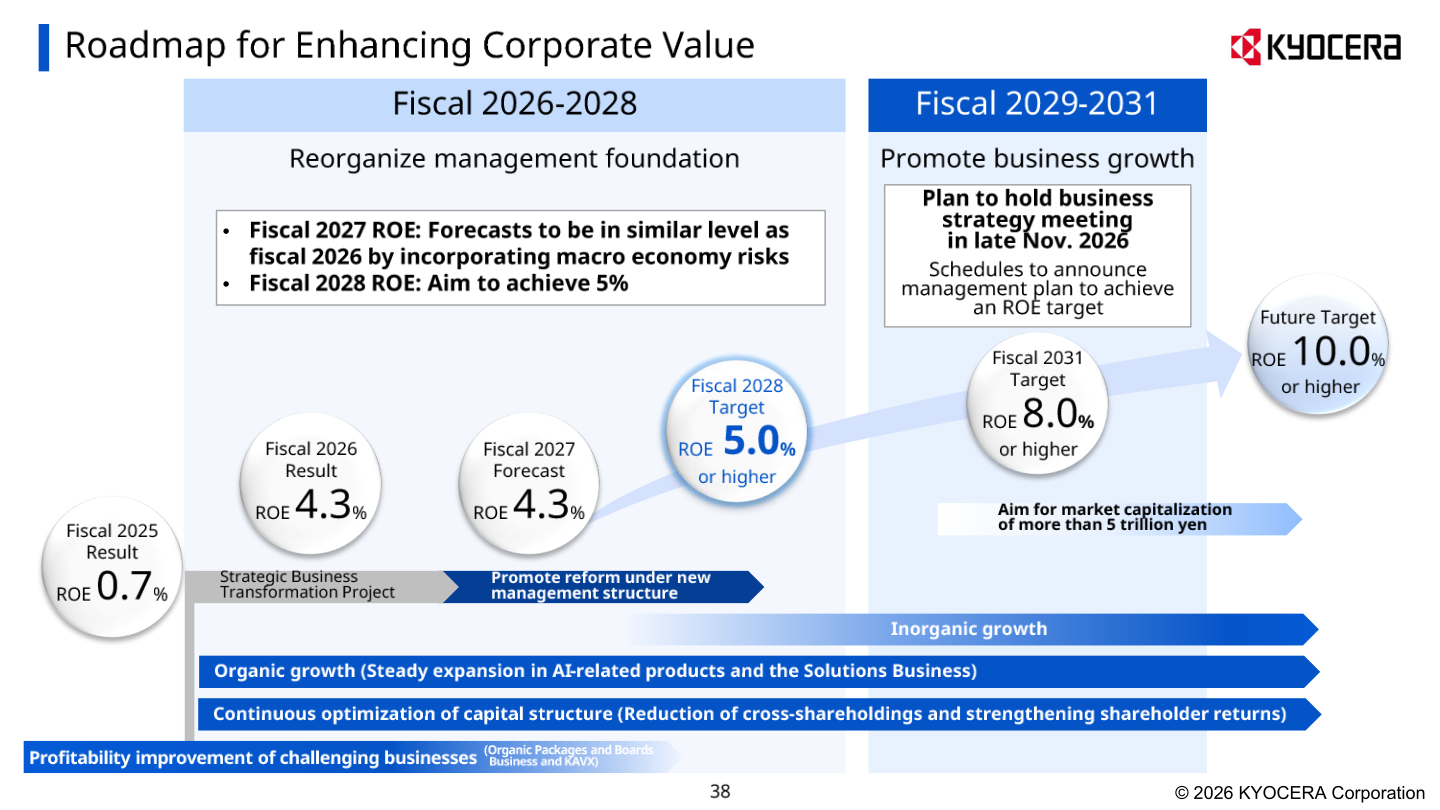
Kyocera’s roadmap for enhancing corporate value positions fiscal 2026-2028 as the period to reorganize the management foundation and fiscal 2029-2031 as the period to promote business growth. ROE was 0.7% in fiscal 2025 and 4.3% in fiscal 2026, is forecast at 4.3% in fiscal 2027 by incorporating macroeconomic risks, and is targeted at 5.0% or higher in fiscal 2028, 8.0% or higher in fiscal 2031 and 10.0% or higher as a future target. The company also states an aim for market capitalization of more than 5 trillion yen and plans to hold a business strategy meeting in late November 2026, at which it schedules to announce a management plan to achieve the ROE target.
Management Direction
In his opening remarks, President and Representative Director, President and Executive Officer, CEO Shiro Sakushima said his primary mission as CEO from April is to promote swift and flexible business management by evolving Amoeba Management, Kyocera’s unique management system, in order to adapt to the rapidly changing global situation and business environment. He also cited proactive enhancement of business portfolio management, cross-sectional organizational rejuvenation in human resources, and maintaining an appropriate balance between growth investment and shareholder returns while improving capital efficiency. In fiscal 2026 Kyocera ran a Strategic Business Transformation Project to decide high-level company direction on business portfolio restructuring and capital policies; from fiscal 2027 onward a newly established Corporate Planning Office takes responsibility for planning growth strategy and managing its progress, including business portfolio management based on ROIC.
This article is an analysis based on publicly available information and is not a recommendation to buy or sell any specific securities. Investment decisions are your own responsibility.
![[Obayashi] Investors’ Guide 2026 — The Complete 24-Article Breakdown](https://japan-equity.com/wp-content/uploads/2026/07/hub_cover-1024x1024.png)
![[Obayashi] IR & SR Policy — Feeding Dialogue Back into Management](https://japan-equity.com/wp-content/uploads/2026/07/p32_sq-1024x1024.jpg)
![[Obayashi] Real Estate Development — 18.7% Margin, ¥287.7bn Unrealized Gains](https://japan-equity.com/wp-content/uploads/2026/07/p20_sq-1024x1024.jpg)
![[Obayashi] Domestic Civil Engineering — Resilience Spending Supports 9.6% Margin](https://japan-equity.com/wp-content/uploads/2026/07/p11_sq-1024x1024.jpg)
![[Obayashi] Share Price & External Ratings — vs TOPIX, ESG Index Inclusion](https://japan-equity.com/wp-content/uploads/2026/07/p40_sq-1024x1024.jpg)
![[Construction] ¥75.5tn Investment, Shrinking Workforce — Big-5 Market Share](https://japan-equity.com/wp-content/uploads/2026/07/p12_sq-1024x1024.jpg)
![[Obayashi] Capital Policy & Shareholder Returns — ROE 10%+, DOE ~5%, ¥100bn Buyback](https://japan-equity.com/wp-content/uploads/2026/07/p27_sq-1024x1024.jpg)
![[Obayashi] Reducing Cross-Shareholdings — ¥285.2bn Sold in Five Years](https://japan-equity.com/wp-content/uploads/2026/07/p29_sq-1024x1024.jpg)
![[Obayashi] ¥750bn Investment Plan — ¥300bn to Development, ¥190bn to Tech/DX](https://japan-equity.com/wp-content/uploads/2026/07/p30_sq-1024x1024.jpg)
![[Obayashi] MTP2022 KPIs — Operating Profit ~2x Target, ROE 14.4%](https://japan-equity.com/wp-content/uploads/2026/07/p25_sq-1024x1024.jpg)
![[Obayashi] Cash Allocation — ¥420bn Investment CF Over Five Years](https://japan-equity.com/wp-content/uploads/2026/07/p26_sq-1024x1024.jpg)
![[Obayashi] Green Energy — 44 Plants, 344MW, and the Green Hydrogen Challenge](https://japan-equity.com/wp-content/uploads/2026/07/p21_sq-1024x1024.jpg)
![[Obayashi] Tackling the Labor Shortage — Robotics Construction®](https://japan-equity.com/wp-content/uploads/2026/07/p14_sq-1024x1024.jpg)
