
This article is based on publicly available IR materials and is not a recommendation to buy or sell any specific securities.
Note: Baycurrent’s fiscal year ends in February, and the company labels the fiscal year ended February 28, 2026 as “FY2026” and the fiscal year ending February 28, 2027 as “FY2027” in its materials. This article follows the company’s labels in the body and tables; the site classifies this most recently completed fiscal year as FY2025. Baycurrent, Inc. (6532), one of the largest consulting firms in Japan, announced its full-year results for FY2026 (fiscal year ended February 28, 2026) on April 14, 2026. Revenue rose 27.8% year on year to 148,332 million yen and EBITDA rose 19.9% to 52,125 million yen (EBITDA margin 35.1%), which the company says largely met its guidance of 143,000 million yen in revenue and 52,000 million yen in EBITDA. Profit increased 23.0% to 37,840 million yen. For FY2027 the company forecasts revenue of 190,000 million yen (+28.1%) and EBITDA of 66,500 million yen (+27.6%), and plans an annual dividend of 130 yen per share, up from 100 yen. This article is based on the company’s English-language “Supplement to Financial Results for the Full-Year of the Fiscal Year Ending February 28, 2026” dated April 14, 2026; figures are under IFRS and in million yen unless otherwise stated.
Consolidated Results (Full-Year Actual)
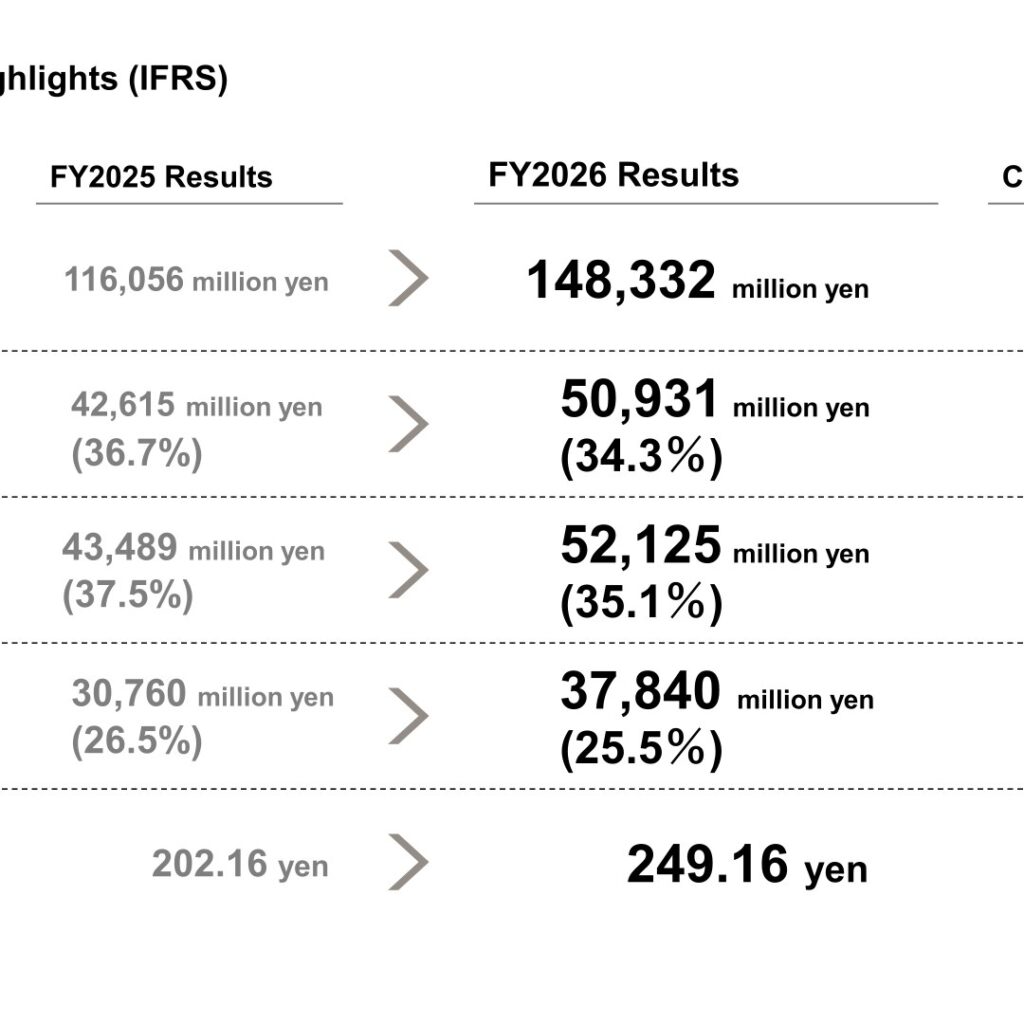
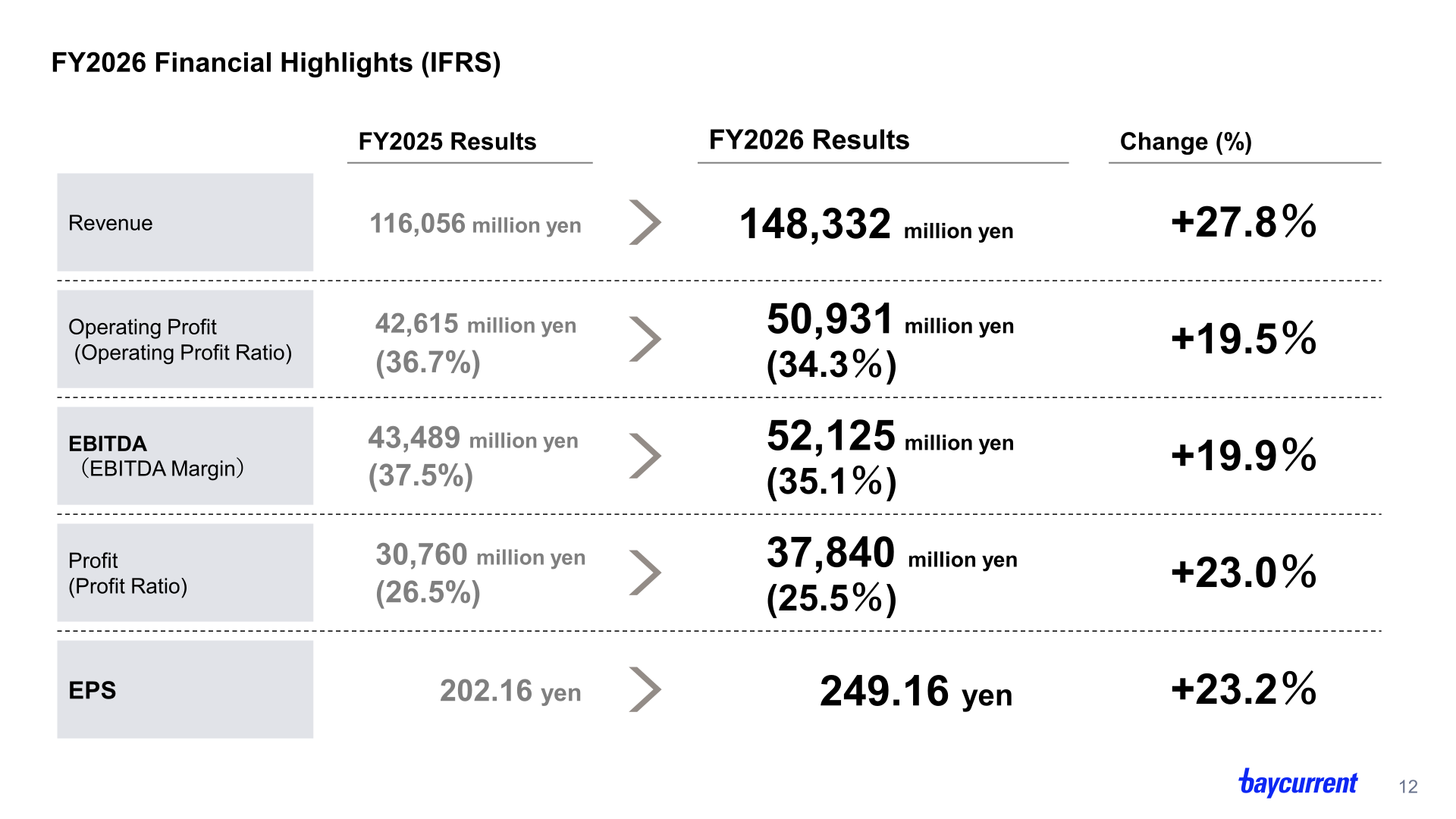
Revenue for FY2026 was 148,332 million yen, up 27.8% from 116,056 million yen in FY2025. Operating profit rose 19.5% to 50,931 million yen (operating profit ratio 34.3%, versus 36.7%), EBITDA rose 19.9% to 52,125 million yen (EBITDA margin 35.1%, versus 37.5%), and profit rose 23.0% to 37,840 million yen (profit ratio 25.5%, versus 26.5%). EPS increased 23.2% to 249.16 yen from 202.16 yen. Against the full-year forecast of 143,000 million yen in revenue (+23.2% YoY) and 52,000 million yen in EBITDA (+19.6% YoY, EBITDA margin 36.4%), the company states that revenue progress toward the full-year target remained at the same level as previous years and revenue largely met the guidance. Because hiring progressed steadily and the number of hires exceeded the plan, recruitment, training and personnel expenses exceeded the plan, while other expenses such as PR expenses remained largely in line; overall, total costs (COGS and SG&A) slightly exceeded the plan. As a result, EBITDA largely met the guidance and the EBITDA margin was within the target range of 30-40%.
| Item | FY2025 Results | FY2026 Results | Change (%) |
|---|---|---|---|
| Revenue (million yen) | 116,056 | 148,332 | +27.8% |
| Operating Profit (million yen) | 42,615 | 50,931 | +19.5% |
| Operating Profit Ratio | 36.7% | 34.3% | – |
| EBITDA (million yen) | 43,489 | 52,125 | +19.9% |
| EBITDA Margin | 37.5% | 35.1% | – |
| Profit (million yen) | 30,760 | 37,840 | +23.0% |
| Profit Ratio | 26.5% | 25.5% | – |
| EPS (yen) | 202.16 | 249.16 | +23.2% |
On a quarterly basis, revenue and EBITDA grew every quarter, but due to seasonality and the impact of recruitment and training costs both tend to increase toward the second half of the year, and the same trend continued in FY2026. Quarterly revenue for FY2026 progressed at the same level as previous years relative to the full year.
| Quarter (million yen) | Revenue FY2025 | Revenue FY2026 | EBITDA FY2025 | EBITDA FY2026 |
|---|---|---|---|---|
| Q1 | 27,297 | 34,307 | 9,671 | 12,455 |
| Q2 | 26,797 | 34,155 | 8,935 | 11,299 |
| Q3 | 29,431 | 37,474 | 10,812 | 12,155 |
| Q4 | 32,531 | 42,396 | 14,071 | 16,216 |
Key Performance Indicators
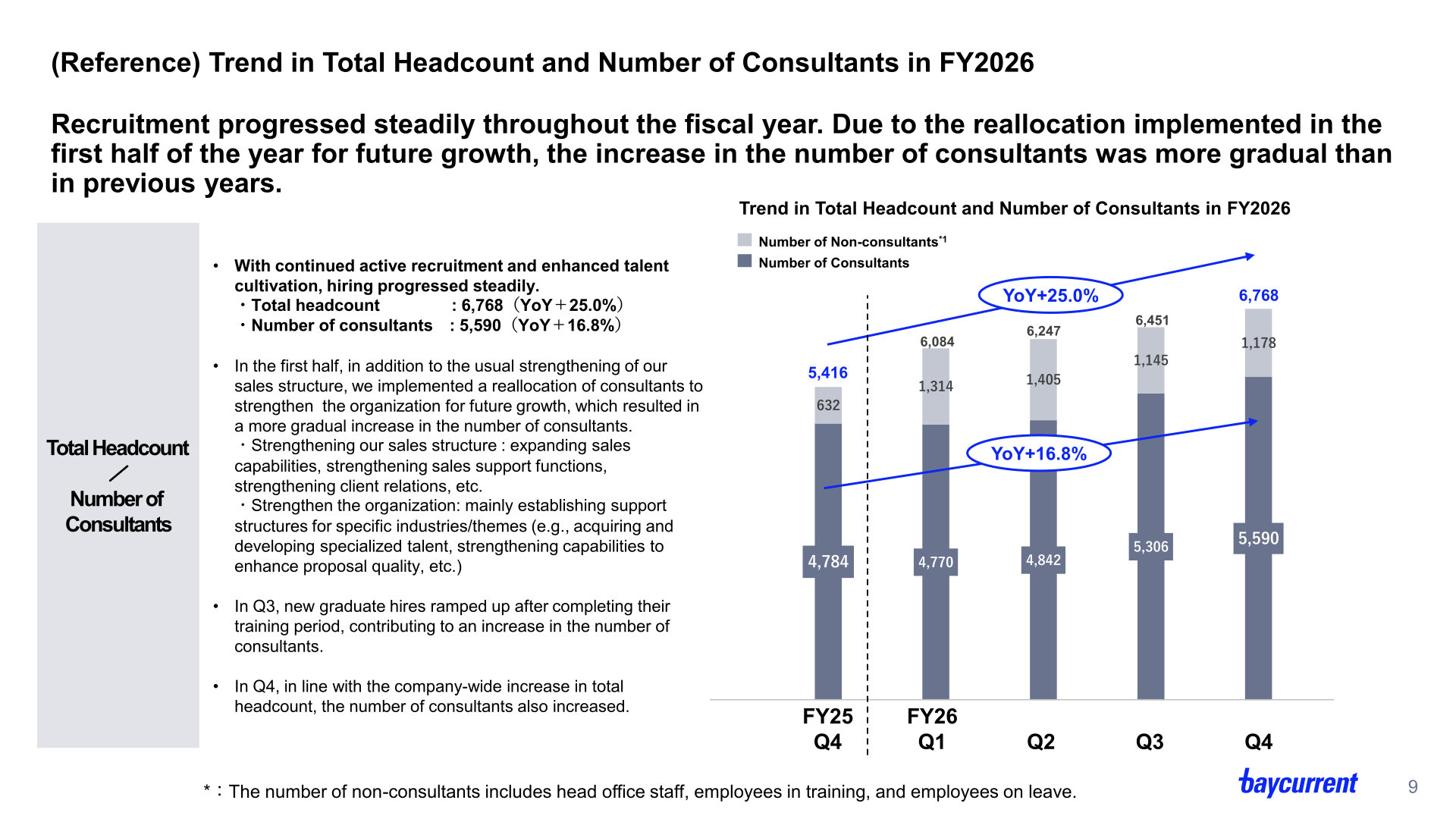
Baycurrent operates a single consulting business and reports KPIs rather than segment results. The number of consultants rose from 4,784 at the end of FY2025 to 5,590 at the end of FY2026 (YoY +16.8%, including new graduate consultants), while total headcount reached 6,768 (YoY +25.0%). The company explains that, in addition to the usual strengthening of its sales structure, it implemented a reallocation of consultants in the first half to strengthen the organization for future growth, so the number of consultants increased more gradually than in previous years but largely met the plan; in Q3 new graduate hires ramped up after completing their training period, and in Q4 the number of consultants increased in line with the company-wide increase in total headcount. Consulting services saw continued strong demand, mainly driven by digital transformation and generative AI, and the number of projects increased largely in line with the full-year plan (YoY +20.7%). The utilization rate remained within the expected range of 80-90% throughout the year, with the full-year average in the mid 80% range, and revenue per consultant was approximately 4% above the plan.
| KPI | FY2025 | FY2026 | YoY |
|---|---|---|---|
| Number of consultants (year-end) | 4,784 | 5,590 | +16.8% |
| Total headcount (year-end) | 5,416 | 6,768 | +25.0% |
| Number of projects | – | – | +20.7% |
| Utilization rate (full-year average) | – | mid 80% range (expected range 80-90%) | – |
| Revenue per consultant | – | approx. 4% above plan | – |
Regarding the treasury share purchases announced in March 2026, the company notes that its share price declined from the second half of FY2026 despite continued performance growth since FY2025, and that in light of the divergence between the share price and underlying fundamentals it determined to implement treasury share purchases of up to approximately JPY 30B (announced March 18, 2026). Responding to investor concerns about the slowdown in consultant growth and the impact of AI on consulting demand, the company states that the domestic consulting market remains in a growth phase (CAGR approx. 10%), that major companies in Japan have begun large-scale multi-year AI investments, that it is supporting many generative AI-related projects, and that it expects the number of consultants, the number of projects and revenue per consultant to continue increasing in FY2027.
FY2027 Forecast
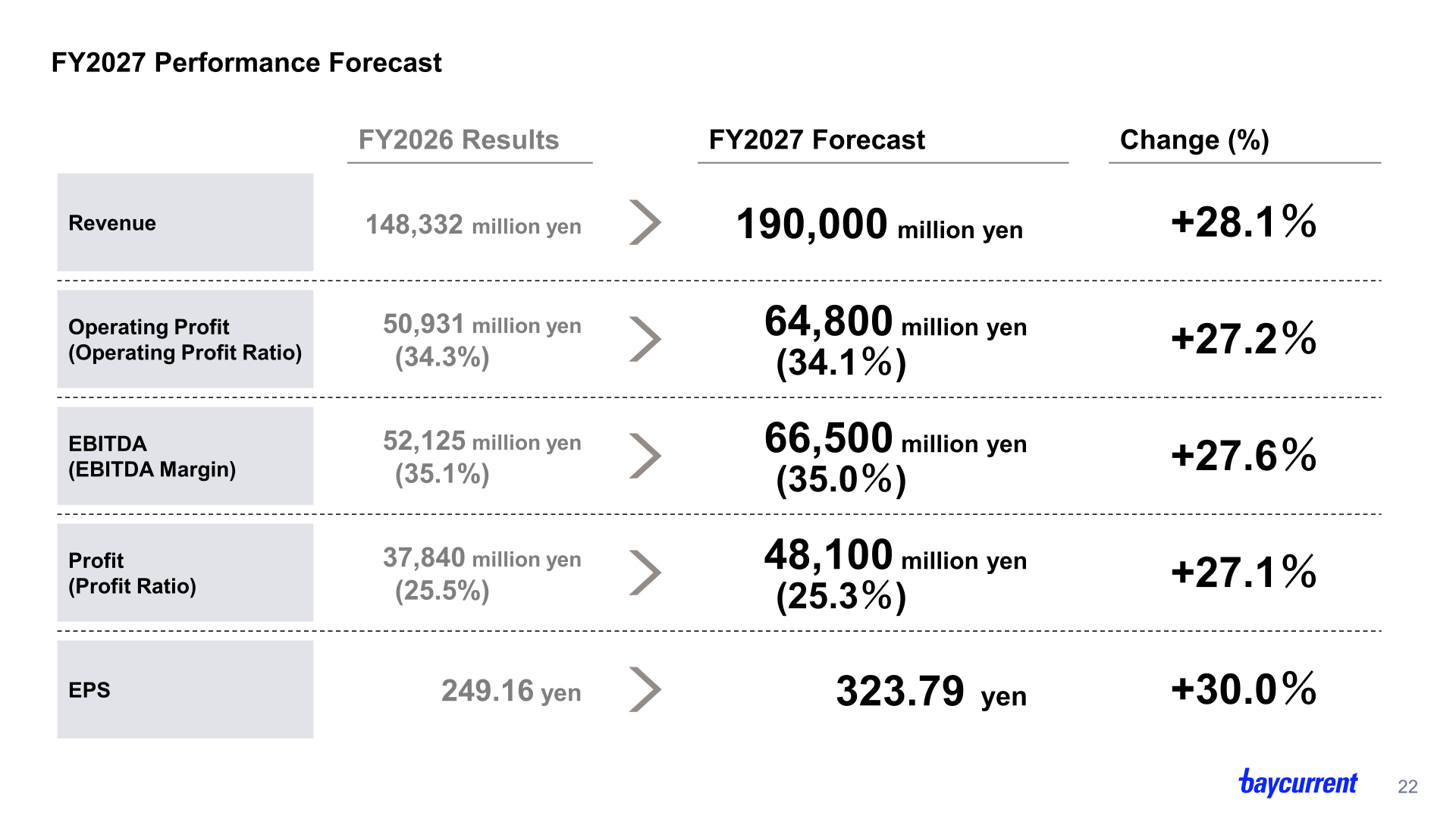
For FY2027 (fiscal year ending February 28, 2027), Baycurrent forecasts revenue of 190,000 million yen (+28.1% YoY), operating profit of 64,800 million yen (+27.2%, operating profit ratio 34.1%), EBITDA of 66,500 million yen (+27.6%, EBITDA margin 35.0%), profit of 48,100 million yen (+27.1%, profit ratio 25.3%) and EPS of 323.79 yen (+30.0%). The company states that while business conditions may vary by industry due to factors such as U.S. tariff policies, exchange rate fluctuations and rising geopolitical risks including the situation in the Middle East, overall investment appetite for digital transformation and generative AI-related initiatives continues to be strong, and it expects consulting demand to continue against the backdrop of a lack of expertise and human resources at each company. It does not anticipate major changes to its management policy or business structure and expects performance growth in line with the Mid-term Business Plan.
| Item | FY2026 Results | FY2027 Forecast | Change (%) |
|---|---|---|---|
| Revenue (million yen) | 148,332 | 190,000 | +28.1% |
| Operating Profit (million yen) | 50,931 | 64,800 | +27.2% |
| Operating Profit Ratio | 34.3% | 34.1% | – |
| EBITDA (million yen) | 52,125 | 66,500 | +27.6% |
| EBITDA Margin | 35.1% | 35.0% | – |
| Profit (million yen) | 37,840 | 48,100 | +27.1% |
| Profit Ratio | 25.5% | 25.3% | – |
| EPS (yen) | 249.16 | 323.79 | +30.0% |
On KPIs, the company expects the number of consultants to increase from 5,590 at the end of FY2026 to approximately 7,000 at the end of FY2027 (YoY approx. +25%, including new graduate consultants scheduled to join in 2026), with total headcount of approximately 8,500 (YoY approx. +25%); new graduate hires joining in FY2027 (approx. 710) are included in the non-consultant headcount during the first half while in training. The number of projects is expected to increase by approx. +25% YoY, with a greater weighting in the second half, and revenue per consultant is assumed to increase by approx. 5% on an average full-year basis. For Q1, the company does not anticipate the completion of any large-scale projects or any one-time large expenses, expects the number of consultants to reach approximately 5,750 at Q1-end (prior Q1-end: 4,770; YoY approx. +20%, excluding new graduate consultants), the utilization rate to remain in the mid-80% range, and revenue per consultant to trend in line with plan (YoY approx. +5%).
Shareholder Returns
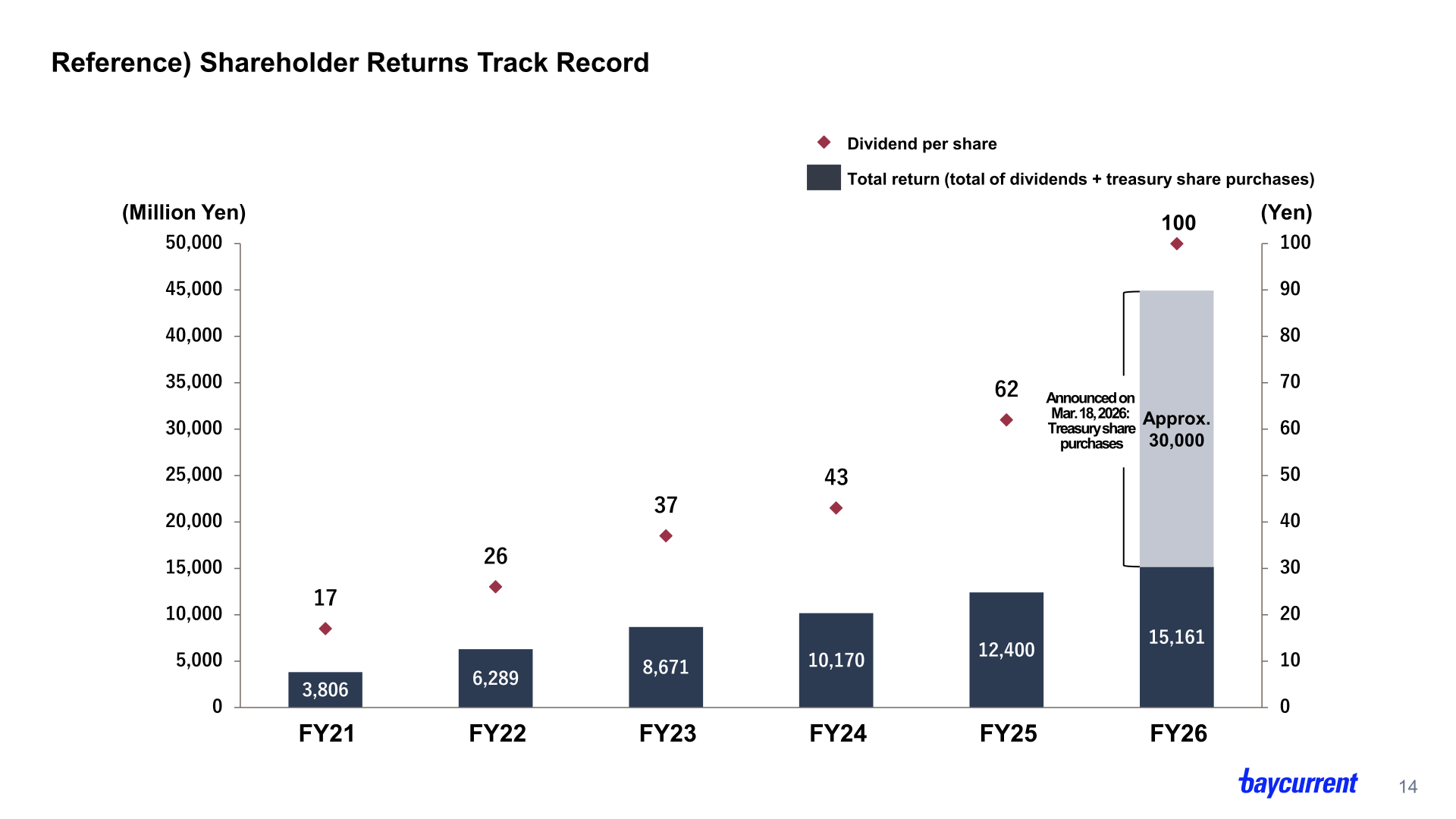
Baycurrent regards the stable return of profit to shareholders as an important management agenda and aims for a dividend payout ratio of 40% as a guideline under IFRS; taking capital efficiency into consideration, any surplus cash generated each fiscal year is to be returned to shareholders primarily through treasury share purchases. For FY2026, the company paid an interim dividend of 50 yen per share as initially planned and a year-end dividend of 50 yen per share, for a full-year total of 100 yen per share. For FY2027, it plans an interim dividend of 65 yen and a year-end dividend of 65 yen, for a full-year total of 130 yen per share. Under its capital policy, the company has set the maximum annual cash level at approximately 40% of forecasted revenue during the current Medium-Term Business Plan (business operations approx. 25%, equivalent to about three months of forecasted revenue; future growth approx. 15%), with annual surplus cash returned primarily through treasury share purchases implemented during the fiscal year or around the time of fiscal year-end disclosure. Treasury share purchases of approximately 30,000 million yen were announced on March 18, 2026.
| Item | FY2026 | FY2027 (Plan) |
|---|---|---|
| Interim dividend per share (yen) | 50 | 65 |
| Year-end dividend per share (yen) | 50 | 65 |
| Annual dividend per share (yen) | 100 | 130 |
| Dividend payout ratio guideline (IFRS) | 40% | 40% |
Medium-Term Business Plan Progress
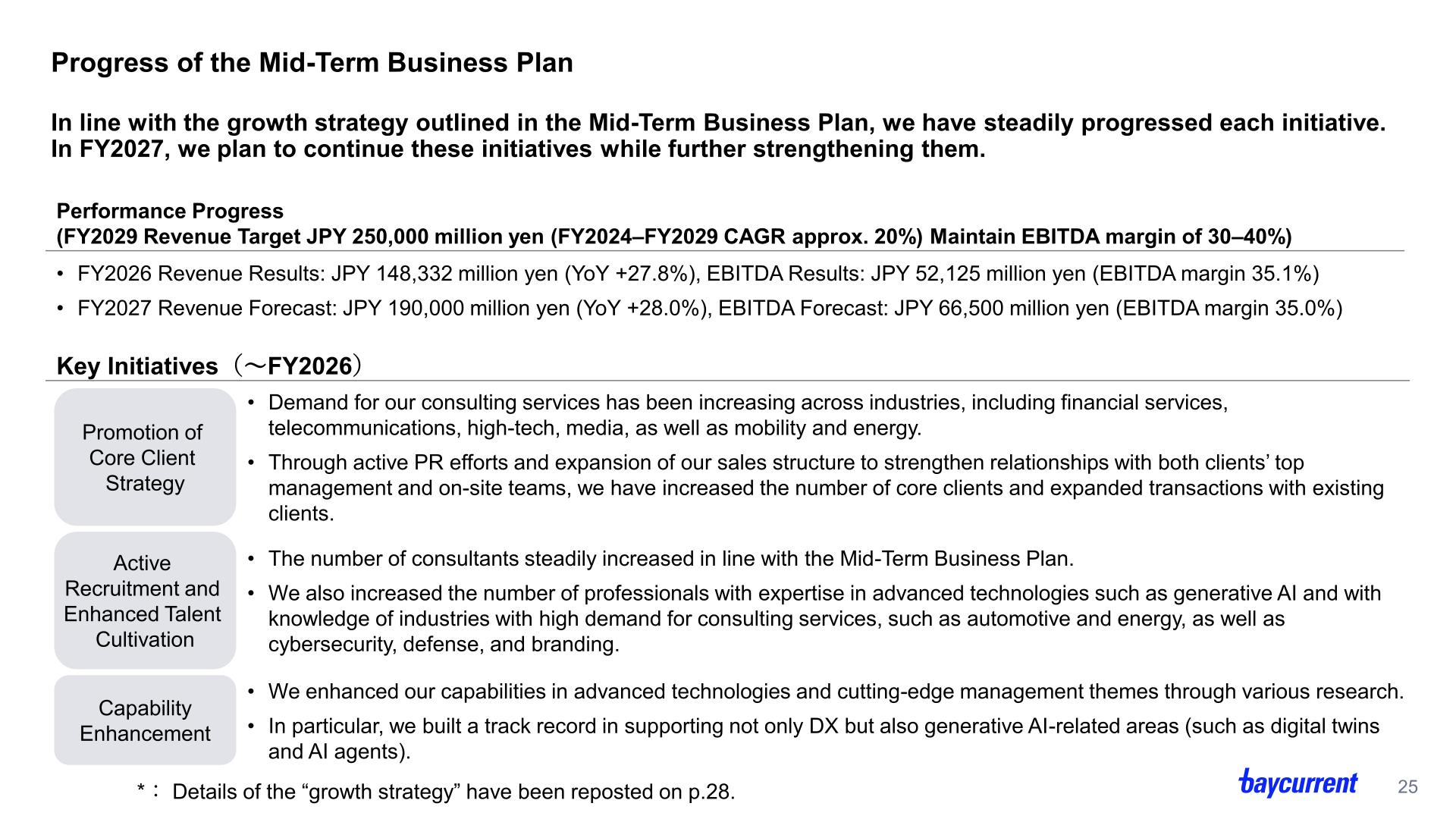
Under its five-year Medium-Term Business Plan, Baycurrent targets revenue of 250,000 million yen in FY2029 (FY2024-FY2029 CAGR approx. 20%) while maintaining an EBITDA margin of 30-40%. The company states that it has steadily progressed each initiative of the growth strategy: promotion of the core client strategy (increasing the number of core clients and expanding transactions with existing clients through active PR and an expanded sales structure), capability enhancement (building a track record not only in DX but also in generative AI-related areas such as digital twins and AI agents), and active recruitment and enhanced talent cultivation (steadily increasing the number of consultants in line with the plan and adding professionals with expertise in generative AI and in industries such as automotive and energy, as well as cybersecurity, defense and branding). It plans to continue and further strengthen these initiatives in FY2027. The company also notes that the utilization rate is assumed to stay within 80-90% (full-year average generally around 85%) and that the target EBITDA margin range is 30-40% (full-year average generally around 35%).
This article is an analysis based on publicly available information and is not a recommendation to buy or sell any specific securities. Investment decisions are your own responsibility.
![[Obayashi] Investors’ Guide 2026 — The Complete 24-Article Breakdown](https://japan-equity.com/wp-content/uploads/2026/07/hub_cover-1024x1024.png)
![[Obayashi] IR & SR Policy — Feeding Dialogue Back into Management](https://japan-equity.com/wp-content/uploads/2026/07/p32_sq-1024x1024.jpg)
![[Obayashi] Domestic Civil Engineering — Resilience Spending Supports 9.6% Margin](https://japan-equity.com/wp-content/uploads/2026/07/p11_sq-1024x1024.jpg)
![[Obayashi] Overseas Construction — Orders Reach ¥1.2tn](https://japan-equity.com/wp-content/uploads/2026/07/p15_sq-1024x1024.jpg)
![[Obayashi] Share Price & External Ratings — vs TOPIX, ESG Index Inclusion](https://japan-equity.com/wp-content/uploads/2026/07/p40_sq-1024x1024.jpg)
![[Construction] ¥75.5tn Investment, Shrinking Workforce — Big-5 Market Share](https://japan-equity.com/wp-content/uploads/2026/07/p12_sq-1024x1024.jpg)
![[Obayashi] Capital Policy & Shareholder Returns — ROE 10%+, DOE ~5%, ¥100bn Buyback](https://japan-equity.com/wp-content/uploads/2026/07/p27_sq-1024x1024.jpg)
![[Obayashi] Reducing Cross-Shareholdings — ¥285.2bn Sold in Five Years](https://japan-equity.com/wp-content/uploads/2026/07/p29_sq-1024x1024.jpg)
![[Obayashi] ¥750bn Investment Plan — ¥300bn to Development, ¥190bn to Tech/DX](https://japan-equity.com/wp-content/uploads/2026/07/p30_sq-1024x1024.jpg)
![[Obayashi] MTP2022 KPIs — Operating Profit ~2x Target, ROE 14.4%](https://japan-equity.com/wp-content/uploads/2026/07/p25_sq-1024x1024.jpg)
![[Obayashi] Cash Allocation — ¥420bn Investment CF Over Five Years](https://japan-equity.com/wp-content/uploads/2026/07/p26_sq-1024x1024.jpg)
![[Obayashi] Green Energy — 44 Plants, 344MW, and the Green Hydrogen Challenge](https://japan-equity.com/wp-content/uploads/2026/07/p21_sq-1024x1024.jpg)
![[Obayashi] Tackling the Labor Shortage — Robotics Construction®](https://japan-equity.com/wp-content/uploads/2026/07/p14_sq-1024x1024.jpg)
