
This article is based on publicly available IR materials and is not a recommendation to buy or sell any specific securities.
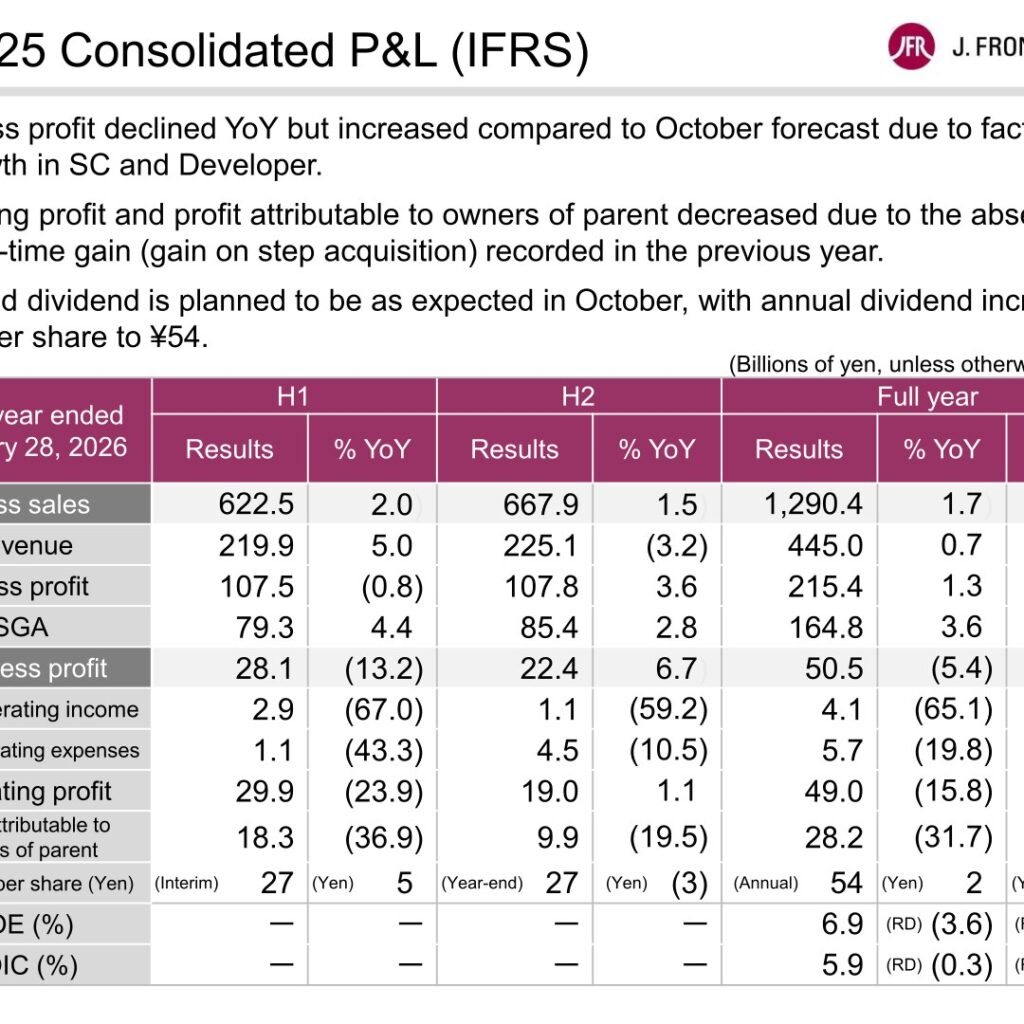
J. Front Retailing Co., Ltd., operator of the Daimaru Matsuzakaya department stores and PARCO shopping complexes, reported consolidated results (IFRS) for FY2025, the fiscal year ended February 28, 2026. Gross sales rose 1.7% year on year to ¥1,290.4 billion and revenue increased 0.7% to ¥445.0 billion, while business profit declined 5.4% to ¥50.5 billion. Profit attributable to owners of parent fell 31.7% to ¥28.2 billion, mainly due to the absence of the one-time gain on step acquisition recorded in the previous year. The annual dividend was raised by ¥2 per share to ¥54, as previously forecast.
Note: J. Front Retailing has a February fiscal year-end, so FY2025 in this article refers to the fiscal year ended February 28, 2026, following the labeling used in the company’s results presentation.
Consolidated Results (Full-Year Actual)
Business profit declined year on year but came in above the October forecast, helped by growth in the SC and Developer segments. Operating profit decreased 15.8% to ¥49.0 billion, reflecting the absence of the prior-year one-time gain on step acquisition. ROE was 6.9% and ROIC was 5.9%.
| Item | FY2025 (¥ billion) | YoY change (%) |
|---|---|---|
| Gross sales | 1,290.4 | 1.7 |
| Revenue | 445.0 | 0.7 |
| Gross profit | 215.4 | 1.3 |
| SGA | 164.8 | 3.6 |
| Business profit | 50.5 | (5.4) |
| Operating profit | 49.0 | (15.8) |
| Profit attributable to owners of parent | 28.2 | (31.7) |
| Dividend per share (annual) | ¥54 | +¥2 |
| ROE (%) | 6.9 | — |
| ROIC (%) | 5.9 | — |
On the balance sheet, total assets stood at ¥1,141.5 billion at fiscal year-end, a decrease of ¥22.5 billion from the end of the previous fiscal year, while equity attributable to owners of parent increased by ¥5.9 billion to ¥415.5 billion, lifting the equity ratio to 36.4%. Interest-bearing liabilities excluding lease liabilities were reduced by ¥13.5 billion to ¥176.5 billion. Net cash provided by operating activities was ¥66.9 billion, down ¥18.8 billion year on year due to factors such as an increase in corporate tax payments, and free cash flow was ¥51.8 billion.
Segment Results
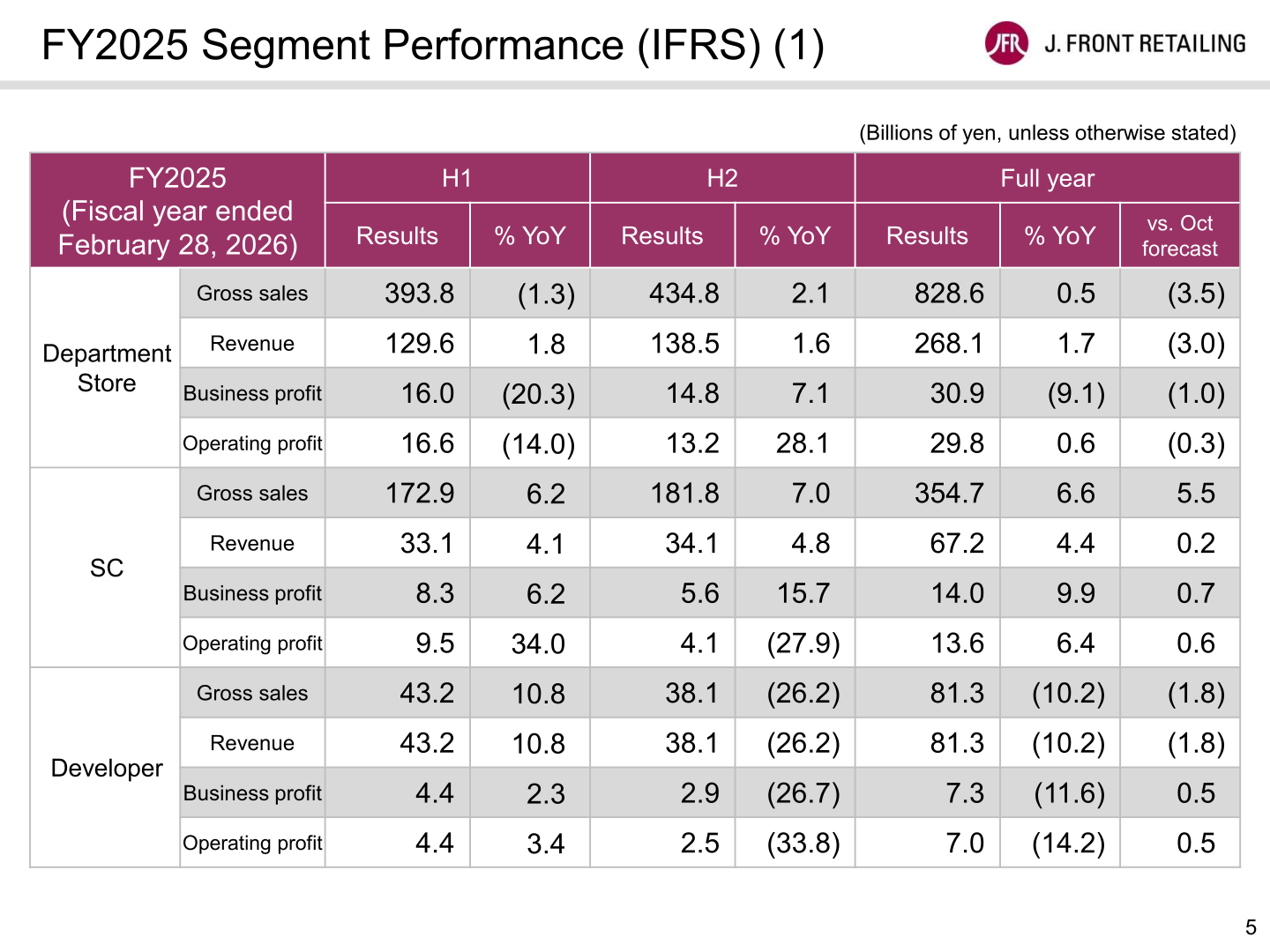
In the Department Store business, revenue increased on robust spending by the affluent and the effects of the Osaka Expo, but profit decreased on higher costs such as price hikes. Duty-free sales in the Department Store business declined by ¥20.0 billion year on year to ¥110.5 billion (down 15.3%), partly due to a decline in Chinese tourists visiting Japan since December; duty-free sales at Daimaru Matsuzakaya Department Stores were ¥104.6 billion, down 13.4%. The SC business was strong, with Shibuya PARCO tenant transaction volume up more than 20% year on year since its major renovation and total comparable-store transaction volume at PARCO up 7.9%. The Developer segment saw revenue and profit decline due to the rebound from the previous year’s property sales, but still achieved its October forecast.
| Segment | Metric | FY2025 (¥ billion) | YoY change (%) |
|---|---|---|---|
| Department Store | Revenue | 268.1 | 1.7 |
| Department Store | Business profit | 30.9 | (9.1) |
| SC | Revenue | 67.2 | 4.4 |
| SC | Business profit | 14.0 | 9.9 |
| Developer | Revenue | 81.3 | (10.2) |
| Developer | Business profit | 7.3 | (11.6) |
| Payment and Finance | Revenue | 13.5 | 2.8 |
| Payment and Finance | Business profit | 0.9 | (41.2) |
| Other | Revenue | 57.9 | 14.3 |
| Other | Business profit | 0.5 | (35.2) |
FY2026 Forecast
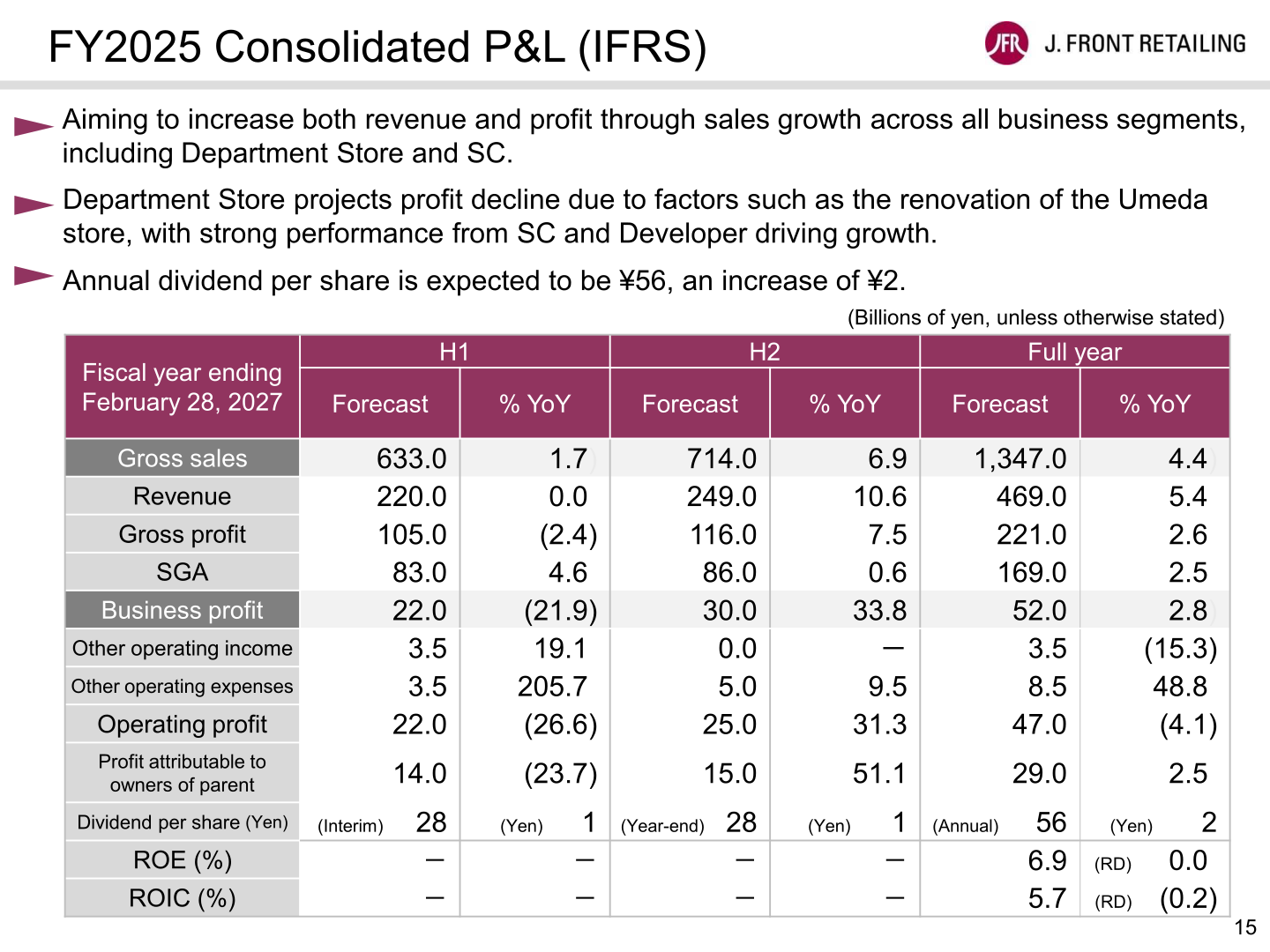
For FY2026, the fiscal year ending February 28, 2027, the company aims to increase both revenue and profit through sales growth across all business segments. Gross sales are forecast at ¥1,347.0 billion (up 4.4%), revenue at ¥469.0 billion (up 5.4%), and business profit at ¥52.0 billion (up 2.8%), while operating profit is forecast at ¥47.0 billion (down 4.1%) and profit attributable to owners of parent at ¥29.0 billion (up 2.5%). The Department Store segment projects a profit decline due to factors such as the renovation of the Umeda store, which is expected to reduce business profit at that store by ¥5.0 billion, with strong performance from SC and Developer driving growth. Duty-free sales are expected to be ¥104.5 billion (down 0.1%).
| Item | FY2026 Forecast (¥ billion) | YoY change (%) |
|---|---|---|
| Gross sales | 1,347.0 | 4.4 |
| Revenue | 469.0 | 5.4 |
| Business profit | 52.0 | 2.8 |
| Operating profit | 47.0 | (4.1) |
| Profit attributable to owners of parent | 29.0 | 2.5 |
| Dividend per share (annual) | ¥56 | +¥2 |
Shareholder Returns
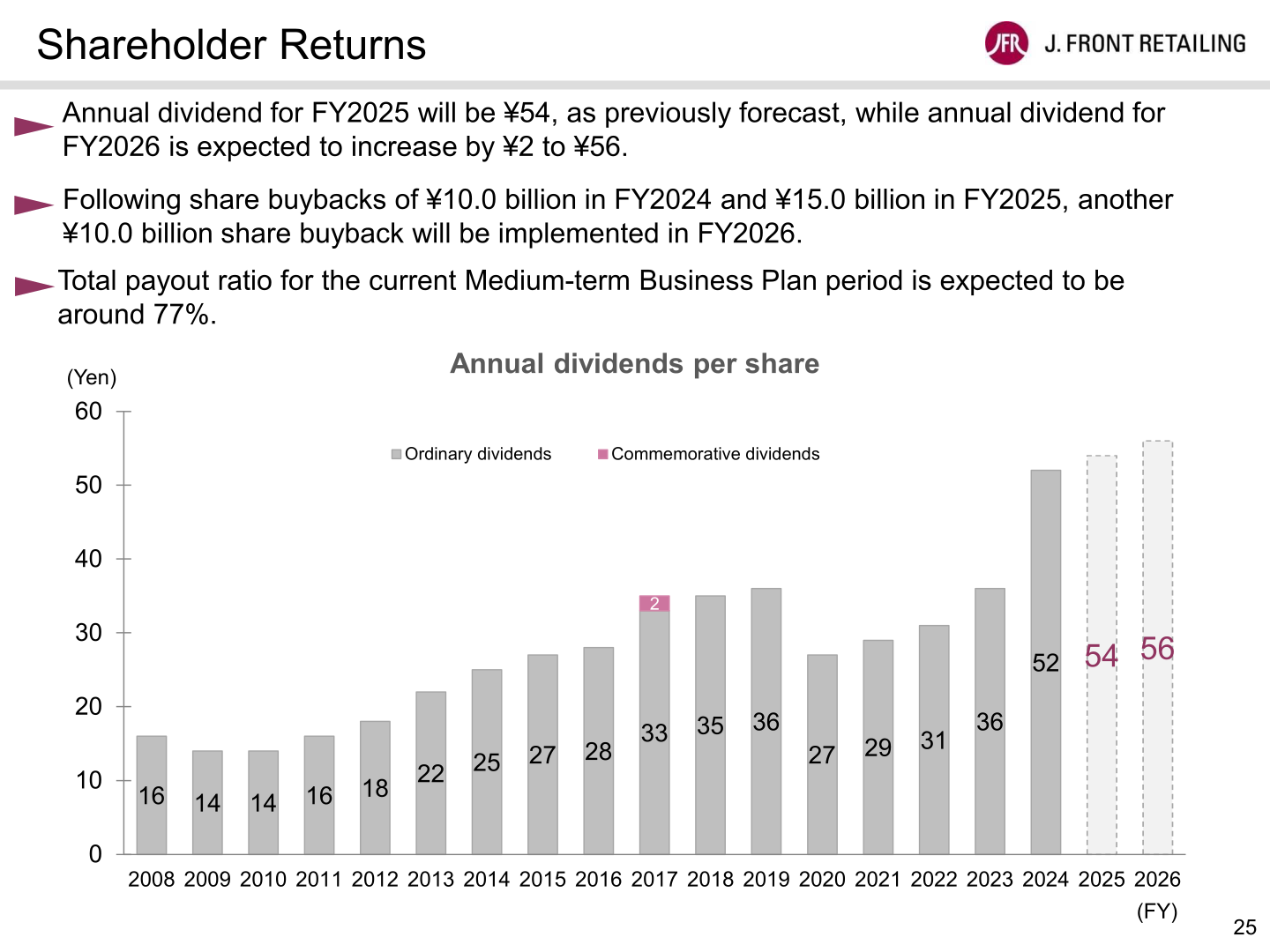
The annual dividend for FY2025 is ¥54 per share (interim ¥27, year-end ¥27), an increase of ¥2, and the annual dividend for FY2026 is expected to increase by a further ¥2 to ¥56. Following share buybacks of ¥10.0 billion in FY2024 and ¥15.0 billion in FY2025, another ¥10.0 billion share buyback will be implemented in FY2026: up to 5,000,000 common shares (2.00% of total shares issued excluding treasury shares), to be acquired between April 15, 2026 and June 26, 2026 through market purchases on the Tokyo Stock Exchange. The total payout ratio for the current Medium-term Business Plan period is expected to be around 77%.
Medium-Term Plan / Topics
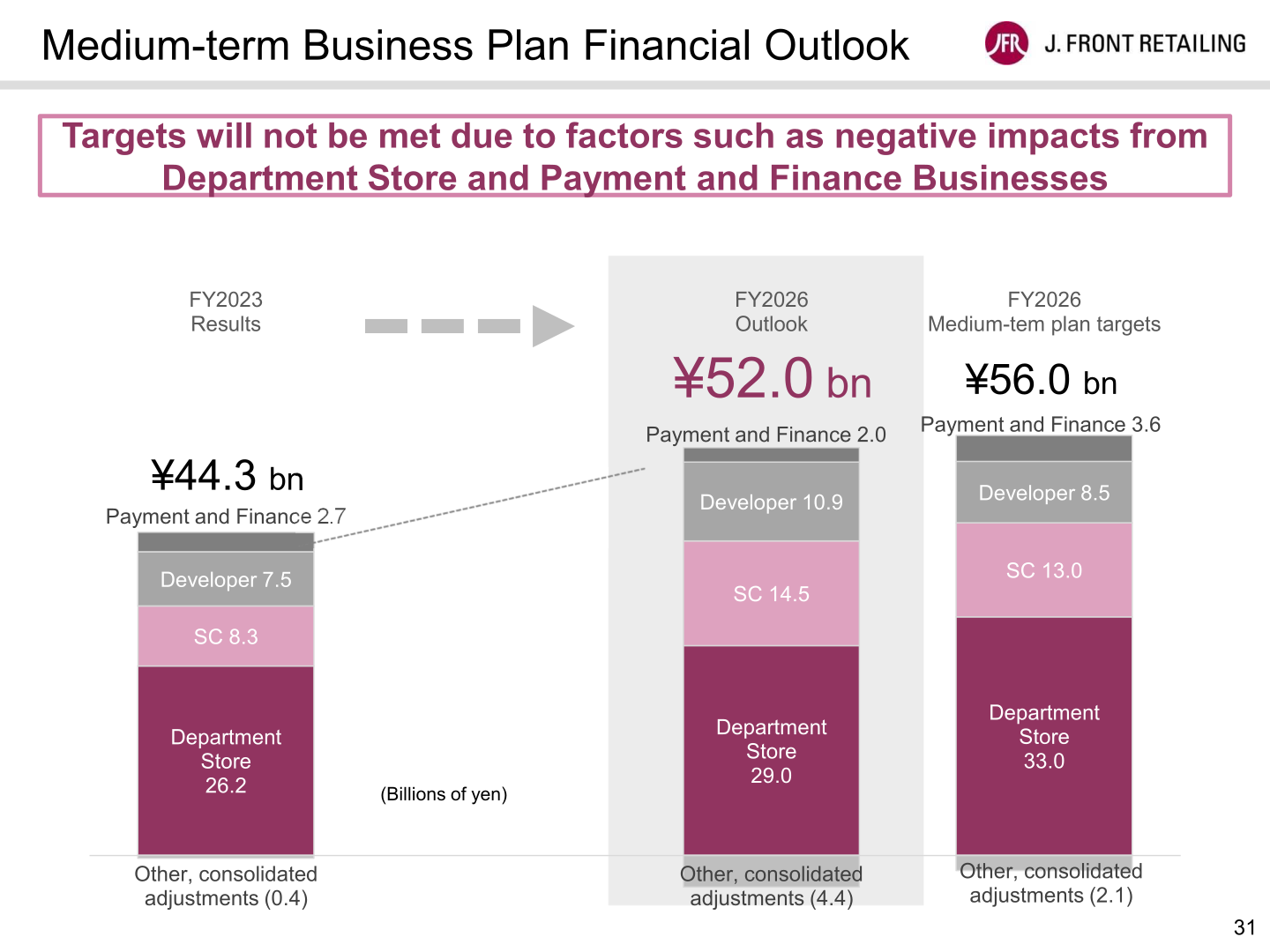
The company stated that the targets of the FY2024-2026 Medium-term Business Plan will not be met, due to factors such as negative impacts from the Department Store and Payment and Finance businesses: the FY2026 business profit outlook is ¥52.0 bn against a plan target of ¥56.0 bn, compared with ¥44.3 bn in FY2023. Over the three-year plan period, cash allocation comprises ¥195.0 bn of business and strategic investments, ¥75.0 bn of shareholder returns, and ¥170.0 bn of repayment of interest-bearing liabilities. FY2026 is positioned as a year serving as a bridge toward rapid growth in FY2027 and beyond, and the company will revise its future vision and formulate the next Medium-term Business Plan with a target of ROE of 10% or higher.
This article is an analysis based on publicly available information and is not a recommendation to buy or sell any specific securities. Investment decisions are your own responsibility.
![[Obayashi] Investors’ Guide 2026 — The Complete 24-Article Breakdown](https://japan-equity.com/wp-content/uploads/2026/07/hub_cover-1024x1024.png)
![[Obayashi] IR & SR Policy — Feeding Dialogue Back into Management](https://japan-equity.com/wp-content/uploads/2026/07/p32_sq-1024x1024.jpg)
![[Obayashi] Real Estate Development — 18.7% Margin, ¥287.7bn Unrealized Gains](https://japan-equity.com/wp-content/uploads/2026/07/p20_sq-1024x1024.jpg)
![[Obayashi] Domestic Civil Engineering — Resilience Spending Supports 9.6% Margin](https://japan-equity.com/wp-content/uploads/2026/07/p11_sq-1024x1024.jpg)
![[Obayashi] Share Price & External Ratings — vs TOPIX, ESG Index Inclusion](https://japan-equity.com/wp-content/uploads/2026/07/p40_sq-1024x1024.jpg)
![[Construction] ¥75.5tn Investment, Shrinking Workforce — Big-5 Market Share](https://japan-equity.com/wp-content/uploads/2026/07/p12_sq-1024x1024.jpg)
![[Obayashi] Capital Policy & Shareholder Returns — ROE 10%+, DOE ~5%, ¥100bn Buyback](https://japan-equity.com/wp-content/uploads/2026/07/p27_sq-1024x1024.jpg)
![[Obayashi] Reducing Cross-Shareholdings — ¥285.2bn Sold in Five Years](https://japan-equity.com/wp-content/uploads/2026/07/p29_sq-1024x1024.jpg)
![[Obayashi] ¥750bn Investment Plan — ¥300bn to Development, ¥190bn to Tech/DX](https://japan-equity.com/wp-content/uploads/2026/07/p30_sq-1024x1024.jpg)
![[Obayashi] MTP2022 KPIs — Operating Profit ~2x Target, ROE 14.4%](https://japan-equity.com/wp-content/uploads/2026/07/p25_sq-1024x1024.jpg)
![[Obayashi] Cash Allocation — ¥420bn Investment CF Over Five Years](https://japan-equity.com/wp-content/uploads/2026/07/p26_sq-1024x1024.jpg)
![[Obayashi] Green Energy — 44 Plants, 344MW, and the Green Hydrogen Challenge](https://japan-equity.com/wp-content/uploads/2026/07/p21_sq-1024x1024.jpg)
![[Obayashi] Tackling the Labor Shortage — Robotics Construction®](https://japan-equity.com/wp-content/uploads/2026/07/p14_sq-1024x1024.jpg)
